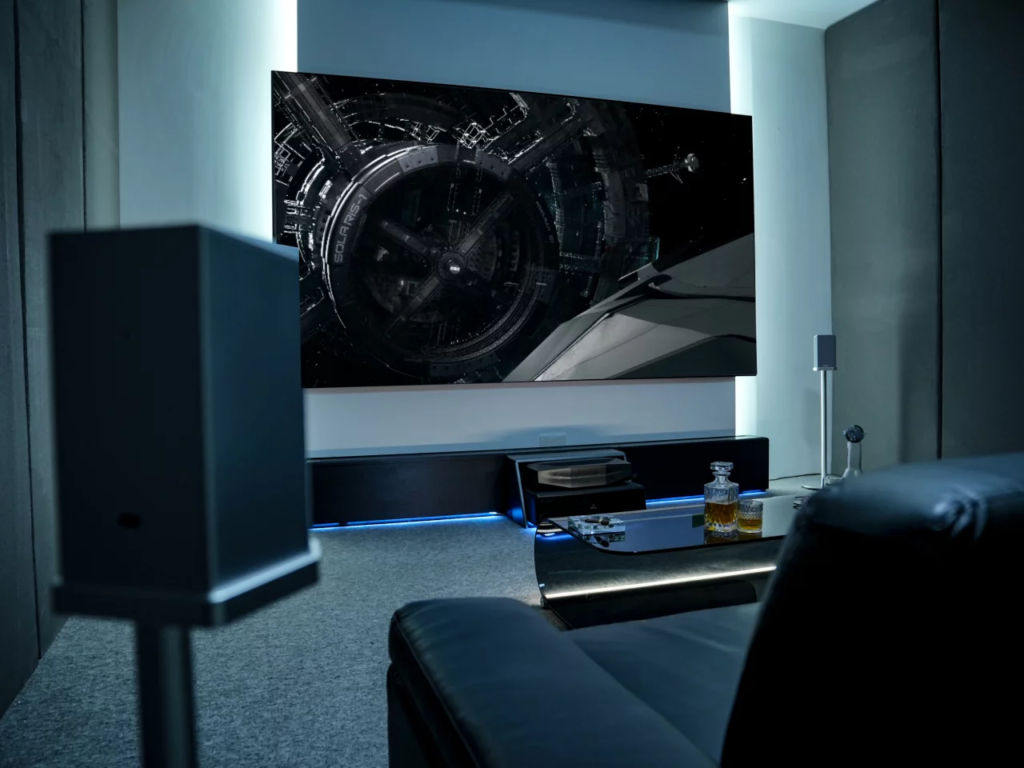
I remember the various iterations of the family TV pretty much always being the focal point of our living room, but it never dominated the space like big flat panels can today. Some of the time the huge flat panel is hypnotizing watchers with the latest blockbuster movie, current viral sensation or – if you’re lucky – an in-depth documentary or two. But much of its life it’s just an unattractive dark presence looming large.
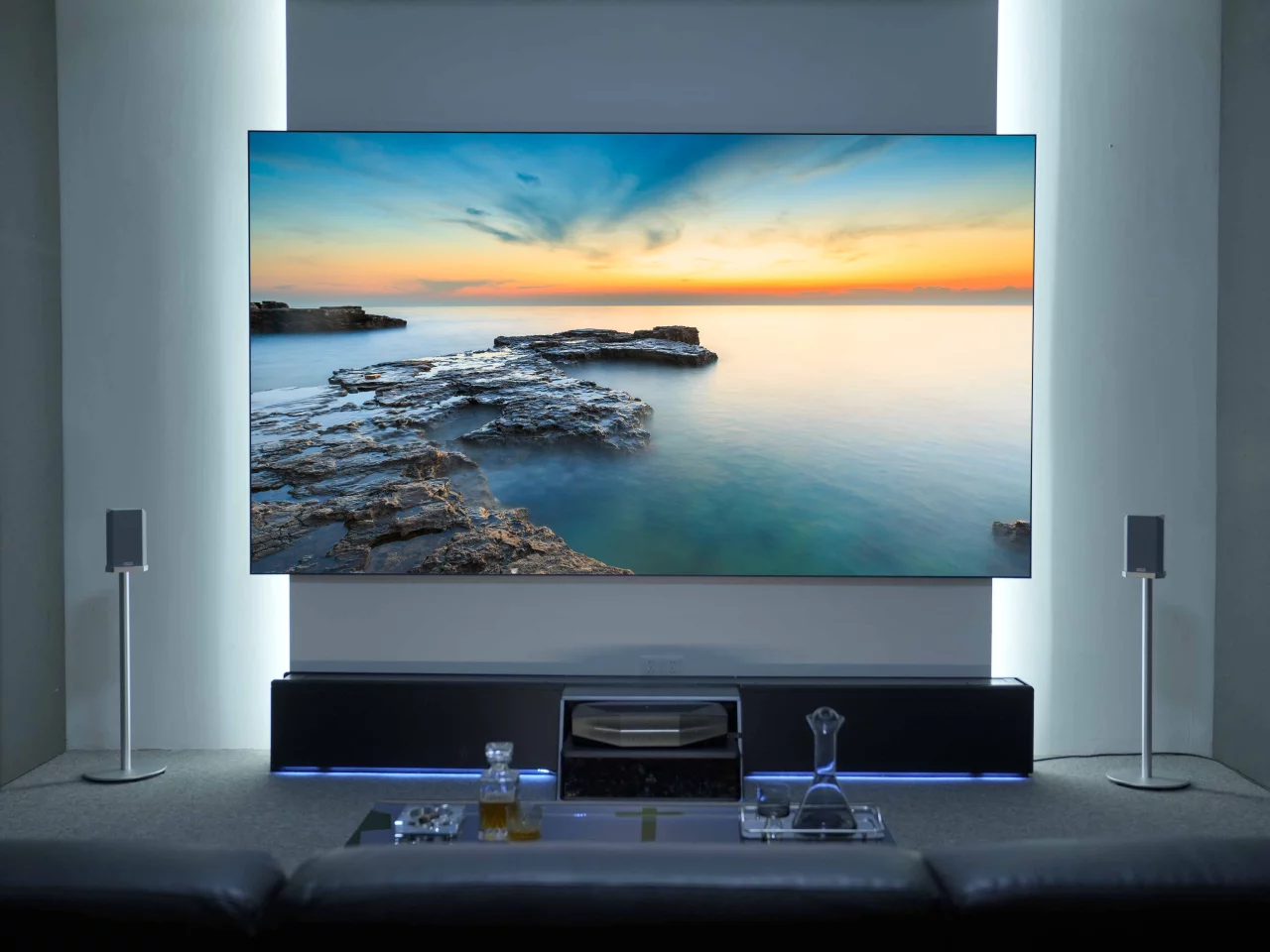
Recently, smart projectors have emerged as an alternative that can be tucked away between uses or even form part of the room decor. They can also offer much bigger viewing rectangles than most goggleboxes, but going really big here would likely see another dark shape appear on the wall for optimum visuals – in the form of an ambient-light-rejecting (ALR) screen.
Many models need a significant gap between the business end and the vertical surface that the visuals are thrown onto. But there’s a tribe that can snuggle close to a wall or screen and throw up imagery at a steep angle. The bigger the gap between the rear end and the wall or screen, the larger the thrown image.

AWOL Vision
Image clarity can suffer as you pull away though, with object edges getting fuzzy, as well as color fringing and/or fading and pixel misalignment taking the shine off the viewing experience. AWOL Vision has launched the Aetherion Series to combat this very problem, promising edge-to-edge pixel-perfect 4K resolution right up to 200 diagonal inches – thanks to technology that compensates for “lens element tolerances, temperature-induced expansion, micro-warping of UST angles, reflective path inconsistencies, and DLP sequencing artifacts.”
Striking design, eye-popping visuals
I’ve been sent a Max model to play with, so let’s start with what’s on offer. First up is a bold chassis design that’s straight out of Astell&Kern’s playbook – with angular edges that make this just as much a fancy art piece as a full-blown entertainment system. I really like the look of the Aetherion projectors, but others may find it a bit too futuristic for the contemporary family room – particularly with the sci-fi light strip activated. More on that in a bit.
At the heart of the unit is DLP display technology featuring a new TI C8445 controller and a large 0.47-inch DMD chip – which sports millions of teeny mirrors that can each be tilted to reflect or block light on its way through the ultra-low dispersion optics boasting sapphire glass with rare-earth coating.
The source of that light is a “pure” RGB laser unit that puts out up to 3,300 ISO lumens, offering potential daytime viewing – though the best results will be when partnered with a super-sized ALR screen, a regular matte screen or blank wall in a darkened space. The light source enables 110% coverage of the Rec.2020 color space for the promise of vivid visuals, and there’s support for HDR10+, Dolby Vision and IMAX Enhanced content too.

Paul Ridden/New Atlas
AWOL has also baked in native contrast of 6,000:1, which gets an algorithmic boost to 60,000:1 dynamic. Plus there’s the company’s Enhanced Black Level mode and seven different IRIS settings that all combine to brings extra detail to the darker zones onscreen.
Powering to the Max
Pushing the illuminated button to the side of the unit (or using the IR/Bluetooth remote) results in the motorized lens cover screeching open. This also closes at the end of the session to help keep nasty dust motes from getting where they shouldn’t and spoiling the show. The Max ships with a stiff card cover too, to further protect the projector’s vitals when not is use.
A thin light bar is active across much of the unit’s face as well, which pulses like a Cylon from Battlestar Gallactica of old when in standby. Or maybe the talking car from Knight Rider. This Lumacore preset can be disabled if desired, or changed to different effects for things like powering on, standby and power off behaviors. Fun.

Paul Ridden/New Atlas
A 0.2:1 throw ratio means that a 100-inch diagonal image is possible when the rear of the unit is just over 6 inches from the vertical viewing surface. Pulling back to a little over 22 inches will get the visuals up to the magic 200, though the largest I managed in my small home was a lil bit under 150. I clearly need to move to a bigger house.
I leaned toward manual keystone correction when repositioning the unit rather than auto, as I found the latter a bit on the fiddly side. On smart projectors that throw a viewing rectangle from some distance away, vision cameras (or other sensors) and algorithms do the work for you. But UST projectors sit too close to the verticals for that to be useful.
Auto keystone here requires the user to ensure that the projector and a smartphone are on the same WLAN network, scan a QR code with the phone’s camera – a grid pattern appears on the wall or screen. A photo of the grid is then taken and prompts followed to upload it. This is processed and the thrown image adjusted accordingly.
I mean, it worked but I still had to tweak manually to tame a wild corner. Honestly, I just found it too faffy for my taste. By comparison, manual keystone simply involved repositioning the unit and adjusting the feet until a thrown image becomes a rectangle, and then fine adjusting the four corners. Autofocus is absent for similar reasons, but manual focus using the partially backlit remote proved pretty straightforward.
If you have a screen to play with, squaring up the thrown image still involves a bit of manual labor – including lining up the thrown image to the bottom of the display area and then twisting the sides for the magic rectangle to be formed. Adjustable feet front and back will help with fine-tuning here too.
AWOL Vision
All your entertainment needs in one place
The Aetherion Series projectors come loaded with Google TV. The wireless remote offers direct access to YouTube, Netflix, Disney+ and Prime Video, as well as a navigation pad and shortcuts to things like settings, Google Assistant via built-in microphone, volume control and more.
Still rare for lifestyle projectors, the Aetherion models running GTV load up with a built-in browser for basic web searches and such – though doing so using the remote proved a little too old school to make the process a fluid or satisfying one for yours truly. Better than not having this option at all though.
The GTV system and the projector’s own settings combine to offer all manner of system and picture tweaking should you wish to go beyond what’s offered out of the box. You can, for example, switch between three IRIS modes (plus off) for improved brightness and contrast, or manually adjust the size of the iris across seven levels. Brighter visuals are produced through a wider iris, while perceived dark levels improve as the aperture gets smaller.
Color can be fine-tuned, and different color gamuts (three plus a native setting) selected to preference. The strength of the light source output can also be adjusted to suit the room and setup. And there are half a dozen picture modes, including a FilmMaker preset designed to calibrate the quality for playback how the creator intended (probably). AI can help bump resolution and boost quality where needed as well, among other things.

Paul Ridden/New Atlas
If you don’t fancy crawling through settings to find the tweak you need, there’s a nifty menu button on the remote that brings up onscreen shortcuts to frequently used settings and tools – which can be configured to preference to some degree.
The image quality out of the box was very pleasing indeed to the old peepers, with sharp, color-rich 4K visuals being the order of the day. In fact, I’ll go out on a limb and say that this model throws the most impressive imagery I’ve seen in the UST projectors I’ve used or tested so far, and AWOL’s flagship is no doubt setting off alarm bells to big-screen TVs everywhere.
The quality and crispness of the thrown entertainment remained impressive when pulling the projector back to produce a larger canvas – though this was very much subjective observation on my part and not determined with the aid of test gadgets. At a comfortable viewing distance, I didn’t noticed any laser speckle though some other online reviewers have mentioned the tiniest amount when moving their eyeballs up real close to the projected image – but that’s not something you’re likely to do in regular use.
Fight the light
In the eternal tussle with bright room lighting or daylight streaming through blinds, the RGB lasers emerged victorious when viewed on a blank wall – at the expense of some color richness and definition. The darker zones within the thrown imagery also brought Steve Strange to mind.
The matte white screen I broke out for some daytime/lights-on viewing reduced the fade and delivered more watchable imagery. But if you want something approaching TV-like satisfaction in such conditions, you’ll need to invest in an ALR screen. Such things will deliver much improved contrast and better performance when ambient light joins the viewing party. But I don’t have one that’s specifically tailored to UST projectors so it was a case of white walls, regular matte screen or nothing here.

Paul Ridden/New Atlas

Paul Ridden/New Atlas

Paul Ridden/New Atlas
ALR screens will also nix one of the problems I encountered on a couple of plain walls. Though my walls look pretty flat and even to the casual eye, light being thrown up from the projector instead of straight on from some distance away can reveal imperfections. In my case that translated to unwelcome shadows from poor DIY when filling in old hook holes, prompting me to switch to other surfaces.
Whatever your viewing poison, waiting for dusk to arrive or seeking out a dark nook will be your best buddy for top-notch visuals.
Cable up
Google TV is a great way to satisfy your hunger for audiovisual entertainment, but sometimes you might just want to break out an old classic on DVD or Blu-ray. Or maybe you want to serve something up via another streaming platform like Roku. This sort of thing is facilitated by three HDMI 2.1 ports to the rear of the unit – and one of those has eARC capabilities for integration into a home theater audio setup.
You can look forward to a snappy response when connected to media or gaming devices, with players promised input lag times of under a millisecond. I’m not a gamer and my attempts to arrange a visit from a friends with a console continually failed to yield results so this remains untested.
There’s a powered USB port around back for providing juice to a streaming stick plugged in nearby. USB-C (DisplayPort) and micro-USB ports are also present, as well as a Type-A USB 3.0 port near the power-on button to the right side.
If you’re viewing content in standard definition, I’d recommend activating HDR Enhancer – which does pretty much what you’d expect, boosting contrast and color for more enriched viewing. And it does this really well.
Wi-Fi 7 is baked in for wireless connectivity, and the system supports screen sharing over Airplay 2, Chromecast or Miracast. The Max is compatible with Apple HomeKit and Google Home, meaning that users can tap into control via Apple or Android devices. Usefully, there’s also Gigabit Ethernet for those who want cabled stability.

Paul Ridden/New Atlas
Turning it up to 11
Don’t smart projectors rock their own sound systems too? Well, yes they do and the Aetherion Series is no exception. There’s a pair of 25-W full-range drivers plus two 20-W tweeters hidden behind a grille split by the funky light bar mentioned earlier.
The sonic output here proved very satisfying indeed, and easily filled a room with soundtracks or tunes. The output is plenty loud too. I don’t think I ever got past 20 on the scale and that was more than enough for the rooms in my home.
Of course I did blow things up to 100 briefly, but this was far too loud for comfortable listening indoors. Perhaps I should have invited the neighbors over for a watch party on the patio, but we’re blessed with lots of rain in the UK so this wasn’t on the menu.
If the default tuning doesn’t rock your boat, seven sound profiles are available for ease – though more tweaking (including EQ) is available via deeper dives into menus. An optical audio port allows for connection to external sound systems. And if you want audio privacy, there’s a 3.5-mm headphone jack in addition to Bluetooth.
Venturing into another dimension
AWOL kindly shipped two pairs of Valerion DLP Link 3D Shutter Glasses with my review unit (Valerion is AWOL’s sister brand, and produces short/long-throw smart projectors like the excellent VisionMaster Pro 2). These are not the simple cardboard specs you might have been given free at your local cinema in decades past – with transparent red plastic over the left eye and blue/cyan over the right.

AWOL Vision
They work by rapidly alternating between opaque for the left eye and transparent for right eye – and vice versa – in sync with a projector’s 3D frame rates via a sensor to the top front of the upper rim. AWOL claims a response time of under 1.5 milliseconds. And the battery in each of these lightweight glasses (28 g/0.9 oz) is reckoned good for up to 5 hours of continuous watching.
The 3D mode of the Aetherion caters for side-by-side and top-bottom stereoscopic content. I don’t usually have 3D content on my watch list, but the test footage and trailers I found on YouTube certainly proved much more immersive than regular content – though the experience wasn’t always a fluid or pleasant one.
As I understand it, the projector automatically detects different 3D formats and adjusts output accordingly while also synchronizing with the glasses. Much of the test footage I watched was pretty smooth and the 3D effects impressive enough to have me moving around to dodge approaching space debris and the like. But other scenes seemed to suffer sync issues, such that I found viewing to be slightly nauseating.
For the most part though, this was a welcome extra to my regular viewing and well worth looking a bit goofy while on the sofa. When there’s no 3D content to sync with, the shuttering ceases and the glasses enter a transparent standby mode.
One important thing to note here is that the Valerion/AWOL Anti-RBE technology is built into this UST projector – and active in Theater Mode via the Picture setting or when Warm-1 is selected as a color temperature. This is reported to all-but eliminate the bothersome rainbow effect, which should mean more comfortable viewing for those affected by it, not only for 2D content but also for 3D.

AWOL Vision
The bottom line
It’s clear that the engineers at AWOL set out to impress with the Aetherion Series UST projectors. And impressed I am. As indicated earlier, this is not a super detailed spec-by-spec analysis aimed at installation professionals or serious home-theater buffs. I’ve tried to look at the AWOL Aetherion Max through the eyes of a regular viewer who might be yearning to ditch the living-room TV.
So the imagery was thrown on a spare wall or matte projector screen, and the unit set up in a living room or bedroom rather than a dedicated home theater space. If you’re hankering for something a whole lot more technical – including gadgetry that reports exact readings for various modes and settings – I’d recommend hopping over to the deep dive at Projector Junkies.
I really like the idea of an ultra-short-throw projector, but the visuals thrown by those I’ve tried previously simply haven’t matched their long/short-throw brethren for eye-popping clarity and detail. The Aetherion Max surprised me from the get-go with its strikingly crisp image from edge to edge, and its out-of-the-box greatness but also its supreme tweakability, as well as its rocksteady sound.

Paul Ridden/New Atlas
Native contrast and perceived black levels in particular weren’t given their best opportunity to show what they can do in my home due to me not having a suitable screen. But as day turned into night or the room lights were set real low, the dark scenes really came to life – a light-rejecting screen would enhance daytime and nighttime viewing considerably (see below for bundles).
It’s by no means a stealthy addition to the room – measuring 22.13 x 12.72 x 5.49 in (562 x 323 x 139.5 mm) and tipping the scales at a hefty 19.3 lb (8.75 kg) – so you might want to keep that in mind when considering purchase.
The Aetherion Series projects has recently emerged from a very successful Kickstarter (raising more than US$18 million), and has now entered the pre-order phase. Reservations are open from April 23, and in return for a $20 deposit AWOL will treat buyers to a discount of $150.
The Max is priced at $4,499, which is quite a chunk of change. In addition to the pre-order discount, AWOL is sweetening the deal by including a 100-132-inch Cinematic ALR Screen – which snags you a saving of up to $2,499 on the expected combo retail price (depending on screen size selected). The Pro can be matched with a 100-200-inch matte white screen for $3,499 (shaving up to $999 off the retail price).

AWOL Vision
Yes, you can get a quality big-screen TV for less. But I’d argue that projectors like this will be less demanding on your eyes thanks to them employing reflected light, you’ll be able to enjoy much bigger viewing rectangles than most TVs in that price range can offer, and moving between rooms should be a good deal easier (unless you factor in mounted ALR screens).
Plus, subjective I know, I just prefer the aesthetic here. The Aetherion is gorgeous and sure to be a conversation starter wherever it finds a home.
Closer to official launch next month, more options will be revealed – including dedicated Laser TV units with an integrated pull-out draw to house the projector and a motorized floor-rising big screen to watch the content on. A unit will also available for outdoor theater, and you can add in the ThunderBeat wireless surround-sound system too. All for extra cash of course.
Product page: Aetherion Series