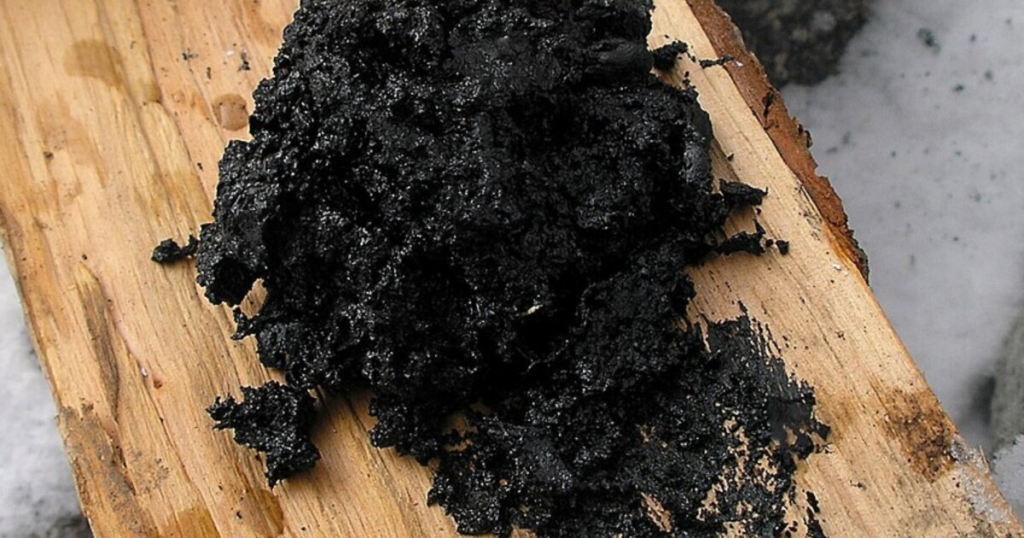
Neanderthals used tar extracted from birch tree bark as a glue to haft their tools, according to previous research. It now appears this dark, sticky substance may have had multiple applications.
A new study published in the journal PLOS One suggests that birch tar may also have been used as an antibiotic substance to treat wounds and skin infections among our ancient cousins.
Lead author Tjaark Siemssen, an archaeologist at the University of Cologne in Germany, told Refractor that indigenous communities such as the Mi’kmaq tribe in Eastern Canada use birch tar extract as a medicinal substance. This extract is known to inhibit various microbial activities.
To test whether the tar produced by Neanderthals also possessed antibacterial properties, Siemssen and his team used bark from silver birch (Betula pendula) and downy birch (Betula pubescens), which were widespread in the European Late Pleistocene. The team used three different methods to produce this tar: distillation in a tin, distillation in a raised clay structure, and the condensation method.
The tars produced by using the above methods were then tested against two common infectious bacteria, a gram-positive species (Staphylococcus aureus) and the gram-negative Escherichia coli.
Irrespective of the method of production, the tar showed no effect against E.coli. On the other hand, tar produced from silver birch in the raised clay structure showed the strongest response against S. aureus. The only tar extracted from downy birch, obtained via the condensation method, did not affect either species of microbe.
This difference in the tar’s antibacterial effects on the different bacteria might be due to their distinct cell structures. An outer membrane present in the E.coli bacteria acts as a defence against the antimicrobial properties of tar, Siemssen says.
Siemssen told us that in another experiment, they made tar by using paper birch (Betula papyrifera) in the absence of oxygen. This tar worked as a broad-spectrum antibiotic against both gram-positive and gram-negative bacteria.
“So we do think at this point that the oxygen impact has something to do with how effective it is as an antibiotic,” he concluded.
Researchers note organic materials are affected by a preservation bias, which could affect how we interpret its use. For instance, plant extracts, resins, or bark may decay quickly over time or may be affected by soil chemistry and temperature.
Though birch bark has antimicrobial properties and Neanderthals used it to produce tar, this “does not indicate that they used it in a medicinal context,” says Ella Been, an anthropologist at Ono Academic College in Israel, who was not involved in this research.
Yet other researchers suspect the Neanderthals were onto something.
“I’m confident most archaeologists would or already do believe that Neanderthals used birch tar as medicine,” says Andrew Sorensen, an archaeologist at Leiden University in the Netherlands, who was also not involved in the study. “You don’t have a relationship with such a material for this long without eventually figuring out all the ways it could be useful!”
This study has been published in the journal PLOS One.
Fact-checked by Mike McRae.