Artificial intelligence (AI) has rapidly become a staple in marketers’ toolkits, making it easier to generate images, copy, and content at the click of a button. According to CleverTap AI, 81% of marketers say their organisations use GPT models such as OpenAI’s ChatGPT or Google’s AI Gemini, and 71.4% report extensive use by content teams.
But AI isn’t just about efficiency. It’s also fueling playful, creative trends. From the “Ghibli trend“, which transformed cherished memories into the animation studio’s iconic style, to AI doll portraits with tiny laptops and coffees, the technology is bringing joy and personality into everyday work life.
Now, the Caricature trend is in the spotlight. Marketing leaders tell MARKETING-INTERACTIVE that caricatures are a playful, exaggerated lens that shows personality, career journeys, and inner motivations in ways traditional headshots cannot. Beyond competence, caricatures capture energy, chaos, humour, and the balancing acts of marketing.
In addition, audiences tired of corporate polish are responding to this mix of individuality, authenticity, and visual fun. In all, marketers see it as part of a broader shift: generative AI is making creative self-expression more accessible, interactive, and culturally relevant, helping professionals stand out in a crowded digital world.
Don’t miss: How IKEA is making trendjacking part of its personality
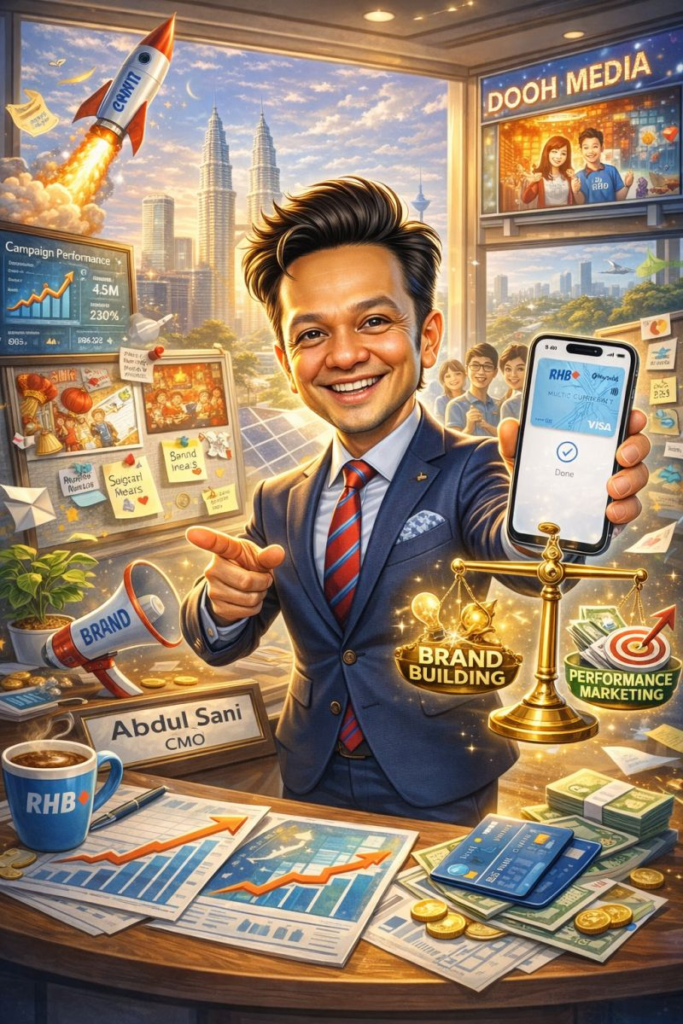
Abdul Sani Abdul Murad, group chief marketing officer, RHB banking group

A professional headshot says, “I am competent. I own a suit. I understand lighting.” A caricature says, “My head is disproportionately large because I overthink things for a living.” The caricature captures something a headshot never can: the absurdity of the job. The balancing act between brand and performance, and the faintly delusional belief that creativity can move markets.
Marketing has always been a tension. Long term brand versus short term sales. Creativity versus commerciality. Courage versus caution. If you are too far to one side, you wobble. Too far to the other, you stall. My career has largely been about defending the irrational in rooms that prefer spreadsheets, and defending spreadsheets in rooms that prefer applause.
Caricatures are resonating because we are exhausted by polish. They reintroduce personality and signal individuality. If professionals are choosing exaggeration over perfection, perhaps it is because exaggeration feels more honest. Exaggeration is simply truth with the volume turned up.
Alex Chan, head of brand, communications and marketing, Geneco

While a headshot helps people associate a face with a name, the caricature trend goes further by visually capturing the essence of a person’s career journey.
For my generation, I was pleasantly surprised by how ChatGPT summarised my profession so accurately, especially when it highlighted the core of my career with the quote, “Let’s drive brand equity!” This put my experience into clear perspective.
LinkedIn rarely sees social media trends, and it is even more unusual to see one that stands out from the platform’s typically polished profiles. Beyond being a fun way to use AI, the trend allows professionals to showcase individuality and authenticity in a more relatable, memorable, and even amusing way.
Adora Sarah Chou, chief marketing officer, Guzman y Gomez Singapore

A professional headshot captures position and credibility and shows what I look like. This caricature captures character and energy and shows how I operate. It conveys movement between strategy and storytelling, boardroom decisions and brand moments. As marketers, we don’t just sit behind campaigns; we build them, obsess over them, and in my case, even voice the commercials on national radio. What this AI caricature captures that photography doesn’t is joy. I genuinely love what I do, and when you enjoy the craft, the line between work and play beautifully blurs.
Modern leadership isn’t one-dimensional. We’re strategists, creators, operators, and communicators often all in the same hour. The caricature reveals that layered reality. The headphones and “ON AIR” sign show my love for storytelling. The strategy deck shows discipline. The burrito signals proximity to product. It blends professionalism with personality. Illustrated identities reflect dimensional leadership, experimentation, and the chance to express how you think and operate, standing out in a digital world.
Koo Sok Hoon, director of marketing, Shangri-La Singapore

The caricature captures the narrative of my career, its milestones, evolution, and personality; in a way a professional headshot simply can’t. While a headshot presents how you look, the caricature conveys where you’ve been, what you’ve built, and the story behind the role.
The focus on advertising effectiveness and ROI felt especially true to my career, as those principles have shaped much of my work. The inclusion of brands such as BMW, GUCCI, Breitling, and Shangri-La Singapore also accurately reflects the diversity and scale of my professional journey.
Caricatures and illustrated identities tap into several compelling dynamics right now. First, there’s the powerful FOMO effect, people naturally want to participate in trends that feel timely and culturally relevant. Second, there’s a sense of delight and curiosity in seeing how accurate platforms such as ChatGPT can synthesise and reflect one’s persona using publicly available information. Finally, the animated, illustrated format adds an element of charm and approachability, making self-expression feel both playful and visually engaging.
Eugene Lee, vice president, chief marketing officer, APAC, CHAGEE

I think caricatures are so fun because they capture the essence of a person — not just how you look, but also your inner world — and bring both to life in a playful way. What I loved most about mine was the sparkle in my eyes and the width of my smile. It really reflects how the past year at CHAGEE has been for me. I’ve genuinely enjoyed the journey, felt energised by the work, and can clearly see where I’ve added value and pushed things forward. Compared to a formal headshot, it feels more human, more honest, and more “me”, showing both the joy and purpose behind what I do.
Peilin Lee, head of marketing, Nespresso Singapore

A headshot is safe. A caricature is honest.
This trend went viral quickly as people can share (and boast) about their diverse interests from the safety of an adorable image.
What my caricature revealed was the coaching side of my role. People often assume marketing is only about loud launches and shiny campaigns. Most of the time, it’s actually leadership, management and helping people develop while delivering business results. My cautious use of LLMs for work showed up too. I deliberately did not name Nespresso for anonymity and confidentiality, and it still created a logo around my coffee-related questions.
This trend is resonating because audiences are tired of corporate polish. They want personality, light heartedness and something deeper than a well-posed, arms folded, studio shot.
Cheryl Lim, global marketing director, corporate coverage, Standard Chartered

A professional headshot says, “steady, credible, corporate.” The caricature captures energy, pace and personality. Akin to a peep behind the corporate face to reveal the engine behind it.
My caricature reflects what truly drives me: a love for marketing strategy balanced with a touch of creative chaos, cultural curiosity and experimentation. The Julia Robert’s smile and perfect wind-in-hair are exaggerated, but the underlying essence is real. I’m genuinely energised by ideas and originality and by building platforms that move people and businesses forward.
For everyday audiences, caricatures are joyful and instant — fun, personalised and done in seconds (and free) — offering easy self-expression in a crowded digital world.
Rashish Pandey, vice president, marketing and communications, APAC, Fortinet

The caricature trend is interesting. A professional headshot is typically a projection, a carefully curated version, of how you want to be seen. A ChatGPT- or Gemini-generated caricature, especially if left largely unedited, is more of a reflection. It’s shaped by your actual interactions with the model, the themes, tone, and patterns that emerge from your digital footprint with AI. This is part of a broader shift: the democratisation of creative design.
In the past, creating something like this meant hiring an agency or mastering tools such as Photoshop. With generative AI, creative capability is becoming universally accessible. Just as social media turned individuals into content creators, generative AI is turning everyone into designers.
Jolene Sng, Singapore country lead and head of agencies, SEA, Samsung Ads

Firstly, I was pleasantly surprised that the caricature captured my professional headline so clearly – me at Samsung Ads and the top line nature of my conversations. Having it in a cartoon style with a big smile also tones down the overly prim LinkedIn headshot and shows a more approachable side of me (which is way more accurate).
The caricature brings out more life and dynamism and probably shaved off five years off my age, which is always a win. The sense of busyness around me professionally is quite an accurate snapshot. The only thing missing is the wider circle of people who actually make work successful, because none of this happens solo with screens only.
Everyone loves something personalised. It’s fascinating to see how much ChatGPT can reflect back about you, but it’s also a reminder of how much information we feed into these systems. I had to refine the image quite a bit with prompts, which actually reassures me. It shows the tool doesn’t fully “see through” or know me and still needs clear direction and context to get it right.
Showcase your most innovative content and gain recognition from a panel of industry leaders by entering the inaugural Content360 Awards. Submit your work today and be part of the celebration that honours the campaigns defining the future of content marketing.
Related articles:
101 on Moltbook: The AI social network that could change marketing
AI ads outperform humans – but only when they don’t look like AI
Is the latest ‘Ghibli’ trend a leap for OpenAI’s facial recognition capability?