CFA Institute

Managing Client Fear: The Cognitive Skill Every Financial Advisor Should Master

Markets move up and down — that’s a fact. Emotional reactions to those movements, however, are optional. But even the most analytical, financially literate clients are not immune to anxiety, fear, or regret. When emotions take hold, investors tend to lose perspective. They start zeroing in on recent losses, alarming headlines, or isolated data points rather than the big-picture goal or why they started initially investing. To appease clients, financial advisors often respond with more information like additional charts, statistics, and explanations. Yet when a client is emotionally activated, more detail fuels the fire, further pushing the client toward the very thing that triggered them. As I’ve noted in previous blogs, it’s important for advisors to address clients’ emotional triggers, lest they manifest as risk aversion in portfolio design and undermine long-term returns. That’s where chunking up comes in. This technique, drawn from cognitive psychology and widely used in athletic coaching, allows investors to reconnect with long-term reasoning, reduce emotional stress, and make decisions aligned with their goals rather than their fears. What follows is a practical framework for financial advisors, supported by client–advisor dialogues, illustrating how to guide clients toward steadier thinking amid inevitable market swings. Chunking Up for the Win Chunking involves grouping information into more meaningful patterns to make sense of more complex ideas. But when markets turn volatile, it’s easy for clients to get lost in the details, or chunk down. Hence: Chunking down: focusing on specifics Chunking up: redirecting attention to broader intentions, values, or goals An advisor “chunks up” by steering clients away from emotionally charged details and back to the higher-level purpose behind their investments, restoring balance and strengthening long-term decision-making. A parallel example appears in sports. When an athlete misses a shot or loses a match, their attention often narrows to the mistake itself, a classic example of chunking down. A skilled coach reframes the moment by shifting the athlete’s attention from the error to the broader objective, such as the team’s overall strategy. This chunking up process diffuses emotional reactivity and promotes mental clarity. Under stress, investors behave similarly. They magnify a short-term loss, a colleague’s poor experience, or a negative headline, losing sight of the broader plan. Chunking up reverses this effect. It draws attention away from the immediate trigger and back to strategy. Its power lies in how it reshapes mental processing, encouraging clients to re-engage in long-term reasoning and escape the cognitive traps that lead to poor strategizing. A Practical Framework Advisors can use the following process to move clients from emotional reactivity to goal-aligned reasoning. Each step builds on the last, guiding the conversation from detail to direction. Identify the emotional anchor: Pinpoint the detail dominating the client’s attention: a recent loss, a worrying headline, or a peer’s negative experience. Recognizing the anchor informs what’s driving the reaction. Chunk up with one question: Introduce a higher-level question that reframes perspective, such as: What was the purpose behind this choice? What long-term goal does this relate to? What were we trying to achieve originally?This simple pivot interrupts the emotional loop and opens the path to broader, more rational reasoning. Connect to values and objectives: Link the discussion back to what truly matters, the client’s long-term goals, priorities, and values. Re-centering on long-term plans (retirement security, independence, family legacy) reactivates purpose and steadies perspective. Reevaluate through the higher frame: With emotions quelled, you can guide clients to reassess choices through this broader lens. Urgency tends to fade once context is restored. Fear often dissolves at this stage. Then return to specifics: With perspective regained, revisit allocations, timing, risk level, and implementation. Clients are calmer and better equipped to make decisions aligned with their long-term objectives. This sequence transforms reactive moments into opportunities for clarity, trust, and insight. In an environment defined by uncertainty, chunking up is one of the most valuable skills an advisor can master. In Practice: Two Client Dialogues Case 1: Fear of Regret (Regret Aversion) Client: I’m afraid of making the wrong call. What if we allocate to equities now and markets drop?Advisor (chunking up): I understand. Let’s step back for a moment. What’s the bigger purpose you’re trying to serve with this allocation?Client: To make my money work better than it currently does.Advisor: And is the goal to avoid temporary declines, or to grow capital over 10–15 years?Client: Growing capital.Advisor: So which choice supports that purpose more: staying fully safe, or taking measured risk?Client: Taking some risk.Advisor: Exactly. From there, we can explore how much risk feels appropriate. Key takeaway: The client’s fear wasn’t about equities; it was about regret. Chunking up surfaced the deeper intention behind the emotion. Case 2: Recency Bias After a Negative Headline Client: I’ve read another article predicting a recession. We should pause all contributions.Advisor (chunking up): Totally understand that instinct. Let me ask, what’s your primary goal with these monthly contributions?Client: To build enough for financial independence.Advisor: And is financial independence something that depends on one quarter or on decades?Client: Decades.Advisor: So if your goal is decades-long independence, how does stopping contributions after one article support or hinder that?Client: …It might actually hurt it.Advisor: Exactly. Shall we look at how disciplined contributions have performed historically during volatile periods? Key takeaway: The advisor avoided debating the headline, likely a losing game, and reconnected the strategy to the client’s true anchor: financial independence. Turning Anxiety into Insight In a profession where uncertainty is constant, the ability to reframe emotion is invaluable. By mastering chunking up, advisors can transform anxious reactions into meaningful dialogue, allowing clients to follow a plan grounded in purpose rather than panic. A single well-timed question can be the bridge between fear and focus and is the mark of an advisor who truly leads with clarity. source

Managing Client Fear: The Cognitive Skill Every Financial Advisor Should Master Read More »

Social Security Claiming Strategies for High-Net-Worth Clients

Conventional retirement planning often treats delaying Social Security until age 70 as a default best practice, citing the value of delayed retirement credits and higher guaranteed lifetime income. For high-net-worth households, however, Social Security represents a relatively small component of overall wealth. Once taxes, opportunity cost, and realistic longevity probabilities are incorporated, delaying benefits often functions less as a superior investment decision and more as a form of longevity insurance, one that may come at a measurable cost to after-tax wealth and liquidity. For financial advisors, the question is therefore not whether delaying Social Security is “right” or “wrong,” but how to frame the trade-offs for affluent clients whose portfolios already bear most of the longevity and income risk. Maximum Benefits and the Economic Cost of Waiting Using Social Security Administration (SSA) projections for a maximum‑earning worker reaching eligibility in the mid‑2020s, approximate monthly benefits are: Claiming Age Estimated Monthly Benefit 62 (Early) $3,000 67 (FRA) $4,200 70 $5,300 Ignoring taxes and investment returns, the cumulative breakeven age, total benefits from delaying equal those from early claiming, generally falls in the early 80s. These breakeven points occur later once taxes and investment returns are considered. For high-net-worth individuals who continue to earn meaningful income from employment or active businesses, claiming Social Security at the earliest eligibility age is often impractical. Prior to full retirement age (FRA), Social Security applies an earnings test to wage and self-employment income (not investment income), and the threshold is relatively low. As a result, benefits may be partially or fully withheld. In practice, many higher earning income individuals choose to delay claiming until benefits can be collected without any earned-income limitations and with the added advantage of higher lifetime benefits. For advisors, this reframes Social Security claiming as a capital-allocation decision within the retirement balance sheet, not a standalone income optimization exercise. Early Claiming as a Capital-Allocation Decision An alternative approach is to claim earlier, at age 62 or at full retirement age (FRA), and invest the proceeds conservatively. The asset mix would typically emphasize high-quality fixed income, such as Treasuries, municipals, or diversified low-risk strategies. Long-term nominal return: approximately 4–5% pre-tax. After-tax return for top-bracket investors on taxable assets: approximately 3%, depending on asset location and tax management. Under these assumptions, an individual claiming at age 62 can accumulate a substantial pool of liquid capital by age 70, while the individual who delays has received no benefits during that period. Importantly, this capital remains fully liquid and available for spending, reinvestment, gifting, or estate planning. For advisors, this reframes Social Security claiming as a capital-allocation decision within the retirement balance sheet, rather than a standalone income optimization exercise. Longevity Risk, Quantified The strongest argument for delaying Social Security is longevity insurance: higher guaranteed income if an individual lives well beyond average life expectancy. That benefit, however, must be weighed against the after-tax economic value of benefits received earlier and invested. Early Claiming and a Potential $220,000 After-Tax Capital Advantage If benefits are claimed at age 62 and invested through age 70, the early claimant can accumulate a meaningful pool of capital before the delayed claimant receives any benefits. Using illustrative assumptions: Maximum benefit at age 62: $3,000 per month. After-tax benefit, assuming approximately 68.5% retained after federal tax (37%*0.85): about $2,055 per month. After-tax investment return: approximately 3.15% annually, equivalent to roughly 5% pre-tax for top-bracket taxable investors. Monthly compounding. Under these assumptions, the cumulative value of invested benefits at age 70 is approximately $220,000. By contrast, the individual who delays claiming until age 70 has accumulated no Social Security benefits during this period. Importantly, the $220,000 represents liquid, investable capital, not an annuity equivalent, and therefore constitutes the initial advantage of the early-claiming strategy. Even if the after-tax investment return is reduced to half the illustrative assumption, the cumulative value at age 70 remains approximately $210,000. At twice the assumed return, cumulative invested benefits rise to approximately $255,000. Over very long horizons, investment returns matter more, but the payoff profile is asymmetric: higher returns have a greater impact on outcomes than lower returns. Net Advantage by Age at Death The table below shows the estimated net after-tax advantage of claiming earlier versus delaying to age 70. Net advantage reflects: After-tax Social Security benefits received After-tax value of invested early claiming The higher monthly benefit received by the delayed claimant. Positive values favor earlier claiming; negative values favor delaying to age 70. Age at Death Male Survival Probability Female Survival Probability Net Advantage: Claim at 62 vs. Delay to 70 Net Advantage: Claim at FRA (67) vs. Delay to 70 70 70% 81% $220,000 $110,000 80 48% 62% $90,000 $55,000 90 17% 28% -$90,000 -$20,000 95 5% 11% -$200,000 -$65,000 100 1% 2% -$330,000 -$120,000 Survival probabilities are approximate cumulative survival from age 62 (for the 62 vs. 70 comparison) and from age 67 (for the FRA vs. 70 comparison), based on SSA period life tables. Figures are rounded for clarity. How to read the Table: Age 70: The early claimant’s advantage is almost entirely the accumulated benefits invested, approximately $220,000. Ages 75 to 85: The advantage declines as the delayed claimant’s higher monthly benefit begins to narrow the gap. Around age 88 to 90: The two strategies typically converge. Extreme longevity (95 to 100): Delaying to age 70 eventually produces higher cumulative after-tax benefits, but only in low-probability scenarios. When outcomes are weighted by survival probabilities rather than extreme endpoints, claiming at age 62 or at full retirement age often produces higher expected after-tax wealth for high-net-worth retirees. Bottom Line For financial advisors working with high-net-worth clients: Claiming Social Security at age 62 or at full retirement age and investing conservatively can often maximize expected after-tax wealth. Delaying benefits until age 70 is best understood as a form of longevity insurance, rather than a universally superior financial return. The appropriate strategy depends on client-specific factors, including health, tax profile, portfolio structure, spousal considerations, and preferences for liquidity versus guaranteed income. Because no client can know ex ante which

Social Security Claiming Strategies for High-Net-Worth Clients Read More »

Momentum Investing: A Stronger, More Resilient Framework for Long-Term Allocators

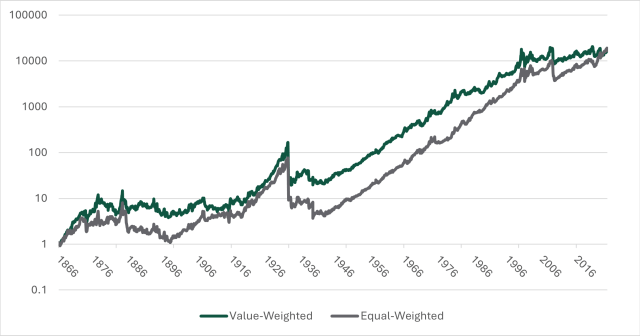
Momentum investing remains a cornerstone of systematic equity strategies, and our recent research shows it is one deserving of allocators’ full attention. In our latest review (forthcoming, 2026), we provide a comprehensive update on its empirical foundations and practical evolution. Drawing on more than 150 years of data and thousands of portfolio specifications, we reaffirm momentum’s resilience while highlighting its transformation into a multidimensional phenomenon. The momentum premium is not a statistical fluke or a product of data mining; rather, it is a consistent and sizable return spread that has endured across eras, geographies, and portfolio construction choices. For institutional investors, however, our findings are both a validation and a challenge: momentum is robust, but its implementation and risk profile have changed in ways that demand careful attention. 150 Years of Persistence….and Counting Momentum’s long-term persistence is perhaps its most defining feature and the primary reason it remains relevant for investors. Exhibit 1 illustrates this long-term performance, showing the cumulative returns of a simple long-short momentum strategy from 1866 to 2024. Over this 150-year sample, a simple long–short strategy that buys past winners and sells past losers turns an initial $1 into more than $10,000, reflecting annualized returns of roughly 8–9%. These returns are not only sizable, but also highly statistically significant, with t-statistics far above the thresholds typically used to determine whether a result is real or due to chance. Importantly, this finding is not sensitive to how the portfolios are constructed. Whether we use value-weighted or equal-weighted returns, adjust the definition of momentum, or alter the time period examined, the premium persists. Such robustness across specifications and sample windows strengthens the conclusion that momentum is not an artifact of a particular methodology. For institutional investors, the message is straightforward: momentum has endured across eras, market conditions, and portfolio designs, indicating that it reflects a structural feature of financial markets rather than a fleeting anomaly. Exhibit 1: Long-Term Performance of Momentum This exhibit shows the cumulative returns of a long-short momentum strategy (winner-minus-loser portfolio) in US equities from 1866 to 2024. Performance is gross of transaction costs in USD. Both value-weighted and equal-weighted portfolios are displayed, highlighting the remarkable growth and resilience of momentum over more than 150 years. Chart represents a snapshot of the data which is fully accounted for through 2024. Source: Baltussen, Dom, Van Vliet & Vidojevic (2026). Momentum factor investing: Evidence and evolution, forthcoming in Journal of Portfolio Management. Yet momentum should not be viewed as a single, uniform strategy. Its performance depends heavily on how the portfolio is built. Design choices such as whether returns are value-weighted or equal-weighted, where breakpoints are set, industry neutralization, and microcap stock inclusion can all affect both the level of returns and the amount of risk taken. To quantify this sensitivity, we create more than 4,000 variations of momentum portfolios. All of them generate positive Sharpe ratios, indicating that the momentum premium is broadly robust. However, the performance range is substantial: the median Sharpe ratio is 0.61, but individual specifications span from 0.38 to 0.94. This indicates that reported returns can vary depending on how the factor is built. For practitioners, it underscores the importance of rigorous specification checks and transparency in factor design, especially when benchmarking or reporting results. In recent decades, momentum research has broadened well beyond simple price trends. New forms of momentum capture different ways in which returns continue over time. Fundamental momentum, based on earnings surprises, analyst revisions, or news sentiment, reflects investors’ tendency to underreact to new information. Residual momentum focuses on firm-specific return patterns, isolating company-level news and typically producing smoother, higher-Sharpe results. Anchor-based momentum, such as the distance to a stock’s 52-week high, exploits behavioral biases like anchoring and the reluctance to sell at a loss. Industry and network momentum capture both top-down forces (sector trends, macro cycles) and bottom-up relationships (product-market linkages, analyst attention spillovers), while factor momentum reflects slow-moving capital flows into styles and persistent macro environments favoring certain characteristics. These alternative signals are imperfectly correlated with traditional price momentum and with one another, providing meaningful diversification. The multidimensional composite (EW_ALL), which equally weights price momentum and ten alternative signals, delivers higher average returns, stronger t-statistics, and substantially improved drawdown characteristics relative to price momentum alone. Exhibit 2 illustrates the cumulative performance of this composite versus traditional price momentum since 1927, making the diversification benefits and risk-efficiency gains readily apparent. Exhibit 2: Multidimensional Momentum vs. Price Momentum This exhibit compares the cumulative returns of traditional price momentum and the multidimensional momentum composite (EW_ALL) since 1927. Performance is gross of transaction costs in USD. All underlying signal portfolios are equal-weighted. The equal-weighted composite combines price momentum with ten alternative momentum signals, demonstrating superior returns and risk-adjusted performance relative to price momentum alone. Chart represents a snapshot of the data which is fully accounted for through 2024. Source: Baltussen et al. (2026). Momentum factor investing: Evidence and evolution, forthcoming in Journal of Portfolio Management. The Blind Spot The Achilles heel of momentum, however, remains its crash risk. Momentum strategies are vulnerable to sharp reversals, particularly during market regime shifts. We document maximum drawdowns as large as –88% for traditional price momentum, accompanied by left-skewed and fat-tailed return distributions. However, many alternative momentum signals are less volatile, and the multidimensional composite meaningfully reduces risk relative to price momentum alone. Building on prior work, we implement volatility-scaling at both the portfolio and stock levels, dramatically reducing drawdowns and improving Sharpe ratios. The resulting risk-managed momentum strategy (RM_MOM) delivers annualized returns of nearly 18% at volatility comparable to standard momentum, with drawdowns cut nearly in half. Diversify the Signals For institutional investors, the implications are clear. Factor construction matters, and robustness checks across portfolio designs are critical. Diversifying momentum signals can deliver superior risk-adjusted returns. Managing crash risk through volatility scaling and multidimensional portfolios is essential for sustainable momentum exposure. While risk-based theories may explain some of the premium, behavioral biases and limits to arbitrage remain central to momentum’s persistence. We consider

Momentum Investing: A Stronger, More Resilient Framework for Long-Term Allocators Read More »

Rethinking Household Asset Allocation Under Capital Constraints

The 60/40 equity–bond portfolio remains a widely used benchmark for long-term asset allocation, despite ongoing debate about its optimality (Pham et al., 2025). For many households, however, the challenge lies not in the framework itself but in the amount of capital required to implement it. Limited investable assets, a desire to avoid explicit borrowing, significant exposure to residential real estate, and the need to maintain liquid reserves often constrain the ability to fully fund a traditional allocation. Leveraged ETFs offer an alternative. Rather than increasing risk, they allow households to achieve a desired risk exposure with less deployed capital, improving the management of liquidity, real-estate leverage, and broader balance-sheet constraints. As illustrated below, leveraged ETFs combined with cash holdings can approximate the risk characteristics of a traditional 60/40 portfolio while avoiding margin accounts, personal credit lines, or other forms of household-level leverage. By separating market exposure from capital commitment, this framework preserves liquidity and financial flexibility while maintaining a familiar asset allocation profile. While many practitioners view leveraged ETFs as unsuitable for long-term use, this analysis is aimed at financial advisors willing to examine that assumption in the context of capital-constrained household portfolios. Motivation: Asset Allocation at the Household Level For most retail investors, portfolio construction takes place within the constraints of the household balance sheet, where housing exposure, mortgage leverage, employment income risk, and liquidity needs shape feasible investment choices. Many households are already structurally leveraged through real estate. Over recent decades, rising home values in developed economies have increased net worth while simultaneously concentrating risk in illiquid assets. As a result, investors often find themselves overweight real assets and underweight liquid financial capital. Traditional forms of financial leverage introduce additional risks that many retail investors are unwilling or unable to bear, including margin calls during drawdowns, fixed repayment obligations on credit lines, and behavioral pressures that can lead to poorly timed de-risking or forced liquidation during periods of heightened volatility. In contrast, when used thoughtfully, leveraged ETFs—whose leverage is contained at the fund level rather than the household balance sheet—allow investors to separate market exposure from capital deployment, providing greater flexibility in household portfolio construction. Methodology and Portfolio Construction The following analysis evaluates whether a portfolio constructed from leveraged equity and bond ETFs combined with cash can approximate the return and volatility characteristics of a traditional 60/40 equity–bond portfolio, without relying on margin, personal borrowing, or other forms of household-level leverage[1]. Benchmark and Instruments The target allocation is a conventional 60/40 portfolio consisting of: 60% exposure to the S&P 500 40% exposure to US Treasuries, represented by a duration of approximately seven years To implement these exposures, the analysis employs the following instruments: A hypothetical ETF providing three times the daily return of the S&P 500 A hypothetical ETF providing three times the daily return of long-duration US Treasuries (20+ year maturity; duration ≈16), with position size scaled to achieve the target portfolio duration Cash earning the overnight rate Although the leveraged Treasury instrument has a longer underlying maturity, its portfolio weight is scaled such that the resulting effective duration of the combined portfolio approximates the seven-year target. Cost and Financing Assumptions To better approximate real-world performance, the following assumptions are incorporated: Annual management expense ratio (MER): 1% Fund-level borrowing cost: overnight rate + 50 basis points Cash earns the overnight rate Portfolio Construction Process Rather than fixing nominal portfolio weights, the strategy targets stable effective market exposures: An equity exposure equivalent to approximately 60% of the S&P 500 A Treasury duration of approximately seven years At each month-end, portfolio weights are adjusted to maintain these exposure targets. Equity and bond ETF allocations are scaled to achieve the desired equity exposure and portfolio duration, with residual capital allocated to cash. Monthly rebalancing is required to offset exposure drift arising from the daily reset nature of leveraged ETFs. Due to the daily reset nature of leveraged ETFs, effective exposures drift over time, necessitating periodic rebalancing. Over the sample period, the resulting average portfolio weights are approximately 20% in the leveraged equity ETF, 15% in the leveraged Treasury ETF, and 65% in cash. Observed Outcomes and Comparison to 60/40 The strategy is back tested using monthly data from 31 December 2002 through 31 December 2024 and evaluated against a traditional 60/40 benchmark (Table 1). Over the sample period, the leveraged ETF plus cash portfolio delivers cumulative returns broadly comparable to the benchmark. More importantly, realized volatility closely tracks that of the traditional 60/40 portfolio, indicating that the exposure-targeting framework is effective in replicating first-order risk characteristics. Table 1 (Summary Statistics) Tracking Differences Periods of divergence between the two portfolios are primarily driven by: Daily leverage reset effects during volatile markets Embedded financing costs within leveraged ETFs Monthly rebalancing frequency The prevailing cash yield environment These factors introduce tracking error but do not materially alter the portfolio’s overall risk profile. Figure 1 (Annual Returns) Figure 2 (Allocation %) Distributional Effects While mean returns and volatility are comparable, the leveraged portfolio exhibits fatter tails relative to the traditional 60/40 portfolio. This reflects the nonlinear return dynamics introduced by daily leveraged instruments, especially during periods with high volatility. Figure 3 (Return Distribution) Practical Risks and Limitations While the framework illustrates a capital-efficient approach to exposure management, it involves important trade-offs that warrant careful consideration. Leveraged ETFs are designed to track multiples of daily index returns; over longer holding periods, their performance becomes path-dependent due to daily leverage resets, with volatility drag increasing nonlinearly as leverage rises (Pessina and Whaley, 2021). In addition, the analysis relies on hypothetical leveraged ETFs, and realized performance of actual products may deviate from modeled results, particularly during periods of market stress. Finally, although average volatility may align with a traditional 60/40 portfolio, the use of leverage increases tail risk, implying a higher likelihood of extreme outcomes. Figure 4 (Drawdown) Capital Efficiency as Portfolio Design Leveraged ETFs are frequently dismissed as unsuitable for long-term investors due to volatility drag and path dependency. This analysis shows that, when employed

Rethinking Household Asset Allocation Under Capital Constraints Read More »

Reducing the Cost of Alpha: A CIO’s Framework for Human+AI Integration

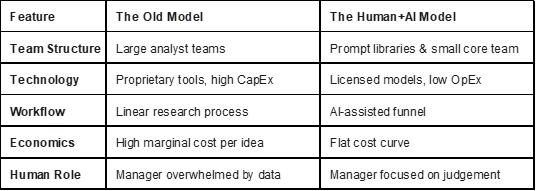
The active asset management industry has reached a breaking point. After decades of thriving on high fees and growing assets, active managers now face relentless margin pressure. Passive investing has eroded revenues, while the cost of producing alpha remains stubbornly high due to large teams, complex data needs, and heavy infrastructure. While some firms have managed to trim absolute costs through traditional cuts, these savings rarely keep pace with the relentless margin compression. With additional burdens from regulation, cybersecurity, and technology upkeep, firms are caught in a structural squeeze: falling fees and weak inflows on one side, rising or inflexible costs on the other. The battleground is no longer performance alone, but the cost of alpha. Technology was supposed to solve this, but in many cases it has done the opposite. Years of investment in AI and automation have failed to reduce costs because most firms remain trapped in a legacy architecture that consumes resources and imposes a growing complexity tax. Much of today’s tech spend simply maintains existing systems (often 60% to 80% of total technology budgets), leaving little room for innovation. Even when modern tools are introduced, human resistance often limits their impact, as portfolio managers and analysts fear loss of control or job relevance. For CIOs, the real transformation is cultural: success comes when AI is used to empower experts, not replace them, freeing teams to focus on the highest-value decisions. Blueprint for a Cost-Effective Alpha Factory   There’s a steep opportunity cost of having highly compensated portfolio managers spend time on manual data gathering rather than high-value judgment. The industry is full of talk, but short on actual, working blueprints. So, how can asset managers escape the fee-cost claw, generate sustainable alpha, break free of the legacy trap, and bring their people along? The solution is to reimagine the investment process itself to build a new kind of alpha factory that is highly efficient and scalable yet keeps human expertise at its core. Drawing on over 20 years of experience managing institutional portfolios (over €1.6bn AUM) and architecting Human+AI investment processes, I have designed and tested a specific end-to-end blueprint that cuts the cost of alpha by addressing these root causes. For instance, during a live run at the beginning of October 2025, the model highlighted an unusual valuation dislocation in the Japanese company IHI Corporation that a traditional factor screen failed to detect. The alert prompted an immediate review of the company’s fundamentals. Within hours, the portfolio manager validated the underlying drivers, judged the mispricing to be genuine, and initiated a position. This trade was part of a live model portfolio designed to test the full Human+AI blueprint in real time and to measure its impact on the cost of alpha. Here’s what the new alpha factory looks like: The New IP: License Models, Build PromptsThe edge today no longer comes from building proprietary AI models — it comes from how firms use them. Instead of sinking capital into in-house development, CIOs should license multiple best-in-class external models and focus on the true differentiator: implementation. That means knowing which models to use, where to deploy them in the investment process, and how to combine their outputs effectively. A firm’s real intellectual property now lies in its prompt library — the tailored workflows that embed its investment philosophy into general-purpose models. This Human+AI approach shifts spending from heavy CapEx to flexible OpEx, often at a modest cost of roughly $500 to $5,000 per model per month and requires continuously monitoring the AI landscape so new and better models can be tested and integrated as they emerge. The New Process: A Four-Stage Human+AI FunnelThe traditional linear research process needs to become a multi-stage system in which humans and machines work together from the top down. In a global equity example (equally applicable to fixed income or multi-asset), AI first supports regime-aware allocation decisions, such as steering cash levels based on market signals and adding a critical layer of risk management before individual stock work begins. From there, portfolio management runs through a four-stage Human+AI funnel: Stage 1: Pre-Screening (e.g., 17,000 → 5,000 stocks)This first step is purely quantitative and requires no AI. It involves screening the global developed-markets universe—roughly 17,000 stocks—against essential criteria such as minimum liquidity and market capitalization. The goal is to narrow the field to a more manageable universe of approximately 5,000 companies that meet basic investability standards. Stage 2: Idea Generation (e.g., 5,000 → 500 stocks)This is where AI’s strength truly comes into play. Machine learning and generative AI models are applied to the 5,000-stock universe to surface new investment ideas aligned with the current market environment. Unlike static screening, this process is adaptive: AI can dynamically shift focus between value and growth styles, identify emerging sector trends, and flag outliers that traditional methods might overlook, like the IHI Corporation example. Stage 3: Deep Analysis (e.g., 500 → 100 stocks)Now you can deploy generative AI functions as a team of junior analysts. Leveraging the firm’s proprietary prompt library, AI reads and analyzes corporate filings, management tone, technical indicators, sentiment data, competitive positioning and much more across the 500 companies that advanced from the prior stage. The AI handles the mechanical workload, while the human analyst or portfolio manager provides the critical interpretation. Together, they distill a high-conviction shortlist of roughly 100 candidates. In the IHI Corporation example, the manager used AI’s deep-dive analysis to validate the firm’s balance-sheet strength and moat, moving from idea to conviction in a fraction of the usual time. Stage 4: Portfolio Construction (e.g., 100 → 70 stocks)Finally, the portfolio manager takes full control, using AI as a co-pilot in the construction phase. With the 100-stock shortlist in hand, the manager employs AI-driven tools to optimize position sizing and manage portfolio-level risk exposures. As detailed in my previous post, this final step—where human judgment meets machine precision—can significantly enhance risk-adjusted performance and ensure that alpha generation is both scalable and cost-effective. This funnel compresses portfolio management cycles, strengthens process

Reducing the Cost of Alpha: A CIO’s Framework for Human+AI Integration Read More »

The Two AI Stories: Measurable Gains and Hidden Balance-Sheet Pressure

AI is delivering real productivity gains across data-rich sectors, yet today’s investment surge is unfolding through highly concentrated capital flows and unprecedented spending on chips, data centers, and cloud infrastructure. At the same time, a growing share of reported growth depends on circular financing loops between chipmakers, cloud providers, and AI developers. These practices — like those of past market bubbles — can inflate demand signals, distort revenue quality, and increase the fragility of a market driven by a small group of firms. For financial analysts, assessing how these forces shape cash-flow durability, valuations, and balance-sheet resilience is critical to distinguishing sustainable AI-driven performance from capital-fueled momentum. A Market Reshaped by Capital Concentration AI investment is reshaping financial and corporate sectors. By 2025, more than half of global VC funding is expected to flow into AI, supporting growth in the United States with large investments in data centers and cloud infrastructure. Although AI capital expenditure still makes up less than 1% of GDP, consistent with an early-stage development, AI’s impact on public markets is considerable. Nearly 50% of the S&P 500’s market cap (about US$20 trillion) is considered to have medium to high AI sensitivity. This concentration creates a tightly connected ecosystem of tech platforms, chipmakers, data-center operators, cloud providers, and financial firms. Inside the Circular Financing Engine Circular financing loops have become a defining feature of this investment cycle. In several major deals, leading chip and cloud companies — such as NVIDIA and Microsoft — take equity stakes, extend credit, or provide other financial support to AI startups and data-center operators like CoreWeave or Nscale. In return, these clients commit to multi-year contracts for GPUs, servers, and cloud capacity. The suppliers recognize revenue from these agreements, boosting their valuations, while the startups gain both credibility and guaranteed access to infrastructure. These long-term contracts also encourage banks and private lenders to extend additional credit, pulling more debt and equity into the same closed ecosystem. How Round-Tripped Revenue Inflates Growth Signals The pace and scale of these agreements are drawing significant market attention. Analysts estimate roughly US$1 trillion in related commitments across suppliers, cloud platforms, and developers. NVIDIA’s proposed US$100 billion pledge to support OpenAI’s 10-gigawatt data-center expansion illustrates the dynamic: it enhances OpenAI’s capacity while directly boosting NVIDIA’s hardware sales. Financial firms, especially G-SIBs, are increasingly flagging these circular arrangements, in which suppliers finance their clients, share ownership, and split revenues. The concern is that these interconnected deals can inflate demand signals, distort revenue and valuation metrics, and obscure underlying vulnerabilities. If conditions deteriorate, integration challenges, organizational delays, regulatory hurdles, or overestimated demand could erode confidence in the AI story, expose overbuilt infrastructure, strain financial relationships, and trigger a broader sector correction. Lessons from Telecom’s Vendor Financing Bubble The telecom surge of the late 1990s offers a useful parallel. Companies such as Lucent, Nortel, Alcatel, and Cisco provided generous vendor financing to carriers, who used the funds to purchase switches, routers, and optical equipment. On paper, sales and profits looked strong, but much of the demand was driven by vendor financing rather than sustainable, revenue-generating customers. When traffic growth and pricing failed to meet expectations, carriers struggled to manage their debt. Defaults became frequent, vendors wrote down large receivables and inventories, and the telecom bubble ultimately burst, exposing the fragility of these intertwined financial arrangements. The AI cycle follows a similar story: leading chipmakers and cloud providers are investing heavily in key AI clients, driving commitments for large infrastructure purchases, and creating “round-tripped” revenue. This dependence on a small group of firms raises meaningful risk. The notion of “limitless AI compute,” much like “infinite bandwidth” in the late 1990s, becomes problematic if GPU and data-center capacity grows faster than it can be monetized. Despite some similarities to past tech booms, several significant differences define the current AI investment scene. Today’s leading AI firms are generally more profitable and carry less debt than many telecom companies during the dot-com era. In addition, a larger share of spending now goes toward physical assets that often have alternative uses or resale value. Where Today’s Cycle Differs—and Why It Still Carries Risk There is also genuine demand from businesses and consumers who actively pay for AI services. Even so, the scale of investment in chips, data centers, and cloud infrastructure could create oversupply, shorten asset lifespans, and reduce returns, particularly since chip generations become obsolete quickly and data-center equipment may last only about five years. Circular financing is not inherently problematic, but it becomes a concern when supplier- or investor-driven demand outpaces sustainable end-user revenue. As a result, experts are now examining AI deal structures and capital plans with the same rigor that credit analysts once applied to telecom vendor financing. Operational and Labor Impacts: Early Productivity, Uneven Effects Beneath the surface of capital inflows, AI is already reshaping how firms and labor markets operate, though unevenly. Routine, rules-based roles remain the most vulnerable; the U.S. Bureau of Labor Statistics expects AI to “moderate or reduce (but not eliminate)” the need for workers such as claims adjusters and examiners. Larger, tech-savvy firms are better positioned to capture these efficiency gains, while smaller or slower adopters may struggle to keep pace. Predictable, task-focused roles face growing pressure to automate, even as demand and wage premiums rise for workers with AI skills. Productivity gains are emerging, but often at the expense of job quality, with greater oversight, faster work pace, fragmented tasks, and some degree of deskilling. Some workers in high-risk roles are already seeing stagnant or declining wages and downgraded positions, with responsibilities and pay shifting rather than disappearing. Yet studies show that only a small share of firms have seen a meaningful impact on profits; one report finds that 95% of organizations report “little to no P&L impact,” with most gains concentrated among major tech firms. Even so, there is a credible positive trajectory, especially over the medium term. Companies are already integrating AI into workflows by automating routine tasks, improving decision-making, and

The Two AI Stories: Measurable Gains and Hidden Balance-Sheet Pressure Read More »

Navigating the Future of Risk Functions: Key Risk Indicators

Imagine steering your organization through a stormy sea, except the waves are now higher, the weather changes by the hour, and the maps you relied on are already outdated. Volatility spikes, rapid rate shifts, and evolving regulations are reshaping market risk faster than many investment teams can adapt. Waiting for quarterly reports or post-event analysis is no longer enough. By then, the damage is done. Key risk indicators (KRIs) are your radar, scanning ahead to detect trouble before it breaches your risk appetite or impacts performance. As a risk professional, I’ve seen well-designed KRIs transform how investment firms anticipate and manage threats. In this post, I’ll share the core principles for building effective KRIs, illustrated with investment-focused examples you can apply immediately. What Are Key Risk Indicators? KRIs are measurable metrics that help organizations identify, monitor, and manage risks that could derail their objectives. Acting as early warning signals, KRIs provide insights into emerging risks or shifts in exposure before they escalate. By tracking KRIs against control benchmarks, businesses can address vulnerabilities proactively, align risk management with strategic goals, and enhance decision-making. 5 Principles of Effective Key Risk Indicators KRIs are only as effective as their design. Below, I outline five essential principles, each paired with an investment risk example and a clear If-Then rule to make the concept immediately actionable. 1. Measurable and Relevant KRIs must target specific risks tied to organizational goals and be calculated consistently to ensure reliability. Overlapping KRIs waste resources and obscure insights. Example: In investment management, metrics like drawdowns, implied volatility, or historical volatility can all measure risk — but using more than one for the same purpose creates noise. For an unleveraged long-only equity portfolio consisting of public equities, historical volatility based on daily returns over one month may be suitable once aligned to the risk appetite of the firm, consistently reflecting investment risk. If–Then: If more than one KRI measures the same underlying risk, then select the single metric most relevant to the investment mandate and apply it consistently. 2. Predictive Unlike key performance indicators (KPIs), which measure past performance, KRIs must anticipate future risks to enable proactive action. Example: A $10M portfolio with 33% each in Apple, Meta, and Tesla had a historical volatility of 38.03%. After shifting to 50% Apple and 50% Meta, recalculating with the new allocation projects 45.71% annualized volatility, a critical forward-looking insight. If–Then: If portfolio holdings or allocations change materially, then recalculate the KRI using the new allocation to capture the updated risk profile. 3. Control Benchmarks KRIs must be actionable, using benchmarks within the organization’s control to secure buy-in and drive decisions. Example: Comparing a portfolio’s simulated volatility of 45.71% to the S&P 500’s 15.87% isolates portfolio-specific risk from market driven risks which are usually outside the control of an unleveraged long-only equity portfolio. If volatility exceeds the agreed multiple of the benchmark, the team can adjust holdings — for example, by adding a stable utility stock. Without a control benchmark, the KRI might flag risks the team can’t control, like market-wide volatility, reducing its usefulness. If–Then: If the KRI measurement design includes factors outside the organization’s control, consider whether enhancing the design of the KRI can minimize uncontrollable factors. 4. Proactive and Timely KRIs must trigger specific actions within set timelines, linking directly to risk mitigation strategies. Example: If portfolio volatility exceeds 2.5x the S&P 500’s level (e.g., 39.67%), the investment team might diversify within 48 hours to lower risk. Dynamic thresholds ensure that limits adjust with market conditions. If–Then: If a KRI breaches its dynamic threshold, then adjust portfolio composition to bring it back within limits using predefined actions within a fixed time frame to reduce risk before it escalates, such as stock or sector re-allocation. 5. Strategic Alignment KRIs must align with the organization’s strategic vision to secure leadership support and foster a risk-aware culture. Example: The risk team calibrates volatility thresholds to optimize the Sharpe Ratio, aligning the KRI with a KPI closely monitored by management. By back-testing to balance risk and return, the KRI’s value becomes clear to both leadership and front-line staff. If–Then: If back-testing shows a KRI misaligns with risk–return objectives, then recalibrate it with stakeholders to maintain both performance and strategic alignment. Overcoming Common KRI Challenges Implementing a robust set of KRIs can raise concerns about complexity, cost, and scalability. These challenges can be addressed with straightforward, investment-focused solutions: Challenge: Complexity of designing KRIs that fit the business unit.Solution: Start with one high-impact KRI for your most material risk exposure, using a clear If–Then rule. Expand gradually as processes mature. Challenge: High cost of implementation.Solution: Leverage existing portfolio data and widely available tools (e.g., Python’s Pandas library) to run simulations and calculations without expensive system upgrades. Challenge: Time-consuming manual updates.Solution: Automate KRI calculations in your portfolio management system or via scheduled scripts, ensuring data refreshes at set intervals without additional staff hours. Challenge: Lack of business unit buy-in.Solution: Tie KRIs directly to decision-making levers the unit controls — for example, linking volatility thresholds to reward metrics — so they see an immediate, tangible connection to performance outcomes. Turning KRI Theory Into Action The future of KRIs is predictive, data-driven, and embedded into real-time decision-making. But you don’t need to wait for the next wave of analytics tools to strengthen your portfolio oversight. Start now: Step 1: Identify your top three investment risk exposures. Step 2: Design one predictive, benchmarked KRI for each. Use metrics you can calculate consistently and that your team can act on. Step 3: Set dynamic thresholds tied to market conditions and agree on the specific portfolio actions to take when they’re breached. By taking these steps within the next quarter, you’ll not only improve your early warning capabilities but also demonstrate clear alignment between your risk framework and investment strategy, turning KRIs from a monitoring tool into a performance edge. source

Navigating the Future of Risk Functions: Key Risk Indicators Read More »

Research and Policy Center Top 10 Publications from 2025

Each year, CFA Institute Research and Policy Center publishes work that helps investment professionals navigate structural change, emerging risks, and innovation across global markets. This year’s most popular pieces reflect that mission. From the expanding role of artificial intelligence (AI) in asset management to capital formation in Africa, tokenization, pensions, and the ethics of private markets, these publications offer practical insight for leaders shaping investment decisions in a rapidly evolving landscape. Below is a selection of the Research and Policy Center’s top publications from 2025. Edited by Joseph Simonian, PhD, this book from CFA Institute Research Foundation and CFA Institute Research and Policy Center demonstrates how artificial intelligence (AI) is transforming asset management. Explore how AI and machine learning (ML) are being applied to portfolio design, risk oversight, and investment decision-making, with insights from leading practitioners and CFA Institute experts. CFA Institute Research and Policy Center convened net-zero thought leaders and investment luminaries to break down the big ideas around achieving net zero. These Voices of Influence provide practical guidance for investors, asset managers, investment professionals, and regulators. More than 50 authors from the United States, Europe, and Asia collaborated on 16 research projects. The initiative won the 2025 Silver Award for Excellence in Sustainable Development Goals Implementation from the Society for Scholarly Publishing. This report, edited by  Olivier Fines, CFA and Phoebe Chan,  offers a detailed assessment of the barriers to capital formation across 11 sub-Saharan African jurisdictions. It highlights how private markets, policy reforms, fintech innovation, and public–private partnerships can expand investment, strengthen infrastructure financing, and support economic resilience. Its country-level contributors, many of them CFA charterholders, provide deep local expertise that anchors the analysis in practical realities. Transparent, explainable AI is essential in finance, not only for regulatory compliance but also for institutional trust, ethical standards, and effective risk governance, as this report by Cheryll-Ann Wilson, PhD, CFA, explains. While automated tools can assist, the report underscores that human oversight and strong organizational alignment remain indispensable. Joseph Simonian, PhD, addresses the ethical concerns and risks of AI washing (AIW) in finance, providing crucial questions for stakeholders to evaluate managers’ AI claims and ensure transparency, integrity, and the genuine application of AI in investment strategies. The report examines what AIW is, why firms engage in it, and how it affects clients and the broader development of AI. It also offers guidance to asset owners on how to spot both genuine AI use and inflated claims in the marketplace. This report from Mercer and CFA Institute benchmark retirement income systems worldwide using more than 50 indicators. It rates global pension systems, recommending reforms to improve outcomes and participant trust in an era of aging populations and increasing government intervention. In part one of this report, Urav Soni, Olivier Fines, CFA, and Jinming Sun, CFA, examine tokenization’s transformative impact on traditional assets. It is a primer on tokenization in which we look at the technical process: what tokenization is, how it works, its value proposition, and current limitations. We also consider the impact this process could have on various asset classes. In part two, Giovanni Bandi, PhD, Olivier Fines, CFA, and Urav Soni examine the legal and regulatory changes needed for tokenization to grow responsibly while ensuring investor protection and market integrity. The report analyzes global regulatory regimes, international standards, and the need for legal clarity. This first of three modules of an updated CFA Institute Research Foundation guide—ETF Features and Evolving Landscape, written by Joanne M. Hill, PhD, Elisabeth Kashner, CFA, and Dave Nadig—explores the properties, benefits, mechanics, and history of exchange traded funds (ETFs). It describes the factors behind ETF’s exponential growth and evaluates the U.S. ETF landscape. This report from Stephen Deane, CFA, and Ken Robinson, CFA, CIPM, explores how continuation funds provide liquidity in sluggish private markets, examining their growth, benefits, and the conflicts of interest they present. The report provides an unbiased understanding of what continuation funds are, what has driven their dramatic growth, and what they tell us about private markets. It also explains both the heightened conflicts of interest arising in continuation funds and mechanisms to address them. Traditional investment wisdom holds that stocks and bonds tend to move in opposite directions, thus offering investors a natural hedge within balanced portfolios. But this longstanding negative correlation has shown signs of reversal. In this CFA Institute Research Foundation research brief, Friedrich Baumann, Abdolreza Nazemi, and Frank J. Fabozzi, CFA, discuss how machine learning can identify macroeconomic drivers of the shifting stock–bond correlation, offering actionable insights for asset allocation and risk management in this research brief. source

Research and Policy Center Top 10 Publications from 2025 Read More »

Why Tight Stop-Losses Often Hurt Investors — and What Robust Capital Growth Really Requires

Ask investors how they manage risk, and many will give the same answer: tight stop-losses. Widely viewed as a cornerstone of disciplined risk management, tight stop-losses can sometimes work against investors’ long-term objectives. A stop-loss is a predefined rule that forces the exit of an investment position when its price moves against the investor by a specified amount. Its primary purpose is to limit downside losses on an individual position without requiring continuous monitoring. The rationale seems straightforward. By limiting losses on individual positions, investors believe they are exercising discipline and protecting the portfolio from severe drawdowns. More broadly, the issue touches on three related questions in risk management: the trade-off between precision and robustness, how trade-level rules aggregate into portfolio-level outcomes, and why controls designed for psychological comfort can impair long-term compounding. In practice, many who rigorously apply tight stop-loss rules experience a frustrating pattern: frequent small losses, occasional gains, and little progress toward durable capital growth. This raises a critical question for long-term investors, portfolio managers, and fiduciaries alike: can widely accepted stop-loss practices be structurally counterproductive? And what can they be replaced with? When Trade-Level Discipline Conflicts with Portfolio Outcomes Viewed in isolation, tight stop-losses appear prudent. By defining a small, predetermined loss, investors feel they have transformed uncertainty into something measurable and controllable. Each trade appears safe in isolation, and losses feel disciplined rather than accidental. This provides investors with a level of psychological comfort. Markets, however, do not reward isolated decisions. They reward sequences of decisions made under uncertainty. In trend-based or breakout strategies (e.g., when an asset or stock moves beyond its target price) profitable opportunities rarely develop smoothly. Early phases are often volatile, marked by reversals and false starts. Narrow stop-losses systematically remove investors during precisely this stage, not because the underlying signal is invalid, but because short-term price fluctuations exceed arbitrarily tight thresholds. Once stopped out, re-entry is difficult. Recent losses discourage recommitment to the same trade, and prices may have already moved away from the original entry point. The result is a portfolio that avoids large losses but also misses the handful of outsized gains that drive long-term returns. What looks like good risk control at the trade level can become opportunity destruction at the portfolio level. The Behavioral Appeal and Cost of Tight Stops The case against tight stop-losses has become stronger as markets themselves have changed. Modern markets are dominated by algorithmic trading, fragmented liquidity, and automated execution. Prices now move faster, liquidity is more conditional, and short-term volatility is often driven by order flow dynamics rather than information. In this environment, stop-losses behave differently than they did in slower, dealer-driven markets. The popularity of tight stop-losses reflects their psychological appeal. By defining a small, predetermined loss, investors feel a sense of control. Losses appear disciplined rather than accidental, and regret is minimized, at least in the short term. But this comfort comes at a cost. Tight stop-losses align closely with behavioral biases such as loss aversion and regret avoidance. They optimize for emotional relief rather than economic outcomes. Markets, however, reward sustained exposure to favorable return distributions, not psychological comfort. Risk Management is Also About Time in the Market Discussions about stop-losses often focus narrowly on loss size. But risk is not only about how much is lost when an investment fails, it is also about how long capital remains exposed to opportunity. Exposure persistence matters because capital growth is multiplicative. Long-term performance depends not only on avoiding losses but on remaining invested long enough to participate in sustained price movements. Truncating exposure too aggressively can be just as damaging as taking excessive losses. To examine this trade-off more clearly, it helps to move beyond individual trades and decompose performance into three components: Position size Win rate Payoff ratio (average gain relative to average loss) Stop-loss design directly affects both win rate and payoff ratio — often in opposing directions. What the Evidence Suggests To make these trade-offs concrete, it is useful to examine how stop-loss width affects portfolio outcomes when other variables are held constant. Specifically, consider a simple long-only trend-entry framework applied to a broad equity index. Positions are initiated when prices cross above a moving average. Position size is held constant, while stop-loss thresholds vary from very tight to relatively wide levels. Using daily S&P 500 (SPX) open, high, low, and close prices as a data source, I simulate 500 investors entering at random dates (2000–2005) and compare outcomes under different stop-loss widths and take-profit targets (15%–30%). Each curve summarizes the average result across investors (Figure 1). The objective is not to identify an optimal trading rule or maximize historical returns. Instead, the goal is to examine how stop-loss width structurally influences win rates, payoff ratios, and cumulative capital growth. As stop-losses widen, win rates increase. Trades are given more room to absorb short-term noise, reducing premature exits. Figure 1: Win Rate as a Function of Stop-Loss Width At the same time, when stop-losses are set farther away from the entry price, the average size of losses increases relative to the average size of gains. Figure 2: Payoff Ratio as a Function of Stop-Loss Width When these effects are combined at the portfolio level, cumulative returns plotted against stop-loss width reveal a striking asymmetry: a single peak surrounded by a broad, uneven plateau. Performance deteriorates sharply when stop-losses are too tight but declines only gradually when they are moderately widened beyond the optimal point. This asymmetry is especially evident when higher take-profit targets are considered. Figure 3: Cumulative Return as a Function of Stop-Loss Width Why Robustness Matters More Than Precision The existence of an optimal stop-loss level does not mean it must be identified with precision. Performance is highly fragile on the left side of the return curve, where stop-losses are too tight and small estimation errors, execution frictions, or regime shifts can have outsized negative effects. On the right side, cumulative returns form a broad plateau. Moderate increases in stop-loss width do

Why Tight Stop-Losses Often Hurt Investors — and What Robust Capital Growth Really Requires Read More »

Defined Contribution Top Trends for 2026: What Plan Sponsors Need to Get Right

Defined contribution (DC) plans sit at the center of the US retirement system. As of the second quarter of 20251, US DC plans held $12.6 trillion, representing approximately 26% of all US retirement assets2. That concentration of capital places a significant fiduciary burden on plan sponsors, who must balance participant outcomes, regulatory expectations, cost pressures, and a rapidly evolving investment and technology landscape. Looking ahead to 2026 and beyond, incremental tweaks are unlikely to be enough. Technology is reshaping how participants engage with their plans. Education is shifting from generic communication to personalized, life-stage–based support. Investment lineups are being tested by higher volatility, new product structures, and renewed debate around alternatives. At the same time, litigation risk and regulatory change continue to redefine what “prudence” looks like in practice. Against this backdrop, plan sponsors are being asked to make more consequential decisions with less margin for error. The following sections highlight priority areas plan sponsors should consider as they evaluate and manage their retirement programs in the year ahead. Advancing Technology The expansion of personalized retirement solutions is increasingly driven by advancements in technology, particularly the rise of AI-powered participant engagement tools. These innovations promise guidance tailored to the unique financial behaviors, goals, and life circumstances of individual participants. A comprehensive retirement plan involves more than just looking at a single retirement plan account. A holistic approach considers the entirety of a participant’s financial life, including spending habits, debt, and savings outside of retirement accounts. This creates inherent scalability challenges. While human advisors offer depth and nuance, they can be costly. Conversely, robo-advisor or automated solutions, though efficient, may risk delivering generic or imprecise advice. There is no one-size-fits-all answer to this trend. Plan sponsors should carefully evaluate available solutions to determine the most appropriate fit for their participants, with particular attention to investment outcomes, service quality, and associated fees. Evolving Education Effectively supporting employees throughout the various phases of their lives and careers is a challenge many organizations face. A thoughtful yet flexible approach can make a meaningful difference, providing employees with the resources they need to grow their financial confidence and expand their knowledge. When employees feel empowered, they tend to be more engaged, collaborative, and productive. Empowerment comes not only from access to resources but from personalization — support that reflects both their career stage and current life circumstances. One-on-one education sessions offer an opportunity for employees to ask questions and explore retirement planning in a way that feels relevant and approachable. Continuity, such as recurring meetings with the same educator and building on previous conversations, can enhance the experience and reinforce progress. Personalized education is no longer considered optional; it is an expectation. Organizations that offer accessible, individualized support are better positioned to meet the evolving needs of their workforce and foster longer-term financial well-being. Resource Assessment When assessing tools and resources offered by recordkeepers, it is critical to evaluate how these platforms enhance participant engagement, foster financial wellness, and promote retirement readiness. Managed accounts and professional advice services represent a growing area of interest. These features provide customized investment strategies tailored to individual participant goals, risk tolerance, and financial situations. Many of these solutions combine algorithmic portfolio management with access to human advisors, enabling participants to make more informed and personalized decisions. Plan sponsors should consider usability, fee transparency, integration with plan data, and quality advice to meet both fiduciary standards and participant needs. In our role as advisor, while we do not recommend these solutions as the qualified default investment alternative (QDIA) for a plan, a well-vetted solution may serve as a valuable tool for participants seeking personalized investment support. Investment Strategy Alternative assets and target date funds The August 7, 2025, Executive Order “Democratizing Access to Alternative Assets for 401(k) Investors,” continues to generate ongoing public debate. While the Executive Order does not mandate that 401(k) plans offer alternative investments, it directs the Department of Labor and the Securities and Exchange Commission to reduce any regulatory barriers that may prevent fiduciaries from considering such options for their plans’ participants. Some commentators are focusing on integrating alternative investments into target date and target risk funds. As such funds are developed and considered by plan sponsors, fiduciaries must employ a prudent and well-documented process when evaluating these investment vehicles. Attention should be paid to how target date and target risk funds manage the traditionally unique characteristics of alternative investments such as limited liquidity, infrequent valuation, and higher fee structures. Active vs. passive fixed income strategies Investors are increasingly pivoting from passive fixed income strategies to active management. The shift may be driven by increased volatility in the bond markets over the last five years, as measured by the Merrill Lynch Option Volatility Estimate (MOVE) Index. Contributing factors driving increased volatility include economic uncertainty, greater geopolitical risk, and interest rate changes. When volatility increases, the stage is set for active bond managers to add value by dynamically adjusting the portfolio’s duration, credit exposure, and sector allocations, as well as locking in durable yields and navigating tightening credit spreads. Alternatively, passive fixed income managers seek to track broad fixed income indexes, which represent the entirety of a bond market’s sector(s) and are most heavily weighted in the most indebted issuers. Passive funds by their nature are unable to adapt quickly to bond market volatility and interest rate changes, limiting their ability to adapt in real time. Regulation and Compliance In 2025, the DC industry witnessed critical developments in litigation and regulation, reshaping the compliance requirements for plan sponsors. The Supreme Court’s 2025 decision in Cunningham v. Cornell University3 shifted the burden of proving exemptions in prohibited transaction cases to the defendants. This decision is expected to increase the number of lawsuits involving DC plans as it makes it easier for plaintiffs to withstand early motions to dismiss. The SECURE 2.0 regulation continues to significantly influence the retirement savings landscape for participants. In addition to the plan design changes spurred by SECURE 2.0, plan sponsors should be

Defined Contribution Top Trends for 2026: What Plan Sponsors Need to Get Right Read More »