CFA Institute

ESG Investing and the Popularity Asset Pricing Model (PAPM)

Thomas M. Idzorek, CFA, is the author of “Personalized Multiple Account Portfolio Optimization,” for the Financial Analysts Journal, and co-author of Popularity: A Bridge between Classical and Behavioral Finance, from the CFA Institute Research Foundation. Like many topics that inspire passion and thoughtful debate, environmental, social, and governance (ESG) investing is complex and multifaceted. Unfortunately, at least in the United States, ESG investing has become politicized, which makes nuanced perspective and analysis more and more difficult. If only there were an economic theory we could leverage to rise above the binary, politicized landscape, that would help us understand the different impacts of ESG analysis on risk and expected return and how such considerations should or should not influence portfolio construction for different investors. Fortunately, we have such a theory — the popularity asset pricing model (PAPM)!  While most finance and investment professionals know about the capital asset pricing model (CAPM) as well as Harry Markowitz’s mean–variance optimization, PAPM knowledge is much more limited. In the CAPM, every investor formulates their investment problem in Markowitz’s mean–variance framework. By assumption, markets are perfectly efficient and all investors “agree” on the risk and expected returns of all assets. Thus, everyone arrives at the same efficient frontier and the same Sharpe-maximizing market portfolio, which is then levered or unleveraged based on risk tolerance. Mean–variance optimization becomes unnecessary, and investors have no other “tastes” beyond their risk tolerance, which leads to different levels of leverage.  Empirically, there are numerous anomalies in which realized long-term average returns differ from the expected returns from the CAPM. Eugene Fama and Kenneth French, in particular, have proposed various hidden risk factors to explain departures from the CAPM. Their paper “Disagreement, Tastes, and Asset Prices,” marks a shift in their perspective. They describe “disagreement” and “tastes” as the two missing ingredients from the CAPM that affect asset prices. Disagreement is the notion that people have different capital market expectations, and tastes are the investor’s individual preferences beyond risk tolerance for various attributes and characteristics. The PAPM incorporates both ingredients in a generalized equilibrium asset pricing model. Each investor solves a mean–variance optimization problem based on their capital market expectations, which include an additional term that captures how much utility the investor derives from a portfolio that tilts toward their preferred characteristics and away from those they dislike. At the same time, that term allows for any magnitude of like and dislike. For example, an investor may be somewhat fond of green energy but hate handguns. If enough investors have a strong positive or negative feeling about a characteristic, it impacts asset prices. Over long periods and in line with the PAPM, many CAPM anomalies indicate that a return premium may accrue to the shunned characteristic. Under PAPM, individual investors may all have unique views on how ESG characteristics or sub-ESG characteristics influence expected risk and return. They may also have different tastes as to what characteristics they want reflected in their portfolio. Likewise, they may view almost any given characteristic from a pecuniary and nonpecuniary perspective.  For example, genetically modified organisms (GMOs) evoke a range of views from investors. From a pecuniary perspective, some may believe that demand and price for GMOs will increase or decrease and, as a result, future returns will be better or worse than the market.  From a nonpecuniary perspective, some investors may prefer investing in companies that produce GMOs because they believe it will help feed humanity and end world hunger. Others may want to avoid such companies because they fear GMOs could threaten biodiversity.  Such views and preferences may or may not be mutually exclusive and at times may defy expectations. One investor may believe that demand and prices for GMO products will fall but still think that fighting world hunger is a worthy cause. Another investor may expect price and demand to rise but feel that it is a small price to pay to prevent GMOs from potentially harming the environment. Investors are complex. As practitioners, we should seek out foundational theories and models that reflect reality and that have fewer and less restrictive assumptions. ESG true believers may think that ESG investing can save the world and improve a portfolio’s expected risk and return. ESG skeptics, on the other hand, may feel that taking ESG considerations into account in investing decisions should be illegal. Both perspectives are flawed. The expectation that selecting only investments with high ESG scores will lead to superior returns is just as wrongheaded as restricting the use of pecuniary ESG information in investment analysis and portfolio construction. After all, investors who ignore pecuniary ESG considerations operate at an informational disadvantage and are likely to underperform. So, too, are those who only invest in securities with good ESG scores for nonpecuniary reasons or who avoid such securities for nonpecuniary reasons. On the other hand, investors who consider pecuniary ESG factors and ignore nonpecuniary ones are likely to overperform. Investors who apply pecuniary ESG considerations and have nonpecuniary tastes are likely to underperform, yet from a PAPM perspective, they should own personalized, utility-maximizing portfolios! For those without tastes or strong pecuniary views, that “personalized” portfolio will often be a passive, low-cost portfolio.  Therefore, individual investors and those that serve them should build personalized portfolios that reflect their views and preferences to the degree that they have them.  As for institutional portfolios, those who manage public pension plans or other large portfolios that serve diverse groups of people should not limit the investment universe based on their personal preferences. This is especially true when those whom the portfolio serves have no other choice. To the degree that any pecuniary factor, ESG, or otherwise, may influence risk and return, stewards of public capital should consider all applicable information and should not be restricted from using applicable pecuniary ESG information. This could include seeking to take advantage of the impact of tastes by purchasing unpopular assets and avoiding overly popular ones. The PAPM moves us beyond broad strokes and divisive rhetoric by explaining how disagreement and tastes influence personalized portfolio construction and ultimately

ESG Investing and the Popularity Asset Pricing Model (PAPM) Read More »

Implementation Shortfalls Hamstring Factor Strategies

The finance community has invested much effort to identify new factors that may indicate a security’s forward-looking performance or a portfolio’s risk attributes. While this research can help us better understand asset pricing and offer the possibility of better performance, too often it presumes continuous markets, free trading, and boundless liquidity. Far less research has focused on the practitioner’s dilemma: implementation shortfalls caused by frictions like trading costs and discontinuous trading. These real-life frictions can erode the performance of smart beta and factor strategies. Along with asset management fees, they are the main sources of the sometimes-vast gap between live results and paper portfolio performance. Smart rebalancing methods can capture most of the factor premia while cutting turnover and trading costs relative to a fully rebalanced portfolio by prioritizing trades to the stocks with the most attractive signals and focusing portfolio turnover on trades that offer the highest potential performance impact. In our study of long-only value, profitability, investment, and momentum factor portfolios created between 1963 and 2020, we examine performance and related turnover. We present results for the same strategies after applying three different turnover reduction methods to periodic portfolio rebalancing. We measure the efficacy of these different rebalancing rules in preserving as much of the factor premiums as possible. We also construct a monthly composite factor based on monthly value and momentum signals to guide rebalancing of multi-factor strategies. The first rebalancing method, which we call proportional rebalancing, trades all stocks proportionally to meet the turnover target. For example, if the strategy indicates trades that are twice as large as the turnover target, this method trades 50% of the indicated trade for each stock. The second rebalancing method, priority best, buys the stocks with the most attractive signals and sells the stocks with the most unattractive signals, until the turnover target is reached.[1] The third method, priority worst, deliberately sorts the queues in the “wrong” order, buying the stocks that seem the most marginal in terms of their signals, saving the strongest buy or sell signals to trade last. In these comparisons, we find that the priority best method typically outperforms the other two methods. Calendar-Driven Rebalancing Not Always the Best Option Instead of forcing portfolios to rebalance on a fixed schedule, we also consider a rule in which we rebalance when the distance between the current and target portfolios exceeds a preset threshold. Conditional on meeting this threshold, we then rebalance a prespecified proportion of the deviations using one of the three rules mentioned above. Again, we find that the priority-best rule generally outperforms the other two rules in the context of non-calendar-based rebalancing. We seek to construct a turnover-constrained factor that retains as much of the reference factor’s premium as possible. An intuitive rule for prioritizing trades is based on stocks’ signal values. For example, if two new stocks enter the top quartile and we have enough turnover budget to trade into just one of them, it might make sense to trade the one with the more attractive signal. This rule implicitly assumes that future average returns are monotonic in the signal. That is, if we have stocks A, B, and C with signals 1.0, 1.5, and 2.0, we would expect a trading rule that prioritizes trades based on signal values to outperform other trading rules. In the first part of our analysis in the Financial Analysts Journal, we report a number of performance metrics for the long-only factors we study. These factors, which hold various segments of the market, earn Sharpe ratios ranging from 0.60 for the monthly-rebalanced composite factor to 0.47 for the monthly-rebalanced value factor. All factors, except for the monthly value factor, earn CAPM alphas that are statistically significant at the 5% level.[2] These Sharpe ratios and alphas, however, are based on the portfolios’ gross returns. The extent to which an investor could have come close to attaining this performance depends on the turnover the factor strategies incur and how much the underlying stocks cost to trade. We then report CAPM alphas and t-values associated with these CAPM alphas for six sets of decile portfolios to assess how monotonic returns are in the signals. Our estimates indicate that expected returns are not entirely monotonic for most of the factors’ signals, meaning a trading rule that prioritizes trades based on signal values may not always add value. Only trades with sufficient conviction can generate a post-trading-cost benefit to investors. If the signals were to convey perfect information about the stocks’ future performance, a fully rebalanced portfolio would deliver the best outcome, though not necessarily net of trading costs. When the signals are noisy and imperfect predictors of expected returns, as in the real world, a full-fledged rebalance is not likely to be the best solution when trades are costly. Priority-Best Rule Optimizes Rebalancing Benefits The priority-best rule, by design, significantly reduces turnover relative to an unconstrained version, while capturing most of the return benefit associated with factor investing. The efficacy of this rule, however, depends, as hypothesized, on the monotonicity of the relationship between a factor’s signal values and its average returns. The main takeaway from our application of the priority-worst rule is that any investor who wants to run a momentum strategy, and accepts that this strategy will trade frequently, would do well to prioritize trades with the most attractive signal values. We also report the results from a simple rebalancing method, using the proportional rebalancing rule, which does not prioritize any trade over another but instead partially executes a fixed fraction of trades to satisfy the turnover constraint. The estimates show that this rule typically falls between the two extremes represented by the priority-best and priority-worst rules. The benefit of this rule may be diversification: by spreading the trades across a larger number of stocks, the resulting portfolios occasionally take less risk. Our estimates suggest the priority-best rule is even better for controlling turnover in a non-calendar-based setting than in a calendar-based setting. Its efficacy in controlling turnover relative to

Implementation Shortfalls Hamstring Factor Strategies Read More »

Book Review: The Power of Money

The Power of Money: How Governments and Banks Create Money and Help Us All Prosper. 2023. Paul Sheard. Penguin Random House. In The Power of Money: How Governments and Banks Create Money and Help Us All Prosper, Paul Sheard, an Australian American economist and the former vice chair of S&P Global, provides novel explanations related to money, including what it is and how governments, commercial banks, and central banks create it and influence its creation. He clarifies several common misunderstandings and controversies that many people have about money, including whether the US government is imposing a huge burden on our grandchildren and mortgaging their future by racking up large amounts of debt. That particular species of fallacious thinking, termed a “category error,” treats the government as if it were a single household, when, in fact, it is analogous to an amalgam of all households in a country. The current generation can borrow only from itself, not from future generations that do not exist yet. According to Sheard, every generation leaves to the next generation a capital stock that is always bigger and better than what it received from the prior generation. There is no reason that governments should always balance their budgets, and generally, they should not. If too much government debt is outstanding at some point, then macroeconomic policy can take care of it. Sheard explores many important money topics that are relevant today, such as bank runs and financial crises, the euro sovereign debt crisis, wealth inequality, and bitcoin and other cryptocurrencies. Money can cause serious problems for an economy and society at large. The risk of bank runs and financial crises arises because of the inherent mismatch between the liquidity of financial claims that the monetary economy generates and the illiquidity of the productive assets that constitute the real economy. The central bank’s role as the lender of last resort empowers it to prevent financial crises and quell those that occur. Sheard argues that the US Federal Reserve erred in not acting as lender of last resort to Lehman Brothers in 2008. The euro sovereign debt crisis of 2009–2010 revealed a deep structural flaw in the euro area’s economic architecture. Member states are obligated to pool their monetary sovereignty but not their fiscal sovereignty. They cede their monetary sovereignty to the European Central Bank while retaining responsibility for their fiscal affairs. The situation results in member nations having to borrow in a foreign currency, one they cannot produce at will. For the euro to endure, says Sheard, euro area members must voluntarily accept stringent fiscal restraints and recognize that pooling monetary sovereignty is a political act. The right of a nation state to create and control its own money is a core aspect of sovereignty. According to Sheard, if the EU political elites cannot explain to their electorates that monetary union is just as deeply political in nature as fiscal union and garner the necessary consent to complete the economic and monetary union, the euro may one day be finished. The book also looks at the economic forces behind large wealth disparities, especially in relation to the tiny cohort of the uber-rich. Sheard argues that extreme wealth inequality is a by-product of prosperity-generating market processes and that the uber-rich do much less harm than is often claimed. If the government deems improving the plight of the poor desirable, it should do so independently of whether and how it “taxes the rich.” Finally, Sheard considers bitcoin and other cryptocurrencies to be not as detached from the legacy monetary system as they appear and likely to struggle to compete with it when it comes to fulfilling the three canonical roles of money: unit of account, medium of exchange, and store of value. Cryptocurrencies are likely to find a permanent niche in the monetary ecosystem, but they may at this time be early in their innovation cycle, making definitive predictions tough. Rather than challenging the traditional monetary system, cryptocurrencies and their foundational technologies are more likely, by spurring innovation, to help reshape it. In summary, this book is useful reading at a time when innovations such as bitcoin and other cryptocurrencies, as well as policy experiments such as quantitative easing (QE), have made it critical to understand how money works. If you liked this post, don’t forget to subscribe to the Enterprising Investor. All posts are the opinion of the author(s). As such, they should not be construed as investment advice, nor do the opinions expressed necessarily reflect the views of CFA Institute or the author’s employer. Professional Learning for CFA Institute Members CFA Institute members are empowered to self-determine and self-report professional learning (PL) credits earned, including content on Enterprising Investor. Members can record credits easily using their online PL tracker. source

Book Review: The Power of Money Read More »

Wall Street’s Latest Flood: Private Credit

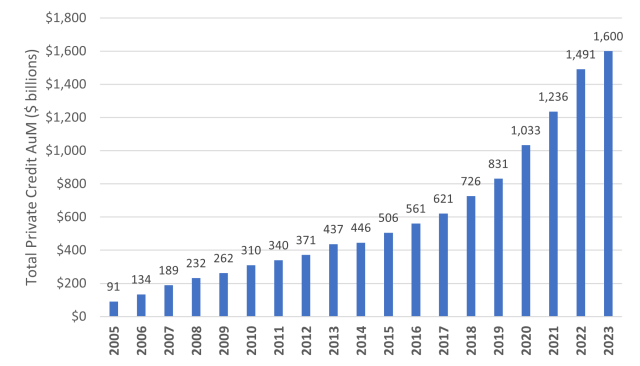
“Once a majority of players adopts a heretofore contrarian position, the minority view becomes the widely held perspective.”[i] DAVID SWENSEN, late CIO of the Yale Investments Office Over the past several years, private credit fund managers have raised enormous amounts of capital, and future inflows are only expected to increase. Figure 1 shows the total assets under management of private credit funds from 2005 to 2023. Institutional investment plans constitute the bulk of these assets, and many investment consultants continue their aggressive pushes to add more. The following article questions the merits of such recommendations. It begins by explaining the distinct nature of alternative asset class investment cycles. Next, it explains the origin and evolution of the private credit boom, which now resides squarely in the “flood” stage of the investment cycle. Finally, it explains how a deep-seated conflict of interest at the heart of the investment consulting model is causing flood waters to rise despite dismal prospects for most investors. Figure 1: Private Credit Assets Under Management (2005-2023). Sources: Financial Times, Preqin, The Wall Street Journal; CION Investments. Alternative Investment Cycles The Fall 2024 issue of the Museum of American Finance’s Financial History magazine includes my article, “A 45-Year Flood: The History of Alternative Asset Classes.” It explains the origins of several alternative asset classes such as venture capital (VC) and buyout funds. It then explains why these asset classes have attracted massive inflows of institutional capital over the past several decades. Most importantly, the article explains the distinct investment cycle through which alternative asset classes progress. The cycle roughly includes the following three phases. Formation: A legitimate void appears in capital markets. For example, in the aftermath of World War II, US companies had a wealth of opportunities to commercialize war-related technologies, but banks remained skittish because of their experiences during the Great Depression. This prompted the formation of the VC industry. Early Phase: Innovative capital providers generate exceptional returns as the number of attractive opportunities exceeds the supply of capital available to fund them. The experience of VC and buyout fund investors, such as the Yale University Endowment, in the 1980s is a perfect example.[ii] Flood Phase: In pursuit of new revenue streams, opportunists launch a barrage of new funds, and then a herd of followers invests in them. This invariably compresses future returns because the supply of capital far exceeds the number of attractive investment opportunities. In 2024, all major alternative asset classes — including private equity, VC, private real estate, hedge funds, and now private credit — have attributes that are consistent with the flood phase. In comparison to traditional asset classes like publicly traded US equity and fixed income, alternative asset classes have much higher fees, significant illiquidity, hidden risks, mind-bending complexity, and limited transparency. Making matters worse, most alternative asset classes have resided squarely in the flood phase for several decades. Unsurprisingly, multiple studies show that, on average, alternative asset classes detracted value from institutional investment plan performance rather than added it over the past few decades. For example, a June 2024 paper published by the Center for Retirement Research at Boston College cited four studies showing significant value detraction. The paper also presented the Center’s own research suggesting that alternatives added slightly less than no value relative to a passive 60/40 index over the past 23 years. Despite the high fees, hidden risks, and lackluster results, trustees massively increased allocations to alternatives over the past few decades. According to Equable, the average public pension plan allocated 33.8% of their portfolio to alternatives in 2023 versus only 9.3% in 2001. Private credit is just the newest alternative investment craze, but its trajectory followed the same well-trodden path. Now, just like those that came before, it is stuck in the flood phase. The Dynamics of the Private Credit Boom “Experience establishes a firm rule, and on few economic matters is understanding more important and frequently, indeed, more slight. Financial operations do not lend themselves to innovation. What is recurrently so described is, without exception, a small variation on an established design, one that owes its distinctive character to the aforementioned brevity of the financial memory. The world of finance hails the invention of the wheel over and over again, often in a slightly more unstable version.”[iii] JOHN KENNETH GALBRAITH, financial historian In the aftermath of the 2008/2009 global financial crisis (GFC), the US commercial banking system tightened lending standards and restricted loan issuance in several market segments. This enabled banks to restore their depleted reserves and strengthen their balance sheets. It also opened a temporary void in capital markets, which triggered a sharp rise in demand for private credit. Much like the formation of VC funds in the aftermath of World War II, private credit was hardly a novel innovation. It has existed in various forms for centuries. But the latest variation on this “established design” was widespread use of the limited partnership model. The key advantage of this model is that it offers fund managers protection against bank runs, which is a timeless risk for commercial banks. The cost of this protection, however, is borne almost entirely by fund investors rather than fund managers. Investors must accept much higher fees, many years of illiquidity, and an enormous lack of transparency regarding the nature and value of the underlying loans in which they are invested. Overlooking these disadvantages and enamored by returns produced in the early phase of the private credit cycle, trustees have poured hundreds of billions of dollars into this asset class over the past several years. They have all but ignored multiple red flags that invariably materialize in the flood phase. Why are institutional investors increasing their allocations to private credit? Because investment consultants are advising trustees to do so. Investment Consulting and Mean-Variance Obfuscation “You don’t want to be average; it’s not worth it, does nothing. In fact, it’s less than the [public] market. The question is ‘how do you get to first quartile?’ If you can’t, it doesn’t

Wall Street’s Latest Flood: Private Credit Read More »

Private Equity Returns Without the Lockups

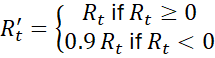
What if you could get the performance of private equity (PE) without locking up your capital for years? Private equity has long been a top-performing asset class, but its illiquidity has kept many investors on the sidelines or second-guessing their allocations. Enter PEARL (private equity accessibility reimagined with liquidity). It is a new approach that offers private equity-like returns with daily liquidity. Using liquid futures and smarter risk management, PEARL delivers institutional-grade performance without the wait. This post unpacks the technical foundation behind PEARL and offers a practical roadmap for investment professionals exploring the next frontier of private market replication. State of Play Over the past two decades, PE has evolved from a niche allocation to a cornerstone of institutional portfolios, with global assets under management exceeding $13 trillion as of June 30, 2023. Large pension funds and endowments have significantly increased their exposure, with leading university endowments allocating approximately 32% to 39% of their capital to private markets. Industry benchmarks like Cambridge Associates, Preqin, and Bloomberg PE indices are published quarterly. They have reporting lags of one to three months and are not investable. These benchmarks report annualized returns of 11% to 15% and Sharpe ratios above 1.5 for the industry. A few research-based, investable daily liquid private equity proxies investing in listed stocks have been developed. These include the factor-based replication inspired by HBS professor Erik Stafford, the Thomson Reuters (TR) sector replication benchmark, and the S&P Listed PE index. While these proxies offer real-time valuation, they markedly underperform in risk-adjusted terms, with annual returns of 10.9% to 12.5%, Sharpe ratios of 0.42 to 0.54, and deeper maximum drawdowns of 41.7% to 50.4% compared to industry benchmarks. This disparity underscores the trade-off between liquidity and performance in PE replication. PEARL aims to bridge the gap between liquid proxies and illiquid industry benchmarks. The objective is to construct a fully liquid, daily replicable strategy targeting annualized returns of ≥17%, a Sharpe ratio of ≥1.2, and a maximum drawdown of ≤20%, by leveraging scalable futures instruments, dynamic graphical models, and tailored asymmetry and overlay techniques. Core Methodological Approach Liquid Futures Instruments PEARL invests in a large universe of highly liquid futures contracts on equity indices like the S&P 500, specific sectors and international markets, foreign exchange, Vix futures, interest rates, and commodities. These instruments typically have average daily trading volumes exceeding $5 billion. This high liquidity enhances scalability and reduces transaction costs compared to traditional replication strategies focused on small-cap equities or niche sectors. Equity futures are used to replicate the long-term returns of private equity investments, while exposures to other asset classes help improve the overall risk profile of the allocation. Graphical Model Decoding We model the replication process as a dynamic Bayesian network, representing allocation weights wt(i) for each asset class i in {Equities, FX, Rates, Commodities}. The framework treats these weights as hidden state variables evolving in time according to a state-space model. The observed NAV follows: Where rt(i) is the return of asset class i at time t. We infer the sequence {w_t} via Bayesian message passing coupled with maximum likelihood estimation, incorporating a Gaussian smoothness prior (penalty λ = 0.01) to enforce continuity across daily updates. Key features of graphical-model approach: State-space formulation: captures the joint dynamics of allocations and returns, extending Kalman filter approaches by modeling cross-asset interactions. Dynamic inference: prediction–correction via message passing refines weight estimates as new data arrives. Interaction modeling: directed links between latent weight variables across time steps allow for richer dependency structures ( e.g., equity–rate spillovers). Continuous updating: allocations adapt to regime changes, leveraging full joint distributions rather than isolated regressions. This graphical-model approach yields stable, interpretable allocations and improves replication accuracy relative to piecewise linear or Kalman-filter methods. In Figure 1, we used a simplified graphical model showing the relationship between observed NAV and inferred allocation as time goes by. For illustration purpose, we used different assets, with one being an Equity shortened in Eq, a second one an exchange rate shorted in Fx, a third one, an interest rates instrument shortened in Ir, and finally a commodity asset shortened in Co. Figure 1. Asymmetric Return Scaling To emulate the valuation smoothing inherent in PE fund reporting, we apply an asymmetric transformation to daily returns. Specifically, resulting in a 10% reduction of negative returns. Empirical analysis indicates this adjustment decreases average monthly drawdown by approximately 50 basis points without materially affecting positive return capture. Tail Risk and Momentum Overlays PEARL integrates two robust overlay strategies: tail risk hedge volatility strategy and risk-off momentum allocation strategy. Both are grounded in empirical machine‐learning and CTA‐style signal filtering, to mitigate drawdowns and enhance risk‐adjusted returns: Tail Risk Hedge Volatility Strategy: A supervised machine‐learning classifier issues probabilistic activation signals to switch between front‑month (short‑term) and fourth‑month (medium‑term) VIX long futures positions. The model leverages three core indicators: 20‑Day Volatility‑Adjusted Momentum: Captures recent VIX futures momentum normalized by realized volatility. VIX Forward‑Curve Ratio: Ratio of next‑month to current‑month VIX futures, serving as a carry proxy. Absolute VIX Level: Reflects mean‑reversion tendencies during elevated volatility regimes. Backtested from January 2007 through December 2024, this overlay: Increases the equity allocation annual return from 9% to 12%. Reduces annualized volatility from 20% to 16%. Curbs maximum drawdown from 56% to 29%. Increases the portfolio Sharpe ratio by 71% and delivers a 2.5× improvement in Return/MaxDD in comparison to a long equity portfolio. Risk‑Off Momentum Allocation Built on a cross‑asset CTA replication framework, this strategy systematically targets trends inversely correlated with the S&P 500. Key metrics include: Diversification Benefit: Achieves a -36% correlation versus the S&P 500. Downside Capture: Generates positive returns in 88% of months when the S&P 500 falls more than 5%. Performance in Stressed Markets: From 2010 to 2024, delivers an average monthly return of 3.6% during equity market downturns, outperforming leading CTA benchmarks by a factor of two in months with negative equity returns. Collectively, these overlays provide a dynamic hedge that activates during risk‑off periods, smoothing equity market shocks and enhancing the overall portfolio resilience.

Private Equity Returns Without the Lockups Read More »

The Debt Ceiling: A Nation Divided and Indebted Cannot Stand

“Exigencies are to be expected to occur, in the affairs of nations, in which there will be a necessity for borrowing. That loans in times of public danger, especially from foreign war, are found an indispensable resource, even to the wealthiest of them . . . it is essential that the credit of a nation should be well established . . . Persuaded as the Secretary is, that the proper funding of the present debt, will render it a national blessing.  Yet he is so far from acceding to the position, in the latitude in which it is sometimes laid down: ‘public debts are public benefits,’ a position inviting to prodigality, and liable to dangerous abuse — that he ardently wishes to see it incorporated, as a fundamental maxim, in the system of public credit of the United States, that the creation of debt should always be accompanied with the means of extinguishment. (Emphases added)” — Alexander Hamilton, “The First Report on Public Credit“ The United States hit its $31.4 trillion debt ceiling on 19 January 2023, a limit Congress approved only two years ago. The US Treasury is now taking extraordinary emergency measures to prevent the nation from defaulting. The current battle over the debt ceiling reveals a painful reality that the nation must confront. There are two important principles at stake, both of which Alexander Hamilton references in the quote above. The first is that maintaining US creditworthiness is essential to the nation’s economic health. To voluntarily default on the federal debt would compromise the very foundation of the country’s economic success. The second is that the current path of unsustainable fiscal deficits could lead to an involuntary default in the years ahead that would be just as catastrophic. These uncomfortable truths have some critical implications: 1. Public Debt Isn’t What It Used to Be In 1790, the survival of the United States was far from certain. The country had won the Revolutionary War and ratified the Constitution, but its finances were in disarray. The states and the federal government couldn’t service their war debt or even pay their veterans. This affected the performance of the nation’s economy and the government’s ability to regulate it. But Hamilton, the first secretary of the Treasury, understood the essential role that the integrity of the nation’s credit played in ensuring economic prosperity. He coordinated the passage of several regulations that restored the nation’s creditworthiness. These programs included the consolidation of war debt under the federal government, the institution of tariffs to fund outstanding debt payments, and the creation of a central bank. Without these measures, the United States may not have had the financial wherewithal to endure the “exigencies” to which Hamilton referred. Adhering to Hamiltonian financial principles helped the United States persevere through the War of 1812, the Civil War, and World War I. When these exigencies ended, the country abided by Hamilton’s second principle and ran federal budget surpluses to extinguish the debt. But that changed after World War II. Initially, the United States paid down its debt as it had before, but by the 1960s, permanent peacetime deficits had become the norm. Over the next decade, this trend is expected to continue with the deficit averaging 5% of GDP per year, according to the Congressional Budget Office’s (CBO’s) 2022 estimate. Such a trajectory is impossible to maintain indefinitely; yet the aging population and secular declines in productivity threaten to make the problem even worse beyond 2032. US Federal Budget Deficit as a Percentage of GDP, 1791 to 2022 Sources: White House Office of Management and Budget (OMB), US Bureau of the Census Why did the United States change its philosophical approach to public credit? One reason is simply that it could. The US dollar became the world’s reserve currency after the Bretton Woods Agreement in 1945, and US Treasuries became an essential store of value for central banks and savers across the world. The massive expansion of entitlement programs also played a role. This is not a political judgment: These programs have real social benefits, but the corresponding costs exceed the nation’s ability to fund them. According to the Congressional Budget Office (CBO), Social Security and health care programs such as Medicare and Medicaid account for much of the federal budget. By 2032, they will account for well over 50%, and their costs will only grow as the population ages. 2. Don’t Make the Cure Worse Than the Disease The United States cannot amass debt faster than the US economy grows forever. But it can for quite a while longer. So, defaulting on the debt by refusing to raise the debt limit constitutes an unforced, self-inflicted wound. At the height of the 2008 global financial crisis (GFC), Congress initially voted down the Troubled Asset Relief Program (TARP), which immediately caused the panic to intensify. In a second vote, the measure passed and TARP helped restore faith in the US financial system. No one knows what would have happened if the second attempt had failed, but it would have been disastrous. The same is true for the debt ceiling. The United States has never defaulted on its public debt, so we can’t predict the consequences. But they will be severe. The possibility of a default in the more distant future is a risk that must be addressed, but a voluntarily default would be the financial equivalent of driving a car off a cliff rather than running out of gas. The Disadvantages of a Divided Nation US political divisions are at a cyclical high, but they have been worse. After all, the nation went to war with itself in 1861. Nevertheless, the threat to US financial stability demands a unified effort. The longer unsustainable debt accumulation goes on, the more severe the consequences and the more draconian the countermeasures will ultimately have to be. As unwise as a voluntary default in 2023 might be, it would be equally irresponsible to saddle future generations with debts they cannot afford or that will require dramatic

The Debt Ceiling: A Nation Divided and Indebted Cannot Stand Read More »

Commercial Real Estate Today: An Overview

Our primer on commercial real estate (CRE) investing explored the core components of real estate investing decisions. But what about CRE investing in the current environment? How has the post-pandemic world of renewed geopolitical tensions, resurgent inflation, and rising interest rate pressures reshaped how real estate capital markets operate? How has hawkish monetary policy impacted CRE over the past year? Where is the CRE sector headed, and how can investors respond? Here we explore the historical data as well as various theories and perspectives on CRE’s “new normal.” Above all, we consider what strategies may emerge for investors. The era of “free money” is over, at least for now. The COVID-19 pandemic and the subsequent fiscal and monetary stimulus efforts brought it to a close, if inadvertently, in late 2021 when US Core Consumer Price Index (CPI) growth — CPI excluding food and energy prices — exceeded 3% per annum for the first time in nearly three decades.  Lockdowns and travel restrictions drove the work-from-home (WFH) phenomenon and helped US families stockpile more than $2.6 trillion in excess liquid savings. With overstuffed consumer balance sheets and a slow return to normalcy, discretionary spending increased throughout 2021 and inflation began to rise. Unemployment plunged from its peak-COVID high of 14.7% in April 2020, which paired with global supply chain issues, among other factors, pushed Core CPI above 6.0% — levels last seen in the stagflation era of the late 1970s and early 1980s.  To control inflation, central banks mainly deploy contractionary monetary policy: They raise interest rates. With inflation soaring in 2021 and 2022, the US Federal Reserve hiked rates at the fastest pace in generations.  With interest rates much higher than last year, investors have a new perspective on cap rates for CRE, which generally are at a spread, or premium, to underlying interest or risk-free rates. Moreover, interest rates are a key driver for any leverage associated with a (direct) real estate investment. As such, these pressures will mean reduced deal flow for CRE in the near term and, likely, moderated return potential across most CRE sectors. But that does not mean there will not be excess value in pockets of CRE. The potential cresting of interest rates and the crisis in the mid-size and regional banking sector — which may get worse before it gets better — have remade the CRE opportunity landscape. The Current State of US Interest Rates and Monetary Policy The Federal Open Market Committee (FOMC) raised benchmark interest rates by an aggregate 500 basis points (bps) between March 2022 and 3 May 2023, and rates seem to have a (temporary) reprieve of further increases over the summer. The Fed confirmed as much at its June meeting, holding firm on the rate and signaling its intent to remain cautious and deliberate over the coming months but indicating that further rate hikes could be in the cards before the end of the year if inflation persists. If the most aggressive phase of monetary tightening is behind us, rates may stabilize in the near future. April’s data showed 10 straight months of declining inflation, with the annualized CPI increase falling below 5% for the first time in two years, to 4.4% in May. Core inflation is slowing, at 5.3% year-over-year in May, vs. 5.5% in April and 5.6% year-over-year in March. The surprising June CPI release solidified these trends: CPI reached 3.0% year-over-year and Core inflation 4.8%; both results were lower than the median estimates. All this suggests that Fed hawkishness may be easing. This is welcome news for real estate markets. As interest rates soared in the second half of 2022 and early 2023, cap rates expanded for the first time in years. In the first quarter of 2023 alone, US residential (apartment) and strip center retail nominal cap rates expanded 15 bps, according to Green Street data. Nominal cap rates for office, perhaps the most challenged sector at present, grew by 115 bps. Amid rising interest rates, asset values declined in most CRE sectors — by an aggregate 15% since property prices peaked around March 2022. Rising interest rates affect real estate valuations through cap rate expansion. This, in turn, influences the profitability of an investment — negatively for liquidating investors and potentially positively for acquiring investors. On a go-forward basis, however, lower asset values are not necessarily bad news for real estate operators. With cap rates higher than they were a year ago, there is once again room for “cap rate compression.” That is, expanding cap rates reflect an adjustment in the pricing of risk in real estate markets: Investors now have more opportunities to acquire assets at appealing rates and engineer compelling total returns by exiting at a calmer, more favorable moment in the market at compressed cap rates. Monetary tightening has also created uncertainty in capital markets, which has compromised transaction volume. Buyers and sellers do not know where the bottom of the market is or what the terminal interest rate is and so cannot come together on a price. This is especially true among real estate operators. If rates stabilize, transaction volumes should increase. Institutional investors are waiting on the sidelines with ample capital to deploy. At the institutional level, private equity real estate (PERE) funds held a record $400 billion in “dry powder” as of Q3 2022. In a higher interest rate environment, distressed opportunities should develop. Operators who transacted in the lower-rate regime now face steeper costs of capital due to floating-rate debt, maturing loans that they cannot refinance at anticipated levels given shifts in cap rates/valuation, or untenable interest rate derivative costs. Even with quality assets in quality markets, these operators may have to sell or default on loans. Turmoil in Mid-Sized Banking Several high-profile regional and mid-sized banks have failed in 2023. Silicon Valley Bank (SVB) and Signature Bank both collapsed within days of one another and, respectively, constituted the second and third largest bank failures in US history. A distressed Credit Suisse was acquired by UBS in close cooperation with Swiss

Commercial Real Estate Today: An Overview Read More »

The Fed’s “Time of Testing”: Is This Where the Trouble Will Stop?

“This is a time of testing — a testing not only of our capacity collectively to reach coherent and intelligent policies, but to stick with them.” — Paul Volcker, 9 October 1979 Paul Volcker and his colleagues on the Federal Open Market Committee (FOMC) deserve praise for sticking to their campaign to tighten monetary policy despite the painful recession of 1981 to 1982. Their actions ended the brutal stagflation that tormented the nation in the latter stages of the Great Inflation of 1965 to 1982. Forty years later, it is easy to forget that Volcker’s programs were much harder to defend when he was, in monetary policy terms, blazing a trail through virgin forest. The United States has suffered devastating depressions and financial panics in the course of its history, but there has only been one Great Inflation. Resolving this extraordinary crisis required the US Federal Reserve to enact untested policies that all but assured a deep recession, a sharp decline in asset values, and a painful spike in unemployment. Volcker spoke to the American Bankers Association (ABA) on 9 October 1979 to win their support for these policies, knowing that his prescription would inevitably cause pain and hardship in the short term. He appealed to his audience’s sense of collective responsibility, acknowledging the extraordinary weight placed on their shoulders. After all, bankers, financiers, and investment professionals are stewards of the nation’s credit, which was repaired by Alexander Hamilton in 1790. The ability to maintain that creditworthiness has fueled the US economy, rescued it from economic crises, and protected the nation from foreign threats. The persistent inflation that Volcker was trying to eliminate had damaged the nation’s economic health. Why was inflation so tenacious in the 1970s? One of the most important reasons was a collective failure of policymakers to delay gratification. Unwilling to sacrifice his Great Society programs, scale back the conflict in Vietnam, or damage his own reelection prospects, President Lyndon Johnson insisted the Fed maintain an overly accommodative monetary policy. President Richard Nixon pursued a similarly self-interested course, and inflation took hold and became endemic. Rather than assert the Fed’s independence, Fed chairs William McChesney Martin, Jr., and Arthur F. Burns succumbed to the political pressure. By letting inflation fester for so long, they made it that much more difficult for their successors to tame. Far more economic pain was required to fix the problem than if the Fed had decisively intervened earlier. Volcker recognized the damage that the Fed’s wavering resolve had caused, but he vowed to persevere. “Some would suggest that we, as a nation, lack the discipline to cope with inflation,” he told the ABA. “I simply do not accept that view.” On 13 September 2022, the US Bureau of Labor Statistics reported that the CPI increased at an annualized rate of 8.3%, placing more pressure on the Fed to respond aggressively. When Jerome Powell says that the Fed will keep tightening until the job is done, I strongly believe that he is sincere. But it remains to be seen whether the Fed’s actions will match these words over the coming months. The first series of rate increases and quantitative tightening were relatively painless. The next phase won’t be. If the Fed follows through, the economy will contract, unemployment will rise, and markets will fall. All of this pain is necessary to ensure that the current temporary inflationary event does not morph into a replay of the Great Inflation, which would threaten our long-term prosperity. During the Panic of 1907, J. Pierpont Morgan realized that the failure of the Trust Company of America would be a fatal tipping point that could plunge the country off the economic precipice. Morgan famously stated, “This is where the trouble stops,” and proceeded to orchestrate a rescue. Even after stopping the run at the Trust Company of America, panic continued to spread on Wall Street. Morgan spent the next three weeks rallying the support of trust companies, national banks, private corporations, politicians, and other stakeholders. Together, they pooled their resources and steered the United States away from the edge of the abyss.  His timely leadership — combined with politicians’ terror at the prospect of confronting a future panic without J. Pierpont Morgan — inspired the creation of the Fed six years later. The Fed leadership now faces a similar tipping point. They will need to decide whether they have the resolve to prevent a second Great Inflation. But countering inflation is not the Fed’s responsibility alone to bear: The moment that is now upon us will require everybody to decide whether we will cling to the excessive but unsustainable spoils of the present or sacrifice now in order to build a richer legacy for future generations. I hope we choose the latter. If you liked this post, don’t forget to subscribe to the Enterprising Investor. All posts are the opinion of the author. As such, they should not be construed as investment advice, nor do the opinions expressed necessarily reflect the views of CFA Institute or the author’s employer. Image courtesy of the Edmond J. Safra Center for Ethics. This file is licensed under the Creative Commons Attribution 2.0 Generic license. Cropped. Professional Learning for CFA Institute Members CFA Institute members are empowered to self-determine and self-report professional learning (PL) credits earned, including content on Enterprising Investor. Members can record credits easily using their online PL tracker. source

The Fed’s “Time of Testing”: Is This Where the Trouble Will Stop? Read More »

Equity Risk Premium Forum: Term Structure, Mean Reversion, and CAPE Reconsidered

For more insights on the equity risk premium from Rob Arnott, Cliff Asness, Mary Ida Compton, Elroy Dimson, William N. Goetzmann, Roger G. Ibbotson, Antti Ilmanen, Martin Leibowitz, Rajnish Mehra, Thomas Philips, and Jeremy Siegel, check out Revisiting the Equity Risk Premium, from CFA Institute Research Foundation. “I see evidence of mean reversion over time horizons from 3 years up to 15 years. It’s similar to business cycles having turned from 4-year cycles into 10-year cycles. We have many questions on structural changes. The evidence is really fuzzy, and usable or actionable evidence is almost zilch because of all this horizon uncertainty.” — Antti Ilmanen Does the equity risk premium (ERP) vary depending on the term structure? Does reversion to the mean dictate that it will decrease the longer the time horizon? In the third installment of the Equity Risk Premium Forum discussion, Laurence B. Siegel and fellow participants Rob Arnott, Elroy Dimson, William N. Goetzmann, Roger G. Ibbotson, Antti Ilmanen, Martin Leibowitz, Rajnish Mehra, and Jeremy Siegel explore these questions as well as the effect of noise on the value premium, whether the CAPE works internationally, and how to test a stock–bond switching strategy, among other topics. Below is a lightly edited transcript of this portion of their conversation. Martin Leibowitz: We’ve been talking about “the” risk premium. Will Goetzmann pointed out, though, that over the course of time, the risk premium has declined, depending on whether you invest for 40 years or 400. The idea of the risk premium being a term structure is very important. Because what premium you would demand if you’re investing for 1 year will be different from when you’re investing for 5 years or, say, 100 years. We would expect that to be a declining curve. That’s very important, because investors can choose their time horizon, just as they can in bonds. Over a long time horizon, the risk that is relevant for them may be much less. Rajnish Mehra: No, Marty, that is not correct. You’re assuming mean reversion. If you have an IID [independent and identically distributed] process, then horizon shouldn’t matter. The result that Will got is precisely because there is a mean-reverting component in the dividend structure. If you have mean reversion, Marty, you are 100% correct. Risky assets will look less risky over time. But if the returns are IID draws, then the time horizon wouldn’t make a difference. Jeremy Siegel: That is true, but I’m making one correction. You have to have a degree of risk aversion over 1 for that. You need two conditions for getting a higher equity allocation for longer time periods: mean reversion and risk aversion greater than 1. Rob Arnott: Mean reversion has been a lively topic. It is weak on a short-term basis, which is one reason the CAPE is such a lousy predictor of one-year returns. But on longer horizons, it’s pretty good. Jeremy, you’ve written about this, where 30-year S&P volatility, when annualized, is distinctly lower than the volatility of 1-year returns. This comes from the fact that there is mean reversion over long horizons. For example, 10-year real returns for US stocks have a –38% serial correlation with subsequent 10-year earnings; and 10-year real earnings growth has a –57% correlation with subsequent 10-year earnings growth. That means there is mean reversion. But it acts over a long enough horizon that most people think that returns are IID. William N. Goetzmann: I just have to put in a word here. I spent the first 10 years of my early research career on the weakness of the mean reversion evidence. But then the 2013 Nobel Prize award cited Bob Shiller’s work demonstrating the predictability of stock returns. The evidence is always a bit marginal and depends on your assumptions and on where you get the data. And, as Amit Goyal and Ivo Welch have shown, sometimes it sort of falls in the statistically significant zone, and sometimes it kind of falls out of it. It depends on when you’re doing your measurement. So, it’s a bit of a chimera to say that we know for sure. I’m not entirely convinced that you would bet your wealth on this reversion process. Antti Ilmanen: When I look at the literature, I see evidence of mean reversion over time horizons from 3 years up to 15 years. It’s similar to business cycles having turned from 4-year cycles into 10-year cycles. We have many questions on structural changes. The evidence is really fuzzy, and usable or actionable evidence is almost zilch because of all this horizon uncertainty. By the way, I wanted to comment earlier on mean reversion in a different context, not about the premium but about the riskiness of stocks being related to the time horizon. There is a counterargument by Lubos Pastor and Robert F. Stambaugh that equity risk doesn’t decline with horizon. When you take into account parameter uncertainty — the fact that we don’t know how big the equity premium is — their analysis suggests that risk in equities doesn’t decline with the time horizon and, if anything, rises with it. Visualizing Returns over Time: Trumpets and Tulips Roger Ibbotson: Even if returns were IID, what you would get, of course, is a lognormal spreading out of wealth outcomes over time — times the square root of time. And the compounded return is divided by the square root of time. So, you get two entirely different shapes, depending on whether we’re talking about the compound return or just your ending wealth. Over time, ending wealth spreads out, in the shape of a tulip. The compound annual return, in contrast, is averaging out and looks more like a trumpet. The tulips and trumpets apply only if returns are IID. If there’s some other sort of return pattern, then the shapes will be different. Coping with Parameter Uncertainty J. Siegel: Antti, I want to return to what you said about Pastor and Stambaugh. Parameter uncertainty also applies to bond returns — you don’t know what the parameters are for the real rcapeisk-free

Equity Risk Premium Forum: Term Structure, Mean Reversion, and CAPE Reconsidered Read More »

Do Sentiment Metrics Matter to the Markets?

Consumer spending accounts for almost 70% of nominal US GDP. As such, consumer sentiment ought to have some correlation with market performance. Financial journalists certainly act as though it does. Whenever new sentiment or confidence numbers — consumer or otherwise — are released, pundits spring into action, speculating on what the data’s implications are for the markets and the overall economy. But how much do these measures actually matter to market performance? To answer this question, we explored the correlations between consumer and business sentiment metrics and market returns. Specifically, we examined monthly data from the University of Michigan Consumer Sentiment Index, the Conference Board’s US Consumer Confidence Index (CCI), and the Business Confidence Index (BCI) and compared their relationship to the performance of nine different MSCI stock and bond indices going back to the 1970s, focusing on US high-yield bonds, US long-term bonds, US short-term bonds, US aggregate fixed income, US growth equity, US value equity, US small cap, US large cap, and international equity.  In aggregate, we did not find any significant or sustained correlation between market returns and the three sentiment measures over the entire 50-plus year sample period. The highest correlation, between the University of Michigan Consumer Sentiment Survey and US small-cap stocks, maxed out at a weak 0.21. Correlations between Changes in Consumer Confidence Indices and Investment Returns, 1970s to 2020s Michigan ConsumerSentiment Index Consumer ConfidenceIndex (CCI) Business ConfidenceIndex (BCI) US High-Yield Bond 0.18 0.17 –0.01 US Long-Term Bond –0.01 0.04 –0.10 US Short-Term Bond –0.01 0.03 –0.11 US Fixed Income –0.01 0.08 –0.13 US Growth 0.14 0.12 0.07 US Value 0.17 0.15 0.07 US Small Cap 0.21 0.14 0.11 US Large Cap 0.15 0.15 0.06 International 0.15 0.18 0.12 Yet over time, the correlations exhibit some illuminating trends. The University of Michigan Consumer Sentiment Index’s correlation with equity returns has diminished. Indeed, since 2010, it has fallen precipitously and been statistically indistinguishable from zero. University of Michigan Consumer Sentiment Index: Historical Market Correlations 1970s 1980s 1990s 2000s 2010s 2020s US High-Yield Bond 0.24 –0.05 0.34 0.35 –0.09 0.20 US Long-Term Bond 0.24 –0.19 0.01 0.17 –0.13 –0.07 US Short-Term Bond 0.23 –0.09 –0.09 0.05 –0.16 0.14 US Fixed Income 0.22 –0.15 –0.01 0.13 –0.18 0.09 US Growth 0.09 0.29 0.12 0.24 –0.04 –0.05 US Value 0.13 0.27 0.11 0.31 –0.07 0.01 US Small Cap 0.08 0.33 0.18 0.36 0.00 0.04 International 0.08 0.31 0.10 0.28 –0.12 0.06 US Large Cap 0.11 0.25 0.13 0.28 –0.03 –0.02 International 0.08 0.31 0.10 0.28 -0.12 0.06 The CCI, however, has displayed the greatest positive correlation to equity returns since the 2000s. And since 2020, equity correlations and bond correlations have averaged a rather significant 0.30. Consumer Confidence Index (CCI): Historical Market Correlations 1970s 1980s 1990s 2000s 2010s 2020s US High-Yield Bond 0.25 0.014 0.16 0.15 0.20 0.35 US Long-Term Bond 0.09 0.01 –0.04 –0.02 –0.09 0.26 US Short-Term Bond 0.04 –0.04 –0.09 –0.09 0.10 0.34 US Fixed Income 0.16 0.03 –0.07 –0.04 0.05 0.36 US Growth 0.00 0.01 0.03 0.25 0.18 0.22 US Value 0.04 –0.01 0.04 0.30 0.19 0.27 US Small Cap 0.08 0.01 0.06 0.22 0.17 0.32 US Large Cap –0.02 0.01 0.04 0.29 0.18 0.24 International 0.03 0.01 0.10 0.28 0.22 0.41 The BCI shows a similar trend. The BCI has charted its highest positive correlations with the equity return measures, with the upswing beginning in the 2010s. The Business Confidence Index (BCI): Historical Market Correlation 1970s 1980s 1990s 2000s 2010s 2020s US High-Yield Bond –0.29 –0.15 0.03 0.13 0.19 0.22 US Long-Term Bond –0.35 –0.21 –0.11 0.05 –0.06 0.09 US Short-Term Bond –0.12 –0.17 –0.22 0.04 0.06 0.06 US Fixed Income –0.39 –0.18 –0.16 0.08 0.06 0.14 US Growth 0.14 –0.04 0.07 0.09 0.20 0.11 US Value 0.05 –0.09 0.05 0.10 0.23 0.23 US Small Cap 0.13 –0.02 0.10 0.15 0.23 0.23 US Large Cap 0.06 –0.09 0.07 0.09 0.21 0.17 International 0.11 0.01 0.15 0.16 0.17 0.28 That markets correlate more with the CCI and BCI than the University of Michigan Consumer Sentiment Index has several potential implications. Perhaps the CCI and BCI have grown in prestige over time relative to the Michigan index and now the market pays more attention to them. Or maybe their methodologies better reflect an evolving market and economy. Of course, whatever the roots of these phenomena, the larger takeaway given the relative weakness of these correlations is that financial journalists and commentators may derive more meaning from these metrics than they warrant. If you liked this post, don’t forget to subscribe to the Enterprising Investor. All posts are the opinion of the author. As such, they should not be construed as investment advice, nor do the opinions expressed necessarily reflect the views of CFA Institute or the author’s employer. Image credit: ©Getty Images / Natee Meepian Professional Learning for CFA Institute Members CFA Institute members are empowered to self-determine and self-report professional learning (PL) credits earned, including content on Enterprising Investor. Members can record credits easily using their online PL tracker. source

Do Sentiment Metrics Matter to the Markets? Read More »