Forrester

No More Coders? You Still Need DevOps.

If you’re not coming out from under a rock, you may have heard that it’s the end of the road if you’re making software today. AI is coming to take your job! We’re entering an age of robots building software! Get on board now, or your competitors will squash you like a bug! There’s a lot of hype … and do I smell tulip bulbs? Frankly, I suspect that’s why we’ve seen a downtick in inquiries and guidance sessions about DevOps. Some enterprises are hoping they can get rid of those costly/scarce software people and replace them with subject matter experts and AI. If coders are gone, why invest in a system to control the software development lifecycle? I believe enterprises choosing that path are about to make a costly mistake. But let’s just say they’re right and I’ve completely missed the train. Tomorrow’s vibe coders will still need a lot more discipline than they realize. In fact, they’ll need a DevOps platform or something very similar. You Still Need To Control Source Source code is the expression of business requirements codified. Let’s assume the AI writes everything for you perfectly, somehow guessing exactly what you want and never hallucinating or misinterpreting. At that point, will you need any source? Surprise! You’ve got source already. It’s just moved up one level of abstraction — you’ve been calling it prompts. You still need to store these as you make changes to the system, add new requirements, update old requirements, and fix the assumptions that you made that turned out not to be true. In fact, you may want to store more than before, since generating code with AI isn’t deterministic — odds are good you’ll need to revert to old working code more frequently. You need source code management, just like what you’ve got in your DevOps platform. You Still Need To Build And Integrate Shiny vibe-coded demos are great, but enterprise-class software is going to have more than one person working on it. That means collaboration and integration. Assuming all those predictions about productivity are right, it means a lot more integration. And subject matter experts won’t be experts in making their software work well with others. That means a build pipeline to automate builds, and you need to manage the change from several experts. You need the continuous integration that you’ve got in your DevOps platform. You Still Need To Test Once you have something that’s executable, you need to prove it works. AI introduces a host of exciting new wrinkles into your life. You don’t just have to make sure your chatbot works and answers correctly when prompted. You also have to make sure that it doesn’t introduce bias or start offering sweetheart deals. That requires testing, and that testing can’t all be done by hand. Once again, the name is different — the cool kids call them “evals” — but it’s really automated testing. You need continuous automated testing, just like what you’ve got in — or integrated with — your DevOps platform. You Still Need To Secure AI has opened brand-new opportunities for malicious actors. Regardless of how you build your code, you need to make sure that it’s not subject to prompt injections or jailbreaking. Beyond that, underneath everything is still just code. How can you make sure that AI hasn’t added vulnerabilities? You’ve got to scan the generated code and keep run-of-the-mill SQL injections and cross-site scripting out of your application. And you want to keep a close eye on your models — especially if data scientists are tweaking them. You need security scans and software supply chain controls, just like what gets run by your DevOps platform. You Still Need To Deploy As one vibe coder learned recently, it’s a bad idea to give your AI unfettered access to prod. You don’t want to discover when your hosting bill arrives that AI has decided the best platform for your documentation is an AWS 16xlarge high-performance compute server. You want your deployment process to be deterministic, repeatable, routine, and — most importantly — dull. Excitement is for users. When it comes to getting bits on servers, you want the same thing to happen every time, with predictable costs. You might use AI to generate infrastructure as code, but once you’ve done that, you’ll want it locked down and in budget. New features still need to trickle out gradually so you can see how users react. You’ll need the same deployment technology that you’ve already got in your DevOps platform. Tomorrow’s AI-Enhanced Developers Need Today’s Practices In short, the AI developers of tomorrow will need strong grounding in the basics of the software development and delivery lifecycle. They’ll need to think about building software the same way we do today. Every article I read about vibe coders losing all their work due to a prompt that went awry, or releasing an app that gets exploited on day one, or building a chat app that offers a car for $1, no takesies-backsies — they all reinforce my belief that AI is a compelling tool but only one tool in our toolbox. Want to learn more? We’ve built a great body of practice and powerful platforms to help Forrester clients evade many of the dangers in software development. It’s painful to watch vibe coders rediscover the need for them, one avoidable fiasco at a time. source

No More Coders? You Still Need DevOps. Read More »

What A Possible Dentsu Sale Means For CMOs

The agency marketplace will not look the same 12 months from now. CMOs’ go-to partners for strategy, creative, and media activation are evolving beyond the traditional agency construct, while the number of competitors continues to decrease. Omnicom Group’s acquisition of IPG will make it the largest global marketing company with nearly $70 billion in media billings. Publicis Groupe’s runaway new business success is increasing its market share. WPP’s announced strategic review will restructure its offerings. And now, dentsu has secured M&A partners to identify potential buyers. A possible dentsu sale of its international business will dramatically impact what the agency industry looks like in the future and whether CMOs select among the big three or four. What Makes Dentsu Attractive? There are several elements that make dentsu’s operations and assets compelling. The company’s overall market capitalization is close to that of WPP ($5 and $6 billion, respectively). While both lag Omnicom and Publicis significantly, they also far exceed that of Havas and Stagwell, which round out the global competitive set. What would a buyer of dentsu’s assets (agency services in the Americas, EU, and APAC outside Japan) be buying? Merkle. Dentsu acquired Merkle in 2016 for approximately $1.6 billion. It offers data, analytics, commerce, and technology credentials and capabilities. Its proprietary dataset leveraging physical and digital identifiers has grown globally. Its data is activated through Merkury, a platform for media, creative, and CX. Any marketing services company looking to compete with Publicis, which is equipped with Epsilon and Omnicom (powered by Acxiom and Omni), would benefit from Merkle. Media. Dentsu’s media capabilities comprise 360i, Carat, iProspect, Vizeum, and dentsu X, which boast significant capabilities in the Americas, APAC, and EU. Clients include BMW, General Motors, ING, Kraft Heinz, Netflix, Proctor & Gamble, and Sonos. Collectively, dentsu’s media manages $27 billion in global billings. Any marketing services company with ambitions to compete with Omnicom, Publicis, and WPP would benefit from the global media scale of dentsu. Technology and production. Dentsu’s technology stack assembles proprietary technologies and accelerators using partner technology. These include dentsu.Connect, its marketing operating system for apps, data, and workflow. The Merkury suite facilitates ID solutions and CX and media activation. Adobe GenStudio dentsu+ uses Adobe’s enterprise marketing and content solutions combined with dentsu’s data and analytics capabilities. And finally, Tag provides virtual, live production, content supply chain, and AI generation capabilities for content velocity. All of these would be critical assets to compete with Omnicom, Publicis, and WPP. Which Companies Would Benefit From Purchasing Dentsu? The companies competing with the big three holding companies range from marketing services to systems integrators to private equity firms. Each would benefit in different ways and from different elements of the dentsu portfolio. Ultimately, time will tell whether Tokyo will find the right strategy and suitor. But for now, here’s my take on buyers and how they benefit: Accenture Song. The global systems integrator would gain advantage from dentsu’s media capabilities. Forrester’s previous evaluations of Accenture Song’s capabilities reflect a relatively modest media capability. Perhaps this is the reason Song hired Dimitri Maex from IPG Mediabrands? While Accenture’s media capabilities would increase from dentsu’s scale, many technology assets would be duplicative. And Accenture gaining possession of a proprietary consumer dataset of digital IDs could conflict with its auditing business as much as it could bolster its CRM. Havas. Havas recently spun off from its parent company, Vivendi, to increase its valuation and shows a robust M&A appetite. “Havas is one of the most acquisitive groups in the industry; we have executed between five to 10 acquisitions every year, for the past 10 years,” says CEO Yannick Bollore. Havas would benefit from all elements of dentsu’s assets. Merkle would provide proprietary data and activation it doesn’t currently possess. Dentsu’s media assets would triple Havas’ media scale to a combined $37 billion. And dentsu.Connect marketing OS and Merkury would bolster Havas’ nascent Converged investments. Private equity. Private equity investment or acquisition is feasible, provided the PE or VC firms were facilitating a holding company sale. Otherwise, it’s more likely that PE would purchase portions of the dentsu portfolio or certain marketplace capabilities. Separating dentsu’s tech from its services devalues both. In other words, decoupling the dentsu marketing OS ecosystem from other agencies decreases the scale of the platform and capabilities of the agencies. This seems less likely. Publicis Groupe. Arthur Sadoun could go for the knockout punch; purchasing dentsu would overtake both Omnicom and WPP. The added dentsu media scale and creative firepower would benefit both Publicis Media and Leo’s growing success. Yet there would be redundancies with Merkle and Sapient; Connect and CoreAI; and Tag and Prodigious. The regulatory hurdles and antitrust concerns would be significant, and Publicis would open itself up to its own criticism of M&A distraction. While it’s impossible to predict if dentsu will sell and to whom, I’m certain that any reshuffling of dentsu capabilities — in conjunction with Omnicom acquiring IPG and WPP restructuring — will reconfigure the concentration of buying power, access to technology, and the number of CMO partners choices. Such a move will impact future CMO partnerships. What does less competition mean for rosters and relationships? A decade of agency consolidation results in fewer partners handling more and more responsibility. This shifts the relationship dynamic from working with point solution providers with a singular focus on representing your needs to broader entities managing large portfolios of technology and data products, managed services, and technology partnerships. Put simply, your agencies will no longer just be agencies. This has ramifications for the number, remit, and remuneration of your agency ecosystem. On October 21, 2025, Forrester will publish “Predictions 2026: Marketing Agencies” to further detail these changes and implications for CMOs. In the meantime, Forrester clients can set up a guidance session with me to discuss and prepare for the coming realignment of marketing services providers, capabilities, and technologies. source

What A Possible Dentsu Sale Means For CMOs Read More »

Adaptive Growth Strategy, Our AI Hackathon: My Highlights For Forrester’s B2B Summit EMEA

Scrolling through my LinkedIn feed lately, it’s clear that B2B marketers are feeling the fatigue — especially when it comes to buzzwords like “volatility,” “ever-evolving,” and “pace of change.” And I get it: It’s exhausting to be a B2B marketer these days. The pressure to grow never lets up, even as everything around us keeps shifting. (Oh, and let’s not forget that you’re expected to do it all with less budget. Don’t you just love your job?!) That’s why, at this year’s B2B Summit EMEA (October 6–8 at the O2 InterContinental in London), my keynote will dive into adaptive growth strategy. We’ll explore how to lead through change, hit aggressive targets, and guide execution teams with clarity — even when resources are tight. I’ll cover the directions you need to provide, the controls to put in place, and the actions that actually move the needle. I’ll also be busting some myths about planning and whether it’s good to have flexibility in planning — because the truth is that when plans change all the time, people cease to rely on them, so I’ll talk about what you can do instead. And yes, I’m going to mention AI (but I promise not to overdo it). One of the things I’m most excited about this year is our revamped AI Hackathon. We’ve seen companies evolve rapidly — one of last year’s winners already went from being an AI novice to building their own agent! So we’re leveling up. This year, delegates will bring their own AI tools and work with a synthetic dataset that we’ll provide. The challenge? Delivering the best analysis and recommendations to the board. For the winning team: glory, bragging rights, and possibly chocolate! Hope to see you at B2B Summit EMEA, October 6–8 at the O2 InterContinental in London. source

Adaptive Growth Strategy, Our AI Hackathon: My Highlights For Forrester’s B2B Summit EMEA Read More »

Build Trust In Marketing Measurement With A Data Strategy

Marketers’ confidence in their ability to accurately measure marketing is at an all-time high. This is good news since proving the value of marketing has never been more important. But a gap exists between those who are most confident and everyone else, driven primarily by inconsistent data quality, too many metrics to measure, and too many disconnected data sources. All three of these top challenges can be addressed with a thoughtful, coherent data strategy for measurement. A solid measurement data strategy unites five key actions: Identifying the right data. Selecting the right data means being thoughtful about which data you are collecting. Collect only the data that matches the metrics and measurement objectives you are tracking. Building reliable data access. Whether you use a data lake, customer data platform, cloud storage solution, or centralized source collecting data from APIs, it is important that you can always access the data required to support your metrics and measurement objectives. Establishing strong data standardization practices. No matter what measurement methods you are using, you will be combining data from various internal and external sources, and each will have a different taxonomy and format. In order to make the different datasets compatible with one another, standardization is required. Refreshing the data at regular intervals. Effective measurement relies on continually updated data, so make sure you have recent data flowing into your system on a predictable basis. Minimum data granularity varies between the different measurement methodologies, but it’s a good goal to have media and revenue data refreshing at least weekly. Maintaining a robust data history. Marketing mix modeling (MMM) requires at least two years of historical data to run effectively. Even if you’re running other methodologies, calculating the impact of seasonality requires multiple years of data. So start collecting this data now even if you’re not yet ready for advanced marketing measurement. Whether you are planning to run your own marketing measurement or partner with an outside provider, thinking critically about all aspects of your data (selection, collection, standardization, refresh cadence, and history) is fundamental to your success. Activating a thoughtful data strategy reinforces investment in measurement talent and tools to ignite a virtuous cycle where measurement contributes to new business goals, in turn creating new data requirements and strategy:   For deeper insights and instructions on how to improve your marketing data strategy and increase your measurement confidence, Forrester clients can read my new report, Must-Have Data For Marketing Measurement. If you’d like to discuss your measurement data strategy in depth, please schedule a guidance session with me. source

Build Trust In Marketing Measurement With A Data Strategy Read More »

Robotics In Data Centers: A Strategic Lever For Scalable And Resilient Infrastructure

As we progress through the fourth industrial revolution — an era defined by seamless integration of people, machines, and systems — there’s an increasing demand for scalable, intelligent, and resilient compute environments. At the core of these technology-driven transformations are data centers, the foundational infrastructure that allows all these advancements to happen at scale. As the need for faster, more efficient data processing and adaptive thermal management grows, data centers are evolving to meet these complex and critical demands. Automating The Routine, Empowering The Strategic To meet these growing demands, data centers are turning to the expanding — but not completely new — field of robotics and automation. Robots are being deployed to assist with a wide range of routine tasks, including security and environmental monitoring, server installation and maintenance, cable organization, hard drive replacement, and even to support liquid cooling systems by automating the insertion and removal of servers from immersion tanks. By offloading these repetitive and physically intensive tasks, data center teams can redirect their focus toward higher-value initiatives such as infrastructure planning, performance optimization, and sustainability strategy. This shift not only enhances productivity but also improves workplace safety by reducing human exposure to high-decibel noise, extreme temperatures, and cooling fluids — conditions that increasingly make data centers inhospitable for prolonged human activity. To fully capitalize on these benefits, organizations should consider investing in continuous workforce development by strengthening employees’ technical skills, enhancing behavioral competencies (e.g., collaboration, leadership, conflict resolution skills), and fostering a culture of innovation. A Gradual Shift, Not A Lights-Off Leap As with any emerging technology, the adoption of robotics in data centers comes with its own set of challenges, especially when the gold standard is five-nines availability (99.999% uptime). This level of reliability leaves little room for error, making it critical that any robotic systems integrated into operations are thoroughly tested, highly reliable, and seamlessly interoperable with existing infrastructure. Robotics integration won’t happen overnight, nor is a fully autonomous, lights-off data center the immediate goal. But incremental integration of robotics can deliver measurable gains in operational efficiency, cost reduction, and workforce productivity. More importantly, it establishes a foundation for future automation, enabling data centers to scale intelligently and meet rising energy demands and sustainability goals without compromising performance or resilience. Learn More Do you have some thoughts, or would like you in-depth insights into the role of robotics in data centers? Forrester clients can access our exclusive reports and set up guidance sessions to continue to explore current trends and solutions. source

Robotics In Data Centers: A Strategic Lever For Scalable And Resilient Infrastructure Read More »

Build A Center of Enablement (COE) to tap into the true potential of Digital Adoption Platforms (DAPs)

Enterprises continue to invest heavily in software to streamline operations, enhance employee experience, and drive customer engagement. Yet, adoption is often the missing link between technology investments and measurable business outcomes. This is where Digital Adoption Platforms (DAPs) come into play. DAPs help users navigate complex digital and AI-powered environments by offering contextual guidance, automation, and analytics. But despite their promise, many DAP initiatives stall or fail to scale due to fragmented ownership, inconsistent execution, and lack of strategic alignment. To overcome these challenges, forward-thinking organizations are establishing Centers of Enablement (COEs) dedicated to DAPs. The Problem: Siloed DAPs Deliver Fragmented Value Without a centralized strategy, different departments deploy different DAPs inconsistently creating: Redundant efforts and wasted resources. Poor user experiences due to inconsistent guidance. Limited visibility into adoption metrics across the enterprise. The Solution: Strategic Alignment Through Centralization A Center of Enablement creates a unified framework for DAP deployment and governance It aligns DAP initiatives by directly supporting business objectives such as: Improving employee productivity by reducing friction in digital workflows. Accelerating software ROI through better usage and engagement. Enhancing change management by supporting users during transitions. Centralization of While centralization has clear benefits, over-centralization can inhibit creativity and effectiveness. Tailor the COE to serve your digital adoption priorities. Avoid COEs that are resource-heavy and choose hybrid models that will centralize core functions and governance, but allow decentralized management for operational effectiveness. The Impact: From Point Solutions to Enterprise Enablement COEs unify ownership, governance, expertise and best practices transforming DAPs from tactical tools to an enterprise-wide enablement layer.  This becomes critical as AI-powered solutions proliferate: employees need consistent support to work effectively with rapidly evolving technologies. A COE for DAPs helps you: Scale. Replicate successful implementations across teams and geographies through centralized framework and knowledge management. Innovate. Balance rapid experimentation with enterprise governance, ensuring compliance while meeting emerging user needs. Measurement: Track adoption KPIs centrally, validate DAP goals periodically and continuously optimize resource allocation. Organizations that invest in a DAP COE position their organizations to scale digital transformation and realize full technology investment value.   Our research on Scale Your DAP Initiatives With A Functional Center Of Enablement, discusses the challenges in setting up COEs and outlines best practices to build a functional COE to scale DAPs for your enterprise. Visit the Forrester bio page and click “Follow” to receive notifications about our upcoming research. Forrester clients can also schedule an inquiry or guidance session to delve deeper into this topic.   source

Build A Center of Enablement (COE) to tap into the true potential of Digital Adoption Platforms (DAPs) Read More »

How Agentic AI Elevates The Enterprise Architect’s Role

Enterprise architects are entering a transformative phase. As agentic AI becomes embedded in enterprise architecture (EA) tools, it’s not just automating tasks — it’s redefining the architect’s role. In our latest report, The Future Of The Enterprise Architect’s Job, we explore how agentic AI is reshaping EA and what architects must do to stay relevant in an AI-augmented enterprise. Agentic AI Is Already Changing EA Tools Agentic AI is now a core feature of every major EA tool, as shown in our Forrester Wave™ evaluation of EA management suites. These agents automate data validation, capability mapping, and artifact creation, freeing architects to focus on strategy and transformation. Tools such as Celonis, SAP Signavio, and ServiceNow are integrating AI to support smarter decisions across business, data, application, and technology domains. AI also improves data quality in EA repositories and enhances application portfolio management capacity. For example, process intelligence software now uses AI to mine inefficiencies and recommend improvements, while agentic AI enables real-time feedback loops that continuously update EA repositories. Architects Must Embrace New Strategic Roles In an AI-driven landscape, architects must evolve. The report outlines four emerging roles: Customer-centric, employee-centric value mapper. Architects will map customer and employee experiences within value streams, building knowledge graphs that help connect architectural decisions to measurable business outcomes. Digital twin strategist. Architects will simulate architecture options using AI-powered digital twins to rehearse strategic bets and expose trade-offs. Enterprise knowledge curator. Architects will govern semantic layers and train data teams in retrieval-augmented generation (RAG) and GraphRAG to ensure that AI outputs are grounded in trusted context. Agentic governance champion. Architects manage farms of AI agents, establishing guardrails and feedback loops to ensure accountability and alignment with business goals. From Tech Custodian To Strategic Advisor The EA mandate is shifting from IT optimization to business value creation. As agentic AI reshapes the enterprise, architects are uniquely positioned to orchestrate intelligent ecosystems. They must lead with purpose, embedding AI into architectural practices while preserving human judgment and strategic foresight. Enterprise architects must: Reframe their role to govern and guide AI usage. Maintain control over AI intent and validate outputs. Follow a structured AI learning path to design feedback-aware systems. Build an end-to-end enterprise view across IT, data, and business processes. Use AI-assisted capability mapping and impact analysis to simulate change. Learn More To explore how agentic AI is transforming EA, Forrester clients can read the full report: The Future Of The Enterprise Architect’s Job. To discuss further, please submit a request or reach out to your account team. source

How Agentic AI Elevates The Enterprise Architect’s Role Read More »

Lessons From Technology & Innovation Summit APAC’s Forrester Women’s Leadership Program: Choose Your Advisors, And Nuggets Of Advice, Wisely

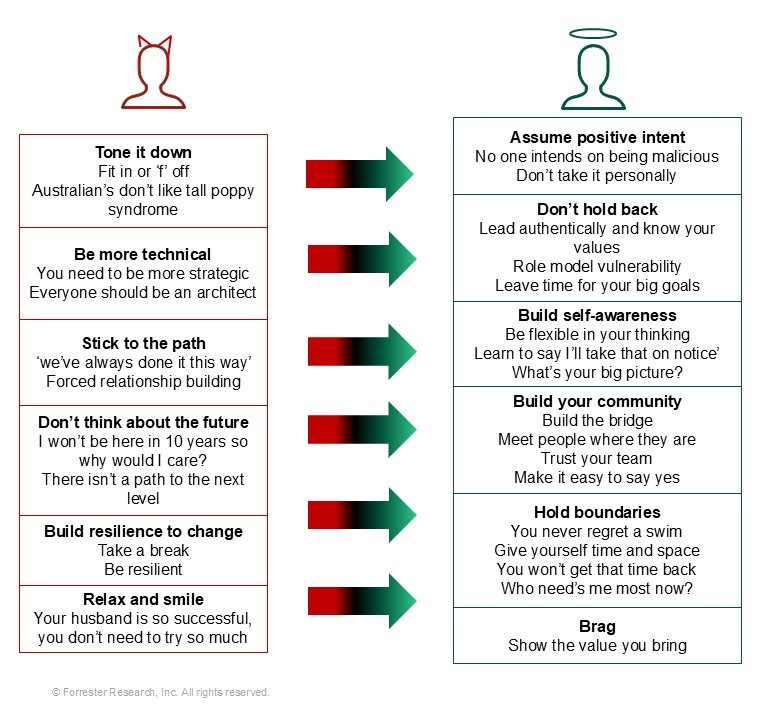
Despite the continuous gender disparity in technology and cybersecurity — just 9% of the top 100 listed companies in APAC have female CISOs, and only 36% of Australian public service STEM roles belong to women — women continue to innovate, contribute, and lead amazing careers. As has now become tradition at our Technology & Innovation Summit APAC, a room full of accomplished women and a few brave men gathered as part of our Forrester Women’s Leadership Program to celebrate successes and posit solutions for the many challenges that women face in this field. The theme? “Choose your advisors — and nuggets of advice — wisely”; a theme inspired by the hugely successful event led by our amazing colleague Amy DeMartine at our 2024 Security & Risk Summit. We asked the attendees to share some of the best and worst advice they received over their careers (see the image below). What resulted was an inspiring, interactive, and thought-provoking session. We discussed how: Determining whom to trust, and when, is an underdiscussed art, with significant impact. I moderated a discussion with senior technology and security leaders Cassandra Highfield and Sulata Bhattarcharjee, who provided unique and powerful insights into their careers. We discussed the people who influenced their careers, with unusual suspects emerging: from parents who tried to discourage constant career changes to life partners who advised them to “go in there with the confidence of a middle-aged white man.” We touched on the loneliness of senior leadership, but our leaders reminded us that it doesn’t always have to be this way if you have the courage to be vulnerable and trust the team that you’ve worked hard to build and grow. Sulata provided a piece of wisdom shared with her at a pivotal moment in her career that will stay with many of us after the session: “Just because something is hard doesn’t mean it’s toxic.” Adapting to, and leading, constant change in the workplace is a nebulous task, requiring strategy, tactics, and time. Throughout your career, you’ll encounter transitions, whether it’s a new leader, emerging technologies (AI, anyone?), or changes in organizational culture. Sometimes you initiate these shifts, and other times they’re driven by the business. These moments can be challenging; being told to “fit in,” “rise to the occasion,” or “be resilient” often oversimplifies reality and can undermine your confidence. The panel recommended distinguishing what’s within your control from broader systemic or cultural issues. We can also prepare early for major transformations, lean on our support networks, and work with a coach to build the emotional strength needed. A powerful insight shared: “Ask yourself: ‘What would it take to make this work?’ If the honest answer is ‘nothing,’ that’s a clear red flag.” By modeling your own commitment and mindset to working in ways that allow you to thrive, you give others permission to do the same. Working excessive hours doesn’t equate to being irreplaceable. Today’s women leaders were raised on yesterday’s belief that they needed to work more, a problem exacerbated by today’s hustling “do more for less” culture. A reflective and heartfelt discussion revealed that this led many to sacrifice meaningful moments with family. One resonant insight came from a participant who shared a guiding question she asks herself during overwhelming moments to help navigate competing personal and work-life demands with compassion: “Who needs me most now?” The group expressed a collective sense of difficulty in switching off from work, questioning the true value of striving to be “the best” professionally at the expense of personal well-being. The biggest mindset shift: Move from proving worth through overwork to embracing presence, balance, and intentionality. Managing stakeholders to build influence and gain advocacy is a must-have, not a nice-to-have. It starts with reading the audience and truly understanding the stakeholders you’re trying to engage with. What drives them? What do they value? And most importantly, why should they care about what you’re bringing to the table? The session highlighted the importance of demonstrating value in a way that resonates while remembering that a “no” isn’t the end; it’s often just part of the dance. Timing, persistence, and adaptability are your partners in this process, and learning the rhythm of your stakeholders can be the difference between resistance and advocacy. A standout takeaway? Forget vague advice like “be more strategic”: Relationships thrive on authenticity, not manipulation or force. To create lasting impact and influence, embrace this truth: “Focus on fostering trust, not imposing control.” I want to leave you with this: Don’t underestimate the power of taking time to share and learn from others. If this year’s edition of the program at Technology & Innovation Summit APAC reminded us of anything, it’s that the power of community, vulnerability, and sharing can lift us all. This blog, and the Forrester Women’s Leadership Program, proudly benefited from a collaboration across the Forrester ecosystem. Women from our consulting, sales, research, and research operation organizations, traversing seniority, age, cultural backgrounds, cities, and countries, collaborated in delivering this experience to our clients. I thank my co-lead, VP of APAC Consulting Alisha Coates, as well as Senior Research Associate Chiara Bragato, Senior Account Director Candice Deppeler, and Principal Analyst Zhi-Ying Barry for their time, energy, partnership, and friendship for this session and all the work we do together. source

Lessons From Technology & Innovation Summit APAC’s Forrester Women’s Leadership Program: Choose Your Advisors, And Nuggets Of Advice, Wisely Read More »

No more coders? You still need DevOps

If you’re not coming out from under a rock, you may have heard that it’s the end of the road if you’re making software today. AI is coming to take your job! We’re entering an age of robots building software! Get on board now, or your competitors will squash you like a bug! There’s a lot of hype … and do I smell tulip bulbs? Frankly, I suspect that’s why we’ve seen a downtick in inquiries and guidance sessions about DevOps. Some enterprises are hoping they can get rid of those costly/scarce software people and replace them with subject matter experts and AI. If coders are gone, why invest in a system to control the software development lifecycle? I believe enterprises choosing that path are about to make a costly mistake. But let’s just say they’re right and I’ve completely missed the train. Tomorrow’s vibe coders will still need a lot more discipline than they realize. In fact, they’ll need a DevOps platform or something very similar. You Still Need To Control Source Source code is the expression of business requirements codified. Let’s assume the AI writes everything for you perfectly, somehow guessing exactly what you want and never hallucinating or misinterpreting. At that point, will you need any source? Surprise! You’ve got source already. It’s just moved up one level of abstraction — you’ve been calling it prompts. You still need to store these as you make changes to the system, add new requirements, update old requirements, and fix the assumptions that you made that turned out not to be true. In fact, you may want to store more than before, since generating code with AI isn’t deterministic — odds are good you’ll need to revert to old working code more frequently. You need source code management, just like what you’ve got in your DevOps platform. You Still Need To Build And Integrate Shiny vibe-coded demos are great, but enterprise-class software is going to have more than one person working on it. That means collaboration and integration. Assuming all those predictions about productivity are right, it means a lot more integration. And subject matter experts won’t be experts in making their software work well with others. That means a build pipeline to automate builds, and you need to manage the change from several experts. You need the continuous integration that you’ve got in your DevOps platform. You Still Need To Test Once you have something that’s executable, you need to prove it works. AI introduces a host of exciting new wrinkles into your life. You don’t just have to make sure your chatbot works and answers correctly when prompted. You also have to make sure that it doesn’t introduce bias or start offering sweetheart deals. That requires testing, and that testing can’t all be done by hand. Once again, the name is different — the cool kids call them “evals” — but it’s really automated testing. You need continuous automated testing, just like what you’ve got in — or integrated with — your DevOps platform. You Still Need To Secure AI has opened brand-new opportunities for malicious actors. Regardless of how you build your code, you need to make sure that it’s not subject to prompt injections or jailbreaking. Beyond that, underneath everything is still just code. How can you make sure that AI hasn’t added vulnerabilities? You’ve got to scan the generated code and keep run-of-the-mill SQL injections and cross-site scripting out of your application. And you want to keep a close eye on your models — especially if data scientists are tweaking them. You need security scans and software supply chain controls, just like what gets run by your DevOps platform. You Still Need To Deploy As one vibe coder learned recently, it’s a bad idea to give your AI unfettered access to prod. You don’t want to discover when your hosting bill arrives that AI has decided the best platform for your documentation is an AWS 16xlarge high-performance compute server. You want your deployment process to be deterministic, repeatable, routine, and — most importantly — dull. Excitement is for users. When it comes to getting bits on servers, you want the same thing to happen every time, with predictable costs. You might use AI to generate infrastructure as code, but once you’ve done that, you’ll want it locked down and in budget. New features still need to trickle out gradually so you can see how users react. You’ll need the same deployment technology that you’ve already got in your DevOps platform. Tomorrow’s AI-Enhanced Developers Need Today’s Practices In short, the AI developers of tomorrow will need strong grounding in the basics of the software development and delivery lifecycle. They’ll need to think about building software the same way we do today. Every article I read about vibe coders losing all their work due to a prompt that went awry, or releasing an app that gets exploited on day one, or building a chat app that offers a car for $1, no takesies-backsies — they all reinforce my belief that AI is a compelling tool but only one tool in our toolbox. Want to learn more? We’ve built a great body of practice and powerful platforms to help Forrester clients evade many of the dangers in software development. It’s painful to watch vibe coders rediscover the need for them, one avoidable fiasco at a time. source

No more coders? You still need DevOps Read More »

How Stripe And Bridge Are Pushing Stablecoin Real-World Adoption: A Conversation With Mai Leduc

On August 20, Stripe hosted its flagship Stripe Tour event in Singapore, bringing together fintech leaders, developers, regulators, and innovators to explore the future of payments. I had the opportunity to sit down with Mai Leduc — head of product at Bridge, a Stripe company — to discuss the evolving landscape of stablecoins and their role in global commerce. Mai brings a rich background in payments and fintech, having held leadership roles at Blackhawk Network, Square, Airbnb, and GoFundMe. Her experience spans traditional financial infrastructure and disruptive technologies, giving her a unique perspective on how stablecoins can solve real-world problems — from cross-border payouts to treasury management. Her journey from skepticism to advocacy for stablecoins is rooted in firsthand experience with the limitations of legacy systems. Market Strategy Meng: You’ve worked in traditional payments companies like Square, and you mentioned being initially skeptical about stablecoins and crypto. What was the tipping point or key moment that changed your perspective and led you to embrace stablecoins? Mai: The inflection point came during my time at Airbnb. We were responsible for payments and commerce across 191 countries. I kept reading feedback from hosts in Brazil and Africa begging us to hold funds in USD — but we couldn’t. We were integrated with traditional financial infrastructure that simply didn’t support it. That same pain showed up at GoFundMe, where people raised money for urgent causes but couldn’t get it to recipients quickly. Stablecoins offered a solution — not as speculative assets but as transactional utility. What changed my mind was seeing how stablecoins could deliver humanitarian aid quickly and compliantly. When I spoke with Zach [Zach Abrams, cofounder of Bridge], he emphasized that stablecoins aren’t about crypto speculation: They’re about speed, utility, and inclusion. That’s what excited me. Bridge’s strategy is built on that utility-first mindset, not crypto hype. We’re not a crypto company — we’re a global payments platform that leverages blockchain. Meng: Stripe’s core advantage is its vast merchant network. How are you leveraging this distribution to drive stablecoin adoption, and what are the early uptake signals from traditional businesses versus crypto-native ones? Mai: Stripe gives us scale and distribution. Bridge started as developer-first, but now we can test and learn with enterprise merchants. Stripe’s financial accounts are backed by stablecoin wallets, but businesses don’t need to think about the underlying tech of stablecoins. They just want to accept payments in Vietnam or Argentina. We’re making stablecoins invisible; they’re embedded into existing flows. For example, we’re integrated into the Visa network, so merchants don’t need to change anything — they just get the benefit of faster, cheaper payments. We’re giving consumers optionality while keeping the merchant experience seamless. That’s the magic: Merchants care about cash flow, cost, and reach — not the underlying tech. The Trust Imperative Meng: Traditional card payments are built on a trust layer of chargebacks and fraud protection. How is Bridge engineering a comparable trust layer for stablecoins to give mainstream merchants the confidence to adopt them? Mai: Trust is foundational. Stripe’s brand helps, but Bridge is compliance-first. We have secured money transmission licenses in the US, are working on an Electronic Money Institution (EMI) license in Luxembourg, and publish transparency reports. We take regulation extremely seriously. Stripe recently launched a foundational model for payments, trained on billions of transactions. That gives us powerful fraud detection and compliance tools. We’re embedding that into Bridge to strengthen our trust layer. Stablecoins like USDB are backed 1:1 and issued under strict regimes. We’re not just building tech — we’re engineering trust. Key Adoption Scenarios Meng: Stripe offers on/off-ramps, global payouts, and business accounts. Which use case is gaining the most traction? Mai: Right now, corporate treasury is huge. Multinationals like SpaceX want to repatriate funds from regions with volatile currencies. We call it the stablecoin sandwich — using stablecoins as a settlement layer. It’s fast, cost-effective, and avoids holding currencies like Nigerian naira or Argentine peso. Payroll and cross-border payments are also strong, especially post-COVID. Freelancers need to get paid fast. In Latin America (LATAM) and Africa, stablecoins offer access to USD. We’re seeing fintechs in those regions use Bridge to serve their customers better. On the consumer side, Visa-powered stablecoin cards are gaining momentum. People want faster, cheaper ways to spend, and stablecoins deliver that. Roadblocks And Catalysts Meng: With recent regulatory clarity from frameworks like MiCA and the GENIUS Act of 2025, how have your conversations with clients evolved? Has regulation become the primary catalyst for adoption? Mai: Absolutely. Regulatory clarity gives institutions confidence. In APAC, Hong Kong is leading the way. Regulation isn’t a hurdle: It’s a catalyst. It protects consumers and gives us a clear framework to operate in. We work closely with regulators to help them understand the real benefits and structure of stablecoins. It’s a partnership. For example, we’re working with MAS in Singapore to align on standards. The difference between this wave of stablecoins and the previous crypto boom is that we’re building with regulators, not around them. Meng: Beyond regulation, what’s the biggest barrier to adoption? Mai: Operational complexity. Blockchain settlement varies by protocol, and reconciling that with financial plumbing is tough. For example, a PSP wants to accept crypto at the point of sale — but card swipes are sub-second, while blockchain confirmations can take minutes. That’s a poor experience. We’re solving for speed, interoperability, and treasury management. Blockchain hasn’t fully contemplated the speed of payments, and that’s where we’re innovating. We’re also working on interoperability across chains, which is critical for global adoption. Product Vision And The Future Meng: Why launch USDB alongside USDC? What makes it unique? Mai: USDB is a closed-loop token designed to let businesses earn rewards. Think of it as a global digital gift card. Unlike USDC, where the issuer earns the yield, USDB passes that value to the business. We orchestrate issuance and redemption, and we believe in a multistablecoin future. We’re not trying to compete with USDC or Tether — we’re building the orchestration layer that makes it all work. USDB is issued across multiple blockchains and regulated under US

How Stripe And Bridge Are Pushing Stablecoin Real-World Adoption: A Conversation With Mai Leduc Read More »