Forrester

Assessment is Anyone’s Guess: Proving The GOAT Requires Validation

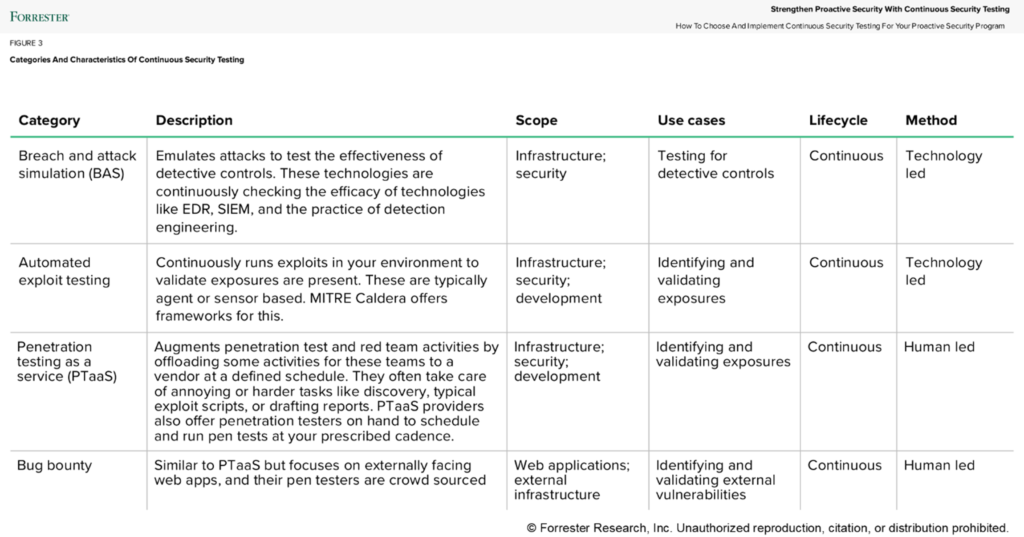
As spectators tuned in to Super Bowl LIX to indulge in American culture rife with consumerism, T. Swift, and rap feuds, the buzz was less around the game and more on determining who is pro football’s GOAT (greatest of all time). Kansas City Chiefs quarterback Patrick Mahomes had an unprecedented opportunity to win a third consecutive Super Bowl, the fourth in his young career, which raised questions from sports analysts of whether Mahomes was surpassing the legacy of another NFL GOAT, New England Patriots QB Tom Brady. It seemed like sports media had already declared Mahomes as the new GOAT, but first, Mahomes would have to win this year’s Super Bowl versus the Philadelphia Eagles to cement this status. That didn’t happen. Instead, a tough Eagles defensive front brought constant pressure that disrupted Mahomes, leading to several costly turnovers. The Chiefs could not overcome the Eagles’ preparation and the effectiveness of their defensive schemes, which validated Philadelphia’s defensive preparations. Validation showed its GOAT-head during the Super Bowl’s commercial breaks, with cybersecurity vendor Pentera’s ad about a half-goat/half-CISO that transformed from being his organization’s scapegoat to the cyber-greatest of all time. Becoming the cyber-GOAT, they say, requires continuous and proactive testing for vulnerabilities. Forrester’s proactive security research outlines visibility, prioritization, and remediation as the core principles of proactive security, with validation being a means to enhance accuracy and focus in prioritization. Vendors such as Pentera, XM Cyber, and Horizon3.ai provide validation that vulnerabilities are exploitable as a means to drive prioritization. Cyber threat exposure management is used by some vendors to describe this prioritization strategy. This is an unnecessary term in an already crowded world of cyber acronyms. Instead, organizations should focus on how to build proactive security programs with prescriptive, use-case centricity — using the three proactive principles to understand how organizations are gaining visibility, prioritizing exposures, and ultimately remediating them. Exposure management is a prioritization strategy and can be one of many prioritization strategies that organizations use. It maps exposures on an attack path and assesses the potential that an opponent could breach them — much like how Chiefs and Eagles head coaches Andy Reid and Nick Sirianni built out their Super Bowl game-day plans and playbooks. But you can only validate the effectiveness of offensive and defensive schemes in the game itself. In cybersecurity, this is how penetration testing and red teams provide singular, point-in-time validations. But now organizations are looking to do these continuously. This is where continuous security testing comes in, which we outlined in our recent report, Strengthen Proactive Security With Continuous Security Testing. Continuous security testing validates and proves that vulnerabilities are exploitable. There are many ways that continuous security testing can factor into remediation prioritization strategies today. Other options include breach and attack simulation, bug bounties, and penetration testing as a service, which all have different use cases and scopes (see image below). And while these are different options that factor into remediation prioritization, it’s likely that your organization will still utilize other prioritization methods such as CISA KEV, CVSS, and EPSS, depending on asset types and circumstances.   Should you do continuous security testing? Before jumping right in, we recommend that security and risk pros first assess how they are gaining visibility into assets and vulnerabilities — our first principle of proactive security. Next, teams should perform assessments of vulnerabilities with vulnerability scanning and combining their increasingly omnipresent sources of vulnerabilities. From there, teams can form their prioritization strategies. Consider exposure management as one of these and improve it with continuous security testing that validates that exposures are exploitable. But don’t forget remediation plans — this use case is often neglected in proactive platform companies (and why we expect to continue to see consolidation in the proactive security market, as companies such as Tenable acquire Vulcan Cyber to enhance remediation processes). Let’s talk! If you want to talk more about proactive security or continuous security, book time with me. source

Assessment is Anyone’s Guess: Proving The GOAT Requires Validation Read More »
“Learn Best Practices, Hear Ideas, And Just Get Motivated” — B2B Summit Attendees Share Why You Should Attend

One of the highlights of attending B2B Summit North America each year is getting to talk with Forrester clients and other marketing, sales, product, and customer success professionals. What I love most, though, is when I see people’s faces light up as a presenter describes a familiar challenge or a peer explains how they transformed their function to achieve game-changing results. There’s a palpable sense of energy and camaraderie. As one attendee put it, “Everyone is motivated to learn. There are many types of companies here, but we’re all trying to solve a lot of the same things and understand our buyers better.” To better understand what makes B2B Summit so special, we asked some past B2B Summit attendees what they have valued most about the event. Here are some of the recurring themes we heard. Industry-Leading Content “I have attended many marketing conferences, and Forrester’s B2B Summit is really a step above,” says attendee Jodi Lebow, vice president of the global demand center at Hexagon, an industrial technology company. “The content is at a higher level.” The content at our sessions and keynotes receives consistently high marks in the surveys we administer throughout the event. The concepts introduced, such as the importance of buying groups, inspire new ways of working. “I was fortunate to have attended last year’s event with a team of several colleagues, and we were able to real-time brainstorm how we can apply the lessons to our work,” says a vice president of marketing at an automotive goods company who has attended the event for the past several years. “The topics we heard were catalysts for us to have follow-up calls with analysts and dig deeper on several areas.” Unparalleled Networking Opportunities B2B Summit attendees tell us that they look forward to connecting with peers and gaining new perspectives. “I enjoy having the opportunities to meet with senior leaders from other companies who are facing challenges similar to mine,” says David Hamilton, CMO at SAP Concur. The event is also a place to rekindle connections made in previous years, notes Nikki Candito, vice president of integrated marketing at Anteriad: “I see some of my favorite people here every year.” Much of the networking happens at the B2B Summit Marketplace, a vendor showcase “that is second-to-none in getting me access to companies providing marketing technology solutions,” SAP Concur’s Hamilton says. He adds that he appreciates having one place to meet with vendors with which he already has long-standing relationships. Learning By Example Case studies held throughout B2B Summit provide a deep dive into how companies worked through a particular problem to realize results. Past attendees tell us that they appreciate the real-world examples and actionable steps to apply the learnings to their own processes. Attendees also find inspiration in our B2B Awards sessions, which spotlight how companies have aligned their marketing, sales, customer, and product functions or transformed a specific function to improve performance. “I learn a tremendous amount from the ROI Honors winners in seeing how other companies have implemented concepts,” says the marketing vice president at the automotive goods firm. “I find it invaluable to see their results and also learn what went well, what didn’t, and what they learned along the way. I always take this learning back to my organization.” Watch this space for our announcement of this year’s B2B ROI Honors and B2B Programs Of The Year Award winners in February. Dedicated Time With Analysts One-on-one sessions with analysts — private, 20-minute onsite sessions with our experts — continually rank among the most valued aspects of B2B Summit. But that’s just one of the ways for attendees to ask analysts questions and get tailored advice. The analyst-led roundtables and small workshops also give attendees plenty of opportunities to dig into their thorniest challenges with analysts. This year’s Summit will include a host of new analyst-facilitated roundtables and analyst-led workshops to accelerate more formalized networking and idea sharing. They will also allow attendees to begin applying Summit learnings to their challenges even before they return home. An Invigorated Sense Of Mission There’s an undeniable charge to the air throughout B2B Summit as it uniquely brings together the entire go-to-market team of marketing, sales, customer, and product leaders. Attendees leave feeling energized, aligned, and empowered to tackle their challenges and innovate, as they know they’ve acquired tools that will equip them to ignite meaningful change. “This whole event not only brought new ideas, but it really remotivated me to get out in front of things that I’ve been thinking about and gave me ideas on how other people are doing it,” says Jennifer Pesci-Kelly, senior director of institutional marketing at Cengage. “I would recommend B2B Summit to all other marketers.” Ready to gain insights, tools, and connections that elevate your game? Learn more about B2B Summit North America and register. source

“Learn Best Practices, Hear Ideas, And Just Get Motivated” — B2B Summit Attendees Share Why You Should Attend Read More »

The Artificial Intelligence Action Summit In France: Maintaining The Dialogue On Global AI Regulation

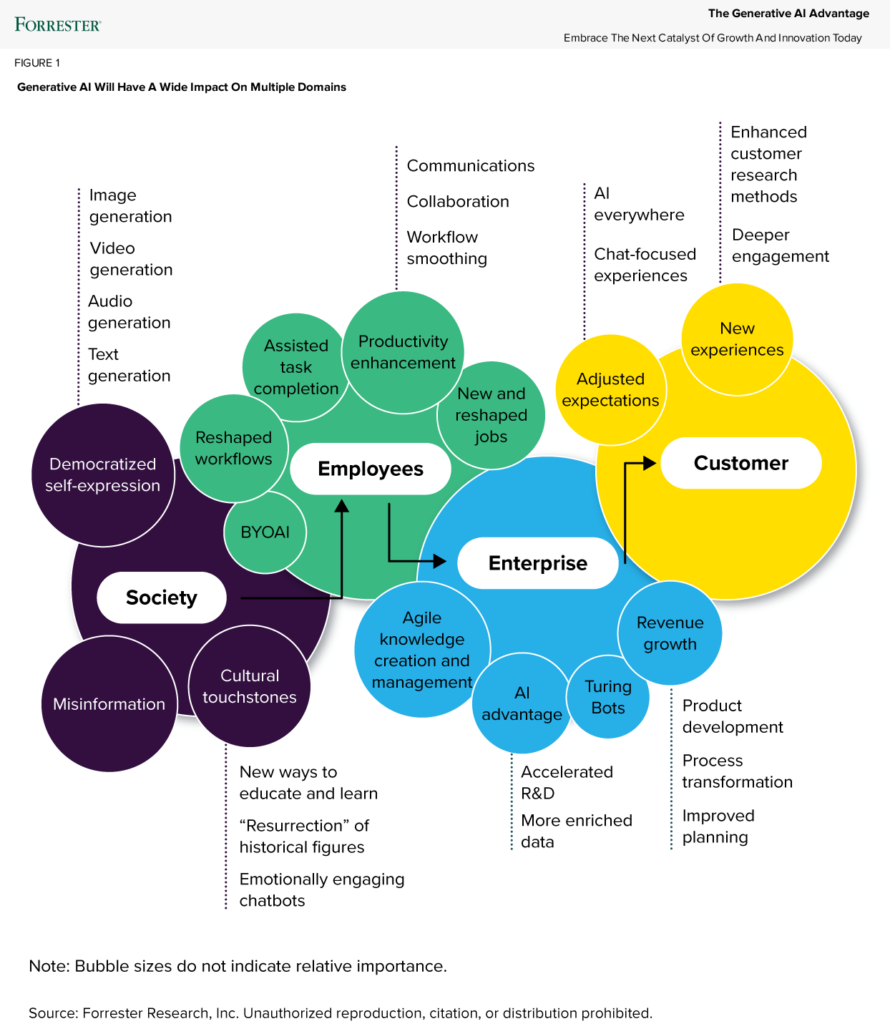
I look forward to attending the Artificial Intelligence Action Summit in Paris, France, next week. After the two previous summits hosted at Bletchley Park in the UK (November 2023) and in Seoul, South Korea (May 2024), French President Emmanuel Macron has decided to host a new AI Action Summit, cochaired with India, on February 10–11 in Paris. Who will attend, and what’s on the agenda? 60 heads of state and government, including US Vice President JD Vance, European Commission President Ursula von der Leyen, Chinese Vice Premier Ding Xuexiang, and Indian Prime Minister Narendra Modi Hundreds of scientists, experts, and academic reseachers, including four Nobel Prize winners and four Turing Award winners More than 300 AI firms and enterprises, with dedicated business meetings and events at Station F Hundreds of side events, with a very rich agenda open to civil society and NGOs, including a cultural weekend Full details of the agenda are here. Why is this event important? Forrester has already shared its perspectives on the disruptive nature of AI and generative AI:   Generative AI will reshape our lives and impact businesses. See the Forrester report, The Generative AI Advantage. AI and the environment are complexly intertwined. While AI has significant potential to help mitigate the environmental crisis, today’s AI tech — especially genAI — has a huge impact on climate change and water resources. We explain how in the Forrester report, How AI Will Accelerate The Green Market Revolution. There’s stronger emphasis on the importance of trust and ethics when leveraging AI technology. See the Forrester blog, Trusted AI Begins And Ends With Alignment. AI represents more than just an industrial and technological revolution. It has the potential to bring about a profound paradigm shift in our society and in how we relate to knowledge, work, information, culture, and even language. Some claim that AI is just mathematics and doesn’t require any regulation at all. Others consider that the European Commission is killing innovation by regulating AI too tightly. Let’s face it: AI is such a complex topic, with so many political, societal, and environmental consequences, that it deserves a more nuanced debate. That’s what the Summit will try to establish — maintaining a dialogue on global governance in an increasingly fragmented world. What should attendees expect? In my opinion, the Summit is first and foremost a diplomatic move that aims at facilitating the convergence of AI governance, generating debate on the impact of AI on society, and establishing thought leadership on AI’s latest developments. It is likely that no major announcement will be made, but what really matters is creating conditions for continuous dialogue on AI global regulation. It is also worth noting that 50 innovative AI for Good projects have been selected and will receive support, communication, and funding at the AI Action Summit; see the full list here. Last but not least, President Macron’s diplomatic move also aims to showcase France’s capabilities and assets in the global AI race to make sure that France remains one of the leading global destinations for foreign investments in artificial intelligence: Excellence in AI and mathematical research with well-known AI scientists such as Yann LeCun (2018 Turing Award winner and chief AI scientist at Meta) Several AI research hubs and decision-making centers that involve global leaders A vibrant AI ecosystem, with more than 1,000 AI startups having raised €1.9 billion in 2024, including Mistral AI and its large language model Powerful computing centers, both public (Jean Zay/GENCI) and private (Scaleway, OUTSCALE, and OVH) Decarbonized electricity source

The Artificial Intelligence Action Summit In France: Maintaining The Dialogue On Global AI Regulation Read More »

You’re Overlooking The Key To Customer Service Automation: Tacit Knowledge

Customer service leaders have long been promised that AI is the silver bullet for all their (many) challenges: streamlining workflows, enhancing customer satisfaction, and, most importantly, reducing costs via lower call volumes. This enthusiasm has only intensified with the adoption of generative AI (genAI) in the enterprise. To be clear: GenAI will transform the customer service landscape. Large language models have significantly expanded AI’s potential in customer service, and the future looks bright. But — and it’s a big but — one pretty major oversight is holding back progress: Enterprises are not capturing the tacit knowledge that employees have but AI solutions don’t. What Does This Gap Mean? For years, contact center vendors have painted the vision of training AI to be as good as your “best” agents — you just need to train AI with your call transcripts. The problem with that approach is the transcript doesn’t capture many elements (and often, those elements aren’t captured anywhere). Tacit knowledge that AI systems don’t capture includes intuitive decisions that a human employee makes or context-dependent conditional knowledge — for example, undocumented exceptions to company policies. Without this knowledge, enterprises will struggle to automate anything beyond the simplest customer service inquiries. What Can You Do? Capturing this tacit knowledge must start with brands evolving to having AI — not humans — lead and own conversations from start to finish. Humans will then transition to supporting AI behind the scenes to problem-solve exceptions within AI-led interactions. We expect a new type of agent workspace to emerge — one that is specifically designed to capture tacit knowledge and begin putting it to work through AI models. Here’s a visual example of how things would change in this scenario:   If you think that this represents a big shift in how contact centers operate today, then you’re right; it certainly does. And that’s why we think the transition to fully AI-led customer service will take years to mature and will evolve across three phases. Learn about these phases — and what enterprises should do right now to prepare for the future of AI-led customer service — in our report, Tacit Knowledge Will Power The AI-Led Contact Center. Forrester clients can also book a guidance session with me to understand what’s ahead and start mapping their next steps to developing an AI-led contact center. source

You’re Overlooking The Key To Customer Service Automation: Tacit Knowledge Read More »

Will AI Take Your B2B Marketing Job?

Ask business leaders why they are investing in AI technologies, and the answer is often emphatic and clear: It’s about efficiency. In Forrester’s 2025 B2B Brand And Communications Survey, 86% of marketing leaders said efficiency was the likeliest impact of AI technologies. Will AI Bring About A New Industrial Revolution? If we believe some of the most fervent supporters of AI, we are on the precipice of a white-collar industrial revolution. Just as manufacturing automation upended ways of working in the 1800s, these supporters also claim that AI will automate office work. In the pursuit of greater efficiency, they believe AI agents will not only take over routine, repetitive tasks and liberate us from drudgery, they will also seamlessly replace much of marketing, HR, accounting, and numerous other office roles. In this narrative, efficiency is really a euphemism: it stands in for “doing more with less,” and the “less” in this logic is people. B2B Marketers See AI As Transformative To Roles, Not Displacing Them Forrester data suggests B2B marketing leaders aren’t so glum or as hyperfocused on using AI to do more with fewer people. While 80% say AI will automate work currently done by people, just 27% think it will make jobs obsolete, and only 8% believe their jobs are at risk. In this narrative, AI will still be a revolution that presents new opportunities and drives career gains. But it’s less a “rip-and-replace” strategy for workers and more a technology transformation that will proliferate new roles and skills that are more strategic and valuable. Luddites Will Lose Wherever you are on this debate, one thing is clear: AI will change white-collar professions. Some changes will be profound, some subtle, but being a Luddite in this new industrial revolution isn’t a winning strategy. B2B business leaders must build a foundation for successful AI adoption, including assessing existing governance processes, IT alignment, and current skills. Then, they must prioritize competing AI use cases to focus on the best opportunities with the highest chance of success. Our research suggests that B2B organizations with strong CTO-CMO ties, an entrepreneurial culture, and a well-managed data infrastructure lead in AI adoption and reap the rewards faster. However, as these leading adopters proliferate AI in their companies, they tend to also experience an AI talent shortage. The bottom line is that the best way to safeguard your professional future is to embrace today’s AI revolution and not sit on the sidelines. source

Will AI Take Your B2B Marketing Job? Read More »

Why The DOJ Is Worried About Networking Innovation And What Paths Lay Ahead For HPE & Juniper

On January 30, 2025, the US Department of Justice (DOJ) moved to block the acquisition of Juniper by HPE. The DOJ is concerned about 60% of the wireless LAN (WLAN) market being occupied by two vendors (HPE and Cisco) and that it would stifle any innovation from other vendors that have single-digit market share. HPE and Juniper have started to contest this ruling with various counterpoints regarding WLAN competition, a classic “better together to fuel innovation” story, and a cautionary tale regarding network security, especially for the next generation of emerging technology. The DOJ is not wrong that sleepy, mature markets like IT networking struggle with innovation without the push from startups. Today, innovation in networking is hard to come by. It’s been a while (early 2000s) since the major networking players drove innovation in the market, such as the creation of new protocols and architectures to help networking organizations overcome technology challenges. Since the 2010s, there has been a chasm. Any innovation in this space has mainly come from two areas: 1) startups like Meraki, Mist, Nicira, and Viptela; and 2) large customers like Facebook and Google. The large cloud providers have been lighthouses for networking professionals in need of guidance on data center best practices, how to automate networks, and alternative network architectures. The enterprise Wi-Fi market hasn’t moved the needle much, either. Despite being around for 25 years, Wi-Fi solutions hardly do more than connect laptops and mobile phones in office settings and have real difficulty adapting to the new ways that users want to leverage other wireless protocols. Few attempts have been made to improve the management experience of supporting the various device types, including IoT devices. Few solutions support basic connections into Bluetooth, EnOcean, NearLink, Thread, and Zigbee technologies. To HPE Aruba’s credit, it has one of the strongest IoT-ready wireless solutions available, offering a strong smart office and retail portfolio featuring AI security insights, edge computing solutions, and IoT data processing capabilities. However, much of this capability came from the innovation under past Aruba leadership/visionaries, Dominic Orr and Keerti Melkote. And that’s just WLAN. This lack of innovation is systemic across the entire IT networking world. The biggest gap is at the edge (manufacturing plants, stadiums, stores, aircrafts, etc.), where nontraditional devices need connectivity. With over 100 billion IoT devices, the market is vast, driven by new applications, devices, security needs, and hardware requirements. Networking at the edge faces significant challenges, such as wireless interference and troubleshooting in distribution centers. The industry needs business-optimized networks (BON) with verticalized solutions. Where does that leave us? The IT networking world needs a hero: someone with the resources and the will to revolutionize the industry. Realistically, that isn’t going to come from a tiny startup. But the big players have been focused on market share, marketing, and margins. Change will require true leadership. Will the DOJ’s action to block the Juniper acquisition save innovation in networking? No. Would the acquisition unlock new innovation? Unlikely. But we’d love to be wrong (see below). Why is it hard to imagine this rosy future? Every major public technology company struggles to fund revolutionary innovation when there are shareholders to satisfy. Realistically, efficiencies gained from a combined portfolio/organization largely go to shareholders, not to fund new organic innovation. And it’s far easier to justify innovation via one-time acquisition costs rather than an ongoing stream of unrealized innovation. Ultimately, either future could hold good news for customers if they are put front and center. Let’s look ahead at the possible outcomes and what each path could entail: Scenario 1: HPE and Juniper remain separate HPE’s broader portfolio paired with its Aruba footprint has a real opportunity to be an edge networking innovator that creates verticalized easy-to-use solutions. In a time when almost every vendor is claiming to have cloud-native, AI-driven platform solutions, HPE is the only networking vendor that has the resources and portfolio today — such as compute, multilayer stack, storage, and software — to put together an edge, IoT, and networking solution to deliver a BON solution for retail and other adjacent verticals, such as hospitality. No one else is making big bets, turning their backs on generic technology providers, and choosing a few verticals to go after. This could be HPE’s moment to reclaim its innovator culture of yesteryear to truly own edge and network verticalization. Juniper’s technology and executive team are ahead of the game with its an AI-driven networking platform, Mist, that unifies the management and monitoring across various networking and security components. Mist innovation is how Juniper grew its WLAN market share so quickly over a short period of time and posed an issue for the competition, including HPE. With more investments, Juniper can continue to disrupt the management of data center and campus networking market with its Mist leadership — under Bob Friday and Sujai Hajela — and Marvis AI solution. As such, Juniper would create a businesswide networking fabric solution, which is essential for the future of networking. Looking forward, the company can expand on its networking platform by seamlessly integrating security services, with Marvis as its foundation to automate the secure networking platform. At this stage, Juniper would just be running up against Extreme’s networking platform, its version of a secure businesswide networking fabric. Cisco, Huawei, and others would be hard-pressed to match Extreme’s and Juniper’s platforms.   Scenario 2: HPE acquires Juniper A combined organization can take the superpowers from both groups to create a dominant force in IT networking; but in practice, it’s too tempting to focus on fast cash for shareholders with the greater leadership from the acquired party choosing to quickly move on as soon as their contract terms allow. To position a combined HPE/Juniper for success, Juniper leadership should take the helm of innovative progress across its portfolio to ensure products like Mist don’t get stifled as the engineers integrate into the Aruba portfolio (Axis, ClearPass, Cape Networks, Silver Peak, etc.). There will likely be some portfolio

Why The DOJ Is Worried About Networking Innovation And What Paths Lay Ahead For HPE & Juniper Read More »

The Product Model Solves For Tech Debt

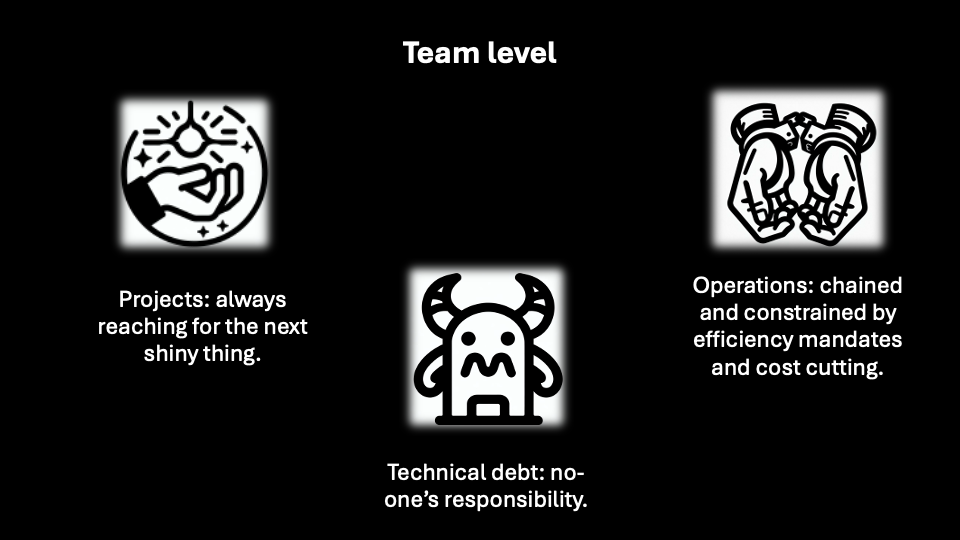
Author’s note: on rereading this, it seems like I’m calling for dev/ops integration via the product model which is hardly revolutionary. Old news, right? And yet … why is there still SO MUCH TECHNICAL DEBT?  ======================= Product management and technical debt are top of mind for many digital and IT organizations, but people are unclear on the relationship between them. Did you know that one is a solution for the other? Let me explain. How Does Tech Debt Arise? The economic cause I see over and over again: It emerges “in the cracks,” between projects funded to achieve new, innovative things and technical operations constantly pressured for efficiency. Neither side has clear accountability for the problem, and so mitigating technical debt becomes highly politicized, with much kicking the can down the road — which only makes matters worse:   The above illustration is how traditional “dev” vs. “ops” teams might perceive it. But both are essentially powerless, because funding doesn’t happen there. At the org level, it looks like this:   The leaders fight over who has to pay for technical debt in the aggregate. The development leader may be “closer to the business,” which controls the money overall, but “the business” is historically uninterested in paying down the debt. In theory, “the business” owns both sides of the problem but in reality tends to focus on new functionality and be much less interested when, for example, a required update to end-of-life (EoL) technology requires millions of dollars of migration costs — essentially to maintain the status quo. So the infrastructure group is told to take it out of constrained operational budgets. Notice also that many of the projects on the left are now handcuffed because the technical debt has started to also slow down project delivery and operations is increasingly fighting fires. In the past, leaders might advocate large-scale “IT transformations” and try to direct some of that funding to paying off technical debt, but such transformations are notorious for failing. Forrester also has heard that such transformations have difficulty making an ROI case for large-scale technical debt paydowns. Forrester does not recommend ROI as a criteria for deciding to rectify technical debt, which should be seen more as essential maintenance spend. Many of us are familiar with these dynamics in traditional plan/build/run IT organizations. Many are also pursuing product model IT transformations, but I haven’t seen much discussion of the impact of the product model on technical debt. What’s becoming clear is that product is potentially a game-changer. Marty Cagan of the Silicon Valley Product Group (one of the leading product thinkers I follow) states that “most companies with a good handle on tech debt will tell you that they work on tech debt every day, with about 10–30% of the engineering capacity.” But how? How can this level of investment be sustained when spending is so politicized and fragmented? Exactly How Does The Product Model Solve For Tech Debt? In the product model, the product team owns both new features and ongoing delivery of value. As my recent blog from the TBM Council conference pointed out, increasingly, product management is a “business within the business,” which means that it owns both development and operational concerns. If the product team is dependent on a major piece of software approaching EoL, it needs to budget for the software’s replacement (and associated migration costs) if the product wants to remain “in business.” In a simple “two in a box” model, we have, for example, a close partnership between a product lead and an engineering lead. Here’s the interesting aspect: A fixed percentage of funding is protected and dedicated to technical debt. Note that the tech debt paydown is controlled by the engineering lead. This is based on a number of conversations I’ve had: Product leads may still have a tendency to focus on the shiny and new, so the engineering lead takes point on prioritizing the tech debt paydown. Devolution of the authority means that decisions are taken closer to the information, a key agile/DevOps value. Ideally there’s a unified funnel ala Mik Kersten’s Flow Framework: all work is either features, defects, debts, or risks.   Higher in the org, note that the protected capacity for tech debt is established and sponsored at the executive level. This of course takes the product lead and CTO presenting a united front that the budget *must* work that way. Ideally, the product model means no more idea of “IT” versus “the business” but many organizations are still working through those nuances. Topic for another day.   Another supportive, product-related development is platform engineering, which reduces the occurrence of technical debt (in part) by streamlining the infrastructure portfolio and reducing variation. Yes, this comes at the cost of some developer independence, but the days when that was a dominant priority are done. There’s growing consensus that too much developer autonomy to choose “flavor of the month” tech results in fragmented and decaying tech stacks that are toxic to innovation and agility. Organizations can’t get a handle on tech debt with so-called “full-stack” teams selecting whatever tech strikes their fancy in a given week. This is why platform engineering has become a major trend, as it replaces bureaucratic architecture processes and drives infrastructure teams toward empathy with their internal customers. Summary Recommendations Integrating dev and ops at the product team level Protecting a “tech debt paydown” stream as an ongoing budgetary priority Investing in platform engineering to reduce sprawl Are you working on a product operating model, tech debt, platform engineering, or the intersections between them? If so, drop me a line. source

The Product Model Solves For Tech Debt Read More »

Europe-5 Retail E-Commerce Growth Drivers, 2025

In 2029, total retail sales of the Europe-5 economies — France, Germany, Italy, Spain, and the UK — will reach €2.7 trillion, per Forrester’s recently published Europe-5 Online Retail Forecast, 2024 To 2029. Additionally, consumers in the Europe-5 countries will spend €565 billion in 2029 on online purchases, accounting for nearly 21% of total retail sales across these five markets. The report provides a five-year forecast for total retail sales, online retail sales, and online retail penetration of 22 product categories for each of the Europe-5 economies, with historical data going back to 2002. Forrester expects that total retail sales, online retail sales, and offline retail sales in these five countries will grow in line with pre-pandemic growth rates from 2025 and thereafter. Key Drivers For Growth Improving economic conditions will drive total retail sales growth. A combination of declining inflation, declining interest rates, falling unemployment rates, rising real disposable incomes, increasing retail trade volumes, and a strong rebound in tourism has created a positive economic climate that will support retail sales growth in the Europe-5 countries over the next five years. Discretionary retail sales, which have been subdued over the past two years due to increased spending on essentials because of high inflation, will regain momentum. Price, selection, and convenience will remain key drivers for online retail sales growth. Two-thirds of e-commerce growth in the Europe-5 markets will come from an increase in online spending per buyer — and one-third will come from an increase in the online buyer population. Marketplace-driven cross-border e-commerce growth and the increasing market presence of Chinese e-commerce platforms such as AliExpress, SHEIN, and Temu in Europe will contribute to e-commerce growth. Offline retail sales will continue to grow. Offline retail sales will see a boost in growth through retailers adopting omnichannel strategies to integrate online and offline experiences. Physical stores remain important because many consumers appreciate the tactile experience, the immediacy of purchasing, and the opportunity to try products before committing to a purchase. Additionally, stores function as convenient hubs for services like click-and-collect and returns, enhancing overall customer satisfaction. Retailers such as Decathlon and Zalando are expanding their physical footprint to complement their online platforms, recognizing that physical stores can also drive increased online sales in nearby (“catchment”) areas. Please contact your Forrester account manager or client success manager to set up a guidance session with me to learn more about e-commerce and overall retail growth in Europe. source

Europe-5 Retail E-Commerce Growth Drivers, 2025 Read More »

’Tis The Season … For B2B Summit

It’s B2B Summit season again here at Forrester, and we’re having fun getting ready. Actually, the season for this year’s event in Phoenix began in September, so our research, events, editorial, graphics, and production teams spend more time on this event than not, making “season” a relative term. For me, every B2B Summit cycle provides a number of journeys that are legitimately more valuable than their destination. I love every minute of our events, but the preparatory work makes me smarter, a better analyst, and more equipped to support our customers. This year, I have four sessions in development. The first, chronologically, is well aligned with the event theme of staying ahead of “buyer mayhem,” since our research shows that 90% of B2B buyers are already using generative AI (genAI) within their purchasing motions. In our practitioner panel — “GenAI, Cobots, And Your GTM Team: Where Do Humans Still Fit In?” — I’ll be hosting Gail Behun, Kevin Clemence, and Jonathan Kvarfordt in a lively conversation. We’ll focus on three takeaways: the table-stakes elements of genAI that delegates should absolutely already be using, the leading-edge attributes that they should currently be exploring, and the human-first duties of marketing, sales, and product leaders that should not be supported by AI. This session is representative of how B2B Summit is evolving: fewer one-to-many presentations and more interactive, audience-centric sessions. Next, I’m copresenting on Wednesday morning, April 2, with Betsy Summers from Forrester’s future-of-work research team, on “Managers As Coaches: Can You Wear Both Hats Successfully?” We’ll acknowledge that every B2B leader’s job description includes the expectation to coach their team members to higher skill, better performance, and a more fulfilling career. Yet the skill sets and outcomes for management, leading, and coaching are incredibly different — and often in direct conflict with each other. That leaves many managers and leaders to learn, often informally and blindly, how to coach their team members. Spoiler alert: If you’re a “Ted Lasso” fan, don’t miss this session. A second panel I’m participating in, “No Plan Is An Island: Program Planning For Improved Campaign Impact,” brings together my colleagues Amy Bills, Kelvin Gee, and Craig Moore for a fun and interactive discussion. When marketing campaigns are developed, not all creators think through the details of reputation, demand, engagement, and enablement: These need to be intricately aligned if there’s a hope for measurable success. I’ll be addressing the revenue enablement piece, focusing on the how, who, when, and where defined by our well-known activity-based enablement model. Finally, true to the spirit of B2B Summit delegates learning from one another and not only from Forrester analysts, our B2B Programs Of The Year Awards will reveal “what great looks like” for revenue leaders, enablers, and channel owners. Nominations are in, vetting is underway, and announcements are pending. Along with our B2B Return On Integration Honors, our seven B2B Programs Of The Year Awards sessions on Wednesday, April 2, will showcase amazing results from organizations willing to do the hard work to stay ahead of “buyer mayhem.” Here’s a great example of a recent B2B sales winner. source

’Tis The Season … For B2B Summit Read More »

Microsoft Paint Is Cool Again

Yes, really! Paint is downright useful now. Like many, I’ve been using generative AI (genAI) systems for about two years. Nothing has quite triggered my imagination like Microsoft Paint’s Cocreator capability. The concept is straightforward: You can doodle using Paint, describe what you want, and genAI will create an image to your specifications. I can’t shake the feeling that this way of working is going to shape the future of collaboration in enterprises. We can see this actively unfolding, coming to more apps you use thanks to AI being included in more basic licenses. Microsoft is enabling Copilot Chat in all enterprise accounts, Google Workspace is including Gemini in its business, and enterprise plans of Zoom include Zoom AI Companion in paid licenses. Embedded cocreating AI is increasingly available, and Paint provides a preview of what interacting with these systems may look like. How Paint Cocreator workflows change modern work As with all genAI systems, showing is better than telling. Let’s walk through the workflow process with visuals on how AI-enhanced Paint with Cocreator changes today’s modern work, workforce dynamics, and productivity. Below is a very poor, very quick rendering of a butterfly using the marker tool:   The panel to the right is Cocreator and its suggestion:   Taking that suggestion, I can place it in the canvas and directly annotate. For example, let’s push the wings to be a bit bluer by painting over them with a marker:   Here, I took the generated image and doodled over it with the pen. The colors are much closer to what I want. Here’s what it looks like, a bit more realistic, turning off the stylization:   But the scene is kind of boring — butterflies deserve flowers. Let’s put it in a field of them:   Scribbling broadly over the background allows me to generate something a lot more detailed:   Further markup allows me to create the broad shape of my vision, but I’m still limited by my own inability to be effective with a trackpad. So I’m cutting Cocreator loose and telling it to run wild creatively with the creativity slider:   Here’s the end result:   I started with this:   All I used was a combination of text prompts and Paint’s marker tool to adjust. This is the new Microsoft Paint: the universal design app on every PC. The system isn’t without some major flaws — like resolution, inability to generate accurate living creatures, some truly upsetting accidental generations, and all generations suffer from the “AI bloom” issue. But Paint is fun to use again. I feel like I’m back in my elementary school computer lab, realizing that on the computer, I could draw anything I wanted. Why does this matter for businesses? In embedding genAI into established application interfaces, Microsoft has proven the AI value proposition in ways many organizations still struggle to do. It provides the ability to go from vague draft to fleshed-out concept in minutes — massively accelerating cycle time, allowing me to directly tweak specific generation components to better meet what I’m trying to accomplish directly in the GUI. And the outputs are transferable. Try it as soon as you can. Some of my favorite generations so far:       You’ll note that the model doesn’t generate text well yet. Have questions? Schedule an inquiry with me. (Access to Paint Cocreator was provided courtesy of Microsoft for testing.) source

Microsoft Paint Is Cool Again Read More »