marketing interactive

Which SG CEOs are getting the headlines, and why?

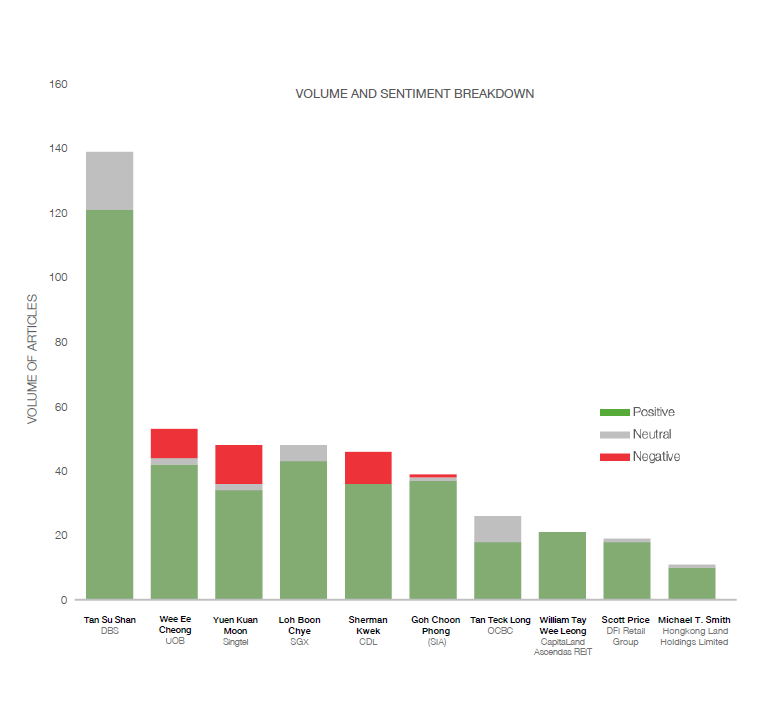
Singapore’s corporate landscape is seeing a shift in how CEOs are perceived by the media, with storytelling, purpose-driven messaging, and crisis communication emerging as key drivers of reputation. A recent analysis of CEO media coverage by media intelligence firm CARMA examined 10 Singaporean CEOs, including Tan Su Shan (DBS), Wee Ee Cheong (UOB), Yuen Kuan Moon (Singtel), Loh Boon Chye (SGX), Sherman Kwek (CDL), Goh Choon Phong (SIA), Tan Teck Long (OCBC), William Tay Wee Leong (CapitaLand Ascendas REIT), Scott Price (DFI Retail Group), and Michael T. Smith (Hongkong Land). The study monitored online coverage across 48 mainstream Singaporean outlets from October 2025 to January 2026, analysing nearly 500 articles in total. Out of all the 10 CEOs, DBS’ Tan Su Shan emerged as the most visible CEO during the monitored period, topping metrics for media visibility, favourability, and headline mentions. Tan also garnered zero negative coverage. The media framed her as a thought leader in digitalisation and AI, spotlighting DBS’ pioneering work in generative AI and her personal accolades, including recognition in Forbes’ 2025 list of the world’s most powerful women, said CARMA.  Don’t miss: Was the McDonald’s CEO’s Big Arch burger bite just a big act?  Coverage focused on her current achievements rather than her succession from Piyush Gupta, signalling that Tan had quickly established a distinct and authoritative personal brand within months of assuming the CEO role. In January 2026, banking CEOs showed distinct visibility patterns. Tan maintained her lead with 15 articles, while recently appointed OCBC CEO Tan Teck Long, who assumed the role on 1 January, was mentioned in 12 articles in his first month. Similarly, media attention on him have also been largely positive following news of OCBC’s share price outperforming expectations.  What drives coverage? Not all CEO visibility correlated with business results. UOB’s Wee Ee Cheong maintained positive coverage despite a 72% decline in net profit in Q3, with media attention highlighting his long-term leadership and community initiatives. In contrast, CDL’s Sherman Kwek faced sustained scrutiny over a high-profile governance dispute, even as CDL ranked among the top 10 performing stocks on the STI. This illustrates that financial results alone do not guarantee positive media coverage. Governance, communication, and context matter just as much, if not more. Meanwhile, operational issues also shaped CEO coverage. Singtel’s Yuen Kuan Moon faced pressure after the Optus outage disrupted emergency services, while Singapore Airlines’ Goh Choon Phong was in the spotlight over a problematic website launch. Their responses underscored the importance of effective crisis communication in maintaining stakeholder confidence.  Furthermore, CEOs who spoke on sustainability and social impact received positive media attention. Wee highlighted UOB’s community engagement and workforce development programs, Scott Price (DFI Retail Group) emphasised diversity and inclusion, and Michael T. Smith (Hongkong Land) launched pioneering environmental initiatives. As such, this suggests that purpose-driven narratives enhance visibility and reputation, helping to position companies as responsible and forward-thinking in the public eye. Language gaps point to untapped audiences Interestingly, CARMA found that coverage skewed heavily toward English-language media, with minimal mentions in Chinese, Malay, or Tamil-language outlets. Lianhe Zaobao, Berita Harian, and Tamil Saithi rarely featured CEO commentary, even on major corporate developments. Across the four-month monitoring period, only one CEO received a mention in Chinese-language media Lianhe Zaobao. The coverage featured Price quoted on the company’s plan to raise its dividend payout to 70%, which lifted its share price nearly 5%. This suggests that Singaporean CEOs and brands may be under-serving non-English-speaking stakeholders, representing a clear opportunity for inclusive communication strategies. Media coverage of CEOs doesn’t just reflect on the individual. In a previous conversation with MARKETING-INTERACTIVE industry professionals shared that coverage on CEOs can also shape perceptions of the entire company. How a leader is portrayed in the news can influence investor confidence, employee morale, and customer trust, whether coverage highlights strategic foresight, crisis management, or social impact. Even high-performing CEOs can face scrutiny if their actions or messaging miss the mark, while purposeful communication and visible leadership initiatives can boost both the executive’s and the company’s reputation. In Singapore, for instance, firms have seen firsthand how executive visibility and narrative framing affect stakeholder sentiment, underscoring that CEOs are often as much a brand asset as they are a decision-maker. Be part of #Content360 Singapore, 22–23 April 2026, where creativity and culture collide. Explore how AI-driven storytelling is shaping the future of content, gain practical insights, discover new tactics, and learn how the best in Asia are creating campaigns that truly resonate.   Related articles:   Why silence isn’t key to managing PropertyLimBrothers’ alleged scandal From boardroom to courtroom: Does comms have a say in the CDL family feud?  Outlasting the gossip: Why Astronomer doesn’t need to kiss its reputation goodbye  source

Which SG CEOs are getting the headlines, and why? Read More »

Misleading AI ad complaints on the rise, says ASAS

The Advertising Standards Authority of Singapore (ASAS) recorded a total of 379 pieces of advertisement feedback in 2025, including seven related to generative artificial intelligence (Gen AI). This is more than double the combined total received in 2023 and 2024. The feedback received by ASAS spanned multiple industries, with the five sectors most complained about in 2025 being telecommunications, restaurants, food and beverage, health, and beauty. Telecommunications received 38 pieces of feedback, followed by restaurants at 35, while food and beverage, health, and beauty rounded out the top five. In a statement, ASAS said the increase reflects the growing use of AI in advertising and highlighted the need for marketers and industry bodies to develop sector-appropriate guidance to protect consumers and stakeholders. “While the guidelines of the Singapore Code of Advertising Practice (SCAP) apply to advertisements across all media platforms and industries, AI creates new opportunities and applications for marketers in each sector,” the authority said. Don’t miss: Can an ‘AI generated’ label really build trust, or will it slow the industry down?  “Indiscriminate and vague disclosures of AI usage are not useful, and they hinder rather than aid consumer discernment. We recommend a risk-based approach that focuses labelling requirements and/or usage restrictions on applications where Gen AI usage has high potential to mislead,” it added.  The authority emphasised that AI is not inherently objectionable in advertising, but asserts that responsible use for honest, decent and legal ethical advertising is still paramount. ASAS’s guidance highlights that advertisers remain responsible for ensuring their content complies with SCAP and national legislation. “False and misleading advertisement content is unacceptable, regardless of the tools used or the disclosures added,” the authority said. In practice, ASAS will first approach advertisers for explanation and substantiation, then assess the advertisement against the SCAP, with enforcement action taken if content is found to be misleading. The regulator pointed to real examples, such as a telemedicine company that used Gen AI to create a video featuring a first-person testimonial. The advertisement gave the impression it came from a real individual, prompting complaints. The advertiser subsequently ceased the ad and conducted an internal review to prevent recurrence. ASAS has also called on industry bodies to collaborate on ethical guidance specific to their sectors, ensuring consumers are properly informed about AI usage in advertising. Stakeholders can seek ASAS’s input on proposed guidelines, while marketers can use its copy advice service to confirm compliance with SCAP. Wider oversight on AI in marketing The government has been actively monitoring AI use in advertising. Earlier in February this year, deputy prime minister Gan Kim Yong told Parliament that agencies including the Consumers Association of Singapore (CASE) and the Competition and Consumer Commission of Singapore (CCS) are collaborating with digital platforms, such as eCommerce and property listing sites, to detect and address AI-generated content that misrepresents products and services. Gan also highlighted that the Council for Estate Agencies’ (CEA) code of ethics and professional client care sets minimum standards for real estate agents. Marketing materials must accurately reflect properties, and agents are required to provide clear disclaimers when AI is used to alter or enhance images or videos. Non-compliance can result in enforcement action, and the CEA is reviewing its regulations to provide further guidance on AI use in ads. Meanwhile, in a statement to MARKETING-INTERACTIVE at the time, CCS said it “continuously monitors market practices and emerging trends, including overseas developments.” In 2025, the commission took action against Quantum Globe, which used ChatGPT to generate fake reviews on Sgcarmart.com. CCS noted that while generative AI can boost productivity and creativity, businesses remain responsible for ensuring their content does not deceive or mislead consumers. The authority has also collaborated with the Infocomm Media Development Authority to develop the AI Markets (AIM) Toolkit, enabling developers to self-assess compliance with fair trading rules. Be part of #Content360 Singapore, 22–23 April 2026, where creativity and culture collide. Explore how AI-driven storytelling is shaping the future of content, gain practical insights, discover new tactics, and learn how the best in Asia are creating campaigns that truly resonate.   Related articles:  Using AI in your content? You could be dampening brand trust Global privacy bodies unite against harmful AI imagery  SG reinforces public service media as trusted platform amid AI misinformation  source

Misleading AI ad complaints on the rise, says ASAS Read More »

Lazada runs up two Guinness World Records for 14th birthday

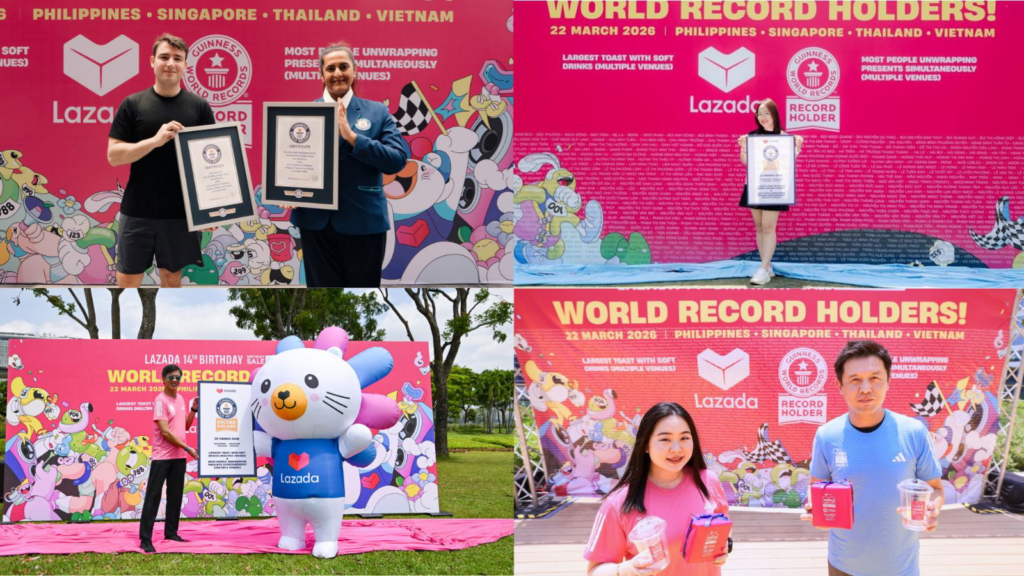
Lazada kicked off its 14th birthday celebrations with a bang, setting not one, but two Guinness World Records across Singapore, Thailand, Vietnam, and the Philippines. On 22 March, over 2,900 participants came together for the “Largest toast with soft drinks (multiple venues)” and “Most people unwrapping presents simultaneously (multiple venues)”, recording 2,728 and 2,625 participants respectively. The record-breaking attempts were part of the Lazada Run Wellness Festival, a series of community-focused events held across six markets in Southeast Asia. In Singapore, the festival at Marina Barrage brought together more than 450 runners and wellness enthusiasts, combining fitness activities, community runs, and interactive brand zones. Don’t miss: This heartbreaking cheating scandal is actually a Lazada 9.9 ad The event also featured over 140 brands across Lazada’s ecosystem, including global names such as Shiseido, Samsung, L’Occitane, Sulwhasoo, Philips, and Anessa, alongside local partners and running clubs such as Singapore Runners and Urban Milers. The celebrations seamlessly led into Lazada’s annual birthday sale, which runs from 24 March to 27 March in Singapore. Shoppers can expect up to 90% off LazFlash deals, 15% off store vouchers, and exclusive SG$20 off vouchers for minimum spends of SG$60. By combining offline experiences with online promotions, Lazada is positioning itself as more than just a transactional marketplace. The anniversary celebrations underscore the platform’s focus on fostering community connections while bringing buyers and sellers closer through shared experiences. “Lazada’s 14th birthday is not just a celebration of our journey, but of the communities that have grown with us across the region. It was remarkable to see how everyone rallied together to make this milestone such an exciting moment,” said Marcus Chew, chief marketing officer, Lazada Group. He added, “Through initiatives such as the Lazada Run Wellness Festival, we would like to continue creating more opportunities to engage our users beyond transactions, bringing together global brands, partners and communities in meaningful and memorable ways.” The Singapore edition is part of a wider regional rollout of the Lazada Run Wellness Festival, including a recent activation in Malaysia. Held at Lalaport’s rooftop garden, the Malaysia event brought together more than 1,000 participants, alongside brands, sellers and over 12 running clubs, for an evening of fitness and social activities. The festival also took on a more communal tone during Ramadan, with participants gathering for iftar, before culminating in a synchronised glow stick moment that earned recognition from the Malaysia Book of Records. The initiative reflects Lazada’s broader strategy to move beyond digital transactions and create real-world touchpoints that foster trust, positioning the platform as a connector of communities as much as a marketplace. Be part of #Content360 Singapore, 22–23 April 2026, where creativity and culture collide. Explore how AI-driven storytelling is shaping the future of content, gain practical insights, discover new tactics, and learn how the best in Asia are creating campaigns that truly resonate.  Related articles:   An iPhone 16 for 10¢? Lazada rolls prices back like it’s 1965 Lazada turns Orchard Road into a giant bingo playground in new campaign   The mysterious sponge man along Orchard Road is actually a Lazada campaign    source

Lazada runs up two Guinness World Records for 14th birthday Read More »

When zero-click becomes the norm, are PR teams still in control of the narrative?

AI-powered search is rapidly reshaping how brands are discovered online, forcing marketers and communications professionals to rethink how visibility is earned in an increasingly “zero-click” environment. Back in November, industry players told MARKETING-INTERACTIVE that AI-generated responses appearing directly on search pages were reducing the need for users to click through to websites. Agencies such as Hashmeta and W360 noted that marketers were shifting focus from driving clicks to establishing authority in AI-powered search results, optimising content for visibility, citations, and brand recognition. Today, the conversation is evolving further. As conversational AI tools such as ChatGPT, Perplexity and Google’s AI-generated summaries become more widely used, brands are now competing not just for rankings but for inclusion in the answers themselves. Don’t miss: How brands can stay relevant as ChatGPT Atlas redefines discovery This raises new questions for communications professionals: how should brands optimise their presence for AI-driven discovery, and what does success look like when users may never click through to a website? Communications professionals MARKETING-INTERACTIVE spoke to said the role of PR is expanding beyond traditional message delivery. Takeo Apitzsch, chief digital officer and deputy GM at The Hoffman Agency, with previous stints at FleishmanHillard and Edelman, said the shift means PR is increasingly about shaping the evidence that artificial intelligence systems rely on when generating responses. “PR is now about shaping the evidence AI uses,” he said, adding: Visibility with accurate representation is the new currency. Rather than treating media coverage as the end goal, Apitzsch explained that brands must now view it as raw material that feeds into AI answers across platforms such as ChatGPT, Gemini and Perplexity. These systems increasingly synthesise information from a wide ecosystem of sources, including earned media, company websites, expert commentary and even forum discussions. Oliver Budgen, founder and CEO of Bud, reinforced this point, noting that “the majority of LLMs cite earned media and editorial sources over paid or owned content. Journalism and credible reporting tend to index very highly in AI-generated answers.” He added that this strengthens the role of earned media, making PR less about traditional visibility and more about shaping trusted sources for AI systems. Shouvik Prasanna Mukherjee, EVP global creative innovation and chief creative officer APAC at Golin, echoed this view, arguing that the communications industry is moving from pursuing visibility to building authority. “When AI cites you without being prompted, you’ve transcended marketing. You’ve become knowledge itself,” he said. Mukherjee added that earned media is playing a particularly important role in this environment. According to analysis by media intelligence platform Muck Rack, more than 85% of AI citations reference earned media sources rather than brand-owned websites. This means communications strategies increasingly prioritise structured credibility and third-party validation, rather than relying solely on owned content. Measuring what matters when clicks don’t The shift towards AI-generated answers is also prompting PR teams to rethink how success is measured. Traditionally, communications effectiveness has often been tied to metrics such as referral traffic, impressions and click-through rates. However, as AI tools increasingly provide answers without requiring users to visit websites, these metrics may no longer tell the full story. Apitzsch said communications teams must now expand their measurement models to consider how brands appear within AI-generated responses. “The new question is not only ‘Did the user visit our site?’ but also ‘Did our brand appear in the answer, was it represented accurately, and was it supported by credible sources?’” he said. Mukherjee added that success is increasingly tied to how deeply a brand’s perspective is embedded in AI responses. He said:  With the majority of search queries now ending without a click, success isn’t being found. It’s being embedded in the answer itself. As a result, communications teams are beginning to track indicators such as citation frequency, AI share of voice and the quality of context in which brands are mentioned. Daryl Ho, managing director at We. Communications and former managing director at Edelman, said the industry is still in the early stages of defining these metrics. “We need new ways of looking at impact and KPIs,” he said, pointing to potential indicators such as “share of model”, answer accuracy, answer sentiment and even AI-driven leads or sales. However, Ho noted that the space remains nascent and that many platforms have yet to provide official analytics tools comparable to traditional search dashboards. The “zero-click” phenomenon requires a complete philosophical overhaul of how communications professionals measure PR success, said Brian Yeung, co-founder, Brandstorm Communications. “For years, click-through rates and website traffic were our holy grail. But as AI overviews satisfy user queries directly on the search page, the absence of a click no longer equates to a lack of engagement. It simply means the user’s need was fulfilled instantly.” Bridging minds and machines As AI-driven discovery grows, experts say communications strategies must increasingly consider how content is interpreted not just by audiences, but also by machines. Ho described this as the need for communications teams to “double code” their work so that it resonates with both humans and AI systems. “The goal should be to make as much of the comms work readable by bots but also engaging for humans,” he said, adding that this balance represents a new skill set for many communications professionals. Budgen also noted that optimising for AI discovery shouldn’t be about gaming the system. “AI systems tend to reward authority, credibility and consensus across trusted sources,” he said. He added, “Communications teams should focus on building credible digital footprints — earned media, thought leadership, research-backed insights — rather than trying to flood the system with content.” Mukherjee similarly described the future of communications as requiring a form of “bilingual fluency”. “The future belongs to those who are bilingual: fluent in data and eloquent in humanity,” he said, noting that content must combine structured, machine-readable information with compelling storytelling for human audiences. At the same time, experts caution against approaching generative engine optimisation purely as a technical exercise. Apitzsch said PR teams should focus less on trying to game algorithms

When zero-click becomes the norm, are PR teams still in control of the narrative? Read More »

HSBC Life Singapore takes a preventative turn on healthcare

HSBC Life Singapore is stepping up its push into preventative care with the launch of “Live life well”, a new wellness campaign aimed at improving access to early intervention and strengthening community health across Singapore. The programme, unveiled by HSBC Life Singapore, is built around a shift away from episodic treatment towards proactive and preventative care. It brings together insurers, healthcare providers and employers in a bid to create a more sustainable healthcare ecosystem. At its core are four pillars: healthier workplaces, inclusive insurance, improved health literacy and stronger community resilience. Don’t miss: HSBC Singapore names new head of propositions and customer life cycle management The insurer said it will embed structured workplace health programmes for corporate clients, including workforce health assessments and tailored intervention plans. It is also advancing more inclusive underwriting to broaden coverage for individuals managing chronic conditions or those typically excluded under traditional models. On the content front, HSBC Life will roll out multi-format health education, spanning newsletters, expert-led insights and short-form digital content, to encourage more informed day-to-day health decisions. Community efforts will focus on scaling initiatives that support mental, physical and financial wellbeing, alongside employee volunteering programmes. The initiative will be progressively rolled out to distributors, corporate clients and the wider public through partnerships, education efforts and community-led activations. As part of the push, HSBC Life has also signed a memorandum of understanding (MoU) with NHG Health. The partnership marks one of the first public-private collaborations of its kind focused on workplace wellness and community health. Under the agreement, HSBC Life will pilot NHG Health’s Health Manager for Companies (HM4C) model for its employee benefits clients. This will see NHG Health conduct structured workforce assessments and recommend tailored intervention programmes aligned with employee health needs. The MoU also provides a framework for potential collaboration across health literacy and preventive care programmes. ”Improving health outcomes at scale requires not just individual effort, but corporate commitment and community engagement,” said Harpreet Bindra, CEO, HSBC Life Singapore.  Bindra added that “Live life well” reflects the brand’s commitment to this shift while supporting national efforts to build a more resilient healthcare ecosystem in Singapore.  The move signals a broader play by HSBC Life to go beyond insurance provision, positioning itself as a partner in long-term health management as demand for preventative care continues to rise This is also the latest series of initiatives by HSBC Life Singapore to promote sustainable healthcare practices in Singapore. The insurer previously partnered with IHH Healthcare, Raffles Medical, Farrer Park Hospital and Thomson Medical to improve access to quality care for its customers. Furthermore, it partnered with O2 Healthcare to support earlier detection and management of sleep-related conditions.  Beyond Singapore, HSBC Life has also been ramping up efforts to support financial wellbeing in the region. In Hong Kong, the insurer recently rolled out a retirement-focused campaign aimed at helping consumers better plan for later life. The campaign builds on its five-in-one retirement plan, which centres on five pillars of protection, including passive income, flexible cash withdrawal, health and emergency coverage, legacy planning and dedicated retirement services. Running until mid-December, the effort was developed with Saatchi & Saatchi, MSL and Omnicom Media Group. According to HSBC Life, the campaign targets the “sandwich class”, alongside families and individuals looking to strengthen their retirement planning, signalling a broader regional push to support both financial and physical wellbeing across life stages. Be part of #Content360 Singapore, 22–23 April 2026, where creativity and culture collide. Explore how AI-driven storytelling is shaping the future of content, gain practical insights, discover new tactics, and learn how the best in Asia are creating campaigns that truly resonate.   Related articles:  HSBC HK spotlights local community heroes in new campaign  HSBC turns iconic passbook moments into mobile banking stories  HSBC reunites with Tony Leung to honour wealth, legacy and personal growth  source

HSBC Life Singapore takes a preventative turn on healthcare Read More »

Coach and Kate Spade conclude global media pitch

Luxury fashion house Tapestry, Inc, parent company of Coach and Kate Spade New York, has appointed Dentsu as its global agency of record outside the US, effective immediately. As part of the partnership, Dentsu will handle full media planning and buying for Tapestry’s flagship brands Coach and Kate Spade across APAC, Europe, the Middle East, Africa and India. The expanded partnership builds on a successful collaboration in China and follows two separate pitch processes that saw Dentsu replace multiple agencies around the world. Work across APAC commenced on 1 February. Don’t miss: Dentsu dials back international sale plans, to slash 8% of workforce Kylene Campos, senior vice president of brand and growth strategy APAC, described Asia is a priority growth region for Tapestry and its brands. “Throughout the pitch process, Dentsu stood out for their deep understanding of our brands, strong local market insight, and ability to translate strategic ambition into meaningful consumer connections,” Campos said. “Building on our successful collaboration in China, we are confident that Dentsu’s connected capabilities, cultural intelligence, and regional expertise will help Coach and Kate Spade deepen relevance with consumers and drive sustainable growth across APAC.” Prerna Mehrotra, chief client officer and practice president at Dentsu APAC, said the appointment reflects Dentsu’s commitment to building agile and bespoke teams tailored to the needs of clients. “We are delighted to be chosen as Tapestry’s partner and energised by their global momentum and ambitions for APAC. Tapestry has built its success by challenging conventions and making bold strategic moves. With Dentsu’s connected capabilities and deep regional expertise, we are well positioned to support Tapestry’s next phase of growth,” Mehrotra said.  She said Dentsu will help Tapestry engage audiences across the region in ways that are authentic, relevant, and resonant by uniting media craft, cultural insight, and experience design. Tapestry joins Dentsu’s luxury portfolio, including car brand BMW. Announced in July last year, the agency was appointed to steer a fresh media strategy for BMW, MINI and BMW Motorrad across Europe from 1 January 2026. The work will roll out worldwide after. Be part of #Content360 Singapore, 22–23 April 2026, where creativity and culture collide. Explore how AI-driven storytelling is shaping the future of content, gain practical insights, discover new tactics, and learn how the best in Asia are creating campaigns that truly resonate.  Related articles: Coach just turned storytelling into a fashion statement Why Coach is betting big on experiential retail in Malaysia How Coach is winning over Gen Z one experience at a time source

Coach and Kate Spade conclude global media pitch Read More »

WordPress lets AI agents write, design, and manage your site

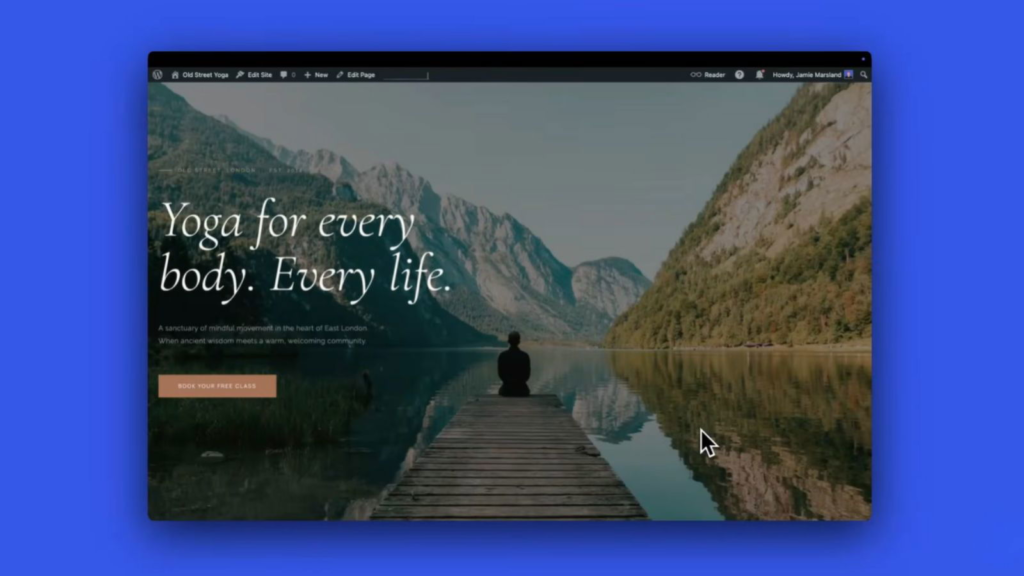
Web hosting platform WordPress.com has upgraded its AI-powered Multichannel Publishing (MCP) tools, enabling agents such as Claude, ChatGPT, Cursor, and OpenClaw to draft posts, build pages, manage comments, and organise site content directly without manual input. The update adds 19 new write functions across posts, pages, comments, categories, tags, and media. Previously, AI agents could access site data, analytics, and settings to guide users through dashboards. Now they can take action on the site itself. In a statement, WordPress said the tools are “design-aware”, matching content to a site’s theme, fonts, colours, and block patterns. Drafts are created by default, deletions are reversible, and all activity is logged for accountability. Don’t miss: OpenClaw for dummies: 101 on how marketers can leverage the ‘lobster fever’ For marketers, the expansion represents a shift from AI-assisted insights to AI-assisted execution. Content creation, publishing, and basic site management can now be partially automated, potentially freeing teams to focus on strategy, campaigns, and creative optimisation rather than routine site updates. Paid WordPress.com users can access the tools immediately via the MCP dashboard. The move reflects a wider trend in marketing technology where AI tools are increasingly expected to not just analyse or suggest, but to act on data in real time. Platforms such as Reddit have already leveraged AI for community insights, helping brands plan campaigns and engage high-intent audiences faster. With WordPress enabling AI to execute content operations, marketers may soon see a convergence of insight and action on owned channels. Meanwhile, Meta has expanded its AI-powered ad tools to give marketers more control over campaign optimisation. The update emphasises value-based optimisation, enabling advertisers to specify the conversions that matter most to their business—whether it’s boosting profit, reducing churn, or acquiring high-value subscribers. Be part of #Content360 Singapore, 22–23 April 2026, where creativity and culture collide. Explore how AI-driven storytelling is shaping the future of content, gain practical insights, discover new tactics, and learn how the best in Asia are creating campaigns that truly resonate.  Related articles: Using AI in your content? You could be dampening brand trust    Meta to acquire AI social network Moltbook    ByteDance vows to curb AI video tool after Disney copyright complaint source

WordPress lets AI agents write, design, and manage your site Read More »

Can Singapore football roar again?

The Football Association of Singapore (FAS) has launched a new brand film aimed at rallying national support for the Lions, positioning football as a unifying force across the country. Titled “Roar together, rise together”, the two-minute film centres on men’s national team head coach Gavin Lee, tracing his journey from discovering the sport as a young boy to leading the team on the touchline. Through his story, it draws a parallel with the shared experiences many Singaporeans have with football across generations and backgrounds. The film opens with Lee delivering a motivational team talk before cutting to 1994, where he is depicted as a young boy watching Singapore football legend Fandi Ahmad on screen. As the goal goes in, crowds across the island erupt in celebration. Don’t miss: Interview: Liverpool legend Robbie Fowler on brand loyalty in the world of football It then shifts to 2005, showing Lee playing football with friends and distracted in school by his growing passion for the sport, signalling the early roots of his journey. The narrative moves through the highs and lows of football, before cutting to a reflective moment where his younger self faces his present-day counterpart. The film culminates with Lee’s appointment as Lions head coach in 2025, interwoven with scenes of Singaporeans rallying behind the team. It closes with a call for the next generation to carry the Lions’ legacy forward, echoing the influence of past greats. Developed in-house by the Football Association of Singapore, the campaign moves beyond matchday action to spotlight the emotional and cultural role football plays in Singapore, framing it as a shared language that connects communities through memory, resilience and pride. The film has been rolled out across FAS’ social media platforms and YouTube channel. Its launch comes as the Lions return home after qualifying for the AFC Asian Cup on merit for the first time, marking a milestone moment for Singapore football. To build on this momentum, FAS is also activating fans around the team’s final qualifier against Bangladesh on 31 March at the National Stadium. Gates will open at 6pm, with pre-match activities including digital giveaways, airbrush tattoos, sticker stations, jersey customisation and photo installations. In-stadium programming from 7pm will feature freebie drops, a live Kallang Roar noise meter, a grand draw and a pre-match performance by local artist Shazza. Half-time entertainment will include a performance by Iman Fandi. Fans attending the match can also receive a commemorative AFC qualifying campaign card, while stocks last. Following the final whistle, the team will return to the pitch to thank supporters, with the evening concluding in a stadium-wide pyrotechnic display. According to FAS, the initiative reflects its broader push to build a more vibrant football culture in Singapore, encouraging fans to show up, wear red and “be part of the roar” as the national team continues its journey. The campaign lands amid a broader wave of brands tapping football’s emotional pull to unite fans beyond the pitch. Most recently, The Coca-Cola Company released a reimagined version of Jump for the FIFA World Cup 2026, featuring J Balvin, Amber Mark, Steve Vai and Travis Barker. Similarly, adidas unveiled “La Preparación Americana” (“The American preparation”), a short film released in November that follows football stars including Trinity Rodman, Florian Wirtz and Lionel Messi as they undergo unconventional training ahead of the tournament. Timed to the World Cup build-up, these campaigns underscore how brands are increasingly using storytelling and entertainment to tap into football fandom and shared cultural moments. Be part of #Content360 Singapore, 22–23 April 2026, where creativity and culture collide. Explore how AI-driven storytelling is shaping the future of content, gain practical insights, discover new tactics, and learn how the best in Asia are creating campaigns that truly resonate.  Related articles:  Pepsi pays tribute to football heritage with nostalgic global campaign  Nike unveils horror-themed brand identity to reshape football’s future   Carlsberg turns cab shifts into match-day magic in surprise fan stunt source

Can Singapore football roar again? Read More »

Unilever's food business picks global influencer agency

Unilever has appointed SAMY to lead global influencer strategy for its foods business group. This includes brands such as Hellmann’s and Knorr among others. The appointment comes as Unilever doubles down on a “many-to-many” brand-building approach across 13 markets. The remit will see SAMY develop and activate a social-first framework rooted in creator partnerships, as Unilever shifts further toward digital-native channels alongside continued brand marketing investment. Don’t miss: Unilever’s independent ice-cream unit picks Publicis Groupe as global media AOR At the heart of the strategy is SAMY’s proprietary Maia platform, which gives Unilever Foods access to more than 120 million influencers globally, alongside performance data to track and optimise impact. A multi-market, ‘glocal’ SAMY team will support execution across key regions including the United States, the United Kingdom, Mexico, Brazil, Indonesia, the Philippines, Germany, France, Poland, Pakistan, Argentina, Canada and Turkey. In addition, the agency will provide hyper-local cultural insight to guide where and how Unilever brands show up, while ensuring relevance in each market. Beyond activation, SAMY will also build systems and frameworks to ensure consistency in how creators and partners represent Unilever brands, as well as measurement models to track and grow audience connections across brands such as Hellmann’s and Knorr. Sonsoles Piñeiro Kruik, chief growth officer at SAMY, said the appointment marks a milestone for both companies as Unilever pilots its social-first approach within Foods. “Taking on Unilever’s ambition to deliver a strategy that can be translated across 13 markets, within an organisation operating at that scale, is a complex challenge,” she said. “With teams working across continents, we’ll bring hyper-local intelligence into a shared global system, enabling Unilever to orchestrate influencer activity at scale while ensuring creator partnerships are shaped by the realities of each local market, rather than a one-size-fits-all approach,” added Kruik. Meg Bass, global media manager at Unilever’s Foods, added that the strategy is centred on meeting consumers where they are and building “desire at scale”. “This means leaning strongly into creators who can help our stories travel further, feel more authentic and resonate more deeply,” she said. “Working with SAMY will allow us to combine technology and data with deep knowledge of the whole social ecosystem, leading to more informed decisions around where and how we activate creator partnerships across markets.” This will also give markets a clearer structure for working with creators, while still allowing them to respond to local behaviours, tastes and cultural context in a way that feels credible, she explained. Last year, Unilever appointed Publicis as its media agency of record for its newly formed independent ice-cream business. The global remit covers media planning, buying and strategy in key global markets, including China, India and Indonesia. The incumbent on the account is WPP Media’s Mindshare, which handled Unilever globally. Related articles: Unilever Indonesia elevates communications head Nurdiana Darus to board director Unilever Indonesia communications director Kristy Nelwan departs after six years Unilever to exit SariWangi as Indonesia tea business changes hands in US$89m deal source

Unilever's food business picks global influencer agency Read More »

Agency Agenda: Outgoing WPP Media SG and MY CEO Arshan Saha on navigating change and transformation

*Disclaimer: This interview was recorded two months prior to Arshan Saha’s resignation. In the face of sweeping change across the advertising industry, outgoing WPP Media Singapore and Malaysia CEO, Arshan Saha was clear-eyed about the challenges, and equally resolute about the path forward. Saha, who sat down with MARKETING-INTERACTIVE for the podcast in early February, had at that point been with WPP for over 13 years. His departure, which was announced to key stakeholders just this week saw Mark Patterson, global president, markets and business operations, WPP Media saying, “We’re grateful to Arshan for his leadership, dedication, and many contributions to our business over the last 13 years. We wish him the best in his future endeavors.” MARKETING-INTERACTIVE understands in the interim, Helen McRae will take on CEO duties for Singapore & Malaysia. Speaking on Marketing Connected’s Agency Agenda prior to his resgination, Saha reflected on a period marked by consolidation, leadership shifts and evolving client demands. But rather than viewing it as a company-specific challenge, he frames it as an industry-wide reset. “The reality of that ecosystem from 10, 20 years ago, and the industry itself, has changed significantly,” he said. “It’s not about WPP alone. It’s about the ecosystem— our clients, consumers, the way consumers are consuming content, media— it’s all changed.” Don’t miss: Agency agenda: Tony Harradine outlines Omnicom Media APAC’s post-deal planCatch the full convesation here:  That shift has driven the need for transformation across holding companies, including WPP. For Saha, the past 24 months had been among the toughest in his career, but also the most defining. “It’s been tough, not just for me, but I think for everyone,” he admitted candidly. During his time there, Saha had been focused on translating WPP Media’s transformation into tangible outcomes on the ground. He pointed to a “clear definement of strategy vision” that is already taking shape, with efforts now centred on scaling and execution. “We’re seeing that every day already, whether its through clients resonating with the output we’re delivering, or clients looking at our strategy and saying— ‘this is what we’ve been looking for’,” he said. A key part of this agenda is staying deeply rooted in local market realities, ensuring that strategies are not just globally aligned, but tailored to the nuances of Singapore and Malaysia. Central to that vision is doubling down on areas such as content, commerce and technology, particularly in markets like Malaysia where “content commerce is a definement of the culture.” Saha highlighted years of investment in creator-led capabilities, automation and workflow optimisation as starting to pay off, forming what he sees as the “future currency of a consumer mid-market.” Ultimately, for Saha, navigating transformation is not just about strategy or structure, it is about belief in the work itself. “There is going to be disruption. There is going to be chaos. But nothing comes easy.” Also tune into the conversation on any of your fave podcast platforms:  Tune into the rest of this conversation on your favourite podcast platforms, by searching up Marketing Connected. For all the visual people out there, we’ve got your back as well, with our vodcasts on YouTube. Related articles: Agency agenda: Amrita Randhawa talks acquisitions and Publicis’ AI playAgency agenda: Ogilvy ASEAN CEO Kunal Jeswani on his 3 big bets for 2026Agency agenda: Sir Martin Sorrell says ‘Data is not the enemy of creativity’ source

Agency Agenda: Outgoing WPP Media SG and MY CEO Arshan Saha on navigating change and transformation Read More »