Pew Research Center

Republican Opinion Shifts on Russia-Ukraine War

Democrats significantly more likely than Republicans to rate NATO positively and to say U.S. benefits from membership (Clockwise from top left: Robert Michael/picture alliance, macky_ch, Tim Warner and olegda88, all via Getty Images) How we did this Pew Research Center conducted this study to understand Americans’ opinions of NATO, Russia and the war between Russia and Ukraine. This analysis builds on previous Center research on Americans’ opinions of NATO, Russia and the war between Russia and Ukraine and on the most pressing foreign policy issues of the day going back decades, such as major world conflicts, trade and tariffs, U.S. military decisions and other related developments of the times. For this analysis, we surveyed 3,605 U.S. adults from March 24 to March 30, 2025. Everyone who took part in this survey is a member of the Center’s American Trends Panel (ATP), a group of people recruited through national, random sampling of residential addresses who have agreed to take surveys regularly. This kind of recruitment gives nearly all U.S. adults a chance of selection. Surveys were conducted either online or by telephone with a live interviewer. The survey is weighted to be representative of the U.S. adult population by gender, race, ethnicity, partisan affiliation, education and other categories. Read more about the ATP’s methodology. Here are the questions used for this analysis, along with responses, and its methodology. More than three years after Russia’s invasion of Ukraine, Americans remain divided along partisan lines in their views of the conflict, as well as in their attitudes toward NATO and perceptions of Russia. Republicans and Republican-leaning independents have become less likely over the past year to say Russia is an enemy of the United States – and more likely to call it a partner or competitor. Republicans have also become less likely to say the U.S. has a responsibility to help Ukraine defend itself and to express concern about Russia defeating Ukraine or invading other countries in the region. As a result of this change in opinion, the partisan gap on many of these issues has grown. For example, when asked whether Russia is an enemy, competitor or partner of the U.S., 40% of Republicans say Russia is an enemy, down from 58% last year. The share of Democrats and Democratic leaners who see Russia as an enemy is down 5 percentage points over the same period. Overall, half of Americans now call Russia an enemy, down from 61% in 2024. These are among the findings from a Pew Research Center survey conducted March 24-30, 2025, among 3,605 U.S. adults. Views of NATO Americans continue to see NATO in a mostly favorable light, and views among Republicans, Democrats and the public overall have changed little over the past year. As has long been the case, Democrats are much more likely than Republicans to have a positive opinion of the military alliance. About two-thirds of Americans (66%) say the U.S. benefits from NATO membership, though this share has decreased slightly from 71% in 2021. This drop is reflected among Republicans (down 6 points) while opinion among Democrats has held steady. Views of Russia and Putin Few in the U.S. see Russia favorably (13%) or have confidence in Russian President Vladimir Putin to do the right thing regarding world affairs (12%). Both Democrats and Republicans have generally negative views of Russia and Putin, but these attitudes are more intense among Democrats – who are more likely than Republicans to express very unfavorable views of Russia (62% vs. 41%) and say they have no confidence at all in Putin (72% vs. 43%). Over the past year, Republicans have become somewhat more likely to see Russia favorably and to express confidence in Putin, while Democratic views are largely unchanged. Views of the Russia-Ukraine war Nearly half of Americans (47%) are extremely or very concerned about Russia invading other countries, and 43% are concerned about Russia defeating and taking over Ukraine. Republicans have become less concerned about both possibilities in recent months, while Democrats have become more so. Majorities of Republicans and Democrats alike see the war between Russia and Ukraine as important to U.S. interests, though Democrats are more likely to hold this view. Most Americans say the war is important to them personally, too, including 47% of Republicans and 66% of Democrats. When it comes to Ukrainian President Volodymyr Zelenskyy, 49% have confidence in him to do the right thing regarding world affairs. Democrats are much more likely to express confidence in Zelenskyy than Republicans (70% vs. 30%). source

Republican Opinion Shifts on Russia-Ukraine War Read More »
1. U.S. views of China and Xi

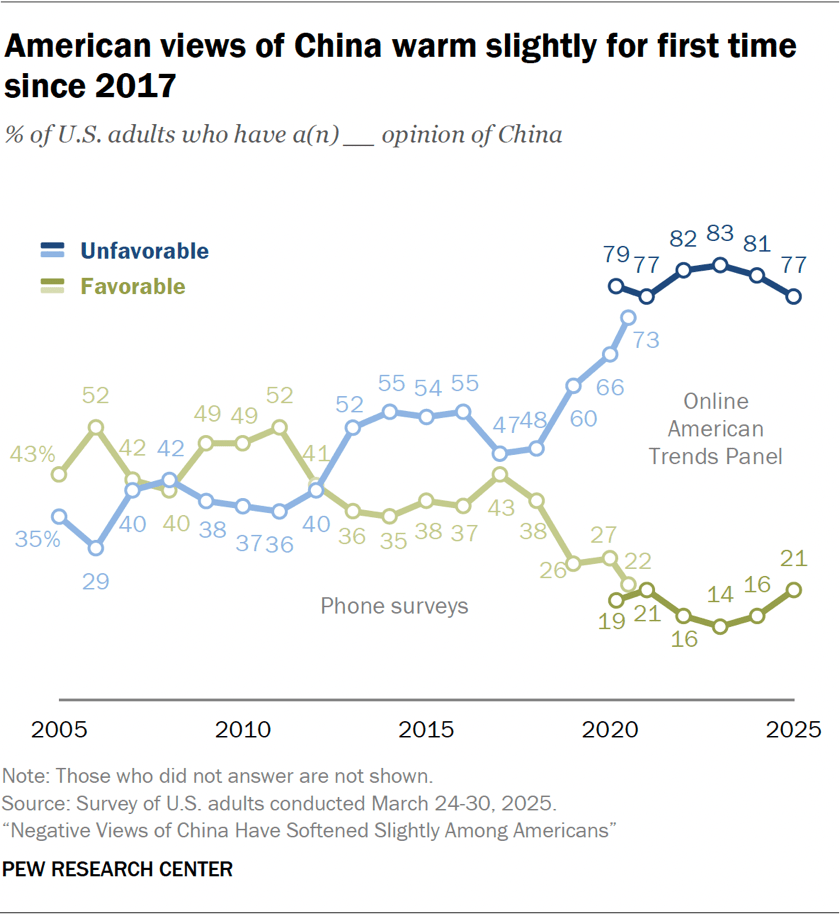
Americans hold largely unfavorable opinions of China and Chinese President Xi Jinping, but ratings of both have improved slightly since 2024. Views of China are mostly negative More than three-quarters of Americans (77%) have an unfavorable opinion of China. Though a sizable majority, this reflects a decrease from 81% in 2024. It also marks the first time in five years we’ve measured a significant year-over-year decline in the share of Americans with an unfavorable view of China. The change is even greater when it comes to the share of those with a very unfavorable view of China: Today, 33% of U.S. adults have a very unfavorable view, down from 43% last year. Views by party Views of China tend to vary by party. While majorities of adults in both parties have an unfavorable opinion of China, Republicans and Republican-leaning independents are significantly more likely than Democrats and Democratic leaners to hold this view (82% vs. 72%). Still, views of China are warming across the board. The share of Republicans with a very unfavorable opinion of China has dropped 16 points since 2024, while the share among Democrats has dropped 6 points.  Conservative Republicans stand out among ideological groups, with about half (51%) saying they have a very unfavorable view of China. That is 20 points more than the share of moderate and liberal Republicans (31%) and roughly double the shares of conservative and moderate Democrats (24%) and liberal Democrats (24%) who say the same. Views by age Older Americans are most critical of China. About half of those ages 65 and older have a very unfavorable opinion of China. This share drops to 37% among those ages 50 to 64, 27% among those ages 30 to 49, and 21% among adults under 30. Americans largely lack confidence in Xi Three-quarters of U.S. adults have little or no confidence in Chinese President Xi Jinping to do the right thing regarding world affairs. This includes 39% who have no confidence at all in him. Only about one-in-ten Americans (11%) say they have some confidence in Xi, and just 1% have a lot of confidence in him. Another 12% say they have never heard of the Chinese president. Similar to Americans’ overall views of China, the share of those with confidence in Xi has risen slightly since 2024 (+4 points). Views by party Opinions of Xi also vary by party. While sizable majorities of both Republicans and Democrats have little or no confidence in Xi’s leadership on the world stage, Republicans are especially likely to lack confidence. Conservative Republicans are the most critical: 86% are not confident in Xi, including 54% who have no confidence at all. Views by age Confidence in Xi is lowest among older Americans. Adults ages 65 and older are 21 points more likely than those ages 18 to 29 to have little or no confidence in the Chinese president (85% vs. 64%). Older adults are also more likely to know who Xi is. When asked, just 5% of those ages 65 and older say they have never heard of him. That share rises to 20% among adults ages 18 to 29. source

1. U.S. views of China and Xi Read More »

Negative Views of China Have Softened Slightly Among Americans

Fewer now consider China an enemy or say it’s the country posing the greatest threat to the U.S. A shipping crate from China awaits inspection by U.S. Customs and Border Protection at a Los Angeles freight facility in 2022. (Patrick T. Fallon/AFP via Getty Images) How we did this Pew Research Center conducted this study to understand how Americans see China and its relationship with the U.S. The report gauges American views of China in terms of both economics and national security. This analysis builds on previous Center research on Americans’ opinions of China and on the most pressing foreign policy issues of the day going back decades, such as major world conflicts, trade and tariffs, U.S. military decisions and other related developments of the times. For this analysis, we surveyed 3,605 U.S. adults from March 24 to March 30, 2025. Everyone who took part in this survey is a member of the Center’s American Trends Panel (ATP), a group of people recruited through national, random sampling of residential addresses who have agreed to take surveys regularly. This kind of recruitment gives nearly all U.S. adults a chance of selection. Surveys were conducted either online or by telephone with a live interviewer. The survey is weighted to be representative of the U.S. adult population by gender, race, ethnicity, partisan affiliation, education and other categories. Read more about the ATP’s methodology. Here are the questions used for this analysis, along with responses, and its methodology. Americans hold largely negative views of China: Most have a very or somewhat unfavorable view of the country, and they tend to name China as the nation that poses the greatest threat to the United States. Still, attitudes toward China have warmed somewhat. For the first time in five years, the share of Americans with an unfavorable opinion of China has fallen from the year before – albeit slightly, from 81% in 2024 to 77% in 2025. And the share who have a very unfavorable opinion of China has dropped 10 percentage points since last year. The share of Americans who call China an enemy of the U.S., rather than a partner or a competitor, has also fallen. One-third now hold this view, down from 42% last year. Still, when asked which country poses the greatest threat to the U.S., Americans mention China more often than any other nation (42%). But the share who name China has fallen 8 points since 2023, when we last asked this question. These are among the findings of a Pew Research Center survey conducted March 24-30, 2025, among 3,605 U.S. adults. The survey took place amid escalating economic tensions between the U.S. and China, caused in part by rapidly shifting tariff policies: Views by party Negative attitudes toward China have softened among Republicans and Republican-leaning independents, though they continue to be more critical of the country than Democrats and Democratic leaners. The share of Republicans with an unfavorable view of China is down 8 points since 2024, including a 16-point drop in the share with a very unfavorable view. In comparison, unfavorable views among Democrats saw a 5-point decline. Republicans are 14 points less likely than they were in 2024 to label China an enemy of the U.S. Since we first began asking this question in 2021, Republicans have generally been more likely to call China an enemy than a competitor, but they are now equally likely to use each label. Among Democrats, the share who consider China an enemy has fallen 6 points since last year. For their part, Democrats have become less likely to name China as the country posing the greatest threat to the U.S. – 28% say this is the case, down from 40% in 2023. Republicans saw a more muted change in that time (-5 points). For Democrats, much of this change relates to an increasing share naming Russia as the top threat to the U.S. For more on U.S. views of Russia, read “Republican Opinion Shifts on Russia-Ukraine War.” There have also been pronounced changes from previous years in partisan assessments of China’s international influence: In 2024, Republicans were 10 points more likely than Democrats to say China’s global influence was growing. Now, adults in both parties are equally likely to hold this view. While Republicans used to be more inclined than Democrats to label China the world’s top economic and military power, Democrats are now more likely to hold these views. Views on trade and tariffs Americans do not think the trade relationship between the U.S. and China is balanced. Nearly half (46%) say China benefits more from U.S.-China trade, though a quarter say both countries benefit equally; 10% think the U.S. benefits more. A majority of Republicans say China benefits more from the U.S.-China trade relationship. Democrats are divided between the view that both countries benefit equally and the view that China benefits more. We asked the same questions about U.S. trade with Canada and Mexico. Americans consider the U.S.-China trade relationship more unbalanced than the others: 26% of Americans say Canada benefits more than the U.S. from their trade relationship, and 29% say this in Mexico’s case. Americans are largely skeptical about the effects of increased tariffs on China. About half say these tariffs will be bad for the U.S., and a similar share say the tariffs will be bad for them personally. Among Democrats, 80% think the tariffs will harm the country, and 75% believe these measures will harm them personally. Republicans are more optimistic. While only 17% say increased tariffs on China will be good for them personally, they are more inclined to say the tariffs will be good than bad for the country (44% vs. 24%). Related: Americans Give Early Trump Foreign Policy Actions Mixed or Negative Reviews source

Negative Views of China Have Softened Slightly Among Americans Read More »

3. How Americans view NATO and U.S. NATO membership

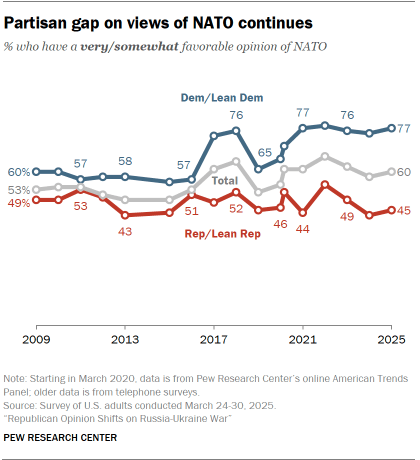
Here are several key takeaways about Americans’ assessments of NATO: While a majority of Americans (60%) express a positive view of NATO, there continue to be partisan differences: 77% of Democrats have a favorable view of the international alliance, compared with 45% of Republicans. These views have not moved significantly over the past year. More Americans say the U.S. benefits from membership in NATO (66%) than say it does not (32%). Democrats are much more likely than Republicans to say the U.S. benefits from NATO membership. NATO favorability Six-in-ten U.S. adults have a favorable view of NATO, similar to the share who said this in 2024. Another 37% have an unfavorable view of the alliance. Partisanship For several years, there has been a wide partisan gap in U.S. opinions of NATO. About three-quarters of Democrats and Democratic-leaning independents (77%) express a positive view of the organization, while 45% of Republicans and Republican leaners feel this way. Neither partisan group has shifted significantly in their views over the past year. There are ideological differences in these views within both partisan coalitions: Moderate or liberal Republicans (51%) are more likely than conservative Republicans (41%) to express a positive view of NATO. Liberal Democrats are more likely than conservative or moderate Democrats to have a favorable opinion of the alliance (85% vs. 72%). Does the U.S. benefit from NATO membership? About two-thirds of Americans (66%) say the U.S. benefits a great deal or a fair amount from being a member of NATO, while 32% say it does not benefit much or at all. The share who say the U.S. benefits from NATO membership has increased modestly from 63% in February 2025, and is the same share who viewed membership favorably in spring 2024. Partisanship and change over time About eight-in-ten Democrats (83%) believe the U.S. benefits from being a member of NATO, compared with about half of Republicans (49%). Liberal Democrats are particularly likely to say the U.S. benefits from membership in the alliance (90%), while a 57% majority of conservative Republicans say the U.S. does not benefit much or at all. The share of Republicans who said the U.S. benefits from being part of NATO has dropped since we first asked this question in spring 2021; at that time, 55% saw at least a fair amount of benefit to NATO membership. Democrats’ views have not changed much since then. Views of international engagement and Russia U.S. adults who say the country should be active in world affairs (81%) are more likely to think the U.S. benefits from being a member of the alliance than those who prefer the country pay less attention to problems overseas and instead focus on domestic issues (52%). And those who say Russia is an enemy of the U.S. (72%) are more likely than those who see Russia as a competitor (49%) or partner (44%) to have a favorable view of NATO. source

3. How Americans view NATO and U.S. NATO membership Read More »

Americans Give Early Trump Foreign Policy Actions Mixed or Negative Reviews

More Americans see the president favoring Russia too much than striking the right balance The sign on the U.S. Agency for International Development’s headquarters building in the District of Columbia is removed on Feb. 7, 2025. (Kayla Bartkowski/Getty Images) How we did this Pew Research Center conducted this study to gauge Americans’ views of the second Trump administration’s earliest foreign policy actions. The issues covered in this report include withdrawing from global agreements, ongoing conflicts in Ukraine and the Middle East, trade and tariffs, and U.S. territorial expansion. This analysis builds on the Center’s previous study of Americans’ opinions on the most pressing foreign policy issues of the day going back decades, such as on major world conflicts, trade and tariffs, U.S. military decisions and other related developments of the times. For this analysis, we surveyed 3,605 U.S. adults from March 24 to 30, 2025. Everyone who took part in this survey is a member of the Center’s American Trends Panel (ATP), a group of people recruited through national, random sampling of residential addresses who have agreed to take surveys regularly. This kind of recruitment gives nearly all U.S. adults a chance of selection. Surveys were conducted either online or by telephone with a live interviewer. The survey is weighted to be representative of the U.S. adult population by gender, race, ethnicity, partisan affiliation, education and other categories. Read more about the ATP’s methodology. Here are the questions used for this analysis, along with responses, and its methodology. President Donald Trump is pursuing a markedly different foreign policy strategy than former President Joe Biden. He has withdrawn the United States from international agreements, is working more closely with Russia to end the war in Ukraine, has discussed taking over foreign territory and has imposed tariffs on trade partners. Many of these early foreign policy actions receive mixed or negative reviews from Americans, according to a survey of 3,605 adults conducted March 24-30, 2025. For example, more Americans disapprove than approve of the U.S.: Leaving the World Health Organization Leaving the Paris Climate Agreement Ending most U.S. Agency for International Development (USAID) programs Russia and Ukraine, Israelis and Palestinians Many Americans also don’t see Trump’s handling of the Russia-Ukraine relationship as balanced: A 43% plurality says he is favoring Russia too much. Roughly three-in-ten say he’s striking about the right balance between Russia and Ukraine and 3% say he’s favoring Ukraine too much. Another 22% are unsure. We also asked the public’s opinion on whether Trump is striking the right balance when it comes to U.S. relations with Israelis and Palestinians. Here, opinions are more mixed. Similar shares see him favoring the Israelis too much (31%) and striking the right balance (29%), with 37% unsure and 3% saying he’s favoring the Palestinians too much. (The survey was conducted prior to Netanyahu’s April visit to the U.S.) Greenland and Gaza Americans are divided over how likely it is that Trump will pursue the U.S. taking over Greenland or Gaza. Around one-in-five Americans think Trump is extremely or very likely to pursue taking over Greenland or Gaza, with more saying these actions are not too or not at all likely. Still, by more than a two-to-one margin, Americans oppose rather than favor the U.S. taking over these territories. More Republicans support (41%) than oppose (28%) Trump’s proposal to take over Greenland, though around three-in-ten (31%) are unsure. But, in the case of taking over Gaza, more Republicans oppose (44%) than support (27%) the idea. Tariffs on China Tariffs are another key part of Trump’s foreign policy. Increased tariffs on China, specifically, receive more negative than positive evaluations. (The survey predated the detailed announcement of widespread global tariffs – including further tariffs on China – on April 2, as well as China’s retaliatory response. But Trump had already increased tariffs on China before the survey was fielded.) Many more think the increased tariffs on China will be bad for the U.S. than say they will be good, though around a quarter either see them having no effect or are unsure. Views of the tariffs’ personal impact are similarly negative: Americans are about five times as likely to say the increased tariffs on China will be bad for them as they are to say the tariffs will be beneficial. Republicans are more likely than Democrats to say increased tariffs on China will be good for the U.S. and good for them personally. Still, when it comes to the personal impact of these tariffs, Republicans are more likely to say the impact will be bad (30%) than good (17%), even as substantial shares express uncertainty or anticipate the tariffs will have limited personal impact. Jump ahead to read about views on: The U.S. withdrawing from the WHO and Paris Climate Agreement, ending most USAID programs Within the first days of his second administration, Trump moved to withdraw the U.S. from both the World Health Organization (WHO) and the Paris Climate Agreement. The administration also took action to end most activities of the U.S. Agency for International Development (USAID). Each of these policies are more unpopular than not, though the share saying they are unsure ranges from 16% to 22%. Views by party 64% of Republicans and Republican-leaning independents support ending most USAID programs, compared with 9% of Democrats and Democratic leaners. 60% of Republicans support the U.S. leaving the Paris Climate Agreement; 7% of Democrats say the same. 58% of Republicans support the U.S. leaving the WHO, as do 8% of Democrats. For each of these policies, Republicans are also more likely than Democrats to say they are unsure. Views by age Generally, older adults are more likely to approve of Trump’s early foreign policy actions than younger adults. For example, around four-in-ten Americans ages 50 and older approve of the U.S. leaving the Paris Climate Agreement, compared with 32% of those ages 30 to 49 and 24% of those under 30. (Younger adults are also more likely to say they are unsure.) Older Republicans are

Americans Give Early Trump Foreign Policy Actions Mixed or Negative Reviews Read More »

4. Religious switching into and out of Islam

Terminology Throughout this report, religious switching refers to a change between the religious group in which a person says they were raised (during their childhood) and their religious identity now (in adulthood). The rates of religious switching are based on responses to two survey questions we asked of adults ages 18 and older: “What is your current religion, if any?” “Thinking about when you were a child, in what religion were you raised, if any?” The responses to these two questions allow us to calculate what percentage of the public has left a religious group (or “switched out”) and what percentage has entered (or “switched in”). This kind of switching can take place without any formal rite or ceremony. We have analyzed switching into and out of five widely recognized, worldwide religions to allow for consistent comparisons around the globe. Specifically, this report analyzes change between the following groups: Christianity, Islam, Judaism, Buddhism, Hinduism, other religions, religiously unaffiliated adults, and those who did not answer the question. For example, someone who was raised Buddhist but now identifies as Christian would be considered as having switched religions – as would someone who was raised Christian but is now unaffiliated. However, switching within a religious tradition, such as between Catholicism and Protestantism, is not captured in this report. (Refer to Pew Research Center’s 2023-24 Religious Landscape Study for an analysis of switching in the United States that does count some switching within Christianity. Read “4 facts about religious switching within Judaism in Israel” for an analysis of switching within Judaism.) Religiously unaffiliated refers to people who answer a question about their current religion (or their upbringing) by saying they are (or were raised as) atheist, agnostic or “nothing in particular.” This category is sometimes called “no religion” or “nones.” Other religions is an umbrella category. It contains a wide variety of religions that are not in the other categories and that have survey sample sizes too small to analyze separately in most countries. This includes Sikhism, Jainism, the Baha’i faith, African traditional religions, Native American religious traditions, and others. Disaffiliation rates refer to the percentage of adults who say they were raised in a religion but are now religiously unaffiliated (or have no religion). Net gains/losses are the differences between the percentage of survey respondents who say they were raised in a particular religious category (as children) and the percentage who identify with that same category at the time of the survey (as adults). The “net” gain or loss takes into account both sides of the equation – those who have left and those who have entered the group. Retention rates show, among all the people who say they were raised in a particular religious group, the percentage who still describe themselves as belonging to that group today. Accession rates (also called entrance rates) show, among all the people who describe themselves as belonging to a particular religious group today, the percentage who were raised in some other group. This section delves into religious switching into and out of Islam, describing where Islam has had the largest net gains and losses, what percentage of adults who were raised Muslim are still Muslim (i.e., retention rates), which religious groups people who left Islam have switched into, and where Islam has the largest shares of new entrants (i.e., the highest accession rates). Of the 36 countries surveyed, 13 have sufficient sample sizes of Muslims to allow analysis of religious switching into and out of Islam. The United States is among these countries. Net gains and losses for Islam Very small percentages of the overall adult population have left or joined Islam in most of the 13 countries analyzed. Remaining Muslim In several countries, nearly all adults who were raised Muslim still identify that way today, yielding high Muslim retention rates. Leaving Islam Fewer than a quarter of adults in all countries analyzed who were raised Muslim no longer identify as Muslim. Most who have left Islam either no longer identify with any religion (i.e., they identify religiously as atheist, agnostic or “nothing in particular”) or now identify as Christian. Entering Islam Large majorities of people who currently identify as Muslim say they were raised as Muslims. The U.S. and Kenya have the highest levels of “accession,” or entrance, into Islam, with 20% of U.S. Muslims and 11% of Kenyan Muslims saying they were raised in another religion or with no religion. That said, overall, Muslims are a minority in both places: About 1% of U.S. adults and 11% of Kenyans currently identify as Muslim. Among those who have switched into Islam, most say they were raised Christian. Where has Islam experienced the largest net gains or losses from religious switching? Across the 13 countries with sufficient sample sizes to analyze religious switching for Muslims, 3% or fewer of all adults have left or entered Islam, resulting in very little change between childhood and current religion from religious switching. For instance, in Indonesia, the share of adults who currently identify as Muslim is equal to the share who say they were raised Muslim (93%). Fewer than 1% of all adults surveyed in Indonesia say they have left or entered Islam. What percentage of people raised Muslim are still Muslim? In several countries, virtually all adults who answer survey questions by saying they were raised Muslim still identify that way today, yielding extremely high retention rates. Except in the U.S., the survey does not show much variation in Muslim retention rates. In most places, upward of 90% of people raised as Muslims have remained Muslims as adults. Even in the U.S. – which has the lowest retention rate among Muslims in the countries surveyed – roughly three-quarters of Americans who were raised Muslim still identify as Muslims today. Which religious groups have former Muslims switched to? Analyzing retention rates also sheds light on the religious groups that former Muslims have joined. In the U.S., 13% of adults who were brought up as Muslims no longer

4. Religious switching into and out of Islam Read More »

1. Artificial intelligence in daily life: Views and experiences

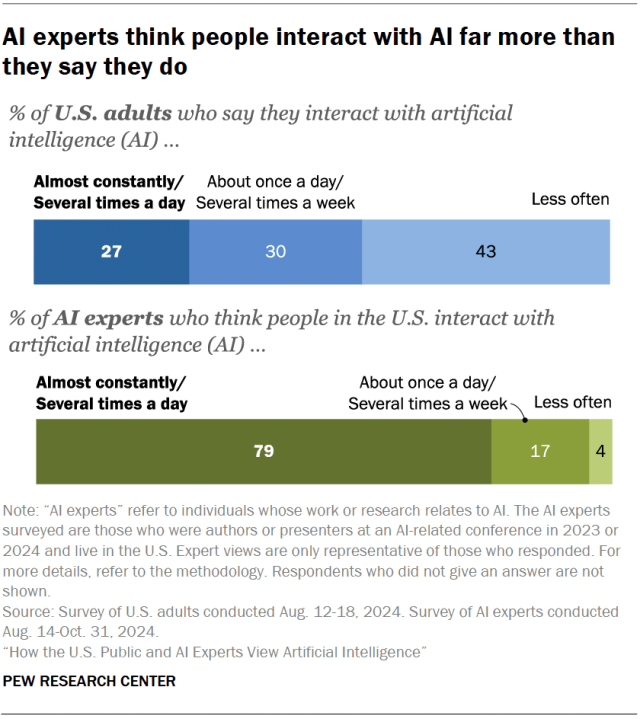
Artificial intelligence is quickly becoming more and more part of everyday life. This chapter explores how the public and experts compare in their experiences and views around the use of AI (such as chatbots) and their control over AI’s role in their lives. Interacting with AI Americans encounter AI in various ways, from social media to health care to financial services. But AI experts believe the public engages with AI more than they report. AI experts were asked how often they think people in the United States interact with AI. A vast majority (79%) say people in the U.S. interact with AI almost constantly or several times a day. A much smaller share of U.S. adults (27%) think they interact with AI at this rate. Three-in-ten say they do so about once a day or several times a week, and 43% report doing so less often. Use and views of chatbots It’s been over two years since ChatGPT was released, and other chatbots came soon after. Since then, Americans have been increasingly using them for work or entertainment. To that end, we asked AI experts and the general public about their use of these tools. Using chatbots is nearly universal among experts, but that’s not the case for the general public. One-third of U.S. adults say they have ever used an AI chatbot, compared with nearly all AI experts surveyed (98%). That said, most Americans (72%) have at least heard of chatbots, including 28% who’ve heard a lot. The public’s experiences with chatbots have not been as positive as those of experts. About six-in-ten AI experts who have used a chatbot (61%) say it was extremely or very helpful to them. Smaller shares of users in the general public (33%) say this. Fewer in both groups report that chatbots have been not too or not at all helpful. Still, U.S. adults who’ve used chatbots are more likely than experts surveyed to say these tools have been not too or not at all helpful (21% vs. 9%). Do people think they have control over AI in their lives? Debates have continued around the difficulty or inability to opt out of AI. On balance, both the American public and the AI experts we surveyed want more control over this technology. When asked about control over AI use in their lives, almost half or more in both groups say they have little or no control, with this sentiment being somewhat more prevalent among U.S. adults (59%) than AI experts surveyed (46%).  Smaller shares of both groups think they have control over whether AI is used in their lives: 14% of the general public and 23% of AI experts say they have a great deal or quite a bit of control. What’s more, both U.S. adults and AI experts most commonly say they want more control over how AI is used in their lives. More than half of both AI experts and U.S. adults (57% and 55%) say they would like more control over how AI is used in their own lives. Fewer in both groups are comfortable with the amount of control they have, though experts are more likely to say this (38% vs. 19%). Uncertainty is more common among the general public. U.S. adults are far more likely than AI experts to say they are unsure how much control they want over AI (26% vs. 4%). By gender, among AI experts surveyed Among experts, women are more likely than men to say that they would like more control over AI (67% vs. 54%). By job sector, among AI experts surveyed Experts who work at colleges or universities are more likely than those who work in private companies to say they want more control over AI (61% vs. 50%). Roughly equal portions of both say they have not too much or no control in how AI is used in their lives (47% and 46%, respectively). source

1. Artificial intelligence in daily life: Views and experiences Read More »

Appendix A: Demographic makeup of AI experts surveyed

ABOUT PEW RESEARCH CENTER Pew Research Center is a nonpartisan, nonadvocacy fact tank that informs the public about the issues, attitudes and trends shaping the world. It does not take policy positions. The Center conducts public opinion polling, demographic research, computational social science research and other data-driven research. Pew Research Center is a subsidiary of The Pew Charitable Trusts, its primary funder. source

Appendix A: Demographic makeup of AI experts surveyed Read More »

En todo el mundo, muchas personas abandonan las religiones de su infancia

Encuestas realizadas en 36 países revelan que el cristianismo y el budismo registran las mayores pérdidas por este “cambio de religión”  Este comunicado de prensa se ha traducido del inglés original al español. En muchos países del mundo, una quinta parte o más de todos los adultos ha abandonado el grupo religioso en el que se criaron. El cristianismo y el budismo han experimentado pérdidas especialmente grandes debido a este “cambio de religión”, mientras que un número cada vez mayor de adultos no tiene ninguna afiliación religiosa, según las encuestas realizadas por el Pew Research Center a casi 80.000 personas en 36 países. ¿Qué es el “cambio de religión”? A lo largo de este informe, el “cambio de religión” se refiere a un cambio entre el grupo religioso en el que una persona dice haberse criado (durante su infancia) y su pertenencia religiosa actual (en la edad adulta).  Utilizamos el término “cambio de religión” en lugar de “conversión” porque los cambios pueden producirse de muchas maneras, tanto como haberse criado bajo una religión a no estar vinculado a ella.  Contamos los cambios entre grandes categorías religiosas (como de budista a cristiano, o de hindú a no vinculado), pero no los cambios dentro de una religión mundial (como de una confesión cristiana a otra).  Para más detalles, consulte la sección Terminología de nuestro informe. Las variaciones en la afiliacion religiosa global varían mucho en todo el mundo, según muestran las encuestas.   En algunos países, cambiar de religión es muy raro. En India, Israel, Nigeria y Tailandia, el 95 % o más de los adultos dicen seguir perteneciendo al grupo religioso en el que se criaron.   Pero en Asia Oriental, Europa Occidental, Norteamérica y Sudamérica, el cambio de religión es bastante común. Por ejemplo, el 50 % de los adultos en Corea del Sur, el 36 % en los Países Bajos, el 28 % en Estados Unidos y el 21 % en Brasil ya no se identifican con la religión de su infancia.   ¿A cuales religiones se están cambiando las personas? La mayor parte de los cambios de religión son desvinculaciones: personas que abandonan la religión de su infancia y ya no se identifican con ninguna religión. Muchas de estas personas fueron criadas como cristianas. Por ejemplo, el 29 % de los adultos en Suecia dicen que fueron criados como cristianos, pero ahora se describen desde el punto de vista religioso como ateos, agnósticos o “sin ninguna religión en particular”. El budismo también está perdiendo adeptos por desvinculación en algunos países. Por ejemplo, el 23 % de los adultos encuestados en Japón y el 13 % en Corea del Sur afirman que se criaron como budistas, pero que actualmente no se identifican con ninguna religión.   Sin embargo, no todos los cambios implican alejarse de la religión. Algunas personas se mueven en la dirección opuesta. De los 36 países encuestados, Corea del Sur cuenta con el mayor porcentaje de personas que afirman no haber sido criadas bajo ninguna religión, pero que hoy profesan una (9 %).La mayoría de ellos (6 % de todos los adultos surcoreanos) afirman no haber sido criados bajo ninguna religión y ahora ser cristianos. ¿Qué grupos religiosos han experimentado las mayores pérdidas por el cambio de religión?     En la mayoría de los países estudiados, el cristianismo registra las mayores perdidas netas – es decir, las mayores proporciones de personas que abandonan frente a las que se adhieren.   En Alemania, por ejemplo, esta proporción entre cristianos es de 19,7 a 1,0, lo que significa que hay casi 20 alemanes que dicen haber sido criados como cristianos en la infancia, pero que hoy no se consideran cristianos respecto a cada alemán que se hizo cristiano después de haber sido criado bajo otra religión mundial o bajo ninguna religión.   La encuesta también muestra que el budismo está experimentando grandes pérdidas por cambio de religión, en su mayoría desvinculación, en unos cuantos países, como Japón, Singapur y Corea del Sur. Sin embargo, la proporción entre abandonos y adhesiones no es tan elevada como en el caso del cristianismo.   ¿Qué grupo religioso ha ganado más adeptos con el cambio de religión?    La categoría que ha experimentado las mayores ganancias netas por el cambio es la de los que no estan vinculados a ninguna religión.   En los países donde hay un gran número de personas que se declaran no religiosas o sin vínculos religiosos, son muchos más aquellos encuestados que reportan no estar vinculados, que los que se han unido a una religion tras haberse criado sin ella.  En Italia, por ejemplo, la relación entre abandono y adhesión entre los no vinculados es de 1,0 a 28,7. Esto quiere decir que por cada persona que se crio sin afiliación religiosa, pero que ahora tiene una religión, más de 28 personas dicen que se criaron bajo una religión, pero ya no la tienen.  ¿Existen diferencias por edad, educacion o sexo en los indices de cambios en la afiliacion religiosa?   La edad: En la mayoría de los países encuestados, los porcentajes de adultos jóvenes y mayores que han cambiado de religión son prácticamente iguales. Sin embargo, en 13 países, incluidas casi todas las naciones latinoamericanas encuestadas, así como varios países de Europa y Norteamérica, los adultos menores de 35 años tienen más probabilidades que los mayores de 50 de haber cambiado de religión.   Educación: En la mayoría de los países, las tasas de cambio de religión no varían mucho entre personas con distintos niveles de educación. Sin embargo, en 12 de los 36 países estudiados, las personas con mayor nivel educativo tienden a tener tasas más elevadas de cambio de religión.   Una vez más, la mayor parte de las personas que cambian de religión en cada nivel educativo es por desvinculación; en concreto, personas que dicen haber sido criadas bajo una tradición religiosa (a menudo como cristianos o budistas), pero que ya no se identifican con ninguna religión.   Género: Asimismo, en la mayoría de los países encuestados, los porcentajes de mujeres y hombres que han cambiado de religión son aproximadamente iguales.   Otras conclusiones claves

En todo el mundo, muchas personas abandonan las religiones de su infancia Read More »

Most Americans Say They Are Tuned In to News About the Trump Administration

Far fewer are hearing about the administration’s relationship with the media than was the case early in Trump’s first term President Donald Trump speaks with reporters on the White House South Lawn on March 21, 2025. (Demetrius Freeman/The Washington Post via Getty Images) How we did this Pew Research Center conducted this study to track how Americans are paying attention to news about the new Trump administration. For many years we have asked U.S. adults for their views and habits related to news about elections, presidential administrations and policy developments. This study builds on work we did leading up to the 2024 election, and on studies in both 2017 and 2021 during the early stages of the Trump and Biden administrations. To do this, we surveyed 5,123 adults from Feb. 24 to March 2, 2025. Everyone who took part in this survey is a member of the Center’s American Trends Panel (ATP), a group of people recruited through national, random sampling of residential addresses who have agreed to take surveys regularly. This kind of recruitment gives nearly all U.S. adults a chance of selection. Interviews were conducted either online or by telephone with a live interviewer. The survey is weighted to be representative of the U.S. adult population by gender, race, ethnicity, partisan affiliation, education and other factors. Read more about the ATP’s methodology. Here are the questions used for this report, along with responses, and its methodology. The second Trump administration has started with a rapid succession of executive orders and policy changes, including tariffs, cuts to government agencies and more. Americans are paying attention, but Democrats and Republicans give different reasons for why they are tuning in, according to a new Pew Research Center survey conducted in late February and early March. As the president and his allies move to reshape the federal government and U.S. foreign policy, about seven-in-ten U.S. adults say they have been following news about the actions and initiatives of the Trump administration very (31%) or fairly (40%) closely. That’s about the same share who said they were following news about the presidential election last September (69%), and slightly higher than the percentage who said they were following news about the actions and initiatives of the new Biden administration in 2021 (66%). There is also a gap between now and the early days of the Biden presidency when it comes to the share who are following administration news very closely (31% vs. 22%). Both partisan coalitions are paying attention to the actions and initiatives of the administration at similar rates. This is different from the first months of the Biden administration in 2021, when Republicans and Republican-leaning independents were less likely than Democrats and Democratic leaners to say they were following the Biden administration’s actions very or fairly closely (60% of Republicans vs. 75% of Democrats). Now, 74% of Republicans and 71% of Democrats say they are following the Trump administration’s actions at least fairly closely. Four-in-ten Americans say they’re now paying more attention to political news than they were before Trump took office, while just 10% say they are paying less attention. Democrats are slightly more likely than Republicans to say they’re paying more attention (44% vs. 37%) and are also more likely to say they’re paying less attention (15% vs. 5%) than before the inauguration. Republicans, meanwhile, are more inclined to say their attention has been steady. Reasons Americans follow – or don’t follow – news about the Trump administration The survey asked the 71% of Americans who say they are following news about the Trump administration very or fairly closely why they are doing this. Respondents were given a list of five possible reasons why they might be following what Trump is doing, and indicated whether each was a major reason, minor reason or not a reason at all. The most common reasons are concern and relevance. About two-thirds of U.S. adults in this group (66%) say “I’m concerned about what the administration is doing” is a major reason they are following its actions. And roughly six-in-ten (62%) say its relevance to their life is a major reason. Smaller shares cite three other potential factors as major reasons they follow news about the Trump administration: Because it’s hard to avoid (43%), Because they like what the administration is doing (36%) or Because they find it entertaining or interesting (25%). Among the smaller share of Americans who aren’t closely following news about the administration, the most common reasons for tuning out are fatigue and lack of interest in politics generally. About half say a major reason for this is that they’re worn out by the amount of news (49%) or that they don’t typically follow political news (48%). Roughly a third say they are tuned out because they don’t like what the administration is doing (34%). Fewer say a major reason is that the news about the Trump administration is not relevant to their life (15%) or that they trust the administration to make good decisions (13%). Reasons by party Among U.S. adults who are closely following news about the Trump administration’s actions and initiatives, identical shares of Democrats and Republicans (62% each) say that the personal relevance to their life is a major reason they are doing so. But on other reasons, there are substantial gaps between the two parties. Democrats are much more likely to say concern about what the administration is doing is a major factor in why they are following news about it (88%), though nearly half of Republicans also cite concern about the administration’s activities as a major reason for paying attention to the news (45%). At the same time, most Republicans (64%) say a major reason they follow this news is that they like what the administration is doing, compared with just 8% of Democrats. Democrats are more likely to say they’re keeping up with this news because that it’s hard to avoid, while more Republicans than Democrats say it’s because the news is entertaining. Republicans respond

Most Americans Say They Are Tuned In to News About the Trump Administration Read More »