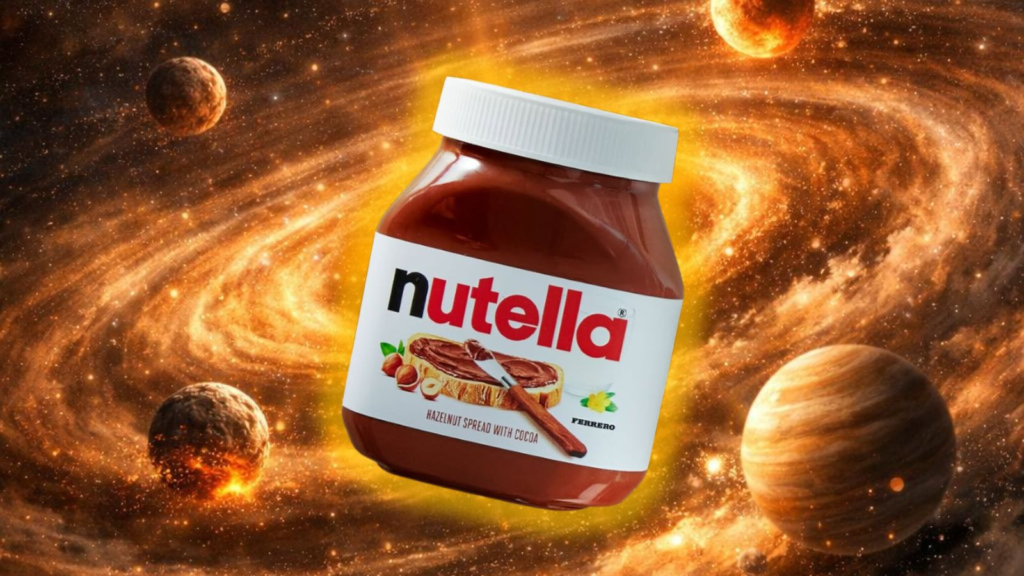
Nutella’s brief float through space may have lasted only seconds, but its impact has lingered far longer online.
What began as a blink-and-you-miss-it moment during a NASA livestream quickly snowballed into a global social media conversation, with millions of engagements and a wave of brand-led content reacting in real time.
For Nutella, the challenge now is no longer about riding the initial surge of attention, but deciding what comes after. Should the brand attempt to extend the moment into a structured campaign, or is there greater value in leaving it as a one-off cultural glitch that worked precisely because it wasn’t overthought?
Don’t miss: What made IKEA and Punch the monkey the perfect viral moment?
For Huiwen Tow, head of strategy at VIRTUE Asia, the moment resonated not just because of its novelty, but because of what it symbolised.
“We’re in a cultural moment where the extraordinary is increasingly being humanised,” she said, pointing to how audiences today are drawn less to spectacle alone, and more to moments that reveal the human behind it. A familiar jar of Nutella appearing inside one of the most advanced environments imaginable created an immediate emotional bridge, a reminder that even astronauts reach for small, everyday comforts.
Just as crucially, she added, the moment felt entirely unmanufactured. In a landscape saturated with engineered virality, its power came from contrast: a recognisable, everyday object appearing within a historic, high-stakes setting.
“It didn’t interrupt culture, it appeared within it,” she said, describing the moment as one that was collectively discovered in real time, rather than designed for attention.
Kristian Olsen, founder and managing director of Type A, echoed a similar sentiment, but more bluntly. The moment worked because it was unexpected, unplanned and, simply put, a little absurd.
“It was the last thing anyone would’ve expected to turn up on a livestream from space,” he said, adding:
In a time where there are spoilers for everything, this was a truly rare and authentic WTF moment.
Build it or leave it?
That unpredictability, however, is exactly what makes the next step tricky. Tow cautioned against the instinct to recreate the moment, noting that what Nutella experienced was not a stunt, but a cultural signal. While stunts can be repeated, signals need to be interpreted.
“What people responded to wasn’t just the visual of Nutella in space, but the meaning behind it,” she said. Rather than attempting to replicate the scenario, she suggested the brand could explore broader territory, building on the idea of everyday rituals appearing in unexpected contexts, and inviting communities to reinterpret it in their own ways. She added:
The goal isn’t to extend the moment. It’s to build a world people can participate in.
Olsen, however, leaned towards restraint. In his view, the moment already belongs to the internet, and that’s precisely why it worked.
“The online community has already rewarded it and the moment exists in culture now,” he said. “The brands that chase these moments too hard are usually the ones that kill them.”
Instead, he suggested a lighter touch: a few well-timed pieces of content that lean into the absurdity, without overthinking it. Nutella appeared to follow that playbook. The brand quickly responded across social platforms, leaning into humour and self-awareness rather than over-explaining the moment.
Sunny Johar, managing director for SEA at KRDS Digital, shared a similar perspective, framing the appeal of the moment in its lack of orchestration.
“This worked because it was completely unmanufactured,” she said. In a landscape where brands increasingly try to engineer virality, the appearance of Nutella during a NASA livestream felt accidental, human and culturally pure.
The contrast, she added, did most of the work, with something as everyday as Nutella set against the vastness of space created a kind of poetic absurdity the internet is quick to embrace. It didn’t read as branded content, but closer to cultural content, a distinction that helped it travel widely and organically.
Adding to this, Ken Cheung, digital director at KREW Digital, noted that while the moment feels fleeting, history suggests space-linked brand appearances can sometimes carry long-term cultural weight. He pointed to the Omega Speedmaster, later dubbed the “Moonwatch” after being worn during the Apollo 11 mission, as an example of how association with space exploration can outlive the moment itself.
In Nutella’s case, he said, the appeal lies in the same tension between the extraordinary and the everyday. A highly technical, distant space mission is instantly humanised by the presence of a familiar jar of spread. That contrast, he added, made the moment feel unforced and emotionally shareable, rather than commercially staged.
The risk of overreach
Experts agreed on one thing, that pushing too hard could undo what made the moment special in the first place.
“The biggest risk is collapsing authenticity into opportunism. If Nutella overplays this, it shifts from ‘we happened to be part of something magical’ to ‘we’re trying to capitalise on it.’ That erodes trust and turns a charming, serendipitous moment into just another brand stunt,” said Johar.
Cheung added that the stakes are even higher given the context. “The biggest risk is over-commercialisation of a historic and scientific milestone. Public space missions carry emotional and national significance, so appearing opportunistic could damage trust,” he said.
For Tow, the biggest risk lies in misreading why it worked. Attempts to recreate the visual may be possible, but replicating the feeling is far harder. Over-engineering a follow-up risks stripping away the ambiguity and openness that allowed audiences to interpret and remix the moment themselves.
As a result, something that once felt alive and participatory could quickly become fixed. and ignored.
“There’s also a reputational risk,” she added, noting that audiences may grow cynical if a culturally open moment is turned into a commercially driven campaign. The danger, she said, is not missing the opportunity, but eroding the goodwill it created. Olsen put it more simply:
If you have to over-explain the punchline then you’ve already failed.
Be part of #Content360 Singapore, 22–23 April 2026, where creativity and culture collide. Explore how AI-driven storytelling is shaping the future of content, gain practical insights, discover new tactics, and learn how the best in Asia are creating campaigns that truly resonate.
Related articles:
Over 400,000 KitKats were stolen, but no one is taking it seriously
Can one purple mascot cause this much chaos?
Pepsi turns viral kiss cam moment into cola smackdown in new Super Bowl spot