4. Restrictions in the 25 most populous countries in 2022

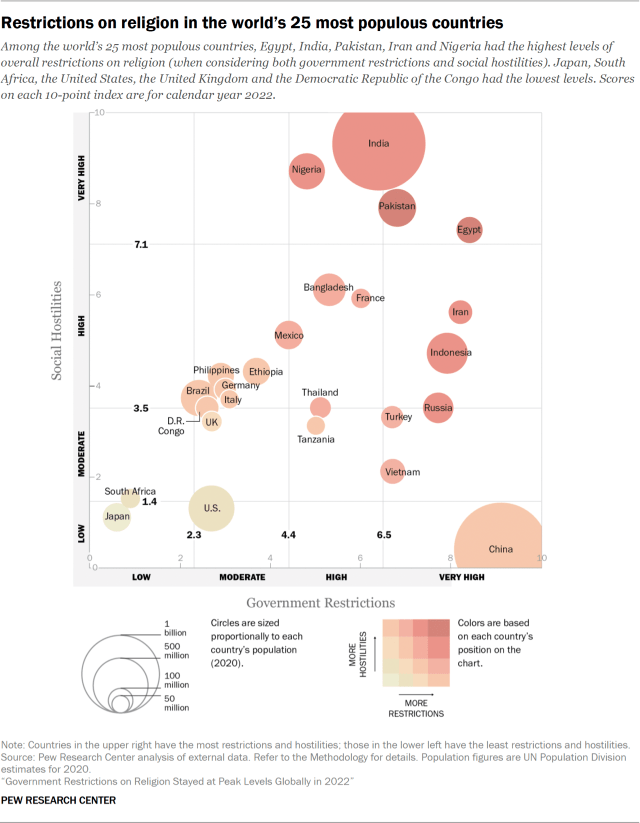
This chapter examines government restrictions and social hostilities in the world’s 25 most populous countries. Looking separately at these populous countries – which are home to about three-quarters of the world’s population – allows us to see how government restrictions and social hostilities impact a large portion of the world’s population. While each country has a national score on the Government Restrictions Index (GRI) and Social Hostilities Index (SHI), it is important to note that the restrictions measured on these indexes don’t affect all inhabitants in a country equally. For example, restrictions can often target minority groups more than majority groups. In 2022, among the 25 most populous countries, Egypt, India, Pakistan, Iran and Nigeria had the highest overall levels of restrictions (meaning, combined government restrictions and social hostilities scores for a country). Japan, South Africa, the United States, the United Kingdom and the Democratic Republic of the Congo had the lowest overall levels of restrictions among these countries. Government Restrictions Index (GRI) China, Egypt, Iran, Indonesia and Russia had the highest levels of government restrictions among the most populous countries, with all five scoring in the “very high” GRI category. Japan, South Africa, Brazil, the Democratic Republic of the Congo and the UK had the lowest levels of government restrictions among this set of countries. Japan and South Africa were in the “low” category on the GRI, while the other three countries were in the “moderate” range. Social Hostilities Index (SHI) In 2022, India, Nigeria, Pakistan, Egypt and Bangladesh had the highest levels of social hostilities among the 25 most populous countries. All of these countries had “very high” SHI scores except for Bangladesh (which had a “high” score). Meanwhile, China, Japan, the U.S., South Africa and Vietnam had the lowest SHI scores. South Africa and Vietnam were in the “moderate” SHI category, while the other three countries were in the “low” range. In seven of these 25 countries, the GRI and SHI scores fell into the same exact categories. For example, Egypt had “very high” scores on both the GRI and SHI; Bangladesh had “high” levels of both government restrictions and social hostilities; and the Democratic Republic of the Congo had “moderate” scores on both indexes. At the same time, a few of the 25 most populous countries had “high” GRI scores but “moderate” or “low” SHI scores. China, for example, had “very high” levels of government restrictions but “low” levels of social hostilities in 2022, as it did the previous year. Vietnam and Turkey had “very high” levels of government restrictions in 2022 (both up from “high” GRI scores in 2021) and “moderate” levels of social hostilities. And Russia had a “very high” GRI score but “moderate” levels of social hostilities in 2022. For more information about how GRI and SHI scores correspond for other countries, refer to this report’s Overview. How GRI scores changed from 2021 to 2022 Most populous countries had a small change (i.e., of less than 1.0 point) in their GRI scores in 2022. Only the Democratic Republic of the Congo had a modest increase (i.e., of 1.0 to 1.9 points) in its GRI score, which shifted the country from the “low” category to the “moderate” range of the GRI. None of the world’s 25 most populous countries had a large change (i.e., of 2.0 points or more) on the index. However, even small changes on the index pushed some countries into different categories. For example, the GRI score for the Philippines rose from 2.2 to 2.9, moving it from the “low” to the “moderate” level. The small increase was partly due to reports that the Philippine government sought to arrest more religious people perceived to be threats. For example, in August 2022, authorities issued an arrest warrant for 16 members of the Rural Missionaries of the Philippines for sending funds to the armed wing of the country’s Communist Party. It was unclear whether the charges were legitimate, according to the U.S. State Department, which reported that the government engaged in a practice – known as “red-tagging” – of publicly associating critics of the government with insurgent, terrorist or separatist groups in an effort to discredit them.   How SHI scores changed from 2021 to 2022 In 2022, a majority of the world’s 25 most populous countries had small changes in their SHI scores. Five countries had modest changes, and one country – Iran – had a large increase in social hostilities. Italy had a small change in its SHI score, from 3.1 to 3.7, enough to shift it from the “moderate” to the “high” category. This was partly due to new reports of recruitment to religion-related terrorist groups within the country. In June, a married couple in Italy was arrested for planning an attack “on behalf of” the militant group ISIS, according to the U.S. State Department. The couple was reported to have been “radicalized to violence online” and was charged with “recruitment, association, and training for the purpose of terrorism.” Iran’s SHI score went up from 2.8 to 5.6 in 2022, moving it from the “moderate” to the “high” SHI category. For more information on incidents that led to Iran’s SHI change and on other countries that had large changes (outside of the 25 most populous), go to Chapter 1. source

4. Restrictions in the 25 most populous countries in 2022 Read More »

6 Reasons Callers Skip Your IVR Survey (+ Easy Fixes)

IVR (Interactive Voice Response) phone surveys are a popular and useful way for businesses and organizations to gather relevant data and gain new insights into their audiences. However, callers don’t exactly line up down the block to complete them. Most callers are trying to get off an IVR system as fast as they can. They want to pay a bill, check an account balance, and what not — and then they want to get on with the rest of their life. That said, a decent number of callers is typically willing to hang around and complete a survey. Even those gracious souls will give up and ditch the survey, usually for one of the following reasons: It provides too many answers to choose from. There’s only one way to submit answers. The survey doesn’t respect the customer’s time. There’s a lack of relevancy. It asks the same old questions. The surveyor fails to follow up. In this post, I’ll go through all six reasons callers abandon surveys and discuss the remedies in detail. But first, we need to answer an important question. 1 RingCentral RingEx Employees per Company Size Micro (0-49), Small (50-249), Medium (250-999), Large (1,000-4,999), Enterprise (5,000+) Medium (250-999 Employees), Large (1,000-4,999 Employees), Enterprise (5,000+ Employees) Medium, Large, Enterprise Features Hosted PBX, Managed PBX, Remote User Ability, and more 2 Talkroute Employees per Company Size Micro (0-49), Small (50-249), Medium (250-999), Large (1,000-4,999), Enterprise (5,000+) Any Company Size Any Company Size Features Call Management/Monitoring, Call Routing, Mobile Capabilities, and more Should you even bother with IVR surveys? It might seem like a lot of work with little payoff, especially if the survey response rate is frustratingly low. But IVR surveys are one of the easiest and most effective ways to measure customer service satisfaction. The answer is yes. One hundred percent. Setting up an IVR survey is generally pretty quick and easy to do, especially with best business phone services or call center software. Most of the leading solutions offer IVR surveys as a built-in feature or available as an add-on with seamless integration. This will provide incredibly valuable data for your organization and improve engagement with your brand. Let’s walk through the main benefits. Gather insights about your customers First and foremost, IVR surveys are a great way to gather constructive criticism in the form of customer feedback. Over time, survey results will provide benchmarks for measuring customer service satisfaction and tracking performance. You will also pick up a host of other insights about who your customers are, what they care about, and how their tastes are changing. Paired with IVR analytics, IVR survey data can help you surface new trends and make data-driven improvements to customer experience. Increase customer engagement An IVR survey actively involves customers and it demonstrates your company’s commitment to understanding and addressing their experiences. It’s a powerful signal that their opinions matter. You can also pair surveys with promotions to foster loyalty and enhance customer engagement. For example, after a customer completes an IVR survey, you might ask if they’d be interested in receiving a discount on a service upgrade based on their feedback. This type of engagement not only encourages immediate action but also builds longer-term customer relationships, improving both conversion rates and overall customer retention. Implement low-cost QA IVR surveys are reasonably affordable to implement. Yes, it costs time and money to transcribe, code, and analyze survey answer data, but the overall benefits can easily outweigh the costs for most businesses and organizations. Surveys are one of the most critical parts of quality assurance, and you may want to use additional channels beyond IVR (like email or SMS) to gather additional survey data. SEE: Learn other call center quality assurance best practices.  Drive survey completion Compared with many other types of surveys, IVR surveys are not as complicated or as taxing on the customers. With just a few questions on a call that was already taking place, you can collect quality data regarding your customer service practices with minimal technical issues. The top six reasons callers abandon an IVR survey Many companies conduct IVR surveys that are designed poorly enough to become an inconvenience to callers on the other end of the line. Here are six big things that they might be doing wrong, which ultimately send callers running for the hills. 1. Providing too many answer options Survey respondents can feel overwhelmed when there are too many answers to choose from, which often causes them to leave or give answers they don’t really mean. This is already a bad practice due to either of those results as it is, but it can also make it harder to collect and evaluate your data effectively — both if there are too many answers for your data to be meaningful and if there are a ton of unreliable answers. For example, rating your customer service on a scale of 1-10 is already a bit too specific to be useful (because what’s the practical difference between, say, 3 and 4?), but it becomes even less useful if you can’t tell which answers were serious and which ones were not. 2. Offering only one way to provide answers When giving options to provide answers, always offer both touch-tone and voice options. Some customers may not feel comfortable or know how to do just one, leading to a higher abandonment rate. It’s also a good idea to allow customers to leave an open-ended response for whatever feedback they decide to give. 3. Not respecting the customer’s time Asking too many questions and not being upfront about the number of questions and topics your survey has — or the estimated time it’ll take to complete — can frustrate respondents and send a message that you don’t respect their time. This, in turn, will lead to lower response rates in many cases. 4. Lack of relevancy When designing your survey, make sure the questions you ask are relevant to the IVR customer experience and/or their experience

6 Reasons Callers Skip Your IVR Survey (+ Easy Fixes) Read More »

Things CIOs and CTOs Need to Do Differently in 2025

It’s that time of year again: the time when journalists and vendors make predictions and IT leaders set priorities for the new year. In a lot of ways, the stakes are high, given a new US presidential administration and the active conflicts in various parts of the world. What will happen to the economy and IT budgets? What will all the unrest equate to in terms of business continuity and cyberattacks?  As the world and technology become increasingly complex, CIOs and CTOs need to figure out what that means to the organization as well as the IT department. Loren Margolis, faculty, Stony Brook University, Women Leaders in STEM Program, warns that IT leaders need to proactively combat cybersecurity threats that continue to become more sophisticated.   “To proactively combat [cyberattacks], leaders must think like them,” says Margolis. “Questions to ask [include] What are our potential openings and soft spots? What are our competitors doing to combat them? If I were a nefarious operative, what would I do to breach our system?”  She also says CIOs and CTOs need to get ahead of machine learning to increase customer satisfaction, reduce costs and increase efficiency. In addition, IT leaders should consider the skill gaps in their workforce.   Related:How CIOs Can Contribute to Corporate Strategy “Keep ahead or at least on top of the cybersecurity, artificial intelligence, and data analytics skills that are needed. Acquire talent and develop that talent so your company remains competitive,” says Margolis. “Find ways to use [AI and analytics] to become even more agile so you remain competitive. Also embrace them as opportunities to train and develop your workforce. Make sure your organization is a place where great tech talent can come to develop and use their skills.”  The following are some other priorities for 2025.  1.  Increase value delivery  Joe Logan, CIO at cloud-native knowledge platform iManage believes CIOs and CTOs will be focused on driving cost to value, especially when it comes to security.   “Because the nature of the threat that organizations face is increasing all the time, the tooling that’s capable of mitigating those threats becomes more and more expensive,” says Logan. “Add to that the constantly changing privacy security rules around the globe and it becomes a real challenge to navigate effectively.”  Also realize that everyone in the organization is on the same team, so problems should be solved as a team. IT leadership is in a unique position to help break down the silos between different stakeholder groups. The companies that master cross-functional problem-solving tend to drive higher value than those that don’t.  Related:What to Do When a Key IT Vendor Suddenly Goes Out of Business 2. Ensure AI investment ROI  In 2024, many organizations discovered that their AI investments weren’t paying off as expected. As a result, AI investments are shifting from rapid innovation at any cost to measurable ROI. Heading into 2025, Uzi Dvir, Global CIO at digital adoption platform WalkMe says CIOs and CTOs will face increased pressure to justify AI investments in the boardroom.  “Change management is emerging as a crucial factor for companies to fully realize the benefits of their AI investments and companies are gravitating towards more intuitive, human-centric AI,” says Dvir. “Faced with more and more AI apps, employees are asking themselves if it’s worth the time and effort to figure out how to use these new technologies for their specific roles. In response, enterprises are now prioritizing better visibility into AI adoption [and identifying] areas ripe for optimization and enhanced security.”  As always, the path to AI mastery doesn’t lie in technology advancements alone. Companies that actively start investing in and addressing change management will reap the true rewards of their technology investments.  3. Overcome budget limitations   Related:Building a Global Team of Experts to Support Complex Enterprise Sales Every IT leader is under pressure to improve efficiency and time to market while reducing costs. As is typical, they’re being asked to do more with less, and do it faster, but in 2025, they’ll increase their usage of AI, machine learning, and low-code/no-code platforms to improve efficiency.    “We are expecting to realize a 10% to 20% improvement in developer productivity via the use of products like GitHub Copilot and Amazon Q. Our current run-rate usage of these products has us bringing in the equivalent of an entire products code base worth of AI-generated code every year,” says Steven Berkovitz, CTO of restaurant technology solutions company PAR Technology. “We also expect these tools to help our developers focus their time on the hard and novel problems and spend less time on the repetitive tasks of development. We particularly expect this to help accelerate starting new projects and products as much of the boilerplate work can be automated.”  However, many developers hesitate to use AI for fear of job loss.  “I think [job loss] concerns are overstated, and developers should be embracing the tooling to improve their efficiency versus fighting I,” says Berkovitz. “[AI] will make them better, faster developers, which makes them more valuable to companies, not less.”  4. Strengthen cybersecurity  Cybersecurity threats are becoming more sophisticated, necessitating stronger defense mechanisms. Unfortunately, the digital services enterprises use to innovate are also utilized by threat actors to exploit.  “Strengthening cybersecurity measures will protect company assets and build trust with customers and partners,” says Rob Kim, CTO at technology services and solutions provider Presidio. “Challenges include the scarcity of skilled professionals in emerging technologies [including] Gen AI, data/lake house modernization and cybersecurity. Ensuring data privacy and regulatory compliance in a rapidly evolving legal landscape can also be complex.”  5. Deal with the lingering talent shortage  The World Economic Forum found there’s a global shortage of nearly 4 million professionals in the cybersecurity industry as demand continues to increase. That shortage follows a 12.6% growth rate in the cybersecurity workforce between 2022 and 2023. Highly regulated industries, such as government and healthcare, are among those experiencing the greatest cybersecurity workforce shortages, which presents unique challenges.  “This same narrative has been repeating

Things CIOs and CTOs Need to Do Differently in 2025 Read More »

Copyright Officials Say Rest Of AI Report To Come Next Year

By Adam Lidgett ( December 17, 2024, 9:43 PM EST) — The U.S. Copyright Office says it won’t be until early next year that it plans to submit the remainder of a report on the intersection of artificial intelligence and copyright law…. Law360 is on it, so you are, too. A Law360 subscription puts you at the center of fast-moving legal issues, trends and developments so you can act with speed and confidence. Over 200 articles are published daily across more than 60 topics, industries, practice areas and jurisdictions. A Law360 subscription includes features such as Daily newsletters Expert analysis Mobile app Advanced search Judge information Real-time alerts 450K+ searchable archived articles And more! Experience Law360 today with a free 7-day trial. source

Copyright Officials Say Rest Of AI Report To Come Next Year Read More »

Upscale Your Video Content for Just $30

TL;DR: Unlock the power of AI-enhanced video editing with VideoProc Converter AI for just $29.97 through January 12 — your all-in-one solution for stunning visuals, both professionally and personally. Because we live in a digital-forward world, video quality matters more than ever. Whether you’re a professional content creator, a business owner, or someone who enjoys personal video editing, the demand for high-quality visuals is at an all-time high and is something we now expect. That’s where VideoProc Converter AI steps in — an all-in-one video converter and editing software equipped with AI technology to upscale, enhance, and stabilize your videos for professional-grade output. And the best part? You can get a Lifetime Family License for just $29.97 through January 12 (reg. $119.99), providing value that’s hard to beat. A reliable video editing tool is necessary for professionals across industries. For example, content creators. Whether you’re running a YouTube channel or working on marketing campaigns, having crisp, clear visuals is a key part of audience engagement. Features VideoProc Converter AI allows you to upscale low-res content to 4K, denoise and deblur footage, and stabilize shaky videos. The result? Polished, professional videos that grab attention. Business professionals can also leverage the easy features of this tool. For webinars, product demonstrations, and corporate training videos, quality is essential. VideoProc Converter AI not only enhances video clarity but also supports seamless screen recording, so you can easily capture and polish your presentations. Add subtitles, adjust speed, and export in multiple formats. But VideoProc Converter AI isn’t just for professionals — its intuitive features make it a great addition to anyone’s digital toolbox. Have you ever come across old, low-quality family videos? With VideoProc Converter, you can breathe new life into them by upscaling to 1080p or even 4K. Say goodbye to grainy, wonky footage and preserve your memories in the best possible quality for future generations. Unlike other software that requires monthly or annual subscriptions, the lifetime Family license for VideoProc Converter AI is a one-time investment of $29.97 (reg. $119.99) through January 12. Prices and availability subject to change. source

Upscale Your Video Content for Just $30 Read More »

Accelerating AI for financial services: Innovation at scale with NVIDIA and Microsoft

Always on the cusp of technology innovation, the financial services industry (FSI) is once again poised for wholesale transformation, this time with Generative AI. Yet the complexity of what’s required highlights the need for partnerships and platforms calibrated to fast-track solutions at scale to capitalize on AI-era change. Financial institutions have an unprecedented opportunity to leverage AI/GenAI to expand services, drive massive productivity gains, mitigate risks, and reduce costs. Across financial services markets, GenAI can play a role in several areas, including: Optimizing product and service innovation Enhancing contact center interactions Delivering personalized banking experiences Modernizing code Detecting fraud Creating predictive analytics and forecasting for investment insights Empowering agent and advisors According to NVIDIA’s State of AI in Financial Services 2024 Trends report, 43% of respondents are already using GenAI in their organization. What’s more, three quarters consider their AI capabilities to be ahead of or right in line with their peers. More than half (51%) say they are confident that AI will be critical to their companies’ future success. GenAI-powered financial services use cases Across the sector, GenAI is empowering innovation and enabling new work patterns. Among them: Banking: Organizations are delivering personalized solutions with recommendations and enhancing customer service operations with avatar-assisted services and Natural Language Processing (NPL) chatbots that fulfill service requests promptly. GenAI is also helping to improve risk assessment via predictive analytics. In one example, BNY is deploying NVIDIA’s DGX SuperPOD AI supercomputer to enable AI-enabled applications, including deposit forecasting, payment automation, predictive trade analytics, and end-of-day cash balances. Trading: GenAI optimizes quant finance, helps refine trading strategies, executes trades more effectively, and revolutionizes capital markets forecasting. Using deep neural networks and Azure GPUs built with NVIDIA technology, startup Riskfuel is developing accelerated models based on AI to determine derivative valuation and risk sensitivity. GenAI can also play a role in report summarization as well as generate new trading opportunities to increase market returns. Payments: GenAI enables synthetic data generation and real-time fraud alerts for more proactive, accurate, and timely fraud monitoring. As new fraud patterns are identified, GenAI is used to create synthetic data and examples used to train enhanced fraud detection models. GenAI also helps identify patterns that assist in Suspicious Activity Report generation for anti-money laundering, greatly reducing investigation time. NVIDIA + Microsoft: Partnering for AI transformation at scale Given the pace of change, FSI companies need to lean into the right partnerships and resources to enable innovation. NVIDIA and Microsoft have a longstanding relationship centered on AI, and over the last two years, the pair have aligned GenAI offerings built from the ground up on Azure and the NVIDIA AI-enabled GPU stack. Microsoft’s Azure infrastructure and ecosystem of software tooling, including NVIDIA AI Enterprise, is tightly coupled with NVIDIA GPUs and networking to establish an AI-ready platform unmatched in performance, security, and resiliency. The NVIDIA DGX SuperPod is the fastest path to AI innovation at scale, delivering a full-stack, turnkey solution that eliminates design complexity and facilitates time to deployment.   The partners have a shared commitment to secure and responsible AI development, and experts and services are available to streamline capacity planning, provisioning, application performance testing, and user/DevOps training at each phase of the GenAI deployment cycle. The bottom line Microsoft and NVIDIA’s decades-long collaboration is unleashing a full spectrum of AI foundations and services that together will quick-start the AI revolution for financial services solutions. Read more from NVIDIA and Microsofthttps://blueprintforai.cio.com/ source

Accelerating AI for financial services: Innovation at scale with NVIDIA and Microsoft Read More »

The Implications Of 2024's AI Rules And Regs For Patent Attys

By Christina Huang, John Smith and Devin Stein ( December 18, 2024, 12:31 PM EST) — 2024 has been a busy year of changes to ethics rules and regulations related to artificial intelligence…. Law360 is on it, so you are, too. A Law360 subscription puts you at the center of fast-moving legal issues, trends and developments so you can act with speed and confidence. Over 200 articles are published daily across more than 60 topics, industries, practice areas and jurisdictions. A Law360 subscription includes features such as Daily newsletters Expert analysis Mobile app Advanced search Judge information Real-time alerts 450K+ searchable archived articles And more! Experience Law360 today with a free 7-day trial. source

The Implications Of 2024's AI Rules And Regs For Patent Attys Read More »

Google debuts new AI video generator Veo 2 claiming better audience scores than Sora

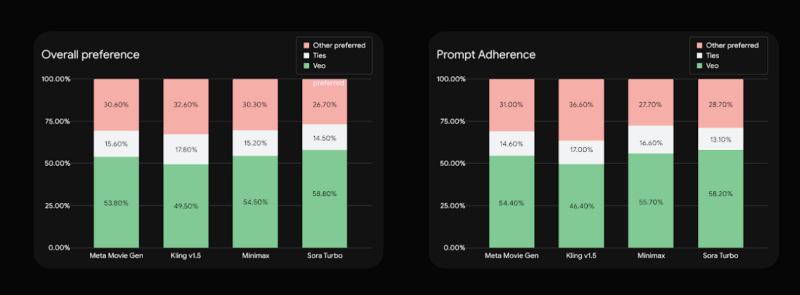
Join our daily and weekly newsletters for the latest updates and exclusive content on industry-leading AI coverage. Learn More Google is going head to head against OpenAI’s Sora with the newest version of its video generation model, Veo 2, which it says makes more realistic-looking videos. The company also updated its image generation model Imagen 3 to produce richer, more detailed photos.  Google said Veo 2 has “a better understanding of real-world physics and the nuances of human movement and expression.” It is available on Google Labs’ VideoFX platform — but only on a waitlisted basis. Users will need to sign up through a Google Form and wait for access to be granted provisionally by Google at a time of its choosing. “Veo 2 also understands the language of cinematography: Ask it for a genre, specify a lens, suggest cinematic effects and Veo 2 will deliver — at resolutions up to 4K,” Google said in a blog post.  Video generated with Veo 2 While Veo 2 is available only to select users, the original Veo remains available on Vertex AI. Videos created with Veo 2 will contain Google’s metadata watermark SynthID to identify these as AI-generated.  Google admits, though, that Veo 2 may still hallucinate extra fingers and the like, but it promises the new model produces fewer hallucinations.   Veo 2 will compete against OpenAI’s recently released Sora video generation model to attract filmmakers and content creators. Sora had been in previews for a while before OpenAI made it available to paying subscribers.  Impressively, Google says that on its own internal tests gauging “overall preference” (i.e. which videos an audience liked better) and “prompt adherence” (how well the videos matched the instructions given by the human creator), Veo was preferred by human evaluators to Sora and other rival AI models. Google announced Veo in May of this year during its Google I/O developer conference with a video made in partnership with actor-musician Donald Glover, aka Childish Gambino. AI video generation still needs some work AI video generation has long been an area of generative AI in which big model developers, like Google and OpenAI, regularly compete with and catch up with relatively smaller companies.  RunwayML, one of the pioneers of AI video generation, recently launched advanced controls for its Gen-3 Alpha Turbo model. Pika Labs released Pika 2.0, giving users more control and enabling them to add their own characters to a video. Luma AI announced a partnership with AWS to bring its models to Bedrock for enterprise use. Luma also expanded its Dream Machine generation model. However, AI video generation still needs to convince both creators and viewers. After Sora’s long-anticipated release, people remained skeptical of its capabilities when it continued to generate physics and anatomy-defying figures. Users felt it gave inconsistent results.  A trailer from the recent Game Awards also showed people’s distrust of what they perceive as “AI slop.”  Some filmmakers, though, have begun to embrace the possibilities AI video generators can provide. Famed director James Cameron joined the board of Stability AI, while actor Andy Serkis announced he was building an AI-focused production company.  Google said it’s seeing interest from many users. The company said YouTube creators have been using VideoFX to make backgrounds for YouTube Shorts to save time.  Updates to Imagen 3 Google also updated its image model Imagen 3, which it recently made available through its Gemini chatbot on the web, to be more realistic and offer brighter images.  Imagen 3 can now render more art styles accurately, “from photorealism to impressionism, from abstract to anime.” Google said the model will also follow prompts more faithfully.  People can access Imagen 3 through ImageFX. source

Google debuts new AI video generator Veo 2 claiming better audience scores than Sora Read More »

Retrieval-Augmented Generation Is Revolutionizing Businesses

Generative AI (genAI) has the potential to radically elevate customer experiences and streamline operations, delivering transformative impact across the enterprise, yet businesses encounter a significant challenge: the inherent limitations of foundational models. These models often struggle with delivering accurate and relevant outputs, primarily due to their constrained training datasets. Our latest Forrester report introduces retrieval-augmented generation (RAG) as a solution, integrating data indexing and knowledge retrieval with generative processes to overcome these challenges. This technology plays a crucial role in advancing genAI, supported by a growing ecosystem of software platforms. The RAG Revolution: From Engine To Ecosystem Leading technology vendors and forward-thinking enterprises are evolving their RAG engines — enhanced with essential core capabilities — into comprehensive, four-layer platforms designed to meet a broad range of real-world business needs. Infrastructure support streamlines integration with existing cloud and data infrastructure. Development enablement facilitates RAG-based application development, especially AI agents; platform operations provide manageability and observability for RAG adoption; and RAG governance offers guardrails for security, privacy, and regulatory compliance. Navigating The Software Ecosystem The ecosystem supporting RAG platforms is diverse, encompassing RAG platform builders, enablers, and service providers. Each plays a crucial role in the development and deployment of RAG technologies. From public cloud providers offering essential building blocks for RAG adoption to AI/ML platform vendors enriching RAG features, the landscape is rich and varied. Our report offers a comprehensive analysis of these players, providing businesses with the knowledge to choose the right partners for their RAG journey. Practical Steps For Business Leaders Adopting RAG isn’t just about leveraging new technology; it’s about transforming business operations to be more efficient, responsive, and intelligent. To this end, our report outlines four pragmatic steps for integrating RAG solutions: Data preparation. Ensuring that your data is AI-ready is foundational. Clean, structured, and ethically sourced data enhances RAG system performance. Optimization. Fine-tuning retrieval algorithms and prompt engineering can significantly improve the quality of generated outputs. Integration. Seamlessly integrating RAG systems with existing workflows and technologies is crucial for maximizing their utility. Human-centric design. Designing RAG systems with the end user in mind ensures that they meet real business needs and gain wider acceptance. For business leaders, understanding and implementing RAG technologies is not just about staying ahead in the tech curve — it’s about redefining what’s possible with AI. RAG platforms offer the promise of intelligent automation, sophisticated data analysis, and enhanced customer interactions, among other benefits. Embarking On Your RAG Journey Our report, Forrester’s Guide To Retrieval-Augmented Generation, Part Two, serves as a roadmap for businesses looking to explore the vast potential of RAG. It provides not only an in-depth analysis of the current state of RAG technology but also practical advice for implementation and optimization. Looking to further delve into how RAG can transform your business capabilities? Check out part one of this report series! Forrester clients can also schedule an inquiry with me for a tailored discussion on your RAG journey. source

Retrieval-Augmented Generation Is Revolutionizing Businesses Read More »

All 6 Types of IVR Routing and When to Use Each One

Interactive Voice Response (IVR) routing is a way to guide your callers to the best-fit agent, department, or service center to answer their questions, solve their queries, and meet their specific needs. The end result? Higher customer satisfaction, plus streamlined call management for your business. IVR is a strategic tool that benefits your callers by reducing their wait times and improving service accuracy. With a well-optimized routing system, they can easily find the department they’re looking for without being transferred from one agent to another. The key is designing call flows that take advantage of different types of IVR routing. Each serves a unique function and has specific scenarios that it’s best suited for. Most businesses use more than one type. These are the six IVR routing types I’ll cover: Caller ID routing. Data-directed routing. Location-based routing. Menu options routing. Time-based routing. Skills-based routing. Most modern business phone services and call center software include built-in tools to set up basic IVR routing. Administrators can easily set up the IVR for a single office or simple phone tree without the help of a specialist. Complex IVR routing may require specialist assistance, as well as upgrades and third-party integrations. 1 RingCentral RingEx Employees per Company Size Micro (0-49), Small (50-249), Medium (250-999), Large (1,000-4,999), Enterprise (5,000+) Medium (250-999 Employees), Large (1,000-4,999 Employees), Enterprise (5,000+ Employees) Medium, Large, Enterprise Features Hosted PBX, Managed PBX, Remote User Ability, and more 2 Talkroute Employees per Company Size Micro (0-49), Small (50-249), Medium (250-999), Large (1,000-4,999), Enterprise (5,000+) Any Company Size Any Company Size Features Call Management/Monitoring, Call Routing, Mobile Capabilities, and more 1. Caller ID routing Caller ID routing uses a caller’s phone number to determine the best course for the call. This method is best if you need to create a personalized experience for frequent callers or prioritize important clients. If that’s the case, you might configure your business’ IVR system to recognize phone numbers of existing clients or VIP customers. When these customers call, the system will route them directly to a dedicated account manager or a priority support team. This ensures high-value clients receive immediate and personalized attention, which should keep them happy. Beyond that, you could also use caller ID routing to identify and redirect frequent callers to specific departments they regularly interact with. This will streamline the caller’s journey by reducing the need for repeated navigation through the IVR menu and also help your business manage call queues more effectively. In short, caller ID routing is a good way to offer a tailored experience to high-value customers or streamline service for existing ones — both of which should reinforce customer loyalty. 2. Data-directed routing Data-directed routing uses your customer’s previous interactions to improve call flows and create a more personalized experience for callers. By accessing customer data like purchase history, account information, or previous service requests, this IVR routing type intelligently directs the call to the most suitable agent or department. Callers identified by account history as being in arrears may be routed to collections, for example, or routed based on real-time information like account status or service level agreements. From there, customers can get information or make a payment using the IVR. Bypassing general inquiry channels saves time for the caller. It also ensures they’re speaking with an agent who is already familiar with their specific requirements. Callers will appreciate data-directed routing, because it personalizes service and reduces the need for them to repeatedly provide the same information over and over again. Like the other types of routing on this list, if you use it right, you’ll see higher satisfaction rates and ultimately greater customer loyalty. 3. Location-based routing In location-based routing, the IVR system utilizes a caller’s geographical location to direct their call to the nearest or most appropriate service center or representative. This method is most helpful if your business has multiple regional offices or service areas, as it ensures your callers get localized support tailored to their specific region. Let’s say you run a retail chain with stores across the country. You can use location-based routing to ensure that your callers are connected to the store that’s closest to them geographically. This approach also allows for region-specific information, like local promotions or inventory, to be conveyed accurately. Similarly, if you have a service-based business that’s region-specific, like a utility company, your callers can be automatically connected to local offices for more relevant assistance. Overall, location-based routing gives callers a more personalized experience while also helping your business manage call volumes more efficiently across different locations. 4. Menu options routing This is one of the more familiar types of IVR routing. As the name implies, callers are given a variety of menu options to choose from. Based on their selections, their call is directed to the most appropriate agent or department. The nice thing about this method is that it’s highly versatile and can be customized to suit a wide range of service needs. For example, a utility company could use menu options routing to categorize calls into billing, outage reporting, or general inquiries. By pressing a corresponding number on their keypad, callers can quickly navigate to the appropriate department without having to speak to an intermediary. This not only speeds up the call handling process but also ensures your callers are connected to the agents best equipped to resolve their specific issues. Menu options can also be great for improving efficiency. It can be designed to decrease high call queuing times during peak hours by distributing calls based on the type of inquiry. During a promotional period, for example, a retail business might have a dedicated menu option just for promotional queries, which helps if you’re expecting an increase in these types of calls. 5. Skill-based routing Skill-based routing is one of several important call center software features. It’s all about connecting your callers with the most qualified agent possible. This is especially helpful if a customer has a more technical issue or needs extra

All 6 Types of IVR Routing and When to Use Each One Read More »