See how Google Gemini 2.0 Flash can perform hours of business analysis in minutes

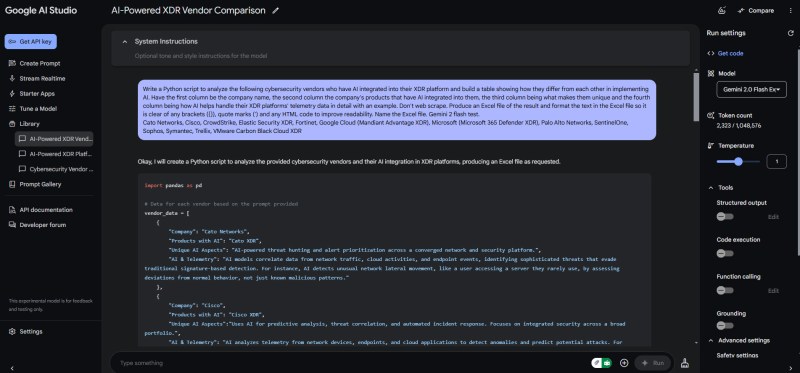
Join our daily and weekly newsletters for the latest updates and exclusive content on industry-leading AI coverage. Learn More Anyone who has had a job that required intensive amounts of analysis will tell you that any speed gain they can find is like getting an extra 30, 60, or 90 minutes back out of their day. Automation tools in general, and AI tools specifically, can assist business analysts who need to crunch massive amounts of data and succinctly communicate it. In fact, a recent Gartner analysis, “An AI-First Strategy Leads to Increasing Returns,” states that the most advanced enterprises rely on AI to increase the accuracy, speed, and scale of analytical work to fuel three core objectives — business growth, customer success, and cost efficiency — with competitive intelligence being core to each. Google’s newly released Gemini 2.0 Flash provides business analysts with greater speed and flexibility in defining Python scripts for complex analysis, giving analysts more precise control over the results they generate. Google claims that Gemini 2.0 Flash builds on the success of 1.5 Flash, its most adopted model yet for developers. Gemini 2.0 Flash outperforms 1.5 Pro on key benchmarks, delivering twice the speed, according to Google. 2.0 Flash also supports multimodal inputs, including images, video, and audio, as well as multimodal output, including natively generated images mixed with text and steerable text-to-speech (TTS) multilingual audio. It can also natively call tools like Google Search, code execution, and third-party user-defined functions. Taking Gemini 2.0 Flash for a test drive VentureBeat gave Gemini 2.0 Flash a series of increasingly complex Python scripting requests to test its speed, accuracy, and precision in dealing with the nuances of the cybersecurity market. Using Google AI Studio to access the model, VentureBeat started with simple scripting requests, working up to more complex ones centered on the cybersecurity market. What’s immediately noticeable about Python scripting with Gemini 2.0 Flash is how fast it is — nearly instantaneous, in fact — at providing Python scripts, generating them in seconds. It’s noticeably faster than 1.5 Pro, Claude, and ChatGPT when handling increasingly complex prompts. VentureBeat asked Gemini 2.0 Flash to perform a typical task that a business or market analyst would be requested to do: Create a matrix comparing a series of vendors and analyze how AI is used across each company’s products. Analysts often have to create tables quickly in response to sales, marketing, or strategic planning requests, and they usually need to include unique advantages or insights into each company. This can take hours and even days to get done manually, depending on an analyst’s experience and knowledge. VentureBeat wanted to make the prompt request realistic by having the script encompass an analysis of 13 XDR vendors, also providing insights into how AI helps the listed vendors handle telemetry data. As is the case with many requests analysts receive, VentureBeat asked Python to produce an Excel file of the results. Here is the prompt we gave Gemini 2.0 Flash to execute: Write a Python script to analyze the following cybersecurity vendors who have AI integrated into their XDR platform and build a table showing how they differ from each other in implementing AI. Have the first column be the company name, the second column the company’s products that have AI integrated into them, the third column being what makes them unique and the fourth column being how AI helps handle their XDR platforms’ telemetry data in detail with an example. Don’t web scrape. Produce an Excel file of the result and format the text in the Excel file so it is clear of any brackets ({}), quote marks (‘) and any HTML code to improve readability. Name the Excel file. Gemini 2 flash test.Cato Networks, Cisco, CrowdStrike, Elastic Security XDR, Fortinet, Google Cloud (Mandiant Advantage XDR), Microsoft (Microsoft 365 Defender XDR), Palo Alto Networks, SentinelOne, Sophos, Symantec, Trellix, VMware Carbon Black Cloud XDR Using Google AI Studio, VentureBeat created the following AI-powered XDR Vendor Comparison Python scripting request, with Python code produced in seconds: Next, VentureBeat saved the code and loaded it into Google Colab. The goal in doing this was to see how bug-free the Python code was outside of Google AI Studio and also measure its speed of being compiled. The code ran flawlessly with no errors and produced the Microsoft Excel file Gemini_2_flash_test.xlsx. The results speak for themselves Within seconds, the script ran, and Colab signaled no errors. It also provided a message at the end of the script that the Excel file was done. VentureBeat downloaded the Excel file and found it had been finished in less than two seconds. The following is a formatted view of the Excel table where the Python script was delivered. The total time needed to get this table done was less than four minutes, from submitting the prompt, getting the Python script, running it in Colab, downloading the Excel file, and doing some quick formatting. A convincing argument to unleash AI on monotonous tasks For the many professionals who have worked in a variety of business, competitive, and market analyst roles in their careers, AI is the force multiplier they’ve been looking for to trim hours off of repetitive, monotonous tasks. Analysts, by nature, have a high degree of intellectual curiosity. Unleashing AI on the most mundane and repetitive parts of their jobs and equipping them to create the comparisons and matrices they are often asked to develop quickly is a powerful boost to an entire team’s productivity. Managers and leaders of business, competitive analysis, and marketing teams need to consider how the fast advances in models, including Google’s Gemini 2.0 Flash, can help their teams get growing workloads under control. Helping lift that burden will give analysts a chance to do what they enjoy and do best, which is to use their intuition, intelligence, and insight to deliver exceptionally valuable ideas. source

See how Google Gemini 2.0 Flash can perform hours of business analysis in minutes Read More »

Striking Gold? HSBC's Gold Token Unlocks New Horizons

In an era marked by rapid digital transformation, HSBC has boldly stepped into the future of finance with the introduction of its Gold Token in Hong Kong. In our latest case study, we dive deep into the key components of HSBC’s Gold Token journey, sharing the strategic insights that have helped the bank advance in the financial services sector.  HSBC’s Strategic Leap Into Tokenized Gold  Many firms pursued blockchain or distributed ledger technology for the sake of innovation or publicity, often resulting in products that failed to address real needs, and eventually faded away. HSBC avoided the trap of innovating for innovation’s sake. Instead, its priority was to address customers’ needs and deliver tangible business value.  At the heart of this Gold Token initiative were three primary motivators:  Market demand and cultural resonance: Recognizing gold’s cultural significance and its role as a safe haven asset, HSBC identified a substantial opportunity in Hong Kong’s market. The bank aimed to democratize access to gold investments, catering to the region’s growing appetite for digital asset solutions.  Innovation meets tradition: With a rich history as one of the world’s leading gold clearing firms, HSBC leveraged its traditional strengths, employing distributed ledger technology to enhance accessibility, efficiency, and the overall customer experience in gold trading.  Strategic differentiation and value creation: Facing competition from traditional and emerging digital financial products, HSBC set out to differentiate its Gold Token by emphasizing convenience, trust, transparency, and regulatory compliance. This approach not only positioned the Gold Token as a pioneering product but also reinforced HSBC’s role as a global bank with customer trust built through a long history.  The 3 Pillars Of HSBC’s Success  HSBC’s journey was underscored by meticulous strategy and execution across several domains:  Customer-centric innovation: Through in-depth market research and customer engagement, HSBC tailored the Gold Token to meet the explicit needs and preferences of its customers, ensuring a seamless and accessible investment experience.  Regulatory navigation and compliance: Proactive engagement with Hong Kong’s regulatory bodies allowed HSBC to align the Gold Token with existing laws and regulations, ensuring trust and security for its customers.  Technological excellence: Utilizing a proven distributed ledger platform for the Gold Token, HSBC capitalized on distributed ledger technology’s potential to offer instant settlements, fractional ownership, and 24/7 trading capabilities, setting new standards in the digital asset space.  Transformative Results And Broader Implications  The Gold Token initiative has not only achieved early success in terms of customer satisfaction and market penetration but has also sparked a conversation about the future of banking and investment in the digital age. HSBC’s experience offers valuable lessons for financial institutions worldwide, highlighting the importance of innovation, customer focus, and regulatory engagement in crafting successful digital asset strategies. Asset tokenization holds a significant potential to reshape the investment landscape going forward. In fact, Forrester predicts that the number of major banks issuing tokenized assets on blockchain will double in 2025. Explore this and more predictions in our latest investment and wealth management prediction report for 2025.  Forrester clients can read the full case study report here, or schedule a guidance session to chat more.  source

Striking Gold? HSBC's Gold Token Unlocks New Horizons Read More »

7 Best Square Alternatives Reviewed By Experts

Best Square alternative for working with a preferred payment processor: Clover Best Square alternative for e-commerce businesses: Shopify Best Square competitor for low-cost payment processing: Helcim Best Square alternative for online payment processing: Stripe Best Square alternative for inventory management: Lightspeed Best Square competitor for full-service restaurants: Toast Best Square alternative for high-risk businesses: PaymentCloud Square is one of the most popular point-of-sale (POS) systems on the market because of its forever-free subscription plan that lets merchants start selling and accepting payments easily. However, there are instances when businesses might outgrow Square’s services or find it lacking. Top Square competitors compared The top Square competitors typically offer free POS software solutions and competitive transaction fees. Below, you can compare my top picks for Square alternatives based on pricing, transaction fees, POS plan inclusion, and hardware costs. Starting price (monthly fee) Transaction fee Free POS plan Hardware starting price Clover $14.95 Varies No $199 (card reader) Shopify $39* 2.4%–2.9% + $0.30 Yes $49 (card reader) Stripe $0 2.9% + $0.30 Yes $59 (card reader) Lightspeed $89 2.6% + $0.30 No Undisclosed Helcim $0 Interchange plus 0.15%-0.50% and $0.15-$0.25 Yes $99 (PIN-enabled card reader) Toast $0 2.49%–2.99% + $0.15 Yes $0 with certain plans PaymentCloud $10 2%–4.3% No Custom *Shopify e-commerce or POS subscription required. Clover: Best Square alternative for working with a preferred payment processor Image: Clover Clover is a POS provider known for its top-of-the-line proprietary hardware, including mobile card readers, terminals, and countertop registers. Like Square, Clover offers solutions to businesses of all sizes and across most industries. But unlike Square, Clover can work with any processor on the Fiserv network, which lets businesses shop for their preferred payment processor. Why I chose Clover The ability to work with other payment processors is Clover’s biggest advantage over Square. This allows merchants to shop around for the lowest rates and work with a provider that suits their needs, unlike Square, which locks you in with their native payment processor. Clover also offers a wide range of proprietary hardware, from mobile card readers to full countertop terminals, kitchen displays, and even kiosks. It is also worth noting Clover’s strong offline functionality, which allows merchants to process card payments for up to seven days. Square only lets you process payments offline for 24 hours, after which you need to sync payments online. That being said, Clover’s hardware is sold through resellers, so pricing greatly varies. However, given that you can choose your preferred provider, doing a thorough research will help lower costs. Pricing Since businesses can purchase pre-programmed Clover hardware and software from their preferred payment processor, pricing greatly varies. Below are fees based on Fiserv terms and rates: Monthly fee: $14.95 to $69.90. Transaction fees: 2.3%–2.6% + 10 cents to 3.5% + $0.10. Hardware cost based on Clover website: $199 for Clover Go (mobile card reader) $279 for Clover Compact (countertop terminal) $1,799 for Clover Station Duo (full POS with cash register and receipt printer) Features Credit card preauthorization. Offline payment processing for up to seven days. Customer profiles based on purchases. Proprietary hardware variety for all types of businesses. Pros and cons Pros Cons Works with other payment processors. Hardware cannot be reprogrammed; it is tied to the payment provider. Strong offline mode. Pricing depends on the payment processor. Easy-to-use proprietary hardware. Expensive hardware. Shopify: Best Square alternative for e-commerce businesses Image: Shopify Shopify is a top-rated and widely popular e-commerce platform for real-world users and experts alike. Launched in 2006, it added a POS system in 2013 to let merchants easily sell in-person and online. Shopify is an excellent choice for multichannel sales as it has strong omnichannel features — an easy-to-use, top-notch website builder, robust e-commerce and marketing features, and POS hardware for in-person selling. All of these tools are readily available from the merchant dashboard and seamlessly integrate with each other. Why I chose Shopify Shopify and Square are known for their multichannel selling features for online and in-person sales. However, as previously mentioned, Shopify was built first as an e-commerce platform, and it shows. Shopify beat Square in almost every e-commerce feature during my evaluation, with its customizable website builder, built-in marketing tools, and advanced inventory management. Shopify also has the edge over Square because it allows its merchants to use their preferred payment processor, unlike Square, which locks you in with its built-in payment provider. Do note, though, that this entails an added fee. Businesses that primarily sell online and are looking to expand into in-person sales will find Shopify to be an excellent Square alternative. Pricing $0 for Shopify POS Lite; included in e-commerce subscription plans ($39-$399). $89 per location for Shopify POS Pro. $49 for card reader, $349 for POS Terminal, $459-$999 for countertop kits. Transaction fees: 2.4% + 30 cents to 2.9% + 30 cents for online transactions. 2.4% to 2.7% for in-person transactions. Additional 0.5 to 2% if using a third-party payment provider. Only available for online sales. Features Complete online store builder with robust inventory and marketing tools. Strong omnichannel sales — native multichannel and social media selling integrations. Extensive third-party integrations. Mobile app and checkout via the Shopify POS mobile app. Return, refund, and exchange processing. Customer and staff management. Other payments accepted — QR, checks, buy now pay later (BNPL). Detailed reports and analytics — cash flow, sales reports (customizable by staff, location, and date), tax, discount reports, product and product categories. Pros and cons Pros Cons Native robust e-commerce platform. Limited offline functionality (no credit card transactions). Smart omnichannel sales tools. Added transaction fees for third-party payment processors. Excellent 24/7 customer support. E-commerce or POS subscription required. Helcim: Best Square competitor for low-cost payment processing Image: Helcim Helcim is a merchant service provider and payment processor that offers a full suite of free tools. However, it is best known for its interchange-plus pricing structure and automated volume discounts, which allow businesses to save significantly on processing fees. Helcim also has strong B2B payment features. Aside from

7 Best Square Alternatives Reviewed By Experts Read More »

Jane Clare體驗店「康膚薈」在尖沙咀廣東道海威商業中心盛大開幕

(相右起)Jane Clare創辦人李慧賢、立法會議員林健鋒。 香港知名護膚品牌Jane Clare一直致力推動以CleanBeauty純淨護膚、安全、無害為原則,堅持不使用有害的化學防腐劑及其他成份,由李慧賢BBS,JP創辦,公司在尖沙咀廣東道海威商業中心的體驗店「康膚薈」日前正式開張,請來大量嘉賓,場面墟冚。康膚薈由地下至2樓有三層,除了銷售產品之外,一樓可以讓會員坐下休息飲杯茶,二樓有廂房給會員做Facial或spa,整體感覺像一個會所,非常舒服。 當日亦請了一些明星出席,例如有香港行政會議成員暨香港立法會議員林健鋒GBM,GBS,JP、第十四屆港區全國政協委員暨香港總商會主席陳瑞娟BBS,CPA、抖音美奢頭部達人昕昕、東南亞及海外市場戰略夥伴Dr. Pepe Colon及JaneClare藥妝有限公司共同創辦人李展偉一起進行啟動儀式。 另外,演員龔慈恩表示,她不僅是以資深演員身份到場,而是Jane Clare一位資深忠實用家,更為大家公開分享她與JaneClare的親密關係。她說:「我慶幸認識到創辦人李慧賢女士(Angela),令到我皮膚受惠,因為工作要常周圍飛,只要皮膚狀態稍差,即找Angela及她團隊急救皮膚,我對護膚不敢說有何心得,因為不算勤力保養,但多年來就靠她們幫手,我其實都覺得護膚是必需的,護膚與化妝也是自己工作的一部份,我有跟女兒(林愷鈴)分享,一齊護膚是我們兩母女最溫馨嘅時刻及記憶畫面。」 另一位演員楊卓娜則為《Jane Clare康膚薈》擔任一日店長,現場有不少粉絲專程到店支持及購買,她現場分享自己使用JaneClare的心得及感受。她表示,最近忙於在深圳拍劇,亦要兼顧平台帶貨的工作。因為長期睡眠不足,令面上長了不少瘡瘡。她說:「我本身是JaneClare用家,靠這個品牌的面膜,幫我急救肌膚。雖然近日我都感冒了,但仍保持不錯的肌膚狀態。」卓娜亦分享護膚心得,她平時會多吃雞蛋,吸收蛋白質,也會多飲湯水及勤力敷面膜,保持皮膚的彈性及水份。 LinkedIn Email Facebook Twitter WhatsApp source

Jane Clare體驗店「康膚薈」在尖沙咀廣東道海威商業中心盛大開幕 Read More »

Gig workers behind AI training firm sue for better conditions

Moreover, the subject matter of many prompts, some of which involved suicidal ideation and violence, among other disturbing topics, coupled with restrictions from Scale AI around break times and outside research, created a grueling, authoritarian workplace in which workers could be terminated for complaining about working conditions, payments, or company processes, the complaint said. Additionally, the suit says that McKinney and the many others in his position were misclassified under California law as independent contractors, rather than employees. Generally speaking, employers have fewer legal responsibilities to independent contractors than they have to full employees, who are more likely to be subject to state and federal laws about overtime payment, among other things. California’s legal standard for deciding which workers are independent contractors and which are employees is fairly strict, and is referred to as an ABC test, for its three-pronged nature. According to the California Labor and Workforce Development Agency, workers are employees unless they are free from the control and direction of the hiring entity, are doing work outside the usual course of the hiring entity’s business, and are “customarily engaged” in an independent business of the type they’re being hired for. None of those standards, the lawsuit argues, are met in the case of McKinney and the other Scale AI workers in his position. source

Gig workers behind AI training firm sue for better conditions Read More »

The Customer Service Tech Landscape: What It Means For You

Face it — companies must navigate a perfect storm of ballooning customer inquiries, talent shortages, hybrid operations, and a rising tide of customer expectations. To succeed, customer service organizations must curate a set of technologies that underpin their operations. To discover the most important ones, we surveyed technology decision-makers, suppliers, and other subject matter experts for their opinions about which ones really mattered. We narrowed our search to technologies that are: 1) the most critical to customer operations; 2) commercially available at enterprise scale; and 3) solve key challenges for self-service and digital engagement, inquiry routing, agent operations, collaboration, and workforce management. We published our findings in our report, The Forrester Tech Tide™: Contact Centers For Customer Service, Q4 2024. Key Findings From Forrester’s Tech Tide Here are some highlights from our report: Technology stalwarts now work better together. Contact center as a service (CCaaS), workforce management, and ticketing form the backbone of customer operations. Even though they’ve been around for decades, vendors continue to make them relevant today. Vendors also realize that these technologies must work together to deliver the most value. They offer guidance and reference architectures to do just that. Generative AI increases the value of a broad swath of technologies. Knowledge management, agent augmentation, and automated quality monitoring have been in the market for years. Yet they haven’t generated their expected value because they’re just too hard to use. Generative AI’s personalization and summarization capabilities have breathed new life into them, making their ROI potential finally achievable. It’s a fine balance between risk and reward for newer technologies. There are many exciting ones out there today. Examples include agent augmentation technologies, which offload repetitive work from agents; conversational AI, which simulates human conversation; and digital adoption platforms, which guide agents through onboarding flows and complex processes. They often show great potential in pilots but don’t always deliver results when scaled because organizations don’t pay enough attention to their adoption, change management, and governance. Some long-established technologies are finally put to rest. AI — coupled with the focus on fluid, ongoing, and personal customer engagement — has killed off some categories. For example, there are no standalone options for touch-tone and directed dialogue IVRs as they are now part of more comprehensive CCaaS solutions. Nowadays, sophisticated conversational experiences driven by large language models replace these basic solutions. This puts an end to one of the longest-standing technologies in the customer service space. We feature 20 of the top technologies for customer service in our report, highlighting their maturity and business value and giving guidance on whether you should experiment, invest in, maintain, or divest from these technologies. Let us know what you think, and connect with me or one of my colleagues via inquiry to discuss further. source

The Customer Service Tech Landscape: What It Means For You Read More »

Building a Global Team of Experts to Support Complex Enterprise Sales

Today’s enterprise data systems are extraordinarily complex, and selling to the world’s largest enterprises requires a team with expertise who has a passion for and a deep understanding of data, infrastructure, and complex technical requirements. From integrating data to managing global performance, the technical team has become more essential now than ever in handling long-cycle, high-stakes deals.   The Changing Role of IT in Enterprise Sales  Over the past decade, the role of IT in enterprise sales has transformed. With the rise of cloud computing and data-driven decisions, clients now expect vendors to partner with them to provide technical solutions and strategic guidance on data integration, scalability, and performance. Today, enterprise sales focus as much on technical expertise as it does on closing deals — and it should, given it’s a key driver of realized business growth.   A significant shift in recent years has divided the market into two categories: product-led growth, where cloud-based and self-service models prevail; and the traditional enterprise sales model, which focuses on large, complex systems that require a hands-on, technology-led approach. Cloud adoption has simplified some aspects of sales for smaller clients, but selling to large enterprises has only become more complex, especially for IT leaders managing the infrastructure and expertise needed for customized, long-cycle solutions.  Related:Things CIOs and CTOs Need To Do Differently in 2025 Navigating Complex IT Requirements in Enterprise Sales  Enterprise sales are characterized by complex IT requirements, involving requirements gathering, multiple decision-makers, and highly customized solutions that must integrate seamlessly with existing infrastructure. This complexity presents both a challenge and an opportunity for IT leaders, and managing these requirements depends on team expertise.   I find it invaluable when technology professionals specialize in enterprise sales intricacies, from data integration and system architecture to performance optimization, big data engineering, and cybersecurity. When this cross-pollination occurs, technical prowess becomes the backbone of sales efforts, ensuring solutions are robust and aligned with a client’s broader goals.  For example, we recently collaborated with a global client facing data integration challenges across regions with diverse privacy regulations. To address their needs, we developed a plan that accounted for regional policies, operational requirements, and technical constraints, ensuring the solution aligned with their broader strategic goals. Our pilot program helped operationalize the solution for production from day one, consolidating workloads like ETL and OLAP analysis, streamlining administration, and enabling seamless scalability. This approach not only supported global growth without compromising data performance or security but also freed up the client’s most valuable resources to focus on next-generation innovation and revenue generation rather than managing or patching legacy systems. This level of expertise is essential for enterprise sales — without it, you risk missing opportunities to deliver the strategic value enterprises need to remain competitive and grow.  Related:How CIOs Can Contribute to Corporate Strategy Recruiting Top Talent  A successful enterprise sales strategy begins with a strong team. Recruiting the right talent is crucial because the data and IT requirements for enterprise sales are complex, and skilled professionals are in short supply.  When hiring for technology-focused roles, prioritize experience in large-scale infrastructure, data management, and system integration. Enterprise sales expertise cannot be taught in a classroom — it comes from years of handling complex systems and understanding how technical capabilities align with business outcomes.    Related:What to Do When a Key IT Vendor Suddenly Goes Out of Business Expanding Talent Search Through Global Recruitment  Before the COVID-19 pandemic, operations were centralized, with salespeople based near clients. Remote work, however, has allowed many growing companies to recruit top talent worldwide, strengthening teams by tapping into a broader talent pool. It has simultaneously dispersed customer locations outside of the company’s headquarters.  At my current company, our team currently spans seven time zones, which gives us unique insights into region-specific challenges. For example, energy availability impacts IT operations differently across regions; in Europe, a strong emphasis on sustainability drives climate-friendly solutions. This regional expertise helps us understand our clients’ unique needs more deeply and enables us to provide tailored solutions that are aligned with local priorities.   Building a Collaborative Culture Across Regions  With a global technical sales team, fostering collaboration and maintaining cohesion are key for alignment and growth across the business. Codify your values by training teams on effective cross-regional work and integrating these values into your performance management system. This helps establish a strong foundation for teams to work off of when solving client challenges and delivering results tied back to key business goals.  To drive collaboration in remote or hybrid settings, I recommend AI note-taking tools to document and streamlining action items, as well as capture the voice of the customer. I also recommend investing in tools like internal wikis, instant message apps and video conference tools, which enable productivity and teamwork regardless of location. At our company, these tools make it possible to operate as a fully remote-first company and improve our recruitment reach and overall efficiency.  Technical Sales’ Role in Building Customer Relationships  While relationships often drive enterprise sales, technology’s role in cultivating these relationships is significant and sometimes overlooked. Technical expertise demonstrated in customer engagements beyond the sales call is critical to establishing trusted relationships and meeting client goals.  It is for this reason that technical teams provide strategic guidance throughout the sales cycle, help drive system optimization, advise on integrating new technologies, and ultimately keep clients competitive. For companies scaling teams for enterprise sales, technical expertise is indispensable. Success in enterprise sales hinges on capable, technical teams skilled in managing data, infrastructures, and complex system integration and consolidation.   By recruiting top technical talent, fostering a collaborative culture, and drawing on global insights, companies can better navigate enterprise sales complexities and deliver solutions that address the unique data needs of the world’s largest companies. Ultimately, long-term success in enterprise sales relies on the combined strengths of the technical sales team, empowered to handle the scale and demands of these high-stakes engagements.  source

Building a Global Team of Experts to Support Complex Enterprise Sales Read More »

Senate Dem's Bill Would Mandate New FCC Outage Reports

By Christopher Cole ( December 17, 2024, 4:51 PM EST) — Networks that receive funding to help them rebound from climate-related disasters would need to file new reports of outages to the Federal Communications Commission under a Democratic bill filed in the U.S. Senate…. Law360 is on it, so you are, too. A Law360 subscription puts you at the center of fast-moving legal issues, trends and developments so you can act with speed and confidence. Over 200 articles are published daily across more than 60 topics, industries, practice areas and jurisdictions. A Law360 subscription includes features such as Daily newsletters Expert analysis Mobile app Advanced search Judge information Real-time alerts 450K+ searchable archived articles And more! Experience Law360 today with a free 7-day trial. source

Senate Dem's Bill Would Mandate New FCC Outage Reports Read More »

MidJourney adds Pinterest-like ‘moodboards’ and support for multiple custom AI image models

Join our daily and weekly newsletters for the latest updates and exclusive content on industry-leading AI coverage. Learn More MidJourney, the popular AI image generator with more than 19 million users (including several of us at VentureBeat), has introduced new features to enhance user customization. Today, the small company launched Pinterest-inspired “moodboards” and support for multiple personalization profiles — meaning users can now create and switch among multiple custom versions of Midjourney’s latest image generator AI model, version 6.1, that are tailored to their unique aesthetics. The updates aim to streamline the creative process for individuals and teams, making it easier to integrate personalized styles across various projects. What are Midjourney’s new moodboards? The standout feature, moodboards, enables users to upload curated collections of images that act as inspiration for generating new art. The AI model adapts to the diversity and complexity of the uploaded images, creating a unique style profile that remixes the visual elements. This addition is complemented by the ability to create multiple personalization profiles, allowing users to organize and deploy their different styles seamlessly. Setting up a custom model has also become significantly faster, with the company claiming a fivefold improvement in image ranking speed. The “ranking” system is how Midjourney trains a custom model on behalf of you, the user. You need to navigate to Midjourney’s image ranker and pick which of a pair of random images you like best, then continue rating pairs of images until you’ve reached a certain threshold where the model understands what kinds of images and aesthetics you like. Users now need just 40 ratings to begin creating a profile, with optimal stability achieved at 200. Previously, you needed 200 to personalize the model. While heavy users may still prefer contributing thousands of ratings for maximum precision, the streamlined process lowers the barrier to entry for new users. Users can begin rating pairs of images at midjourney.com/personalize. Better organization features The updates also introduce organizational improvements. Users can now name their profiles, designate one or multiple profiles as defaults, and track all images associated with specific profiles. Midjourney emphasizes that these features are particularly beneficial for those juggling multiple projects or collaborating with others. David Holz, founder of Midjourney, shared the announcement on the company’s Discord server earlier today. He explained the motivation behind the updates, expressing a desire to make personalization accessible for a broader range of creative workflows. Holz highlighted that the new tools allow users to take control of their projects while maintaining the flexibility to work with diverse creative teams. As Midjourney continues to refine its personalization infrastructure, the company is soliciting user feedback through its “ideas-and-features” channel. These developments highlight the platform’s commitment to empowering creators with tools that are both intuitive and powerful, marking another step forward in the evolution of AI-assisted creativity. The additions come as expected following Midjourney’s announcement last week of an experimental new collaborative image-making whiteboard feature called Patchwork. source

MidJourney adds Pinterest-like ‘moodboards’ and support for multiple custom AI image models Read More »

What Omnicom’s Acquisition Of IPG Means For Marketers

Omnicom Group and Interpublic Group (IPG) announced their intention to merge to form the largest global agency holding company. Executives indicate that they anticipate closing the deal in the second half of 2025. This would reshape the marketing services category by consolidating the media scale of two global holding companies, accelerating the role of technology and AI in marketing delivery, and setting the industry on a path toward a hybrid services and SaaS model. Both Omnicom and IPG executives held a joint conference call earlier today. What we know and can infer about the proposed deal thus far is: This is an acquisition, not a merger. Omnicom is acquiring IPG — this is not a merger of equals. Omnicom would be acquiring a slightly distressed IPG that has reported relatively flat growth for the last five quarters. This shows in the proposed leadership of the new company. In a joint conference call this morning, the two companies announced that John Wren will remain chairman and CEO of Omnicom; Phil Angelastro will remain EVP and CFO of Omnicom; and Philippe Krakowsky and Daryl Simm will serve as co-presidents and COOs of Omnicom. We assume a similar dynamic for the eventual structure of the new company. The benefit of this acquisition is scale. The new company would enjoy significant scale of technology, data, media clout, and the ability to produce content at the velocity and volume of media impressions. We anticipate that IPG Mediabrands will likely roll up to Omnicom Media Group, IPG’s growing commerce practice will likely be aligned with Omnicom’s Flywheel Digital unit, and Acxiom will likely be aligned with the technology group managing Omni, the holding company’s suite of proprietary technology. The combination of the Omni marketing operating system, Flywheel Digital, and Acxiom capabilities is a potent one, enabling Omnicom to better compete with Publicis Groupe, its Epsilon PeopleCloud, and recent commerce acquisition of Mars United. The new company would concentrate a culture of creativity. The Omnicom and IPG acquisition would place some of Madison Avenue’s most iconic creative agencies, such as McCann, FCB, The Martin Agency, Mullen, TBWA, BBDO, DDB, Goodby, and GSD&M, under single ownership. Both Omnicom and Interpublic Group leverage agency-first go-to-market models, rather than an integrated, holding-company-first model like that of Publicis Groupe or Dentsu. Omnicom and IPG’s like-minded approach to agency brands makes for a stronger likelihood of successful integration and enables the new company to focus on client and talent retention. Executives from both holding companies acknowledge that details regarding future leadership and structure remain undecided and that the deal is subject to regulatory review. Nonetheless, the larger industry and client implications are beginning to come into focus. For clients of either Omnicom Group or IPG, this acquisition means: Fewer enterprise choices will facilitate more independent options. The “big six” holding cos. may soon be the “big five,” creating some concern with having fewer options. Yet consolidation at the global level makes for opportunities in the independent marketplace. PE-backed, independent agencies like Horizon Media, PMG, DEPT, Tinuiti, Wpromote, and others have grown to capture scale in buying while delivering performance and tech skill. These companies must and will react to a shifting competitive landscape. Anticipate more growth in independents’ innovation investments and more focus in their proposition to compete with the global consolidation of marketing scale at Omnicom, Publicis, and WPP. Technology and innovation investments will accelerate AI’s role in marketing services. Omnicom and IPG executives point out that the combined resources will boost their technology investments. This will accelerate the already-underway AI arms race among the holding cos. and independents: 61% of agencies already use generative AI in marketing, the most mature group compared to IT, marketing orgs, and in-house agencies. Marketers should anticipate the proliferation of AI marketing in production, creative development, and media activation. As agencies race to build competing AI marketing platforms, the combination of SaaS and services will change not only how marketing is created but also how it’s paid for. Principal media solutions will proliferate and grow to account for nearly 10% global billings. Until recently, IPG was the last major holding company not to take an interest in media. While principal media practices are controversial, our research suggests that they represent less than 10% of total global media dollars under agency management. Yet with Omnicom’s existing principal media framework, marketers should expect a percentage of the IPG Mediabrands/MAGNA dollars to transact in principal media solutions, advancing the practice as more mainstream within the industry and within a combined Omnicon Media Group and IPG Mediabrands. If you are a Forrester client working with Omnicom or IPG and want to understand what this acquisition could mean for your business/brand, feel free to book an inquiry or guidance session with me. Some additional Forrester resources include: The Forrester Wave™: Media Management Services, Q4 2024 The Marketing Creative And Content Services Landscape, Q4 2024 Predictions 2025: Marketing Agencies Brand AI Models Will Reinvent How Marketing Creates Business Value source

What Omnicom’s Acquisition Of IPG Means For Marketers Read More »