OpenAI Slams Musk's 'Evidence-Free' Bid To Block For-Profit

By Lauren Berg ( December 13, 2024, 11:26 PM EST) — OpenAI urged a California federal judge Friday to reject Elon Musk’s bid to block the artificial intelligence research organization from transitioning into a for-profit enterprise, scoffing at Musk’s assertions of anticompetitive practices and arguing that the injunctive motion is “just another evidence-free effort to harass a competitor.”… Law360 is on it, so you are, too. A Law360 subscription puts you at the center of fast-moving legal issues, trends and developments so you can act with speed and confidence. Over 200 articles are published daily across more than 60 topics, industries, practice areas and jurisdictions. A Law360 subscription includes features such as Daily newsletters Expert analysis Mobile app Advanced search Judge information Real-time alerts 450K+ searchable archived articles And more! Experience Law360 today with a free 7-day trial. source

OpenAI Slams Musk's 'Evidence-Free' Bid To Block For-Profit Read More »

2. How different groups of U.S. Hispanics describe ‘machismo’

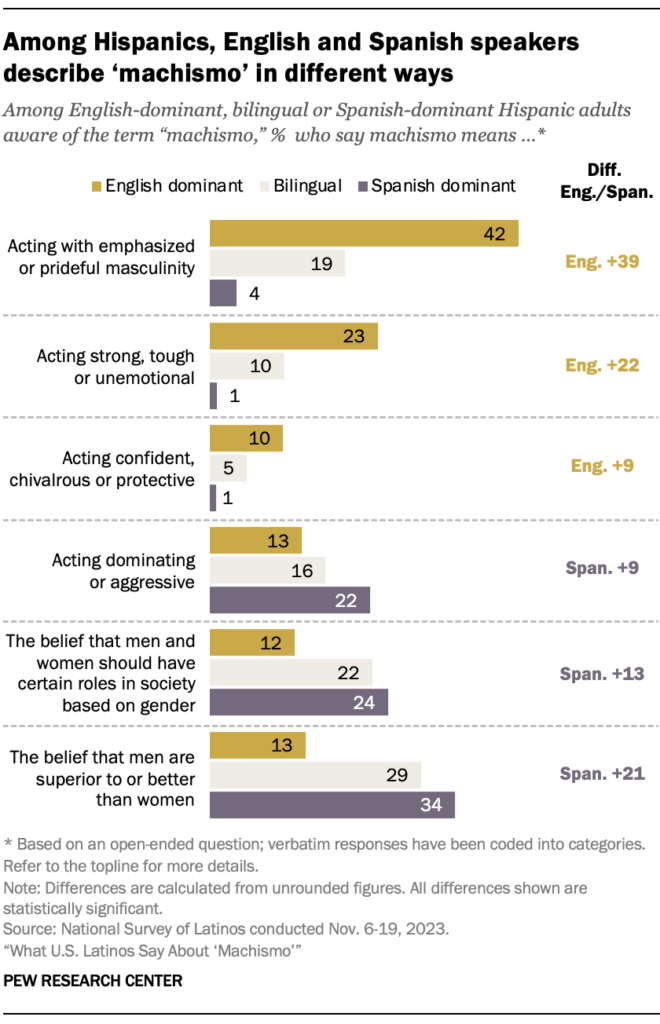
“Machismo” doesn’t have a single meaning among Hispanic adults who have heard of the term. However, certain groups of Hispanics are more likely to describe the concept in some ways than others. This chapter explores patterns among Hispanic adults in what machismo means to them. By language Machismo has its roots in the Spanish language, but the concept is prevalent in both Spanish- and English-speaking contexts. Survey findings show that views of machismo differ across Latinos’ language dominance.   Latinos who have heard of machismo and primarily speak English are more likely than primary Spanish speakers to say machismo means: Acting with emphasized masculinity or having masculine pride (42% of English-dominant Latinos say this vs. 4% of Spanish-dominant Latinos) Acting strong, tough or unemotional (23% vs. 1%) On the other hand, Spanish-dominant Latinos are more likely than English-dominant Latinos to say machismo is: The belief that men are superior to or better than women (34% of Spanish-dominant Latinos describe machismo this way vs. 13% of English-dominant Latinos) The belief that certain roles in society should be based on gender (24% vs. 12%) By nativity and immigrant generation Hispanics’ birthplace and the number of generations their family has lived in the U.S. are also linked to their views of machismo. For instance, among those who have heard of “machismo,” immigrants are twice as likely as U.S.-born Hispanics to say machismo is the belief that men are superior to women (34% vs. 16%). Among the U.S. born, there are also differences by generation: 20% of second-generation Latinos – those with at least one immigrant parent – define machismo this way, while 10% of Latinos with two U.S.-born parents do. By spouse or partner ethnicity Hispanics who are married to or living with a Hispanic partner hold different views about machismo than those with a non-Hispanic spouse or partner. For example, among Hispanic adults aware of the concept, those with a Hispanic partner are more likely than those with a non-Hispanic partner to describe machismo as the belief that men and women should have gender-based roles (25% vs. 12%). This pattern appears among both men and women: Among Hispanic men, 23% with a Hispanic partner say machismo is the belief that roles in society should be based on gender, versus 7% with a non-Hispanic partner. Among Hispanic women, 27% with a Hispanic partner describe machismo this way, versus 16% with a non-Hispanic partner. By gender There are only modest differences in how Hispanic men and women who have heard of machismo describe the concept: Hispanic men are more likely than Hispanic women to say machismo means emphasized or prideful masculinity (26% vs. 18%). Meanwhile, Hispanic women are more likely to say machismo is the belief that men and women should have gender-based roles (23% vs. 16%) or that it means acting dominating or aggressive (20% vs. 13%). When describing machismo in other ways, however, Hispanic men and women are closely aligned. For example, similar shares say machismo means acting strong, tough or unemotional (13% of men and 11% of women). By political party Latinos across political parties define machismo in similar ways. For example, 17% of Democrats and Democratic-leaning independents say machismo means acting dominating or aggressive, as do 15% of Republicans and Republican leaners. For more details on how other groups of Latinos describe machismo, including by age and education, refer to the appendix. U.S. Hispanics’ views of the pressures Hispanic men face The survey also asked Hispanic adults related questions about the pressures that Hispanic men face in the U.S. today: 46% say that in general, Hispanic men in the U.S. today face a great deal or fair amount of pressure to avoid talking about their feelings. 33% say Hispanic men face pressure to join in when other men are talking about women in a sexual way. 28% say Hispanic men face pressure to physically intimidate others. Overall, Hispanic adults are more likely to say that Hispanic men face each of these pressures than Hispanic women do. For example, 29% say Hispanic women in the U.S. today face a great deal or fair amount of pressure to avoid talking about their feelings – smaller than the 46% who say the same about Hispanic men. However, Hispanic adults are more likely to say Hispanic women face pressure than Hispanic men on other topics asked about in the survey. Some of these include doing the cooking and cleaning at home, being physically attractive and having few sexual partners. For additional survey findings on the pressures that Hispanic women and men face in the U.S. today, read “A Majority of Latinas Feel Pressure to Support Their Families or To Succeed at Work.” source

2. How different groups of U.S. Hispanics describe ‘machismo’ Read More »

How To Run a VoIP Quality Test and Improve Your MOS

A VoIP quality test measures the performance of your network connection. The test simulates a set number of calls on your network and uses key metrics to determine how calls would sound in different situations. It can help you understand whether your connection is strong enough before implementing a VoIP system and alert you to potential post deployment issues as well. Mean opinion score (MOS) is an industry standard metric for VoIP call quality — it’s a simple 1-5 rating system with 1 being the worst and 5 being the best. Anything above a 4 is sufficient and scores below 3.5 should be considered unacceptable. Below that range, users are more likely to experience mic echo, dropped calls, choppy or robotic sounds, and cutting out. This guide covers everything you need to know to perform VoIP tests and tweak settings to optimize for MOS. 1 RingCentral RingEx Employees per Company Size Micro (0-49), Small (50-249), Medium (250-999), Large (1,000-4,999), Enterprise (5,000+) Medium (250-999 Employees), Large (1,000-4,999 Employees), Enterprise (5,000+ Employees) Medium, Large, Enterprise Features Hosted PBX, Managed PBX, Remote User Ability, and more 2 Talkroute Employees per Company Size Micro (0-49), Small (50-249), Medium (250-999), Large (1,000-4,999), Enterprise (5,000+) Any Company Size Any Company Size Features Call Management/Monitoring, Call Routing, Mobile Capabilities, and more What a VoIP quality test measures Before we dive into how to run a VoIP quality test, it’s important to understand what metrics you’ll get back and what they mean. Every VoIP test is different, but most measure things like: Upload and download speed — Measures how fast data packets can move through your network. In general, the higher the speed, the better the quality. Bandwidth — The maximum amount of data that can be transmitted across your network. It directly impacts the number of simultaneous calls you can have before quality takes a nose dive. Jitter — Variations between sent and received data packets. If these variations are significant, users might miss entire words or sentences during the call. Latency (or ping) — Measures the delay from one caller to another. High latency is often caused by network congestion and results in echoing. Packet loss — Refers to data packets that never reach their final destination. If it exceeds 1%, calls will likely have choppy audio and other distortions. Many will also let you simulate calls with different VoIP codecs. This is a parameter that defines how much compression happens during a call. More compression makes packets smaller, resulting in faster transmissions and reduced network congestion. But too much compression can lower audio quality to the point it’s unrecognizable. The key is finding a good balance that works for your team. Lastly, some of the better VoIP quality tests calculate your MOS by factoring in all of these elements and metrics. It’s also worth noting that some tools let you run tests for different numbers of simultaneous calls, and you may even be able to change the origin location of the call. As you adjust different parameters and variables, you may get a different MOS. For example, you might have a perfect score right next to your router but a lower score if you’re on the other side of the building. SEE: Learn how to optimize your VoIP network.  How to run a VoIP quality test There are dozens of tools that let you test VoIP quality. To keep it simple, I’ll show you how to do it in just a few minutes for free, and what to use if you’re a developer or need more granular insights. Free online VoIP quality tests Many business phone providers have their own online VoIP quality tests you can use for free. They’re very easy and quick, making them perfect if you’re not quite sure what’s going on and just need a simple way to tell if your network is stable enough. Most measure latency, jitter, upload speed, and download speed. Some (but not all) also measure packet loss and calculate your MOS. RingCentral’s quality of service test is one of the best free options I’ve seen. Test the quality of your VoIP network with RingCentral’s free online test. Image: Ringcentral.com The best part about this test is that it gives you MOS. It also measures packet loss, latency, and jitter in your audit summary. Another standout of RingCentral’s test is the ability to adjust your codec. You can also test up to 50 simultaneous calls and run the test for up to five minutes — the longer you test, the better chance you have of finding an issue. Once the test is finished, it does a good job of explaining what all the numbers mean and whether or not your connection passes. It’s also about as easy as it gets to run. All you have to do is select your preferred number of concurrent calls, adjust the duration, and tweak the codec if you want. While RingCentral’s is one of the most detailed free options, there are others you can use to validate your results if you’d like. There are other VoIP quality tests on the market that you can use, and it might be a good idea to try multiple to see if you get consistent results across the board. Here are some others worth checking out: Nextiva’s test — Simple option for testing up to 200 simultaneous calls. Ooma’s test — Easy way to check latency, jitter, upload, and download speed. 8×8’s test — Similar to Ooma, but lets you change the host. Overall, RingCentral’s is the most detailed, but these other free VoIP quality tests can give you more data points to ensure accuracy. SEE: Learn more about our favorite VoIP providers: RingCentral review | Nextiva review | Ooma review | 8×8 review. Network monitoring software (paid with a free trial) Network monitoring software is typically used by IT network administrators to ensure their network is running smoothly. It’s also useful for identifying issues with various components (routers, servers, firewalls, switches, etc.). You

How To Run a VoIP Quality Test and Improve Your MOS Read More »

Whatever happened to the three-year IT roadmap?

She continues: “Some changes — like implementing gen AI — are fast to value. That’s where we need to implement, iterate, and improve quickly, while working toward our long-term strategies. Other changes can take more time, especially if they involve complex cross-functional work, significant investment, or upskilling.” Bobby Cameron, vice president and principal analyst at Forrester Research, says the length of IT roadmaps vary. Some IT organizations benefit from longer outlooks while others benefit from shorter ones depending on various factors, such as the pace of change in their industries, their organization’s objectives, and the projects and systems encompassed by a particular roadmap. But Cameron says research has found that the highest-performing IT organizations, which Forrester defines as transformational ones, have abandoned the three-year roadmap in favor of ones that are two years or less. And they’re refreshing their roadmaps at least quarterly to incorporate changes in the technology and business landscapes. source

Whatever happened to the three-year IT roadmap? Read More »

Writer’s new AI model aims to fix the ‘sameness problem’ in generative content

Join our daily and weekly newsletters for the latest updates and exclusive content on industry-leading AI coverage. Learn More Writer, the fast-rising enterprise AI startup recently valued at $1.9 billion, has launched Palmyra Creative, a specialized AI model promising to change how businesses tackle creative tasks. Unlike traditional AI models — often criticized for their rigid, predictable outputs — Palmyra Creative introduces a new approach aimed at fostering originality and breaking free from the sameness that has begun to plague AI-generated content. “All the AI models sound remarkably similar,” said Writer’s chief technology officer Waseem AlShikh in an interview with VentureBeat. “What’s surprising is how quickly humans have learned to spot AI-generated text — not just specialists, but everyone can now identify it almost instantly.” By addressing this “sameness problem,” Writer is positioning itself as a key player in the $1 trillion generative AI market, offering enterprises a tool that combines creativity with domain-specific expertise — a balance that few competitors have managed to achieve. Writer’s Palmyra Creative model shown in a product demo, with customization controls for tailoring AI outputs to different business needs. (Credit: Writer) How Palmyra Creative thinks differently Rather than chasing the industry trend of expanding training data, Writer has developed a fundamentally different approach to AI architecture. While most AI models rely on vast datasets and fine-tuning, Palmyra Creative uses merging techniques and adaptive model layering to restructure how the model interprets and generates language. “[We thought] let’s not actually focus on the training data,” AlShikh explained. “Can we focus on actually recreating the layering [within] the model so the model can see the token differently? We trained three different models with three different datasets and used some techniques called merging techniques.” This innovative method reorganizes how relationships between tokens are processed within the model, resulting in outputs that are more dynamic and less predictable. The result is a model capable of generating unique, engaging content without requiring monumental amounts of new training data. Writer’s approach is also cost-effective. Training Palmyra Creative cost just $700,000, a fraction of the $4.6 million it reportedly costs competitors like OpenAI to train similarly sized models. Creativity meets accuracy: Guardrails for enterprise use Palmyra Creative doesn’t just produce creative outputs — it does so while maintaining high levels of accuracy and reliability, thanks to Writer’s new “claim detection” system. This feature ensures that creative outputs generated by the model remain grounded when combined with Writer’s industry-specific models, such as Palmyra Med for healthcare or Palmyra Fin for finance. “We had to put [in] a lot of guardrails because creative is great, but there is some limit when [what is] created actually could ruin the input,” said AlShikh. “When you have a chain of thought with multiple models, we create a cell layer to develop checks — what we call the claim system.” This system evaluates whether claims made by the creative model align with factual inputs from domain-specific models, ensuring outputs are as reliable as they are innovative. For instance, when integrating a healthcare model with Palmyra Creative, the system flags any divergence from established medical facts, allowing enterprises to maintain compliance and trustworthiness. Measuring creativity: A unique challenge Unlike traditional benchmarks like Stanford’s HELM or MMLU, which evaluate models based on accuracy and reasoning, creativity doesn’t fit neatly into established metrics. To address this, Writer developed a new evaluation framework, employing a team of 20 linguists who spent three weeks analyzing Palmyra Creative’s outputs. The company also introduced a benchmark system that measures token uniqueness across multiple generations of outputs. “We try to work differently,” AlShikh said. “We measure creativity by looking at token uniqueness and how relationships between tokens differ from the training data. It’s a way to quantify originality.” Writer plans to publish this benchmark as an open-source tool in January, potentially setting a new industry standard for evaluating creative AI. Real-world applications: Creativity in action Palmyra Creative is already being used to address a variety of creative challenges in industries like marketing, finance, and product development. For example, the model can help businesses brainstorm original strategies, such as devising loyalty programs or crafting unconventional marketing campaigns, while maintaining brand distinctiveness. In one demonstration, Palmyra Creative suggested unique ideas for a small-town bakery competing with a national chain. Among its recommendations: hosting sensory baking sessions for seniors to recreate childhood treats, organizing community bake-offs for charity, and using gamified loyalty programs to engage customers. These kinds of imaginative, tailored solutions are precisely what enterprises need to stand out in competitive markets. A billion-dollar bet on the future of enterprise AI The Palmyra Creative launch comes at a pivotal time for Writer, which recently raised $200 million in Series C funding co-led by Premji Invest, Radical Ventures, and ICONIQ Growth. With high-profile clients such as Salesforce, Uber, L’Oréal, and Accenture, Writer is doubling down on its enterprise-first strategy, offering tools that promise measurable ROI and scalability. “Enterprises don’t just need AI — they need AI that works for their unique challenges,” said Patrick Stokes, EVP of product at Salesforce, in a statement. “Writer provides a refined, AI-powered solution that’s effective, easy to deploy, and has rapidly accelerated our workflows.” Writer’s partnership with Nvidia further underscores its commitment to enterprise scalability. Palmyra Creative is packaged as a NVIDIA NIM microservice, allowing businesses to deploy it across cloud, data center, and edge environments with ease. Can Writer outpace the competition? By addressing the “sameness problem” in AI-generated content, Writer is staking its claim in a crowded market dominated by tech giants like OpenAI, Google, Microsoft and Anthropic. Its focus on creativity, coupled with cost-effective innovation and enterprise-grade reliability, gives it a unique edge. However, the road ahead won’t be easy. Competing in generative AI requires not only technical excellence but also robust governance frameworks to address emerging issues like bias and safety. Writer’s claim detection system and open-source benchmarks are promising steps, but the company will need to continue innovating to stay ahead. With the generative AI market

Writer’s new AI model aims to fix the ‘sameness problem’ in generative content Read More »

1. U.S. Latinos’ awareness of ‘machismo’ and how they describe it

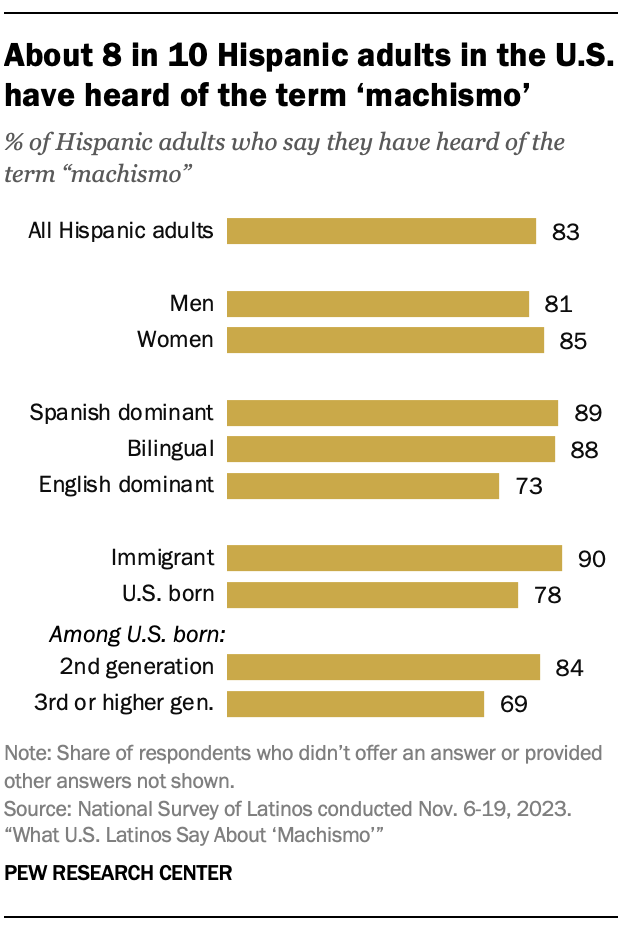
Most Hispanic adults in the U.S. have heard of the term machismo, but the concept can mean many things. This chapter explores the different ways that Hispanic adults describe machismo. Awareness of the term ‘machismo’ Roughly eight-in-ten Hispanic adults (83%) say they have heard of the term machismo, while 16% say they have not heard of it before. Majorities of Latinos across most demographic subgroups are familiar with the term. Similar shares of men and women say they have heard of it (81% and 85%). However, awareness differs somewhat by other factors: Language: Awareness of machismo is higher among Latinos who primarily speak Spanish (89%) or are bilingual in English and Spanish (88%), compared with those who are English dominant (73%). Immigrant generation: 90% of Latinos who are immigrants and 84% who are second-generation Americans have heard the term – higher than the share of third-generation or higher who have (69%). Education: 92% of Latinos with a bachelor’s degree are familiar with the term, versus 86% with some college experience and 78% with a high school diploma or less. What ‘machismo’ means to U.S. Latinos, in their own words The survey asked Hispanic adults who know the term an open-ended question about what machismo means, in their own words. ‘Machismo’ and ideas about gender in society Many respondents associate machismo with broader ideas about gender in society. A quarter of Hispanic adults who are aware of the term said machismo is the belief that men are superior to or better than women. Some 19% said machismo is the belief that men and women should have certain roles in society based on gender. This includes 13% who specify that machismo is the belief that men’s role should be as leaders or decision makers and 6% who say machismo means women’s role should be taking care of the home or children. “Para algunos hombres hay labores que son solo para hombres y creen que la mujer está solo para cuidar niños, y limpiar la casa,” said one immigrant woman in her late 40s. Additionally, 10% of responses were about men and women being treated unequally in society. One immigrant man in his early 50s described machismo as “men [being] above women in many social, political and economic matters.” And 7% said machismo is the result of social or cultural expectations around masculinity and the pressure it puts on men and women to act certain ways. One U.S.-born man in his mid-20s described machismo as “a social construct where men are expected to be strong, intimidating [or] stoic along with several other stereotypical traits. … Historically, there has been an expectation for Hispanic men to be masculine which has led to toxic behavior within the culture.” ‘Machismo’ and specific behaviors or characteristics Some respondents described machismo by specific behaviors or characteristics. About a quarter of Latino adults who have heard of machismo (22%) say it means acting with emphasized masculinity or having masculine pride, or as one immigrant man in his early 60s put it, “behaving manly or like a macho man.” Acting dominating or aggressive appeared in 17% of responses. This includes 5% who said machismo means acting violent, abusive or threatening. One U.S.-born woman in her early 20s said that machismo is “a culture where violence and sexism are deeply intertwined.” Some 12% said machismo means acting strong, tough or unemotional. One man said machismo is the “stereotypical strong, in-command Spanish male [who] shows little softness in action or emotion” like the “strong silent type [that] was depicted in the movies” (U.S.-born, early 70s). Additionally, 11% of Latino adults aware of machismo said the concept means acting self-important or egotistical. A small share (6%) also described machismo as acting confident, chivalrous or protective. As one respondent put it, machismo is about being “a man other men can look up to” (U.S.-born man, early 50s). Respondents often named several characteristics in their answer. For example, one respondent said machismo “usually refers to men who are puffing out their chests or are overbearing to their female counterparts or family. I see it as [having] a negative connotation, but I have heard it used in the chivalric context, referring to a gentlemanly action; like holding a woman’s bag or protecting a woman from another man” (U.S.-born man, mid-30s). source

1. U.S. Latinos’ awareness of ‘machismo’ and how they describe it Read More »

Shutting It Down: Why U.S. Federal Restructuring Is More Normal Than It Seems

When President-elect Donald Trump declared that he would “shut it down” during his campaign, many dismissed it as mere rhetoric. Yet beneath the sound bite sits a policy approach that’s surprisingly ordinary — at least by international standards. It’s what many democracies call “machinery of government” (MoG) changes: administrative overhauls — common in countries such as Australia, Canada, and the UK — that align government functions with evolving policy priorities. What Are Machinery Of Government Changes? MoG refers to the administrative restructuring of government organizations: creating new departments, merging existing ones, or redistributing their functions. MoG changes enhance government effectiveness and efficiency by tailoring structures to serve the needs of the moment. In parliamentary democracies, prime ministers regularly wield MoG powers to respond to emerging challenges or shift priorities. For instance: Australia: The Department of Climate Change was reestablished to reflect renewed environmental priorities in 2022. Canada: The Indigenous Services portfolio was divided to address reconciliation with First Nations more effectively. United Kingdom: The Department for Business, Energy & Industrial Strategy was split into three distinct entities in 2023. A Comparison Of US And Commonwealth Approaches In the United States, MoG changes are disdained as chaotic political overreach, especially when considered through a partisan lens. The US, constrained by its separation of powers, requires Congress for major restructuring, making the process slower and more fragmented. By contrast, MoG changes are considered pragmatic in parliamentary systems, where more centralized authority enables swift changes. Aspect United States Commonwealth (e.g., Australia, the UK) Decision-Making President, with Congress’ involvement Prime Minister/Cabinet decision Legal Requirements Often requires legislative action Executive prerogative; less legislative input Speed Of Changes Slow; often crisis-driven Fast, proactive, and systemic Drivers Of Change Crises or political mandates Strategic policy shifts Examples  DHS (2003); DNI (2004); CFPB (2010) MBIE (2012); UK Health Security Agency (2021) Why More Systematic And Regular MoG Changes Could Work For The US Adopting a more MoG-like approach to government restructuring offers several benefits. Future administrations — regardless of party — could use MoG changes to modernize government operations and better serve national priorities by: Aligning better with policy priorities. An MoG approach could reorganize departments to align with evolving national goals, such as reshaping energy and environmental agencies to address climate change. Improving civil service efficiency. The US federal government is notorious for duplication of effort. For example, over 40 federal agencies oversee food safety. Streamlining such fragmented oversight could cut costs and improve service delivery. The incoming Trump administration has proposed merging the Food and Drug Administration’s food safety responsibilities with the Food Safety and Inspection Service to create a single “Federal Food Safety Agency” to unify oversight. Increasing responsiveness to crises. The COVID-19 pandemic highlighted the limits of US bureaucratic agility. Establishing temporary crisis agencies or task forces with clear mandates — as is done in the UK and Canada — could help the US respond more effectively to future challenges, whether public health emergencies or natural disasters. Modernizing the bureaucracy. Eliminating redundant layers of bureaucracy and focusing on digital transformation would make federal agencies more responsive and transparent. For example, the incoming Trump administration has said that it will consolidate narrow commissions and bureaus such as the Bureau of Alcohol, Tobacco, Firearms and Explosives. Similarly, Australia folded narrower agencies into a single Border Force. Enhancing customer experiences. By focusing agencies on customer journeys, the US government could make customer experiences more intuitive and efficient. Service Canada aligns agency operations around life events such as retirement, unemployment, or having a child. The Biden administration has already taken steps toward a journey-centric life events model (Forrester client access only). Simplifying politics. MoG changes could help reduce legislative gridlock by shifting responsibilities within the executive branch. While such changes would require careful planning to maintain checks and balances, they could enable administrations to implement necessary reforms without years of partisan negotiation. Could this be the moment that the US federal government embraces MoG as a strategic tool for more effective public services? Let’s discuss. source

Shutting It Down: Why U.S. Federal Restructuring Is More Normal Than It Seems Read More »

Forrester Award Keynote: Schneider Electric Deputy CISO on Managing Trust, Supplier Risk

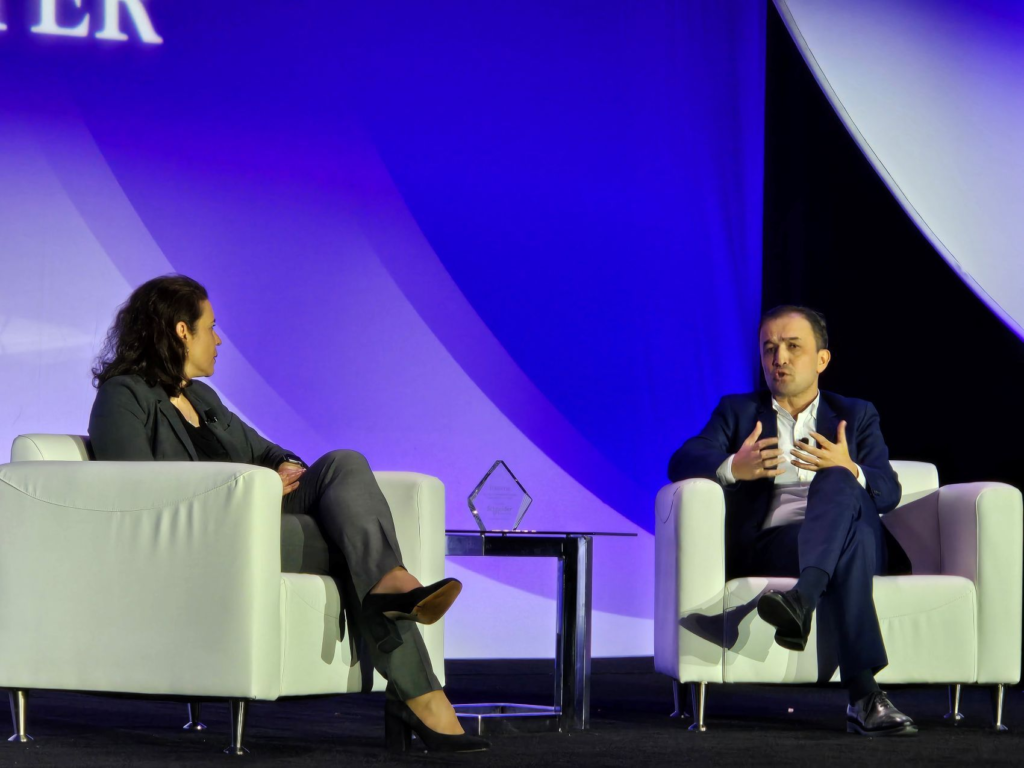
During a keynote at last week’s Forrester Security & Risk Summit in Baltimore, the research firm presented energy management and industrial automation company Schneider Electric with the Security & Risk Enterprise Leadership Award. Stephanie Balaouras, vice president and group director at Forrester, led a discussion with Mansur Abilkasimov, Schneider Electric’s deputy CISO & chief product security officer, and bestowed this year’s honor.   Balaouras noted that the judges, a group of Forrester analysts, voted unanimously to choose Schneider Electric. Barclays was the first recipient of the award in 2023.   Schneider Electric’s ability to integrate security, privacy, and risk management across the enterprise stood out as a factor in being chosen, according to Balaouras.  “We wanted to recognize organizations that have figured out how to take these functions, embed them across the enterprise, and actually use them as a driver of business, use them to drive business success and drive results, and improve the organization’s reputation for trust with customers, employees, and partners,” Balaouras told the audience.  A Holistic Approach to Security and Trust  Schneider Electric is a company that develops everything from DC chargers to safety instrumented systems. It maintains a holistic approach to energy and management in which security, privacy, and risk do not exist in silos.   Related:Quantum-Proofing Your IT Systems Carrying out an integrated strategy is a challenge for a company like Schneider Electric given its wide footprint in infrastructure, distribution centers, and factories filled with industrial machines. Abilkasimov told the audience that nobody can achieve 100% visibility, but gaining this visibility as part of risk management is a key challenge for the organization.  In his keynote, Abilkasimov stressed that product security is not an afterthought and is integrated in the “holistic vision” of a product’s life cycle. In a “security by design” or “security by operations strategy,” the manufacturing teams are responsible for security by design as well as security by operation, he said.  The company received the award because of its implementation of a Trust Charter that incorporates ethics, safety, cybersecurity, and governance as well as a Trust Center, which addresses the requests of customers and stakeholders in security and data protection. “Trust Charter is a document that embodies all our principles and tenants for code of conduct, from AI to cybersecurity, from ethics and compliance to price, from safety to quality,” Abilkasimov explained in the keynote. Related:What Do We Know About the New Ransomware Gang Termite? Abilkasimov and his team also organize a “Trust Month” in which they lead discussions around cybersecurity with employees and partners around trust. “Cyber is one of the pillars of this trust,” he said.  Trust is important for both cybersecurity and talent retention. Forrester recognized Schneider Electric for its ability to find talent for cybersecurity roles in operational technology (OT). according to Balaouras.  “Companies that are trusted, they earn and retain customers,” Balaouras told the audience. “They earn and retain the best talent. And what we’ve also found is customers are actually more willing to share sensitive data with trusted companies and even embrace emerging tech, where in other situations, they would have skepticism or fear of engaging with that emerging tech.”  Schneider Electric Tackles Third-Party Risk   In his keynote remarks, Abilkasimov described Schneider Electric’s approach to managing risk from the company’s 52,000 suppliers, which includes suppliers for Internet of Things components and regular IT as well as service providers. He explained that companies must prioritize which suppliers to work with on a security assessment. “It’s impossible to cover all of the suppliers with a cybersecurity or third-party security program, so sometimes you need to choose your battle,” Abilkasimov told InformationWeek after the session.  Related:Finding Your Shadow: Can Shadow IT Be Controlled? Schneider Electric has added 5,000 suppliers to its third-party cybersecurity program. It started with the 300 most critical IT suppliers, and the company will grow the program further, according to Abilkasimov.   “We work with those companies on cyber, crisis simulations, partnerships, C-level connections, and continuous monitoring through threat intelligence or cybersecurity scoring platforms,” Abilkasimov said in our interview.  He added, “Be it an IoT supplier or simple product security component supplier, they all go through this process.”  In Forrester’s “Security Survey 2024,” 28% of breaches stemmed from a software supply chain attack. Also, in another Forrester report, “What 2023’s Most Notable Breaches Mean for Tech Execs,” third-party vulnerabilities were the top cause of breaches in 2023 and comprised 23% of all breaches.   How Forrester Chooses Its Security Leadership Award Winners  Forrester had opened nominations for the award on May 1. Balaouras said the evaluation process is similar to a security maturity assessment. Companies must show metrics or KPIs that prove ROI, and they should exhibit how they approach security by design and privacy by design.  “We talk about their overall approach to embedding security, privacy and risk management across the enterprise not as discrete functions, but how they embed it across the enterprise,” Balaouras told InformationWeek after the session.  Balaouras stressed that Forrester doesn’t handpick the winners. “We put out the award and put out the criteria, and we invite companies and organizations from the public sector to look at them and nominate themselves,” she said.  Barclays received the award in 2023 for maintaining trust and transparency in its universal banking operations and for its human risk behavior metrics that revamped the company’s security culture.  A key factor in Schneider Electric’s success in managing security and risk is making trust concrete, according to Balaouras.  “When I compare Barclays to Schneider Electric, I think one thing they had in common was executive-level commitment to security, privacy, and risk management as critical features of building trust,” Balaouras said. “Both organizations from top to bottom really had buy-in.”  She continued, “When I look at Schneider, they put trust front and center, and they had operationalized it. What was truly unique at Barclays … last year was they had really extensive security awareness and training for a large financial institution. They had really mapped out all the complex matrices, all the different stakeholders


Forrester Award Keynote: Schneider Electric Deputy CISO on Managing Trust, Supplier Risk Read More »

Engineered Arts restructures with $10M to create humanoid robots

Join our daily and weekly newsletters for the latest updates and exclusive content on industry-leading AI coverage. Learn More Engineered Arts, a United Kingdom firm making humanoid robots, has restructured as a U.S. company and raised $10 million. The reason for moving to the U.S. is to expand its footprint and meet U.S. growing demand. And the company raised the new round to accelerate product refinement, manufacturing readiness, scale production, and investment in advanced business systems. This milestone brings Engineered Arts’ total funding to $16.2 million to date. And it advances its mission to integrate humanoid robots into daily life with a human-focused approach to AI. Engineered Arts’ humanoid entertainment robots are designed to foster natural and intuitive interactions, enhancing experiences at businesses, science centers, theme parks, and conventions with unforgettable, one-of-a-kind engagements. Helium-3 Ventures led the Series A funding, with additional participation from AppDirect CEO Nicolas Desmarais, Belvoir Investments and a consortium of investors, including ThirtySeven Holdings and Figueira Capital. Matthew Bellamy, frontman of the English rock band Muse and a partner in Helium-3 Ventures, will join Engineered Arts’ board as an observer. “Our motto is simple: ‘Be wow!’” said Will Jackson, CEO of Engineered Arts, in a statement. “When you meet one of our robots, you’ll experience a connection to technology in the most human way possible. The saying goes, ‘The future is already here; you just haven’t seen it yet.’ We’re changing that. Get ready to experience the power of embodied AI.” Scaling robots Ameca is a humanoid robot from Engineered Arts. While many companies are just beginning to explore the development and commercialization of humanoid robotics, Engineered Arts has been a pioneer in the field for over 20 years. With a proven track record, the company has deployed over 200 robots worldwide and developed six distinct humanoid robotic models, all ready to scale. Two years ago, footage about Ameca — its most advanced humanoid robot — went viral, captivating millions with videos showcasing its conversation with researchers. The new funding will enable Engineered Arts to make its full-sized and desktop robots more accessible, launch a virtual robot character platform, and expand its cloud-based AI services to enhance product features and fleet deployment. Focusing on next-generation robot hardware development, Engineered Arts will enhance dexterity and locomotion to bring humanoid robots closer to everyday functionality. Additionally, scaled support and regional offices will enable Engineered Arts to provide customization for specific use cases. The company plans to hire approximately 20 new employees for the Redwood City, California, location over the next year-and-a-half, ranging from top-level execs and sales to software, assembly, and support engineers. “We envision a world where the virtual seamlessly integrates into everyday life,” said Jackson, in a statement. “Our robots are designed to support, entertain, inform, and educate —providing a genuinely human-centric vision of AI-driven technology.” Captivating and engaging applications Ameca has human-like expressions. Engineered Arts’ humanoid robots are already making an impact. They serve marquee customers like Madison Square Garden’s Sphere in Las Vegas, where they deliver entertainment and drive customer engagement. Pharmaceutical giant GSK uses them to connect with attendees at trade events. At the Computer History Museum in Mountain View, California, Ameca sits at the center of an exhibit, “Chatbots Decoded: Exploring AI,” an immersive experience that takes visitors through the history, current landscape, and future possibilities of chatbots and AI. “Ameca is a milestone in the history of AI, bringing together decades of work in robotics, natural language processing, large language models, and more,” shared Kirsten Tashev, vice president and chief curatorial and exhibitions officer at CHM, in a statement. “It delivers a highly engaging, nearly mind-blowing experience for our visitors. With its lifelike expressions, dynamic personality, sharp sense of humor, and remarkable ability to ‘read the room,’ Ameca continually amazes and delights audiences of all ages — even younger visitors, who are notoriously hard to engage.” Tashev cites partnering with Engineered Arts as a significant contributor to the exhibit’s success. “Interactive experiences must be reliable, safe, and magical in the education and entertainment industry. It’s a tall order, but Engineered Arts masterfully does all three,” Tashev said. source

Engineered Arts restructures with $10M to create humanoid robots Read More »