Dotmatics aims to speed drug development, break data silos with Geneious Luma

Join our daily and weekly newsletters for the latest updates and exclusive content on industry-leading AI coverage. Learn More Even as enterprises across sectors explore how to integrate generative AI, it’s clear that biomedical research and the sciences are among the areas that could benefit most — as highlighted in the recent Nobel Prizes in Chemistry and Physics awarded to AI researchers. Now Dotmatics, a leader in research and development scientific software, wants to give drug researchers the power of AI to speed up their development of new, life-saving and improving drugs. Today, the Boston-based company launches Geneious Luma, a powerful new bioinformatics solution for antibody discovery, built on its Luma Scientific Intelligence Platform. Geneious Luma is designed to streamline the process of biologic therapeutic discovery by integrating advanced sequence analysis, data management, and AI-powered automation. This release marks the first of several multimodal solutions aimed at transforming scientific research and accelerating the discovery of new therapies. Thomas Swalla, CEO of Dotmatics, explained the benefit of Geneious Luma in a recent video interview with VentureBeat: “The problem we’re solving is that discovering new molecules and drugs has become increasingly complicated. It takes over a decade to bring a drug to market and costs anywhere from two to six billion dollars.” Screenshot of Geneious Luma dashboard. Credit: Dotmatics With Geneious Luma, Dotmatics addresses the challenges of fragmented workflows and siloed data in biologic research. The platform integrates key tools like Geneious Prime and Geneious Biologics to streamline antibody sequence discovery and protein engineering, from in-silico design to wet-lab experimentation and decision support. As Swalla noted, “Dotmatics is addressing the fragmentation and complexity of drug discovery. The promise of new therapies, like cell and gene therapies, is tremendous, but the science is really complicated. We’re working to pull all these areas together.” As such, it goes up against other AI drug discovery platforms such as VeriSIM Life and Platforma.bio, but can also integrate data from them — with the scientist users’ permission, of course. Antibody research Dotmatics supports over 2 million scientists and 10,000 customers in 180 countries. Its solutions streamline R&D processes by connecting science, data, and decision-making. Dotmatics’ team of over 850 employees operates globally, with its principal office in Boston. Geneious Luma builds upon the capabilities of the Luma platform to provide seamless bioinformatics solutions tailored specifically for antibody and protein engineering. The platform is designed to accelerate workflows across therapeutic modalities, including antibodies, antibody-drug conjugates (ADCs), RNA and gene therapies, and vaccines. t enables researchers to work more efficiently by automating complex data processes and centralizing all relevant data into a unified workspace. By incorporating tools like Geneious Prime, which offers industry-leading cloning and sequence analysis, and Geneious Biologics, which enhances antibody sequence discovery, Geneious Luma ensures that researchers have the advanced capabilities needed to tackle the complexities of antibody engineering. Swalla further emphasized how the platform enhances research efficiency: “With our new product, Luma, you can pull together massive datasets across these fragmented areas of science, putting language models on top of them to speed up the discovery of new molecules and drugs.” Advances in AI The flexibility of Geneious Luma is one of its greatest strengths. It leverages AI and machine learning to automate workflows, enabling scientists to manage complex biological data with greater accuracy and speed. Michael Swartz, Chief Strategy Officer at Dotmatics, told VentureBeat in the same video interview call how the platform adapts to real-time needs: “Our software is able to adapt in near real-time to whatever the scientist decides to do. Luma can call out to external models like [DeepMind’s] AlphaFold to assist, which hasn’t been possible before.” But that’s just one of many external AI tools and resources that users can pipe into Geneious Luma. “Today, we enable AI models through Luma, but our customers can pick whichever model they want and put it closest to the data in their life sciences ecosystem,” Swalla clarified. “We know we have to partner with companies that bring models and help with accelerated compute because that’s what will make AI in drug discovery economically feasible.” In addition to AI-assisted discovery, Geneious Luma incorporates powerful tools like Luma Lab Connect, which automates data ingestion from lab instruments such as flow cytometers and mass spectrometers, allowing researchers to efficiently collect, process, and analyze data from multiple sources. “When you think about instrument integration, it’s not static,” Swartz explained. “We grab the data off the software and deliver it precisely at the right time and in the right organizational framework, in a frictionless way.” Solving for siloed data In the increasingly complex landscape of therapeutic discovery, the ability to manage large and diverse datasets is crucial. Geneious Luma offers a solution to one of the biggest hurdles in life sciences today—siloed and unstructured data. Swalla commented, “The real issue in life sciences isn’t a lack of AI models; it’s that the data isn’t big enough, structured enough, or trusted enough to train those models. That’s the problem we’re trying to solve with Luma.” By integrating all the necessary tools and workflows into a single, cohesive platform, Geneious Luma enables researchers to overcome these data challenges, fostering collaboration across teams and speeding up the discovery process. Beyond antibodies While the initial focus of Geneious Luma is on antibody and protein engineering, Dotmatics plans to extend the platform’s capabilities into other areas of biologic research, such as CAR-T therapies, CRISPR, and RNA-based medicine. Swalla sees this as a tremendous opportunity: “In this industry, people are still using paper and pencil, and there are companies that haven’t moved to the cloud. We’re 15 years behind in terms of tech adoption, which is a huge opportunity for us.” The flexibility of the Geneious Luma platform ensures that it can be adapted for various therapeutic discovery processes, driving efficiency across the industry. Dotmatics is also exploring opportunities to extend the platform into other scientific domains, including material science and agritech. Geneious Luma is available now as part of the Dotmatics Luma

Dotmatics aims to speed drug development, break data silos with Geneious Luma Read More »

Microsoft’s new AI agents set to shake up enterprise software, sparking new battle with Salesforce

Join our daily and weekly newsletters for the latest updates and exclusive content on industry-leading AI coverage. Learn More Microsoft just announced a suite of autonomous AI agents for its Dynamics 365 platform, intensifying the competition with Salesforce in the enterprise AI market. The tech giant will release ten new autonomous agents designed to augment sales, service, finance, and supply chain teams. Available in public preview starting next month, these AI agents aim to automate complex tasks and orchestrate business processes across organizations. They surpass traditional chatbots and Microsoft’s earlier AI offerings by reasoning over intent and context, making judgments based on a broader set of data. “We think of these agents as really the apps of the AI era,” said Bryan Goode, Corporate Vice President at Microsoft, in an interview with VentureBeat. “Every line of business system that exists today is going to get reimagined as an agent that sits on top of a copilot.” AI titans clash: Microsoft’s counterpunch to Salesforce’s Agentforce The move comes just weeks after Salesforce unveiled its Agentforce platform, which CEO Marc Benioff has been aggressively promoting while criticizing Microsoft’s Copilot. Benioff recently called Microsoft Copilot “more like Clippy 2.0,” referring to Microsoft’s much-maligned Office assistant from the 1990s. Microsoft’s new offering appears to be a direct challenge to Salesforce’s Agentforce. While Salesforce’s platform relies on its Atlas reasoning engine, Microsoft’s agents are powered by advanced language models and the company’s vast troves of enterprise data. Goode emphasized that these agents are not meant to replace human workers but to enhance their capabilities. “In many cases, these agents can actually enable people to add capabilities that they wouldn’t have otherwise been able to do,” he explained. Battle for AI dominance: Microsoft and Salesforce lead the charge The tech industry is witnessing a paradigm shift as AI agents move from experimental technology to core business tools. Microsoft and Salesforce are at the forefront, each leveraging their unique strengths to shape the future of enterprise software. Microsoft’s strategy hinges on its ubiquitous presence in office productivity and cloud computing. By integrating AI agents with familiar tools like Microsoft 365 and Azure, the company aims to make AI adoption seamless for its vast user base. Salesforce, on the other hand, is banking on its CRM expertise and the power of its recently developed Data Cloud to create AI agents that understand and optimize customer relationships. The success of these platforms could redefine the future of work and enterprise software. As AI agents become more sophisticated, they may blur the lines between human and machine tasks, potentially reshaping organizational structures and job roles. However, challenges remain. Data privacy concerns, the need for transparent AI decision-making, and the potential for job displacement are issues both companies must navigate carefully. Their ability to address these concerns while delivering tangible business value will likely determine the pace and extent of AI agent adoption. As this AI revolution unfolds, one thing is clear: the enterprise software landscape is on the cusp of a major transformation. Whether it’s Microsoft’s vision of “agents plus copilot plus humans” or Salesforce’s “human at the helm” approach, the future of work is being rewritten — one AI agent at a time. source

Microsoft’s new AI agents set to shake up enterprise software, sparking new battle with Salesforce Read More »

The AI-driven capabilities transforming the supply chain

Presented by SAP Thanks to the growth of generative AI, a truly autonomous supply chain may be closer than we think. Here’s why. Ask any supply chain professional over the last year and they’ll tell you that their company wants to reap the results of generative AI. Research by EY backs this up, finding that nearly three-quarters (73%) of supply chain and operations executives are planning to deploy GenAI. However, just 7% of them say they have successfully implemented the technology. Making the technical leap from proof-of-concept to GenAI at scale is challenging. This becomes even clearer when you consider that supply chain operations everywhere struggle with data quality, organizational readiness and volatility — both internally and externally. However, organizations who have invested in AI early on have, at least partially, broken through these barriers. A 2023 survey from McKinsey found that supply chain and inventory management were two areas that report meaningful revenue increases through AI. To take advantage of this however, it must become simpler for teams to integrate GenAI in their everyday workflows. Here’s how. Accurate, proactive planning Supply chain success is built on a foundation of smart decision-marking. However, without a base of historical business knowledge, supply chain planning leaders are left to manage important lead times and inventory based off gut feelings rather than accurate supply and demand data. The resulting guess work impacts lead times and ultimately affects customer satisfaction. “Data integrity is one of the most powerful components to consider as we move towards the era of autonomous supply chains — it’s essential to enable a seamless end-to-end process across the entire supply chain,” says Mindy Davis, global vice president, product marketing for digital supply chain at SAP. Many companies on a digitalization journey may have eliminated most of their paper-based systems to gain better control over their supply chain, but they haven’t fully incorporated these types of analytics into their decision-making processes. EY’s research found that even for organizations using GenAI in their supply chain, only 50% have achieved end-to-end visibility. “It may sound antiquated, but quite frankly, digitizing paper-based systems is the first step to establish a digital foundation so you can access comprehensive data that impacts your supply chain,” says Davis. AI also proves to be a powerful tool for planners to get a leg up and bridge this gap. With verified and consolidated data, supply chain teams can train AI models to help accurately predict future lead times or track the status of shipments in real-time. Accurate lead times mean teams can deliver the right products at the right time and keep customers satisfied. As companies move toward an era of autonomous supply chains, an AI solution integrated into their ERP can help supercharge business decisions. At SAP, Davis and her team leverage business and financial data found in the company’s ERP solution, SAP S/4HANA, to help planners using their other applications, like SAP Integrated Business Planning, to make more informed decisions and accurately predict lead times. Then, using SAP’s AI copilot Joule, they can get better insight into the variables or constraints facing their inventory and solicit recommendations to be more proactive in their planning. “We’re envisioning a path characterized by technological, procedural and data enhancements that will propel the supply chain into an autonomous era, where supply chains operate with minimal human intervention,” says Davis. Efficient, error-free manufacturing In today’s supply chain environment, there really is no room for disruption — be it labor shortages, geopolitical strife or malfunctions within manufacturing. To keep up with demand, supply chain teams are focused on continuous improvement and finding ways to remove the burden on expensive manual labor in favor of automated, digital solutions. When faulty products come off the production line, it must be addressed quickly. AI can accelerate the resolution process faster than human labor in many instances — preventing production standstills and even catching errors before they occur. Engineers who are creating a product can lean on these insights too, using AI to assess all the errors that have happened in the past to make sure that they don’t happen in the future. But AI doesn’t just improve error resolution, it can transform the first phases of production as well, such as eliminating redundant tasks like tagging data on product visualizations. It can even make designs more efficient, developing, enhancing and customizing recipes for products while supporting product compliance and sustainability. Powerful, predictive maintenance Manufacturing the millions of products that move throughout the supply chain starts with the machinery used to produce them. This “up” time — hours when equipment is in action — is the backbone of effective operations. When those components fail or reach the end of their lifespan, that has an enormous operational and financial impact, shifting budget, influencing payment terms and mitigating cash flow. Regular maintenance on essential equipment is key to keeping the supply chain moving. But monitoring wear and tear to catch issues before they even happen is even better, and increasingly possible thanks to AI. Through camera footage and visual inspections, AI models can help detect errors, faults or defects in equipment before they happen. If the technology identifies an issue — or predicts the need for maintenance — teams can arrange for a technician to perform repairs. This predictive maintenance minimizes unplanned outages, reduces disruptions across the supply chain and optimizes asset performance. Swiss Federal Railways (SBB) is piloting this capability through SAP to help get passengers where they want to go on time and safely by examining a small but critical piece of railway infrastructure: the pantograph. This component mounted on the roof of an electric train collects power through contact with an overhead line. “What many companies will do is implement generative AI tools for small uses cases,”says Davis. “Implementing use cases that show initial success helps show the potential of this technology for the supply chain, and then you can consider scaling across your organization.” Using AI, SBB can assess the pantograph’s thickness and conductivity to determine when

The AI-driven capabilities transforming the supply chain Read More »

Board Of Clients Book + Media List, 2024

Every year for the last 26 years, Forrester has convened its Board of Clients — a group of clients (pic to the left) who advise us on our strategy, new products, and research agenda. These meetings have had extraordinary impact on our voyage, helping us to continually improve and to meet the high standards of the companies we serve. The current board includes executives from CITGO, Prudential, NOAA, Bank of America, SAP, and other longtime clients — a fantastic group! One of our traditions is to share books and other media recommendations. Here are this year’s “picks” from the Board: Books: Slow Productivity, Cal Newport Team of Rivals: The Political Genius of Abraham Lincoln, Doris Kearns Goodwin Outlive, Peter Attia Build the Life You Want, Arthur Brooks and Oprah Winfrey My Beloved Monster, Caleb Carr A Soldier of the Great War, Mark Helprin The Future and Its Enemies, Virginia Postrel   Podcasts: Acquired Business Wars Dolly Parton’s America 60 Songs That Explain the ’90s SmartLess The Moth   TV series: Bad Monkey The Repair Shop Drops of God Only Murders in the Building source

Board Of Clients Book + Media List, 2024 Read More »

4. Views of the impact of changing gender roles

We asked Americans a series of questions about changing gender roles for men and women. First, we asked if society is too accepting or not accepting enough of men and women who take on roles typically associated with the other gender. On balance, the public thinks society is not accepting enough of men and women who do this. Overall, 43% of adults say society is not accepting enough of men who take on roles typically associated with women, 19% say society is too accepting of these men and 37% say acceptance is about right. When we asked about women who take on roles typically associated with men, the results were almost identical. Some 44% say society is not accepting enough of women who do this, 19% say society is too accepting and 36% say things are about right. Differences by gender Women are more likely than men to say that society is not accepting enough of men who take on roles typically associated with women (49% vs. 36%), while men are more likely than women to say acceptance is about right (43% vs. 33%). In addition, a higher share of women than men say society is not accepting enough of women who take on roles usually associated with men (53% vs. 35%). Again, men are much more likely than women to say things are about right (42% vs. 30%). Differences by party Republicans and Democrats have very different views on these issues. On balance, Republicans and Republican-leaning independents are about evenly divided on whether society is too accepting (28%) or not accepting enough (27%) of men who take on roles that are usually associated with women. Some 45% of Republicans say things are about right. Democrats and Democratic leaners tilt heavily toward the position that society is not accepting enough of men who take on women’s roles. About six-in-ten Democrats (59%) say this, while only 10% say society is too accepting of these men and 30% say things are about right. The partisan pattern is very similar on the question of how society treats women who take on roles typically associated with men. Republicans are divided over whether society is too accepting or not accepting enough of these women, while a majority of Democrats say society is not accepting enough. Across gender groups within the parties, Republican men are the most likely to say that society is too accepting of men who take on roles often associated with women (30% say this) and of women who take on roles associated with men (33%). Democratic women are the most likely to say there’s not enough acceptance for these men (62%) and women (69%). How have changing gender roles impacted men and women? We also asked Americans about the impact of having more women working outside the home and men more involved in household chores and child care. Overall, the public thinks the changing roles of women and men in our society have been more beneficial for women than for men. When it comes to being successful at work: 61% say changing gender roles have made it easier for women. 36% say they’ve made it easier for men. And when it comes to leading satisfying lives: 57% say changing gender roles have made it easier for women. 43% say they’ve made it easier for men. The public also sees more benefit than harm from changing gender roles for married couples and families: 57% say changing roles have made it easier for families to earn enough money to live comfortably. 47% say they’ve made it easier for marriages to be successful. Differences by gender Men and women are mostly in agreement about the impact changing gender roles have had on the areas of life we asked about. Women are somewhat more likely than men to say these changes have made it easier for women and men to lead satisfying lives and for marriages to be successful. Still, on balance, both men and women see these changes as more beneficial than harmful. Among women, those with a bachelor’s degree or more education are significantly more likely than those without a four-year college degree to say changing gender roles have been beneficial across almost all items. For example, 67% of women with at least a bachelor’s degree, compared with 55% of women with less education, say these changes have made it easier for women to lead satisfying lives. The one exception is on the impact changing gender roles have had on men’s ability to be successful at work. Here, 40% of women without a four-year college degree say these changes have made it easier for men to be successful, while only 32% of women with at least a bachelor’s degree say the same. Differences by party Democrats and Republicans have differing views on the impact changing gender roles have had on women, men and families. By significant margins, larger shares of Democrats than Republicans say changing gender roles have made each of the following easier: Women leading satisfying lives (69% vs. 48%) Women being successful at work (68% vs. 54%) Families earning enough money to live comfortably (63% vs. 53%) Marriages being successful (55% vs. 40%) Men leading satisfying lives (50% vs. 38%) Men being successful at work (38% vs. 35%) For their part, significant shares of Republicans say changing gender roles have made certain aspects of life harder. A third of Republicans say these changes have made it harder for marriages to be successful, compared with 18% of Democrats who say the same. A quarter of Republicans (versus 13% of Democrats) say the changes have made it harder for men to lead satisfying lives. And 24% (versus 11% of Democrats) say they’ve made it harder for women to lead satisfying lives. source

4. Views of the impact of changing gender roles Read More »

DataStax looks to help enterprises stuck in AI ‘development hell’, with a little help from Nvidia

Join our daily and weekly newsletters for the latest updates and exclusive content on industry-leading AI coverage. Learn More DataStax has been steadily expanding its data platform in recent years to help meet the growing need of enterprise AI developers. Today the company is taking the next step forward with the launch of the DataStax AI Platform, Built with Nvidia AI. The new platform integrates DataStax’s existing database technology including DataStax Astra for cloud native and the DataStax Hyper-Converged Database (HCD) for self-managed deployments. It also includes the company’s Langflow technology which is used to help build out agentic AI workflows. The Nvidia enterprise AI components include technologies that will help to accelerate and improve organization’s ability to rapidly build and deploy models. Among the Nvidia enterprise components in the stack are NeMo Retriever, NeMo Guardrails and NIM Agent Blueprints. According to DataStax the new platform can reduce AI development time by 60% and handle AI workloads 19 times faster than current solutions. “Time to production is one of the things we talk about, building these things takes a bunch of time,” Ed Anuff, Chief Product Officer at DataStax told VentureBeat. “What we’ve seen has been that a lot of folks are stuck in development hell.” How Langflow enables enterprises to benefit from agentic AI Langflow, DataStax’s visual AI orchestration tool, plays a crucial role in the new AI platform.   Langflow allows developers to visually construct AI workflows by dragging and dropping components onto a canvas. These components represent various DataStax and Nvidia capabilities, including data sources, AI models and processing steps. This visual approach significantly simplifies the process of building complex AI applications. “What Langflow allows us to do is surface all of the DataStax capabilities and APIs, as well as all of the Nvidia components and microservices as visual components that can be connected together and run in an interactive way,” Anuff said. Langflow also is the critical technology that enables agentic AI to the new DataStax platform as well. According to Anuff, the platform facilitates the development of three main types of agents: Task-oriented agents: These agents can perform specific tasks on behalf of users. For example, in a travel application, an agent could assemble a vacation package based on user preferences. Automation agents: These agents operate behind the scenes, handling tasks without direct user interaction. They often involve APIs communicating with other APIs and agents, facilitating complex automated workflows. Multi-agent systems: This approach involves breaking down complex tasks into subtasks handled by specialized agents.  What the Nvidia DataStax combination enables for enterprise AI The combination of the Nvidia capabilities with DataStax’s data and Langflow will help enterprise AI users in a number of different ways, according to Anuff. He explained that the Nvidia integration will allow enterprise users to more easily invoke custom language models and embeddings through a standardized NIM microservices architecture. By using Nvidia’s microservices, users can also tap into Nvidia’s hardware and software capabilities to run these models efficiently. Guardrails support is another key addition that will help DataStax users to prevent unsafe content and model outputs. “The guardrails capability is one of the features that I think probably has the most developer and end user impact,”Anuff said. “Guardrails are basically a sidecar model, that is able to recognize and intercept unsafe content that is either coming from the user, ingestion or through, stuff retrieved from databases.” The Nvidia integration also will help to enable continuous model improvement. Anuff explained that the NeMo Curator allows enterprise AI users to  be able to determine additional content that can be used for fine tuning purposes. The overall impact of the integration is to help enterprises benefit from AI faster and in a cost efficient approach. Anuff noted that it’s an approach that doesn’t necessarily have to rely entirely on GPUs either. “The Nvidia enterprise stack actually is able to execute workloads on CPUs as well as GPUs,” Anuff said. “GPUs will be faster and  generally are going to be where you want to put these workloads, but if you want to offload some of the stuff to CPUs for cost savings in areas where, where it doesn’t matter, it lets you do that as well.” source

DataStax looks to help enterprises stuck in AI ‘development hell’, with a little help from Nvidia Read More »

CUHK CSRCom & Sustainability Hub’s 2024 Professional Workshop

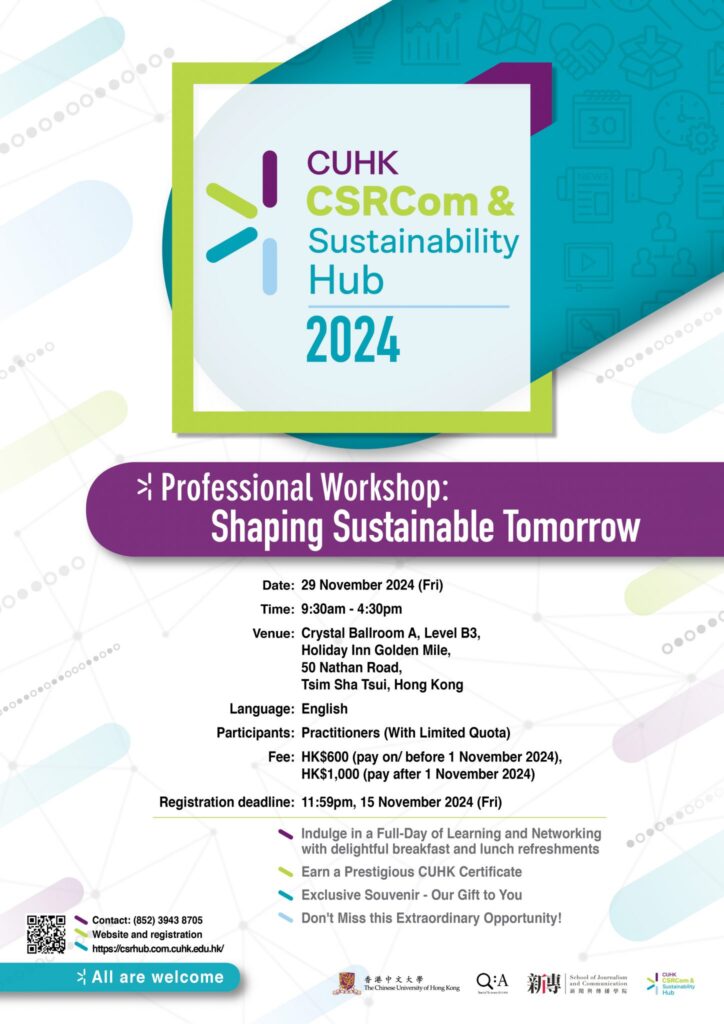
CUHK CSRCom & Sustainability Hub’s 2024 Professional Workshop: Shaping Sustainable Tomorrow

The School of Journalism and Communication of CUHK is thrilled to invite you to the CUHK CSRCom & Sustainability Hub’s 2024 Professional Workshop: Shaping Sustainable Tomorrow! This is a fantastic opportunity for you and your colleagues to engage with thought leaders in strategic communication, Corporate Social Responsibility (CSR), Environmental, Social, and Governance (ESG) practices, and sustainability. Workshop Details: Date: 29 November 2024 (Friday) Time: 9:30 am to 4:30 pm Venue: Crystal Ballroom A, Level B3, Holiday Inn Golden Mile, 50 Nathan Road, Tsim Sha Tsui, Hong Kong Registration Fee: • HK$600 per person (pay on/ before 1 November 2024) / • HK$1,000 per person (pay after 1 November 2024) Language: English Convener: Prof. Sora Kim (Professor, Director of M.S.Sc. in Corporate Communication Programme, Director of CSRCom & Sustainability Hub,School of Journalism and Communication, CUHK) Co-Convener: Prof. Shih-chia Wu (Associate Professor of Practice, Deputy Director of M.S.Sc. in Corporate Communication Programme, School of Journalism and Communication, CUHK) Registration deadline: 11:59 pm, 15 November 2024 (Friday) Registration link: https://cloud.itsc.cuhk.edu.hk/webform/view.php?id=13694212 Join us for a dynamic day filled with insightful presentations, interactive discussions, and practical case studies designed to equip you with the knowledge and tools to foster sustainability in your organization. Whether you are looking to enhance your professional skills, network with industry professionals, or gain new insights, this workshop promises to be highly enriching! Seats are limited, so we encourage you to register early to secure your spot! Please find the promotional poster attached for more details about the workshop, including our esteemed speakers and the exciting topics we will cover. If you are interested, please REGISTER HERE on or before 11:59 pm, 15 November 2024 (Friday). For more information, please refer to the attached poster. Should you have any enquiries, you may reach us at 3943-8705. We look forward to your participation! For more details, please click here.

CUHK CSRCom & Sustainability Hub’s 2024 Professional Workshop: Shaping Sustainable Tomorrow Read More »

Conquer Europe: Your Passport to Success with Search Marketing

Conquer Europe: Your Passport to Success with Search Marketing

Get ready to unlock the European market with expert insights and actionable strategies for Chinese and Hong Kong brands. This is the very first event of many worldwide, enpowered and supported by the best. Learn from industry experts who have successfully navigated the European landscape, bringing invaluable insights and practical advice for Chinese and Hong Kong brands. For more details, please click here.

Conquer Europe: Your Passport to Success with Search Marketing Read More »

Sustainability Talent – Challenges & Future Demand

Sustainability Talent – Challenges & Future Demand

As sustainability and environmental, social, and governance (ESG) practices become top priorities for companies, there is a growing demand for professionals equipped with the skills to drive this transformation. But how is the talent market evolving to meet these needs? Join us for a discussion on the current and future state of sustainability and ESG talent in Hong Kong. We’ll explore the challenges facing this rapidly expanding sector, from skills gaps and recruitment hurdles to retaining top talent. Whether you’re an HR professional, a hiring manager, or someone looking to build a career in this space, this session will provide different perspectives on shaping a workforce that can succeed in a purpose-driven economy. For more details, please click here.

Sustainability Talent – Challenges & Future Demand Read More »

Preserving Legacy, Embracing Innovation: Hong Kong’s Cultural Legacy

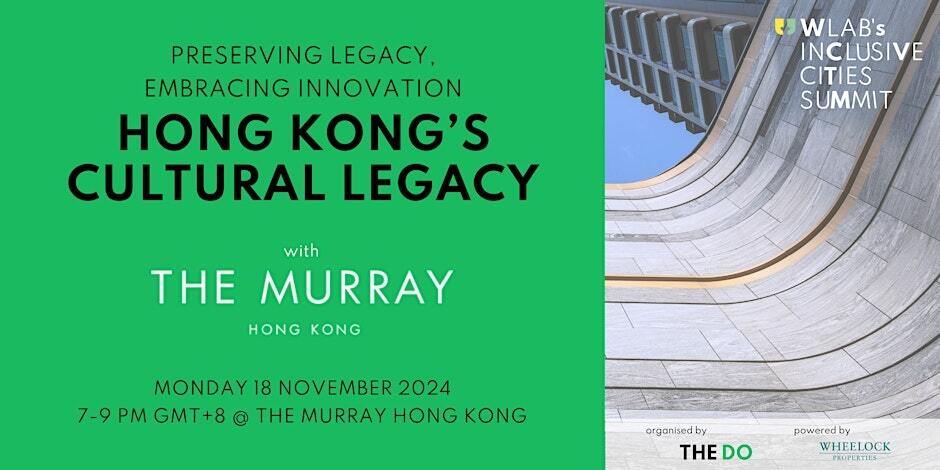
Preserving Legacy, Embracing Innovation: Hong Kong’s Cultural Legacy

Join us for a captivating exploration of the intricate dance between tradition and modernity in Hong Kong, set against the backdrop of the city’s iconic architecture and storied landscapes. Our esteemed panel of experts will delve into the pivotal role of technology in cultural preservation, the significance of community engagement, and the enduring legacy of Hong Kong’s rich cultural tapestry. This event offers an extraordinary opportunity to connect with the essence of Hong Kong’s heritage. As one of the city’s most iconic landmarks and member of Historic Hotels Worldwide, The Murray Hong Kong has a rich history and significance to all Hongkongers. After serving as a government office, The Murray building has undergone successful revitalization, becoming the only commercial project under the “Conserving Central” initiative. Coined as “striking balance between conservation and development” by former Undersecretary for Development, Michael Wong, The Murray Hong Kong is the ideal venue for this panel discussion. For more details, please click here.

Preserving Legacy, Embracing Innovation: Hong Kong’s Cultural Legacy Read More »