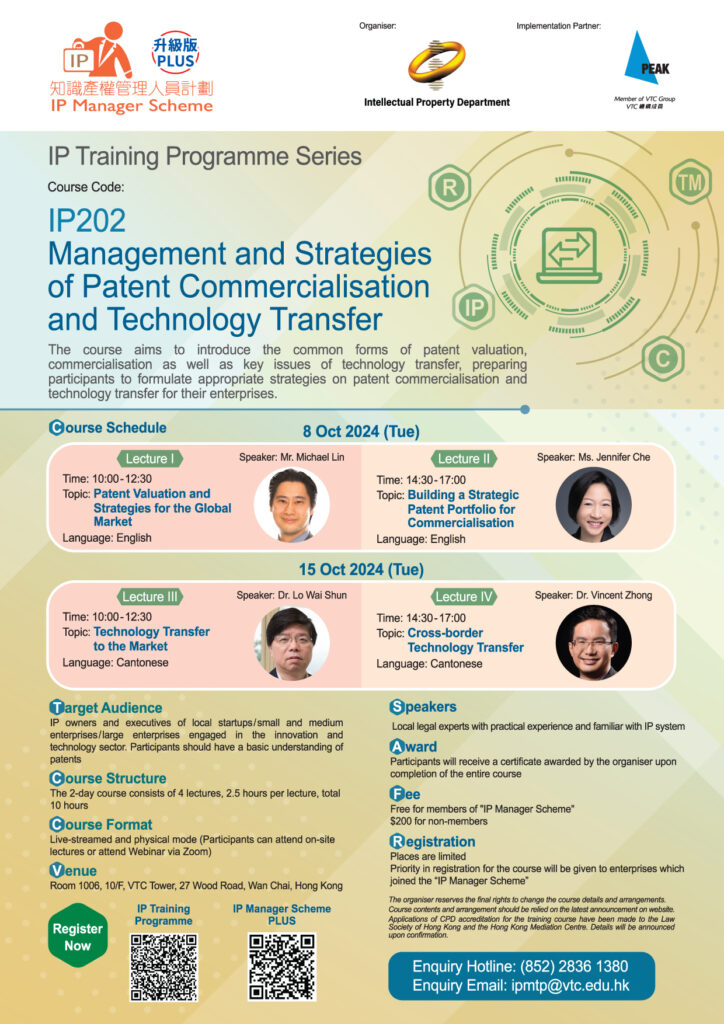
IP202 Management and Strategies of Patent Commercialisation and Technology Transfer

IP202 Management and Strategies of Patent Commercialisation and Technology Transfer

The course aims to introduce the common forms of patent valuation, commercialisation as well as key issues of technology transfer, preparing participants to formulate appropriate strategies on patent commercialization and technology transfer for their enterprises. The medium of instruction will be Cantonese and English. Participants will receive a certificate upon completion of the respective training course. For more details, please click here. For registration, please click here.

IP202 Management and Strategies of Patent Commercialisation and Technology Transfer Read More »

inno4life 創意文化及科技創新展覽 2024

inno4life 創意文化及科技創新展覽 2024

第三屆Inno4life—創意文化及科技創新展覽強勢回歸。Inno4life-創意文化及科技創新2024將於2024年10月4日至6日假香港灣仔會議展覽中心3樓展覽廳F及G舉行。是次的展覽共有五大關鍵區域,將會繼續向公眾分別展示更多在美容和生活、醫療技術、教育發展、環境以及金融科技四個方面的創新科技項目和技術。展會為參觀者提供豐富的參觀體驗,包括購物、最新生活科技展示、工作坊和講座。 Inno4life-創意文化及科技創新展覽2024讓訪客花一個周末,迎接創意創新的生活態度。 欲知更多信息,請點擊這裏。

inno4life 創意文化及科技創新展覽 2024 Read More »

HKUST-SINO One Million Dollar Entrepreneurship Competition 2024

HKUST-SINO One Million Dollar Entrepreneurship Competition 2024

Join us and be part of an exciting celebration of innovation and entrepreneurship on October 4, 2024, at Shaw Auditorium! This is a fantastic opportunity for the HKUST community to witness the Final Round Competition and the Award Ceremony. Date: October 4, 2024 Venue: Main Hall, Shaw Auditorium, HKUST Time: 09:40 – 13:05 Final Round Competition 13:15 – 14:00 Finalist Showcase Booth 14:00 – 15:20 Award Ceremony 15:30 – 17:00 Finalist Showcase Booth & Networking For more details, visit https://ec.hkust.edu.hk/one-million/hk/2024 or contact us at [email protected] For more details, please click here.

HKUST-SINO One Million Dollar Entrepreneurship Competition 2024 Read More »

2. Behaviors people find acceptable and unacceptable in men

When it comes to how Americans view certain behaviors in men, most say they personally think it’s not too or not at all acceptable for men to: Join in when other men are talking about women in a sexual way (75%) Have many different sexual partners rather than commit to one relationship (69%) Drink a lot of alcohol when out with friends (63%) Throw a punch if provoked (62%) Four-in-ten also think it’s unacceptable for men to play video games on a regular basis. Another 22% say this is extremely or very acceptable, and 37% find it somewhat acceptable. Of the behaviors asked about in the survey, the only one more people find highly acceptable (42%) than highly unacceptable (15%) is for men to put a lot of effort into their style and fashion choices. Differences by gender Women are more likely than men to see five of the six behaviors asked about in the survey as unacceptable for men. Still, majorities of both women and men agree that it’s unacceptable for men to join in when other men are talking about women in a sexual way (80% vs. 69%); have many different sexual partners rather than commit to one relationship (74% vs. 65%); drink a lot of alcohol when out with friends (67% vs. 59%); or throw a punch if provoked (66% vs. 59%). Men are somewhat more likely than women to say it’s unacceptable for men to put a lot of effort into their style and fashion choices (18% vs. 13%), but relatively small shares in each group say this. Differences by age Adults under 30 are more likely than those in older age groups to see each of the behaviors asked about in the survey as extremely or very acceptable for men, with differences of 10 points or more on the following items: Putting a lot of effort into their style and fashion choices: 58% of those ages 18 to 30, 45% of those 30 to 49, and 32% of those 50 and older say this is acceptable. Playing video games on a regular basis: 40% of those ages 18 to 30, 29% of those 30 to 49, and 10% of those 50 and older find this acceptable. In turn, adults ages 65 and older are the most likely to see almost every behavior we asked about as unacceptable for men. The exception is when it comes to putting a lot of effort into their style and fashion choices. On that item, the difference is between those ages 50 and older and those under 50, with the older group somewhat more likely than the younger group to see this as unacceptable. These patterns are similar among both men and women. Differences by party Majorities of Republicans and Democrats see four of the six items asked about as unacceptable for men. Still, there are partisan differences in how Americans see these behaviors. By double-digit margins, larger shares of Republicans than Democrats say it’s not too or not at all acceptable for men to have many different sexual partners rather than commit to one relationship (76% vs. 61%) or to play video games on a regular basis (48% vs. 32%). For their part, Democrats are more likely than Republicans to say it’s unacceptable for men to throw a punch if provoked (68% vs. 57%). There are more modest partisan differences on other items. What is and isn’t acceptable in relationships We also asked some questions about things people may or may not find acceptable for men who date women or who are in a relationship with a woman. A majority of U.S. adults (57%) say it’s extremely or very acceptable for a man to take care of the home and children while his wife works for pay. Smaller shares say it’s highly acceptable for men to take charge in day-to-day decisions about the relationship (35%), split the bill when out on a date (34%) or take their wife’s last name when they get married (23%). Just over half of U.S. adults (53%) think it’s not too or not at all acceptable for a man to take his wife’s name when they get married. Differences by age Similar shares across age groups say it’s extremely or very acceptable for a man to take care of the home and children while his wife works for pay. But adults under 30 are more likely than older Americans to say it’s as acceptable for men to take charge in day-to-day decisions about the relationship, split the bill when out on a date, or take their wife’s name when they get married. Adults ages 50 and older are generally less accepting of these behaviors. For example, most adults ages 50 to 64 (61%) and 65 and older (65%) say it’s not too or not at all acceptable for men to take their wife’s name when they get married. That compares with 48% of those ages 30 to 49 and a smaller share (36%) of adults under 30. Differences by party Similar shares of Democrats and Republicans say it’s extremely or very acceptable for men to take charge in day-to-day decisions about the relationship, but larger shares of Democrats than Republicans say it’s highly acceptable for a man to: Take care of the home and children while his wife works (66% vs. 48%) Split the bill on a date (44% vs. 24%) Take his wife’s last name (34% vs. 12%) Republicans are more likely than Democrats to see each of these three items as not too or not at all acceptable. Gender and age differences on splitting the bill Views on whether it’s acceptable for men to do each of these things varies only modestly, if at all, between men and women. For example, about a third of men (34%) and women (33%) say it’s extremely or very acceptable for a man to split the bill when out on a date with a woman. But an interesting pattern emerges when looking at different age

2. Behaviors people find acceptable and unacceptable in men Read More »

From Emerging Tech to AI: My New Forrester Mission

After three years dedicated to Forrester’s emerging technology portfolio, I’m excited to embark on a new chapter as VP of emerging technology and principal analyst. In this role, I’ll be focusing much of my time on researching the transformative impact of artificial intelligence as part of Forrester’s new Data, AI & Analytics service. While AI has been a part of my research, this transition allows me to dedicate more focus to helping clients generate real, measurable value from their AI investments. AI Computing: A New Era Of Human Empowerment A pivotal moment in my work came with the publication of Forrester’s landmark report, Change the Interface; Change the World, in which we lay out how AI will reshape the world over the next 20 years. This report is not just a statement on technology’s future; it also marks the beginning of a new era of human empowerment, where interfaces recognize human intention and agents work autonomously on our behalf. Together with my colleague Ted Schadler, I will soon release a follow-up report on the investment strategies that companies must embrace to thrive in the era of AI computing. This work will provide actionable insights to help organizations align their investments with future innovations. Cutting Through The AI Fog With Value Management The AI landscape is full of potential, but it’s also overwhelming. New technologies emerge almost daily, leaving business leaders wondering, Am I doing enough? Did I make the right investments? This flood of information can lead to confusion — what I call the “AI fog.” Cutting through this is critical for staying competitive in this new era of AI computing, and the key lies in AI value management. My early research shows that firms taking a more structured approach tend to grow faster. But many organizations still struggle to quantify AI’s impact on business outcomes. My upcoming research will explore what drives the growth of leaders and how firms can replicate it. My goal is to provide frameworks to assess the total picture of AI benefits, costs, and risks, helping firms develop this deep understanding. Pushing Research Boundaries On AI And Quantum Computing Tech Beyond AI computing and value, I will continue leading Forrester’s research at the frontier of AI technologies. My focus includes studying AI agents and their progression toward artificial general intelligence (AGI). This research will provide insight into the short-, medium-, and long-term implications of AGI — a future in which AI systems can perform any intellectual tasks that were once reserved only for humans, raising important questions about AI safety and ethics. Although my primary focus is now on AI, I will continue tracking quantum computing, a technology I’ve been researching for over a decade. I will help firms understand how quantum computing will move from theory to practical applications, ensuring that they are prepared for its potential disruptions. Continuing To Lead Emerging Technology Research I will also continue to lead Forrester’s emerging technology research, a critical area that helps organizations stay ahead of disruptive innovation. Over the past three years, we’ve developed a dedicated portfolio of reports on the top 10 and next 10 emerging technologies. To make this research more accessible, we’ve launched an emerging technology hub for Forrester Decisions clients. Additionally, we’ve collaborated with our internal generative AI team to enhance our AI-driven insights. Our genAI-powered assistant, Izola, is now available in beta, designed to help clients explore emerging technology use cases and trends. Looking ahead, my goal is to continue supporting the emerging technology process, publish our flagship “top emerging technologies” reports this summer, and collaborate with our team to innovate digital experiences, including enhancing genAI capabilities. Let’s Connect As I transition into this new role, I’m excited to continue delivering insights that help our clients navigate the technological shifts shaping the future. Clients, consider scheduling a guidance session or inquiry with me to discuss any of these research areas and what I’m learning along the way. Clients and nonclients alike, I’m always eager to hear compelling stories from firms. Please feel free to reach out via LinkedIn or contact your Forrester account representative. source

From Emerging Tech to AI: My New Forrester Mission Read More »

Cognizant adds multi-agent functionality to AI application platform

Join our daily and weekly newsletters for the latest updates and exclusive content on industry-leading AI coverage. Learn More Cognizant’s Neuro AI platform, announced last year, will get more AI as the consultancy adds multi-agent capabilities to the service. The Neuro AI platform helps organizations ideate, prototype and test generative AI applications without coding. Babak Hodjat, Cognizant’s CTO of AI, told VentureBeat the service used to be something Cognizant’s experts did for customers. However, Neuro AI will now be available for enterprises to use themselves. “One of the things we train into as we started demoing it to clients was them saying, hey, this is really fascinating, we want to use it ourselves and host it in-house,” Hodjat said. “In some ways, they started thinking of it as this factory that generates ideas for where to apply generative AI in their businesses.” Hodjat said Neuro AI’s use of multiple agents makes it stand out from other AI app platforms, which Cognizant was already exploring while reconfiguring the service for clients. AI agents, of course, have become a big trend for enterprise AI this year.  The platform has four steps, all of which rely on pre-configured agents: the Opportunity Finder, Scoping Agent, Data Generator and Model Orchestrator.  It acts as a Cognizant consultant for clients who want to build applications. The platform goes through the process of ideating an application and, in the end, provides a framework for the customer to follow.  When people first start using Neuro AI, they’re asked to describe what issues they want solved. The Opportunity Finder then deploys agents to search for industry-specific use cases. Once a potential use case is identified, users then move to the Scoping agent, which will show the use case’s impact on specific categories and performance indicators. The Data Generation agent will generate synthetic data related to the use case to test out the application.  The Model Orchestrator sets up the application. Hodjat said it uses several agents that make calls to build out the system. For example, a project describer agent will return a JSON description followed by a context agent or an outcome mapper. The number of agents the Orchestrator will manage depends on the use case.  “We had the agents communicate with each other to identify what capabilities are needed,” Hodjat said. “We did that by encapsulating each agent’s expertise so these agents are talking to each other. One agent is asking the other agent, hey, I have this use case to build. Can you do something for me? The main trick here is to actually have the agents in communicating with each other.” Hodjat said his team used LangChain as a framework to build out its multi-agent orchestration and remain LLM agnostic. He said the framework is not perfect, but since many clients prefer to use different models, it was important Neuro AI can handle both open and closed models.  Competition in AI application consulting is growing This is not Cognizant’s first foray into generative AI. In March, it opened an AI lab in San Francisco to help boost enterprise use of the technology.  Companies like Cognizant, which helps other enterprises set up their own AI applications or programs, are creating new product offerings to make using generative AI easier. Accenture, along with AWS, released a platform that evaluates AI readiness and responsible AI policies. McKinsey and Company set up a chatbot for its consultants called Lilli last year.  Consulting and business process service providers are starting to create their niche in the increasingly competitive AI platform space. Enterprise software providers, like Salesforce, SAP and Oracle, already give customers access to platforms to easily create agents or other AI applications. Organizations like Cognizant are building products that seem to cater to businesses that are still unsure of how to harness generative AI fully.  source

Cognizant adds multi-agent functionality to AI application platform Read More »

Turks Lean Negative on Erdoğan, Give National Government Mixed Ratings

8 in 10 Turkish adults see the U.S. negatively President Recep Tayyip Erdoğan of Turkey attends a press conference during the 75th NATO summit in Washington, D.C., on July 11, 2024. (Beata Zawrzel/NurPhoto via Getty Images) This Pew Research Center analysis focuses on public opinion of domestic and international issues in Turkey. Views of the government leaders, institutions and other countries are examined in the context of long-term trend data. The report draws on nationally representative surveys of 1,049 Turkish adults conducted from Jan. 29 to March 11, 2024. Surveys were conducted face-to-face and weighted to be representative of the Turkish adult population with the following variables: gender, age, education, region, urbanicity and probability of selection of respondent. To compare educational groups across countries, we standardize education levels based on the UN’s International Standard Classification of Education (ISCED). Prior to 2024, combined totals were based on rounded topline figures. For all reports beginning in 2024, totals are based on unrounded topline figures, so combined totals might be different than in previous years. Refer to the 2024 topline to see our new rounding procedures applied to past years’ data. Here are the questions used for the report, along with responses, and the survey methodology. In May 2023, voters in Turkey elected Recep Tayyip Erdoğan to his third term as president. Less than a year later, Erdoğan’s Justice and Development party (AKP) suffered its worst-ever electoral defeat in local elections. In the time between these two elections, Pew Research Center surveyed 1,049 Turkish adults. The results show negative opinions of Erdoğanand mixed views of the national government he leads. Overall, 55% of Turkish adults have an unfavorable opinion of Erdoğan, while 43% have a favorable opinion. This marks a 32 percentage point decrease in favorability from 2017, including a 27-point drop in the share of Turks with a very favorable opinion of their president. The 2017 survey was conducted eight months after Erdoğan and his government survived a coup attempt by a faction of the military. Support for Erdoğan is a key factor in Turkish public opinion on domestic and international topics alike. Compared with those who have an unfavorable opinion of the president, Turkish adults who see Erdoğan favorably are: More trusting in the national government to do the right thing for Turkey More confident that the May 2023 elections were conducted fairly and accurately More confident that the government will take the necessary measures to prepare for future natural disasters More satisfied with the way democracy currently works in Turkey More supportive of a form of government that relies on a strong leader More likely to see groups and institutions such as the military, religious leaders and the courts as having a good influence on the country  More favorable toward China and Russia, and more confident in these countries’ leaders Age is another key indicator of public opinion on several topics. For example, adults ages 50 and older are more positive toward Erdoğan and the national government when compared with adults ages 18 to 34. Frequency of prayer among the 98% of Turks who are Muslim is also tied to views of multiple issues. Muslim adults who pray more frequently (one of the Center’s measures of religiosity) have more confidence that the 2023 election was conducted fairly and accurately, for instance. Below are some other key findings from the survey, which marks the first time since 2019 that Pew Research Center has polled in Turkey. Confidence in the government Overall, Turkish adults express limited confidence in their national government. Roughly half (51%) say they do not trust the government to do what is right for the country. A similar share (53%) is not confident that the May 2023 presidential election was conducted fairly and accurately. And about a year after a 7.8 magnitude earthquake hit Turkey – leaving more than 50,000 dead – 61% of Turks are not confident that the government will take the necessary steps to prepare for future natural disasters. Jump to Chapter 1 for more on how people in Turkey view their government. Views of democracy Two-thirds of Turks are dissatisfied with the way democracy is currently working in their country. But democracy itself – in both representative and direct form – is still a popular idea. Majorities of Turks say representative and direct democracy would be good ways to govern Turkey (80% and 79%, respectively). And 59% say rule by experts, sometimes called technocracy, would be a good system of government. Much smaller shares say rule by a strong leader (34%) or by the military (14%) are good options. However, Turks with a positive view of Erdoğan are significantly more likely than nonsupporters to say each of these nondemocratic systems would be a good way to govern Turkey. Jump to Chapter 2 for more on how people in Turkey view democracy. Views of institutions and societal conflicts In Turkey, majorities say the police and the military have a positive impact on Turkish society (78% and 62%, respectively). On the other hand, a third of adults or fewer say the media, large international companies, and banks and other financial institutions have a positive influence. When it comes to tensions within their society, Turks see especially strong conflicts between people who support different political parties. Fewer Turks – though still a majority – say there are strong conflicts between people with different ethnic identities. Notably, in a country where a vast majority of people are Muslim, about half of adults (47%) say there are strong conflicts between Turks who practice different religions. Jump to Chapter 3 for more on how people in Turkey view institutions and conflicts in their society. Views of international affairs When it comes to foreign relations, Turks give mostly negative ratings to other countries and their leaders. Majorities have unfavorable opinions of the United States, China and Russia, and most lack confidence in their respective presidents. Turks also report low trust in other international political leaders – including former U.S. President Donald

Turks Lean Negative on Erdoğan, Give National Government Mixed Ratings Read More »

How Americans See Men and Masculinity

Pew Research Center conducted this study to understand Americans’ views of men and masculinity at a time when these topics are at the forefront of national conversations. For this analysis, we surveyed 6,204 adults from Sept. 3 to 15, 2024. Most of the respondents who took part in this survey are members of the Center’s American Trends Panel (ATP), a group of people recruited through national, random sampling of residential addresses who have agreed to take surveys regularly. The survey also included an oversample of Black, Hispanic and Asian adults from the SSRS Opinion Panel, another probability-based online survey web panel recruited primarily through national, random sampling of residential addresses. Surveys were conducted either online or by telephone with a live interviewer. The survey is weighted to be representative of the U.S. adult population by gender, race, ethnicity, partisan affiliation, education and other factors. Read more about the ATP’s methodology. Here are the questions used for this report, the topline and the survey methodology. source

How Americans See Men and Masculinity Read More »

Simplismart supercharges AI performance with personalized, software-optimized inference engine

Join our daily and weekly newsletters for the latest updates and exclusive content on industry-leading AI coverage. Learn More Enterprises are all in on AI. They want their models to run in production environments smoothly and with as high performance as possible to obtain a high return on investment. However, even with all the advanced models available in the market, teams continue to struggle with deployment issues. Last year, Peter Bendor-Samuel, the CEO of Everest Group, estimated that 90% of the gen AI pilots started will not make it to production. Even Gartner has predicted that a significant portion of generative AI projects are likely to be abandoned after proof of concept by the end of 2025.  Among the hurdles to adoption, the largest one is orchestration. Teams just don’t have the resources to do everything in-house, which leaves them reliant on rigid and expensive third-party APIs. Today, Simplismart AI raised $7 million in funding to address this gap with its end-to-end MLOps platform that accelerates the entire orchestration effort by taking care of everything from fine-tuning models to deployment and observability. While there are other MLOps solutions in the market, including those from Datadog, what makes this startup different is its personalized software-optimized inference engine. It deploys models at lightning-fast speed, significantly boosting their performance while driving down associated costs. “Without any hardware optimization, we’ve unlocked a throughput of 501 tokens per second on the Llama3.1 8B model, which far beats other inference engines. Similarly, we’ve achieved better results across all modalities, including text-to-speech, speech-to-text, text-to-image, image-to-image,” Amritanshu Jain, former Oracle engineer who co-founded the startup with ex-Google techie Devansh Ghatak, tells VentureBeat. Solving orchestration gaps with Simplismart optimized inference When deploying AI in-house (for enhanced control and privacy), teams have to deal with several bottlenecks, right from accessing compute power and optimizing model performance to scaling infrastructure, CI/CD pipelines and cost efficiency. Handling everything manually can easily take months. Not to mention, a slight error here or there in the pipeline can hit the performance of the model and lead to high costs and poor ROI. With its end-to-end orchestration platform, Simplismart standardizes this entire workflow, allowing users to fine-tune, deploy and observe highly optimized open-source models – covering different modalities – according to their needs.  “Users can either use our shared infrastructure or bring their own compute, cloud account to configure their infrastructure and deployments with ease. The intuitive dashboard of the platform allows them to set parameters like GPUs, machine types, scaling ranges, etc. Once the cluster is ready, users can deploy from a wide range of pre-optimized models or import their own… Finally, the observability features come into play and allow users to track SLAs, monitor the performance of the model in the real world and benchmark performance against past numbers…,” Jain explained. The Terraform-like declarative orchestration language of the platform lets enterprises easily manage the entire pipeline, putting complete control back into their hands and reducing their dependency on the DevOps teams. Meanwhile, the personalized, software-optimized inference engine at its heart ensures that the models are deployed to deliver the desired performance and cost results.  “Simplismart stands out as the platform that can deliver a personalized inference engine tailored to each enterprise’s needs—whether it’s load, SLAs, performance requirements, GPU usage, etc. This helps enterprises strike the right balance between cost and performance,” Jain said. He noted that the inference engine performance is optimized across three main layers. First, it optimizes application serving with a custom serving layer for ML workloads. Then, it supports infrastructure with rapid upscaling/downscaling and sharding of models across GPUs to maximize hardware utilization. Finally, it optimizes model-GPU interaction with 28 custom kernels using CUDA. This allows the engine to squeeze even more performance out of the hardware being used. He said the optimized inference engine is already running some popular models, including Llama 3.1 8B, OpenAI’s Whisper v2 and SDXL, with a major performance boost. “We’ve consistently recorded a throughput of 501 tokens/sec during multiple Llama 3.1 8B runs. That said, this doesn’t mean every single request will achieve that exact figure, as performance can fluctuate within a band, which is typical for all inference engines. In our tests, we observed a median of ~350 tokens/second under sustained load. What’s particularly exciting is that even at this median, our performance band remains significantly higher than any other inference engine on the market,” he noted.  The company’s primary competitors in this space are TogetherAI, Baseten, Replicate, Fireworks and Amazon Bedrock. Plan to double down on performance Simplismart already has a pipeline of 30 enterprise customers, including Invideo, Dashtoon, Dubverse and Vodex. One pharma marketplace used the company’s platform to deploy InternVL2 models for digitizing hand-written prescriptions and was able to improve spatial configuration detection, processing 2.5x more images at half the cost. As the next step in this work, Simplismart wants to improve the performance of its MLOps platforms further. It will use the fresh funding to fuel R&D and come up with new techniques to increase the speed of AI inference and stay ahead of the competition.  “The company has tripled revenue in the last four months to reach ~$1M annual revenue run-rate. We aim to scale to $10M ARR in the next 15 months. Our major levers are to target the top 50 AI-first enterprises and drive open-source adoption of our terraform-like orchestration language,” Jain noted. source

Simplismart supercharges AI performance with personalized, software-optimized inference engine Read More »

Introducing Forrester's Partner Selection Blueprint

Selecting the right partner can be the difference between success and failure for technology-driven initiatives. Businesses and institutions make dozens or hundreds of technology and service provider selections every year. Most don’t follow a rigorous process or involve all the right people in the decision. Many go with an old standby rather than canvas the field for a provider with the right capabilities, cultural fit, and technology ecosystem. To help, Forrester has integrated its extensive portfolio of research and best practices for technology leadership clients into a new solution blueprint to select the best partner for you. This blueprint draws on our extensive best practices and our tons of experience in advising clients with their partner selection initiatives — and of course, the hundreds of Forrester Landscape reports and Forrester Wave™ evaluations that augment that expertise. This blueprint will help you assemble the right team, follow the right process, narrow the provider options, and begin the contracting process. The process includes four steps: Establish a multistakeholder agreement for the selection process. After following the three activities in this step, the selection strategy, team, and business case are ready to go. Build a plan to choose the right provider. After completing the activities in this step, your selection process is laid out, with clear steps, templates, and processes. Choose a shortlist of providers to assess. After this step, the RFP is complete, and you are ready to send it out to a shortlist of providers. Assess providers and make a first choice. The three activities in this step help you score the responses, make a choice, and propose a candidate. You are ready to review, confirm, and begin negotiating the contract. Forrester clients can use the selection blueprint on their own; they can engage Forrester analysts in a guidance journey to make the right selection with the help of our subject matter experts; and they can accelerate their process with the help of Forrester Consulting. Don’t hesitate to reach out if we can help! source

Introducing Forrester's Partner Selection Blueprint Read More »