0+ 時裝展
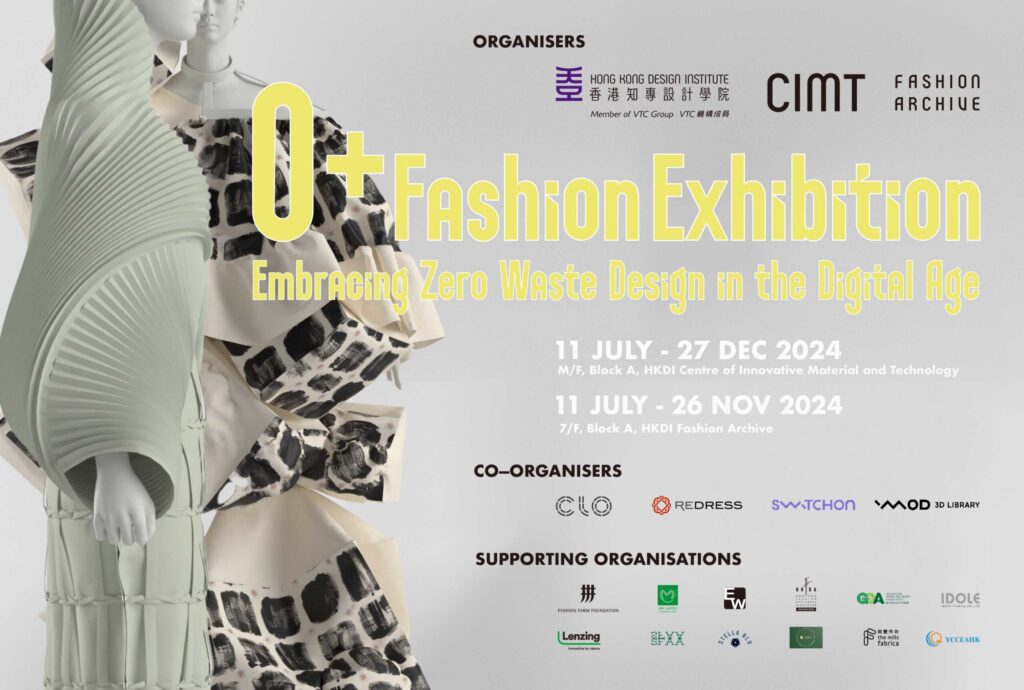
作為區內領先的設計學院,香港知專設計學院(HKDI)向來關注業內發展動向,並為學生提供前沿的理念及技術實踐。有鑒於時尚行業中服裝用料常被廢棄的現象,HKDI 及其旗下的知識資源中心 – 知專設創源、時裝資料館,由即日起至 2024 年 11 月 26 日,攜手舉辦以可持續發展和科技為主題的「0+時裝展」,展出由 HKDI年輕時裝設計師製作的 12 件零浪費時裝,希望透過展示零廢棄布料及零廢棄紙樣製作的理念和技術,喚起公眾對可持續布料及時裝設計的認知。 欲知更多信息,請點擊這裏。
作為區內領先的設計學院,香港知專設計學院(HKDI)向來關注業內發展動向,並為學生提供前沿的理念及技術實踐。有鑒於時尚行業中服裝用料常被廢棄的現象,HKDI 及其旗下的知識資源中心 – 知專設創源、時裝資料館,由即日起至 2024 年 11 月 26 日,攜手舉辦以可持續發展和科技為主題的「0+時裝展」,展出由 HKDI年輕時裝設計師製作的 12 件零浪費時裝,希望透過展示零廢棄布料及零廢棄紙樣製作的理念和技術,喚起公眾對可持續布料及時裝設計的認知。 欲知更多信息,請點擊這裏。

Australian family offices often manage substantial wealth accumulated over many generations (since the Australian gold rushes, starting in 1851), providing them with a strong capital base to engage in diverse investment opportunities including land acquisition, farming, mining and real estate. Unlike institutional investors, family offices are not bound by short-term performance metrics. This allows them to pursue long-term investment strategies, often leading to more stable and sustainable returns. Does it make some business sense to cooperate between family offices in other places (such as in Australia and Hong Kong) for bilateral co-investment opportunities? Here are potential rationale into these partnerships or investment model: 1. Market Access Diversification: By investing in each other’s markets, family offices can diversify their portfolios geographically and sectoral, spreading risk and increasing potential returns, e.g. many Australian family offices have significant expertise in the real estate sector, which remains a cornerstone of their investment portfolios. Their ability to identify and invest in high-potential real estate projects is a major strength. HK family offices could be very interest in Australian real estate sector. Economic Synergies: Combining the financial strength and investment expertise of Hong Kong family offices with Australia’s robust economic sectors creates powerful investment opportunities, e.g. many Australian family offices may be interested a more populated market such as in the Greater Bay Area whereas there is an 85 million population with great consumption capabilities for Australian products/services. Australia family offices could be interest to find a right “blind stick” to invest there. 2. Expertise Sharing: Knowledge Transfer: Collaborative investments allow family offices to share market insights, regulatory understanding, and sector-specific expertise, enhancing overall investment quality or success, e.g. many Australian family offices have robust governance structures in place, ensuring that investment decisions align with the family’s values and long-term goals. This will be attractive to Hong Kong Family offices. 3. Tax Efficiency: HK government has offered a profits tax exemption on foreign-sourced income for family-owned investment holding vehicles (FIHVs) and their underlying special purpose entities (SPEs). This is part of Hong Kong’s strategy to maintain its competitive edge as a low-tax jurisdiction. A local HK family office partner will be helpful for Australian family offices. I can see the opportunities and threats in the above co-investment model and concept. If you are interested to learn more about family office co-investment opportunities in Australia-Hong Kong, please write email to [email protected]

Replacing an AI chatbot with a digital human involves several key considerations: Realism and Interactivity: The digital human should be highly realistic, with natural-looking facial expressions, body movements, and speech patterns that create an engaging and immersive interaction for the user. This may require advanced technologies such as 3D modeling, motion capture, and natural language processing. Conversational Abilities: The digital human should have the ability to understand and r… To read the content, please register or login Username Password Remember Me Forgot Password
How to smoothly replace AI Chatbot by Digital Human? Read More »

Digital humans have the potential to replace traditional chatbots in certain scenarios: Compared to text-based chatbots, digital humans can leverage advanced computer graphics, animation, and speech synthesis to provide more realistic and engaging interactions. This can lead to more natural and immersive conversations, potentially enhancing the user experience. Digital humans can be designed with the ability to sense and respond to human emotions, providing more empathetic and personaliz… To read the content, please register or login
Digital Humans: Complementing or Completely Replacing Chatbots? Read More »
Why it is difficult for startups to raise funds locally? Up to the year 2023, Hong Kong’s start-up ecosystem is thriving. In 2023, the number of start-ups in Hong Kong grew to more than 4,200 with some 16,453 people employed in such businesses. Biotechnology, artificial intelligence (AI), smart city and financial technologies (fintech) have been identified as the four key areas for Hong Kong’s innovation and technology (I&T) industry. The city’s expenditure on research and development has almost doubled in absolute terms from a decade ago. However, the stagnant initial public offerings and geopolitical tensions have created a challenging venture capital environment in Hong Kong, resulting in a domino effect, forcing companies and investors to look elsewhere for opportunities. So there never have shortage of tech inventors and innovators in the city, but it is hard to commercialize their products. And even successful commercialized tech companies are doing very little to do more to help struggling start-ups and create much-needed ecosystems. There are no shortage of tech entrepreneurs with brilliant ideas, but investors are slow to put money into projects. There are a few key reasons why it can be difficult for startups to raise funds to commercialize: * Limited access to venture capital and angel investors: Many of the largest and most active venture capital firms and angel investor networks tend to be concentrated in major global tech hubs in U.S. like Silicon Valley, New York, and Boston. Startups located outside of these hubs, Hong Kong, have less direct access to these funding sources. * Smaller and shrinking local investor pools: The pool of active local investors, whether angel investors or venture capitalists, is often smaller in regions outside of the major tech centers. This reduces the number of potential funding sources for startups. Although the number of startups are climbing up from a decade ago, Hong Kong still has a limited venture capitalist ecosystem, which results in limited access to venture capital, which also is originated from lack of a strong market momentum in encouraging more potential investors. Due to these reasons, Hong Kong startups have to face funding problems, eventually leading to business losses or even closure. Indeed, many of the startups try their own ways to overcome this problem by adopting bootstrapping, which rely on the funds generated through the operations of the startup business and the money saved by limited continuous R&D activities. These startups are trying their best all the times to find other alternative funding sources like angel investors, private investors, and even more relying on government grants to get them alive. However, the success rate of obtaining government fundings is far from expected. * Lack of startup ecosystem maturity: Thriving startup ecosystems take time to develop. Regions without a well-established history of successful startups, lack of promising exits for investors, and slump of active investors may struggle to attract the same level of funding and support for new ventures. * Geographic bias: Due to internal economy downturn and various external risks and challenges, the Investors, especially larger VC firms, may be hesitant to invest in startups located far from their own offices, as a large portion of these overseas investors may have exited or only maintain a minimum office space in Hong Kong. It will be more challenging to provide hands-on support and oversight from a distance. * Perceived risk: Investors may view the Hong Kong as less established startup regions as riskier investments, due to factors like access to talent, industry expertise, and exit opportunities. Other unfavorable factors: – Talent Acquisition and Retention – High Cost of Living and Operating Expenses – Market Competition – Stringent Regulations and Compliance ~ ~ ~ ~ ~ ~ ~ ~ ~ ~ Why should you consider listing on Nasdaq? The main considerations are the key differences between a Hong Kong IPO and a Nasdaq IPO: * Listing Requirements: The Hong Kong Stock Exchange (HKEX) has specific listing requirements such as a minimum market capitalization, track record, and financial criteria that companies must meet to list in Hong Kong. NASDAQ: The NASDAQ exchange has its own set of listing requirements differ from the HKEX requirements. NASDAQ listing rules focus on factors like minimum share price, minimum number of shareholders, and financial metrics. * Regulatory Environment: The IPO process and listing requirements in Hong Kong are governed by the Securities and Futures Ordinance and regulated by the Securities and Futures Commission (SFC). The IPO process and listing requirements in the United States, including NASDAQ, are regulated by the Securities and Exchange Commission (SEC). * Investor Base: The investor base in Hong Kong is primarily composed of local and regional Asian investors, with a significant presence of institutional investors from mainland China. The investor focus is less variety but more on traditional equity and fixed income investment, less willing to pour into higher risky and higher return venture. The NASDAQ exchange attracts a more diverse global investor base, including a large number of institutional and retail investors from the United States and internationally. * Industry Focus: The HKEX has a strong focus on industries such as financials, real estate, traditional industry sectors, and companies with China-related business operations. The NASDAQ exchange is known for its concentration of emerging technology, biotechnology, and other high-growth companies. ~ ~ ~ ~ ~ ~ ~ ~ ~ When is the best time to list (in Nasdaq Capital Market)? For most of the startup with their dream to launch the successive fundraising, here is some hints of the best conditions for a startup to list on the Nasdaq Capital Market: * Company Size and Maturity: The Nasdaq Capital Market is generally suitable for smaller, less-established companies compared to the Nasdaq Global Select or Nasdaq Global Market. Typically, startups with a market capitalization between $50 million to $300 million are well-suited for the Nasdaq Capital Market. * Financial Requirements: Minimum share price: $4 per share Minimum market value of publicly held shares: $15 million Minimum stockholders’ equity: $5 million Minimum number of

“Show me the money.” It’s not just about money, though. In business, it’s 90% about money and 10% about making the right business decision. Many of my Australian friends and partners have asked me about how to accelerate their business growth or commercialise their products/services or increase their company valuation 100%-200% within two years. This LinkedIn post provides a different perspective for Australian enterprises who are interested to accelerate their products and services in a fast-track and tapping into a nearby ready and fast growth market overseas. Australia Market Size: A country of 27,077,833 (2024 Estimate) with its GDP $1.742 trillion (nominal; 2023) $1.724 trillion (PPP; 2023) GBA Market Size: As of 2024, the GBA has a population of approximately 86.17 million people. The Greater Bay Area (GBA), which includes nine cities in Guangdong province along with the Hong Kong and Macau Special Administrative Regions, is a significant economic powerhouse in China. As of recent estimates, the GDP of the GBA has surpassed USD 2 trillion. Hong Kong is within an “hour living circle” (一小时生活圈) to Shenzhen, the innovative technology hub of China. How to combine the Australia Market and the GBA Market? It looks complicated. However, there is a bridge built between the two markets. There is an Australia-Hong Kong Free Trade Agreement (A-HKFTA) and Investment Agreement, which came into effect in January 2020, enhances the economic relationship by providing greater market access and legal certainty for businesses. Thru Hong Kong as the stepping stone, the two markets could be connected seamlessly. Trade: Hong Kong is one of Australia’s significant trading partners. Investment: There are substantial investment flows between Australia and Hong Kong. Hong Kong serves as a gateway for Australian businesses looking to enter mainland China and other Asian markets. The Closer Economic Partnership Arrangement (CEPA) between Hong Kong and Mainland China is a comprehensive free trade agreement designed to enhance economic cooperation and integration. CEPA eliminates tariffs on all goods originating from Hong Kong, provided they meet specific rules of origin. This facilitates a more competitive market for Hong Kong manufacturers and exporters. The relationship between Hong Kong and Australia is multifaceted and characterized by strong economic ties, educational exchanges, and people-to-people connections. As a business growth advisor, I will recommend entrepreneurs, family offices, institutions and investors of Australia-Hong Kong to consider further business exploration and friendship strengthening. If you are interested to learn more about A-HKFTA, Australia-Hong Kong bilateral trade and investment, an “hour living circle” (一小时生活圈) to Shenzhen, please write email to [email protected]
How Australia market can reach 110 Millions population immediately? Read More »

This LinkedIn Post is written for Australian Startup (or Scale-ups) CEOs who are thinking to raise capital or finding distribution partners from overseas such as Hong Kong or Singapore or Tokyo. During the past two years, I had been a project manager, supporting and organising five (5) Australian Missions (3 Missions related to Healthtech Startups/Scaleup and 2 Missions related to Fintech and Financial Services), meeting around 70-80 investors of various categories such as angels, HNWI, PE Funds, VCs, Family offices and banks. In my opinion, cultural and communication barriers are not the main reasons leading to misunderstandings and misalignments in expectations between Australian entrepreneurs and Asian investors/partners. Australian CEO may face these blind spots when trying to raise funding or finding distribution partners in Asian cities. 1. Investible and Readiness – CEOs may assume a great idea is enough to attract investors – Investors need to see proof of concept and market traction, e.g. how and where to validate your technology, products or services? – Investors are interested to know about your detail monetarisation plan and when they can get back their invested money 2. Overestimating Market Demand – CEOs often overestimate the market demand for their product or service (as there are many other competitors already in the market). 3. Neglecting of Audited Financial Reports – Lack of audited financial statements in the past two to three years have deterred investors (even your Startup is a pre-revenue company) – The financial statements could tell the investors about your financial metrics such as burn rate, runway, and how much you have invested into R&D (this helps to decide the company valuation), etc. 4. Poor Pitch Preparation – Failing to prepare a compelling and concise pitch. 5. Inadequate Networking – Relying solely on cold pitches and neglecting relationship-building (and follow-ups via zoom or emails or messaging). 6. Not Understanding Investor Needs – Failing to align with what investors are looking for. 7. Underestimating Time and Effort Required – Believing that raising capital will be quick and easy. – Underestimating the time and effort can lead to rushed or poorly executed fundraising rounds. 8. Overemphasis on Valuation – Focusing too much on securing a high company valuation. 9. Inflexibility – Being inflexible with terms and negotiations. – Inflexibility can turn away potential investors and/or distribution partners of your technology, products or services By being aware of these blind spots and actively addressing them, Australian startup/scale-ups CEOs can improve their chances of successfully raising the capital needed to grow their businesses. If you are interested to learn more about how to raise funding, find distribution partners and attract investor’s attention in Asia, please write email to [email protected]. Thank you.
Blind spots that Australian Startup CEOs can avoid? Read More »

Despite the challenging weather conditions yesterday, the dedication and commitment of our startup entrepreneurs were nothing short of inspiring! 🌧️💪We are deeply grateful to everyone who braved the elements to attend our event, “Funding & Expansion: Strategies for Startups,” held on July 31, 2024. Event details: https://lnkd.in/gv82Ef_M Your passion and resilience are what make our community truly special. 🙌 A special shoutout and heartfelt thanks to our esteemed speakers and supporting organizations: Peter Luk, Vice Chairman of the HK International Family Office Association (HKIFOA) 🌟 Crystal TAI, Senior Manager, Business and Partnership at RD Technologies 🚀 Thomas Gijsels, Head of Business Operations at Evident Capital 🌐 And our amazing partners including Oracle NetSuite for their unwavering support. Your insights and expertise have made a significant impact and we are incredibly thankful for your contributions. 💼✨ The feedback and responses we’ve received so far have been overwhelmingly positive. We are thrilled to hear that you found the event valuable and insightful. Your feedback is invaluable and will help us continue to improve and deliver even better experiences in the future. 📈📊 At Startups Community (Asia) Limited (StartHub Asia), our mission is to empower startups through funding, networking, mentorship, and strategic partnerships. We are committed to organizing more events and seminars that bring value to our community and support your growth and success. 🌍🚀 Stay tuned for more exciting events and initiatives! Together, let’s build a thriving startup ecosystem across Asia. 🌏💡 Hashtag: #ThankYou hashtag#Startups hashtag#Entrepreneurship hashtag#Innovation hashtag#Networking hashtag#Funding hashtag#BusinessExpansion #StartHubAsia hashtag#Community hashtag#Mentorship hashtag#StrategicPartnerships
🌟 Thank You to Our Incredible Community! 🌟 Read More »
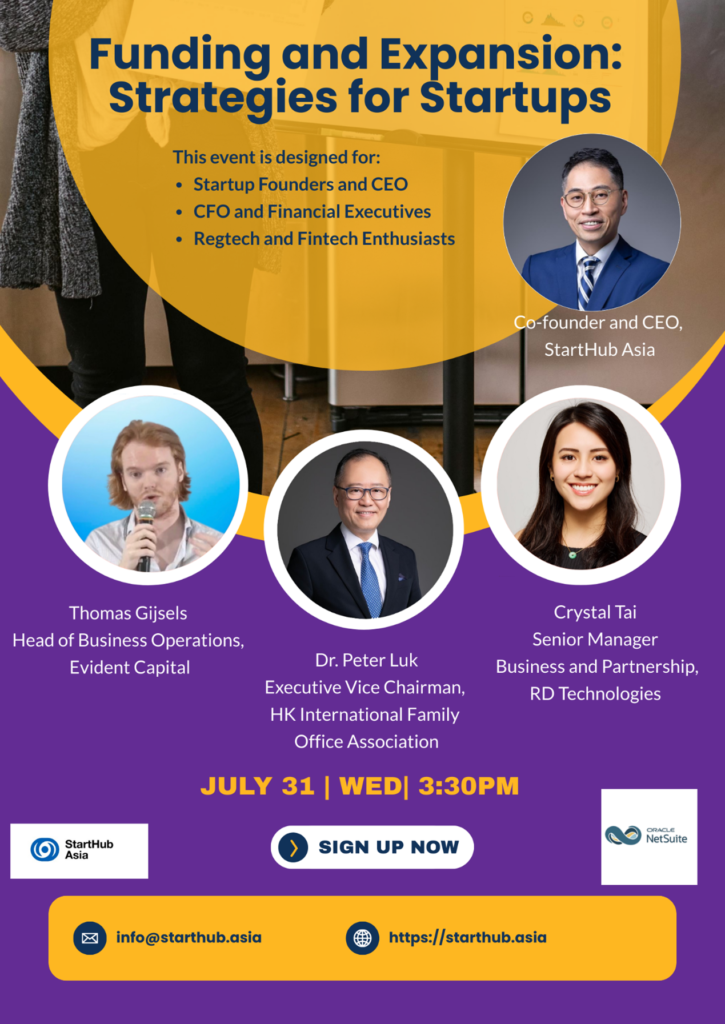
Join the “Funding & Expansion: Strategies for Startups” seminar on July 31, 2024, organized by Startups Community (Asia) Limited. Tailored for startup founders, CEOs, CFOs, and financial executives, this event offers insights on investment landscapes, digital and regulatory technologies, and innovative fundraising strategies. Register now to secure your spot.
[HK, 2 July 2024] – Startups Community (Asia) Limited, the leading platform dedicated to empowering startups and entrepreneurs in Asia, is thrilled to announce a strategic partnership with Evident Capital, a pioneer in the investment of alternative assets. This partnership marks a significant step forward in enhancing the growth and development of innovative startups and providing them with access to transformative financial strategies and investments. Background and Mission Alignment: Startups Community (Asia) Limited, operating through its platform StartHub.asia, has been instrumental in providing resources, networking opportunities, and support to startups across Asia, fostering an environment where new ideas can thrive and receive the visibility they deserve. Evident Capital, known for its revolutionary approach to investing in alternative assets and empowering investors with impactful opportunities, aligns perfectly with StartHub.asia’s mission to nurture innovation. Synergies and Common Interests: The partnership between Startups Community (Asia) Limited and Evident Capital is built on a shared vision of innovation and sustainable growth. Both organizations are committed to: Empowering Entrepreneurs: Providing startups with not only funding but also strategic insights into asset management, helping them to scale sustainably. Innovation in Funding: Leveraging Evident Capital’s expertise in alternative assets to offer startups novel funding avenues that go beyond traditional venture capital. Sustainable Impact: Focusing on investments that promote sustainability and positive social impact, aligning with global shifts towards responsible business practices. Access to Global Markets: Helping startups expand their reach into new markets through Evident Capital’s extensive network and financial expertise. Comments from Leadership: Paul Chan, Co-Founder and CEO of Startups Community (Asia) Limited, stated, “This partnership with Evident Capital represents a transformative opportunity for Asian startups. Evident’s expertise in alternative investments and our platform’s reach within the startup community will create unparalleled opportunities for growth and innovation.” Florian Matthaeus Spiegl, Founder and CEO of Evident Capital, commented, “We are excited to partner with StartHub.asia as we see a great synergy between our investment strategies and their robust support ecosystem for startups. Together, we aim to drive substantial impact and empower startups to not only succeed but excel in their respective sectors.” Future Prospects: The strategic partnership will kick off with joint programs aimed at education and direct investment opportunities for startups in Asia. These initiatives will include workshops, joint events, and exclusive sessions designed to equip entrepreneurs with the knowledge and resources to engage with alternative assets effectively. About Startups Community (Asia) Limited: Startups Community (Asia) Limited operates StartHub.asia (https://starthub.asia), a premier platform that supports startups through resources, mentorship, and networking opportunities aimed at fostering innovation and business growth across Asia. About Evident Capital: Evident Capital (https://www.evident.capital/) invests in and manages alternative assets, focusing on empowering investors by offering impactful and sustainable investment opportunities. Licensed and regulated by the Securities and Futures Commission in Hong Kong, Evident Capital is at the forefront of financial innovation. Contact Information: For more information, please contact: [email protected]