Dyson Singapore picks new social AOR

Dyson Singapore has appointed creative agency ballsy as its social agency-of-record (AOR) following a pitch. MARKETING-INTERACTIVE understands the appointment is on a one-year retainer and began with KOL work, and will roll out monthly social assets from end-May. Don’t miss: Ministry of Transport concludes social media pitch As part of the new scope, Dyson has rolled out a social-first campaign featuring local influencer Munah Bagharib. The short video opens with her struggling with visibly frizzy hair before snapping into a “Singapore-proofed” transformation, achieved using Dyson’s hair care tools. The film showcases the Dyson Airstrait and Dyson Omega hydrating hair oil, positioning the duo as a humidity-ready routine. It closes with the line “now you’re ready for Singapore”, leaning into the city’s trademark frizz-inducing weather conditions. MARKETING-INTERACTIVE has reached out to Dyson for more information. The appointment comes amid wider changes to Dyson’s global media operations. Earlier this year, Dyson appointed Omnicom Media Group to handle its global media planning and buying duties following a competitive pitch last year. The account is being managed through a cross-agency model, drawing on capabilities across multiple Omnicom media brands with a focus on data, identity solutions and advanced analytics. The collaboration aims to support Dyson’s broader global media transformation strategy by strengthening technology integration, improving audience targeting, and speeding up time-to-market. Related articles: GovTech picks agency to manage digital and social media channels   Maybank Singapore calls for social media pitch   URA names new social media agency source

Dyson Singapore picks new social AOR Read More »

Forever chemicals may change when they enter your body. Here's what we know.

Carrie McDonough, Carnegie Mellon University / The Conversation Virtually every living thing on Earth, from Patagonian penguins to newborn human babies, has been touched by the synthetic chemicals known as per- and polyfluoroalkyl substances, or PFAS. In fact, you would be hard-pressed to find a sample of human blood, tissue, or breast milk without detectable levels of at least one type of PFAS. Making matters worse, researchers are continually uncovering links between human exposure to PFAS and poor health outcomes, including a weakened immune system, a heightened risk of kidney and testicular cancer, and pregnancy complications, including preeclampsia and reduced birth weight. The levels of some PFAS considered safe in US drinking water are decreasing. Despite this, the Trump administration is in the process of revoking and possibly rewriting proposed regulations for all but PFOA and PFOS, two of the most commonly used PFAS until the early 2000s. US maximum contaminant level goals for PFOA and PFOS are 0 parts per trillion – meaning there are no levels the US Environmental Protection Agency considers safe. Meanwhile, thousands of PFAS have not been studied and have no regulation or oversight. In many cases, there is no monitoring data on their presence in consumer products, water and food. As an expert in chemical pollution, I have studied a wide range of synthetic and natural chemicals that can have harmful health effects for humans and wildlife. A major focus of my current research is tracing PFAS from their initial source – including consumer products, contaminated food and water, and the air – to their resulting fingerprint in an organism’s blood and tissues. By following the journey of how PFAS move into the bodies of living things – including people – scientists like me are working to improve safety recommendations and usage guidelines for these chemicals. First, though, we need to understand how these complex chemical mixtures are transformed as they accumulate in the body. What are PFAS? PFAS are a large class of organic chemicals – meaning molecules that contain carbon atoms – that have fluorine atoms added to them. This fluorination allows PFAS to aggregate on surfaces in ways that are desirable for many applications. For example, PFAS are used in nonstick cookware, food packaging, cosmetics, textiles and even toilet paper, among many other commercial and industrial products. They’re also heavily used in semiconductor manufacturing and lithium-ion batteries. How PFAS harm our health — and why they’re everywhere PFAS are commonly called “forever chemicals” because of their astonishing persistence – due to the strong chemical bonds between carbon and fluorine, they don’t break down easily. This durability is desirable for manufacturers, as materials made with PFAS can function for a long time without degrading. However, persistence becomes problematic when PFAS leach or evaporate out of products and into the surrounding environment. PFAS can remain in drinking water sources and in sediment for decades to centuries. If dissolved in water or released into the air, PFAS can also travel long distances from their point of origin, ending up in remote locations. For example, PFAS initially released from industrial regions can end up in the blood of white sharks in the Atlantic Ocean or in Arctic environments. PFAS fingerprints What happens when PFAS are absorbed and accumulate in the body? When someone is exposed to PFAS, it leaves a unique pattern of chemical contamination – what researchers call a PFAS fingerprint – in their blood. Studying these PFAS fingerprints enables scientists to learn about sources of PFAS exposure and how they differ among people who live in different places, have different jobs, and use different products, among other factors. But to be able to use these PFAS fingerprints, researchers first need to understand how specific exposures contribute to someone’s PFAS fingerprint over time. The composition of this fingerprint is different from the mixture of chemicals someone was initially exposed to, as some PFAS accumulate in blood to a greater extent than others. Without understanding how a PFAS mixture is distorted and changed in the body, it’s very difficult to know what sources were major contributors to a person’s lifelong PFAS exposure. For example, firefighters and military service members use aqueous film-forming foams that contain hundreds of poorly studied PFAS. These are soapy, sudsy materials that form a film over fire and starve it of oxygen. They’re commonly used in emergencies, such as airplane crashes, train wrecks, vehicle fires, or any other fire involving fuels. Many firefighters and first responders who have used these foams are now grappling with serious health problems, including cancer, and many have wondered whether PFAS contributed to their illness. A clearer understanding of the PFAS fingerprint that would be expected in someone’s blood after years of using these foams could help determine whether they are a unique source of the PFAS accumulating in their blood. PFAS in the body Fingerprints at the scene of a crime are often a major clue leading detectives to the perpetrator. When it comes to identifying sources of PFAS contaminating human bodies, however, researchers like me aren’t always so lucky. For one, PFAS are typically present at low concentrations in the environment but can build up to higher levels in the body. For example, people drinking water containing PFOS will typically have levels 50 to 100 times higher in their blood than were measured in the water. This is because the body’s rate of PFOS uptake exceeds its rate of excretion. But not all PFAS will increase in blood to the same degree. PFAS that are more likely to bind to biological components, such as proteins and fats, will more readily accumulate in the body. As the mixture of chemicals in drinking water, for example, continues to accumulate in the body, these types of more bioaccumulative PFAS, such as PFOS, will make up a higher proportion of the fingerprint than other types. This distortion complicates my and other scientists’ job, since we need to be able to predict how much each PFAS accumulates in

Forever chemicals may change when they enter your body. Here's what we know. Read More »

Review: 2026 GMC Sierra 1500 has a powertrain for everybody

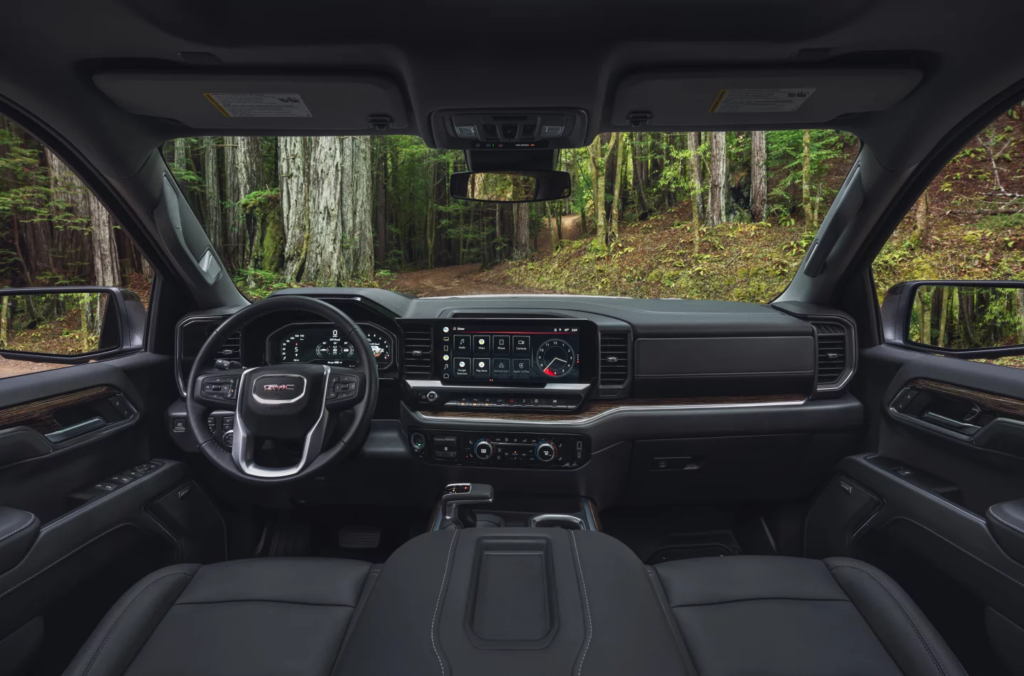
Trucks used to be pretty easy. You bought a GMC because it was nicer than the others. Powertrain choice was about what your plans were with the truck. Now it’s … Well, still easy. It just looks complicated. At a glance Four propulsion options for four sets of needs For actual truck use, the diesel is probably still tops Turbo-four in a full-sized truck? What? For commuting, the EV is the best proposition Today, GMC has decided that the Sierra should be all things to all people. I drove the gas, diesel, and electric models to see what’s going on here. What this means is you can buy the gasoline one because you want it simple, or you like V8 noises and make the occasional weekend lumber store runs. Or you get the diesel because you tow things big and small. Then there’s the electric one, which you buy if you’re going to commute. The weird part is that GMC hasn’t built four entirely different personalities here. Instead, it’s built four versions of the same idea: a premium truck for people who want capability wrapped in leather, giant screens, and enough chrome to make Harley riders envious. With all of the GMC Sierra models, steering is predictable, ride quality has improved substantially over previous generations, and GMC continues to separate itself from Chevrolet by leaning harder into upscale refinement. The Denali trims, especially, have crossed firmly into “luxury vehicle that accidentally owns a toolbox” territory. The interior quality is genuinely impressive now. Soft-touch materials are everywhere, the tech is mostly intuitive, and the available Super Cruise hands-free driving system remains one of the few driver assistance systems that doesn’t make you want to drive directly into a lake out of frustration. The 2026 GMC Sierra 1500 interior, even without all of the Denali and large-screen upgrades, is still extremely functionalGMC The V8 gasoline Sierra remains the most familiar of the bunch. Under the hood, GMC continues offering the tried-and-true 5.3-liter V8 and the glorious 6.2-liter V8, depending on trim. The 6.2, especially, remains one of the best truck engines on the market. Not because it’s efficient or technologically groundbreaking, but because it behaves exactly how a full-size truck engine should. It rumbles and it shoves. That engine still gives the Sierra an effortless personality. The truck moves with confidence, towing is easy, and highway passing feels way too easy. The 10-speed automatic transmission for either V8 engine goes a long way in making this feeling come to fruition. Fuel economy? Well, nobody buys a 6.2-liter V8 because they’re trying to save polar bears. Real-world numbers hover in the “acceptable for a big truck” category. Middle teens at best. Then there’s the diesel. Ah yes, the 3.0-liter Duramax inline-six. The engine for people who use the phrase “torque curve” recreationally. This is arguably the sweet spot in the Sierra lineup. The baby Duramax continues to be absurdly good at truck things. It delivers excellent towing manners, calm highway cruising, and fuel economy numbers that feel borderline illegal for something this large. I routinely saw mileage in the high 20s and even around 30 mpg (7.8 l/100 km) on highway drives. That’s bananas for a full-size pickup. Again, thank that 10-speed automatic for all its work here. It’s also why the diesel-powered Sierra 1500 drives like a regular vehicle instead of a slow-on-the-uptake hauler. The inline-six turbocharge diesel engine in the Duaramax model of the 2026 GMC Sierra is the best works-for-a-living powerplantAaron Turpen / New Atlas The diesel Sierra feels relaxed all the time. The low-end torque delivery makes the truck feel smoother and less frantic than the gas V8s. You don’t need to hammer the throttle to get moving. The truck just leans into the work and gets on with life like a ranch foreman who drinks coffee black and silently judges your hitch setup. For long-distance drivers, the diesel remains king. Road trips are easy, towing range is fantastic, and there’s still something deeply satisfying about covering 700-plus miles on a single tank. Classic rock tracks not required. The downside, of course, is diesel ownership itself. Fuel prices fluctuate wildly, emissions equipment can become annoying over time, and maintenance costs tend to creep upward as mileage piles on. Modern diesels are brilliant when they’re happy and dramatically expensive when they’re not. Still, if I were buying a Sierra tomorrow with my own money and intended to actually use it like a truck, the diesel would probably be the one parked in my driveway. The gasoline and diesel models of the 2026 GMC Sierra 1500 are all similar in exterior looksAaron Turpen / New Atlas Somehow, right next to that diesel on the sales lot is a Sierra powered by a turbocharged inline four-cylinder gasoline engine. Yes. A full-sized truck with a four banger under the hood. For those who don’t need impressive exhaust notes, five-digit towing figures, or bragging rights, the TurboMax offers a pretty decent daily drive through its eight-speed automatic. But if you think this one will save you gas money over its V8 brethren … Well, don’t get too excited. Daily MPG returns will still be under 20 (11.8 l/100 km). That’s where the GMC Sierra EV comes in. It’s electric so it’s hilariously quick for something roughly the size and weight of a small bus. Depending on trim, power climbs from 765 lb-ft of torque up to 785 (1,037 to 1,064 Nm). With a 0-60 mph (97 km/h) sprint time that rivals a Corvette. The GMC Sierra EV, while not built on the same platform as the gasoline and diesel versions, shares much in common with themAaron Turpen / New Atlas The Sierra EV launches with the kind of violence that makes passengers say words usually censored on network television. Yet somehow it remains composed. The battery placement gives the truck a low center of gravity, and GMC has done an admirable job hiding the sheer mass involved. More or less. Physics still exists.

Review: 2026 GMC Sierra 1500 has a powertrain for everybody Read More »

FairPrice Group CMO Alvin Neo to depart after nearly 7 years

After a significant period of transformation and capability-building at FairPrice Group, Alvin Neo is transitioning from his role as chief customer and marketing officer to an advisor, leaving behind an organisation he believes is “strongly positioned for its next chapter”. For Neo, the move marks the natural close of a leadership season rather than a hard stop. During his time at FairPrice Group, the organisation modernised its customer ecosystem, strengthened customer experience and loyalty capabilities, elevated the brand, deepened its focus on the “lived experience” of customers, evolved its social impact efforts, and moved early on AI augmentation as a real operating capability. “I’ve always believed transformation leadership has seasons. The responsibility is to leave the institution stronger than you found it and position it for what comes next,” Neo told MARKETING-INTERACTIVE. Neo has been with NTUC Enterprise since 2019, serving as chief customer and marketing officer for both NTUC Enterprise and FairPrice Group, while also leading NTUC Link as managing director. Prior to that, he held senior marketing and commercial leadership roles at Parkway Pantai, where he served as group chief marketing officer, and Johnson & Johnson Medical, where he led regional and global marketing portfolios across Asia Pacific and emerging markets. Don’t miss: Howie Lau bids farewell to NCS Group after five years  Building a customer and transformation engine  Looking back, one of Neo’s proudest achievements was reshaping marketing from a campaign and communications function into a growth, customer and transformation engine. When he joined FairPrice Group, the brand already enjoyed strong goodwill in Singapore. The challenge, as such, was to modernise its relevance. This was especially so among younger families and digitally native consumers, while staying true to the organisation’s unique position as part retailer, part co-operative and part social enterprise. A key part of that work was shaping “Every day, made a little better” into more than a tagline. Today, “Every day, made a little better” became an organising philosophy across brand, customer experience, loyalty and culture, pushing the organisation to look more closely at the real pressures families face around time, nutrition and affordability. Behind the scenes, marketing was repositioned to operate akin to the organisation’s “customer control tower”, strengthening data and insights, modernising loyalty, and upgrading CX operations. FairPrice Group also grew its digitally connected customers to more than two-thirds of its shopper base, creating a stronger foundation for omnichannel engagement and data-enabled personalisation. At the same time, the organisation moved early on AI augmentation, not as a buzzword exercise, but as an operating capability built around people, platforms and processes. The results, according to Neo, have been tangible. FairPrice moved from #4 to #2 in Singapore’s Brand Finance brand strength rankings in 2026, topped the Corporate Equity Index, and steadily improved NPS as it worked towards becoming world-class in the “lived experience” delivered across stores, digital and service touchpoints. “Most importantly, we are proving that purpose and performance are not opposing forces. Trust is economic,” said Neo. That belief has shaped how he views marketing within FairPrice Group where in an organisation that sits at the intersection of retail, co-operative values and social enterprise, marketing cannot simply be about transactions or campaigns. “At FairPrice Group, marketing is not just about transactions. It shapes affordability perception, food accessibility and everyday quality of life,” he explained.  That makes marketing closer to stewardship. Decisions around pricing, promotions and loyalty influence how people feel about value, trust and the cost of living. The FairPrice Foundation reinforces that broader purpose, with programmes such as “Start strong, stay strong” addressing practical issues such as nutrition access and healthier living. It also changes how growth is understood. Discount-led engagement, Neo cautioned, is not the same as loyalty: If customers only engage when discounts appear, you have not built loyalty. You have trained dependency. The same principle applies to AI and personalisation. Used well, they can make customer experiences more relevant and useful. Used poorly, they risk adding more noise. “AI and personalisation are powerful when used responsibly. The goal is not to flood customers with content, but to reduce friction and make experiences genuinely useful,” said Neo.  Transformation, trust and the next wave of retail Neo’s approach to leadership has also been shaped by the harder lessons of transformation. One of the most important was learning that speed alone does not create progress. Earlier in his career, Neo believed the right strategy would naturally drive movement. Over time, that view changed. Transformation, he learnt, is rarely constrained by intelligence alone. More often, it is constrained by alignment, trust and energy. That lesson has influenced how he thinks about customer-centricity. For it to become real, frontline operations, customer service, digital and marketing teams need to move beyond silos and solve problems together. “I learned that customer-centricity only becomes real when frontline operations, customer service, digital and marketing teams stop defending turf and start solving problems together,” said Neo. Leadership today, in his view, is less about having every answer and more about integrating people and perspectives across the organisation. That same belief shapes his view of the next wave of transformation in retail, loyalty and customer engagement in Singapore. Neo sees three defining forces ahead: intelligence, trust and integration. AI will make retail more predictive and adaptive across pricing, loyalty and customer service. However, as hyper-personalisation scales, consumers will become more sensitive to manipulation, AI-generated noise and brands that are efficient but emotionally forgettable. Furthermore, integration will be just as critical. Physical retail, digital commerce, payments, loyalty and media are increasingly converging into one connected customer ecosystem. Yet many large organisations remain structured around internal silos, where marketing owns campaigns, digital owns apps, and service owns complaints. “One capability most organisations still underinvest in is enterprise-wide customer orchestration. Many companies still operate in silos. Marketing owns campaigns, digital owns apps, service owns complaints, but customers experience one continuous relationship,” said Neo.  As such, the advantage will go to organisations that can understand and engage customers holistically, in near real time, across


FairPrice Group CMO Alvin Neo to depart after nearly 7 years Read More »

tent lands in USA to elevate luxury base camps

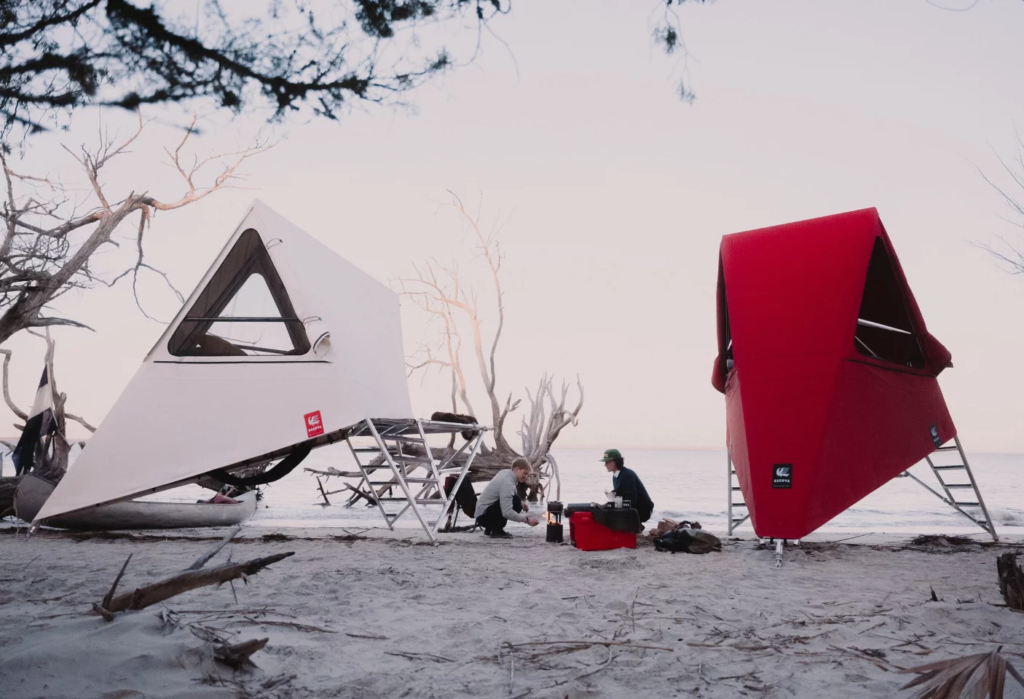
In 2025, we took a look at the K-Tent from Great Britain’s Kudhva Kanvas, a unique piece of semi-permanent light architecture that struck us as a cross between heavy-duty safari tents and hard-walled A-frames, with a touch of treehouse mixed in for good measure. The tent was a spinoff from Kudhvas’ original business renting out permanently installed, glass-and-timber dwellings of that same shape and style at its off-grid resort on the North Cornish Coast. Now, those K-Tent portable canvas structures are traveling across the Atlantic to serve as the basis of a planned series of American glamping resorts. When we looked at the K-Tent last year, it was being positioned as a retail “take-away” product. But with a 705-lb (320-kg) weight and £12,500 (US$16,800) price tag (which has since risen rapidly to £20K), the heavy-duty two-person tent’s appeal for basic everyday campers seemed absolutely razor thin. It seemed from the start a much more attractive solution for resorts and hospitality companies, particularly those looking for a shelter solution both sturdy and portable. The K-Tent’s tubular aluminum frame and heavy canvas construction is designed to hold up to 80-mph (129-km/h) winds, but the tent can also be broken down, transported and rebuilt in a short time. Estimates put build time for two people at inside an hour. Kudhva has added the tent to the Kudhva Landscape Hotel that houses the original hard-walled design, offering another alternative to the cabins and tipis that make up the resort. It now expands its footprint out internationally by teaming up with American startup British American Camping (BAC) to bring the experience westward. Adding some vibrant color to a naturally neutral scene BAC was founded by Murphy Talmadge after a trip to Great Britain left a lasting impression. Talmadge, a government relations specialist by trade, found the combination of authentically thoughtful hospitality and stunningly raw landscapes he and his family experienced there difficult to replicate in the States. “I built British American Camping because I wanted somewhere to take my family that did not yet exist. BAC is the answer to that gap,” Talmadge said in introducing the brand this month. Well, that, plus the fact that his other enterprise, Lovejoy Capital, is an investment firm allocating tens of millions of dollars into public-private land development projects at parks and beaches. Glamping in various forms has been at the heart of several of the firm’s proposals. But the murmur of a “kettle warming quietly in the corner” and neatly stacked shelves of bunny-eared books “someone genuinely chose” are certainly nice, too. Mix in incomparable southern cooking, and you could definitely take glamping to new heights … in our hungry opinion BAC is working with Kudhva and New British Design, the firm that penned the original Kudhva cabins and K-Tent to life, in bringing British-style glamping to select sites around Talmadge’s home state of Georgia. Instead of K-Tent, it calls the structure simply the “K1,” but it appears to be the very same heavily framed, raised-floor canvas dwelling born on the shores of Cornwall. The trio of legs can adjust to level out the incongruities of soft coastal sands or duff-and-root-littered forest floor. The cross-Atlantic collaboration set up a temporary test site on Jekyll Island, one of the southernmost in the Sea Islands string of barrier islands that stretch up and down the coast of South Carolina, Georgia and Florida. Accessible from the mainland via causeway, the island is known for its rich history, hard-weathered leafless trees and driftwood, and unspoiled white sand beaches, maritime forests and marshlands. The skeletal appearance of the undressed K1 frame matches the look of the island’s famed trees rather brilliantly. The bright-red tent canvas stands out, but the skeletal aluminum frame blends in rather naturally with the Jekyll Island surroundings British American Camping BAC plans to launch the K1 tents at three rental sites in the future, all in Georgia. Yellow River will deliver a tranquil stay where river intersects dense woodland; West Point Lake will sit between pine lands and lakeshore; and Oculmogee will deliver a setting in ancient wetlands. The K1 tents are making their way to the US during a time of market growth for new outdoor and glamping experiences. Once a niche concept barely on the radar of most outdoorsy folks, glamping has shown staying power and grown into a booming market and an attractive way of experiencing the great outdoors. In 2022, Kampgrounds of Americas’ North American Glamping Report noted that glamping had exploded by 300% during the course of the preceding decade. Growth continued from there, and the American glamping market flirted with $1 billion in 2025, raking in a total of $993.2 million, according to numbers from Grand View Research. The industry should officially surpass the $1 billion mark this year and double it within the next five years, if projections prove accurate. That’s a big pie, and according to the American Glamping Association, unique accommodations will prove a key driver of which glamping destinations feast on it. Opening the first Kudhva tent accommodations in the US certainly seems like an answer to the call for distinctive glamping that stands out in a crowding marketplace. Like the original British K-Tent, the K1 includes a small deck outside of the canvas BAC made its official premiere at the International Contemporary Furniture Fair (ICFF) in New York City earlier this month. The K1 tent created serious buzz at the show, culminating in BAC taking home the ICFF Award in the Outdoor category. The reservation books for BAC’s first K1 tent sites will open in the near future. Source: British American Camping source

tent lands in USA to elevate luxury base camps Read More »

GM’s new California ideas unit reimagines the off-roader

Fancy driving an off-roader guided by its own remote drone flying ahead to recce the terrain and relay images back to your dashboard screen? What about a customizable body and interior you can adapt for different adventures with switchable wings, fenders and even different dashboard screens? Okay, GM’s new concept Hummer X is unlikely to be rolling into a showroom near you any time soon – but as a showcase of ideas percolating behind the scenes, it’s one of the most interesting vehicles of the year. This electric off-roader concept is designed as either a pickup or SUV and when GM says it “reimagines what a vehicle can mean to the people who drive it” for once it’s not just over-the-top marketingspeak. It really seems to be a testbed for some radical new technologies. GMC HUMMER X Mid-Size SUV Concept | Official GM B-Roll GMC HUMMER X Mid-Size Pickup Concept | Official GM B-Roll Right from the fundamental level, the Hummer concept is different. GM’s design team envisages building it using a new fast, small-batch, on-demand production system. This would be similar to 3D printing, but for metal. That means each Hummer X could be completely configurable because it uses no specialized stamping tools. Multiple designs would be possible from the same platform. GM calls this small production system ‘Flex Fab’ and there’s more than a hint of Southern California about the thinking involved. And that is no surprise, when you spot that the concept was revealed as part of the official opening of GM’s new advanced design studio in Pasadena. This brainstorming unit spans 148,000 square feet (1,300 sq m) across three buildings, and is equipped for full-size clay modeling, fabrication and immersive digital collaboration. It houses a 100 -strong team spanning design, sculpting and fabrication. The studio’s focus is on conceptual design studies intended to drive new ideas across the company. GM says its designers look beyond current production programs to envision “what could be.” The Hummer X Concept SUV has a ground clearance of 13.2 inches, a breakover angle of 30.9 deg, and measures 188.3 inches long with a 116-inch wheelbaseGeneral Motors For example, the Hummer X replaces adhesives with snap fits and mechanical fasteners so parts can be fully recycled and swapped in and out. There’s a list of parts made from recycled bits which is fairly meaningless when the exercise is all at the concept level but nevertheless shows where GM’s thinking is heading. It is taking recycling so seriously it describes the Hummer X as part of a circular economy and community of switchable, reusable parts. However it is put together and whatever it’s made from, the X Concept seems to have unlocked a new Hummer vibe: a clean, flat-topped silhouette with smooth radiused edges, laser-welded seams and visible precision bolts. To our eyes it looks embarrassingly better than the standard Hummer EV that’s actually on sale. Regular readers will recall we spent a week testing the latest production Hummer recently, where our own Aaron Turpen called it ‘a mobile playhouse for adults who love extremes.’ Interestingly the new X Concept has been designed significantly smaller yet fully crammed with ideas and rock-crawling capabilities. The SUV Concept X is slightly more monstrous than its pickup sibling, with massive 37-inch off-road tires that AutoExpress magazine has likened to something you’d drive on the Moon. There’s a towering ground clearance of 13.2 in (334 mm) and its approach and departure angles of 44 and 46 degrees completely out crawl a Land Rover Defender’s 40-degree maximum. The hardcore beadlock wheels mechanically clamp the edge of the tire to the rim. Unlike standard wheels, which rely solely on air pressure to push the tire against the rim, beadlocks use a bolted outer ring to physically sandwich the tire in place. Fancy driving a truck with this dash? The Hummer X Concept’s dash has the potential to expand to NASA control room levels of intelGeneral Motors But let’s get back to that extraordinary customizable dashboard, one of the most noticeable features. There are up to seven screen systems available. You can stack them all in there, side-by-side, or just pick the ones you want for your particular adventure. One of them, for example, links to a scout drone camera surveying the terrain ahead and feeding back route data to the driver. This is from a Southern Californian think tank remember, so all the boring technical details like range and performance weren’t included in the press materials. It clearly isn’t about creating a production concept but an ideas showcase. Nevertheless, if the X aims to out-perform the standard Hummer EV, it will need the largest battery fitted to any production car. The standard EV is currently powered by the biggest in any car in the world, a huge 212-kWh unit three times the size of a Chevy Bolt’s battery which is humongous enough to power several homes at once or more than 400 ebikes simultaneously. Source: GMC source

GM’s new California ideas unit reimagines the off-roader Read More »

Nissan moves beyond camper vans, turns popular SUV into camper wagon

With help from its Autech/NMC tuning and customization arm, Nissan has developed out quite a camper van line in Japan, ranging from adorable tiny campers to large wellness-retreat ramblers. Traditionally, those models have all been based on some form of van, but one of the latest Nissan campers to arrive as a factory option comes based instead on Nissan’s top-selling SUV platform. The new X-Trail Rock Creek Multi-Bed is a rugged, versatile all-terrain camper wagon, and while it’s a pure Japanese-market vehicle for now, it could have micro-camping implications for markets around the world, even the USA. We happened upon the X-Trail Rock Creek Multi-Bed when looking last week at Nissan’s all-new pegboard-powered Clipper Multi-Rack micro-camper and found it quite interesting for a number of reasons. For one, it’s not a van-based vehicle like all the other Nissan camper products and concepts we’ve looked at throughout the 2020s and beyond. A bed kit for the X-Trail puts Nissan squarely in the camper wagon market, at the cross section of everyday driving, rugged all-terrain adventuring and overnight sheltering. Two, the new Multi-Bed camper is built on the rugged, outdoorsy Rock Creek trim, making it a particularly sporty, all-terrain-ready camper option for those who want to explore and camp off the beaten path, not just in paved, amenity-loaded campgrounds right off the highway. Nissan makes its most popular SUV platform an all-terrain micro-camperNissan And three – potentially the biggest of all, the X-Trail ranks as one of Nissan’s most popular global vehicles, offered in over 90 countries around the world. Nissan sold more than 8 million X-Trail vehicles globally between the model’s debut in late 2000 and its 25th birthday last year. The X-Trail nameplate may sound unfamiliar to some Americans, but for over a decade, the model has shared a platform with the Rogue, Nissan’s perennial US bestseller that has contributed heavily to those 8 million global sales. None of that even so much as hints that Nissan will offer the X-Trail Multi-Bed anywhere outside Japan, but it certainly presents more hope than Nissan campers built atop kei vans and other JDM (Japanese Domestic Market) vehicles. The Nissan X-Trail Rock Creek gets its own light camper wagon optionNissan Nissan keeps the X-Trail package highly purpose-focused and streamlined, simpler than some of the multifunctional Multi-Bed products it’s released previously. The upgrade kit comprises a three-panel platform mattress sized to collapse behind the second-row seats. At camp, the mattress sets up over top the folded second row seats, running from the back of the front seats straight back to the rear of the tailgate load floor. The two-person bed offers a sleeping area measuring 180 x 115 cm (71 x 45 in). Because it stands atop legs and support rails and doesn’t merely rest on the vehicle floor, the extended mattress leaves space below for storing gear and cargo. The hard floor panel comes as part of the kit and serves to create a neat, flat under-bed load floor. Setting up camp with gear stored belowNissan In developing the mattress, Nissan aimed for a mix of camping comfort and haul-anywhere ruggedness. Compatibility with the relatively low roof 25.6 in (65 cm) overhead had to be top of mind as well, The mattress measures 2.4 in (6 cm) thick and features a rugged water-resistant Cordura fabric cover. “Lava Red” stitching gives the dark mattress a little pop and matches the stitching and accents of the X-Trail Rock Creek’s interior. As for the Rock Creek itself, whether talking about the US-spec Rogue or the global X-Trail, it serves as a rugged, off-road-focused trim. In Japan, it’s primarily an aesthetics package with 19-in aluminum wheels, a distinctive triple-silver-slot grille, black roof rails, fold-in side-view mirrors with FOB control, a hands-free power tailgate, and loads of Lava Red accents and Rock Creek badges inside and out. Buyers can further upgrade with exclusive options and packages that include a roof basket, rock rails and Rock Creek floor mats. The X-Trail Rock Creek all dressed up in additional options, including the roof basket, Outdoor Package with rock rails, mud flaps and more, and the rugged fender flares of the Sotoasobi packageNissan The five-seat X-Trail Rock Creek comes powered by Nissan’s e-Power self-charging hybrid system featuring e-4orce all-wheel drive with 201-hp front and 134-hp rear electric motors. The 1.5-liter variable compression turbo inline-three works as a power generator for the lithium battery-equipped electric drive. The X-Trail Rock Creek Multi-Bed made its world premiere at the Tokyo Auto Salon earlier this year and is available to order now for a base price of ¥5,327,300 (approx. US$33,550), including consumption tax. That’s ¥570,900 (approx. $3,575) more than the base two-row X-Trail Rock Creek without Multi-Bed or any other options (in free, non-upgrade “dark metal gray” paint) – not exactly cheap for a basic in-SUV bed kit, but still a nice drive-away factory option to have. The Multi-Bed is designed to sleep two people inside the X-Trail Rock CreekNissan Nissan explained in its Tokyo Auto Salon announcement it added the X-Trail Rock Creek Multi-Bed to its ever-expanding light camper and sleeper van lineup in direct response to growing domestic demand for SUVs suitable for overnight stays. It sure seems to us that type of demand exists in the RV-crazed US, too, and Nissan could easily ship this kit over for use in the Rogue. On the other hand, the bed measures just under 6 feet (1.8 m) long, a bit short for the US market. And if that $3,500-ballpark price tag were to carry over, you’d be better shopping the aftermarket for something like the 6-foot-long Pacific Adventure Works Hideaway Double 40 platform, which fits the Rogue. That one starts at $800 but does not include a mattress. The inflatable Exped Megamat Duo Pacific Adventure Works offers checks in at $400, and you could certainly find cheaper options. Source: Nissan Japan source

Nissan moves beyond camper vans, turns popular SUV into camper wagon Read More »

365-sq-ft tiny house provides a compact but comfortable life on wheels

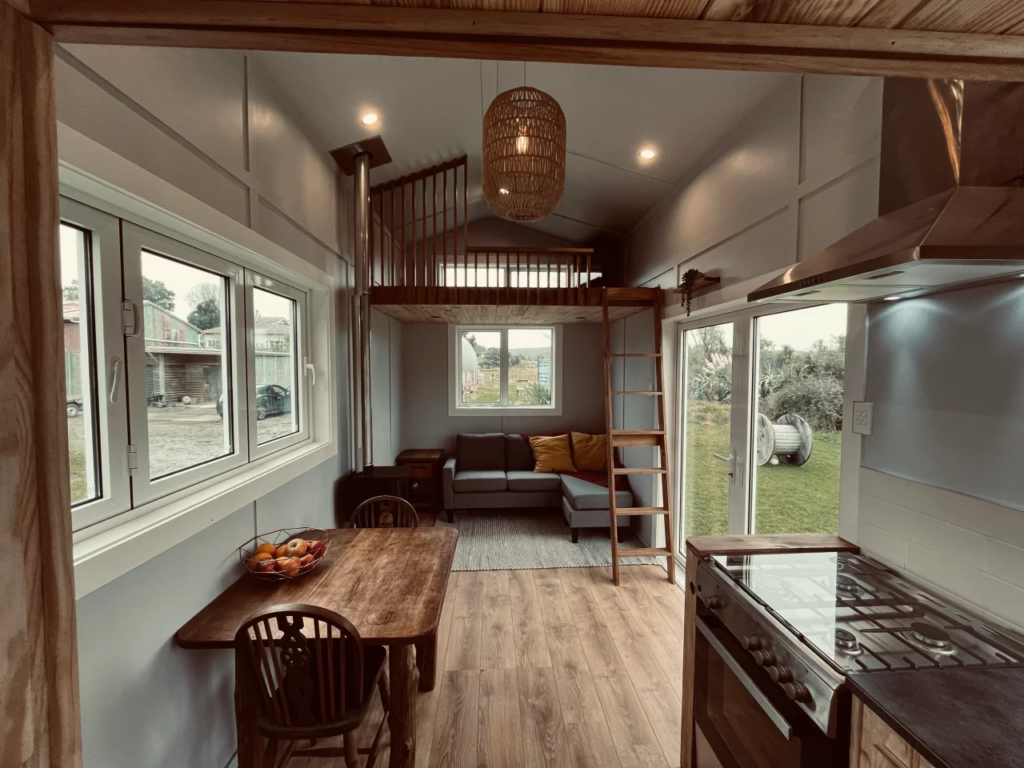
With its length of just 8 m (26 ft), the Maple strikes a good balance between portability and comfort. The tiny house features a well-designed interior that would be a good fit as either a vacation home or a full-time residence. The Maple is designed by New Zealand’s Tiny Timber Homes and is based on a triple-axle trailer. Its exterior combines standing-seam metal cladding with timber accents and a metal roof. The Maple’s living room includes an L-shaped sofa and a wood-burning stoveTiny Timber Homes With a name like Tiny Timber Homes, it’s no surprise that wood features heavily throughout the interior of this one. The home includes knotty timber detailing and is arranged around a large open living area that connects to the outside with double glass doors. The living room can often be an afterthought with compact models like these, but some thought has been paid to comfort here, with an L-shaped sofa and plenty of space to stretch out. A wood-burning stove is also installed for warmth. The kitchen in this model takes up much of the ground floor and has eye-catching wood cabinetry. It’s equipped with an oven and four-burner propane-powered stove, a double basin sink, a fridge/freezer, and lots of countertop space, with room for more appliances. Trifold windows help connect the kitchen to the outdoors, while a wooden farmhouse-style dining table adds some character. There’s also a useful shelf area above the kitchen. The Maple’s interior includes knotty timber cabinetry and detailingTiny Timber Homes The bathroom is reached from the kitchen and includes a glass-enclosed shower, a flushing toilet, and a utility area with a deep farmhouse-style sink and a washer/dryer. There are two bedrooms in the Maple. The main bedroom is located above the kitchen and bathroom and is reached by a storage-integrated staircase. It contains a double bed and some storage, as well as a lowered standing platform that makes it easier to get dressed. The secondary bedroom is positioned over the living room and has room for a double bed, though in this case it seems to be used as a general hangout area, with a bean bag chair and a TV installed. It’s accessed by a folding ladder, which is stowed away when not in use, preserving floorspace below. The Maple’s secondary bedroom is reached by a wooden ladder and has an attractive wooden railingTiny Timber Homes The Maple starts at NZD 105,000 (for reference, this works out at roughly US$68,000), though we’ve no word on delivery, so those interested will need to contact the firm directly. There are also multiple options available, such as changing the materials used and even its size and layout. Source: Tiny Timber Homes source

365-sq-ft tiny house provides a compact but comfortable life on wheels Read More »

Stock Market Today: Dow Up As Trump Says This On Iran; AI Stocks Pop On Anthropic IPO Move (Live Coverage)

The Dow Jones Industrial Average and other major indexes ended Monday higher after President Donald Trump spoke out on Iran. Oil prices popped while Berkshire Hathaway (BRKB) boosted a housing stock. Also, Nvidia (NVDA) was among winning stocks while Anthropic made an IPO move and IBM (IBM) tested an entry on the stock market today. The Dow industrials fought back… Copyright ©2026 Investor’s Business Daily, LLC. All rights reserved. 87990cbe856818d5eddac44c7b1cdeb8 source

Stock Market Today: Dow Up As Trump Says This On Iran; AI Stocks Pop On Anthropic IPO Move (Live Coverage) Read More »

Australian artist Cj Hendry turns IMBA Theatre into a double debut

IMBA Theatre at Gardens by the Bay is bringing internationally acclaimed Australian artist Cj Hendry to Southeast Asia for the first time this June, with two large-scale immersive installations that blur the lines between art, experience design and cultural marketing. The double activation will see Hendry’s “Flower market” and the world premiere of “JuJu World” take over IMBA Theatre’s gallery space in a limited-run format, positioning Gardens by the Bay as a temporary home for experiential, participation-led art. “Flower market” will run from 10 to 14 June 2026 as a free-entry experience, while “JuJu World” will follow from 20 June to 18 July 2026 as a ticketed installation. Both experiences are designed around interaction rather than observation, reflecting a growing shift in how audiences engage with culture, not just as spectators, but as active participants. Don’t miss: LEGO turns Jewel Changi Airport into SEA’s largest Botanicals mall activation  Known for transforming hyperrealistic drawings into large-scale, immersive environments, Hendry has built a global reputation for creating art that behaves akin to a brand experience: highly visual, shareable and designed for physical engagement. In “Flower market”, IMBA Theatre will be transformed into a surreal floral retail environment featuring tens of thousands of plush blooms. Visitors are invited to browse, pick and assemble their own bouquets in a format that mirrors retail and experiential activation mechanics, rather than traditional gallery viewing. The Singapore edition will introduce more than 30 flower varieties, including locally inspired designs such as the Papilionanthe Miss Joaquim, Raffles’ Pitcher Plant and Singapore Ginger Flower. Each visitor will also receive a complimentary flower upon entry, reinforcing the participatory nature of the experience. Meanwhile, “JuJu World” marks the first inflatable experience built around Hendry’s JuJu collectible series, introducing a bold yellow colourway created exclusively for Singapore. The installation extends her collectible universe into a physical, immersive format, with limited large-scale JuJu pieces available only during the run. The experience continues a broader trend in experiential marketing where art, retail and entertainment increasingly overlap, with installations designed to be photographed, shared and socially amplified as much as they are experienced in person. Michael Lee, chief executive of IMBA, said the collaboration reflects a focus on building participatory cultural formats that move beyond passive viewing. “Henry’s installations cross every boundary of language, age and background, and we see real potential to build programming and community experiences around them. We can’t wait to welcome Singapore to these two experiences,” said Lee.  In tandem, Teyi Guo, director, leisure events at the Singapore Tourism Board, said the activations add to Singapore’s pipeline of world-class experiential offerings and reinforce its positioning as a destination for cultural tourism and immersive experiences. Artist Hendry on the other hand said the Southeast Asia debut is rooted in shared emotional cues such as curiosity, nostalgia and play, with the aim of making art more accessible and engaging across audiences. “Presenting my works in Southeast Asia with IMBA feels incredibly exciting because these activations represent our shared emotion and universal experiences, from curiosity to adolescence and nostalgia. This double bill at IMBA Theatre will spark joy among new audiences in the region, demonstrating that art is meant for everyone. This is something I value enormously in my practice and I hope audiences will treasure during the two limited runs at IMBA Theatre at Gardens by the Bay,” said Henry.  Together, “Flower market” and “JuJu World” signal one of the most ambitious experiential art takeovers in the region to date, reflecting how cultural spaces are increasingly adopting the language of branded experiences, interaction and immersion.  The IMBA Theatre takeover comes as Singapore continues to lean into experiential and destination-led cultural programming that merges art, leisure and brand storytelling. Recent examples include Tanjong Beach’s transformation into “Lobster beach”, a large-scale public art activation by British pop artist Philip Colbert, where an 8-metre ice-cream sculpture and inflatable installations turned the shoreline into an immersive, shareable playground. Presented by Mastercard and supported by Sentosa Development Corporation, the activation highlighted how public spaces are increasingly being used as canvases for experiential marketing, blending gallery-led art with open-air, audience-first engagement designed to drive footfall, dwell time and social content creation. Related articles:   MINISO debuts its first global art gallery in Shanghai  Bibit, Stockbit turn to art to frame resilience and reinvention in investing  How Kotex is putting period blood back into the art world  source

Australian artist Cj Hendry turns IMBA Theatre into a double debut Read More »