Key Digital Asset Issues Require Antitrust Vigilance

By Luke Taeschler, Sarah Gilbert and Jared Levine ( April 22, 2025, 6:01 PM EDT) — Only three months into his second term, President Donald Trump has taken several steps to advance the growth of the digital assets industry…. Law360 is on it, so you are, too. A Law360 subscription puts you at the center of fast-moving legal issues, trends and developments so you can act with speed and confidence. Over 200 articles are published daily across more than 60 topics, industries, practice areas and jurisdictions. A Law360 subscription includes features such as Daily newsletters Expert analysis Mobile app Advanced search Judge information Real-time alerts 450K+ searchable archived articles And more! Experience Law360 today with a free 7-day trial. source

Key Digital Asset Issues Require Antitrust Vigilance Read More »

Trump’s Job Rating Drops, Key Policies Draw Majority Disapproval as He Nears 100 Days

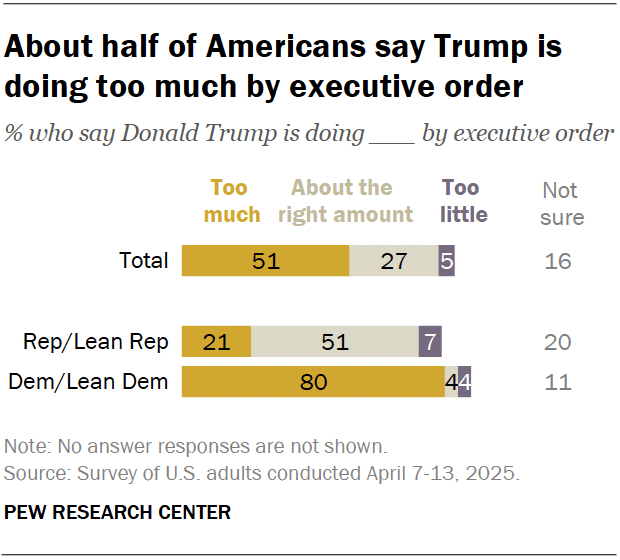
President Donald Trump speaks to members of the media on the South Lawn of the White House on April 3, 2025. (Andrew Harnik/Getty Images) How we did this Pew Research Center conducted this study to understand how Americans view President Donald Trump and the recent actions his administration has taken on key issues. For this analysis, we surveyed 3,589 adults from April 7 to April 13, 2025. Everyone who took part in this survey is a member of the Center’s American Trends Panel (ATP), a group of people recruited through national, random sampling of residential addresses who have agreed to take surveys regularly. This kind of recruitment gives nearly all U.S. adults a chance of selection. Interviews were conducted either online or by telephone with a live interviewer. The survey is weighted to be representative of the U.S. adult population by gender, race, ethnicity, partisan affiliation, education and other factors. Read more about the ATP’s methodology. Here are the questions used for this report, the topline and the survey methodology. With President Donald Trump’s second term approaching its 100-day mark, 40% of Americans approve of how he’s handling the job – a decline of 7 percentage points from February. And, even as Trump continues to receive high marks from his strongest supporters, several of his key policy actions are viewed more negatively than positively by the public: 59% of Americans disapprove of the administration’s tariff increases, while 39% approve. 55% disapprove of the cuts the administration is making to federal departments and agencies, while 44% approve. Trump’s use of executive authority also comes in for criticism: 51% of U.S. adults say he is setting too much policy via executive order. Far smaller shares say he is doing about the right amount (27%) or too little (5%) through executive orders. Note: This survey was conducted after Trump’s April 2 announcement of sweeping new tariffs on nearly all U.S. trading partners, which triggered several days of volatility in U.S. and global stock markets. The survey was in the field on April 9 when Trump paused tariffs on most countries but levied higher rates on China. Americans’ opinions (including those about the economy and tariffs) were largely unchanged throughout the April 7-13 field period. With many of the administration’s actions facing legal challenges in federal courts, there is widespread – largely bipartisan – sentiment that the administration would have to end an action if a federal court deemed it illegal. 78% say the Trump administration should have to follow a federal court’s ruling, rising to 88% if the Supreme Court were to issue the ruling. 91% of Democrats and 65% of Republicans say the administration would need to stop an action if a federal court ruled it illegal, rising to 95% of Democrats and 82% of Republicans for a Supreme Court ruling. However, the latest national survey by Pew Research Center, conducted April 7-13 among 3,589 adults, finds much wider partisan differences in evaluations of Trump’s overall job performance and some key policies. Seven-in-ten or more Republicans and Republican-leaning independents approve of: Trump’s job performance (75%) The administration’s cuts to government (78%) Increased tariffs (70%) Ending diversity, equity and inclusion (DEI) policies in the federal government (78%) By comparison, even wider majorities of Democrats and Democratic leaners disapprove of: Trump’s job performance (93%) The administration’s cuts to government (89%) Increased tariffs (90%) Ending DEI policies in the federal government (86%) Trump’s job rating compared with his first term and his predecessors Trump’s current approval rating of 40% is on par with his rating at this point in his first term. It remains lower than other recent presidents’ approval ratings in the early months of their presidencies. Among Trump’s predecessors dating back to Ronald Reagan, the only other leader who did not enjoy majority approval at his 100-day mark is Bill Clinton (49% approval in April 1993). In April 2021, Joe Biden’s job approval rating stood at 59% – though it would drop substantially to 44% by September of that year. Read Chapter 1 for more on Trump’s approval rating and explore demographic breaks in the detailed tables. In their own words: How Americans view the first months of Trump’s presidency Asked to describe what they like most – and least – about the administration’s actions so far, similar topics come up in both questions, though to different degrees. Immigration actions Trump’s immigration actions top the list of what Americans say they like most about the administration: 20% point to immigration, including 7% who specifically mention Trump’s deportation actions. But immigration actions, including deportations, also are cited by 11% of Americans as the thing they like least about the administration. Related: Americans’ Views of Deportations Approach to governing About two-in-ten Americans (22%) describe an aspect of Trump’s governing approach as what they like least about the administration. This includes mentions of “carelessness” (3%), Cabinet and other staffing picks (2%), perceived targeting of law firms and universities (2%), and terms like “authoritarian” or “dictator” (3%). Conversely, 11% of Americans cite his “keeping promises” or “getting things done” as what they like most. Tariffs and cuts to government Tariffs and trade policy (15%) and government cuts (11%) are both mentioned by at least one-in-ten Americans as actions they like least. But these are also volunteered by sizable shares (6% and 9%, respectively) as aspects of Trump’s presidency they like most. Views of cuts to the federal government As the administration continues to plan and implement large-scale reductions across federal agencies, 59% of Americans say it is being “too careless” in how it makes these cuts. And the public is more likely to see the cuts having negative, rather than positive, effects. 51% say the cuts will make the government run worse, while 36% say they will make the government run better. 48% expect the cuts will cost Americans money in the long run. Fewer (41%) say the cuts will save money. Read Chapter 3 for more on the Trump administration’s actions. Other key findings The

Trump’s Job Rating Drops, Key Policies Draw Majority Disapproval as He Nears 100 Days Read More »

Meet the Dutch tech stars speaking at TNW Conference

As our favourite Dutch holiday approaches, TNW is celebrating the tech titans shaping the future in the Netherlands. Our beloved home country is the proud parent of a prodigious brood of digital talent. It’s given birth to cultivated meat, raised Booking.com to become the world’s largest online travel agency, and watched with joy as ASML grew into Europe’s most valuable tech company. The family also includes a gifted group of startups and scaleups. In recent years, economic headwinds, geopolitical turbulence, and questionable government policies have blown some of their progress off course, but Dutch tech continues to punch well above its weight. Just last month, the Netherlands ranked 10th in a global index of tech competitiveness — ahead of every G7 country. The country also boasts an illustrious list of tech luminaries. Many of them will be at TNW Conference — and so could you. In our spirit of patriotism (and, perhaps, a bit of Dutch courage), we’re offering a ludicrously generous discount on tickets to mark Koningsdag — aka King’s Day, an orange-infused celebration of the monarch’s birthday. 40% off TNW Conference! For 1 week only… Register by 28 April & save up to €700 on General Admission, Corporate, VIP & Investor Passes, and Startup/Scaleup packages You can find all the details on the offer at the bottom of this article. But first, we want to introduce you to eight Dutch tech leaders who will grace the stages of TNW Conference on June 19 and 20. 1. Peter Wennink A legend of Dutch tech, Peter Wennink led chip giant ASML to become the most valuable tech firm in Europe. Over his 25-year career at the Veldhoven-based business — including over a decade as CEO — ASML earned acclaim as the world’s only supplier and producer of extreme ultraviolet (EUV) lithography machines. These systems are essential for manufacturing the world’s most advanced chips. They’ve become a crucial force behind countless innovations, from iPhones and MacBooks to autonomous vehicles and Nvidia GPUs. On the TNW stage, Wennink will speak in an exclusive session titled “Gods of Industry: The Battle for Deep Tech Dominance.” He’ll be joined by Young Sohn, the founding managing partner of Walden Catalyst Ventures, a VC fund dedicated to deep tech. The duo will give a glimpse into a future that is hard for most of us to even imagine. “It’s difficult for mankind to foresee the impact of exponentiality because it often yields something seemingly impossible,” Wennink told TNW. “But that’s exactly what science and deep tech will create, making the impossible possible.” 2. Vidya Peters As the CEO of Dutch unicorn DataSnipper, Vidya Peters has overseen the scaleup’s rise to become the fastest-growing tech company in the Netherlands for two years. Under her leadership, DataSnipper has become a global force in audit and finance automation. Over 500,000 professionals across more than 125 countries now use its software. After honing her expertise in Silicon Valley, Peters has also become a powerful advocate for European tech. Rather than merely mimicking US tech, she urges startups and scaleups to embrace the continent’s strengths. A key one is sustainable, long-term growth. “Five years ago, it wasn’t very fashionable to be profitable,” Peters told TNW. “But I think this is where the European sensibility is a strength, because European companies have always taken this approach, and now it’s hugely valued in the current economic climate.” Peters has also guided DataSnipper’s adoption of artificial intelligence. At TNW Conference, she’ll share her learnings in a session titled “AI’s Big Glow-Up: Generating Ideas, Innovation, and Impact.” Vidya Peters, the CEO of DataSnipper, flanked by the company’s three founders. Credit: DataSnipper 3. Daan Klein Douwel Joining Peters in her session will be Daan Klein Douwel, the head of data and AI at one of the biggest companies in the Netherlands: KLM Royal Dutch Airlines. Klein Douwel drives the company’s efforts to leverage the power of AI and data. KLM has applied these technologies to numerous applications, from automating responses to customer enquiries to predicting hand luggage amounts and cutting food waste. Klein Douwel will take the TNW stage to share practical insights on deploying AI. 4. Robert Doornbos In Max Verstappen, the Netherlands boasts the reigning four-time Formula 1 World Champion. In Robert Doornbos, TNW boasts one of the drivers who paved the path for Verstappen’s rise. A former F1 and Indycar driver, Doornbos was a driver for Jordan and Red Bull Racing — Max Verstappen’s team. He was also Minardi’s last-ever race driver. Today, he’s a renowned F1 analyst. His career in motorsports has given him unique insights into vehicle technology. He’ll join TNW Conference to explore the future of mobility in a talk titled “The Road Ahead: Driving Innovation and Sustainability.” 5. Jacqueline van den Ende Jacqueline van den Ende is playing a powerful role in fostering impactful companies. She’s the co-founder and CEO of Carbon Equity, an investment platform that unlocks private capital to solve one of the world’s greatest challenges: climate change. Earlier this month, the platform announced that it had raised €105mn for its Climate Tech Portfolio Fund III. “Despite the current geopolitical uncertainty, we have raised over €100mn within a year for innovative climate solutions. I’m proud of that,” van den Ende said.  “It also confirms that the momentum for investing in climate technology continues. The energy transition is already in full swing — not driven by idealism, but simply because sustainable solutions are economically smarter.” She’ll explore the challenges and opportunities for venture capital in a conference session titled “Off with Their Heads: Death to the VC & Building Smarter Investment Models.” 6. Marc Wesselink Joining van den Ende in her session will be Marc Wesselink, the co-founder of Venturerock, an all-in-one investment and venture-building platform. A serial entrepreneur, Wesselink has launched 12 companies. He’s also failed with four, gaining valuable insights about the startup world. In addition to his role at Venturerock, Wesselink is a founding partner at Startupbootcamp, responsible for its alumni portfolio. He’s now using those experiences to build a

Meet the Dutch tech stars speaking at TNW Conference Read More »

Invest in AI search as an enterprise business asset

Nearly every enterprise is experimenting with AI, but an overwhelming 90% of AI projects never scale beyond the proof-of-concept stage, and more than 97% of organizations experience difficulties demonstrating the business value of generative AI (genAI), according to an Informatica survey.[i] A major reason is that many cautious business leaders treat AI as a source of incremental improvements to existing processes rather than a tool to reshape core business functions. Too often, business leaders underestimate the people, behavior, and organizational changes entailed by strategically using AI. In particular, the transformative potential of AI-powered search is overlooked. That’s despite the fact that search is a function knowledge workers use every day. As data volumes continue to grow, employees and customers are increasingly challenged to find the information they want.[ii] Various studies have found that employees spend between 20% and 30% of their time looking for information.[iii] They have become accustomed to instant gratification on the web, but the lack of investment many organizations make in relevance and content curation makes searching inside the corporate firewall maddeningly unproductive. AI search not only incrementally improves productivity but can radically reshape core business capabilities. It replaces simple keyword searches with advanced semantic techniques that understand the intent and context behind a query. Semantic search combines technologies including natural language processing, vector data stores, and machine learning to deliver results that more closely match what users need than keywords without requiring major investments in content curation.  “We can now understand context better than was possible with keyword search alone,” says Steve Mayzak, global managing director of Search AI at Elastic. “With semantic search, you can search across an entire book instead of relying on the index alone.” By leveraging genAI assistants and large language models, AI search can interpret a user request and deliver results in a business context.  When considering an AI search platform, look for these features.  Flexible integration with multiple data types and sources – Enterprise data is spread across a multitude of databases, internal applications, and software-as-a-service. An AI search engine should connect seamlessly to the data sources you need and deliver integrated results regardless of the location or type of data. Near real-time data ingestion and indexing – The pace of business is too fast to permit most organizations the luxury of waiting hours or days for critical data. AI search should make data available seconds after it’s ingested. APIs – These make the onboarding of new applications and data sources easier. Look for an open ecosystem that integrates with all the major AI foundation models and supports your own models so existing investments aren’t wasted. A serverless architecture that scales up and down on demand to deliver maximum efficiency at the lowest cost.  Multimodal capabilities that support searching of images, video, and audio.  AI search makes it possible for organizations to consolidate a multitude of application-specific search engines into a single utility that works across all the organization’s data.  Elastic’s powerful, scalable, and AI-driven search solution delivers fast, relevant, and secure search experiences across structured and unstructured data in batch and real time. It offers advanced full-text search, vector search, and AI-powered relevance tuning, making it ideal for diverse use cases. To learn more about Elasticsearch click here.  [i] “CDO Insights 2025 – global data leaders racing ahead, despite headwinds to being AI ready, latest survey finds,” March 14, 2025, Informatica.com. [ii] “Amount of Data Created Daily (2025),” April 24, 2025, ExplodingTopics.com. [iii] “Various survey statistics: Workers spend too much time searching for information,” Cottrill Research.    source

Invest in AI search as an enterprise business asset Read More »

Google Exec Warns Of 'Shadow' Of Chrome If DOJ Wins Sale

By Bryan Koenig ( April 25, 2025, 11:14 PM EDT) — Chrome’s top executive told a D.C. federal judge Friday that the Justice Department’s bid to force the sale of Google’s prized web browser would cause a dramatic degradation in quality for a product that is used by over one billion people and is heavily integrated into the rest of Google…. Law360 is on it, so you are, too. A Law360 subscription puts you at the center of fast-moving legal issues, trends and developments so you can act with speed and confidence. Over 200 articles are published daily across more than 60 topics, industries, practice areas and jurisdictions. A Law360 subscription includes features such as Daily newsletters Expert analysis Mobile app Advanced search Judge information Real-time alerts 450K+ searchable archived articles And more! Experience Law360 today with a free 7-day trial. source

Google Exec Warns Of 'Shadow' Of Chrome If DOJ Wins Sale Read More »

5 tips for transforming company data into new revenue streams

Ensure your data has actionable value The most monetizable data types provide insights that can’t be found elsewhere, ISG’s Rudy says. “This includes benchmark data for comparison to peers to help drive actionable change, competitive intelligence that’s specific, predictive analytics to help drive fact-based decisions, and AI-driven insights that pull from multiple sources of data that are typically siloed.” User behavior data is one of the most monetizable data types, says Agility Writers’ Yong, pointing to Google Analytics as an example. “It tracks user interactions, which enterprises can then use to fine-tune their website or marketing efforts,” he explains. Even deeper data, such as purchase intent or churn rates, can be sold to third parties or used for targeted marketing, making it highly valuable. The types of data that aren’t worth monetizing include outdated data, third-party data anyone can access, data your organization lacks the specific rights to use — which could lead to potential lawsuits — or inconsistent or partial data that could lead to bad decisions, Rudy says. source

5 tips for transforming company data into new revenue streams Read More »

2. Views of how the Trump administration governs

Following Trump’s record-breaking series of executive orders at the start of his second term, many of his administration’s actions are being held up in federal court as judges weigh whether or not they are legal. With the status of some of these actions uncertain, 51% of Americans say Trump is doing too much by executive order, while 5% believe he is doing too little. About a quarter (27%) say Trump is doing about the right amount, with 16% unsure. Democrats overwhelmingly say Trump is doing too much by executive order (80%). And while 51% of Republicans say he’s doing about the right amount, about two-in-ten say he’s doing too much (21%) or that they are unsure (20%). Expectations for the administration’s response to federal courts If a federal court rules that an action by the Trump administration is illegal, nearly eight-in-ten Americans (78%) say the administration has to follow the court’s ruling and stop its action. This includes an overwhelming majority of Democrats and Democratic-leaning independents (91%), as well as most Republican and Republican leaners (65%). When pressed further on whether the Trump administration would need to follow a Supreme Court ruling, even fewer say the administration could disregard rulings from both courts: Just 9% of Americans say the Trump administration would not need to stop an action ruled illegal by a federal court and by the Supreme Court. 10% say the administration would not have to abide by a federal court ruling blocking its action but would need to stop if the Supreme Court ruled it illegal. Relatively small shares in both parties say the administration would be free to continue an action ruled illegal by the Supreme Court: Just 14% of Republicans and 4% of Democrats say that if the Supreme Court rules an action by the administration illegal, it does not have to follow the Supreme Court’s ruling. We asked a separate half of survey respondents a slightly different question: Would it be a problem if the Trump administration refused to stop an action after the court ruled against it? Responses follow a similar pattern: Democrats overwhelmingly say it would be a major problem if the Trump administration did not stop an action ruled illegal in federal court (89%). Three-quarters of Republicans say this would be either a major (39%) or minor (36%) problem. Ethical standards of Trump administration officials Americans offer mixed assessments on the ethical standards of Trump administration officials. While 36% of adults rate the ethical standards of top administration officials as excellent or good, 43% rate them as poor. An additional 19% say their ethics are only fair. Assessments of Trump officials’ ethics versus Biden officials’ ethics Evaluations of Trump officials’ ethical standards are more negative than evaluations of Biden officials’ ethics were at this point in Biden’s presidency. In April 2021, roughly half of Americans (52%) rated the ethical standards of Biden administration officials as excellent or good, while about a quarter each rated their ethics as only fair (22%) or poor (25%). Public evaluations of Biden officials’ ethics declined later in his presidency. They were also less polarized than current evaluations of Trump officials: The share of Americans rating Trump officials’ ethics as excellent today is higher than the share saying this about Biden officials in 2023 (16% vs. 9%). But the share rating Trump officials’ ethics as poor is also higher than the share who rated Biden officials this way (43% vs. 32%). Current ratings of Trump officials’ ethics are on par with those measured during his first term. And they’re lower than ratings of other presidential administrations measured in phone surveys dating back to the Reagan administration. Republicans and Democrats have very different views of Trump officials’ ethical standards: Nearly seven-in-ten Republicans rate the ethical standards of Trump officials as excellent (32%) or good (37%), compared with 21% who say only fair and 9% who say poor. About eight-in-ten Democrats (78%) rate these officials’ ethics as poor, with just 6% saying they are excellent or good. Americans’ trust in Trump’s statements About half of Americans (48%) trust what Trump says less than previous presidents; a smaller share (32%) say they trust what he says more. About two-in-ten (19%) say they trust what Trump says about the same amount as previous presidents. Democrats are far more skeptical than Republicans of the things Trump says: Democrats overwhelmingly trust what Trump says less than past presidents (82%), with just 6% saying they trust him more. By comparison, a 60% majority of Republicans trust Trump more than past presidents. Republicans are also about twice as likely as Democrats to say they trust the things Trump says about the same amount as previous presidents (25% vs. 11%). Who do Americans think Trump should represent? In both parties, wide majorities say Trump should primarily focus on addressing the concerns of all Americans – even if it means disappointing some of his supporters – rather than focusing mainly on the concerns of his supporters. Republicans overwhelmingly say Trump should focus on addressing the concerns of all Americans (81%), rather than just those who voted for him. More than nine-in-ten Democrats (93%) say the same. source

2. Views of how the Trump administration governs Read More »

Intelligent XO With Agentic AI

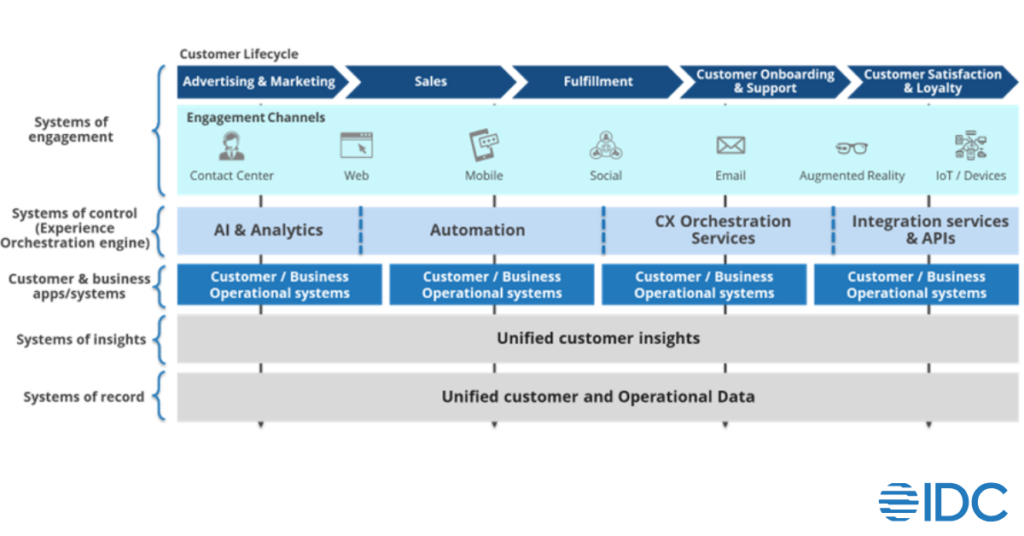
IDC’s 2024 Customer Experience Management Strategies survey found that businesses globally have shifted to a focus on improving the effectiveness of their customer experience (CX) investments while driving profitable revenue growth. IDC finds that C-suite priorities for customer experience are squarely focused on optimizing experience delivery, making experience consumption easy, and achieving experiential value parity. But achieving these directives requires organizations to rethink experience delivery as greater than just the sum of multi-channel, front-office interactions. When done right, IDC research shows that unified CX can lead to higher customer retention, improved advocacy and ultimately profitable revenue growth. What does it mean to orchestrate unified experiences across the full lifecycle of customer outcomes? IDC’s 2024 CX Path survey found that improving scale and consistency for orchestrating experiences across the enterprise was the #1 business driver for companies implementing customer experience orchestration solutions. To negotiate the complexity across channels, touchpoints, journeys, and systems/applications across functions, that deliver value-based outcomes based on changing customer context at every moment, organizations must adopt a multi-layered approach to CX delivery across all organizational layers, including middle and back-office functions. This involves integrating systems of record, insights, control, and engagement to ensure seamless and consistent customer interactions. Systems of Record Organizations need to address data fragmentation by unifying customer and operational data. This integration is crucial for scalable AI workloads and deeper customer insights. IDC’s 2024 CXMS survey found that only about 24% of organizations have access to a single source of customer data with full integration across the stack. By pooling data from front-office and back-office functions, companies can create a comprehensive view of the customer journey. Systems of Insights A cohesive fabric of customer insights is essential. Organizations should combine structured and unstructured data to generate actionable customer intelligence. Sharing and integrating these insights into daily operations can significantly improve customer engagement and business outcomes. Systems of Control The orchestration layer acts as the connective tissue, integrating various systems and ensuring real-time, context-aware customer engagement. This layer leverages AI and automation to manage workflows, business logic, and customer interactions, enhancing decision-making across the organization. Systems of Engagement This layer includes, but is not limited to, the various customer engagement channels across digital, physical, and blended, employee-facing tools and platforms that may be either exclusive or shared by both employees and customers, and various engagement channels through which 3rd parties engage with the brand. Organizations that isolate experience delivery to one stakeholder group will ultimately get left behind. Where do AI Agents and Agentic systems fit into intelligent experience orchestration? AI Agents are a route to deliver greater sophistication for unified experience orchestration. Data and computing power advancements and the availability of advanced reasoning models are driving more sophisticated, more advanced Agentic AI capabilities. Core characteristics of AI Agents make them optimally suited to address the gaps organizations must fill in order to deliver unified intelligent experience orchestration. AI Agents all share the following core characteristics: Planning: AI agents can plan and sequence actions to achieve specific goals. Empowers Al to break down complex tasks into manageable steps, developing structured approaches to problem-solving. The integration of LLMs has revolutionized their planning capabilities. Perception: AI agents can perceive and process information from their environment, to make them more interactive and context aware. This information includes visual, auditory, and other sensory data. Tool usage: Advanced AI agents can use various tools, such as code execution, search, and computation capabilities, to perform tasks effectively. AI agents often use tools through function calling. Multi-Agent Collaboration: Facilitates multiple Al agents working together, each with specialized roles, to tackle complex problems more effectively. Memory: AI agents have the ability to remember past interactions (tool usage and perception) and behaviors (tool usage and planning). They store these experiences and even perform self-reflection to inform future actions. This memory component allows for continuity and improvement in agent performance over time. This enables AI Agents to create a new layer of ‘intelligent actions’ on top of CX and business applications. AI Agents consume and hand off customer and operational data, insights, tasks, across systems, workstreams, processes, and business functions, in a continuous, context-aware, manner. A system of AI agents essentially functions as the glue / connective tissue that connects organizational functions, systems/applications (customer-facing, operational systems, and employee tools), and data. This offers organizations the needed automation and scale for seamless vertical integration through the multiple layers for unified experience orchestration. With 35% of enterprises reporting that fulfillment aspects of the customer journey don’t extend beyond front-office processes, enterprises face a significant gap in orchestrating and delivering whole journey customer experiences. Agentic AI presents an equally significant opportunity to unlock machine scale, beyond just productivity gains to improve connectedness across the entire CX ecosystem with intelligence at the core. AI Agents can even bridge gaps in the fragmented technology landscape at many organizations. However, harnessing value from Agentic AI for CX will require enterprises to address long-standing, foundational challenges such as customer and operational data integrity, unification, and governance, AI governance, and customer privacy/security. Crucially, organizations must prioritize approaches to address the workforce impact of GenAI and agentic technology capabilities up front, especially front-line employees, who will continue to remain an integral part of delivering excellent customer experiences. source


Intelligent XO With Agentic AI Read More »

Trade routes of the digital age: How data gravity shapes cloud strategy

Every strategic decision, from customer engagement to AI-driven automation, relies on an organization’s ability to manage, process and move vast amounts of information efficiently. However, as companies expand their operations and adopt multi-cloud architectures, they are faced with an invisible but powerful challenge: Data gravity. Data gravity is a term coined by Dave McCrory in 2010 to describe the tendency of large datasets to attract applications, services and even more data, making them increasingly difficult and costly to move. Just as celestial bodies exert gravitational pull, keeping objects in orbit around them, data exerts a similar force in cloud computing. Once data reaches a critical mass within a given platform or region, it becomes a magnet for computing workloads, applications and analytics services, creating a self-reinforcing cycle — just like cities along the Silk Road pulled in traders, wealth and innovation. This gravitational effect presents a paradox for IT leaders. While centralizing data can improve performance and security, it can also lead to inefficiencies, increased costs and limitations on cloud mobility. Organizations that fail to account for data gravity risk being trapped in a single cloud provider’s ecosystem, incurring high egress fees, experiencing latency issues and struggling with compliance requirements. Those who manage it strategically, however, can turn data gravity into a competitive advantage, using it to enhance performance, security and agility across a distributed cloud infrastructure. source

Trade routes of the digital age: How data gravity shapes cloud strategy Read More »

FTC's Holyoak Wants 'Predictable' Regulatory Space For AI

Law360, Washington, D.C. (April 22, 2025, 11:36 PM EDT) — The Federal Trade Commission won’t stop policing fraud and deception powered by artificial intelligence, but flexibility is needed to avoid “misguided enforcement actions or excessive regulation” that could stifle innovation and competition in the emerging field, Commissioner Melissa Holyoak said Tuesday.  In a keynote address at the International Association of Privacy Professionals‘ Global Privacy Summit in Washington, D.C., the Republican commissioner laid out three of her top data privacy priorities: the regulation of AI technology, boosting protections for children and teens online, and strengthening enforcement against companies that sell, transfer or disclose Americans’ geolocation information and other sensitive data to foreign adversaries.  “The commission is committed to protecting consumers’ privacy and security interests while promoting competition and innovation,” Holyoak said in her remarks, which she stressed expressed her own views. “We’ll do that by enforcing the laws we have and not by stretching our legal authorities, and we’ll continue to do it by taking a flexible, risk-based approach to privacy enforcement that balances potential privacy harms, consumer expectations, legal obligations, business needs and competition.” When it comes to the rapid development of AI and other digital technologies that are fueled by vast quantities of consumer data, Holyoak said that the commission — which is currently being steered by three Republicans, following the abrupt firings of the agency’s two Democrats last month — would continue to “aggressively root out AI-powered frauds and scams and stop companies from making false or unsubstantiated representations that harm consumers.” However, Holyoak also urged caution, saying that she saw the fast pace of these new technological developments as presenting “opportunities” rather than challenges for policymakers, enforcers and compliance professionals to forge a path forward that protects consumers while still allowing for “innovation to flourish.” “With artificial intelligence, the commission should create a predictable regulatory and enforcement environment that promotes innovation and development of new technologies,” Holyoak said in her speech, which marked the first on data privacy issues since Republican Chairman Andrew Ferguson took over three months ago. “Under the leadership of Chairman Ferguson, the commission will promote AI growth and innovation, not hammer it with misguided enforcement actions or excessive regulation.” In order to strike an appropriate balance, Holyoak repeatedly stressed the importance of the FTC studying “this nascent industry and how privacy enforcement and regulations may impact its development.” The commissioner noted that she supported the use of the agency’s Section 6(b) authority to issue a report on AI partnerships and investments in the waning days of the prior Democratic administration “because it advanced our knowledge of some of the commercial dynamics shaping AI’s evolution” and that she saw additional opportunities moving forward to further strengthen the agency’s understanding of AI, including taking a closer look at “how regulatory and enforcement efforts in privacy may impact a firm’s ability to access and train data, and importantly, how they impact the firm’s ability to compete.”  As an example, Holyoak explained that while requiring consent for using certain types of data in some instances may “level the competitive playing field by requiring the same level of privacy protections across the board,” establishing a mandate for affirmative consent from users for data collection or use “may actually favor dominant players, because users are more familiar with big firms, and thus may have more trust in how those firms will collect or use their data.” The commissioner also encouraged privacy professionals to respond to recent requests for information issued by the FTC and U.S. Department of Justice to help the agencies identify potentially anticompetitive regulations at the state and federal level, noting that there have been more than 500 AI-related bills introduced in the states and that this public input “will help us understand the different regulatory burdens for firms and whether those burdens create barriers to new entrants and competition.” Holyoak, a mother of four and former solicitor general of Utah, also drew from her personal experience in stressing the ongoing importance of ensuring that children are protected online and that Americans’ sensitive information isn’t ending up in the hands of foreign adversaries.  She urged the commission to continue to use “every tool that Congress has given” it to protect underage internet users, including its authorities under the Children’s Online Privacy Protection Act and its power to police both deception and unfair practices that are “grounded in sound economic theories of harm and reliable empirical research” under Section 5 of the FTC Act.  Additionally, the commission should be careful to not overlook the practice of foreign adversaries buying Americans’ sensitive information in bulk from data brokers, according to Holyoak, who suggested that “there may be opportunities” in the future for the commission to partner with the DOJ as it enforces its recently enacted rules to prevent China, Russia, Iran and other foreign entities from exploiting Americans’ sensitive personal data through commercial transactions. “Precise geolocation data is particularly sensitive and can reveal our religious beliefs, our political affiliations and even medical conditions and treatment,” Holyoak said. “This information can be exploited and poses significant, and frankly unacceptable, risks to our national and economic security.” –Editing by Jay Jackson Jr. For a reprint of this article, please contact [email protected]. source

FTC's Holyoak Wants 'Predictable' Regulatory Space For AI Read More »