To DOGE Or Not To DOGE – Tesla Hits A Road Block

“Soufflé Under A Sledgehammer” Elon Musk, Tesla’s CEO, said in 2020 that if the company didn’t deliver on profits, Tesla stock would be “crushed like a soufflé under a sledgehammer.” Messy dessert, anyone? The fairytale growth story of Tesla had already hit a speed bump in 2024 as revenue and profit declined. In Q1 of 2025, the sledgehammer came down, with net profits dropping a whopping 71%. The remainder of the year represents a pivotal inflection point: Can Tesla reset its growth trajectory, or will it continue to lose ground as competitors get bolder and erstwhile loyal followers flee what they perceive to be a toxic brand? Investors and industry watchers should keep an eye on three key areas in Tesla’s 2025 playbook: innovation, affordability, and neutrality. 1. Innovation: staving off stagnation while seeking the next big thingTesla’s reputation is built on relentless innovation, but its core product lineup is beginning to show its age. Meanwhile, competitors are flooding the market with fresh models and new features. To reignite excitement, Tesla is betting big on new and diverse technologies. Musk promised the rollout of fully self-driving vehicles in select markets this year, with robotaxis plying Austin in June. Additionally, the Optimus humanoid robot is expected to work in Tesla factories by the end of 2025. Given Tesla’s history of missing ambitious timelines, however, these bold commitments may provide cold comfort to many. 2. Affordability: the missing pieceAffordability has become the new battleground in the electric vehicle market. Tesla’s much-anticipated budget model was supposed to launch in mid-2025, but there are rumblings that it will be delayed to late 2025 or early 2026. This delay is problematic, as rivals such as BYD and Chevrolet are already selling EVs well below Tesla’s price point, especially in markets outside the US, where price sensitivity is higher. The absence of a sub-$25,000 Tesla limits its addressable market and cedes ground to competitors that are scaling up production and gaining market share at a rapid pace. 3. Neutrality: to DOGE or not to DOGE, that is the questionTesla’s brand perception (and that of its leader), once synonymous with innovation and environmental consciousness, is now toxic to many. Musk’s public political stances and association with the US administration have alienated Tesla’s core customer base, particularly among affluent, environmentally conscious buyers who once formed the backbone of its growth. If Musk’s promise during the earnings call that he is going to step back from the Department of Government Efficiency comes to fruition, Tesla will benefit from his less-divided attention. But one wonders how much of the brand’s equity has been irretrievably tarnished. Explore the “five levers” of Forrester’s growth strategy framework: Unlock Your Revenue Growth Potential. Follow my work: Go to my Forrester bio and click “Follow.” Chat with me: If you are a Forrester client interested in discussing these topics, please schedule time with me for an inquiry or a guidance session. Plan a session: If you are a Forrester client looking to host a strategy session on a related topic, please contact your account team or email me at [email protected]. source

To DOGE Or Not To DOGE – Tesla Hits A Road Block Read More »

Is that really your boss calling? Jericho Security raises $15M to stop deepfake fraud that’s cost businesses $200M in 2025 alone

Join our daily and weekly newsletters for the latest updates and exclusive content on industry-leading AI coverage. Learn More New York-based Jericho Security has secured $15 million in Series A funding to scale its AI-powered cybersecurity training platform. The investment, announced today, follows the company’s successful five-month execution of a $1.8 million Department of Defense contract that put the two-year-old startup on the cybersecurity map. “Within minutes, a sophisticated attacker can now create a voice clone that sounds exactly like your CFO requesting an urgent wire transfer,” said Sage Wohns, co-founder and Chief Executive Officer of Jericho Security, in an exclusive interview with VentureBeat. “Traditional cybersecurity training simply hasn’t kept pace with these threats.” The funding round was led by Jasper Lau at Era Fund, who previously backed the company’s $3 million seed round in August 2023. Additional investors include Lux Capital, Dash Fund, Gaingels Enterprise Fund and Gaingels AI Fund, Distique Ventures, Plug & Play Ventures, and several specialized venture firms. Military cybersecurity contract established credibility in competitive market Jericho’s profile rose significantly last November when the Pentagon selected the company for its first generative AI defense contract. The $1.8 million award through AFWERX, the innovation arm of the Air Force, charged Jericho with protecting military personnel from increasingly sophisticated phishing attacks. “There was a highly publicized spear-phishing attack targeting Air Force drone pilots using fake user manuals,” Wohns noted in an earlier interview. The incident underscored how even highly trained personnel can fall victim to carefully crafted deception. This federal contract helped Jericho stand out in a crowded cybersecurity market where established players like KnowBe4, Proofpoint, and Cofense dominate. Industry analysts value the security awareness training sector at $5 billion annually, with projected growth to $10 billion by 2027 as organizations increasingly recognize human vulnerability as their primary security weakness. How AI fights AI: Automated adversaries that learn employee weaknesses Unlike conventional security training that relies on static templates and predictable scenarios, Jericho’s platform employs what Wohns calls “agentic AI” — autonomous systems that behave like actual attackers. “If an employee ignores a suspicious email, our system might follow up with a text message that appears to come from their manager,” Wohns explained. “Just like real attackers, our AI adapts to behavior, learning which approaches work best against specific individuals.” This multi-channel approach addresses a fundamental limitation of traditional security training: most programs prepare employees for yesterday’s attacks, not tomorrow’s. Jericho’s simulations can span email, voice, text messaging, and even video calls, creating personalized attack scenarios based on an employee’s role, behavior patterns, and previous responses. The company’s client dashboard shows which employees fall for which types of attacks, allowing organizations to deliver targeted remediation. Early data suggests that employees trained with adaptive, AI-driven simulations are 64% less likely to fall for actual phishing attempts than those who receive traditional security awareness training. Singapore CFO loses $500,000 to deepfake executive impersonation The financial stakes of these new threats became clear in a case Wohns highlighted involving a finance executive deceived by artificially generated versions of company leadership. “A CFO in Singapore was deceived into transferring nearly $500,000 during a video call that appeared to include the company’s CEO and other executives,” Wohns recounted. “Unbeknownst to the CFO, these participants were AI-generated deepfakes, crafted using publicly available videos and recordings.” The attack began with a seemingly innocent WhatsApp message requesting an urgent Zoom meeting. During the call, the deepfake avatars persuaded the CFO to authorize the transfer. Only when the attackers attempted to extract more funds did suspicions arise, eventually involving authorities who recovered the initial transfer. Such incidents are becoming alarmingly common. According to Resemble AI’s Q1 2025 Deepfake Incident Report, financial losses from deepfake-enabled fraud exceeded $200 million globally during just the first quarter of 2025. The report found that North America experienced the highest number of incidents (38%), followed by Asia (27%) and Europe (21%). Industry reports have documented staggering growth rates in recent years, with some studies showing deepfake fraud attempts increasing by more than 1,700% in North America and exceeding 2,000% in certain European financial sectors. New threat horizon: When AI systems attack other AI systems Wohns identified an even more concerning emerging threat that few security teams are prepared for: “AI agents phishing AI agents.” “As AI tools proliferate inside companies from customer support chatbots to internal automations, attackers are beginning to target and exploit these agents directly,” he explained. “It’s no longer just humans being deceived. AI systems are now both the targets and the unwitting accomplices of compromise.” This represents a fundamental shift in the cybersecurity landscape. When organizations deploy AI assistants that can access internal systems, approve requests, or provide information, they create new attack surfaces that traditional security approaches don’t address. Self-service platform opens access to smaller businesses as attack targets broaden While major enterprises have long been primary targets for sophisticated attacks, smaller organizations are increasingly finding themselves in cybercriminals’ crosshairs. Recognizing this trend, Jericho has launched a self-service platform that allows companies to deploy AI-powered security training without the enterprise sales cycle. “The self-service registration is in addition to our enterprise sales approach,” Wohns said. “Self-Service is designed to provide no-touch/low-touch for Small to Medium Businesses.” Users can sign up for a seven-day free trial and explore the product without sales meetings. This approach stands in contrast to industry norms, where cybersecurity solutions typically involve lengthy procurement processes and high-touch sales approaches. Future-proofing security as AI capabilities accelerate The $15 million investment will primarily fund three initiatives: expanding research and development, scaling go-to-market strategies through partnerships, and growing Jericho’s team with a focus on AI and cybersecurity talent. “One of our biggest technical challenges has been keeping pace with the rapid evolution of AI itself,” said Wohns. “The tools, models, and techniques are improving at an extraordinary rate, which means our architecture needs to be flexible enough to adapt quickly.” Early customers have responded enthusiastically to Jericho’s approach. “Customers have been exceedingly frustrated at the lack

Is that really your boss calling? Jericho Security raises $15M to stop deepfake fraud that’s cost businesses $200M in 2025 alone Read More »

Knowledge Gaps Influence CEO IT Decisions

CEOs are increasingly honest about their IT knowledge deficiencies. Anyone who has worked in tech in the past several decades has a story or two about the imperious and dismissive attitude taken by the C-suite toward tech issues. It is a cost center, a gamble, an unworthy investment.  There are plenty of CEOs and other executives who still refuse to engage with the tech side of the business. But they are now viewed as dinosaurs — relics of an age where tech was a novelty. Now, CEOs and their cohorts have been compelled to acknowledge these errors. Many are attempting to correct them — both personally and on an organizational level.  A recent Istari survey found that 72% of CEOs felt uncomfortable making cybersecurity decisions. Respondents to the survey acknowledged the need to trust the knowledge of their tech counterparts — an encouraging finding for CIOs.   The difficulty of this shift is understandable. CEOs were initially only responsible for industrial operations and the money they produced. Following the Industrial Revolution, their responsibilities became largely financial. Now they must juggle both fiscal and technological aspects to remain competitive.   Strategic implementation of technology, both in expanding business and defending it against attackers, is increasingly essential. Doing so requires a working knowledge of tech trends and how they can be leveraged across the organization. This may be a difficult ask for people who come from strictly business backgrounds. Thus, it is incumbent upon them to both educate themselves and consult with their CIOs to ensure that informed decisions are made.   Related:Surgical Center CIO Builds an IT Department According to a 2021 MIT Sloan Management review, organizations whose leadership was savvy to new tech developments saw 48% more revenue growth. Now, when organizations seek a CEO, they increasingly ask whether their candidates possess the knowledge necessary to manage the risks and benefits of implementing new technologies such as AI while maintaining a strong security posture.   Here, InformationWeek explores the knowledge gaps that CEOs need to be aware of — and how they can fill them — with insights from Ashish Nagar, CEO of customer service AI company Level AI, and Susie Wee, CEO of DevAI, an AI company working on optimizing IT workflows.  What CEOs Don’t Know  Business-trained CEOs may lack many technological skills — an understanding of AI, how to best manage cybersecurity, and the ability to determine what infrastructure is a worthwhile investment. The narrow parameters of their training and the responsibilities of their previous roles leave many of them in the dark on how to manage the integration of technological aspects into the businesses they manage.   Related:The Kraft Group CIO Talks Gillette Stadium Updates and FIFA World Cup Prep “Technology is not their business. The technology is used to fortify their offer,” Wee says. “The question is, how can they use technology to compete while thinking first about their customers?”  Susie Wee, DevAI A 2025 report issued by Cisco offers intriguing findings about the feelings of CEOs on IT knowledge gaps. Of the CEOs surveyed, some 73% were concerned that they had lost competitive advantage due to IT knowledge gaps in their organization. And 74% felt that their deficiencies in knowledge of AI were holding them back from making informed business decisions regarding the technology.   “The arc of what is possible right now with these modern technologies, especially with how fast things are changing, is what I see as the biggest gap,” Nagar says. “That’s where it creates friction between technical leaders and the CEO.” CEOs who cannot connect the dots between the capabilities of nascent tech and what it may offer in the future do a disservice to their organizations.  According to Cisco, around 84% of respondents believed that CEOs will need to be increasingly informed about new technologies in coming years in order to operate effectively. However, other data from the report suggests that some CEOs view IT deficiencies as the responsibility of their teams — only 26% saw problems with their own lack of knowledge.  Related:CIO Angelic Gibson: Quell AI Fears by Making Learning Fun “Some are very scared — and actually frozen and not moving forward. They’re deciding to allow legal and compliance to put up gates everywhere,” Wee observes.  Other research, however, indicates that CEOs are taking ownership of their personal knowledge gaps — 64% of respondents to an AND Digital survey felt that they were “analogue leaders.” That is, they were concerned that their skill sets did not match the increasing integration of digital into all aspects of business. And some 34% said that their digital knowledge was insufficient to lead their companies to the next growth phase. The survey found that female CEOs were more nervous about their knowledge gaps — 46% thought they lacked the necessary technological skills.  “The buck stops with me. If anything goes wrong in cyber for whatever reason, customers will not excuse me because it is in an area I can say somebody else is looking after,” said one CEO who spoke with Istari.  One of their main complaints is the lack of usable data and how to obtain it. If they have structured data, many of them can adapt their existing skill sets around it and make effective decisions. But obtaining that information requires at least a general understanding of the landscape. If they can direct their subordinates to capture that data and massage it into a usable format, they can make more informed choices for their organizations.  How CEOs Can Bridge the Gap  CEOs are increasingly seeking tech training — 78% were enrolled in digital upskilling courses according to the AND Digital survey. Some CEOs are even engaging in reverse mentoring, where they form partnerships in which their subordinates share their skill sets in a semi-structured environment, allowing them to leverage that knowledge. Advisory boards and other programs that put CEOs in contact with their tech teams are also useful in facilitating upward knowledge transfer.   Digital immersion programs in which executives are embedded with their tech

Knowledge Gaps Influence CEO IT Decisions Read More »

Watch: Google DeepMind CEO and AI Nobel winner Demis Hassabis on CBS’ ’60 Minutes’

Join our daily and weekly newsletters for the latest updates and exclusive content on industry-leading AI coverage. Learn More A segment on CBS weekly in-depth TV news program 60 Minutes last night (also shared on YouTube here) offered an inside look at Google’s DeepMind and the vision of its co-founder and Nobel Prize-winning CEO, legendary AI researcher Demis Hassabis. The interview traced DeepMind’s rapid progress in artificial intelligence and its ambition to achieve artificial general intelligence (AGI)—a machine intelligence with human-like versatility and superhuman scale. Hassabis described today’s AI trajectory as being on an “exponential curve of improvement,” fueled by growing interest, talent, and resources entering the field. Two years after a prior 60 Minutes interview heralded the chatbot era, Hassabis and DeepMind are now pursuing more capable systems designed not only to understand language, but also the physical world around them. The interview came after Google’s Cloud Next 2025 conference earlier this month, in which the search giant introduced a host of new AI models and features centered around its Gemini 2.5 multimodal AI model family. Google came out of that conference appearing to have taken a lead compared to other tech companies at providing powerful AI for enterprise use cases at the most affordable price points, surpassing OpenAI. More details on Google DeepMind’s ‘Project Astra’ One of the segment’s focal points was Project Astra, DeepMind’s next-generation chatbot that goes beyond text. Astra is designed to interpret the visual world in real time. In one demo, it identified paintings, inferred emotional states, and created a story around a Hopper painting with the line: “Only the flow of ideas moving onward.” When asked if it was growing bored, Astra replied thoughtfully, revealing a degree of sensitivity to tone and interpersonal nuance. Product manager Bibbo Shu underscored Astra’s unique design: an AI that can “see, hear, and chat about anything”—a marked step toward embodied AI systems. Gemini: Toward actionable AI The broadcast also featured Gemini, DeepMind’s AI system being trained not only to interpret the world but also to act in it—completing tasks like booking tickets and shopping online. Hassabis said Gemini is a step toward AGI: an AI with a human-like ability to navigate and operate in complex environments. The 60 Minutes team tried out a prototype embedded in glasses, demonstrating real-time visual recognition and audio responses. Could it also hint at an upcoming return of the pioneering yet ultimately off-putting early augmented reality glasses known as Google Glass, which debuted in 2012 before being retired in 2015? While specific Gemini model versions like Gemini 2.5 Pro or Flash were not mentioned in the segment, Google’s broader AI ecosystem has recently introduced those models for enterprise use, which may reflect parallel development efforts. These integrations support Google’s growing ambitions in applied AI, though they fall outside the scope of what was directly covered in the interview. AGI as soon as 2030? When asked for a timeline, Hassabis projected AGI could arrive as soon as 2030, with systems that understand their environments “in very nuanced and deep ways.” He suggested that such systems could be seamlessly embedded into everyday life, from wearables to home assistants. The interview also addressed the possibility of self-awareness in AI. Hassabis said current systems are not conscious, but that future models could exhibit signs of self-understanding. Still, he emphasized the philosophical and biological divide: even if machines mimic conscious behavior, they are not made of the same “squishy carbon matter” as humans. Hassabis also predicted major developments in robotics, saying breakthroughs could come in the next few years. The segment featured robots completing tasks with vague instructions—like identifying a green block formed by mixing yellow and blue—suggesting rising reasoning abilities in physical systems. Accomplishments and safety concerns The segment revisited DeepMind’s landmark achievement with AlphaFold, the AI model that predicted the structure of over 200 million proteins. Hassabis and colleague John Jumper were awarded the 2024 Nobel Prize in Chemistry for this work. Hassabis emphasized that this advance could accelerate drug development, potentially shrinking timelines from a decade to just weeks. “I think one day maybe we can cure all disease with the help of AI,” he said. Despite the optimism, Hassabis voiced clear concerns. He cited two major risks: the misuse of AI by bad actors and the growing autonomy of systems beyond human control. He emphasized the importance of building in guardrails and value systems—teaching AI as one might teach a child. He also called for international cooperation, noting that AI’s influence will touch every country and culture. “One of my big worries,” he said, “is that the race for AI dominance could become a race to the bottom for safety.” He stressed the need for leading players and nation-states to coordinate on ethical development and oversight. The segment ended with a meditation on the future: a world where AI tools could transform almost every human endeavor—and eventually reshape how we think about knowledge, consciousness, and even the meaning of life. As Hassabis put it, “We need new great philosophers to come about… to understand the implications of this system.” source

Watch: Google DeepMind CEO and AI Nobel winner Demis Hassabis on CBS’ ’60 Minutes’ Read More »

IBM and ESA launch AI model with ‘intuitive’ understanding of Earth

IBM and the European Space Agency (ESA) today launched TerraMind, a new open-source AI model with an “intuitive” understanding of Earth. According to the research team, the system is the best-performing AI model for Earth observation. In an ESA-led evaluation, TerraMind beat 12 leading AI models on the PANGAEA benchmark — a community standard for Earth observation. The model excelled at various real-world tasks, including land cover classification, change detection, and multi-sensor analysis. On average, it outperformed other models by 8% or more. “To me, what sets TerraMind apart is its ability to go beyond simply processing earth observations with computer vision algorithms,” said Juan Bernabé-Moreno, director of IBM Research UK and Ireland. “It instead has an intuitive understanding of geospatial data and our planet.” TerraMind is a generative AI model that can understand different types of data — such as images, text, and time-based sequences (like climate patterns) — and spot connections between these different kinds of information. That’s particularly useful when dealing with an immensely complex system like Earth.   40% off TNW Conference! For 1 week only… Register by 28 April & save up to €700 on General Admission, Corporate, VIP & Investor Passes, and Startup/Scaleup packages The model was trained on 9 million samples drawn from nine different data types, including satellite images, climate records, terrain features, and vegetation maps. The broad dataset covered every region and biome on Earth. It was designed to minimise bias and ensure the model can be used reliably across the globe, the researchers said.  ESA and IBM expand AI’s push into climate modelling TerraMind is built on Prithvi, an open-source family of foundational climate models launched by IBM and NASA in 2023. The Prithvi models require relatively less computational power than traditional climate modelling software, making them potentially more environmentally friendly. A standout feature of TerraMind is its “Thinking-in-Modalities” (TiM) tuning. Similar to chain-of-thought reasoning in language models, TiM lets TerraMind self-generate extra data to improve its performance.  “TiM tuning boosts data efficiency by self-generating the additional training data relevant to the problem being addressed — for example, by telling the model to ‘think’ about land cover when mapping water bodies,” said Johannes Jakubik, an IBM research scientist based in Zurich.  TerraMind was built in collaboration with Polish spacetech firm KP Labs, the Jülich Supercomputing Centre in Germany, and the German Space Agency (DLR). The model is now available open-source on Hugging Face. Fine-tuned versions will be released in the coming months.  ESA, NASA, and IBM are by no means the only organisations experimenting with AI models for climate forecasting. Another example emerged from Google DeepMind, which recently unveiled an AI weather forecaster that makes faster and more accurate predictions than the best system available today. The EU has also experimented with the tech. Last year, the union unveiled a comprehensive digital twin of the Earth that uses vast troves of data to improve climate predictions. source

IBM and ESA launch AI model with ‘intuitive’ understanding of Earth Read More »

Fusion energy could be ‘decisive’ for Europe's energy security

Highly dependent on imported fossil fuels and renewable energy technologies from foreign powers such as the US, China, and Russia, Europe’s energy security is in a precarious state. One potential fix? Harnessing nuclear fusion — the same atom-colliding reaction that powers the Sun and stars. While not yet proven commercially, fusion energy could provide Europe with a vital source of safe, locally produced, always-on clean power. Another plus is that future fusion power plants will likely run on abundant fuels like deuterium and tritium, which aren’t confined to specific geographies. Francesco Sciortino, co-founder and CEO of German startup Proxima Fusion, believes fusion energy can complement wind and solar power and become a “decisive building block” for Europe’s energy security. “Fusion holds the potential to fundamentally transform the way we think about energy, changing the world from a place that’s controlled by those with reserves of oil and gas, to one where technology lets countries control their own fate,” he told TNW.  The 💜 of EU tech The latest rumblings from the EU tech scene, a story from our wise ol’ founder Boris, and some questionable AI art. It’s free, every week, in your inbox. Sign up now! One of the most advanced kind of fusion energy globally approaches is magnetic confinement. These ring-shaped machines use powerful magnetic fields to contain super-hot plasma, creating the conditions for fusion reactions to occur. It’s a technology in which Europe already has a head start.  “Europe has an incredible strength in magnetic confinement fusion, with around twice the number of researchers and large-scale [fusion] devices than the US,” said Sciortino.  Proxima — the first company to spin out from the Max Planck Institute of Plasma Physics in Germany — is building a type of magnetic confinement device called a stellarator. This machine differs from the more common tokamak design at the heart of major international projects like ITER in France and STEP in the UK.   While more complex to build, ​​stellarators have several advantages over tokamaks. They need less power to operate and make the plasma easier to control. This stability is critical for a viable fusion energy plant.  Europe is a world leader in this kind of fusion technology. Germany hosts the most advanced stellarator, Wendelstein 7-X. That machine laid the foundation for Proxima’s Stellaris reactor design, revealed in February.  Proxima aims to complete its first demo device in just six years. The machine will lay the foundation for Stellaris, a 1GW fusion reactor which the company hopes will power up sometime in the 2030s.  Proxima is one of dozens of fusion energy startups racing to commercialise the technology, many of which are Europe-based. The best-funded include the UK’s Tokamak Energy and Germany’s Marvel Fusion.  The future of fusion energy There’s a cliche that fusion technology is always “30 years away,” but 70% of experts believe we’ll have a fusion device powering the grid by 2035, a Fusion Industry Association survey found last year.  If those predictions come to pass, fusion could become an important part of Europe’s renewable energy mix — and one with distinct advantages. Unlike wind or solar, fusion would provide continuous power. Unlike fossil fuels, much of which is imported from countries like Russia and the US, fusion is clean and could be homegrown, boosting energy security.    However, with the US leading in private investment in fusion energy, Sciortino warned that Europe may lose its advantage and urged governments to support emerging startups. “This is an important moment for Europe — a moment when we have the chance to make choices that will define the coming decades, and a chance to seize the lead in the global race to commercial fusion,” he said. “Europe cannot afford to squander the opportunity; it must invest in companies that are working towards our continent’s energy security and sovereignty.” European sovereignty will be a hot topic at TNW Conference, which takes place on June 19-20 in Amsterdam. Tickets for the event are now on sale — use the code TNWXMEDIA2025 at the check-out to get 30% off. source

Fusion energy could be ‘decisive’ for Europe's energy security Read More »

Government Leaders: Prioritize Cyber Efficiency Amid Federal Volatility

Government agencies at the federal, state, and local levels must prepare for a future where they experience uncertainty, headcount reductions, contract cancellations, and budget cuts. This is gut-wrenchingly difficult to process, yet remaining leaders must figure out how to move forward to serve the mission. For public sector cybersecurity leaders, this is even more paramount. The threat landscape is rapidly evolving with the onset of AI-related innovation, regulatory disruption, and job loss radicalization. This, coupled with their own major organizational and funding changes, leaves agencies vulnerable. The mission and challenge to keep systems, data, employees, and citizens secure has not changed. It is time to regroup and figure out how best to support that mission despite current obstacles. At the same time, public-sector security leaders must demonstrate how their programs deliver value, secure vital data and systems, and help their departments demonstrate trust — efficiently and effectively — to avoid additional cuts. Yet budget and personnel constraints exacerbate the challenge to do so. Recognizing these real constraints, we’ve outlined key initiatives and strategies that public sector organizations must prioritize today to demonstrate near-term operational efficiencies and plan for long-term success. Prioritize What You Can Control Today The old maxim “control the controllables” applies to security leaders in these uncertain times. It is the fundamentals, communication in and outside your team, and embedding security that will serve your mission best when resources are constrained. Focus efforts on things in your sphere of control and: Use Zero Trust as your anchor and justification for funding. Despite federal policy changes, Zero Trust adoption remains a government priority. Federal, state, and local agencies should continue prioritizing Zero Trust to counter rising cyber threats and streamline operations. Zero Trust offers the path of least resistance to justify current security projects and demonstrate funding needs for future capabilities. Map your current security initiatives to the Zero Trust capabilities they enable. Highlight Zero Trust as the modern, proactive approach to securing systems in the face of increased attacks and its value to reduce risk. Emphasize its alignment with existing government cybersecurity strategies and leverage federal grants (if not severely impacted) to help fund Zero Trust adoption for state and local governments. Specifically, prioritize Zero Trust initiatives that improve segmentation, streamlining access controls and increasing visibility to demonstrate quick ROI through cost avoidance and operational efficiency. Augment security operations with MDR partners. As staffing becomes constrained, bolster security operations by relying on the MDR partners you already have. Your security operations staff may have to play double duty and support other cybersecurity initiatives, so having your outsourced provider do as much of the heavy lifting as possible will reduce friction. For example, many MDR providers are adding abilities for managed proactive security services, such as vulnerability prioritization and attack surface management, which their situational and reactional insights naturally augment. Work with groups of similar agencies and roles. Coalitions of agencies, states, counties, and municipalities will likely provide more actionable advice today than centralized resources you may have used in years past. For example, the National Conference of State Legislatures on Artificial Intelligence, Cybersecurity and Privacy and Government AI coalition are two examples of consortiums focused on dealing with specific challenges related to current innovation, with context from people working in and alongside government entities. One example from the recent concern over MITRE and CVE funding includes the CVE Foundation, launched to decouple this critical service from its reliance on government sponsorship. Additionally, the Advanced Technology Academic Research Center’s working group on Continual Authorization to Operate (cATO) is helping government agencies reduce the notoriously high cost and effort that agencies bear to deploy and maintain compliant systems. Accelerate your transition to DevSecOps. Adopting a DevSecOps approach is essential for your future success. The advantages include quicker releases with enhanced quality and security, automated documentation to meet cybersecurity mandates such as providing a software bill of materials (SBOM), enforced secure coding practices, boosted developer productivity, and faster time to fix security vulnerabilities. No matter what your current stage in the DevSecOps journey, review the DevSecOps best-practices roadmap — prepare, crawl, walk, run — to assess your current position and plan your next steps. Select metrics to monitor progress, such as the percentage of applications undergoing automated security testing or the reduction in the mean time to remediate (MTTR). Prove your value by sharing progress, successes, and lessons learned with other teams. Update incident response plans to support mission continuity. Security teams can’t let incident response (IR) procedures sit idle as they navigate significant staffing and leadership changes, availability of support services, and new organizational priorities. Map key IT systems, applications, and data to specific mission services and planning to minimize disruptions during and after an incident occurs. Refine your IR plan and playbooks to adapt to abrupt changes in staff and ensure that each member of the core IR team has a bench that is at least two practitioners deep — and that those practitioners, especially those on development paths to fill key IR team roles, are provided opportunities to refine or reinforce critical IR and recovery skills. Make sure incident response capabilities are tested, documented, and tied to mission continuity plans. Maintain a regular schedule of tabletop exercises for key mission programs and services. Pursue Strategies To Strengthen Operational Efficiency Operational efficiency and cost savings are paramount for both the public and private sectors now. With fewer resources, efficiency is vital to execute on the mission and to mitigate human error amid all the change. Take stock of your security program and: Align security and risk metrics to mission outcomes and impact. Metrics are even more essential in times of volatility. They demonstrate the historical baseline of security programs and how external circumstances such as budget, evolving threats, system/process changes, or resource constraints are improving or diminishing security program goals. While federal security teams track a variety of operational metrics, including quarterly FISMA CIO metrics, these metrics lack strategic alignment with mission outcomes and risk reduction goals. Highlight how


Government Leaders: Prioritize Cyber Efficiency Amid Federal Volatility Read More »

European climate tech funding sunk to five-year low in Q1

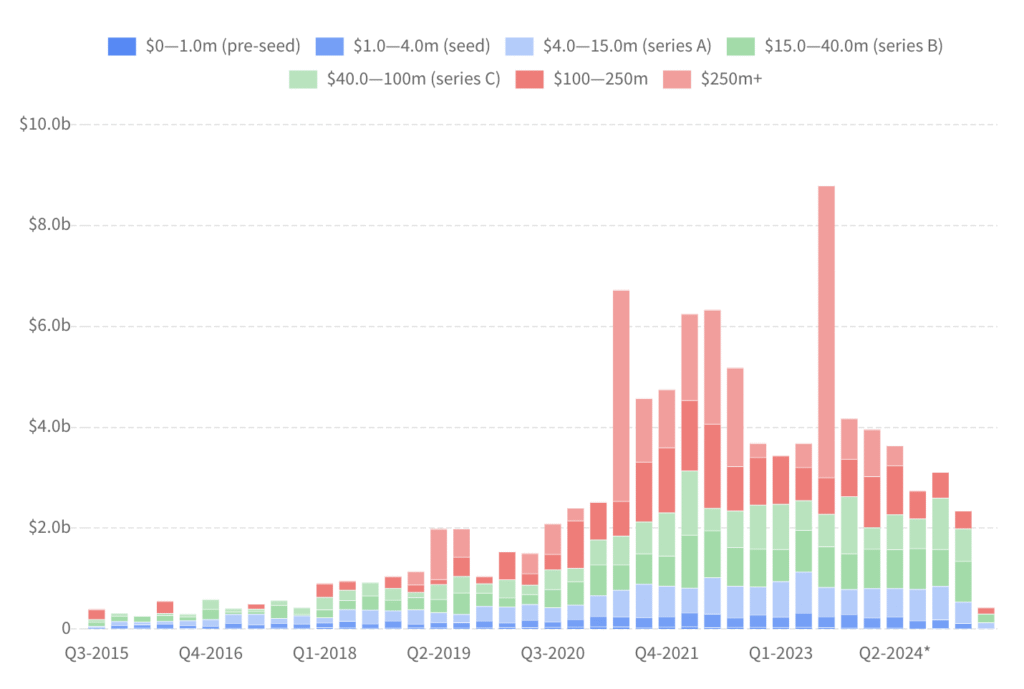
Europe’s climate tech startups raised $2.3bn (€2bn) in the first quarter of this year — the lowest total since Q3 2020, according to Dealroom data.  Behind the headline figure lies a complex mix of growing pains, shifting investor focuses, and broader VC market dynamics, experts told TNW. More specifically, they said the slowdown stems from a blend of market maturity, strategic repositioning, AI’s outsized pull on capital, and a tough exit environment.  “If we use the narrative of Dunning-Kruger Curve, we are at a slope of despair in climate now, at least for investors,” Rokas Peciulaitis, founder and managing partner at Lithuania-based Contrarian Ventures, told TNW.   40% off TNW Conference! For 1 week only… Register by 28 April & save up to €700 on General Admission, Corporate, VIP & Investor Passes, and Startup/Scaleup packages “No quick wins, no massive exits, mergers and acquisitions are limited,” he added. “Most companies required more capital than assumed, and did not show enough traction. Also, the regulatory tailwind completely failed in most cases.”   However, Peciulaitis believes there is light at the end of the tunnel. “I think those who are disciplined will prevail and win, both on the founder and VC side,” he said.     European climate tech startups raised $2.3bn in Q1 2025. This graph also includes the start of Q2. Credit: Dealrom The funding dip comes off the back of an exceptional run. European climate tech funding has soared over the past decade. The sector’s best year was in 2023, when climate tech startups raised $15bn in venture capital — more than their counterparts in the US. That’s despite an overall poor funding environment that year.  Orla Browne, head of insights at Dealroom, told TNW that there are several possible reasons why Europe’s climate tech funding has slowed down so far in 2025.  Firstly, the market is maturing. Some forms of cleantech that previously attracted heaps of VC cash — like electric mobility startups — have gone mainstream. As these markets become more established and growth stabilises, they tend to attract less early-stage venture funding, Browne said.   Investor hype around AI could also be fuelling the slowdown. “AI is taking the oxygen out of VC, at least for other sectors,” Browne said. “More than 25% of all VC now goes to AI startups, up from single-digit percentages just a few years ago.”  Another reason for the slump could be that climate tech startups are rebranding themselves as a “resilience” or “security” play to capitalise on skyrocketing defence tech spending and Europe’s current push for tech sovereignty.  The dip likely also signals a broader return to normal, following an unprecedented spike in VC investment in 2021. But Peciulaitis believes there could be a lot of “unannounced deals” in the pipeline this year.  Startup funding is one of the the key themes at TNW Conference, which takes place on June 19-20 in Amsterdam. Tickets for the event are now on sale — use the code TNWXMEDIA2025 at the checkout to get 30% off. source

European climate tech funding sunk to five-year low in Q1 Read More »

Technology Service Provider Acquisitions: A Strategic Shift To AI And Industry Services Is Underway

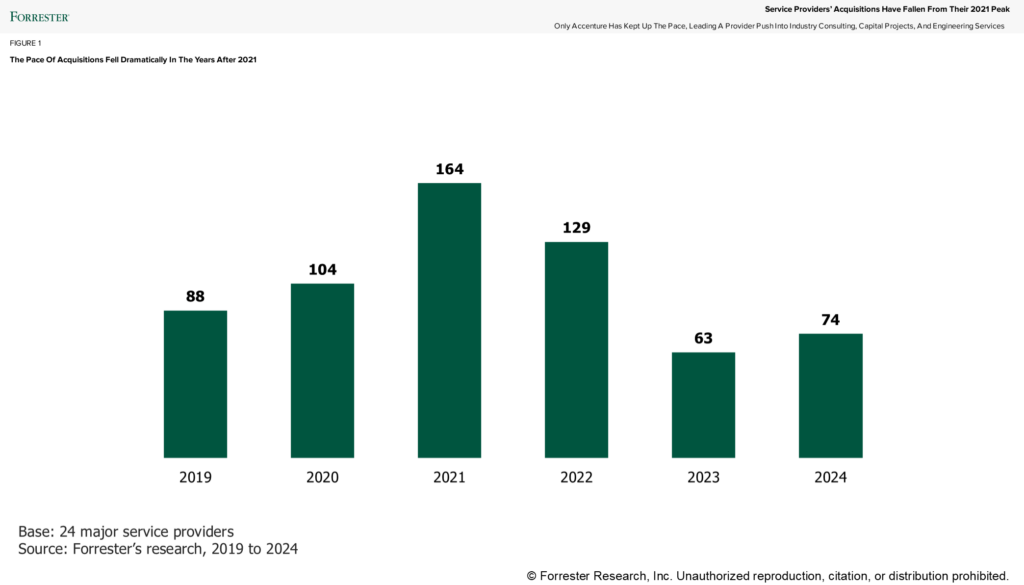
The number of acquisitions by 24 top service providers — including Accenture; Atos; Bain & Company; BearingPoint; Boston Consulting Group; Capgemini; CGI; Cognizant; Deloitte; DXC Technology; EPAM; EY; Globant; HCLTech; IBM; Infosys; KPMG; McKinsey & Company; NTT DATA; Perficient; PwC; Tech Mahindra; West Monroe; and Wipro — fell sharply from 164 in 2021 to 63 in 2023 and rebounded only slightly to 74 deals in 2024 (see the figure below). Compared with 2020 and 2021, when the COVID response still drove most deals, three factors tamped down acquisition fever in 2023 and 2024, continuing to be slow in today’s volatile environment: High valuations: unrealistically high valuations that deterred acquisitions Demand trends: flat or slowly rising demand for technology services Interest rates: high interest rates that increased the cost of capital Only Accenture kept up the pace: Over the past two years, Accenture accounted for almost half of the acquisitions tracked, adding 66 firms (and a forecasted 2–3% inorganic growth) to the 131 it acquired between 2019 and 2022. The next biggest acquirer in the period was Deloitte with nine deals — far off its pace of 55 between 2019 and 2022. This makes Accenture a bellwether for the expansion strategy of the services industry.   Providers Are Heading Toward New Kinds Of Services Service providers continually reassess their best opportunities to expand. They acquire companies to enter new markets, introduce new lines of service, or expand capacity. All three reasons motivated providers in 2023 and 2024 to acquire firms in 12 categories (see the figure below). AI and data showed up in the deal categories, rising to number three in the lineup. That AI service purchase momentum continues (in a slow deals market) in 2025 with purchases of Hakkoda by IBM Consulting and Halfspace by Accenture, for example. In addition to AI, the acquisition pivots signal where providers are headed: Industry consulting services. Industry consultants are closer to an enterprise context than general systems integrators. For example, Globant acquired US-based ExperienceIT for its healthcare prowess; Accenture acquired Italy-based Intellera Consulting, focused on public sector and healthcare services. Business application implementation services. Services to implement Oracle, Salesforce, SAP, and Workday have been on the acquisition list for years. In 2023–2024, ServiceNow became a hot acquisition target: Cognizant acquired US-based Thirdera, EY acquired UK-based whyaye, and NTT DATA acquired Brazilian provider Aoop, all for their ServiceNow skills. Capital project management services. Providers are expanding into managing large infrastructure projects. Deloitte acquired Nihar in Australia, while Accenture acquired six firms providing infrastructure project services, including Boslan in Spain and Comtech Group in Canada. Training services. Training services have gained importance due to rapid workforce changes stemming from AI. Accenture joined Infosys in 2024 by acquiring Udacity and Award Solutions to expand its learning platform and services.   What Providers’ Acquisition Strategies Mean For Technology Executives Companies depend deeply on the providers they hire. In Forrester’s Business And Technology Services Survey, 2024, enterprise services decision-makers said that, on average, their firm would spend 28% of its IT budget on third-party service providers in 2024. This means that they must care about key providers’ strategies, including their approach to acquisitions and track record of success (or quiet failure). Ask your strategic partners about their: Acquisition strategy. What is the provider’s acquisition strategy, and how will it support your evolving needs? Make their acquisition strategy part of your vetting process and annual master service agreement review. Impact on existing work. How will a particular acquisition affect the work you’re already doing with the provider? If you are already working with the acquired firm, ask it directly. If not, ask for an introduction to get the straight scoop on the acquirer’s plan. Contract protection. Procurement professionals should write contracts that protect against the provider being acquired and investigate any changes stemming from an acquisition that could affect the validity of the contract. For the in-depth report, click here. (Thanks to my colleagues Hannah Murphy and Hayden Weatherall for this research foundation.) source

Technology Service Provider Acquisitions: A Strategic Shift To AI And Industry Services Is Underway Read More »

BREAKING: Apple, Meta Fined €700M By EU For Market Breaches

By Najiyya Budaly ( April 23, 2025, 11:33 AM BST) — The European Commission said Wednesday it has fined Apple Inc. €500 million ($570 million) and Meta €200 million for failing to give consumers choices on offers and how their personal data is used — the first decision under the bloc’s Digital Markets Act…. Law360 is on it, so you are, too. A Law360 subscription puts you at the center of fast-moving legal issues, trends and developments so you can act with speed and confidence. Over 200 articles are published daily across more than 60 topics, industries, practice areas and jurisdictions. A Law360 subscription includes features such as Daily newsletters Expert analysis Mobile app Advanced search Judge information Real-time alerts 450K+ searchable archived articles And more! Experience Law360 today with a free 7-day trial. source

BREAKING: Apple, Meta Fined €700M By EU For Market Breaches Read More »