Abu Dhabi pioneers AI-Driven governance with Microsoft and G42 partnership

In a landmark move, the Abu Dhabi Government, Microsoft, and Core42 was made in the presence of H.H. Sheikh Tahnoon bin Zayed Al Nahyan, Deputy Ruler of Abu Dhabi and Chairman of the Artificial Intelligence and Advanced Technology Council, and Khaldoon Al Mubarak, Chairman of the Executive Affairs Authority and member of the Artificial Intelligence and Advanced Technology Council will create a unified, high-performance sovereign cloud computing environment capable of processing over 11 million daily digital interactions between government entities, citizens, residents, and businesses. Ahmed Tamim Hisham Al Kuttab, Chairman of the Department of Government Enablement—Abu Dhabi, Satya Nadella, Chairman and CEO of Microsoft, and Peng Xiao, Group CEO of G42, entered into the partnership which will be a critical milestone in Abu Dhabi’s digital transformation journey, aiming to make the emirate the world’s first fully AI-native government by 2027. The initiative is backed by a significant 3.54 USD billion investment in digital infrastructure under the Abu Dhabi Government Digital Strategy 2025-2027. This strategy includes deploying over 200 AI-driven solutions to enhance public service delivery, boost operational efficiency, and promote environmental sustainability. Satya Nadella, Chairman and CEO of Microsoft, emphasized that AI will transform how governments operate and serve their citizens, with Abu Dhabi leading the way. The partnership sets a standard for AI adoption in the public sector, ensuring data sovereignty while harnessing hyperscale innovation through Core42’s Sovereign Public Cloud, powered by Azure. source

Abu Dhabi pioneers AI-Driven governance with Microsoft and G42 partnership Read More »

Amazon Beats Consumer's Suit Over Late Delivery Again

By Rachel Riley ( March 21, 2025, 9:05 PM EDT) — A Washington federal judge on Friday permanently threw out a proposed class action accusing Amazon of breaking scheduled delivery promises, finding that the e-commerce giant did not engage in deception by requiring customers to request shipping fee refunds for packages that arrive after a guaranteed time…. Law360 is on it, so you are, too. A Law360 subscription puts you at the center of fast-moving legal issues, trends and developments so you can act with speed and confidence. Over 200 articles are published daily across more than 60 topics, industries, practice areas and jurisdictions. A Law360 subscription includes features such as Daily newsletters Expert analysis Mobile app Advanced search Judge information Real-time alerts 450K+ searchable archived articles And more! Experience Law360 today with a free 7-day trial. source

Amazon Beats Consumer's Suit Over Late Delivery Again Read More »

Siri’s ‘Non-Existent’ AI Features Spark Apple Legal Battle

Image: TheClimateGroup/Creative Commons (2014) A federal lawsuit filed on behalf of disgruntled consumers claims that Apple misled buyers with promises of advanced artificial intelligence features for Siri that never materialized. The complaint alleges that during a high-profile marketing campaign for the iPhone 16 series, Apple touted a suite of capabilities — collectively branded as Apple Intelligence — that were never delivered, deceiving millions into overpaying for devices that lacked the promised functionality. Must-read Apple coverage False promises and misleading marketing According to the complaint filed by plaintiff Peter Landsheft, Apple’s aggressive advertising campaign built significant consumer expectations. The company claimed that Siri would soon offer personalized assistance by drawing on a user’s context, allowing commands like “Play that podcast that Jamie recommended,” or “When is Mom’s flight landing?” and perform hundreds of new actions across apps. However, the lawsuit contends that these claims were nothing more than marketing hype. Apple has since admitted that such advanced features do not currently exist and, if they ever do, they won’t be available until 2026. SEE: Apple Passwords App Vulnerability Exposed Users for Months The suit argues that by advertising non-existent features, Apple violated several state consumer protection laws, including the California Unfair Competition Law, False Advertising Law, and Consumers Legal Remedies Act. Furthermore, the complaint accuses the tech giant of fraud, negligent misrepresentation, breach of contract, and breach of the implied warranty of merchantability. Consumer impact and industry implications The class action complaint alleges that the deceptive campaign not only induced consumers to purchase the new iPhone models at premium prices but also unfairly boosted Apple’s market position. SEE: EU Cracks Down on Apple for Anti-Competitive Behavior – Here’s What Apple Told Us in Response The false promises were widely disseminated through television, social media, and the company’s own retail channels, reaching millions during peak viewing periods such as the NFL season. This widespread misrepresentation, the lawsuit asserts, not only harmed consumers financially but also distorted competition in the smartphone market at a time when rivals like Samsung, Google, and others are aggressively advancing their own AI capabilities. While Apple has yet to comment on the lawsuit, industry analysts note that the company’s struggles in the AI race are becoming increasingly apparent. The litigation could compel Apple to revise its marketing practices and potentially offer compensation to affected consumers, underscoring the risks companies face when they promise cutting-edge innovation without the tech to back it up. This legal challenge serves as a stark reminder of the importance of accurate advertising in today’s tech-driven market — a lesson for both consumers and corporations navigating the rapidly evolving AI landscape. source

Siri’s ‘Non-Existent’ AI Features Spark Apple Legal Battle Read More »

From data to impact: How the right technology drives generative AI excellence

By Bryan Kirschner, Vice President, Strategy at DataStax Change management across people, processes, and technologies is a critical part of succeeding with generative AI (genAI). In earlier articles, we’ve covered the human element and how to adapt your processes; here, we’ll take a look at the third: technology. A recap: A growth mindset and the cognitive value chain Because deploying technology is a means to an end rather than an end in itself, here’s a recap of the keys to achieving great outcomes by deploying a winning genAI infrastructure and architecture. With people, the goal is to inspire a growth mindset toward genAI, much as they would take toward any new tool or technique (such as a spreadsheet or the blameless post mortem). But with genAI, they should be pursuing augmentation excellence (“that was a smart way to use it”) and excellent augmentation (“I’m really glad we did that”). With processes, the goal is to evolve toward a “new normal” way of working in which a cognitive value chain enables knowledge to infuse workflows, at pace and scale, in order to reduce error. It’s conceptually similar to how enterprises developed digital value chains that enabled data to infuse digital experiences, at pace and scale, in order to increase their value. Our goal here is to point you toward technology that will always help, never stumble, and never stand in the way. Access to the right data Let’s start by level-setting on what that entails by using a concrete example that’s likely to become a ubiquitous use of genAI in large enterprises. Here’s what Teresa Heitsenrether, JPMorgan’s chief data and analytics officer, told a Wall Street Journal reporter when asked how genAI will transform work at JPMorgan: “Think about any place in the bank where people are preparing to go and talk to their clients. Today, you have armies of people running around, pulling briefing memos together and making sure that everybody’s prepped. This is a great way of being able to pull those things together more quickly. We see it in legal, in any place where you’ve got lots of documents, a lot of information to sift through.” Off the rack, an LLM-powered genAI app such as ChatGPT Enterprise can lend a hand to any user who can craft a prompt and insert documents into its context window. But with important, ongoing workflows such as preparing for customer meetings, sales calls, or contract negotiations, individuals willy-nilly copying-and-pasting from 17 different data sources simply doesn’t make sense. You want your genAI app developers to be able to build access to the right data sources into tailored enterprise apps, which we represent with the diagram below. The upshot is simple: richer context means better results and greater impact. DataStax Agency and orchestration But there’s an added twist with genAI. Traditional apps can’t display any agency beyond the data sources and queries hard-coded into them. genAI, on the other hand, can choose to make use of tools and APIs to which its given access. So the developer tooling layer must incorporate elements of orchestration, too, a concept which we represent with the next diagram below. It’s a matter of bringing not just whatever is in your data estate to bear, but what might be relevant beyond it as well. For example: if a ticketing database is the system of record for customer support, but one ticket ends with “let’s take this conversation over to Slack,” the genAI app could be equipped to follow the trail. Or if the AI finds conflicting data from internal sources about a customer’s business metrics that are available from a high-quality source such as Dun & Bradstreet, it could tee up the issue and ask permission to make the call. DataStax Finally, for all the human-mind-like behavior genAI can manifest, a genAI app still depends on “math” under the hood to find the most relevant context. And while vector search is table stakes for genAI apps, we know that hybrid search approaches such as combining vector search (for semantic understanding) and lexical search (for exact keyword matching) can improve results. So what we call a knowledge layer is inserted in order to provide full multi-modal search capabilities beyond the SQL queries that used to be the predominant link between your developers and your data. DataStax The building blocks of AI success Putting it all together, these three changes – unstructured data becoming a first-class citizen of the data layer; adding orchestration and data access capabilities at the dev tools layer; and the new knowledge layer – will underpin winning processes for leveraging genAI and set up people (both end users and developers) for success with it. Learn more about DataStax and the technology to help with genAI success. About Bryan Kirschner:Bryan is Vice President, Strategy at DataStax. For more than 20 years he has helped large organizations build and execute strategy when they are seeking new ways forward and a future materially different from their past. He specializes in removing fear, uncertainty, and doubt from strategic decision-making through empirical data and market sensing. source

From data to impact: How the right technology drives generative AI excellence Read More »

Anthropic just gave Claude a superpower: real-time web search. Here’s why it changes everything

Join our daily and weekly newsletters for the latest updates and exclusive content on industry-leading AI coverage. Learn More Anthropic announced today that its AI assistant Claude can now search and process information from the internet in real-time, addressing one of users’ most requested features and closing a critical competitive gap with OpenAI’s ChatGPT. The new web search capability, available immediately for paid Claude users in the United States, transforms the AI assistant from a tool limited by its training data cutoff to one that can access and synthesize the latest information across the web. “With web search, Claude has access to the latest events and information, boosting its accuracy on tasks that benefit from the most recent data,” Anthropic said in its announcement. The company emphasized that Claude will provide direct citations to sources, allowing users to fact-check information— a direct response to growing concerns about AI hallucinations and misinformation. AI arms race intensifies as Anthropic secures billions in funding This launch comes at an important moment in the rapidly evolving AI sector. Just three weeks ago, Anthropic secured $3.5 billion in Series E funding at a post-money valuation of $61.5 billion, underscoring the high stakes in the AI race. Major backers include Lightspeed Venture Partners, Google (which holds a 14% stake) and Amazon, which has integrated Claude into its Alexa+ service. The web search rollout also follows Anthropic’s recent release of Claude 3.7 Sonnet, which the company claims has set “a new high-water mark in coding abilities.” This focus on programming proficiency appears strategic, especially in light of CEO Dario Amodei’s recent prediction at a Council on Foreign Relations event that “in three to six months, AI will be writing 90% of the code” that software developers currently produce. The timing of this feature launch reveals Anthropic’s determination to challenge OpenAI’s dominance in the consumer AI assistant market. While Claude has gained popularity among technical users for its nuanced reasoning and longer context window, the lack of real-time information access has been a significant handicap in head-to-head comparisons with ChatGPT. This update effectively neutralizes that disadvantage. How Claude’s web search transforms enterprise decision-making Unlike traditional search engines that return a list of links, Claude processes search results and delivers them in a conversational format. Users simply toggle on web search in their profile settings, and Claude will automatically search the internet when needed to inform its responses. Anthropic highlighted several business use cases for the web-enabled Claude: sales teams analyzing industry trends, financial analysts assessing current market data, researchers building grant proposals and shoppers comparing products across multiple sources. This feature fundamentally changes how enterprise users can interact with AI assistants. Previously, professionals needed to toggle between search engines and AI tools, manually feeding information from one to the other. Claude’s integrated approach streamlines this workflow dramatically, potentially saving hours of research time for knowledge workers. For financial services firms in particular, the ability to combine historical training data with breaking news creates a powerful analysis tool that could provide genuine competitive advantages. Investment decisions often hinge on connecting disparate pieces of information quickly — exactly the kind of task this integration aims to solve. Behind the scenes: The technical infrastructure powering Claude’s new capabilities Behind this seemingly straightforward feature lies considerable technical complexity. Anthropic has likely spent months fine-tuning Claude’s ability to search effectively, understand context and determine when web search would improve its responses. The update integrates with other recent technical improvements to the Anthropic API, including cache-aware rate limits, simpler prompt caching, and token-efficient tool use. These enhancements, announced earlier this month, aim to help developers process more requests while reducing costs. For certain applications, these enhancements can reduce token usage by up to 90%. Anthropic has also upgraded its developer console to enable collaboration among teams working on AI implementations. The revised console allows developers to share prompts, collaborate on refinements and control extended thinking budgets — features particularly valuable for enterprise customers integrating Claude into their workflows. The investment in these backend capabilities suggests Anthropic is building for scale, anticipating rapid adoption as more companies integrate AI into their operations. By focusing on developer experience alongside user-facing features, Anthropic is creating an ecosystem rather than just a product — a strategy that has served companies like Microsoft well in enterprise markets. Voice mode: Anthropic’s next frontier in natural AI interaction A web search may be just the beginning of Anthropic’s feature expansion. According to a recent report in the Financial Times, the company is developing voice capabilities for Claude, potentially transforming how users interact with the AI assistant. Mike Krieger, Anthropic’s chief product officer, told the Financial Times that the company is working on experiences that would allow users to speak directly to Claude. “We are doing some work around how Claude for desktop evolves… if it is going to be operating your computer, a more natural user interface might be to [speak to it],” Krieger said. The company has reportedly held discussions with Amazon and voice-focused AI startup ElevenLabs about potential partnerships, though no deals have been finalized. Voice interaction would represent a significant leap forward in making AI assistants more accessible and intuitive. The current text-based interaction model creates friction that voice could eliminate, potentially expanding Claude’s appeal beyond tech-savvy early adopters to a much broader user base. How Anthropic’s safety-first approach shapes regulatory conversations As Anthropic expands Claude’s capabilities, the company continues to emphasize its commitment to responsible AI development. In response to California Governor Gavin Newsom’s Working Group on AI Frontier Models draft report released earlier this week, Anthropic expressed support for “objective standards and evidence-based policy guidance,” particularly highlighting transparency as “a low-cost, high-impact means of growing the evidence base around a new technology.” “Many of the report’s recommendations already reflect industry best practices which Anthropic adheres to,” the company stated, noting its Responsible Scaling Policy that outlines how it assesses models for misuse and autonomy risks. This focus on responsible development represents a core differentiator in

Anthropic just gave Claude a superpower: real-time web search. Here’s why it changes everything Read More »

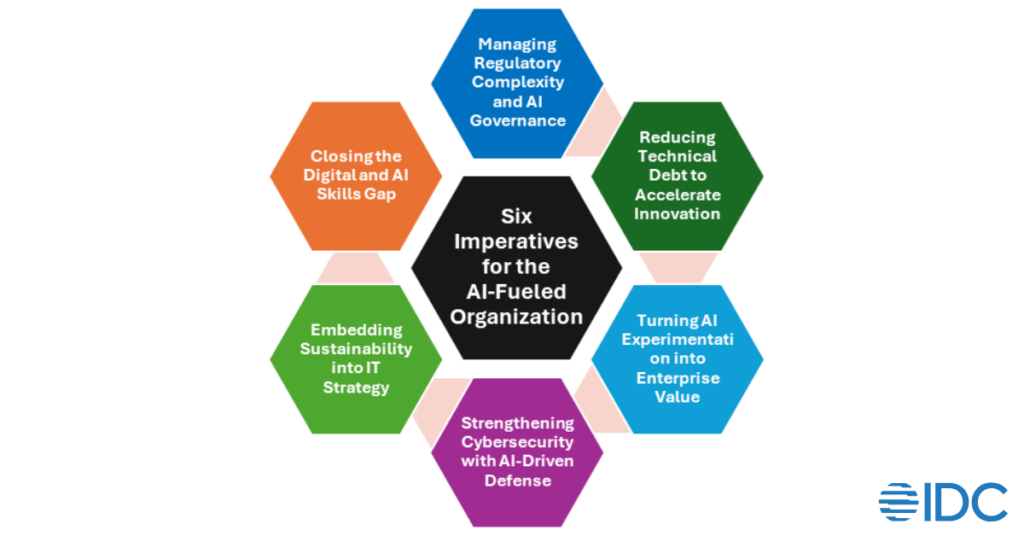
The CIO Imperative: Six Priorities for the AI-Fueled Organization

Technology is no longer just an enabler – it transforms how organizations function, compete, and deliver value.  Specifically, AI is now fundamentally changing business processes, operations, and experiences, something that presents CIOs with both challenges and opportunities. As a result, the role of the CIO and IT must evolve beyond an enabling function. Historically focused on operational excellence, CIOs now face a strategic imperative: becoming orchestrators of business value. Leveraging deep technical expertise and proactively acquiring new capabilities, CIOs are expected to effectively harness AI to drive meaningful innovation and measurable business outcomes. However, many CIOs and IT departments remain too focused on traditional IT and IT-related metrics, limiting their ability to drive broader business outcomes. Closing this gap requires a fundamental shift that was already anticipated as part of digitalization efforts but now intensified by the pressure to deliver value on the AI agenda. CIOs must evolve from technology stewards to strategic innovators, driving resilient and adaptive organizations. Those who proactively do and align AI with business priorities will shape their organization’s future, those who hesitate risk being left behind. To successfully navigate this evolution, CIOs must address six imperatives. This is what this looks like in practice. 1. Manage Regulatory Complexity and Enforce AI Governance Rapidly changing AI regulations present major hurdles. In the report IDC FutureScape: Worldwide CIO Agenda 2025 Predictions – Asia/Pacific (Excluding) Japan Implications, IDC predicts that in 2025, 50% of the Asia-based top 1000 (A1000) organizations will struggle with divergent regulatory changes and rapidly evolving compliance standards, challenging their ability to adapt to market conditions and drive AI innovation. CIOs must proactively address these challenges by developing agile compliance frameworks. Also, 41% of APEJ organizations are focusing on establishing organizational data governance policies for AI/GenAI usage, according to the IDC 2024 CIO Sentiment Survey. We expect this to increase as this regulatory complexity demands organizations to have unified AI governance, and IDC predicts that by 2025, 70% of organizations will be formalizing policies and oversight to address AI risks (e.g., ethical, brand, and PII), aligning AI governance with strategic business goals. CIOs must develop trust-centric AI governance models that align clearly with strategic business objectives. This can help organizations use AI responsibly, maintaining customer trust, while still capturing the benefits of rapid technological innovation. 2. Reduce Technical Debt to Accelerate Innovation Modernizing IT is the top strategic priority for 37% of CIOs in the Asia/Pacific region, according to the same survey. This is because technical debt creates complexity, slows innovation, and restricts the ability to effectively adopt and scale new technologies like AI. IDC predicts that responding to the drag of technical debt, 40% of CIOs in 2025 will drive enterprise initiatives in high-impact areas to remediate technical debt for competitive advantage. Clearing technical debt – from aging codebases to outdated systems, and inefficient processes – enables organizations to quickly adopt new technologies, reducing barriers to innovation and accelerating AI integration. CIOs who prioritize tackling technical debt will position their organizations to adopt technology innovations faster, ensuring readiness for more complex AI-driven transformations. This can help boost innovation, improve agility, and increase the return on technology investments. 3. Turn AI Experimentation into Enterprise Value Although AI adoption has rapidly moved from niche to mainstream, many organizations remain stuck in pilot paralysis, struggling to advance beyond the proof-of-concept (PoC) stage. According to the IDC’s 2024 Future Enterprise Resiliency and Spending (FERS) survey, wave 4, organizations in Asia Pacific conducted an average of 24 GenAI pilots over the past 12 months, but only 3 progressed into production, partly due to the lack of clear direction. In fact, IDC predicts that in 2026, over one-third of organizations will be stuck in the experimental, point-solution phase of AI experimentation, requiring a shift of focus to enterprise use cases to deliver ROI. This stagnation hinders competitiveness, slows growth, and increases exposure to ethical risks and regulatory scrutiny. CIOs must become orchestrators of business value by effectively partnering with other CxOs to translate unclear ideas into practical AI applications. They should establish an AI Center of Excellence (CoE) to centralize expertise, share best practices, and coordinate cross-functional teams, accelerating AI deployment and ensuring consistency. Additionally, CIOs must lead the creation of a strategic roadmap for responsible AI that maximizes business impact, ensures ethical deployment, and proactively mitigates risks. So, we expect that by 2026, 70% of CIOs will lead the creation of a strategic road map to rapidly implement responsible AI solutions, maximizing benefits while mitigating risks across their operations. CIOs who bridge the gap between innovative AI experimentation and enterprise-wide deployment will help their organizations capture substantial competitive advantages and achieve tangible financial returns. 4. Strengthen Cybersecurity with AI-Driven Defense Cybersecurity is much more than just an IT issue; it is a strategic business imperative. Yet, CIOs are ultimately responsible for safeguarding their organizations, particularly as threats grow increasingly sophisticated. IDC predicts that in 2026, 50% of CIOs will diversify and broaden security strategies across their organization’s IT and security teams to address new/fast-evolving threats to their technology and supply chain ecosystem. CIOs must actively integrate AI and ML into their cyber-defense systems to protect against advanced threats, both internal and external. AI-driven cybersecurity can help not only improve threat detection, but also enhance incident response times, potentially reducing risks to operations and reputation. CIOs who effectively leverage AI to protect their IT infrastructure can improve organizational resilience, positioning their organizations as leaders in cybersecurity effectiveness. 5. Embed Sustainability into IT Strategy Sustainability has become a core business priority and technology investments play a critical role in achieving organizations’ ESG goals. IDC predicts that by 2027, 50% of CIOs will be accountable for embedding sustainability goals into every technology project, measuring outcomes to refine investments and align with environmental objectives. CIOs must actively incorporate environmental considerations into IT investment decisions, embedding clear sustainability metrics into infrastructure development and AI initiatives. By proactively integrating sustainability into their technology agendas, CIOs are effectively linking technology leadership with broader corporate responsibility.


The CIO Imperative: Six Priorities for the AI-Fueled Organization Read More »

Amazon, Google & Meta Push for Nuclear Power Growth by 2050

Image: World Nuclear Association In a significant move to address global energy challenges, Amazon, Google, and Meta recently joined forces with other large energy-intensive users to advocate for a substantial increase in nuclear power capacity. The coalition is calling for a tripling of global nuclear energy production by the year 2050, aiming to bolster energy security, meet escalating demand, and mitigate the impacts of climate change. Signers of the Large Energy Users Pledge are: Allseas, Amazon, Bureau Veritas, Carbon3Energy, Clean Energy Buyers Association, Core Power, Dow, Fly Green Alliance, Google, Lloyd’s Register, Meta, Occidental, OSGE, Siemens Energy (statement of support). The World Nuclear Association reported that this group joins 14 major global banks and financial institutions, 140 nuclear industry companies, and 31 countries in supporting the goal. More about data centers Strategic coordination across sectors Recognizing the complexities inherent in such an ambitious expansion, these companies emphasize the necessity for coordinated efforts among developers, utilities, governments, and consumers. The initiative, reported by the Financial Times, underscores that achieving the desired growth in nuclear capacity will require unprecedented collaboration across various sectors to ensure the alignment of goals and resources. This corporate call to action mirrors a similar pledge made by leading financial institutions during the COP28 UN climate conference. The financial sector’s backing highlights a growing consensus on the pivotal role of nuclear energy in achieving global sustainability targets and underscores the importance of diverse support for such efforts. Progress and policy revisions post-COP28 Since the COP28 conference, notable advancements in nuclear energy have been observed. Eight new reactors have been integrated into the global energy grid, and construction has commenced on 12 additional reactors, according to the World Nuclear Association. Countries such as Japan and Italy are reevaluating and revising their nuclear policies in response to rising electricity demands and the pressing need for sustainable energy solutions. Despite the momentum, the path to expanding nuclear energy is fraught with challenges; high costs and stringent regulatory requirements pose significant hurdles. Additionally, next-generation nuclear technologies, including small modular reactors (SMRs), present uncertainties and potential risks that must be carefully managed. Industry perspectives on nuclear development Key figures from major energy companies have shared diverse viewpoints on the future of nuclear energy; while some express a strong commitment to advancing nuclear technologies, others remain cautious, citing concerns about economic feasibility and the readiness of emerging technologies to meet current energy demands. These perspectives reflect the broader debate within the industry about the role of nuclear power in the global energy transition. The success of this initiative will depend on overcoming financial, regulatory, and technological challenges through collaborative efforts and innovative solutions. source

Amazon, Google & Meta Push for Nuclear Power Growth by 2050 Read More »

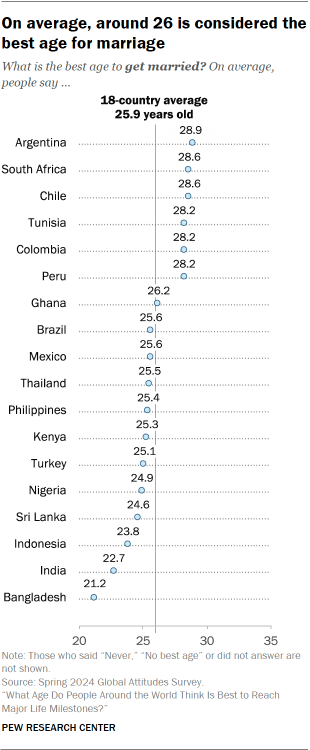
1. What is the best age to get married?

We asked people in 18 mostly middle-income countries what they think is the best age to get married. On average, respondents say 25.9 years old is the ideal age for marriage. But opinions vary by country. For instance, Argentine adults say the best age to get married is 28.9 – on the older end when compared with other country averages. People in Chile, Colombia, Peru, South Africa and Tunisia also suggest ages on the older end, saying it is best to marry around 28 years old.  Conversely, Bangladeshis say it’s best to get married younger – at 21.2 years old, on average. People in India and Indonesia generally agree that the ideal age for marriage is under 25. The United Nations has global data on when men and women typically get married for the first time. Across the countries included in our analysis, actual ages at first marriage generally fall within the same range as the ideal ages suggested in our survey: between 20 and 29 years old. Overall, the ideal and actual ages for marriage are positively related. In countries where the age of first marriage is older – Chile, South Africa and Tunisia – people tend to say it is best to get married later in life. Refer to Appendix A for actual average ages at first marriage in each country. In addition to the average age suggested in each country, we can also look at the distribution of ages people in that country say are ideal for marriage. Here, we see even more variation.  In Bangladesh for example, a majority of adults say the best age to get married is under 25. The largest share say the ideal age for this life event is between 20 and 24, and the next-largest share say under age 20 is best. In Peru, however, we measure the opposite pattern. Only 11% of Peruvians say the best age for marriage is under 25. Instead, 39% of respondents think the ideal age is between 30 and 34, and 33% say it’s between 25 and 29. Another 10% say people should wait to get married until age 35 or older. In Mexico, responses are more evenly distributed: 43% of Mexicans say the best age for marriage is between 25 and 29, while about equal shares say slightly older or slightly younger is ideal. Generally, people in the Asian countries surveyed suggest younger ages for marriage, while people in the Latin American countries choose older ideal ages. However, what is seen as the best age for marriage in many countries varies slightly based on some demographic factors. Views by gender, age, education and religiousness Men tend to say the best age for marriage is later in life, compared with women. There’s a similar gender gap in the actual ages of men and women at their first marriage. Older adults generally say the best age to get married is earlier in life, compared with younger adults. In Chile, Colombia, Peru, and Thailand, the average ideal ages suggested by the oldest and youngest respondents differ by about three years. Ghana is the only country where younger adults say it is best to get married slightly earlier in life, compared with older adults. Views also vary somewhat by education. On average, adults with more education say it is better to get married later in life, compared with those who have less education. This is especially the case across the Latin American countries surveyed. In 11 countries, people who say religion is very important in their life suggest a younger age for marriage, compared with those who say religion is somewhat or less important to them.  source

1. What is the best age to get married? Read More »

生產力局「生命健康科技館」向公眾展示本地初創科研成果

(相)香港生產力促進局舉辦「香港生命健康產業發展論壇暨主題展館開幕典禮」,主禮嘉賓包括香港特別行政區政府創新科技署署長李國彬先生(中)、香港生產力促進局主席陳祖恒議員(右)、香港生產力促進局總裁畢堅文先生(左)。 生命健康科技在《香港創新科技發展藍圖》中被列為具策略意義的新興產業。香港生產力促進局(生產力局)積極響應國家和特區政府的發展戰略,舉辦「香港生命健康產業發展論壇暨主題展館開幕典禮」,在創新科技署署長李國彬先生及一眾嘉賓見證下隆重啟動「生命健康科技館」。該展館將對公眾開放,展示本地初創的創新技術及科研成果,並為業界提供交流合作和促進產業落地的最佳平台,助力香港成為國際醫療創新樞紐。 生命健康科技是全球科技創新的核心領域之一,2025年全國兩會報告提出培育壯大生物製造等未來產業。特區政府亦在2025-26財政預算案中透過各項措施,積極推動生命健康產業的發展,因地制宜發展新質生產力。  創新科技署署長李國彬先生表示:「全球人口老化為生命健康產業提供了龐大機遇及發展潛力,特區政府一直大力投放資源推動生命健康科技發展,透過多項政策及資助計劃,更有效發揮香港在生命健康科技的獨特優勢,並吸引世界頂尖科研團隊和企業落戶香港,建立蓬勃的創科生態圈。生產力局作為政府和業界的重要合作夥伴,積極推動新質生產力,助力產業升級轉型。『生命健康科技館』透過展示本地先進科研成果和應用方案,加速產業化進程並提升行業整體水平,鞏固香港作為全球生命健康創新中心的地位。」 香港生產力促進局主席陳祖恒議員表示:「香港在生命健康科技領域擁有雄厚的科研實力,生產力局擔當香港前沿科研成果『從1到N』落地的重要橋樑,透過先進技術賦能企業,包括運用人工智能、機械人及3D打印等創新科技,攜手業界實現升級轉型,加速產業化。『生命健康科技館』將成為構建蓬勃的生命健康科技生態圈重要里程碑,推動科技創新和產業融合發展,促進生命健康科技成為香港經濟增長的新動能。」 香港生命健康產業發展論壇雲集來自政、產、學、研、投各界領袖,包括香港藥物及醫療器械監督管理中心籌備辦公室助理署長陳詩濤先生、香港城市大學副校長(研究)岑浩璋教授、香港工業總會第33分組:生物科技及醫療保健協會主席杜偉樑教授、賽意香港科技有限公司咨詢委員會召集人蔡明都先生,圍繞科技轉化與產業落地、國際競爭力與區域合作和政策支持與產業升級等三大範疇,聚焦探討生命健康科技產業的最新趨勢及發展機遇。 「生命健康科技館」集中展示超過28個由生產力局、InnoHK研發平台、本地院校及業界最新的科研成果以及創新應用,包括3D打印、檢測技術、先進治療、人工智能醫學影像、延展實境、基因編輯及樂齡科技等八大技術。當中亦展示了生產力局利用創新的精準生產技術系統——SUPER 生產系統,客制化協助本地初創企業在香港通過新型工業化,並融合了「智能微工廠」的概念,建立智能生產線,實現其世界首創的多孔結構矽微囊技術的產業化;同時「生命健康科技館」亦展出生產力局先進3D打印技術平台、生產力局及香港工業人工智能及機械人研發中心(FLAIR)合作研發的工業AI應用平台「天工開物」等創新方案。 生產力局將為業界提供技術研發、產業化、法規諮詢、培訓、行業支援的五個服務範疇,正規劃一系列的培訓以及論壇,如醫療器材產品註冊、法律法規體系、人工智能在生命健康領域應用、生物技術研討、數碼醫療科技等專題活動,積極促進大灣區及國際合作,推動生命健康產業發展。 「生命健康科技館」即日起可透過此連結預約參觀;有關重點展品的簡介,請按此參閱附錄。 LinkedIn Email Facebook Twitter WhatsApp source

生產力局「生命健康科技館」向公眾展示本地初創科研成果 Read More »