
Adobe Firefly AI video generator debuts—the most ‘IP-safe’ AI tool yet?

Join our daily and weekly newsletters for the latest updates and exclusive content on industry-leading AI coverage. Learn More Adobe is expanding its generative AI capabilities with the release of a new video generation model, marking a significant step in the company’s push to provide professional creators with AI tools they can safely use in commercial projects. The company announced today that its Firefly Video Model is entering public beta, offering AI-powered video generation tools that Adobe claims are trained only on licensed content — a key differentiator in the increasingly crowded AI video generation market. “We’re the most useful solution because we’re IP friendly, commercially safe model,” Alexandru Costin, who leads Adobe’s AI initiatives, said in an interview with VentureBeat. “You can use our model. There is no risk of IP infringement. More than anybody else, we’re passionate about solving professional videographer needs.” (Credit: Adobe) How Adobe’s new pricing strategy makes AI video generation more accessible The launch comes as Adobe reports that its Firefly family of AI models has generated more than 18 billion assets globally since its initial release in March 2023. This rapid adoption suggests strong demand for AI tools that creative professionals can confidently use in commercial work. The new video capabilities will be available through Adobe’s redesigned Firefly web application and integrated into Premiere Pro, Adobe’s professional video editing software. The system can generate 1080P video clips from text prompts or images, with features like camera angle control and atmospheric effects generation. “Just coming from the research lab, they were demoing to me this morning some of the amazing generation capabilities that are coming, increasing the resolution, doing transparent video overlays… doing real time video,” Costin revealed, indicating Adobe’s roadmap for the technology. Adobe is introducing tiered pricing plans starting at $9.99 monthly for the Standard plan, which includes 2,000 video/audio credits — enough for approximately 20 five-second 1080p video generations. A Pro plan at $29.99 offers 7,000 credits. (Credit: Adobe) Inside Adobe’s Strategy to Dominate Professional AI Video Creation The integration with Adobe’s existing creative tools appears to be a key strategic advantage. Kylee Pena, senior product marketing manager at Adobe, demonstrated how editors can use the technology to fill gaps in video timelines or generate atmospheric effects like snow, then seamlessly adjust the results using Premiere Pro’s professional tools. “Because I’m in Premiere Pro, I also have a lot of additional pro level tools, including AI tools we’ve had for a while, like color match,” Pena explained during a demonstration. The launch comes as competition intensifies in the AI video generation space, with recent entries like OpenAI’s Sora generating significant attention. Adobe is betting that its focus on commercial safety and professional workflow integration will help it stand out in an increasingly crowded market. To ensure transparency, Adobe will include Content Credentials, a type of digital certification, with all AI-generated video content. This aligns with the company’s leadership in the Content Authenticity Initiative, which aims to provide verification tools for digital content. Global brands including Dentsu, Gatorade and Stagwell are already testing the technology in beta, suggesting potential enterprise adoption. Adobe plans to introduce a Premium plan designed for high-volume professional users in the near future. The development signals Adobe’s strategic focus on maintaining its position as the go-to provider of creative tools for professionals while adapting to the AI revolution reshaping the creative industry. With 85% of projects at the recent Sundance Film Festival using Adobe Creative Cloud, the company appears well-positioned to bridge the gap between traditional creative workflows and emerging AI capabilities. source

Adobe Firefly AI video generator debuts—the most ‘IP-safe’ AI tool yet? Read More »
How to Remove Your Saved Passwords in Chrome

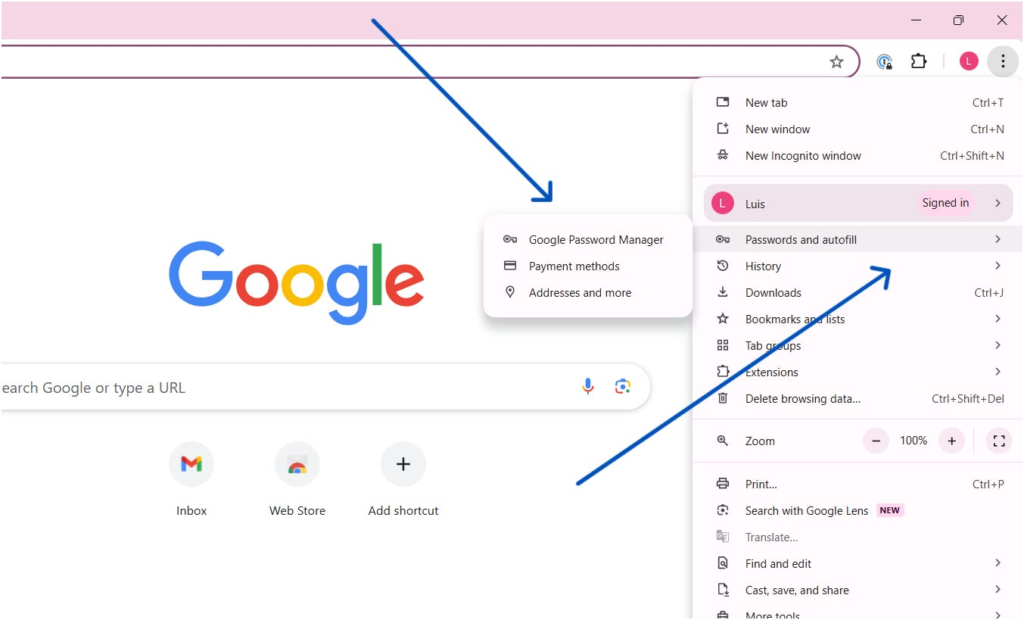
If you’re immersed in the Google ecosystem, you’ve likely used the password manager that’s baked into their Chrome browser. With its seamless integration with Chrome, you may have dozens of passwords stored and saved within Google’s flavor of password management. While it’s undoubtedly convenient, it may not be the best overall solution to securely store your login details. For one, leaving all your passwords here can be risky — especially if your Google account gets compromised. It also lacks extra security features commonly found in other password manager services, like having a robust folder system or data breach scanning. In this article, I will show you how to remove your saved passwords in Chrome and offer alternatives in its place. NordPass Employees per Company Size Micro (0-49), Small (50-249), Medium (250-999), Large (1,000-4,999), Enterprise (5,000+) Micro (0-49 Employees), Small (50-249 Employees), Medium (250-999 Employees), Large (1,000-4,999 Employees), Enterprise (5,000+ Employees) Micro, Small, Medium, Large, Enterprise Features Activity Log, Business Admin Panel for user management, Company-wide settings, and more Dashlane Employees per Company Size Micro (0-49), Small (50-249), Medium (250-999), Large (1,000-4,999), Enterprise (5,000+) Micro (0-49 Employees), Small (50-249 Employees), Medium (250-999 Employees), Large (1,000-4,999 Employees), Enterprise (5,000+ Employees) Micro, Small, Medium, Large, Enterprise Features Automated Provisioning Scalefusion Single Sign-On Employees per Company Size Micro (0-49), Small (50-249), Medium (250-999), Large (1,000-4,999), Enterprise (5,000+) Any Company Size Any Company Size Features Access Management, Conditional Access, Credential Management, and more How to remove your passwords saved in Chrome 1. Navigate to the Google Password Manager service. Google Password Manager is the name of the password management service integrated within the Chrome browser. Unlike other password managers with dedicated desktop apps and browser extensions, Google Password Manager can be accessed directly through the Chrome browser. To go to the Google Password Manager, follow these steps: Open the three-dot menu on the right side of your Chrome browser. Hover over the Passwords and autofill button found below your Google Account name. Click Google Password Manager. Accessing Google Password Manager in the Chrome sidebar. Image: Luis Millares You can also open Google Password Manager by using the Chrome address bar. To do so, simply type “passwords” or “manage passwords” in the address bar and click “Manage Passwords.” Navigating to the password manager using the address bar. Image: Luis Millares Either method will work as both ways will redirect you to the Google Password Manager page. 2. Choose the password you want to remove. Once you’re in Google Password Manager, you’ll see all your saved passwords listed out front and center. Google typically organizes your saved credentials depending on the account or service used. At this stage, you do the following: Choose which login credential you want to be removed. Click on your chosen password or press the arrow found on the right side of that login. My Amazon login that’s saved in Chrome. Image: Luis Millares For the purposes of this tutorial, I’ll be removing the Amazon login details and passwords I have saved in my test account. Selecting my Amazon login details. Image: Luis Millares 3. Click the delete button within the password menu. After you select the password, it will show you the full details you have saved to that account. This includes the password itself, the username you have saved, and any notes you may have added about that specific account. From this page, you can now choose to either Edit or Delete the password. Click Delete. Deleting my Amazon login credentials saved in Chrome. Image: Luis Millares After clicking Delete, you’ve done it! You have now officially removed a saved password in Chrome and the Google Password Manager. How do I remove all my saved passwords in Chrome? If you want to delete all your logins and passwords in Chrome without going through them individually, Google Password Manager has a “delete all” button that can do so with a single click. To use it, follow these steps: Navigate to the Google Password Manager. On the left sidebar, click Settings. Look for “Delete all Google Password Manager data.” Select “Delete data.” Deleting all data within the Google Password Manager. Image: Luis Millares As a reminder, clicking this option will permanently remove all the data you have stored in Google Password Manager. This includes your passwords, usernames, passkeys, and all other items. With this, I strongly recommend exporting and migrating all your saved data and passwords first before moving forward. Below is a tutorial on how to do so. How to export saved passwords in Chrome Exporting and downloading your saved passwords in Google Password Manager follows similar steps as using the Delete all button to remove all saved passwords with one click. Here is the process: Navigate to the Google Password Manager. On the left sidebar, click Settings. Look for “Export passwords” Select “Download file.” Choose where you want your data to be saved. Click Save. Exporting passwords saved in Chrome. Image: Luis Millares At this point, you’re now safe to remove all your saved passwords in Chrome and store your credentials wherever you see fit. SEE: Securing Linux Policy (TechRepublic Premium) Should you save passwords in Chrome in the first place? While the Google Password Manager provides basic protection for your passwords, it’s very basic compared to other password managers. Full-fledged password managers have more extensive multifactor authentication options, provide better support for browsers and devices aside from Chrome, and pack a bunch more security features like secure password sharing, password audits, and password health reports. To be clear, using Google Password Manager is better than not using a password manager at all. It conveniently saves all your passwords right from the browser and encourages you to use strong passwords with its password generator. However, because it is more of an add-on service to Chrome, you won’t get as comprehensive a feature set as providers offering dedicated password management services. There is also the concern of having a larger attack surface, with it being a service tied to users’ Google

How to Remove Your Saved Passwords in Chrome Read More »

Zero Trust security, why it’s essential In today’s threat landscape

Coined in 2010 by Forrester Research, the term “zero trust” has long been hijacked by security vendors eager to take advantage of the hype that surrounds the concept. Today, it’s so overused and misused that many see it as a meaningless buzzword—but that’s far from the truth. In fact, its widespread misappropriation demonstrates the power of zero trust security. Why else would countless vendors try to capitalize on it? As they say, imitation is the sincerest form of flattery. Zero trust is not a mere label. Rather, zero trust is an architecture—though you’ll also hear of a zero trust methodology, framework, paradigm, and infrastructure—and it’s based on the idea of zero implicit trust, meaning no one should be trusted by default. The key zero trust principle of least-privileged access says a user should be given access only to a specific IT resource the user is authorized to access, at the moment that user needs it, and nothing more. Hence the zero trust maxim, “never trust, always verify.” As a networking and security strategy, zero trust stands in stark contrast to traditional, network-centric, perimeter-based architectures built with firewalls and VPNs, which involve excessive permissions and increase cyber risk. To learn about their weaknesses in more detail, you can read this ebook. The main point is this: you cannot do zero trust with firewall- and VPN-centric architectures. Those approaches were not designed for today’s world or its sophisticated cyberthreats, and that is why zero trust is now key for cybersecurity. So, what sets zero trust apart and makes it a good fit for modern organizations? Not all segmentation is equal Lateral movement is a step in the attack chain that occurs when a threat makes it past an organization’s defenses and onto the network, where it moves across connected apps and expands the reach of the breach. This is an inherent weakness of perimeter-based architectures, which connect users to the network as a whole, giving them wide access to the resources therein. The solutions to this problem are often assumed to be network segmentation and microsegmentation, whereby the network and its contents are split into smaller segments that are separated by (fire)walls. But this strategy is complex and expensive to set up and maintain, and tries to lessen a symptom of yesterday’s architectures without solving the underlying problems: the architectures themselves. The actual solution is zero trust segmentation. A zero trust architecture connects users directly to authorized apps in a one-to-one fashion—nobody receives access to the network as a whole. As a result, the potential for lateral threat movement is eliminated, along with complexity and cost. Plenty of people hear “zero trust” and assume it’s the same as zero trust network access (ZTNA). But ZTNA is a specific solution, not an architecture. What ZTNA does, despite its inaccurate naming convention, is provide users with zero trust access directly to private apps hosted in data centers and private clouds—it does not give access to the network. ZTNA is certainly a key part of any platform providing zero trust architecture, but it is not the whole story. Users access more than private applications alone. They also access the web, SaaS apps, and other IT resources across a variety of environments. Beyond that, it’s not just users that need secure access. There are also workloads, IoT and OT devices, and B2B partners that regularly connect to IT resources. As such, having a complete zero trust architecture means securing any of these entities as they access any IT resource. This is why one will often hear the analogy of an intelligent switchboard that provides secure any-to-any connectivity in a one-to-one fashion.  From the moment we are handed our first devices, we are conditioned to see identity authentication as the standard for cybersecurity. That typically carries through to conversations about identity and access management (IAM), where verifying user identity is seen as the ideal means of determining whether someone should be granted access to a resource. But identity alone is not enough—even if it involves consideration of user group. There are two reasons for this. First, users’ identities can be stolen, as evinced by countless breaches involving the theft of VPN credentials. Second, users who are who they say they are can still engage in malicious or careless behavior that exposes organizations to cyberattacks and data loss. Instead of sticking to this risky status quo, zero trust uses context to assess risk and govern access. That does include identity (which is a core part of zero trust architecture), but it goes far beyond it to consider other variables like device posture, destination and content risk, user behavior, and more. As an added point, this contextual analysis typically requires a heavy dose of AI/ML.  Zero trust architecture stops cyberattacks in four key ways (some of which we’ve already mentioned): Zero trust eliminates firewalls, VPNs, and their public IP addresses, which are attractive targets for cyberattackers. Instead, apps are hidden behind a zero trust cloud, eliminating the attack surface. In other words, inbound connections are replaced with inside-out connections.  Zero trust prevents compromise through context-aware policies and, unlike hardware and virtual appliances, a high-performance cloud with the scalability necessary to inspect encrypted traffic (where most threats hide (but more on that below (aren’t parentheses fun?))).  Zero trust gives direct-to-app connectivity rather than network access, preventing the potential for lateral movement across resources.  Zero trust stops data loss by, once again, inspecting encrypted traffic (where most data loss occurs), and protecting all modern data leakage paths, including SaaS app sharing, removable storage on endpoints, and a lot more. In addition to the above, a fully featured zero trust platform should provide cyberthreat protection functionality like cloud sandboxing, DNS security, browser isolation, and more. Similarly, it should provide data protection capabilities like SSPM, out-of-band CASB, EDM, and more. To dive a bit deeper into something alluded to above, zero trust is a cloud native architecture. That is, it cannot be achieved merely by deploying another appliance in a data center

Zero Trust security, why it’s essential In today’s threat landscape Read More »

Willkie-Led Defense Firm Karman Prices Upsized $506M IPO

By Tom Zanki ( February 13, 2025, 12:01 PM EST) — Shares of Karman Holdings Inc. soared in debut trading Thursday after the defense and space systems firm priced an upsized $506 million above its marketed range, raising money for Karman and its private equity shareholders, represented by Willkie Farr & Gallagher LLP and underwriters’ counsel Latham & Watkins LLP…. Law360 is on it, so you are, too. A Law360 subscription puts you at the center of fast-moving legal issues, trends and developments so you can act with speed and confidence. Over 200 articles are published daily across more than 60 topics, industries, practice areas and jurisdictions. A Law360 subscription includes features such as Daily newsletters Expert analysis Mobile app Advanced search Judge information Real-time alerts 450K+ searchable archived articles And more! Experience Law360 today with a free 7-day trial. source

Willkie-Led Defense Firm Karman Prices Upsized $506M IPO Read More »

Why The DOJ Is Worried About Networking Innovation And What Paths Lie Ahead For HPE And Juniper

On January 30, 2025, the US Department of Justice (DOJ) moved to block the acquisition of Juniper by HPE. The DOJ is concerned about 60% of the wireless LAN (WLAN) market being occupied by two vendors (HPE and Cisco) and that it would stifle any innovation from other vendors that have single-digit market share. HPE and Juniper have started to contest this ruling with various counterpoints regarding WLAN competition, a classic “better together to fuel innovation” story, and a cautionary tale regarding network security, especially for the next generation of emerging technology. The DOJ is not wrong that sleepy, mature markets like IT networking struggle with innovation without the push from startups. Today, innovation in networking is hard to come by. It’s been a while (early 2000s) since the major networking players drove innovation in the market, such as the creation of new protocols and architectures to help networking organizations overcome technology challenges. Since the 2010s, there has been a chasm. Any innovation in this space has mainly come from two areas: 1) startups like Meraki, Mist, Nicira, and Viptela; and 2) large customers like Facebook and Google. The large cloud providers have been lighthouses for networking professionals in need of guidance on data center best practices, how to automate networks, and alternative network architectures. The enterprise Wi-Fi market hasn’t moved the needle much, either. Despite being around for 25 years, Wi-Fi solutions hardly do more than connect laptops and mobile phones in office settings and have real difficulty adapting to the new ways that users want to leverage other wireless protocols. Few attempts have been made to improve the management experience of supporting the various device types, including IoT devices. Few solutions support basic connections into Bluetooth, EnOcean, NearLink, Thread, and Zigbee technologies. To HPE Aruba’s credit, it has one of the strongest IoT-ready wireless solutions available, offering a strong smart office and retail portfolio featuring AI security insights, edge computing solutions, and IoT data processing capabilities. However, much of this capability came from the innovation under past Aruba leadership/visionaries, Dominic Orr and Keerti Melkote. And that’s just WLAN. This lack of innovation is systemic across the entire IT networking world. The biggest gap is at the edge (manufacturing plants, stadiums, stores, aircrafts, etc.), where nontraditional devices need connectivity. With over 100 billion IoT devices, the market is vast, driven by new applications, devices, security needs, and hardware requirements. Networking at the edge faces significant challenges, such as wireless interference and troubleshooting in distribution centers. The industry needs business-optimized networks (BON) with verticalized solutions. Where does that leave us? The IT networking world needs a hero: someone with the resources and the will to revolutionize the industry. Realistically, that isn’t going to come from a tiny startup. But the big players have been focused on market share, marketing, and margins. Change will require true leadership. Will the DOJ’s action to block the Juniper acquisition save innovation in networking? No. Would the acquisition unlock new innovation? Unlikely. But we’d love to be wrong (see below). Why is it hard to imagine this rosy future? Every major public technology company struggles to fund revolutionary innovation when there are shareholders to satisfy. Realistically, efficiencies gained from a combined portfolio/organization largely go to shareholders, not to fund new organic innovation. And it’s far easier to justify innovation via one-time acquisition costs rather than an ongoing stream of unrealized innovation. Ultimately, either future could hold good news for customers if they are put front and center. Let’s look ahead at the possible outcomes and what each path could entail: Scenario 1: HPE and Juniper remain separate HPE’s broader portfolio paired with its Aruba footprint has a real opportunity to be an edge networking innovator that creates verticalized easy-to-use solutions. In a time when almost every vendor is claiming to have cloud-native, AI-driven platform solutions, HPE is the only networking vendor that has the resources and portfolio today — such as compute, multilayer stack, storage, and software — to put together an edge, IoT, and networking solution to deliver a BON solution for retail and other adjacent verticals, such as hospitality. No one else is making big bets, turning their backs on generic technology providers, and choosing a few verticals to go after. This could be HPE’s moment to reclaim its innovator culture of yesteryear to truly own edge and network verticalization. Juniper’s technology and executive team are ahead of the game with its an AI-driven networking platform, Mist, that unifies the management and monitoring across various networking and security components. Mist innovation is how Juniper grew its WLAN market share so quickly over a short period of time and posed an issue for the competition, including HPE. With more investments, Juniper can continue to disrupt the management of data center and campus networking market with its Mist leadership — under Bob Friday and Sujai Hajela — and Marvis AI solution. As such, Juniper would create a businesswide networking fabric solution, which is essential for the future of networking. Looking forward, the company can expand on its networking platform by seamlessly integrating security services, with Marvis as its foundation to automate the secure networking platform. At this stage, Juniper would just be running up against Extreme’s networking platform, its version of a secure businesswide networking fabric. Cisco, Huawei, and others would be hard-pressed to match Extreme’s and Juniper’s platforms. Scenario 2: HPE acquires Juniper A combined organization can take the superpowers from both groups to create a dominant force in IT networking; but in practice, it’s too tempting to focus on fast cash for shareholders with the greater leadership from the acquired party choosing to quickly move on as soon as their contract terms allow. To position a combined HPE/Juniper for success, Juniper leadership should take the helm of innovative progress across its portfolio to ensure products like Mist don’t get stifled as the engineers integrate into the Aruba portfolio (Axis, ClearPass, Cape Networks, Silver Peak, etc.). There will likely be some portfolio rationalization.

Why The DOJ Is Worried About Networking Innovation And What Paths Lie Ahead For HPE And Juniper Read More »

‘Personalized, unrestricted’ AI lab Nous Research launches first toggle-on reasoning model: DeepHermes-3

Join our daily and weekly newsletters for the latest updates and exclusive content on industry-leading AI coverage. Learn More AI reasoning models — those that produce “chains-of-thought” (CoT) in text and reflect on their own analysis to try and catch errors midstream before outputting a response — are all the rage now thanks to the likes of DeepSeek and OpenAI’s “o” series. Still, it’s pretty incredible to me the speed at which the reasoning model approach has spread across the AI industry, with this week’s announcement that there’s yet another new model to try, this one from the mysterious yet laudably principled Nous Research collective of engineers, whose entire mission since launching in New York City in 2023 has been to make “personalized, unrestricted” AI models — often by taking and fine-tuning or retraining open-source models such as Meta’s Llama series and those from French startup Mistral. As posted on the Nous Research account on X and in the firm’s Discord channel, this new open reasoning model is called “DeepHermes-3 Preview,” and is described as an “LLM [large language model] that unifies reasoning and intuitive language model capabilities,” and allows the user to switch at will between longer reasoning processes and shorter, faster, less computationally demanding responses. It’s an 8-billion parameter (settings count) variant of Hermes 3, itself a variant of Meta’s Llama released by Nous back in August 2024. Sample exchanges have shown that it could enter into metacognition-like displays of thinking about itself and the role of AI compared to human consciousness, trigging something approaching an existential crisis in the model’s outputs. Users can download the full model code on HuggingFace and a version that’s been quantized (reduced bit count) and saved in the GPT-generated unified format (GGUF), which is designed to run model inferences (the actual production build, as opposed to training) on consumer-grade PCs and servers. Nous today wrote that its researchers “hope our unique approach to user controlled, toggleable reasoning mode furthers our mission of giving those who use DeepHermes more steerability for whatever need they have.” Building on Hermes 3: The data and training approach DeepHermes-3 builds on the Hermes 3, a meticulously curated multi-domain dataset that Nous Research developed for the broader Hermes 3 series. According to the Hermes 3 Technical Report released in August, this dataset is composed of approximately 390 million tokens spanning diverse instructional and reasoning-based domains. The dataset is broken down into the following key categories: General instructions (60.6%): Broad, open-ended prompts similar to those found in general-purpose AI chat models. Domain expert data (12.8%): Specialized knowledge in fields like science, law and engineering. Mathematics (6.7%): Advanced problem-solving datasets aimed at improving numerical and logical reasoning. Roleplaying and creative writing (6.1%): Data designed to enhance storytelling and simulated dialogue. Coding and software development (4.5%): Code generation and debugging tasks. Tool use, agentic reasoning and retrieval-augmented generation (RAG) (4.3%): Training on function calling, planning and knowledge retrieval. Content generation (3.0%): Writing, summarization and structured output tasks. Steering and alignment (2.5%): Data focused on making the model highly steerable and responsive to user prompts. In addition, the pseudonymous Nous Research team member @Teknium (@Teknium1 on X) wrote in response to a user of the company’s Discord server that the model was trained on “1M non cots and 150K cots,” or 1 million non-CoT outputs and 150,000 CoT outputs. This data mixture supports DeepHermes-3’s unique ability to toggle between intuitive responses and deep, structured reasoning, a key feature that distinguishes it from other LLMs. How toggleable reasoning mode works DeepHermes-3 allows users to control its reasoning depth using a system prompt. The user must enter the following text before a prompt to “toggle on” the model’s reasoning mode: “You are a deep thinking AI, you may use extremely long chains of thought to deeply consider the problem and deliberate with yourself via systematic reasoning processes to help come to a correct solution prior to answering. You should enclose your thoughts and internal monologue inside tags, and then provide your solution or response to the problem.“ When reasoning mode is enabled, the model processes information in long CoTs, allowing it to deliberate systematically before generating an answer. This is achieved using the <think></think> tags, where the model’s internal monologue is structured before presenting a final solution. In standard response mode, the model operates more like a traditional AI chatbot, providing quicker, intuition-based responses without deep logical processing. Performance insights and community feedback Early benchmarking and community testing have provided key insights into DeepHermes-3’s capabilities: Mathematical reasoning: DeepHermes-3 scores 67% on MATH benchmarks, compared to 89.1% for DeepSeek’s R1-distilled model. While DeepSeek outperforms it in pure math tasks, Nous Research positions DeepHermes-3 as a more generalist model with broader conversational and reasoning skills. Multi-turn conversations: Some testers report that reasoning mode activates correctly on the first response, but may fail to persist in extended conversations. Community members suggest enforcing <think>n at the start of each response, a method also used in DeepSeek-R1. Function calling: DeepHermes-3 supports tool use, although it was not explicitly trained to integrate reasoning mode and function calling simultaneously. Some users report that while combining both features improves accuracy in executing tools, results remain inconsistent. Nous Research is actively gathering user feedback to refine reasoning persistence and improve multi-turn interactions. Deployment and hardware performance DeepHermes-3 is available for testing on Hugging Face, with GGUF quantized versions optimized for low-power hardware. The model is compatible with vLLM for inference and uses Llama-Chat format for multi-turn dialogue. One user reported a processing speed of 28.98 tokens per second on a MacBook Pro M4 Max, demonstrating that the model can run efficiently on consumer hardware. DeepHermes-3 is based on Meta’s Llama 3 model and is governed by the Meta Llama 3 Community License. While the model is freely available for use, modification and redistribution, certain conditions apply: Redistribution: Any derivative models or deployments must include the original license and prominently display “Built with Meta Llama 3.” Restrictions on model training: Users cannot use

‘Personalized, unrestricted’ AI lab Nous Research launches first toggle-on reasoning model: DeepHermes-3 Read More »

Texas 911 Agencies Back GPS Alternative At FCC

By Jared Foretek ( February 14, 2025, 6:36 PM EST) — A coalition of emergency response agencies in Texas is urging the Federal Communications Commission to look beyond traditional GPS technology and explore ways to improve indoor location signaling for emergency calls, supporting a tech company’s bid for an exclusive spectrum license to roll out next-generation navigation and positioning technology…. Law360 is on it, so you are, too. A Law360 subscription puts you at the center of fast-moving legal issues, trends and developments so you can act with speed and confidence. Over 200 articles are published daily across more than 60 topics, industries, practice areas and jurisdictions. A Law360 subscription includes features such as Daily newsletters Expert analysis Mobile app Advanced search Judge information Real-time alerts 450K+ searchable archived articles And more! Experience Law360 today with a free 7-day trial. source

Texas 911 Agencies Back GPS Alternative At FCC Read More »

The Essential Role Of Process In Executing Your B2B Strategy

B2B organizations often find themselves at a crossroads between strategy formulation and strategy execution. The harsh reality is that many fail to transform their well-crafted strategies into tangible results, a disconnect stemming from a fundamental oversight: the underestimation of process as a critical lever for execution. Process is not merely a conduit for efficiency; it’s the backbone of converting strategy into results. Without a robust process in place to develop and execute strategy, reaching your goals becomes a herculean task. This necessity becomes even more pronounced when executing a customer-obsessed growth strategy in which the focus intensifies on delivering value at every customer touchpoint. Why do so many organizations falter in executing their strategies? The answer often lies in the gap between those who devise strategies and those tasked with implementing them. Many B2B companies possess a growth strategy, or at the very least, target revenue goals. Yet instead of focusing on aligning their strategy with how they operate, they quickly turn to buying new technology or reorganizing resources, thinking that it will solve their problems. Process matters immensely. It has a direct impact on the customers’ experiences, whether the process is internally focused or is a customer-facing activity. Processes accelerate an organization’s time to market, allow organizations to adapt to market changes, lead to predictable outcomes, enhance efficiency, reduce costs, and increase profitability. In essence, process is the engine that drives growth, not just by optimizing performance but by enabling companies to be agile and responsive in a dynamic market environment. Follow these steps to adopt process optimization as the required tool used to execute your strategy: Articulate the business challenge. Clearly define what you are trying to solve for; assess the impact, importance, and urgency of the challenge; and sell the business case that justifies the resources necessary to deliver the value. Connect root causes to potential solutions. Understand why the challenge exists and how it can be addressed. This often involves linking multiple processes — planning, preparation, and production — to craft a comprehensive solution. Take action. Move beyond planning and preparation to actual execution. Ensure that you have the processes sequenced to minimize rework and costs, allocate resources effectively, and measure baseline performance to gauge the impact of your efforts. Allow the change to be progressive. Processes are critical to driving a culture of alignment and collaboration. Conducting periodic retrospectives, creating an iterative feedback loop with stakeholders, and breaking down your strategy into manageable, agile pieces all helps to maintain alignment and enable progression toward business-objective achievement. Understand, however, that perfection is often the enemy of progress. Finally, don’t forget to celebrate wins, both big and small, along the way! Providing an avenue for team members to acknowledge their successes fosters a culture of recognition and motivates teams to strive for continuous improvement. It’s a vital component of maintaining momentum and reinforcing the value of the processes that have been put in place. The significance of process in strategy execution cannot be overstated. It’s the linchpin that connects strategic planning with tangible outcomes. By investing in and meticulously designing interconnected processes, organizations can not only anticipate but also adapt to market changes, ultimately driving sustainable growth. The journey from strategy to execution may be complex, but with a robust process as your guide, achieving your B2B goals is not just possible — it’s probable. Join me at the upcoming B2B Summit North America event happening March 31–April 3 in Phoenix, Arizona, and digitally. B2B Summit is an exceptional opportunity to delve deeper into how process turns ambiguity into action. It’s a platform to learn how to build a customer-obsessed growth strategy, execute that strategy effectively, and manage the change that accompanies its execution. B2B Summit will also showcase real B2B success stories, providing invaluable insights into how companies have navigated their own growth journeys. I hope to see you there! source

The Essential Role Of Process In Executing Your B2B Strategy Read More »

A Complete Guide to Sprint Planning Meetings

When tackling a large project, it is essential for teams to come together to strategize and align on their upcoming work. Instead of diving in without a plan, sprint planning ensures every team member knows their role, what to expect, and how to move forward together within the broader context of project management. 1 monday.com Employees per Company Size Micro (0-49), Small (50-249), Medium (250-999), Large (1,000-4,999), Enterprise (5,000+) Any Company Size Any Company Size Features Agile Development, Analytics / Reports, API, and more 2 Quickbase Employees per Company Size Micro (0-49), Small (50-249), Medium (250-999), Large (1,000-4,999), Enterprise (5,000+) Small (50-249 Employees), Medium (250-999 Employees), Large (1,000-4,999 Employees), Enterprise (5,000+ Employees) Small, Medium, Large, Enterprise Features Agile Development, Analytics / Reports, API, and more 3 Accelo Employees per Company Size Micro (0-49), Small (50-249), Medium (250-999), Large (1,000-4,999), Enterprise (5,000+) Small (50-249 Employees), Medium (250-999 Employees), Large (1,000-4,999 Employees) Small, Medium, Large Features Analytics / Reports, API, Billing / Invoicing, and more What is sprint planning? Sprint planning is an essential event within the scrum framework that officially starts the sprint. It provides the entire scrum team a platform to collaborate, define their goals, and decide which tasks to prioritize. This planning session is held at the beginning of each sprint, typically lasting 1–4 weeks, depending on the team’s chosen sprint cycle. It ensures that all team members are on the same page, fostering a shared commitment to the sprint’s success. During sprint planning, teams establish what can be delivered, how the work will be done, and why this work is valuable. The process also includes setting a clear sprint goal that aligns with the overall product vision. Additionally, it involves identifying who will be responsible for each task, reviewing team capacity, and assessing the inputs such as the product backlog. By thoroughly addressing potential challenges and aligning priorities, the team ensures they have a realistic and actionable plan that drives both short-term success and long-term progress. The above happens in meetings where teams get to review and prioritize the product backlog and make sure that everyone understands their roles and responsibilities. These meetings, known as sprint planning meetings, help foster a shared understanding of the work required to achieve the sprint’s objectives and drive cohesive collaboration throughout the sprint, especially when agile project management software tools are in use. What is a sprint planning meeting? A sprint planning meeting serves as the kickoff point for every sprint. It sets the tone for collaboration and alignment across the scrum team, which includes the product owner, scrum master, and developers. During the meeting, the product owner provides an updated product backlog, highlighting the most important tasks. The scrum master facilitates the meeting to ensure the team can effectively plan the sprint. The primary purpose of the sprint planning meeting is to define the sprint goal and clarify the tasks required to achieve that goal. It also serves as a forum for discussing capacity, constraints, and potential blockers that could arise during the sprint. This alignment helps teams stay focused on delivering high-quality work while meeting deadlines. Some sprint planning meetings might also address dependencies between teams, technical constraints, or unforeseen obstacles, making sure the plan is as detailed and realistic as possible. How to prepare for a sprint planning meeting Proper preparation is key to the success of a sprint planning meeting—especially when utilizing project management software to streamline communication and track progress. Without preparation, the meeting can be unproductive, which yields a poorly planned sprint. The product owner plays a critical role in preparing for the meeting, particularly in refining the product backlog ahead of time. Here’s what preparation involves: Backlog grooming: The product owner reviews the product backlog. This is done by removing outdated tasks, adding new user stories based on customer feedback, and breaking down larger user stories into smaller, more manageable pieces. Each item is then assigned story points and prioritized based on importance. Understanding team capacity: Know exactly how much work your team can take on during the sprint. Before the meeting, identify any upcoming vacations, non-project tasks, or events that could affect your team’s capacity. Make sure every member’s availability is clear so you can plan realistically and avoid overcommitting. This step ensures that the workload is manageable, which helps the team remain motivated and focused throughout the sprint. Clearing dependencies: Identify and resolve external dependencies ahead of time. Whether these involve another team or third-party providers, ensure they are addressed before sprint planning. Clearing dependencies early helps to prevent potential blockers and ensures that tasks can proceed smoothly once the sprint starts. Effective preparation means that the team can dive into the high-priority work with clarity and confidence, making the sprint planning meeting as productive as possible. How to run a sprint planning meeting Structure and clarity are both key for a successful sprint planning meeting. The scrum master leads the meeting, making sure it stays on track and all necessary aspects are covered. Below are the typical steps to expect during a sprint planning meeting: Establish team availability Start by assessing everyone’s availability for the sprint. Go through holidays, ongoing projects, or other factors that might reduce capacity. Get clear on who is available and when. You need this information to make realistic commitments. Set the sprint goal Define a clear sprint goal. The product owner, in collaboration with the team, should articulate what success looks like for this sprint. This goal is a guiding star that helps the team stay focused on what really matters and ignore distractions. Make sure the goal is specific, achievable, and aligns with the broader project objectives. Review and select backlog items Go through the product backlog and select the tasks that will help achieve the sprint goal. Estimate the effort required and prioritize the items based on the team’s capacity. See to it that everyone understands why these tasks are important and how they contribute to the sprint goal. Be realistic—determine how much work

A Complete Guide to Sprint Planning Meetings Read More »