OpenAI CEO Sam Altman shares plans to bring o3 Deep Research agent to free and ChatGPT Plus users

Join our daily and weekly newsletters for the latest updates and exclusive content on industry-leading AI coverage. Learn More Earlier this month, OpenAI debuted a new AI agent powered by its upcoming full o3 reasoning AI model called “Deep Research.” As with Google’s Gemini-powered Deep Research agent released late last year, the idea behind OpenAI’s Deep Research is to provide a largely autonomous assistant that can scour the web and other digital scholarly sources for information about a topic or problem. The agent then compiles it all into a neat report while the user goes about their business in other tabs, or leaving their computer behind entirely, providing the final report several minutes or even hours later with a notification. Yet unlike Google’s Deep Research, the value of the OpenAi o3 Deep Research was immediately apparent to many outside the AI community, including economist Tyler Cowen, who called it “amazing.” OpenAI provides more democratic access While initially unveiled as a product limited to ChatGPT Pro subscribers ($200 per month), OpenAI said at the time it would move its subscription tiers down to the lower-priced ChatGPT Plus ($20 per month) and Team ($30 per month) as well as Edu and Enterprise (variable pricing) plans. OpenAI co-founder and CEO Sam Altman clarified more of the company’s current thinking around making o3 Deep Research more widely available, quote-posting another user on X, @seconds_0, who wrote: “ok, OAI Deep Research is worth probably $1,000 a month to me. This is utterly transformative to how my brain engages with the world. I’m beyond in love and a little in awe.” Altman responded: “I think we are going to initially offer 10 uses per month for ChatGPT plus and 2 per month in the free tier, with the intent to scale these up over time. It probably is worth $1,000 a month to some users but I’m excited to see what everyone does with it!” While 10 users per month for the ChatGPT Plus tier seems workable, to me two uses per month seems almost trivial. I guess if you’re a free user, the hope is to hook you with how well it works and encourage you to upgrade to a higher cost plan, pulling you up the funnel — or whatever salespeople like to say. Still, it is helpful to learn what OpenAI is thinking when it comes to the availability of its powerful new products and agents. If you’re a free ChatGPT user, you best make sure your 2 uses per month of Deep Research are for queries your really want or need answered. And, compared to Deep Research — which is free (although powered by last generation’s Gemini 1.5 Pro model — OpenAI better hope that its o3 Deep Research is worth the price. source

OpenAI CEO Sam Altman shares plans to bring o3 Deep Research agent to free and ChatGPT Plus users Read More »

AI's Achilles heel: Securing the next revolution

Artificial intelligence (AI)-enabled systems are driving a new era of business transformation, revolutionizing industries through prescriptive analytics, personalized customer experiences and process automation. From manufacturing to healthcare and finance to defense, AI enhances efficiency, decision-making and operational agility, providing organizations a competitive edge in an increasingly data-driven world. Its processing of vast datasets enables supply chain precision, life-saving diagnostics and hyper-personalized consumer interactions, fostering scalability and innovation.  However, as AI adoption accelerates, organizations face rising threats from adversarial attacks, data poisoning, algorithmic bias and regulatory uncertainties. Without robust security and governance frameworks, unsecured AI systems can erode stakeholder trust, disrupt operations and expose businesses to compliance and reputational risks.  Senior executives are challenged with securing AI, aligning initiatives with governance frameworks and fortifying business resilience. Organizations can unlock AI’s full potential by proactively addressing security, ethics and operational challenges while ensuring transparency, reliability and long-term sustainability.  source

AI's Achilles heel: Securing the next revolution Read More »

富德拳館多年來培養拳擊運動人才

(相右2)富德拳館創辦人江富德師傅。 富德拳館昨天舉行新年春茗,筆者發現,打拳是一項很好的運動,值得推廣。富德拳館成立40多年,有30多間拳舘,遍佈中港澳台,學生數以十萬計。創辦人江富德師傅,堪稱香港武術界的泰斗。江師傅是首位華人挑戰世界頂級拳王,首個華人最高身價拳手,首位華人獲取泰拳錦標賽金腰帶。 江師傅年屆70歲,每天仍堅持練功兩三小時,從未間斷。每當在大賽前,還親自督操其下弟子。當弟子在擂台上比賽時,還不時在台下吶喊教路,恨不得自己上台比賽,徒孫見有師公助威鼓勵,也打得特別醒神。他講述自己開這麼多拳館,並不是為賺多一點錢,只是希望能養活年青拳手,讓他們專注於訓練,在比賽上獲取好成績;也希望發掘多一些年輕人,加以栽培。他說:「運動員要有成績,必需有安穩的生活,才能專注於運動事業。搏擊運動員要成功,還需具備武德。一個門派要代代相傳,更必需人才濟濟,文武兼備,仁德並重。」 有些學生只是玩下搏擊,鍛煉身體;有些則代表富德比賽,爭取獎牌。他們有的選擇「學成下山」自立門户開設拳館;有的在各行各業工作;有的則留在富德一邊做教練,一邊比賽。學生之中,有的是父子兵,兩代也在富德練拳;有的是夫妻檔;更多的是兄弟班。無論他(她)們是留在富德,還是隱伏於各行各業中,當有比賽時,都義不容辭,担當不同崗位包括工作人員、啦啦隊或觀眾等,為富德拳手打氣。 富德30多間拳館,就猶如潛藏於繁華鬧市中的少林寺,沒有豪華的装修,昂貴的器材。只有身體發出的汗水,練沙包的撞擊聲和教練們的火熱激情。 富德國際理事長Allen Yung文武兼備 (相右)富德國際搏擊聯盟理事長翁燦燐。 另外,富德國際搏擊聯盟理事長翁燦燐為紅人堂體育及娛樂集團及富德紅人堂創辦人,文從嶺南,武從富德。於20多歲成為會計師,曾任職於四大會計師行之一。八十年代後期創辦會計師樓,經常接觸社會不同階層,善於為企業出謀獻策,扭轉乾坤。也熱衷創作及中英文撰寫文章。 九十年代成為中小型企業總商會會長,經常出席電視及電台等節目,評論時事及經濟情況。於2000年回歸母校服務,加入嶺南教育機構及嶺南會所,服務至今。 現為Viu TV品牌故事節目擔任嘉賓主持及為中英文媒體包括The Standard, AM730, 明報及信報等撰寫文章。並是一本校園實體及網上版雜誌 《彩頁》之總編輯,為開拓學校及NGO市場之供應商提供更有效渠道。 他曾擔任多項公職包括香港中小型企業總商會會長、扶輪社社長、嶺南大學校董及中學校監等。現仍為幼稚園校監、富德國際搏擊聯盟理事長、香港城市大學課程顧問、嶺南教育機構及嶺南會所理事等。 LinkedIn Email Facebook Twitter WhatsApp source

富德拳館多年來培養拳擊運動人才 Read More »

Truist Checking Account Review: Fees, Perks & Features

Truist FDIC member is a traditional bank that offers three business checking accounts with no monthly maintenance fee options. It has two regular business banking accounts and one specialized nonprofit account that features unlimited cash deposits. Signing up for a higher-tier checking account gives you additional rewards. The higher your balances, the greater your benefits. In addition, you can earn cashback when using a debit card for purchases, making it worthwhile for business owners. Truist’s fast facts Our rating: 4.0 out of 5 Starting price: Free for basic business checking services. No monthly maintenance fees or minimum balance requirements. Key features for Truist’s business checking accounts No monthly fees. Offers total combined Transactions include deposits and deposited items, checks, ATM transactions, point-of-sale purchases, and ACH debits. transactions and free cash deposits Fee-free limits depend on the checking product. . Checking reward levels Dynamic Business Checking Debit card cash back. Integrates with QuickBooks and Zelle. Image: Truist Truist is known for its superb Community Business Checking account, which lets you save on standard banking fees. Its low-tier account, Simple Business Checking, provides an equally cost-saving feature by not charging monthly maintenance fees. Meanwhile, its Dynamic Business Checking allows businesses to make large cash deposits and benefit from more rewards based on balances. Let’s continue to explore Truist’s standout features, pricing structure, and how it compares to other business banking services. Truist reviews: What users think of Truist 1.8/5 Few Truist checking account reviews are available. Many users gave Truist low ratings, although some shared their positive customer service experiences with knowledgeable, customer-focused, and friendly bank representatives. Feedback was mostly about other Truist business banking products and services. Several complained that the bank was short-staffed, and calling the bank resulted in long wait times. Some also reported that Truist charges multiple overdraft fees and places long hold times on check deposits. Another claimed that only a small portion of the money in an account was reimbursed despite the charges made from a system integration and accessibility error. Truist’s pricing structure 3.96/5 Truist business accounts offer savings for businesses with low monthly transactions and great account benefits for companies with large transaction volumes. Under Community Business Checking, nonprofits can save on banking fees through its 225 free transactions, no monthly fee, and unlimited fee-free cash deposits. Truist’s Accounts: Simple Business Checking (basic tier): no monthly maintenance fees. Community Business Checking (nonprofit): no monthly maintenance fees. Dynamic Business Checking (higher-tier): $20; waivable $5,000 average relationship balance, which includes business checking, savings, money market account, and certificate of deposit (CD) and free for the first 65 days Waived with a $5,000 average combined balance, over three months, in a Truist business checking, savings, money market account, or CD . $100 opening deposit. Four free incoming domestic wires (Dynamic Business Checking). Unlimited fee-free cash deposits (Community Business Checking). Free integration with accounting software, QuickBooks, and Zelle. The higher-tier product, Dynamic Business Checking, offers more free transactions (500) and a higher cash deposit allowance ($25,000) than the basic tier, Simple Business Checking, which gives 50 free combined transactions and a monthly cash deposit allowance of $2,000. Truist’s key features 4.00/5 Each of Truist’s checking accounts offers standout features, such as no monthly fees for its basic and nonprofit checking accounts. This makes it a practical option for small businesses and civic organizations. Larger firms can also perform more transactions and cash deposits for free through Dynamic Business Checking. Additionally, Truist provides different reward levels for more discounts and reduced fees. Check the following key features that give Truist an edge over its competitors: Simple Business Checking Dynamic Business Checking Community Business Checking Monthly Fees None Waivable monthly fee. None Number of Free Transactions 50 total combined transactions 500 total combined transactions 225 total combined transactions Free Cash Deposits $2,000 $25,000 Unlimited ATM Fees $3 at domestic nonnetwork ATMs; $5 internationally First Check Order Discount $25 $50 $25 No monthly fees Unlike most business checking accounts from traditional providers with waiver conditions, Truist offers its basic tier and nonprofit account with no monthly maintenance fee. It leads to plenty of savings for small business owners just starting out and nonprofit organizations that want to reduce their account costs. Unlimited fee-free cash deposits Truist is our best overall bank for nonprofit organizations because you can deposit cash for free without limits. Charitable groups can focus on their mission and won’t need to worry about exceeding cash deposit limits. Checking reward levels Dynamic Business Checking has three tier reward levels: Core, Plus, and Preferred. Large companies with high balances across checking, savings, money market accounts, and CDs can benefit through discounts on merchant services and business loans, including reduced annual fees for a Delta SkyMiles Business Debit Card. Additional service benefits Dynamic Business Checking users can provide perks to employees through financial wellness training to support their staff’s financial learning. You can also get additional fraud protection to limit fraudulent incidents. Debit card cashback As a Truist business account holder, you can enroll in Truist deals, a free program providing cashback rewards when you use your business debit card for purchases at designated merchants. Some deals are available at Dunkin’, Subway, CVS, Chevron, Disney+, and more. Would our expert use Truist? 4.75/5 If you’re a small business owner with a transaction activity of less than 50 monthly, I recommend opening a starter checking account with Truist to save on monthly maintenance fees. Larger businesses with combined balances of up to $50,000 can sign up for a higher-tier account to maximize reward benefits. You can also make free cash deposits up to $25,000 monthly and will pay a small fee for every excess dollar. Nonprofits will consider the Truist Community Checking account cost-effective since no monthly maintenance fees are charged like the basic tier account. I also find the unlimited fee-free cash deposit feature convenient. Additionally, you get a high limit of free transactions (225) and will only pay 35 cents for each excess item. However, Truist business checking accounts

Truist Checking Account Review: Fees, Perks & Features Read More »

Who’s using AI the most? The Anthropic Economic Index breaks down the data

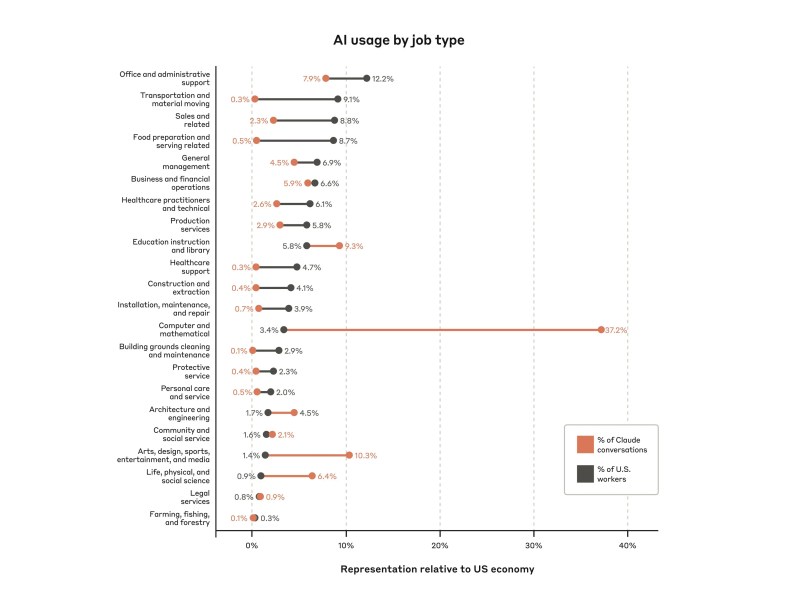
Join our daily and weekly newsletters for the latest updates and exclusive content on industry-leading AI coverage. Learn More AI is reshaping the modern workplace, but until now, its impact on individual tasks and occupations has been difficult to quantify. A new report from Anthropic, the AI startup behind Claude, offers a data-driven view of how businesses and professionals are integrating AI into their work. The Anthropic Economic Index, released today, provides a detailed analysis of AI usage across industries, drawing from millions of anonymized conversations with Claude, Anthropic’s AI assistant. The report finds that while AI is not yet broadly automating entire jobs, it is being widely used to augment specific tasks—especially in software development, technical writing and business analysis. “AI usage primarily concentrates in software development and writing tasks, which together account for nearly half of all total usage,” the report states. “However, usage of AI extends more broadly across the economy, with ~36% of occupations using AI for at least a quarter of their associated tasks.” Computer-related jobs dominate AI usage, while physical labor shows minimal adoption, according to Anthropic’s analysis. (Credit: Anthropic) Not just hype: Anthropic provide a ground-level view of AI adoption Unlike previous studies that have relied on expert predictions or self-reported surveys, Anthropic’s research is based on direct analysis of how workers are actually using AI. The company leveraged its privacy-preserving analysis tool Clio to examine more than four million user conversations with Claude. These interactions were then mapped to occupational categories from the U.S. Department of Labor’s O*NET database. The data suggests that AI is playing a significant role as a collaborative tool rather than simply serving as an automation engine. In fact, 57% of AI usage in the dataset involved “augmentation,” meaning AI was assisting workers rather than replacing them. This includes tasks such as brainstorming, refining ideas and checking work for accuracy. The remaining 43% of usage fell into the category of direct automation, where AI performed tasks with minimal human involvement. This balance between augmentation and automation is a crucial indicator of how businesses are deploying AI today. “We find that 57% of interactions show augmentative patterns (back-and-forth iteration on a task) while 43% suggest automation (fulfilling a request with minimal human involvement),” the report states. Workers are using AI more as a collaborator (57%) than as a replacement (43%), the study finds. (Credit: Anthropic) More partner than replacement: AI is boosting, not eliminating, jobs One of the report’s most striking conclusions is that AI is not rendering entire job roles obsolete. Instead, it is being adopted selectively, assisting with specific tasks rather than fully automating occupations. “Only ~4% of occupations exhibit AI usage for at least 75% of their tasks, suggesting the potential for deep task-level use in some roles,” the report notes. “More broadly, ~36% of occupations show usage in at least 25% of their tasks, indicating that AI has already begun to diffuse into task portfolios across a substantial portion of the workforce.” This selective adoption suggests that while AI is transforming work, it is not yet leading to widespread job displacement. Instead, professionals are using AI to enhance productivity, offload repetitive work and improve decision-making. The report identifies software engineering as the field with the highest AI adoption, accounting for 37.2% of the analyzed conversations. These interactions typically involved tasks like debugging code, modifying software and troubleshooting networks. The second-highest category of use was in creative and editorial work, including roles in media, marketing and content production (10.3% of queries). AI is widely used to draft and refine text, assist with research and generate ideas. However, AI usage was significantly lower in fields that require physical labor, such as healthcare, transportation and agriculture. For example, only 0.1% of analyzed conversations were related to farming, fishing and forestry tasks. This disparity highlights the current limitations of AI, which excels at text-based and analytical tasks but struggles with jobs that require hands-on work, manual dexterity or complex interpersonal interactions. AI’s wage divide: The surprising sweet spot for adoption One of the most intriguing findings of the report is that AI usage does not follow a simple pattern when correlated with wages. Rather than being concentrated in either low- or high-wage jobs, AI adoption peaks in the mid-to-high salary range. “AI use peaks in the upper quartile of wages but drops off at both extremes of the wage spectrum,” the report notes. “Most high-usage occupations clustered in the upper quartile correspond predominantly to software industry positions, while both very high-wage occupations (physicians) and low-wage positions (restaurant workers) demonstrate relatively low usage.” This means that AI is being adopted most aggressively in roles that require analytical and technical skills but not necessarily the highest levels of specialized expertise. It also raises important questions about whether AI will exacerbate or mitigate existing economic inequalities — particularly if lower-wage workers have less access to AI’s productivity-boosting benefits. AI adoption peaks among mid-salary jobs like computer programmers, with less usage among both low-wage and very high-wage positions. (Credit: Anthropic) What business leaders need to know as AI reshapes the workforce For technical decision-makers, the report provides a roadmap for where AI is likely to have the greatest near-term impact. The data suggests that businesses should focus on AI adoption in knowledge-based professions where augmentation, rather than outright replacement, is the dominant pattern. The report also provides an early warning for policymakers: While AI is not yet replacing entire jobs at scale, its increasing presence in high-value tasks could have a profound impact on workforce dynamics. “AI has already begun to diffuse into task portfolios across a substantial portion of the workforce,” the report states. “While our data reveals where AI is being used today, inferring long-term consequences from these early usage trends poses significant empirical challenges.” Anthropic has open-sourced the dataset behind its analysis, inviting researchers to further explore how AI is shaping the economy. A detailed look at how different professions are using AI, with software development leading adoption. (Credit:

Who’s using AI the most? The Anthropic Economic Index breaks down the data Read More »

What Is Square? How Does It Work & What Does It Do?

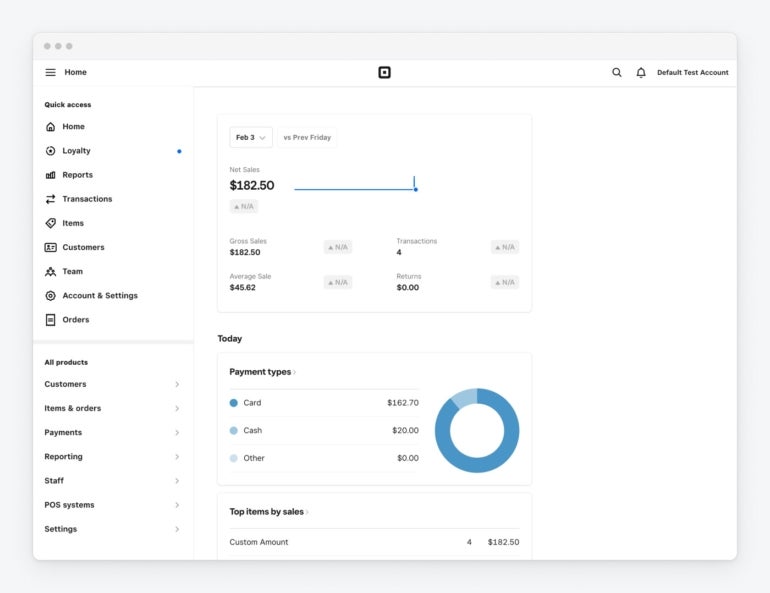
Key takeaways: Square is a pioneer in mobile payment technology. It came out with the first mobile card reader and has evolved into an ecosystem of business operations tools designed to serve businesses of all sizes. Square’s free pricing and flat-fee payment processing structure are its biggest advantages, providing an all-in-one solution for merchants, especially small businesses looking to find ways to keep operational costs low. Square Payments lets merchants accept a variety of payment methods, such as in-person, online, mobile, manual/keyed-in, invoiced, and recurring billing. Square is a widely popular and highly recommended point-of-sale (POS) solution by experts and real-world users alike. It has featured in a lot of our POS buyer’s guides, mainly owing to its price point, suite of robust features, and low-cost fees and hardware options. Read on to learn more about Square as I tackle how it works, what it does, and how much it costs. What is Square? Square is a trailblazer in mobile card and payment technology, having invented the first mobile card reader in 2009. Square didn’t require long-term contracts nor lengthy application or approval processes, and most of all, came with no fixed monthly costs and offered a free POS system. This innovation helped businesses take payments anywhere and completely changed the payment landscape in the retail industry. Today, Square is more than a payment processor — it has evolved into a business technology platform serving all kinds of businesses. The Square ecosystem allows businesses to sell anywhere, manage inventory, communicate with customers, book appointments, order online, and so much more. The Square ecosystem has more than 36 products, providing support and countless opportunities for any operation, from global chains to mom-and-pop shops. Given the incredible value Square provides and the numerous other tools besides payment processing it offers for free or at minimal costs, Square is the perfect payment solution for small businesses processing less than $120,000 per month. How does Square work? Square primarily lets small businesses process payments through credit cards, contactless payments, and ACH transfers. From this service, it then offers various tools within its ecosystem that seamlessly work together and provide a complete business solution. Essentially, Square can provide you with all the tools you need to run your business. Here are Square products available within its ecosystem: Payments: Mobile and in-store payments, hardware, vertical terminal, invoicing, chargeback and dispute management. Point-of-Sale (POS): Mobile and iPad apps, inventory tracking, reporting and analytics, customer and team management. Industry-specific POS: Retail (Square for Retail), food and beverage (Square for Restaurants), services (Square Appointments). Online ordering: E-commerce (Square Online). Business management: Payroll, email marketing, customer messaging (support), loyalty program. Banking: Checking account, savings account, debit card, small business loans. What you get with Square Here are all the features you get with a free Square account: POS Square POS software lets you process a variety of payment methods, links to all your products, syncs your inventory, tracks your customer data, team members, and more through a central Square dashboard. The view from the Square dashboard. Image: Square It enables you to accept the following payment methods: cash, check, vouchers; credit and debit cards; digital wallets, ACH transfers, gift cards, buy now, pay later (BNPL) through Afterpay; and peer-to-peer payments through CashApp. Square also supports the following payment services: mobile payments, in-store POS, online payment gateway, invoicing, recurring payments, virtual terminal, and the CBD program. Online Store When you sign up with Square, you also get a free online store. Called Square Online, it comes with an easy-to-use website builder and e-commerce platform that allows you to take orders online. What’s great about Square Online is that inventory automatically syncs with Square POS, allowing you to have real-time inventory tracking. The website builder interface of Square Online. Image: Square Square pricing Take a look at the associated fees with Square’s point-of-sale (POS, payment processing, and POS hardware. Square POS pricing Square POS software’s basic subscription is free, and any upgrades are billed monthly. The software works on Square hardware and mobile devices—iPad, iPhone, and Android devices. Related: Square payment processing fees Square’s biggest advantage over its competitors is its simple, flat-rate payment processing, with no monthly fees. This means that Square deducts a fixed percentage fee on successful payment transactions. Cash, cheque, vouchers, and other tenders: $0 In-person, mobile, and gift card payments: 2.6% + 10 cents per transaction Online payments: 2.9% + 30 cents per transaction Recurring billing and card-on-file transactions: 3.5% + 15 cents per transaction Keyed-in payments (virtual terminal) transactions: 3.5% + 15 cents per transaction ACH bank transfers: 1% with a $1 minimum transaction Invoiced payments: 3.3% + 30 cents per transaction Afterpay: 6% + 30 cents per transaction CBD program transactions: From 3.5% + 10 cents per transaction Chargeback fee: Waived up to $250/month Square POS hardware To accept in-person and mobile payments, Square offers various low-cost hardware options (interest-free installment plans are also available) to let you swipe, insert, or tap cards to complete a sale. All hardware listed below work on smartphones and iPads using Square’s free POS app. Square Reader for Magstripe: First free, additional reader $10 Square Reader for Contactless and Chip (2nd generation): $59 Square Terminal: $299 ($27/month with financing) Square has different mobile card readers. Image: Square Square Stand (2nd generation, USB-C): $149.00 ($14.00/mo with financing) Square Register: $799.00 ($39.00/mo with financing) Square offers hardware kits perfect for brick-and-mortar stores. Image: Square How long does Square take to process payment? Square lets you transfer funds from completed transactions to your bank account at varying speeds. By default, fund transfers are completed the next business day, and these are free. Payments taken before 5 p.m., PT/8 p.m., ET will be available in a merchant’s bank account the next business day. Payments accepted on Friday before 5 p.m., PT will be posted to a merchant’s bank account by Monday morning (depending on your bank’s processing speeds). Instant and same-day payout options are also available for an added fee – 1.75%


What Is Square? How Does It Work & What Does It Do? Read More »

Hollywood AI pioneer Flawless launches new editing tool

AI took another step into Hollywood today with the launch of a new filmmaking tool from showbiz startup Flawless. The product — named DeepEditor — promises cinematic wizardry for the digital age. For movie makers, the tool offers photorealistic edits without a costly return to set. Flawless has showcased several use cases. One transfers an actor’s performance from one shot to another. Another adds new dialogue while keeping the original scene. The character’s lip movements are synchronised with the updated words. Users can also trim lines, insert pauses, and re-time delivery. Every edit is delivered in 4K resolution. The results have already hit the silver screen. One early test case was the survival thriller Fall, which was directed by Scott Mann — the co-founder of Flawless. AI editing arrives in Tinseltown Mann applied the software to clean up the movie’s dialogue. The first cut featured dozens of f-bombs, which were pushing Fall towards an R rating that would have severely restricted the audience. Those curse words had to go. To replace them, Flawless first converted the actors’ faces into 3D models. Next, neural networks then analysed and reconstructed the performances. Facial expressions and lip movements were then synchronised with the new dialogue. The experiment was a success. Fall secured a PH-13 rating and became a sleeper hit, grossing a reported $21mn against a budget of just $3mn. A sequel is now shooting in Thailand. The results convinced Mann to bring the tech to market, which led to today’s commercial launch of DeepEditor. “It’s already altering where people are shooting,” Mann told TNW last month. “And as it extends out, I think it’s going to completely transform how we make movies.” Flawless has also integrated protections for creators. Embedded in DeepEditor is a tool called the Artistic Rights Treasury (A.R.T.), which allows performers to review and consent to AI edits. Actor’s union SAG-AFTRA has endorsed the approach. “DeepEditor is proof that AI can enhance storytelling while ensuring performers and editors remain in control,” Mann said. “It provides real creative flexibility, operates on clean, copyrightable data, and respects the artistry behind every film.” If all goes to plan, movie lovers will soon be able to review the results for themselves. But if the AI edits are as good as advertised, we won’t even know that they exist. AI will take centre stage again at TNW Conference, which takes place on June 19-20 in Amsterdam. Tickets for the event are now on sale. Use the code TNWXMEDIA2025 at the check-out to get 30% off the price tag.   source

Hollywood AI pioneer Flawless launches new editing tool Read More »

Cerebras-Perplexity deal targets $100B search market with ultra-fast AI

Join our daily and weekly newsletters for the latest updates and exclusive content on industry-leading AI coverage. Learn More Cerebras Systems and Perplexity AI are joining forces to challenge the dominance of conventional search engines, announcing a partnership that promises to deliver near-instantaneous AI-powered search results at speeds previously thought impossible. The collaboration, announced in an exclusive VentureBeat report, centers on Perplexity’s new Sonar model, which runs on Cerebras’s specialized AI chips at 1,200 tokens per second — making it one of the fastest AI search systems available. Built on Meta’s Llama 3.3 70B foundation, Sonar represents a significant bet that users will embrace AI-first search experiences if they’re fast enough. “Our partnership with Cerebras has been instrumental in bringing Sonar to life,” Denis Yarats, Perplexity’s CTO, said in a statement. “Cerebras’s cutting-edge AI inference infrastructure has enabled us to achieve unprecedented speeds and efficiency.” AI search just got faster — and big tech should pay attention The timing is notable, coming just days after Cerebras made headlines with its DeepSeek implementation, which demonstrated speeds 57 times faster than traditional GPU-based solutions. The company appears to be leveraging this momentum to establish itself as the go-to provider for high-speed AI inference. According to Perplexity’s internal testing, Sonar outperforms both GPT-4o mini and Claude 3.5 Haiku “by a substantial margin” in user satisfaction metrics, while matching or exceeding more expensive models like Claude 3.5 Sonnet. The company’s evaluations show Sonar achieving factuality scores of 85.1 out of 100, compared to 83.9 for GPT-4o and 75.8 for Claude 3.5 Sonnet. Specialized hardware: The new battleground for AI companies The partnership reflects a growing trend of AI companies seeking competitive advantages through specialized hardware. Cerebras CEO Andrew Feldman recently argued that such technological advances expand rather than contract the market. “Every time compute has been made less expensive, they [public market investors] have systematically assumed that made the market smaller,” Feldman told ZDNET in a recent interview. “And in every single instance, over 50 years, it’s made the market bigger.” Industry analysts suggest this alliance could pressure traditional search providers and other AI companies to reconsider their hardware strategies. The ability to deliver near-instant results could prove particularly compelling for enterprise customers, where speed and accuracy directly impact productivity. Market impact: Can specialized chips reshape enterprise search? However, questions remain about the scalability and cost-effectiveness of specialized AI chips compared to traditional GPU-based solutions. While Cerebras has demonstrated impressive speed advantages, the company faces the challenge of convincing customers that the performance benefits justify potential premium pricing. The partnership also highlights the increasingly competitive landscape in AI search, where companies are racing to differentiate themselves through speed and accuracy rather than just raw model size. For Perplexity, which has been gaining attention as an AI-native alternative to traditional search engines, the Cerebras partnership could help establish it as a serious contender in the enterprise search market. Perplexity plans to make Sonar available to Pro users initially, with broader availability coming soon. The companies did not disclose the financial terms of their partnership. source

Cerebras-Perplexity deal targets $100B search market with ultra-fast AI Read More »

Mistral CEO: Europe must ‘own and operate’ its AI infrastructure

Mistral CEO and co-founder Arthur Mensch has urged Europe to invest more in AI infrastructure amid fears that the continent is falling behind the US and China in tech development. “It’s important to have European players coming to the game,” Mensch said at the Visionaries Unplugged conference in Paris yesterday. “Europe needs to invest in owning and operating the infrastructure so that the money that is being made will not just go back to the hyperscalers in the US.” Mensch was joined at the conference by a cohort of tech luminaries, including DeepMind founder Demis Hassabis, LinkedIn co-founder Reid Hoffman, Anthropic founder Dario Amodei, and former Google CEO Eric Schmidt. Many of them echoed Mensch’s sentiment.   “Ambition in Europe is on par or higher than the US — it’s not a talent problem but a structural one,” said Schmidt.  TNW Conference FLASH SALE is LIVE This week only, take advantage of our 50% our Startup, Scaleup and Investor Programs. Ends 21 February. Xavier Niel, a French billionaire tech investor, added the continent must retain control over AI developments. “Models built in the US and China are not built with the same kind of life we have in Europe,” said Niel, whose telecommunications firm Iliad recently pledged €3bn to advance AI development in France. “I don’t want our kids relying on models that are not created with the same rules that we have in Europe, for people in my country or my continent to not have models they can rely on.” Founders and investors at the event repeatedly called for regulation in Europe that is “flexible enough” to support innovation and competitiveness, according to a press release.  The call comes as the EU pushes ahead with its landmark AI Act, which entered force last year. The act lays out a rulebook for governing AI based on risk levels, designed to ensure the technology is deployed safely, transparently, and ethically.    The US, meanwhile, is moving in a very different direction. While the EU imposes strict rules, the Trump administration is removing AI protections and giving tech sector leaders prominent roles in government. At the AI Action Summit in Paris this week, US Vice President JD Vance criticised the EU’s efforts to regulate the burgeoning AI sector. He said the Trump administration will not accept foreign governments “tightening the screws” on US tech firms. source

Mistral CEO: Europe must ‘own and operate’ its AI infrastructure Read More »