Getting Smart On Content Intelligence

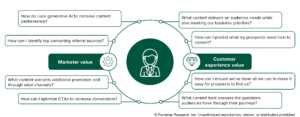
Back in March 2023, I published The Future Of B2B Content, a report that I reflected upon in recent weeks when my colleague Jessie Johnson and I published a new report, In The Age Of AI, Marketers Need To Rethink Content Intelligence. In the first report, I proposed that marketers must take a fresh look at the nature of content, pointing out that, instead of thinking of content as a container of information that’s pushed to an audience, marketers must leverage content as data in an information exchange with customers and other stakeholders. In that report, I quoted Bence Gazdag, vice president, global marketing technology, at Oracle, which remains prescient: “Today, companies predict a customer journey; in the future, we’ll simply read their actual journey in the data — that’s the nirvana.” We may not have reached that nirvana, but with AI, it’s perhaps a whole lot closer! In the new report, we define content intelligence as: The capture, correlation, and analysis of data about content and its consumption to inform buyer and customer insights, drive activation, and deliver more meaningful performance measurement. Content intelligence provides a data-based framework for marketers to harness predictive and generative AI to uncover buying signals and exchange value with buyers and customers through the differentiated experiences they demand. By doing so, marketers can transition from an often vicious cycle of ineffective content production to a virtuous cycle of continuously improving the customer experience with more personalized engagement. Andrew Bolton, chief customer officer at Knotch, put it this way: “Content measurement provides a metric, but content intelligence reveals the ‘why’ behind it — and, more importantly, guides and supports the actions to take based on that insight.” Forrester’s Marketing Survey, 2024, shows that two-thirds of B2B marketing decision-makers said they would increase their marketing tech spending on AI content creation. Doing so will open a world of content intelligence opportunity. Generative AI helps B2B marketers leverage content as data by creating asset and interaction metadata that helps them detect, classify, and extract buying signals from buyer and customer interactions. Because AI features in content technologies can auto-tag content attributes, content intelligence is codified into asset creation and activation. Then, by effectively analyzing audience and interaction intent and scenarios, marketers can use content intelligence to activate and tailor content, adapt and optimize it, and deliver increasingly frictionless, personalized interactions. We recommend that all marketers with B2B content responsibilities start putting the essential building blocks for content intelligence in place. Evaluate the current technology that is supporting the content lifecycle for content intelligence capabilities and include your digital engagement systems, revenue marketing platforms, and conversation automation systems. This will help solidify your genAI and overall content technologies roadmap to plot where such capabilities may be built into the solutions you plan to adopt. Make 2025 the year you get smart on content intelligence! Forrester Decisions clients: Access the report to learn more about harnessing content intelligence and reach out to your account manager to schedule guidance or inquiry sessions. Also, consider attending our Content Intelligence Workshop at Forrester’s B2B Summit North America 2025 this March 31–April 3 in Phoenix.   source

Getting Smart On Content Intelligence Read More »

GM, OnStar Agree To FTC's Ban On Location Data Sharing

By Lauren Berg ( January 16, 2025, 10:40 PM EST) — General Motors and OnStar agreed to a five-year ban on disclosing geolocation and driver behavior data to consumer reporting agencies to resolve the Federal Trade Commission’s allegations that the companies didn’t get drivers’ consent before sharing, the agency announced Thursday…. Law360 is on it, so you are, too. A Law360 subscription puts you at the center of fast-moving legal issues, trends and developments so you can act with speed and confidence. Over 200 articles are published daily across more than 60 topics, industries, practice areas and jurisdictions. A Law360 subscription includes features such as Daily newsletters Expert analysis Mobile app Advanced search Judge information Real-time alerts 450K+ searchable archived articles And more! Experience Law360 today with a free 7-day trial. source

GM, OnStar Agree To FTC's Ban On Location Data Sharing Read More »

Bridging a Culture Gap: A CISO’s Role in the Zero-Trust Era

Adopting zero-trust security architectures is increasingly becoming a corporate imperative, with zero trust serving as the recommended approach for building resilience against the evolving nature of enterprise threats. This shift represents more than just implementing the latest and greatest best-of-breed tools. It’s a foundational shift away from perimeter-based security controls and external network defenses that were not designed for today’s threat landscape.   More than 80% of all data breaches today are attributed to human error or negligence, making human risk a pressing security concern amid the rise of hybrid work environments. A zero-trust architecture limits the damage that a compromised user can cause by segmenting the organization’s security environment into smaller, isolated zones that restrict the ability to access sensitive data across the entire ecosystem. Unfortunately, the path to effective implementation has proven challenging. Forrester research found that more than 63% of enterprises are struggling to implement zero-trust frameworks, and Gartner predicts that by 2026 only 10% of large enterprises will have a mature and measurable zero-trust program in place.   This heightens the role of the transformational CISO to the forefront. CISO success today requires more than being a pure technologist from the SOC room. They need to serve as transformational leaders who are capable of navigating shifting organizational priorities to foster collective buy-in amongst executive leaders, establish effective processes with business line stakeholders, and develop versatile security teams. Cultivating this company-wide alignment is critical to alleviating the roadblocks that hinder zero-trust adoption today.   Related:What Does Biden’s New Executive Order Mean for Cybersecurity? Articulating Zero Trust’s Value   Nearly 50% of IT professionals describe collaboration between security risk management and business risk management as poor or nonexistent, according to NIST research. As CISOs, it’s our job to bridge this divide by framing zero trust as an enabler of business agility, operational efficiency, and competitive advantage rather than focusing on technical specifications. Leveraging scenario-based planning and risk quantification techniques can effectively articulate the value of zero trust in terms that resonate with various stakeholders — correlating the ramifications of cyber incidents to high-value outcomes that impact their department. Marketing leaders, for example, might better appreciate zero trust when they understand how it prevents customer data breaches that result in brand reputational damage.  Related:3 Strategies For a Seamless EU NIS2 Implementation CISOs should establish regular touchpoints with business unit leaders to understand their workflows, pain points, and growth initiatives. This collaborative approach helps identify opportunities where zero trust can enhance business processes rather than hinder them. By securing visible support from the C-suite, CISOs can overcome initial resistance and ensure the necessary resources are allocated for successful implementation. It also helps strengthen organizational buy-in across all employees, giving the company a platform to address concerns, share implementation progress, and maintain alignment with business objectives.   Minimizing Organizational Friction  Successful zero-trust adoption requires a carefully orchestrated change management strategy. Rather than pursuing lower-risk areas, organizations often achieve better results by starting with mid-risk priorities and moving methodically toward more complex challenges. This approach prevents implementation paralysis and drives meaningful security advancement.  Clear communication at every stage is essential. Regular updates, user awareness training, and open feedback channels help maintain transparency and address concerns proactively. When employees realize that zero trust can streamline their access to resources while maintaining security, resistance typically diminishes. The key lies in balancing security requirements with user experience. Modern implementations should leverage automation and contextual access controls to make security seamless. Implementing single sign-on solutions alongside zero-trust principles can enhance both security and convenience, making the transition more palatable for end users.  Related:Microsoft Rings in 2025 With Record Security Update In addition, developing a comprehensive change impact assessment helps identify potential friction points before they emerge. This involves mapping current workflows, understanding dependencies, and creating mitigation strategies. Regular user satisfaction surveys and feedback sessions enable continuous refinement of the implementation approach, ensuring that security measures align with operational needs while maintaining robust protection.  Positioning Practitioners for Success   The technical complexity of zero-trust architectures demands a targeted focus on skill development amongst security practitioners. With practitioners often wearing multiple hats across architecture, implementation, operations, and monitoring, they must be all-around defenders who are capable of seamlessly transitioning between functional roles. This requires a strong foundational knowledge spanning both on-premises and cloud security domains. Security teams must understand the organization’s end-to-end security environment, from network tools to cloud applications, endpoints, and data storage systems.  Investment in targeted learning is crucial here. Prioritize formal trainings and upskilling programs that build team-wide competencies and implement cross-training initiatives that facilitate knowledge sharing to reduce key person dependencies and develop operational resilience. Establishing a dedicated zero-trust center of excellence can accelerate this skill development by providing guidance and support to other security team members while maintaining documentation and best practices.  The path to zero trust is a continuous journey of organizational transformation. While technical implementation remains crucial, the transformational CISO’s ability to bridge cultural gaps, foster organizational alignment, and develop comprehensive team capabilities will determine the success of zero-trust initiatives. As cyber threats continue to evolve and regulatory pressures mount, organizations that successfully execute this cultural and technical transformation will be better positioned to protect their critical assets and maintain business continuity in an increasingly complex threat landscape.  source

Bridging a Culture Gap: A CISO’s Role in the Zero-Trust Era Read More »

ITC To Review Samsung Mobile Device Imports Over Maxell IP

By Adam Lidgett ( January 17, 2025, 9:55 PM EST) — The U.S. International Trade Commission will look into allegations from Japan-based Maxell Ltd. that Samsung was infringing a variety of patents through the South Korean company’s imports of products like smartphones…. Law360 is on it, so you are, too. A Law360 subscription puts you at the center of fast-moving legal issues, trends and developments so you can act with speed and confidence. Over 200 articles are published daily across more than 60 topics, industries, practice areas and jurisdictions. A Law360 subscription includes features such as Daily newsletters Expert analysis Mobile app Advanced search Judge information Real-time alerts 450K+ searchable archived articles And more! Experience Law360 today with a free 7-day trial. source

ITC To Review Samsung Mobile Device Imports Over Maxell IP Read More »

Key Insights From The Forrester Wave™: Experience Optimization Solutions, Q4 2024

Not long ago, we predicted that 2025 would be another year of customer experience (CX) mediocrity, but this rather gloomy outlook also provides an opportunity for bold leaders to buck the trend. Many will aim to do so by doubling down on digital experiences. According to Forrester’s Priorities Survey, 2024, adding or improving digital experience is the top action that business and technology professionals who indicated that improving the experience of their customers is a priority for their organization are taking to improve CX. Experience optimization (EO) solutions enable you to do exactly this: They help improve digital experience in real time by collecting and ingesting data, analyzing data to generate insights, and ideating and delivering thousands of different personalized digital experiences. Forrester defines EO solutions as: Solutions that enable the ongoing delivery of relevant, timely, and optimized digital experiences to meet evolving customer needs by leveraging cross-channel customer interactions. EO Solutions Support A Variety Of Use Cases That Win, Serve, And Retain Customers By helping digital teams understand and meet customers’ unique and evolving needs, EO solutions help their organizations win, serve, and retain customers. They also support a broad range of different use cases. The core use cases enabled by EO solutions are experimentation; next-best product, offer, or action; next-best experience; and experimentation with recommendations or personalization. Extended use cases focus on customer audience and segments, user experience/product/customer behavior understanding, cross-channel optimization, automatic optimization opportunities discovery, customer feedback and experimentation, and feature experimentation. EO Solutions Leverage GenAI To Help Companies Manage Personalization At Scale The EO market has evolved from basic online testing capabilities to offering AI-powered personalization and generative AI (genAI) applications, such as opportunities identification, creative assets generation, or segments creation. If you are looking to purchase or upgrade your EO solution, you can leverage our newly published report, The Forrester Wave™: Experience Optimization Solutions, Q4 2024, to evaluate the top 11 players and identify the best vendor for you. As you consider your options, pay attention to the following differentiators: GenAI. Providers with robust genAI capabilities have the potential to streamline the creation and optimization of digital experiences, thus facilitating a more tailored customer journey. Data integration. Advanced EO solutions stand out by integrating diverse data sources, not limited to digital interactions, to enable more effective personalization. Strategy support. Look to EO providers that offer not just technology but also strategic guidance, helping their clients refine and implement effective EO strategies. Don’t Just Count On EO Solutions To Satisfy Your Analytics Requirements Our research revealed a gap (and an opportunity) around digital analytics. Regardless of the vendor, EO customers complained about the analytics capabilities provided in their platforms. While they acknowledge the necessity of integrating EO solutions with their digital analytics solution to better inform EO activities as well as understand their performance, they’d like EO solution providers to strengthen native EO analytics capabilities. For instance, a multi-brand company told us that it’s currently unable to compare EO performance across its various brands within its EO platform. Instead, customers need to download the data from the EO solution and conduct this analysis separately. This isn’t surprising in the context of the history of EO solutions: Vendors in this space are focused on helping clients take action on data, and this is their core job, but they underestimate the importance of the analysis that informs EO. No one expects EO vendors to become the next Google Analytics, but improving analytics capabilities is a clear opportunity in two areas: 1) understanding the parts of the experience that need to be optimized, and for which customers and 2) understanding the performances of optimization activities to identify potential improvements. If you wish to understand the EO market better and which EO solution can be right for you, please schedule an inquiry or a guidance session with us. source

Key Insights From The Forrester Wave™: Experience Optimization Solutions, Q4 2024 Read More »

《鯉魚門紹香園》X《老夫子》推聯乘產品獲老夫子漫畫作家王澤親臨支持

(相左起)紹香園第三代傳人–營運總經理 Benny、老夫子漫畫作家—王澤老師。 香港老字號品牌《鯉魚門紹香園》為慶祝經典漫畫人物《老夫子》60週年紀念,推出一系列香港情懷特色禮盒。是次聯乘結合了美食及漫畫元素,定必為粉絲們帶來驚喜。 《鯉魚門紹香園》誠邀老夫子漫畫作家—王澤老師親臨香港進行簽名活動,除了介紹老夫子聯乘產品外,進行簽名活動。紹香園第三代傳人–營運總經理 Benny 與王澤老師對話及分享合作感想。 王澤指出,香港有很多文化寶藏、高質素產品和值得欣賞及重視的地方,香港人應該好好珍惜和發揮所長,所以今次專程由定居的台灣回來香港,為香港打氣! 《鯉魚門紹香園》始於1968年 紹香園現今逾四十多間連鎖店分佈全香港, 延續100%經典的香港特色風味,不斷創新研發健康食品,包括賀年食品、琥珀合桃、 果仁糕點、惹味肉乾、創意零食等。 LinkedIn Email Facebook Twitter WhatsApp The post 《鯉魚門紹香園》X《老夫子》推聯乘產品獲老夫子漫畫作家王澤親臨支持 appeared first on VeriMedia. source

《鯉魚門紹香園》X《老夫子》推聯乘產品獲老夫子漫畫作家王澤親臨支持 Read More »

Microsoft to End Support for Office 365 Apps on Windows 10 in October

Microsoft has announced that the final day it will offer security support for Word, Excel, and PowerPoint on Windows 10 will be Oct. 14, 2025. Businesses that rely on Microsoft 365 apps and use the outdated operating system must upgrade to Windows 11. “After that date, if you’re running Microsoft 365 on a Windows 10 device, the applications will continue to function as before,” Microsoft said in the announcement. “However, we strongly recommend upgrading to Windows 11 to avoid performance and reliability issues over time.” This applies to the subscription version of Office, Microsoft 365, and non-subscription versions of Office 2021, Office 2019, and Office 2016. Microsoft says that when a user upgrades to Windows 11, all Microsoft 365 features and security updates will resume as before and they can run an Office update to ensure they have the latest version. SEE: What’s Inside Microsoft’s Major Windows 11 Update? This October cutoff will also mark the end of Windows 10 support, joining Windows 7, Windows 8, and Windows 8.1 in the operating system graveyard. However, Windows 10 is still the most used Microsoft OS, with 62.7% of the market share as of Dec. 2024. Windows 11 has just 34.12% of the market share. What’s hot at TechRepublic Microsoft calls 2025 ‘the year of the Windows 11 PC refresh’ Microsoft has dubbed 2025 “the year of the Windows 11 PC refresh.” Yusuf Mehdi, Microsoft’s Executive VP, said in a blog post: “We believe that one of the most important pieces of technology people will look to refresh in 2025 isn’t the refrigerator, the television, or their mobile phone. It will be their Windows 10 PC, and they will move forward with Windows 11.” The post is seemingly attempting to solicit users to upgrade by associating Windows 11 with its Copilot+ PCs and other AI innovations. Microsoft has also tried pestering users into submission, by displaying full-screen pop-ups suggesting users upgrade their device and transfer their files. SEE: Microsoft Copilot Cheat Sheet: Price, Versions & Benefits Windows 11 has proven a controversial upgrade due to the “non-negotiable” requirement that devices looking to do so must have the Trusted Platform Module 2.0, which was announced in 2021. Microsoft claims that TPM 2.0 “raise(s) the security baseline” by enabling features like BitLocker, Windows Hello, and Virtualisation-Based Security, which are necessary for protection against modern threats such as ransomware. PCs manufactured after mid-2016 typically support TPM 2.0, though it may need enabling in BIOS, but only CPUs released from 2018 onwards will support Windows 11. Older PCs without TPM 2.0 cannot run the OS officially; users must upgrade hardware or, at their own risk, bypass requirements using one of the many workarounds discovered by the Windows community. Microsoft offering extended security updates For those who are set on continuing to use Office apps on Windows 10, there is one more way to do this securely. Microsoft is offering Extended Security Updates to consumers for the first time, meaning that for $30, anyone can receive one extra year of “Critical and Important security updates”. Enrollment for this will be opened “closer to the end of support in 2025.” Businesses will be able to pay for up to three years of ESU. It will cost $61 for the first year but the price will double for each consecutive year. Enrollment for this is open now and the first update will deploy in November. Those who purchased Windows 10 Long-Term Servicing Branch or Long Term Servicing Channel will also continue to receive security updates after Oct. 14. source

Microsoft to End Support for Office 365 Apps on Windows 10 in October Read More »