3. How people in Turkey view societal conflicts and institutions in their country

Turkish adults see various conflicts among different groups in their society. Majorities say there are conflicts between people who support different political parties (77%) and between people with different ethnic backgrounds (59%). Opinions are more mixed in the majority-Muslim nation when it comes to conflicts between people who practice different religions, with 47% saying there are strong religious conflicts and 51% saying there are generally not. Notably, Turkish Muslims who pray less than weekly are somewhat more likely than those who pray five salah daily to say there are conflicts between people of different religions. Fewer see conflicts between people who live in cities and people who live in rural areas. Only about a quarter of Turkish adults (26%) say there are strong conflicts of this nature. Turkish adults with lower incomes are more likely than those with higher incomes to say there are strong urban-rural conflicts in Turkey (+22 points, though higher-income adults were less likely to respond to the question). Those with lower incomes are also more likely to see strong religious conflicts (+18) and ethnic conflicts (+13). Turkish adults who hold a favorable opinion of Erdoğan are less likely than Turks with an unfavorable view of the president to report strong religious (-12), political (-11) and ethnic (-9) conflicts in their society. Views of institutions Majorities of Turkish adults say the police (78%) and the military (62%) have a good influence in the country, making these the only two institutions or organizations we asked about that at least half of the public sees positively. Most Turks say the court system, religious leaders and the media (including television, newspapers and magazines) have a bad influence in the country. About a quarter or more, in fact, say the influence of each of these is very bad. Large companies from other countries, as well as banks and other financial institutions, get the most negative ratings. For example, around three-quarters of Turks (73%) say banks have a bad influence on the country. Related: 83% of Turks say their country’s current economic situation is bad Views over time We last asked about many of these institutions in 2017. Compared with seven years ago, fewer Turks now believe the media (-24 points), religious leaders (-20), the court system (-16) and the military (-15) have a good influence in Turkey. Political and demographic differences Turkish adults who have a positive view of Erdoğan are more likely than those with an unfavorable view of him to say various institutions have a good influence in the country. For example, those who think positively of Erdoğan are 50 points more likely than those with an unfavorable view of the president to say that religious leaders have a good influence in Turkey (67% vs. 17%). Erdoğan supporters are also more likely than nonsupporters to have a positive view of the influence of the court system, the police, the media and the military. On the other hand, Turks who have a favorable opinion of former opposition leader Kemal Kılıçdaroğlu – Erdoğan’s opponent in the May 2023 presidential election – see a number of institutions differently. For instance, Kilicdaroglu supporters are 31 points less likely than those who see him unfavorably to say that religious leaders have a good influence in the country. They are also less likely to have a positive view of the influence of the court system (-15 points) and the police (-9). There are no significant differences between Erdoğan or Kılıçdaroğlu supporters when it comes to the influence of banks and foreign companies, but there are differences by age. Turkish adults under 35 are more likely than those ages 50 and older to say that large companies from other countries (35% vs. 23%) and banks and other financial institutions (26% vs. 17%) have a positive influence in Turkey. source

3. How people in Turkey view societal conflicts and institutions in their country Read More »

GenAI Use Cases That Transform Smartphone User Experiences

As GenAI increasingly becomes mainstream, its applications in smartphones are fast becoming a key design vector for smartphone manufacturers. IDC’s latest forecast estimates that GenAI smartphone shipments will grow 364% year-over-year in 2024, reaching 234.2 million units, growing to 912 million units in 2028 implying a compound annual growth rate (CAGR) of 78.4% for 2023-2028. Over the past year, many market participants have announced their own set of artificial intelligence (AI) tools to demonstrate smartphone UX changes. These are based on various foundational models, large and small language models (LLM and SLM) enabling generative AI (GenAI) features with on-device processing, and multimodal input and output. The OEMs have a hybrid approach to enabling AI features-device-based for localized and cloud-based for heavy computational activities. While many of these AI features are presently limited to premium smartphones, we should expect to see these trickle down the pecking order made possible by the use of cloud-based AI solutions as these devices will lack necessary hardware. However, a reduced scope and privacy/latency remain key considerations. Below are some of these features and how they are different across the OEMs. OEMs are Adding Their Unique Flavor with AI Features While the AI features fall within the same broad categories for all major platforms and devices, each OEM imprints their unique signature, along with the tools from the likes of Google and OpenAI. Almost every key OEM has announced features/tools for photo/video editing, writing/editing, translation and interpretation, summarizing, search enhancement etc., targeting the most used smartphone features. To most users, it may not matter if AI is the enabler as long as they get a better outcome. Case in point, users are more interested in the final portrait photo than in the hardware, software, or AI driving it. A big hit, according to the market participants, are Circle to Search, a Google AI feature tied to Android 14, mentioned by Samsung in their earnings in Apr 2024 as the most used feature and Eraser which OPPO claimed is used 15 times per day on average. Live translation is another extremely useful feature overcoming the barriers of language and can be used conveniently even in an offline mode. There is also increased focus on wellness, where Google, for example has Sleep and Snore detection, Samsung recently announced Sleep Apnea detection, and Apple has been talking about monitoring vitals. AI Features – An Extension of Brand Message for the OEMs While the end-use for GenAI features is driven by the same user needs, OEMs use AI features as an extension of their brand message and stand out from the others. Apple announced GenAI capabilities as “Apple Intelligence”, indicating AI is central and all under one hood on its devices, with features designed to have cross-functionality across various apps and iPad, iPhone, and Mac devices. It might not be a radically new way of how a user interacts with the iPhone, but enhancing the app functionalities and fun activities such as creating personalized memories, Genmojis and avatars. The revamped Siri with access to underlying user data (emails, messages, photos, locations, files etc.,) can be more context-aware, while sticking to its central message around privacy even as the user connects to ChatGPT. Apple’s vertically integrated approach relies largely on in-house language models and its private cloud infrastructure, while partnering with OpenAI for ChatGPT.  Google continued with its legacy of using software to enhance smartphone capabilities. Pixel 8 Pro enabled many on-device GenAI features by running language models on the device. It has a host of features such as call management (Clear Calling, spam calls, Call Assistant); photo/video editing (Photo/Audio Eraser, Best Take); communication (Proof Read, Smart Reply, Summarize, Magic Compose) etc. For Google, it can be a blurry line between what is unique to Pixel smartphones vs the rest of the Android lineup. Google has been managing this by bringing some of the features to Pixel smartphones first before they go to the wider Android players. OPPO, in continuation of its focus on camera and photography features, has features such as AI Best Face, AI Eraser, AI Studio and AI Clear Face, while also expanding AI features to broader spectrum of AI applications for communication and productivity. OPPO also introduced Social Media Creation tools to assist in creating content specifically tailored for social media platforms. Samsung launched Galaxy AI tools on its flagship Galaxy S24 series and on Galaxy Z6 Foldables recently, and extended some of these features to its older models, focusing on communication and productivity. Live translation as well as real-time Interpreter are standout features. Galaxy AI includes Photo Assist, Instant Slow-Mo, AI summarization, Chat Assist and Magic compose writing/editing tools. Features such as dual-screen mode for Interpreter are customized for the foldable form factor.  While other Android players have also announced AI tools – Xiaomi’s AI-generated subtitles for video calls and Image Editor, Honor’s eye-tracking AI functions, Motorola’s personalization and privacy-oriented features – partnership with Google remains vital to have access to the broader set of tools integrated with the Android operating system.   Another area of differentiation is the size and number of LLMs and the training material used which impact performance and UX. Apple uses its own language models, and OpenAI for tasks that are beyond its realm. Android players use Gemini models (Pro and Nano) and multiple other different-sized models. OPPO has its own SLM that uses 7 billion parameters as well as an LLM AndesGPT in addition to using Gemini. There are partnerships with other tech companies including Qualcomm, MediaTek, and Microsoft. Further, there are differences in the execution of these features and their accessibility for third-party apps. iOS developers and apps have experience of automating tasks or working with features such as Siri Intents and Shortcuts. For example, developers and apps with SiriKit already integrated into their apps could see immediate enhancement with new Siri capabilities. Some of their AI tools such as writing tools would be easily available to developers for their third-party apps. Google also provides developers with APIs and

GenAI Use Cases That Transform Smartphone User Experiences Read More »

Visa Risk And Identity Solutions Acquires Fraud Management Vendor Featurespace

Last week, Visa announced the acquisition of Featurespace, a UK-based enterprise fraud management and anti-money-laundering (AML) vendor. Forrester estimates the acquisition price to be between $350–450 million. Founded in 2008, Featurespace employs over 400 people. The move comes as a bit of surprise, since Visa’s Cybersource solution already addresses e-commerce and retail fraud management/digital fraud management use cases. Cybersource has been using rules and machine learning-based models for risk scoring and has extensive alert and case routing and investigation features. This means the Featurespace acquisition brings in significantly overlapping technology for Visa. Forrester expects that the success of the acquisition will depend on the following factors, namely Visa’s ability and execution to: Converge the Cybersource and Featurespace solutions’ intellectual property. While it may look viable to maintain two separate technology stacks in the two portfolios, this means duplicating engineering, marketing, and sales efforts, which is not efficient and can result in the erosion of Visa’s competitive position against other fraud management and AML vendors. Provide convincing fraud management and AML cyber/online and transaction monitoring capabilities. Cybersource has focused on detecting merchant-side payment transaction fraud (e.g., fraudsters using stolen credit card numbers on a merchant’s website or fraudsters taking over legitimate users’ online accounts on e-commerce websites), while Featurespace has specialized in detecting issuer bank-side payment fraud and offering some cyber/online (account takeover, fraudulent registration) fraud detection capabilities. Featurespace has also entered the AML space, with a focus on transaction monitoring. Visa, with its Featurespace acquisition, needs to assemble its assets to offer end-to-end (i.e., cyber/online and transaction monitoring) fraud management that covers scams, new account fraud, and peer-to-peer payments. Offer bank/issuer-facing and e-commerce-facing fraud management tools. Fraud management is still an industry-specific product market. Vendors increasingly provide more than just risk-scoring rule management and machine learning; alert and case management; and reporting capabilities for fraud management but also bring in a wealth of fraud domain-level knowledge (i.e., models trained to detect typical fraud patterns such as account takeover, excessive payments, mule activities, or scams), especially given today’s transition from on-premises to SaaS-delivered fraud management solutions. Consequently, Visa needs to use its access to payment network, issuer (Featurespace), and merchant-side (Cybersource) data to provide powerful solutions to issuers/banks and e-commerce verticals. Fraud management continues to be a rapidly evolving market. I recommend reading my evaluation, The Forrester Wave™: Enterprise Fraud Management Solutions, Q2 2024, or scheduling a guidance session or inquiry with me to discuss the current state of fraud management. source

Visa Risk And Identity Solutions Acquires Fraud Management Vendor Featurespace Read More »

Unleashing Blockchain’s Potential Across Industries

Blockchain technology is more frequently associated with cryptocurrencies and financial transactions. However, its usefulness extends far beyond the financial services sector. As a decentralized and immutable ledger, blockchain offers unmatched security, transparency, and efficiency across various industries. This blog post explores the value of blockchain outside of financial services in industries including retail supply chain management, healthcare, intellectual property protection, real estate, identity verification, energy, digital marketplaces, and government and public services. Supply Chain Management Supply chain management, a prime example of blockchain’s application beyond finance, has long grappled with issues like lack of transparency and inefficiencies, leading to problems such as counterfeit goods, fraud, and delayed deliveries. Blockchain steps in as a solution, offering a transparent and immutable record of every transaction and movement of goods within the supply chain. A case in point is the collaboration between Walmart and IBM, which use blockchain to trace the origin of food products. By scanning a product’s QR code, consumers can instantly access detailed information about its journey from farm to store shelf, ensuring product authenticity and quality and enabling swift response in case of contamination or recall. Healthcare In the healthcare industry, where the security and privacy of patient data are of utmost importance, blockchain is emerging as a game-changer. With patient data scattered across various systems and institutions, inconsistencies, breaches, and difficulties in data sharing have been a persistent challenge. However, blockchain is changing the game by creating a unified and secure patient record system accessible only by authorized parties. MedRec, a blockchain-based system, is a shining example of this. It ensures that patient data is secure and easily accessible to healthcare providers, enhancing coordination and patient care delivery. Moreover, patients have control over their data, deciding who can access their medical history, thereby instilling a sense of security and control in them. Intellectual Property and Copyright Protection Intellectual property (IP) protection is another area in which blockchain can substantially impact. The current IP systems are often slow and prone to ownership disputes. Blockchain provides a transparent, timestamped, and immutable record of IP rights, making it easier to prove ownership and combat piracy. Platforms like Ascribe and KodakOne use blockchain to protect the works of artists and photographers. By registering their creations on a blockchain, creators can ensure that their IP rights are securely recorded and indisputable, simplifying the enforcement of copyright and licensing agreements. Real Estate Real estate transactions are historically complex and slow, involving numerous intermediaries and paperwork. Blockchain can streamline these processes by providing a transparent and secure ledger for recording property transactions, thereby reducing fraud and increasing efficiency. Propy is a blockchain-based platform that enables the buying and selling of real estate using smart contracts. These contracts automatically execute and verify transactions, ensuring all parties fulfill their obligations before transferring the property title. This reduces the need for intermediaries, speeds up transactions, and lowers costs. Identity Verification Identity verification is essential for various services, yet traditional methods are often cumbersome and insecure. Blockchain provides a decentralized solution where individuals can securely control their personal information. Sovrin is an example of a decentralized identity management system. It allows individuals to create and control a digital identity that they can securely share with others. This system reduces identity theft risk and simplifies the verification process for individuals and service providers. Energy Sector Blockchain technology is making waves in the energy sector, particularly enabling peer-to-peer (P2P) energy trading. This allows consumers to buy and sell excess energy directly to each other, promoting renewable energy sources and increasing efficiency. Power Ledger is a platform that facilitates P2P energy trading using blockchain. Consumers with solar panels can sell surplus energy to neighbors, creating a decentralized and efficient energy market. This empowers consumers and contributes to the broader adoption of renewable energy. Government and Public Services Blockchain enhances transparency and efficiency in government and public services. From maintaining public records to managing public funds, blockchain ensures that records are immutable and verifiable. Estonia pioneered using blockchain for e-governance. The country uses blockchain to secure public records, including land registries and health records. This ensures data integrity, reduces fraud, and enhances the efficiency of public services. Digital Commerce and Cloud Marketplaces A blockchain-enabled marketplace enables peer-to-peer (P2P) on-platform buying and selling that allows the sale of goods without intermediaries. A traditional online marketplace is centralized, meaning a third party regulates the entire buying and selling process. Transactions go through intermediary platforms that retain some percentage of the transaction. Transactions become costly, and the intermediary becomes a powerful holder of sensitive data. All marketplace participants must trust the administrator as all the operations happen only on the platform. These factors are especially relevant in the context of cross-border transactions, in which there are no mechanisms to ensure effective legal protection of the parties. Integrating blockchain in digital commerce could potentially address these concerns by providing a decentralized and transparent system for transactions and data management. The immutability of transactions in the blockchain ensures that it is impossible to modify or lose data on participant transactions by the platform operator. Blockchain marketplace transactions are regulated by digitally signed agreements called smart contracts. These contracts can be accessed by everyone and are immutable. The terms must be approved by both parties before the transaction concludes. Reviews and ratings are the most requested information before buyers conduct transactions. Blockchain can be used to ensure users are provided with objective and transparent information about suppliers and solutions. Blockchain technology holds immense potential beyond the realm of crypto financial services. Its applications in supply chain management, healthcare, government and the public sector, intellectual property, real estate, identity verification, energy, and digital commerce prove its versatility and transformative power. By leveraging blockchain, various industries can achieve greater transparency, security, and efficiency, paving the way for innovative solutions to enduring challenges. As blockchain evolves and use cases expand, its adoption across different industries will accelerate, unlocking opportunities for growth and innovation. source

Unleashing Blockchain’s Potential Across Industries Read More »

2. How people in Turkey view democracy and other forms of government

A third of Turkish adults are satisfied with the way democracy is working in their country, while the other two-thirds express dissatisfaction. More than a third (37%) say they are not satisfied at all. Since we last asked this question in Turkey in 2019, satisfaction with democracy has dropped 14 points, from 47% to 33% today. Turks who hold a favorable opinion of President Recep Tayyip Erdoğan are more likely than those who see him unfavorably to express satisfaction with democracy (65% vs. 9%). And Muslims who pray five salah daily are more likely than those who pray less frequently to have a positive outlook on their democracy. On the other hand, only 13% of those with a positive opinion of former opposition leader Kemal Kılıçdaroğlu – Erdoğan’s opponent in the May 2023 presidential election – are satisfied with the way democracy is working. Views of different political systems Turks greatly prefer democratic types of government to nondemocratic systems like rule by the military or by a strong leader. Eight-in-ten Turkish adults say that a representative democracy (a system where representatives elected by citizens decide what becomes law) would be a good way to govern the country. An almost identical share (79%) says the same about a direct democracy (a system where citizens, not elected officials, vote directly on major national issues to decide what becomes law). Only 14% in Turkey say that military rule would be a good way of governing, making it the least popular political system we asked about. However, support for this system has risen from 9% in 2017. Turks’ evaluations of various government systems are generally comparable to the results of a 24-country survey we conducted in 2023. Turks are within a few points of the 24-country medians when it comes to their support for representative democracy, rule by experts and rule by the military. On direct democracy and rule by a strong leader, Turks express a slightly more positive view than the median respondent.    Views of autocratic leadership Views on autocracy vary across different groups in Turkey. Roughly half (49%) of those who hold a favorable opinion of Erdoğan think that rule by a strong leader would be a good way to govern the country, compared with 23% of those with an unfavorable view of the Turkish president. Adults with lower levels of education are more likely than their counterparts with more education (37% vs. 21%) to say autocracy would be a good way to govern the country. (The “less education” category refers to people who have a secondary education or less, while the “more education” category refers to those with a postsecondary education or more.) In addition, Turkish adults ages 50 and older are 15 points more likely than adults under 35 to say that autocracy would be good for Turkey (43% vs. 28%). source

2. How people in Turkey view democracy and other forms of government Read More »

Reimagining Industries: Unleashing the Power of AI in India

The Artificial Intelligence (AI) revolution has taken the world by storm. IDC forecasts that worldwide AI spending will exceed $512 billion by 2027, more than double its 2024 market size. While AI was picking up pace, the introduction of Generative AI (GenAI) changed the way enterprises leveraged AI. In India, AI and GenAI adoption is significantly increasing across software, services, and hardware for AI-centric systems, with AI and GenAI spending projected to reach $6 billion by 2027 with a compound annual growth rate (CAGR) of 33.7% for the period 2022-2027. The AI revolution has also accelerated digital adoption in India with 62% of Indian enterprises expecting more than 50% of revenue to come from digital models by 2026. Multiple AI Use Cases Are Emerging Across Indian Industries Industries that have been slow in terms of digital adoption have accelerated their journey to get ready for their AI journey while industries that have been digital leaders have already started evaluating and deploying relevant use cases. Governments in the Asia Pacific are the third-largest adopters of AI/GenAI, with spending expected to increase with a 5-year CAGR of 96.2% by 2027. This growth offers a chance to enhance efficiency, transparency, and citizen engagement in public services. In India, almost 50% of government organizations are planning to invest significantly in data management-related services, such as discovery, quality, data engineering, and governance in 2024. Hence, the approach is clearly shifting towards data-centric rather than model-centric. Additionally, a sizable chunk of these organizations is planning to significantly increase investments in AI and Machine Learning (ML), including GenAI. For example, citizen services in states like Haryana are leveraging Jugalbandi, a new GenAI-powered chatbot on WhatsApp, to facilitate a wide range of tasks, including pension payments and college scholarship applications. While adopting AI/GenAI, the government also has a responsibility to govern the usage of this technology while giving the necessary impetus for innovation. Digital in healthcare has been a focal point in recent years, particularly in the post-pandemic period. The Indian healthcare sector is witnessing a surge in clinical data driven by patient-centric care management that is evolving into real-time patient data capture and analysis. Such a surge in the clinical data, along with immunity to AI investments by healthcare organizations aligns the healthcare sector increasingly towards an “AI everywhere” approach. There is already an increased focus on early detection of diseases, both communicable and non-communicable diseases. During our discussions with CIOs of multi-specialty hospitals, AI-based use cases, mainly focusing on diagnostic accuracy, speed, and workflow efficiency are popular. For example, Apollo Hospital is set to leverage the use of AI to detect TB from chest X-rays, as a means of triaging. They even scan the villages to screen TB cases. Another case is the launch of “iOncology.ai”, by AIIMS Delhi for early detection of breast and ovarian cancers, the two most prominent types of cancer in the country and percolate the solution to district hospitals. AI is also transforming every corner of the Banking, Financial Services, and Insurance (BFSI) sector, with the most significant impact on customer interactions, risk management, and operational efficiency in India’s financial landscape. JP Morgan’s AI-focused strategy, implemented six years ago, exemplifies the long-term commitment of leading financial institutions to AI integration. In a highly regulated industry like BFSI, institutions face challenges such as big data management, outdated IT infrastructure, market responsiveness, and cyber fraud risks, which function as a speed breaker for AI adoption. Despite that, we are witnessing growing importance for GenAI pilots among many BFSI institutions in India across various business functions primarily to enhance existing services. Telecom operators are aspiring to be more than just connectivity providers –  they want to be recognized as digital leaders. India is the second largest market by subscribers globally, yet it has one of the lowest average revenues per user. IDC predicts total connections in India will reach 1.5 billion in 2028 (both mobile and fixed) with a total data traffic of 468 exabytes. Though the demand is high, balancing churn and profit margins have continued to challenge telcos in India. Two areas which tie into churn and profit margins are customer experience (CX) and network operations. For CX, the augmentation of AI is at the forefront of addressing customers across various touchpoints. For example, any ambiguity in the bill will lead to customer churn, both in consumers and enterprises. Use of AI to explain and analyze bills consisting of varying bill cycles, bill splits, multiple payment modes, loyalty, and promotional offers reduces the number and duration of calls for contact center agents.  On the network operations side, AI is infused to shift from reactive to proactive network management eventually to predictive network management. As networks become more disaggregated with increased virtualization and edge deployments, the urgent need to look past manual troubleshooting has led to network automation. The closed-loop network management should span across network operation workflows and BSS systems.   India is at a pivotal moment, ready to become a global manufacturing hub as the world looks for alternatives to China. Today, China makes up about 28% of global manufacturing, while India accounts for only 3.3%, competing with countries like Vietnam and South Korea in Southeast Asia. For India to become a manufacturing hub, India must leverage technologies like AI, robotics, automation, IoT, and 3D printing. Furthermore, the manufacturing industry also faces challenges with regular supply chain disruptions. According to IDC’s April 2024 Global Supply Chain Survey, more than 30% of India’s manufacturers, retailers, and logistics companies are expecting supply chain disruptions due to rising costs, talent shortages, and regulatory compliance issues. These challenges are also accelerating the adoption of data-driven technologies and AI in the manufacturing sector. AI can help India with three very important competitive factors in the manufacturing industry – enable scale, reduce cost, and increase efficiency. AI can also enhance supply chain security by detecting any risk or fraud in the supply chain system. Furthermore, navigating regulatory compliance is becoming more manageable with AI solutions that

Reimagining Industries: Unleashing the Power of AI in India Read More »

1. How people in Turkey view their government

Turkish adults are divided when it comes to trust in their national government: 46% trust the government to do what is right for the country, while 51% do not. Trust is especially high among those who have a favorable opinion of President Recep Tayyip Erdoğan. The president’s supporters are nearly five times as likely as nonsupporters to have trust in the national government (84% vs. 17%). Age also plays a role in views of the government. Turkish adults under 35 are less likely than older adults to express trust in the government. Trust in the government is significantly higher among Muslims who pray salah – the ritual prayers required of Muslims five times a day – when compared with those who pray less often. About seven-in-ten Muslims who pray five salah daily (69%) say that they trust the national government to do what is right. This compares with 40% of Muslims who pray at least weekly (but not five times daily) and 26% of those who pray less than weekly. (The Center uses frequency of prayer as a measure of religiosity.) Education is another key factor. While 52% of Turkish adults with a secondary education trust the government, this falls to just 26% among those who have a postsecondary education or more. Preparedness for natural disasters In this survey – conducted roughly one year after a 7.8 magnitude earthquake struck Turkey and Syria, leaving more than 50,000 dead – we asked Turks how confident they are that the government will take the necessary measures to prepare for future natural disasters. About six-in-ten Turks (61%) are not confident the government will do this, including 40% who say they are not confident at all. Views on this question differ widely depending on how respondents see Erdoğan. Three-quarters of Turks with a favorable opinion of Erdoğan have confidence that the government will take steps to be prepared for a future natural disaster. Only 9% of those with an unfavorable opinion of Erdoğan agree. May 2023 election fairness In a May 2023 national election, Erdoğan faced off against Kemal Kılıçdaroğlu, then the leader of the opposition Republican People’s Party (CHP). Erdoğan won in a runoff with 52% of the vote. Beginning the following January, we asked Turkish adults if they believe the election was conducted fairly and accurately. Overall, 53% of Turks do not think the election was fair, but this opinion varies widely depending on how favorable they are toward each candidate. Among Turks with a favorable opinion of Erdoğan, 86% are confident the election was conducted fairly and accurately. Just 15% of those with a favorable view of Kılıçdaroğlu agree. Confidence in the election is also higher among Turks ages 50 and older than those under 35. About half of the older group (52%) are confident that the election was fair, compared with about a third of the younger group (34%). Among Turkish Muslims, 70% of those who pray five salah daily are confident in the fairness of the election, including 46% who are very confident. Much smaller shares of those who pray less frequently agree. Favorability of Erdoğan and Kılıçdaroğlu over time In our surveys, Erdoğan has consistently received higher favorability ratings than Kılıçdaroğlu. Still, Erdoğan’s favorability is down 32 points from 2017; that year’s survey was conducted eight months after a coup attempt against his government. Today, 43% of Turks see Erdoğan favorably. Kılıçdaroğlu’s favorability, by comparison, is similar to where it was when we last asked about him in 2015. Today, 27% view him favorably, compared with 23% in 2015. (It’s important to note that the most recent survey was fielded after Kılıçdaroğlu was replaced as leader of the Republican People’s Party.) People ages 35 and older, adults with less education and Muslims who pray more frequently hold more favorable opinions of Erdoğan than their demographic counterparts. Kılıçdaroğlu, who is an Alevi Muslim, is seen more favorably by Turkish Muslims who pray less than once a week than by those who pray five salah daily. About one-third of Turkish adults have a negative opinion of both Erdoğan and Kılıçdaroğlu. Similar to demographic patterns on trust in government, these people are more likely to be young (adults under 35), to have at least a college degree and to pray salah five times a day, if Muslim. source

1. How people in Turkey view their government Read More »

Predictions 2025: Security And Risk Pros Will Brace For Regulations And Resilience

In 2024, regulators around the globe introduced a myriad of proposed cybersecurity- and privacy-focused policies and legislation to better manage emerging risks relating to emerging technologies such as generative AI (genAI), as well as those related to managing third-party relationships. Security and risk leaders sprinted to secure genAI, even as its use cases were still evolving; almost every industry experienced critical IT disruptions due to lack of resilience planning; and despite downplaying third-party risks, organizations globally saw an increase in software supply chain breaches. With cybercrime expected to cost $12 trillion in 2025, regulators will take a more active role in protecting consumer data while organizations pivot to adopt more proactive security measures to limit material impacts. This year’s cybersecurity, risk, and privacy predictions from Forrester for 2025 reflect how organizations need to evolve to address these emerging risk domains. Here are three of those predictions: CISOs will deprioritize genAI use by 10% due to lack of quantifiable value. According to Forrester’s 2024 data, 35% of global CISOs and CIOs consider exploring and deploying use cases for genAI to improve employee productivity as a top priority. The security product market has been quick to hype genAI’s expected productivity benefits, but a lack of practical outcomes is fostering disillusionment. The thought of an autonomous security operations center using genAI generated a lot of hype, but it couldn’t be further from reality. In 2025, the trend will continue, and security practitioners will sink deeper into disenchantment as challenges such as inadequate budgets and unrealized AI benefits reduce the number of security-focused genAI deployments. Breach-related class-action costs will surpass regulatory fines by 50%. Breach-related spending is no longer limited to regulatory fines and remediation costs. Historically, cyber regulations have not gone far enough to protect customers and employees — causing these same people to pursue class-action lawsuits and seek damages. Class-action costs are enormous in data breach litigations. And with the percentage of companies facing class actions at a 13-year high, CISOs will be asked to contribute toward the company’s class-action defense fund in 2025, making costs from class actions greatly exceed fines imposed by regulators. A Western government will bar specific third-party or open-source software. Software supply chain attacks are a top culprit for data breaches in organizations globally. Growing pressure from Western governments to require private companies to produce software bills of materials (SBOMs) has been a boon for software component transparency, but these SBOMs highlight the role of third-party and open-source software in the products that governments purchase. In 2025, a government armed with this information will restrict an open-source component on the grounds of national security. To comply, software suppliers will need to remove the offending component and replace the functionality. Forrester clients can read the full Predictions 2025: Cybersecurity, Risk, And Privacy report to get more detail about these predictions as well as two additional predictions related to the EU AI Act and internet-of-things device security. You can also register for the upcoming client webinar. If you aren’t a client, sign up here to receive our complimentary Predictions guide, which covers our top predictions for 2025, when it becomes available later this month. Get additional complimentary resources, including webinars, on the Predictions 2025 hub. source

Predictions 2025: Security And Risk Pros Will Brace For Regulations And Resilience Read More »

Tesla’s big ‘We, Robot’ event criticized for ‘parlor tricks’ and vague timelines for robots, Cybercab, Robovan

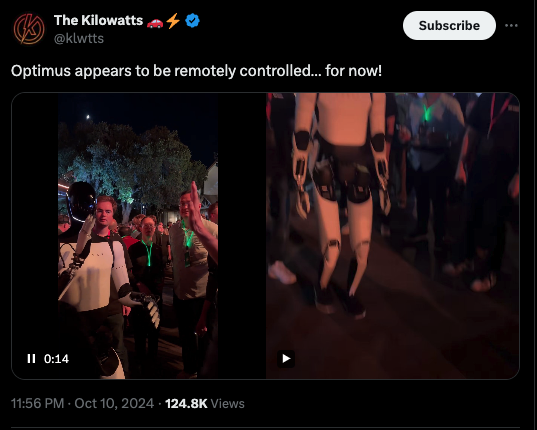
Join our daily and weekly newsletters for the latest updates and exclusive content on industry-leading AI coverage. Learn More Elon Musk’s publicly traded electric vehicle company Tesla, Inc. hosted its highly anticipated “We Robot” event on Oct. 10, 2024, at Warner Bros. Discovery Studios in Burbank, California and streamed it live on his social network X and YouTube. Despite showing off slick prototypes of a new “Cybercab” autonomous car without a steering wheel or gas and brake pedals, and a similarly sparse, art deco retrofuturistic “Robovan” capable of seating 20 passengers, the event was criticized by some prominent observers as being more style than substance. lt was lacking in precise details on timelines, costs and legal issues, and even came across as misleading in some cases. The most glaring example of potentially misleading information was Tesla’s move to have its still-in-development humanoid Optimus robots filling the venue space and interacting with attendees, even serving drinks at a bar. While some present assumed the robots were entirely autonomous, reports confirmed they were teleoperated — meaning controlled by a human in another room. “Not wholly AI? Not at all AI,” wrote venture capitalist Josh Wolfe, co-founder of Lux Capital on Musk’s social network X. “Totally worthy to celebrate low latency remote control but totally dishonest to demo these as autonomous robots—call it the parlor trick it is.” This skepticism raises questions about how far Tesla has truly advanced in developing artificial intelligence for robotics. While Musk touted the Optimus, Cybercab and Robotaxi as tremendously impactful inventions for society, EV reviewers The Kilowatts noted on X that much of the technology will remain “unbelievable” to investors and consumers until it is shipped. For now, Tesla’s vision of fully autonomous personal robots as well as new autonomous electric vehicle types remains more speculative than realistic. Here’s a summary of what was discussed: Cybercab: all autonomous and cheaper than a bus or Model 3? Credit: Tesla Perhaps the most expected of the announcements was Tesla’s Cybercab, a two-seater electric vehicle designed for autonomous operation. Musk described the Cybercab as a sleek, more compact version of the Cybertruck, and it will reportedly cost less than $30,000. That is below the current price of Tesla’s most affordable personal vehicle, the Model 3, which debuted at $35,000 in 2019 but has since seen its price rise to around $42,000. According to Musk, Tesla aims for the Cybercab’s operating cost to be between $0.20 and $0.30 per mile compared to the operational cost of a bus, which he placed at around $1 per mile. The vehicles would be powered by inductive (wireless) charging, eliminating the need for plug-in charging stations and further integrating autonomous cars into the urban landscape. The promise of an individualized “mass transit” future has long been part of Musk’s vision, and the Cybercab is a key component of that goal. During the event, Musk proudly displayed 20 Cybercabs driving autonomously around the venue. He emphasized that the Cybercab is part of a broader effort to make cities safer, cleaner and more efficient. Tesla’s AI Vision system, trained on millions of cars, allows these vehicles to operate without the fatigue and distractions that affect human drivers. Musk claimed that Tesla’s autonomous technology could eventually make driving 10 to 30 times safer than human operation. He also floated the idea that autonomous car owners could manage fleets of vehicles, offering ride-hailing services similar to Uber or Lyft. This business model, if successful, could reshape the gig economy and create new opportunities for individuals to generate income. However, while the Cybercab’s debut was met with enthusiasm, industry insiders raised concerns about the lack of concrete details surrounding its rollout. Musk indicated that production on the Cybercab would begin between “probably” in 2026 or “before 2027,” but admitted he “tend[ed] to be a little optimistic with timeframes.” Indeed, Tesla has historically struggled with meeting deadlines for its more ambitious projects such as its Full Self-Driving (FSD) and even shipping the Cybertruck, which Musk at one point suggested would be waterproof enough to act as a boat for short journeys (it is not and cannot). As Washington Post technology journalist Faiz Siddiqui noted on X, the entire We, Robot event livestream was preceded by a heavy disclaimer from Tesla stating, in part, that “Forward-looking statements are based on assumptions with respect to the future, are based on management’s current expectations, involve certain risks and uncertainties, and are not guarantees. Future results may differ materially from those expressed in any forward-looking statement.” While the vision of affordable autonomous transportation is compelling, much remains uncertain about when—or if—Tesla can deliver on these promises. Robovan: Tesla’s answer to buses, trains, and mass transit Credit: Tesla Another key reveal at the event was Tesla’s Robovan, a large autonomous vehicle designed to transport up to 20 passengers or goods. Musk positioned the Robovan as a potential solution for high-density urban transport, hinting at a future where autonomous shuttles replace conventional buses. The Robovan represents a vision of more efficient, less congested cities where autonomous vehicles run frequently enough to eliminate the need for large, underutilized parking lots. Musk suggested that, over time, cities could convert parking spaces into parks, improving the quality of life in urban areas. Some technology observers such as Brian Roemmele on X were overjoyed at the news, especially the Robovan’s sleek, striking art deco design, even predicting that “100s of 1000s” or hundreds of thousands of people would be living in Robovans converted into mobile homes by 2031. Credit: Tesla Despite these ambitious goals and praise, critics were quick to point out that Tesla offered no specific timeline for the Robovan’s production. X user Facts Chaser noted that while Tesla unveiled a prototype, China already has operational autonomous vans in real urban environments. Tesla Full Self-Driving coming to Texas and California next year? A recurring theme at the We Robot event was Musk’s long-held belief that autonomous vehicles will revolutionize urban life by reducing traffic, improving safety and reclaiming public

Tesla’s big ‘We, Robot’ event criticized for ‘parlor tricks’ and vague timelines for robots, Cybercab, Robovan Read More »

Hey Elon, the media business isn't rocket science. It's harder

 While Musk took the right approach in buying an established media brand, what’s missing is a description of his new strategy for Twitter. Getty Images How well does Elon Musk understand the media business? His $44 billion proposed acquisition implies that he has a better plan for monetizing Twitter than the current management but that’s unlikely given what he has said about his plans so far. The multi-talented Musk has proven his leadership skills in building successful companies as head of Tesla, SpaceX, and as former head of PayPal. Those businesses were not media businesses and media businesses are in a different industry – a market that’s declining in revenues and in quality. The media industry business model continues to be in flux – there is no reliable, sustainable model based on advertising. It’s been in a steady decline for two decades. The ad industry has managed to disintermediate media publishers via technologies that can target consumers directly, almost anywhere on the Internet, repeatedly. There’s no reason to pay high ad rates to target wealthy New York Times online readers when your ads can follow them wherever they go. But those advertisers don’t want their ads to appear next to controversial content, or fake news, or on scam websites.  Twitter has tried to eliminate controversial content, and remove people from its platform and newsfeeds. And this has calmed some of the advertisers’ concerns.  Musk, however, has been critical of Twitter’s policies in banning certain content and controversial people. Under Musk ownership of Twitter we can expect a revision of such standards and the allowing of controversial content and personalities.  Advertisers won’t be happy over such changes and there’s likely to be an exodus. And Musk’s version of free expression will likely not meet European Union regulations, which seek to stop publication of harmful content – and penalties can be severe.  Musk has the option of offering a paid subscription service that doesn’t require support from advertisers and won’t have to conform to their social and moral standards.  But that would create a far smaller-sized Twitter because it would likely become a place where extremist views are freely shared and thus less appealing to the majority of users. While Musk needs to figure out a viable revenue strategy, he has chosen the right approach in not launching his own Twitter-like service. It would have taken him two or more years to build such a brand and with a high risk of failure. It’s a much better strategy to acquire an established brand. Jeff Bezos, co-founder of Amazon, chose a similar strategy in buying an established media brand, when he purchased the Washington Post in 2013 for $250 million.  In the same year, fellow billionaire Pierre Omidyar, co-founder of eBay, launched his media venture First Look Media – a fresh new business. Omidyar’s strategy was to launch well-known journalists in their own online media ventures. The journalists would come with a ready-made audience and therefore there should be no need to pay a premium for an already established media business.  It did not work out that way for First Look Media, which suffered greatly from not knowing how to build a media venture from scratch. There is a description of its disastrous history here on Wikipedia.  While Musk took the right approach in buying an established media brand, what’s missing is a description of his new strategy for Twitter. So far, Twitter employees have not been told of any changes associated with the acquisition beyond that they should continue as normal since it will likely be about six months for the deal to be completed.  With Twitter as a private company, Musk’s management team will have an advantage in that it will be able to plan for longer-term revenue goals since it won’t be tied to the quarterly financial reports cycle of a public company.  Wall Street scrutiny of publicly traded companies affects their share price, which acts as a control on what management can do, forcing a short-term focus on the business. Privacy will give Twitter’s management greater freedom and also shield it from having to reveal key metrics. Free speech has never been free of serious social responsibilities – it’s something that Twitter has struggled to learn – and it’s a lesson that Musk will also need.  source

Hey Elon, the media business isn't rocket science. It's harder Read More »