Tesla’s big ‘We, Robot’ event criticized for ‘parlor tricks’ and vague timelines for robots, Cybercab, Robovan
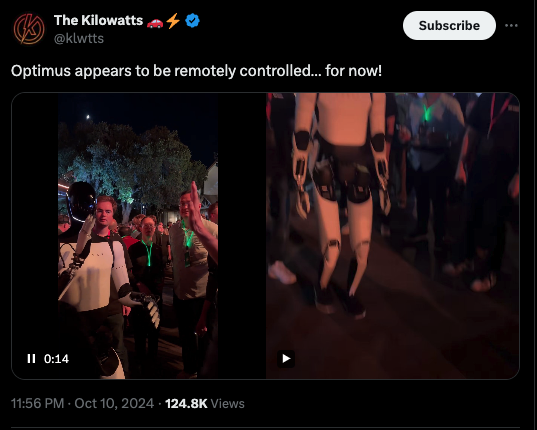
Join our daily and weekly newsletters for the latest updates and exclusive content on industry-leading AI coverage. Learn More Elon Musk’s publicly traded electric vehicle company Tesla, Inc. hosted its highly anticipated “We Robot” event on Oct. 10, 2024, at Warner Bros. Discovery Studios in Burbank, California and streamed it live on his social network X and YouTube. Despite showing off slick prototypes of a new “Cybercab” autonomous car without a steering wheel or gas and brake pedals, and a similarly sparse, art deco retrofuturistic “Robovan” capable of seating 20 passengers, the event was criticized by some prominent observers as being more style than substance. lt was lacking in precise details on timelines, costs and legal issues, and even came across as misleading in some cases. The most glaring example of potentially misleading information was Tesla’s move to have its still-in-development humanoid Optimus robots filling the venue space and interacting with attendees, even serving drinks at a bar. While some present assumed the robots were entirely autonomous, reports confirmed they were teleoperated — meaning controlled by a human in another room. “Not wholly AI? Not at all AI,” wrote venture capitalist Josh Wolfe, co-founder of Lux Capital on Musk’s social network X. “Totally worthy to celebrate low latency remote control but totally dishonest to demo these as autonomous robots—call it the parlor trick it is.” This skepticism raises questions about how far Tesla has truly advanced in developing artificial intelligence for robotics. While Musk touted the Optimus, Cybercab and Robotaxi as tremendously impactful inventions for society, EV reviewers The Kilowatts noted on X that much of the technology will remain “unbelievable” to investors and consumers until it is shipped. For now, Tesla’s vision of fully autonomous personal robots as well as new autonomous electric vehicle types remains more speculative than realistic. Here’s a summary of what was discussed: Cybercab: all autonomous and cheaper than a bus or Model 3? Credit: Tesla Perhaps the most expected of the announcements was Tesla’s Cybercab, a two-seater electric vehicle designed for autonomous operation. Musk described the Cybercab as a sleek, more compact version of the Cybertruck, and it will reportedly cost less than $30,000. That is below the current price of Tesla’s most affordable personal vehicle, the Model 3, which debuted at $35,000 in 2019 but has since seen its price rise to around $42,000. According to Musk, Tesla aims for the Cybercab’s operating cost to be between $0.20 and $0.30 per mile compared to the operational cost of a bus, which he placed at around $1 per mile. The vehicles would be powered by inductive (wireless) charging, eliminating the need for plug-in charging stations and further integrating autonomous cars into the urban landscape. The promise of an individualized “mass transit” future has long been part of Musk’s vision, and the Cybercab is a key component of that goal. During the event, Musk proudly displayed 20 Cybercabs driving autonomously around the venue. He emphasized that the Cybercab is part of a broader effort to make cities safer, cleaner and more efficient. Tesla’s AI Vision system, trained on millions of cars, allows these vehicles to operate without the fatigue and distractions that affect human drivers. Musk claimed that Tesla’s autonomous technology could eventually make driving 10 to 30 times safer than human operation. He also floated the idea that autonomous car owners could manage fleets of vehicles, offering ride-hailing services similar to Uber or Lyft. This business model, if successful, could reshape the gig economy and create new opportunities for individuals to generate income. However, while the Cybercab’s debut was met with enthusiasm, industry insiders raised concerns about the lack of concrete details surrounding its rollout. Musk indicated that production on the Cybercab would begin between “probably” in 2026 or “before 2027,” but admitted he “tend[ed] to be a little optimistic with timeframes.” Indeed, Tesla has historically struggled with meeting deadlines for its more ambitious projects such as its Full Self-Driving (FSD) and even shipping the Cybertruck, which Musk at one point suggested would be waterproof enough to act as a boat for short journeys (it is not and cannot). As Washington Post technology journalist Faiz Siddiqui noted on X, the entire We, Robot event livestream was preceded by a heavy disclaimer from Tesla stating, in part, that “Forward-looking statements are based on assumptions with respect to the future, are based on management’s current expectations, involve certain risks and uncertainties, and are not guarantees. Future results may differ materially from those expressed in any forward-looking statement.” While the vision of affordable autonomous transportation is compelling, much remains uncertain about when—or if—Tesla can deliver on these promises. Robovan: Tesla’s answer to buses, trains, and mass transit Credit: Tesla Another key reveal at the event was Tesla’s Robovan, a large autonomous vehicle designed to transport up to 20 passengers or goods. Musk positioned the Robovan as a potential solution for high-density urban transport, hinting at a future where autonomous shuttles replace conventional buses. The Robovan represents a vision of more efficient, less congested cities where autonomous vehicles run frequently enough to eliminate the need for large, underutilized parking lots. Musk suggested that, over time, cities could convert parking spaces into parks, improving the quality of life in urban areas. Some technology observers such as Brian Roemmele on X were overjoyed at the news, especially the Robovan’s sleek, striking art deco design, even predicting that “100s of 1000s” or hundreds of thousands of people would be living in Robovans converted into mobile homes by 2031. Credit: Tesla Despite these ambitious goals and praise, critics were quick to point out that Tesla offered no specific timeline for the Robovan’s production. X user Facts Chaser noted that while Tesla unveiled a prototype, China already has operational autonomous vans in real urban environments. Tesla Full Self-Driving coming to Texas and California next year? A recurring theme at the We Robot event was Musk’s long-held belief that autonomous vehicles will revolutionize urban life by reducing traffic, improving safety and reclaiming public