BYD's first purpose-built global plug-in hybrid breaks cover

BYD has lifted the covers off of the new Dolphin G DM-i, a car that essentially becomes its first proper global offering. With it, the auto brand looks to take on the regional players across markets; whether that be Chery and Tata in Asia, Tesla in the States, VW and Toyota in Europe, among others. It is a VW Polo-sized plug-in hybrid hatchback, which means there’s an electric motor working the front wheels as well as a petrol engine in there. Pricing? Tipped to start under £20,000 (US$27,000 per direct conversion). Sure, take a long, hard look at it and you’ll immediately realize the Dolphin G DM-i looks a lot like the Atto 2. And it looks like BYD has purposely used the Atto platform and fitted it with the Super Hybrid with DM technology for two key reasons: it meets key regulations for global use, and second, BYD could simply save some cash by using a platform that’s so well known by now. The Dolphin G DM-i is a VW Polo-sized PHEV hatchbackBYD The biggest selling point? A range of over 621 miles (1,000 km) on a full charge and a full tank of petrol. While we don’t yet know the specifics behind the DM-i system, it’s widely rumored that it will be largely based on the one found on the Atto 2 DM-i, which uses a 1.5-liter normally aspirated gas engine for the ICE motor. So far, all that we do know is that it will sport a front-mounted single-motor setup. Interestingly enough, BYD’s Seal 5 DM-i and the Sealion 5 DM-i make use of those same powertrain setups, so expect a fairly similar performance. As for the battery, it is expected to come with two LFP battery pack options – 7.8 kWh and 18 kWh, exactly like the Atto 2 DM-i. It will arrive as a sibling to the Dolphin Surf, BYD’s smallest and most affordable all-electric car sold in global markets. The Dolphin G DM-i boasts a range of over 621 miles (1,000 km)BYD The PHEV measures 164 in (4,160 mm) in length by 72 in (1,825 mm) in width, which effectively places it perfectly in the European B-segment category. Up front, it gets thin, sharp headlights with a hood that seems to be stretched out, akin to the Sealion 6. The wheels are blacked out, which gives it a nice sporty feel, especially with that orange paint scheme in the promo shots. The same color-matching accents are carried over inside the cabin as well. As for the features and other performance metrics, BYD seems to be holding those close to its chest for the moment. The Dolphin G DM-i is BYD’s first purpose-built global plug-in hybridBYD The Dolphin G DM-i is set to go on sale in Europe in the coming weeks, with deliveries slated for later this summer. Keep in mind, it comes from a carmaker that overtook the likes of Tesla, Kia, and others to become the best-selling EV brand in the UK, Australia, and a few other global markets in the first quarter of this year. Source: BYD source

BYD's first purpose-built global plug-in hybrid breaks cover Read More »

Dow Jones Futures Rise As Trump Says This After Iran, Israel Attacks; Apple AI, SpaceX IPO Ahea

Dow Jones futures turned slightly higher Monday morning, while S&P 500 futures and especially Nasdaq futures rose. President Donald Trump demanded that Iran and Israel “stop shooting” after they exchanged missile attacks, later saying that the countries are “looking to do” a new ceasefire. Oracle (ORCL) earnings, Apple (AAPL) AI announcements and the long-awaited mammoth SpaceX (SPCX) IPO are on… Copyright ©2026 Investor’s Business Daily, LLC. All rights reserved. 87990cbe856818d5eddac44c7b1cdeb8 source

Dow Jones Futures Rise As Trump Says This After Iran, Israel Attacks; Apple AI, SpaceX IPO Ahea Read More »

'Space smoothies' may help astronauts stomach long missions

Sure, space travel sounds exciting, but space travelers are still workers – workers who could ordinarily go to restaurants for lunch or go home for dinner. And while the dining habits of cosmonauts, astronauts, taikonauts, and other void-venturers might seem trivial to us Earth-bound folks who’ll never get to traipse among the stars, space travelers do face serious complications from their truly risky missions in which they sacrifice days, months, or even years away from family, friends, and Earth to expand our knowledge and prepare a multiplanetary future for humanity. One such risk is “space anorexia,” the failure of space travelers to consume sufficient calories due to factors including disruption in circadian rhythms. That caloric deficit drives bone loss and muscle shrinkage. Then there’s the psychological barrier of knowing your meals will be repetitive, or worse, if certain experiments prove practical, that your last … uh… output … could become your next input. So, if not the answer, could space smoothies be an answer? In a paper recently published in ACS Food Science & Technology, researchers from Australia’s University of Adelaide and the UK’s University of Nottingham discuss how creating a space-based smoothie bar will fight flavor fatigue while incorporating essential omega-3 fatty acids. To overcome the morale-withering blahs of dried, shelf-stable foods and the ick of squeeze-tubes, the researchers designed emulsified drinks stable in microgravity with a choice of flavors and sweetness levels. “Fortified beverage emulsions could potentially help there, especially when providing nutrients at levels not met by normal nutrition,” says first author and co-lead Svenja Schmidt, a researcher in the School of Chemical Engineering and the ARC Centre of Excellence in Plants for Space at Adelaide University. “We suggested omega-3 fatty acids to help protect against space radiation and increase the bone formation rate.” Focusing on creating stable mixtures with water-soluble substances such as sugar and oil-soluble ones such omega-3 fatty acids, the team developed a capillary-force system for emulsifying small amounts of water and oil. According to co-lead Volker Hessel, this microfluidic system will work in microgravitic environments such as that of Artemis missions and the International Space Station. While Schmidt and her team aren’t quite ready to open their own line of space-based Jamba Juice outlets, they have experimented with various blends of fish oils, fruit acids, coconut fats, emulsifiers, flavorings, and, of course, sugar, to craft six customizable recipes, which in a 330-mL (11-liquid-ounce) serving offers up to a third of daily required omega-3 fatty acids. As soon as feasible, the team will send its space smoothies on an actual mission so crew members can report their taste and mouth-feel in microgravity, and evaluate how long the components will last. After all, who wants to haul a shipping container of smoothie mix to Ceres or Titan if after a few months it blends and tastes like sawdust? Regardless of the results, Hessel says that “being one small piece in the big puzzle of human space exploration and helping astronauts to stay healthy is a visionary privilege.” Of course, space food has greatly advanced since the days of tube-food and chalky ice cream. Dehydrated and canned foods are common, and Russian cosmonauts on the ISS currently enjoy any of a whopping 450 dishes including beef tongue with olives, cottage cheese with sea-buckthorn, and – stereotype alert – goulash and borscht, while trading cottage cheese for shrimp from US astronauts, and sashimi and ramen from Japanese uchuu-hikoushi (宇宙飛行士). And while in North America there’s hardly a tiny town without its own Chinese restaurant, aboard their very own space station Chinese taikonauts feast on yuxiang pork, Kung Pao chicken, freshly roasted chicken wings and steaks, eight-treasure rice, fresh fruit including apples and grapes, fresh lettuce from their own space garden and, of course, moon cakes. But smoothies would still be pretty nice, too. Source: American Chemical Society source

'Space smoothies' may help astronauts stomach long missions Read More »

We hung out with around 100 robots – and here are the bizarre highlights

Humanoids may be winning marathons and getting factory jobs, but after spending a few days with around 100 different robots of all shapes and sizes, one thing was clear: There’s a chasm separating viral demonstration video and reality. At the recent InnoEX technology expo in Hong Kong, humanoids, robot dogs and everything in between were all vying for the attention of attendees. But the three-day conference – a test of endurance even for us humans – revealed at once the impressive advancements made in this industry and the hurdles it still faces to meet the hype. As this 2026 study showed, the better bipedal robots get at autonomous operation, the more their movements drain existing energy supplies. Make no mistake, from what I’ve seen in the last six months, China is leading the way, but even now the most advanced humanoids are hampered by battery power. That said, some of the models on display showed incredible hand dexterity and joint movement – when they were charged up, anyway. Here are some of our favorite moments, with many more in the gallery. Shenzhen DX Intech Technology won my imaginary “uncanny valley” prize for its set of robots, which were eerily human-like except for the part where they glided around on their wheeled-base. I particularly liked this one, probably because I’m a Swifty and it’s heavily late-Eras-Tour coded. The Chinese company is aiming to roll (no pun intended) these robots out into the service industry in customer-facing roles. Linkerbot is expected to dominate the humanoid hand market – and deservedly soNew Atlas Beijing’s Linkerbot showed why it’s dominating the dextrous-limb department with a humanoid band. The dancing model from Humanoid out front (see below video) captured most of the attention, but this company is one to watch. It says it produces hands with the most degrees of freedom to date, and I didn’t see anything to make me doubt it. The hands were honestly one of the highlights for me. Humanoid puts on a show in Hong Kong Another Beijing company, Galbot, had its G1 model on display, showing how it could get items you order from a screen off a shelf and deliver it, occasionally tossing it at you across the bench to keep you on your toes. Galbot’s G1 can retrieve items from shelves and deliver them to customers. But the experience felt a little like ordering a snack from a sleep-deprived convenience-store worker at 3amNew Atlas Meanwhile, Shenzhen startup EngineAI can be forgiven for tiring out its PM01 humanoid. I happened to walk by a “robot shop” a few days later in its home city and was really impressed by its agility and fluidity of movement. But sometimes it’s good to see the future looking like an exhausted call-center worker forced to wear business attire to the office. That said, this company is definitely one to watch. Also from Shenzhen, the more well-known UBTech had its Walker S2 model on display, but it was also taking a snooze in the upright position. It’s a safe bet that we’ll be seeing more of this company in the comping year, given that its sales and push for rapid AI advancement have it positioned as one of China’s leading robot-makers in 2026. UBTech’s Walker S2 had clearly walked enough by the time I found itNew Atlas Multi-day expos are surprisingly taxing, and this AgiBot humanoid captured how I was feeling on the final day. While I sadly missed the demo sessions for this one, it’s another to keep a close eye on. The company was founded just three years ago by former Huawei engineers Deng Taihua and Peng Zhihui. AgiBot’s humanoid seemed far too relatable on InnoEx’s third dayNew Atlas Finally, a couple of clips that continue to haunt me – the first for obvious reasons, and the second, when I had Unitree’s Go2 robot dog follow me and ask me to shake its paw, and I forgot what that was so instead tried to high-five it. In the same week I collided with a food delivery robot while turning a corner in a Shenzhen hotel hallway and saw restaurant staff roll their eyes at a machine colleague taking dishes to tables with chaotic energy. The robots are undoubtedly coming, but they have a long way to go yet. Shenzhen DX Intech Technology puts on a show Robot dog outsmarts human Source: InnoEx source

We hung out with around 100 robots – and here are the bizarre highlights Read More »

Coreless carbon valve stem says sayonara to breaks and clogs

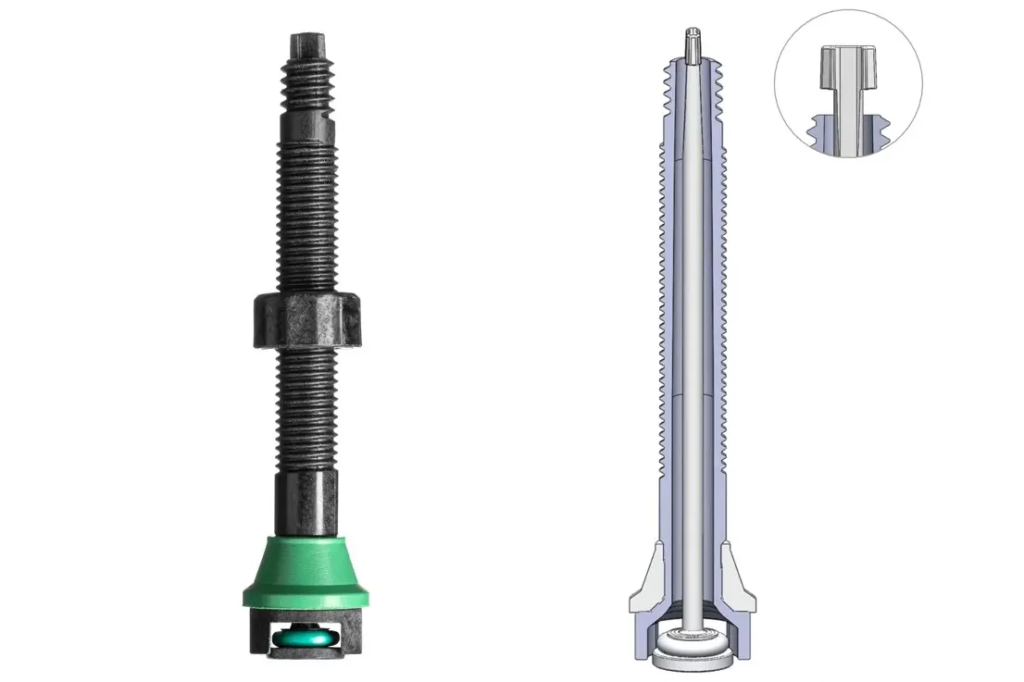
Presta valves are one of those things that a lot of serious cyclists use, but perhaps secretly hate. Well, those folks might have a much more loving relationship with the Aether valve stem, which does away with a traditional Presta valve’s problematic core. So first of all, why do most “fancy” bikes even have Presta valves in the first place? Among other things, they’re better than Shrader valves at maintaining high air pressure, they’re lighter, and they’re narrower. And because they’re narrower, the holes that are drilled in the rims for them are smaller, and thus less likely to compromise the integrity of narrow road bike rims. Additionally, their cores can (usually) be removed, allowing sealant to be injected through them into tubeless tires. Those cores, however, are annoyingly fragile – they frequently get bent or even snapped right off, plus they can can become clogged with sealant. That is where the Aether valve comes in. It’s manufactured by UK firm absoluteBLACK, which also makes a graphene-based chain lube. An X-ray view of the Aether valveAbsoluteBLACK The carbon fiber composite device replaces the core with a rubber plunger mechanism that sits at the bottom of the stem inside the rim cavity. When the tire is being inflated, the air pressure pushes the plunger out of the way, allowing air to flow through into the tire. Once the pumping stops, the air pressure within the tire presses the plunger back up into a sealed position. By absoluteBLACK’s own admission, this setup is similar to bottom-sealing valves such as Fillmore and Peaty’s, which are in turn based on a concept dating all the way back to 1915. The Aether valve is reportedly much simpler in design, however – it has just two primary functional components, the stem and the rod-plunger assembly – so it’s said to be significantly less likely to clog. The Aether is compatible with all rims and pumps designed for Presta valvesAbsoluteBLACK At a claimed weight of just 2.6 to 3.1 grams, it’s also lighter than other alternatives. And, because there’s no core restricting the air flow, users should actually be able to seat tubeless tires via a regular floor pump. The simplicity of its design does have one tradeoff, however – it is not serviceable, so the whole thing has to be replaced once it stops working. The Aether valve stem is designed for road, gravel and mountain bikes, and is available in sets of two for US$29.95. Presta-frustrated cyclists might also want to check out the CoreCap and the Clik Valve. Source: absoluteBLACK source

Coreless carbon valve stem says sayonara to breaks and clogs Read More »

Dow Jones Futures Fall As Trump Says This After Iran Attacks Israel; Market Rally Faces First Real Test

Dow Jones futures fell slightly Sunday night, while S&P 500 futures and Nasdaq futures rose modestly. President Donald Trump demanded that Iran and Israel “stop shooting” after they exchanged missile attacks. Oracle (ORCL) earnings, Apple (AAPL) AI announcements and the long-awaited mammoth SpaceX (SPCX) IPO are on tap this week. The stock market saw ugly action to close out last… Copyright ©2026 Investor’s Business Daily, LLC. All rights reserved. 87990cbe856818d5eddac44c7b1cdeb8 source

Dow Jones Futures Fall As Trump Says This After Iran Attacks Israel; Market Rally Faces First Real Test Read More »

Litigation Finance: An Industry at a Crossroads

The modern litigation finance market expanded rapidly from a niche practice into a multi-billion-dollar asset class. Early funders deployed non-recourse capital into individual cases in exchange for a share of any recovery, often bearing the full downside risk in pursuit of a portion of proceeds. This approach proved effective in establishing the market. It enabled claimants without financial resources to pursue litigation, extending beyond the traditional contingency-based model used by law firms, while offering capital providers the prospect of uncorrelated, potentially high and repeatable returns. However, the structure of that model, shaped by the industry’s origins, also embedded many of the challenges now coming to the surface. Early underwriting emphasized case merits and probability of success. While necessary, this approach often placed less emphasis on portfolio construction, capital allocation across cases, and the pricing of duration. In practice, investment decisions frequently resembled legal analysis rather than institutional underwriting. A related question historically was why law firms themselves did not become the primary risk transferees. While some smaller firms operated on contingency, larger firms were generally not structured to absorb sustained downside risk, given overhead and business models. This gap helped give rise to dedicated litigation funders, entities combining legal expertise with capital provision, but often retaining a legal, case-by-case approach to risk. The case-by-case, venture-style model reinforced these dynamics. Returns depended heavily on binary outcomes, and duration, the time required for cases to resolve, was not systematically incorporated into return expectations. As the market scaled, these design choices came under pressure.Courts have increasingly scrutinized funding arrangements. The UK Supreme Court’s PACCAR decision determined that litigation funding agreements entitling funders to a percentage of damages could fall within damages-based agreement regulations, rendering many existing agreements unenforceable.  Subsequent rulings in the Competition Appeal Tribunal, including the refusal to certify collective proceedings in Riefa v. Apple and Amazon, highlighted concerns that success fees could generate excessive returns for funders, that payment structures could prioritize funders over claimants, and that confidentiality provisions could limit transparency. These developments reflect underlying structural tensions. Funding arrangements can create misalignment between funders seeking higher returns and claimants seeking timely resolution. Courts, recognizing these dynamics, have shown a willingness to intervene. Duration risk has also become more visible. Litigation timelines frequently extend beyond expectations, tying up capital without additional compensation under traditional models. Taken together, these factors are reshaping how litigation finance is evaluated by allocators, structured by fund managers, and supported by insurers. source

Litigation Finance: An Industry at a Crossroads Read More »

Reusable bricks could build and rebuild houses like Lego

Demolition of old structures at the end of their service life results in large amounts of waste and carbon emissions, not to mention the labor involved and the cost of producing new materials. According to official statistics, construction and demolition waste accounts for more than one third of all waste generated in Europe. A team from Austria’s Graz University of Technology (TU Graz) questioned if there might be a better, more sustainable approach to dealing with old brick buildings. What if instead of being demolished, they could be carefully deconstructed, so that the bricks could be reused in future construction projects? This concept is similar to taking apart a Lego structure and rebuilding it elsewhere with the same parts. Obviously, using conventional mortar is not going to work in such a case. Instead of binding bricks together permanently, the researchers developed prefabricated brick wall elements connected through so-called reversible joints. As of now, there is unfortunately not much information disclosed about the design or any technical details of the reversible joints. We’ve reached out to the researchers, but are still waiting to hear back. The test structure, after it had initially been built from the reusable bricksIBPSC – TU Graz The bricks used in the project are 44 cm (17.3 in) thick and contain insulating wool for improved thermal performance. These wall elements are pre-plastered at the factory, which reduces the amount of work required on the construction site. One of the main goals behind the project was to reduce emissions from construction materials, and, according to project manager Hans Hafellner from the Institute of Building Physics, Services and Construction at TU Graz, the results look very promising. “The results of our research to date show that a significant proportion of total emissions can be avoided during the second phase of use through reuse by developing an innovative jointing solution,” he says. “Considering three life cycles, CO₂ emissions can be reduced by around 60% compared to conventional construction methods.” Permanent mortar is what typically provides structural stability to a whole building, and since it could not be used, the engineers at TU Graz had to develop alternative methods to ensure the same safety standards. This became one of the main challenges for the research team, and they came up with two solutions: stability can be achieved either through a roof that is heavy enough to stabilize the entire structure, or through vertically pre-stressed threaded rods that run through the bricks. Both methods reportedly provide the necessary structural strength, meet all safety regulations, and still allow the walls to be dismantled when required and reused for new buildings. The test structure after being fully reassembledIBPSC – TU Graz The idea was tested using a demonstrator building. After being dismantled and reconstructed at a different location, the new structure was fully functional and met all the requirements. The concept of a circular economy is at the core of this project, which means that resources can be reused multiple times instead of just creating more waste. If adopted on a global scale, this solution will not only have a positive impact on the environment but also benefit the economy by increasing the residual value of buildings at the end of their service life. Source: TU Graz source

Reusable bricks could build and rebuild houses like Lego Read More »

Pilot-controlled TaxiBot could slash aircraft ground emissions by 80%

To cut costs and emissions, Amsterdam’s Schiphol Airport is rolling out a pilot program using a semi-robotic ground tug called TaxiBot that allows pilots to taxi airliners around the airport without using their main jet engines. According to the Royal Schiphol Group, about 68,770,805 passengers pass through Amsterdam Schiphol Airport every year. That puts it fourth in Europe by passenger traffic and 17th worldwide, but it’s worth wondering how many understand all the bumps, whines, lurches, and howls involved in moving an aircraft from the gate to takeoff. You may hear what sounds like a jet engine running as the doors close, but it’s actually the Auxiliary Power Unit (APU), a small turbine housed in the tail cone that provides electrical power to the aircraft’s systems and compressed air to the main engines. The engines remain offline as the airliner is pushed back from the gate by a vehicle called a ground tug that’s attached to the nose gear. TaxiBot is being tested at Amsterdam Schiphol AirportSmart Airport Systems As the aircraft moves backward, the pilot starts each of the primary engines and brings them up to a stable idle. Once on the boundary of the runway ramp, the tug stops and disconnects. The nose-gear steering bypass pin is removed, the pilot regains full steering control, and the aircraft begins moving under its own power, taxiing to the runway threshold before lining up for takeoff while passengers wonder what’s taking so long. So far, so standard procedure. The problem is that powering up the engines, idling them, and then using their massive power just to trundle around the tarmac is scarcely economical. In fact, it burns a surprising amount of fuel for a task that requires very little power, while also generating significant emissions. It’s a problem that has long been recognized, and there have been a number of attempts to solve it. Most, however, rely on extremely expensive and specialized ground systems that pull airliners around like trams, which tends to defeat the purpose. The TaxiBot’s human crew is only for safetySmart Airport Systems Built by Smart Airport Systems (SAS) in cooperation with TLD and Israel Aerospace Industries (IAI), TaxiBot is a semi-robotic, pilot-controlled towing vehicle designed for “engines-off” taxiing, and it’s now being tested at Schiphol in partnership with EasyJet, Airbus, and Menzies Aviation using a dedicated fleet of EasyJet Airbus A320neo aircraft. TaxiBot may look like a conventional ground tug, complete with a cab and crew, but the human element is there largely for safety and regulatory compliance. What the new vehicle does is take over the initial pushback operation. However, instead of the pilot starting the engines during pushback and the tug disconnecting afterward, TaxiBot remains attached to the nose gear via a specialized pivoting clamping platform. Here’s the clever bit. Instead of starting the engines during pushback, the pilot leaves them off while the electric-powered TaxiBot tows the aircraft across the airport. The pilot remains in control, steering via the cockpit tiller and pedals. This setup uses the aircraft’s existing control interfaces and requires no structural modifications to the airframe or avionics. More importantly, the engines only need to be started shortly before reaching the active runway threshold. That potentially reduces taxi-related emissions by up to 80%, according to the developers. Once the plane is in position, TaxiBot disconnects and the aircraft proceeds with takeoff as normal. All while passengers continue wondering what’s taking so long and why airline seats are so uncomfortable. Source: Smart Airport Systems source

Pilot-controlled TaxiBot could slash aircraft ground emissions by 80% Read More »

SIA tightens Business Class seat selection rules, links access to fare type and KrisFlyer status

Singapore Airlines has revised its Business Class advance seat selection policy, introducing fare-based and membership-linked access tiers from 2 June 2026, in a move it said is aimed at balancing commercial considerations with customer needs. The updated framework differentiates seat selection privileges based on both fare type and status within KrisFlyer. The airline said the changes apply to all seat selections made on or after 2 June 2026, regardless of when tickets were purchased. Under the revised policy, PPS Club members, alongside customers booked on Business Flexi or Business Standard fares, will continue to have access to any available seat at the time of booking. Don’t miss: Re-writing a contract of trust: Why SIA’s KrisFlyer overhaul feels personal In contrast, passengers travelling on Business Lite fares, as well as Saver or Advantage award tickets, will only be able to select from a more limited range of seats during booking. SIA said the segmentation reflects ongoing adjustments to seat availability “for commercial reasons”, while still taking into account customers with specific needs. The airline clarified that all seat selections made before 2 June 2026 will remain unaffected, regardless of fare type or membership status. Customers can view seat maps, select seats, or make changes through the “Manage booking” function on the airline’s website or via the SingaporeAir mobile app. SIA apologised to customers if their preferred seats are unavailable under the revised structure, noting that availability may vary depending on fare category and timing of selection. The latest seat selection changes come against a backdrop of wider adjustments to SIA’s loyalty ecosystem. SIA previously unveiled a major revamp of its KrisFlyer programme, which introduced higher mileage requirements across several redemption categories. From 1 November 2025, miles required for Business and Suites/First saver awards for flights within Asia and the Southwest Pacific increased by 5%, while Economy Saver awards in the same region were reduced by 5%. For long-haul routes, flights to and from Europe and the United States saw a 5% increase in saver award rates across all cabins. Meanwhile, flights to Africa, the Middle East and Turkey rose by 10% to 20%. Related articles: Singapore Airlines kicks off FIFA World Cup 2026 at 30,000 feet   Singapore Airlines turns Miffy into its cutest co-pilot    AIA taps Singapore Airlines Academy to elevate customer experience and talent skills source

SIA tightens Business Class seat selection rules, links access to fare type and KrisFlyer status Read More »