Third time's the charm? Titanium wrenching multitool is back in 3rd-Gen form

Over the past few years, the team at tool company IF has successfully launched two wrench-based multitools on Kickstarter. Their latest release, the OmniPro Wrench 3.0, combines elements from both earlier versions and also has a few added features. One of the common issues with EDC (everyday carry) tools is that they are either too small to function effectively as real tools, or too bulky to be carried comfortably for “just in case” situations. The OmniPro wrench sits right between those two extremes and seems to balance compact size and functionality pretty well. The first generation model focused mostly on compactness, while the second one added more functions. For the third generation, the creators considered all the feedback from earlier backers and attempted to implement some of the most requested additions. Those included a better grip, an extension rod, protective blade groove, and a fully integrated magnetic system. The various components of the OmniPro 3.0IF In total, the 3.0 combines 15 functions into a compact body measuring 104.5 x 46 mm (4.11 x 1.81 in) and weighing 174 g (6.14 oz). Features include a magnetic eternal pen, ruler, #11 scalpel blade, bottle opener, ceramic-bead glass breaker, bit driver, caliper, and adjustable wrench with a 0-18 mm capacity. The shape of the tool is one of its most interesting characteristics. It almost feels like a tiny Lego set, where every part is moving, rotating, twisting, extending, and transforming into different tools. The OmniPro Wrench 3.0 also includes modular storage for six bits of different sizes and eight tritium slots. Both the extension rod and modular bit storage use a magnetic snap-and-lock system. A few accessories also rely on magnetic attachments as well, including the pen, bit drivers, bit storage, and ratchet holder. The 3.0 is made from CNC-machined titaniumIF Its ratchet can operate in both directions, and can also be positioned at three different angles. In earlier versions, users had to remove the ratchet head to reverse direction, but the new version features a quick-switch mechanism instead. Another update requested by backers was the addition of the extension rod, which improves access to tighter spaces. The bottle opener has also been moved away from the wrench jaws to the rear for better grip and stability. The side-mounted #11 scalpel blade includes a finger groove designed to make it safer to deploy and use. Backers can choose between Sandblasted Titanium and Black PVD finishesIF The tool is made from Grade 5 titanium and is also CNC machined, meaning there are no sharp edges or rough spots on the tool. It can be carried in a pocket or attached to a belt with a leather carrying case sold separately. The wrench is available in Sandblasted Titanium and Black PVD finishes. The full package, which also includes four 4-mm (1/6-in) and six 6-mm (1/4-in) bits, will cost US$309 for early Kickstarter backers, with a planned retail price of $518. Shipping is currently planned for September, assuming the campaign is successful. OmniPro Wrench 3.0 — Titanium Multi-Tool Wrench System Source: Kickstarter Note: New Atlas may earn commission from purchases made via links. source

Third time's the charm? Titanium wrenching multitool is back in 3rd-Gen form Read More »

When Tech Dominates EM, Passive Is No Longer Neutral

For decades, emerging markets traded as a macro asset class, a leveraged expression of the dollar cycle, domestic growth, and external balances (we discuss this further in 10 Rules of Country Selection in Emerging Markets). Today, the EM equity index looks very different. It has become increasingly dominated by a few mega-cap technology companies whose fortunes are tied more closely to AI investment and global supply chains than to traditional EM macro drivers. Yet many global allocators still approach EM as a macro asset class tied to currencies, domestic growth, and external balances. This creates a growing disconnect: in its current form, the EM index increasingly functions as an indirect play on global technology investment and US-led AI capital expenditure. As a result, investors seeking diversification away from US equities may not achieve the intended outcome through passive EM exposure alone. Furthermore, research by Arslanalp et al. (IMF, 2020) highlights that benchmark-driven allocations can amplify the role of external factors at the expense of domestic fundamentals, increasing the risk of flows that are disconnected from local economic conditions. For allocators aiming to express macro views, a more targeted approach may be required. Active strategies, in this context, offer the flexibility to align portfolios with underlying macro drivers rather than with the backward-looking composition of the index. source

When Tech Dominates EM, Passive Is No Longer Neutral Read More »

OREO and BTS serve a cookie made for fans, not shelves

OREO is tapping into K-pop fandom culture with a new global collaboration with BTS, unveiling a limited-edition cookie inspired by Korean street food and fan engagement traditions. The campaign, which will roll out across more than 80 markets, introduces the “Limited edition OREO & BTS cookies”, a brown sugar pancake-flavoured OREO inspired by hotteok, a popular Korean street snack. According to the brand, the flavour was co-created with BTS members RM, Jin, SUGA, j-hope, Jimin, V and Jung Kook, drawing from the group’s childhood memories of eating both hotteok and OREO cookies. Don’t miss: From BLACKPINK to Pokémon: How OREO leverages partnerships in SEA for sweet success  The limited-edition cookies also feature 13 unique embossments designed by BTS to commemorate the band’s 13th anniversary. These include member names, a BTS light stick, and three OREO cookies that together reveal a hidden message for fans. In tandem, the packaging takes inspiration from South Korea’s street market culture, featuring visuals designed to reflect the sights, sounds and energy associated with Korean food markets. Beyond the product launch, OREO is also leaning into fan participation through a digital activation inspired by BTS fandom traditions. Starting 8 June this year, consumers can scan a QR code on the pack or visit the campaign microsite to submit digital letters to BTS as part of an initiative the brand described as an attempt to create the “world’s largest love letter” to the group. Fans who participate will also stand a chance to win exclusive OREO and BTS prizes. The collaboration is part of OREO’s broader strategy to drive cultural relevance through partnerships designed to generate conversation and fan engagement in an increasingly competitive snack market. The “Limited edition OREO & BTS cookies” will be available for presale from 1 June 2026 via OREO’s website, before rolling out at retailers from 8 June for a limited time. “At its core, this partnership is about shared passion. We’re uniting BTS’ incredibly dedicated fanbase with our own loyal OREO fans to create something genuinely new and exciting,” said Matt Foley, VP of marketing, OREO. He added, “It’s this commitment to uniting our fanbases that keeps us at the forefront of pop culture and demonstrates how a brand with a rich history can continue to lead the conversation.”   BTS said the collaboration held personal significance for the group, as OREO was a snack they grew up eating and still enjoy during studio sessions. The band added that the partnership also gave them an opportunity to share a taste of Korean culture with fans around the world through the hotteok-inspired flavour. The BTS collaboration also builds on OREO’s growing push into K-pop partnerships across Asia. Last year, the brand teamed up with BABYMONSTER for a limited-edition campaign that reimagined its signature “Twist, lick, dunk” ritual through a custom dance challenge and co-created cookie experience. At the time, OREO said the launch marked its first Southeast Asian cookie co-creation with a global artist. Related articles: LANEIGE gives Neo Cushion a glow-up with BTS’ Jin   Visa backs BTS comeback as worldwide sponsor of ‘ARIRANG’ tour    Samsung strikes BTS tour deal to put Galaxy at centre of fan experience source

OREO and BTS serve a cookie made for fans, not shelves Read More »

Taiwan officially opens the world's longest single-mast bridge

This week, Taiwan cut the red ribbon on a giant infrastructure project its own construction team once deemed “impossible:” the 3,000-ft-long Danjiang Bridge. The structure features a single-tower asymmetric cable-stayed design courtesy of Zaha Hadid Architects (ZHA), and is the longest of its kind in the world. Its form is said to minimize its visual impact and impedance of sunset views over the Tamsui River from popular spots nearby – and it’s engineered to withstand severe earthquakes too. This bridge spans the mouth of the Tamsui River near northern Taiwan, and connects Bali in New Taipei City with Tamsui district. ZHA noted that it would shave off 25 minutes of travel time between the two as commuters crossed the river. This render presents another view of the now-complete landmark spanning the mouth of the Tamsui riverZaha Hadid Architects The lone mast stands 656 ft (200 m) tall with a span of 1,476 ft (450 m), and the use of a single mast in this design minimizes disruption to the riverbed and the estuary’s aquatic ecosystem. The single-mast design reduces disturbance of the Tamsui riverbed and its surrounding aquatic ecosystemNorthern Region New Construction Branch Office, Highway Bureau, MOTC Taiwan The main roadway is roughly 233 ft (71 m) wide, with pedestrian and cycling pathways, as well as a lane for motor vehicles that’s now open, and a light rail line set to be operational later on. With its motoring lane and pedestrian and cycling pathways, the bridge reduces travel time between districts by 25 minutesNorthern Region New Construction Branch Office, Highway Bureau, MOTC Taiwan Capable of resisting earthquakes of magnitude 7 or above – a crucial feature given Taiwan’s location on active tectonic plates – the Danjiang Bridge incorporates a complex seismic support system that manages forces that act on it in vertical and horizontal directions. The Danjiang bridge incorporates a complex seismic support system that enables it to resist earthquakesNorthern Region New Construction Branch Office, Highway Bureau, MOTC Taiwan Vertical seismic forces are transferred directly to the foundation via pier supports and cable stays, while longitudinal and lateral horizontal forces are absorbed and dissipated using specialized hydraulic dampers, friction pendulum bearings, and synthetic rubber pads. The bridge looks stunning when lit up after dark, as it’s seen here during its opening celebrationsNorthern Region New Construction Branch Office, Highway Bureau, MOTC Taiwan Construction began in 2019 and was slated to conclude by 2024 – but the project faced numerous setbacks, including challenging weather conditions and labor shortages, which delayed its opening by two years. The build was budgeted at roughly US$400 million, though I imagine the prolonged construction might have bumped up the cost. At any rate, it looks worth it. Source: Highway Bureau, MOTC ROC via Business Wire source

Taiwan officially opens the world's longest single-mast bridge Read More »

DBS CEO Tan Su Shan replies to LinkedIn complaint mid-flight, wins industry praise

A DBS customer who took to LinkedIn to complain about a broken banking feature received an unexpected reply this week: a personal response from CEO Tan Su Shan while she was onboard a flight. Singapore-based customer Neelkamal Semwal aired his frustration over a DBS feature that had allegedly been non-functional for more than two weeks. In a now-deleted LinkedIn post published on 27 May, Semwal claimed a service allowing users to register their NRIC with their bank account had remained broken for over 15 days despite repeated attempts to resolve the matter through customer service. In screenshots seen by MARKETING-INTERACTIVE, Semwal wrote that “Even after complaining about it with customer care more than a week ago, they still haven’t either figured out how to fix this or just don’t care,” he wrote, while tagging both Tan and DBS chief information officer Eugene Huang directly. Don’t miss: Why StanChart’s ‘lower-value human’ layoffs became a PR problem, not just a job cuts announcement About an hour later, Tan replied publicly. “Just had my tech team check this out for you. Am on a plane but someone will definitely respond,” she commented. Semwal later updated the post to say the matter had since been addressed and thanked Tan for stepping in. “I got a call from DBS to help me in fixing this issue. According to them, it should be resolved very soon. Thanks to Tan Su Shan for the initiative. So, all fine here,” he wrote. The exchange quickly drew attention online, not just because the issue was resolved, but because of the image it painted: one of Asia’s most prominent banking CEOs personally responding to a LinkedIn complaint while in the air, earning praises from the industry for her quick response and for “leading from the front”, according to screenshots seen by MARKETING-INTERACTIVE.  The incident reflects a broader shift in how CEOs are increasingly expected to show up publicly and visibly online. Earlier in March, a study by media intelligence firm CARMA found that Tan emerged as Singapore’s most visible CEO across mainstream media coverage between October 2025 and January 2026, topping metrics for visibility, favourability and headline mentions while receiving zero negative coverage. According to CARMA, media coverage surrounding Tan largely framed her as a thought leader in digitalisation and AI, while spotlighting DBS’ work in generative AI and her growing profile as a corporate leader. The report also noted that coverage had moved beyond her succession from former DBS CEO Piyush Gupta, signalling that Tan had quickly established a distinct personal brand within months of assuming the role. The LinkedIn exchange further highlights how platforms such as LinkedIn are increasingly becoming public escalation channels for frustrated customers, particularly in Singapore’s corporate circles. Once largely reserved for networking and career updates, the platform is now also home to public complaints, corporate call-outs and customer service escalations directed at senior executives. And while CEOs personally stepping into customer complaints is still relatively uncommon, moments such as these increasingly shape how leadership is perceived online, especially at a time when visibility, responsiveness and accessibility are becoming closely tied to brand trust. A day later, Fortune named Tan the sixth most powerful woman in business globally and the highest-ranked executive in Asia on its 2026 list. The ranking recognised women leading some of the world’s largest companies across sectors including finance, technology and healthcare. Related articles:    DBS Foundation’s Karen Ngui says ageing isn’t the problem, outdated perceptions are Are podcasts the new boardroom? DBS thinks so Was the McDonald’s CEO’s Big Arch burger bite just a big act?   source

DBS CEO Tan Su Shan replies to LinkedIn complaint mid-flight, wins industry praise Read More »

SR-71 successor? Quarterhorse Mk 2.1 prototype cracks the sound barrier

The venerable Cold War SR-71 Blackbird may be looking nervously at its laurels after Hermeus’s latest Quarterhorse Mk 2.1 uncrewed prototype broke the sound barrier at Spaceport America over the White Sands Missile Range airspace in New Mexico in March 2026. To this day, the Lockheed SR-71 Blackbird holds a number of air records, including the official world airspeed record for a crewed, air-breathing jet aircraft when it reached Mach 3.32 in 1976; the absolute altitude record for sustained horizontal flight; and speed over a closed 1,000-km (621-mile) course. Added to this, it also set time-and-distance records for flights between New York and London; London and Los Angeles; Los Angeles and Washington, DC; Kansas City and Washington, DC; and St. Louis and Cincinnati. Not only could the high-altitude spy plane set such records, it could cruise at high supersonic speeds as a matter of routine while gathering intelligence for the US and NATO, all while reportedly outrunning more than 4,000 anti-aircraft missiles during its operational career. Quarterhorse 2.1 The Blackbirds were retired to museums three decades ago, but their legacy lives on as both an example and a challenge to modern aerospace engineers. Though it’s uncrewed, Hermeus sees its Quarterhorse project as both the spiritual and technological successor to the SR-71. The goal of the project is not only to build an aircraft capable of surpassing the Blackbird’s records, but also to act as a testbed for critical technologies needed for routine, sustained hypersonic flight. These include the company’s Chimera turbine-based combined-cycle (TBCC) propulsion system, which integrates a conventional turbojet engine with a ramjet to enable transitions from subsonic to hypersonic speeds. Hermeus’s approach isn’t to build a single airframe. Instead, its engineers have opted for rapid prototyping by building a series of aircraft, each designed to handle a specific phase of development – from taxi tests to takeoff and landing, and now supersonic flight – before eventually taking on the legacy of the SR-71. The Quarterhorse Mk 2.1 taking offHermeus The latest flight of the F-16 Fighting Falcon-sized Mk 2.1 took place 364 days after the maiden flight of the Quarthorse Mk 1, reaching a top speed of Mach 1.21. According to the company, data collected from the current tests will be used to develop the Mk 2.2 and Mk 2.3, moving toward sustained high-supersonic flight with the uncrewed Darkhorse multi-mission military aircraft and, ultimately, the Halcyon, a 20-passenger commercial hypersonic transport jet. “Our customers at the Department of War are paying close attention to how fast this program is moving,” said AJ Piplica, CEO and Co-founder of Hermeus. “This flight demonstrates a pace of execution that is extremely rare in modern aviation. Our country’s ability to deliver new asymmetric military capability at scale depends on teams that can solve hard technical challenges quickly. That’s exactly what we’re proving with each test flight we conduct and each new aircraft we build at Hermeus.” Source: Hermeus source

SR-71 successor? Quarterhorse Mk 2.1 prototype cracks the sound barrier Read More »

Watch: Disabled parrot takes up jousting to stay king of the keas

A disabled kea – a native New Zealand parrot – has invented a bizarre jousting technique that helped turn him into the undefeated alpha male of his group. While parrots are known for their smarts, this particular level of inventiveness to hold his place among peers shows real ingenuity and resourcefulness. In an international study led by the University of Canterbury, researchers discovered that Bruce, a disabled kea missing his upper beak, became the undefeated alpha male of his circus (the collective noun for these NZ birds). His secret weapon: Using his exposed lower beak as a tiny punching “sword” to joust with the other males. Bruce the disabled parrot learns to joust Yes, you read that correctly. A jousting kea. It’s the sort of inventive behavior that may be less surprising than it sounds. Kea (Nestor notabilis) are already famous for being among the world’s most intelligent and curious parrots, with a reputation for playful chaos that has made them legends across New Zealand’s South Island. These alpine-dwelling birds have been observed rolling snowballs, tossing objects back and forth, and enthusiastically investigating tourists’ cars and their belongings. Unfortunately for tourists, that curiosity often plays out at a cost; the birds have been known to peel apart rubber trim, rip off exterior pieces, and even puncture tires while the humans are off hiking. Nothing as tasty as a hiker’s car while the humans are out in the mountains It’s a brand of chaos made possible by the kea’s strong beak – with both the upper and lower halves working synergistically like a built-in multi-tool. Of course, parrots may be the best at chaos in the bird world, as we have reported on before – be it turning on public taps or rummaging through trash cans that humans have failed to lock them out of. Beyond vandal antics, their beaks play a vital role in the parrots’ day-to-day survival, such as climbing trees, foraging for and consuming food, and preening their feathers – an important part of keeping their plumage well-oiled and free of parasites. For a species so dependent on dexterity and curiosity, losing half of that tool should have been a major challenge for Bruce. But according to Alex Grabham, a postdoctoral researcher at the University of Canterbury and lead author of the study, this unusual and talented kea appears to have responded by rewriting the rules of the game. “Everything we know about animal contests predicts that the bigger, better-armed competitor should prevail,” Grabham says. “Missing his entire upper beak should have put Bruce at a serious disadvantage. “Yet Bruce, the only disabled bird in the group, was undefeated in his dominance interactions with other males,” he adds. “Bruce was the alpha male.” While most kea squabble by biting downward at each other, Bruce approaches conflict more like a tiny feathered knight defending his role as “top dog” in the circus. Instead of fighting like other kea, Bruce uses his exposed lower beak in a forward-thrusting attack style the researchers compare to jousting. “Bruce has not just found a way to compensate for his missing beak, he innovated a completely novel fighting style and turned it to his advantage,” says Grabham. It’s a strategy found to be remarkably effective. Over the course of 30 days, researchers observed 227 social conflicts within the group, including 36 dominance interactions involving Bruce and other males, with our beak-challenged boy coming out on top every time. They also found that rival kea consistently backed down or gave way to Bruce at feeding stations, reinforcing his status as the boss. The team also witnessed subordinate kea grooming debris from inside Bruce’s damaged beak – a benefit thought to be reserved for closely bonded birds only. All told, these payoffs result in Bruce having the lowest fecal glucocorticoid metabolite levels among the males, suggesting the parrot’s unusual adaptations may have ultimately made life within the group easier. In fact, four years ago, Bruce became a sensation in his home country when scientists captured him grooming himself with a tool – thought to be a kea world first. For all his tiny stabby theatrics, Bruce’s success story is not just about leveraging his disability. It could be the first known case of a disabled animal independently maintaining alpha status through behavioral innovation alone. After all, there’s a reason “pecking order” comes from the way birds establish hierarchies in their communities. Professor Ximena Nelson says the findings highlight just how adaptable intelligent animals can be when faced with physical challenges. “The flexibility of what animals can achieve is only truly understood when you look at behaviour and its underlying physiology in combination,” says Nelson. “Bruce’s success forces us to rethink what disability means for behaviorally complex species.” And here’s another kea video, because this is the cheeky mood we need leading into the weekend, courtesy of the Smithsonian Channel. These Birds Become Really Playful When They Hear This Sound | Smithsonian Channel This article was published in Current Biology Source: University of Canterbury Fact-checked by Bronwyn Thompson source

Watch: Disabled parrot takes up jousting to stay king of the keas Read More »

World's largest eVTOL just proved it can play nice with other flyers

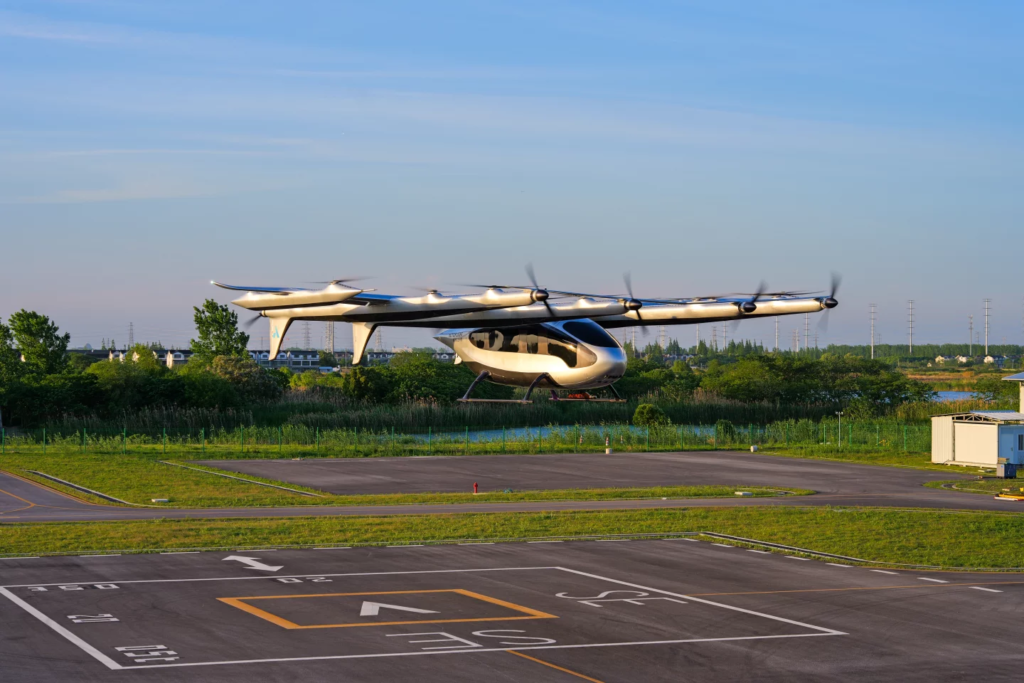
AutoFlight has completed a heterogeneous three-aircraft formation flight with the V5000 Matrix, a 5-metric-ton electric aircraft that could push eVTOL technology well beyond the urban air taxi niche. The mission – one V5000 Matrix flying in coordination with two V2000-series aircraft – validated cross-platform communication links, route planning, flight coordination, and safety control across 5-ton and 2-ton platforms simultaneously. Many eVTOLs making headlines are compact machines designed to ferry two or four passengers across a city center. AutoFlight is literally thinking much bigger. The V5000 Matrix spans 20 m (65.6 ft) wingtip to wingtip, stretches 17.1 m (56.1 ft) in length, stands nearly 3.3 m (11 ft) tall, and has a maximum takeoff weight of 5,700 kg (12,566 lb) – making it the largest publicly known, full-scale crewed eVTOL in development by sheer physical footprint. AutoFlight Matrix formation flight To appreciate how far ahead that puts the Matrix, consider the competition. The Lilium Jet, one of the widest eVTOLs ever designed with a wingspan pushing 14 m (45.9 ft), caps out at 3,175 kg (7,000 lb). Joby’s S4 – the furthest along in FAA certification – is smaller still, at roughly 2,400 kg (5,291 lb) and a wingspan of 14 m (46 ft). BETA’s ALIA and Archer’s Midnight both sit around 15-m (49.2 ft) wingspans. No other eVTOL currently flying or in late-stage development matches the Matrix’s wingspan-plus-length footprint. Unless one does, and it’s currently classified. The Matrix is a platform with two distinct personalities. The all-electric passenger version seats up to 10 in a business-class layout or six in a VIP configuration, with lavatories, climate control, ambient lighting, and oversized windows. AutoFlight compares its cabin experience to that of high-end business jets. Electric range is 250 km (155 miles). Back in February, this version completed a full transition flight at the Kunshan civil drone test base in China – moving from vertical takeoff to fixed-wing cruise and back to vertical landing. That’s a technical hurdle many next-generation aircraft designs have yet to clear. The formation test validated communication, route planning, flight coordination, and safety control across the VTOL platformsAutoFlight The cargo variant, designated V5000CGH, swaps pure-electric propulsion for a hybrid-electric system that dramatically extends its reach. Its 14-cubic-meter (494-cu-ft) hold fits two standard AKE containers – the same storage units used in commercial aviation – and carries up to 1,500 kg (3,307 lb) of payload. With that hybrid-electric system pushing it to 280 km/h (174 mph) over distances up to 1,500 km (932 miles), it sits firmly in regional logistics territory. AutoFlight has just announced that this flavor has officially entered the airworthiness certification process, signaling a move from R&D validation to a standardized regulatory approval path. The Matrix uses the “Lift and Cruise” composite-wing configuration AutoFlight has refined across previous models, including the Gen-4 Prosperity – the aircraft the company used in 2023 to set what was then the longest eVTOL flight on record, covering 250 km (155 miles). Six rotor rows handle vertical thrust during takeoff and landing, while the wings generate lift in cruise. Twenty lift motors run in parallel, and AutoFlight says the system remains safe even if two fail simultaneously. That redundancy matters when the aircraft is carrying 10 human lives or a metric ton and a half of valuable freight. The V5000 Matrix spans 20 meters (65.6 ft) and has a maximum takeoff weight of 5,700 kg (12,566 lb)AutoFlight The Matrix could eventually operate from the solar-powered floating airports AutoFlight unveiled in Shanghai last November – vertical takeoff and landing platforms installed on river or coastal barges. Pair that infrastructure with an aircraft of this size, and use cases will start to pile up, from disaster response to logistics in infrastructure-poor regions. Source: AutoFlight via PR Newswire source

World's largest eVTOL just proved it can play nice with other flyers Read More »

Samsung Ads plugs Eyeota data into CTV push for sharper household targeting

Samsung Ads Southeast Asia has partnered with global data technology firm Eyeota, a Dun & Bradstreet company, to overlay viewership insights from millions of Samsung Smart TVs with Eyeota’s consumer data for the first time. The move aims to help advertisers better reach relevant household audiences across Singapore, Thailand and the Philippines through connected TV (CTV) campaigns. The collaboration, which comes 18 months after Samsung Ads launched its free streaming service Samsung TV Plus in Southeast Asia, marks its first data partnership in the region. It combines Samsung TV’s scale and regional reach with Eyeota’s data network, strengthening Samsung Ads’ targeting capabilities. Don’t miss: How advertisers can deliver premium CTV ad experiences without overspending With the integration, advertisers can target audiences based on demographics, interests and behavioural signals, enabling more precise delivery of native and video ad formats on the largest screen in the home, as CTV adoption accelerates across Southeast Asia. “Our new partnership with Eyeota empowers advertisers to unlock the full potential of CTV. The combination of scale and unique audience segmentation gives brands greater confidence that their campaigns are reaching the right consumers to ultimately deliver better outcomes,” said Alex Spurzem, managing director Samsung Ads Southeast Asia and Oceania (SEAO). In tandem, Marc Fanelli, General Manager, Dun & Bradstreet sales and marketing services, commented, “Whether the goal is driving broad discovery or accurately converting intent into purchase, understanding CTV audiences and meeting them where they are watching is key to delivering campaign impact.” “Our work with Samsung Ads significantly increases accessibility for brands and advertisers, ensuring campaign budgets are spent reaching the audiences that matter most,” he added.  Samsung Ads has also been scaling its CTV ecosystem through existing infrastructure partnerships. Last year, it extended its multi-year global partnership with Publica by IAS, reinforcing an exclusive collaboration aimed at enhancing CTV ad experiences worldwide. The deal saw Samsung Ads continue leveraging Publica’s CTV ad server and unified auction technology to improve yield, optimise ad revenue and deliver a more seamless, TV-like viewing experience. Through Publica, Samsung Ads gives advertisers access to premium CTV inventory on Samsung TV Plus, the company’s free ad-supported TV (FAST) service streaming more than 700 channels in the US and 3,500 globally. Related articles: Marketers to slash display spend by 30% as AI and CTV redefine engagement: Forrester   Half of CTV viewers use the home screen as their guide – and brands are taking notice   LinkedIn ramps up video ad tools, launches First Impression ads and CTV upgrades for B2B source

Samsung Ads plugs Eyeota data into CTV push for sharper household targeting Read More »

Record-breaking apartment building 3D printed in just 34 days

Europe’s largest 3D-printed apartment building has been completed in France. Containing 12 social housing apartments spread across three floors, the project’s printing process was carried out in just 34 days. ViliaSprint² was created by developer Plurial Novilia, with designer HOBO Architecture, and printed by PERI 3D Construction using a COBOD BOD2 3D printer, which is the same type used in the previously covered 3D-printed data center and earthquake-resistant house. It’s positioned next to another very similar building by the same developer, which was constructed using traditional techniques and took three months longer to complete. ViliaSprint² was completed three months faster than a neighboring conventionally constructed buildingPlurial Novilia According to COBOD, ViliaSprint² is the first building in France in which both the load-bearing structure and all walls were printed directly on-site. The COBOD BOD2 printer extruded a cement-like mixture supplied by Holcim in layers to build up the basic shell. This printing was originally planned to last 50 days but took just 34 days in all, with three human operators overseeing the work. The rest of the build process, including traditional construction work by human builders like adding the roof, windows, and wiring, began in March 2025 and was completed in early 2026. “The curved facade and rounded floorplan are only economical because of 3D printing, complex geometries that would add significant cost with conventional formwork come at no premium,” says COBOD. “On-site concrete production further reduces transport emissions. The optimized form also saved approximately 10% of concrete volume. The building integrates perlite insulation, timber balcony structures, 500 sq m (5,400 sq ft) of photovoltaic panels, and a hybrid gas/heat pump system by Atlantic Systèmes, achieving around 60% energy self-sufficiency in compliance with France’s RE2020 2025 [green building] targets.” The interior consists of 800 sq m (8,611 sq ft) of living space, spread over the three floors. Each of the dozen social housing apartments also comes with its own balcony. Each of the apartments in ViliaSprint² opens onto its own balcony areaPlurial Novilia As far as we can tell, the ViliaSprint² could actually be the world’s largest 3D-printed apartment building, but with this construction space being so decentralized and fast-moving, perhaps we’ve missed one. Let us know in the comments if you know of something larger. Looking to the future, Plurial Novilia and its partners are planning another larger project containing approximately 40 apartments using two 3D printers simultaneously. The aim is to reduce print time by a factor of four and lower costs to that of conventional construction. Sources: Plurial Novilia [in French], COBOD source

Record-breaking apartment building 3D printed in just 34 days Read More »