VW reinvigorates US van life with first new camper van in decades

Volkswagen withdrew its classic Transporter vans (Eurovan) from the American market after the 2003 model year, thus putting a fast end to a romantic decades-long era of great American road trips. The tiny, breezy VW camper vans that had symbolized the open-ended freedom of the road were no more … at least so far as brand-new models were concerned. The American camper van industry was never quite the same after that, scrambling its way upmarket to larger, more customized vehicles that now commonly price above luxury SUVs. But that dark near-quarter century of American RV history is coming to an end as Volkswagen announces a new factory camper van. Before getting too excited, we must point out the catch: Volkswagen is installing its camper package into the ID. Buzz. You remember, that little electric van that Americans seemed excited about right up until it was available stateside and they became vigorously disinterested. V-Dub sold a mere 7,300 ID. Buzz units in North America in 2025 before putting the model on hold for MY2026. Unless you follow automotive news daily, you might not have even realized the ID. Buzz was missing. Actually, unless you live somewhere with an uncommonly high Buzz concentration, you might not have even known it launched at all. I’ve spotted maybe two or three ID. Buzz vans locally over the past year, a fraction of the classic 80s-era Vanagons, hard-roof and pop-top, I spot regularly. We thought that MY2026 pause might ultimately end a failed American ID. Buzz experiment, but VW remained true to its plan to return the ID. Buzz to market, complete with the model that America might actually want enough to buy: a camper van. We’re not entirely sure why Volkswagen didn’t include a camper van model as part of its original American ID. Buzz launch – even if buyers didn’t ultimately run en masse to buy them, it would have added some much-needed excitement to a launch that ended up dragging out and fizzling nearly eight years after the Buzz concept made its world premiere in Detroit. And it’d have made a nice halo for attracting customers that might have ultimately driven off in different VW models. One advantage of not including a kitchen block to the side of the bed is that the Good Night bed is free to stretch widerVolkswagen Because even the super-simple ID. Buzz camper VW adds to its 2027 lineup looks pretty sweet. It technically debuts as the Tourer 4Motion model, with an included camper conversion kit that’s based off the European-market Good Night Package. That kit starts with a fold-out mattress that rests on a sleeping platform set up atop the folded rear seats and tailgate floor. It also includes window blinds to create a properly dark sleeping environment, ventilation panels integrated into the front windows to ensure de-stuffing anti-condensation airflow, and an outdoor table/chair set. The Tourer 4Motion further benefits from the addition of an Overnight Mode that adapts interior and exterior functions to in-van sleeping, presumably helping with things like overnight climate control, and an electrochromic smart roof that should prove a beautiful addition to stargazing while also working to block sunlight during those mandatory post-adventure wind-downs (i.e. afternoon naps). Volkswagen completes the Tourer 4Motion trim with additional standard features like a retractable tow hitch receiver, captain’s seats, Area View and 20-in dark graphite wheels. Window covers create a dark, comfy bedroom inside the ID. Buzz, preventing first light from waking you violently from a deep sleep Volkswagen The Tourer model also gains a software bump that benefits the entire 2027 ID. Buzz lineup, which is slated to include Pro S RWD, Pro S 4Motion and Pro S Plus 4Motion trims. The Android-based ID.S 6 software package brings improvements like a refreshed navigation home screen with quicker inputs and a new vehicle settings page for quicker access to interior features. The 2027 ID. Buzz lineup will also feature a North American Charging System (NACS) adapter and single-pedal driving. It will be available exclusively in two-tone paint schemes, including a new Candy White/Cherry Red with white wheels that sounds like a delicious homage to vintage Type 2 Microbuses. Along with the unpopular all-electric base van that threatens to suck all the wind out of the sails of Volkswagen’s return to the US camper van market, there’s another disappointing footnote to the story. There’s no word of pop-up roof or mini-kitchen options, features buyers will still have to find from third-party conversion shops. So Volkswagen’s Good Night Buzz is really more of a sleeper van/light camper than it is a full camper van, a la the California. Still, it’s a step back in the right direction, and the fact that you’ll now be able walk into a Volkswagen dealership and roll out in an actual camper van is pretty big, welcome news in itself. Window vents are critical to sleeping in a small, non-pop-up vehicle, bringing in much-needed airflow and preventing condensation. You can buy cheap window socks on Amazon, but a built-in solution like Volkswagen is adding to the ID. Buzz Tourer 4Motion is even betterVolkswagen Automakers love to trickle out the big details piece at a time, so Volkswagen has not even vaguely alluded to pricing or availability dates. The 2025 ID. Buzz Pro S’ starting MSRP of $61,545 and Pro S Plus 4Motion’s MSRP of $69,545 still feel too high to increase the 234-mile (377-km) electric van’s popularity any, but if Volkswagen can work starting price down to the sub-$49,000 base pricing to which dealerships have been discounting 2025 models, it starts to look much better. And a 335-hp all-wheel-drive light e-camper for, say, $60K to $65K sounds pretty good to us. But that might just be wishful thinking. We’ll find out soon enough. In the meantime, you can read all about our experience driving and camping in the ID. Buzz (via an aftermarket Ququq camper kit) in our 2024 review. And our auto reviews editor Aaron Turpen had his own take from

VW reinvigorates US van life with first new camper van in decades Read More »

Review: Fraimic canvas sucks AI art out of virtual and into real life

Fraimic wants to turn AI art into something you can put on your wall, rather than forgotten images somewhere in your phone’s gallery. And honestly? That’s a pretty neat idea. I’ve been testing a preproduction Standard Canvas unit for a while now, and while the software is still under active development, it’s been interesting watching features and fixes roll out over the last two months. New gallery functionality suddenly appeared. API access showed up. Local integrations evolved. There were definitely bugs in the beginning. For example, my unit initially tried redirecting me to a broken dashboard, or API docs pointed to invalid endpoints … but really, none of this matters because I was testing a product that hasn’t even launched yet. It was still in active development. And seeing the real-time updates when I’d mention to them that something was broken, and Fraimic would reply the next day saying “fixed!” was pretty neat. Fraimic itself won’t fully launch until June, and everything is looking very polished on the software side now. Sometimes it’ll hiccup, like when I used a prompt asking for a robot raven in the style of Banksy and trash Polka. Ultimately, your art is at the hands of OpenAI when it boils down to it.JS @ New Atlas But onto the art frame itself: The Standard Canvas (US$499) uses a 13.3-inch color e-ink Spectra 6 display housed in a 14x18x1-inch walnut frame, while the larger Large Canvas bumps things up significantly in size and price: $1,499 for the 31.5-inch Spectra 6 display in a 24 x 36 x 2-inch (61x 91 x 5.1-cm) frame. Pricing isn’t for the faint of heart, but what price do you put on art, really? At least the Fraimic won’t shred itself at auction. Banksy – Shredding his artwork at Sotheby’s live auction on October 5th 2018 (October 5, 2018) I had the opportunity to talk to Anthony Mattana, CEO and creator of Fraimic. I did ask him about pricing, to which he said the Spectra 6 e-ink displays are really expensive. And it’s true. Just the 13.3-inch display alone – without battery, software, circuit boards, frame, etc – averages into the hundreds of dollars. That being said, Spectra 6 is the latest and greatest in e-ink technology. Unlike traditional displays, it’s reflective rather than emissive, meaning no backlight or screen glare. It looks more like canvas than a screen. If it’s dark in the room, the Fraimic will also look dark, just like any other photo on your wall. According to the specs, the Spectra 6 can reproduce up to 60,000 colors with better saturation and contrast than any previous e-ink tech. The standard frame has a 1,200 x 1,600 screen at 150 DPI, while the large has a 2,560 x 1,440 screen at 94 DPI, so you’re very much “getting what you paid for.” Mattana’s entire ethos around Fraimic is “artists first.” Instead of leaning into “AI-slop generator” territory, Fraimic is planning an ecosystem where real artists can upload and feature their work, create custom style prompts, and potentially monetize their creations through the platform. When Fraimic launches in June, they’ll do so with artwork from The Met. That’s kind of a big deal, I think. This long exposure, midnight mountaintop photo I took of my old truck while I ran around it with a flashlight looks amazing on the FraimicJS @ New Atlas Mattana repeatedly emphasized during our conversation that he doesn’t view the device as a “smart frame,” but rather as a “smart canvas.” The guts of the frame itself run on an ESP32 platform – a low-power chipset – paired with a relatively massive 10,000-mAh battery (about two iPhones’ worth of power). It sounds silly when you think about how e-ink works: the display only really draws power when the image changes. Once an image is on the screen, it basically just sits there passively. No backlight. No constant refresh. No OLED burn-in. No LCD glow. Just art. Granted, the matte around the display does have a Wi-Fi chip and completely invisible touch panel used to activate voice control to prompt your frame into generating a new image, so there is a little bit more power draw than just the display, but it’s peanuts, really. Fraimic says the battery can last for years between charges, depending on usage. I believe it, because even with all my tinkering on it, the battery is still at 85% after a few months. And it’s as easy as plugging in a USB-C cable to charge it. Voice-generated AI artwork is pretty much the headliner of Fraimic’s display. Tap that touchpad I mentioned to activate the mic (it doesn’t listen constantly) and a red LED comes on, then tell it what you want and tap it again to end voice input. The red LED turns white for a moment as it thinks about it (really, it’s a ChatGPT model that it relays the prompt to), and within a minute or so, you’ll have a brand new piece of AI art on your wall tailored the way you want it. From Fraimic’s website, this was the result of the prompt: “A black and white 35mm film photograph of a cinematic nighttime cityscape with reflections” Looks cool, but I’m not sure what language 6OETSI LOEWS is. Fraimic As it stands, users get 100 free AI image generations per year, which works out to roughly one new image every three-ish days if you get your prompt right the first time. Results may vary, and sometimes you’ll end up doing a couple in a row until you’re satisfied. You can buy more generations if you burn through those (best bang for your buck is 50 smackeroos to get 400 more generations … there are a few other cheaper options as well), but otherwise, there are no subscription fees. AI image generation does require internet access, of course, but one of the coolest bits is that the frame itself doesn’t turn into a paperweight if Fraimic

Review: Fraimic canvas sucks AI art out of virtual and into real life Read More »

Can Scotch tape record information like audio tape?

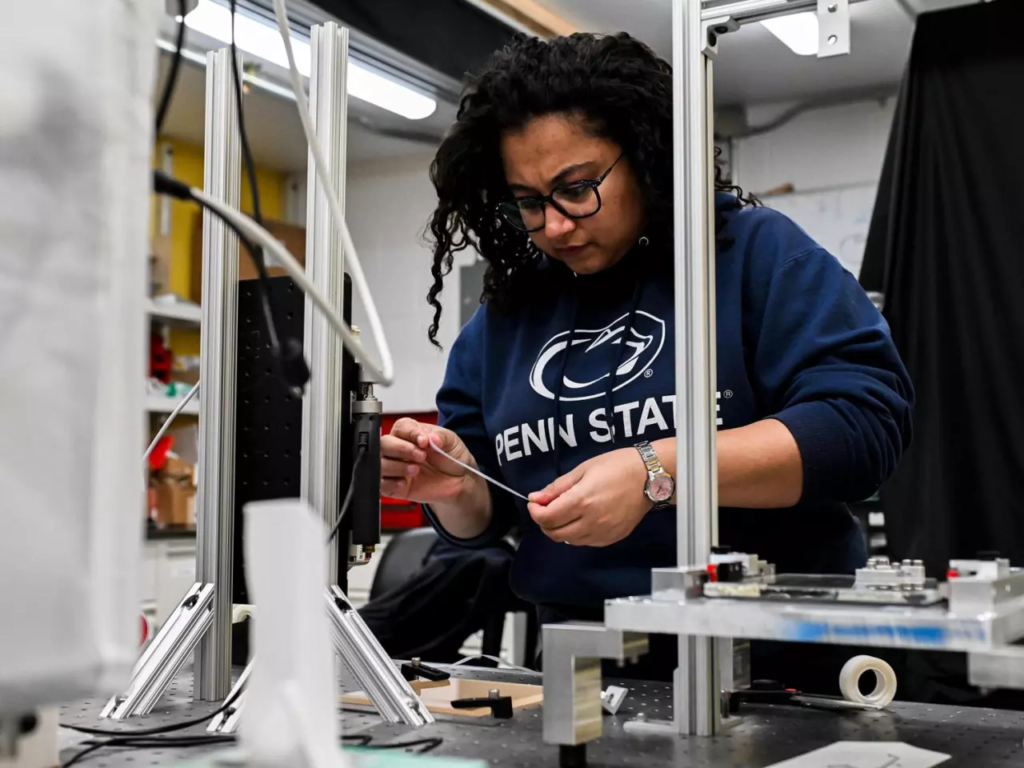
Back in the olden days of the previous millennium, long before the digital revolution compressed entire albums and even movies into ultra-high-fidelity files that users could download in seconds, hundreds of millions of people relied on physical tape to store albums on cassettes (or 8-tracks) and video on low-resolution VHS cassettes. But what if sticky tape – not audio or video tape – were a viable recording medium, too? “There has long been an interest in developing devices that don’t need electricity and don’t have the same vulnerabilities as electronic computers,” says Nathan Keim, a professor of Physics at Pennsylvania State University. In a New Journal of Physics paper, he and co-authors explore the soft matter physics of storing and retrieving mechanical imprints following rearrangement or distortion. For instance, how can partially peeling and reapplying everyday sticky tape mechanically store retrievable information? In other words, how can sticky tape function as a memory material? Currently, researchers and engineers use memory materials for various purposes. For instance, the insulator vanadium dioxide can “remember” stimuli including electrical currents, a valuable property for storing and processing data; a strong, reusable adhesive employs a temperature-activated shape-memory polymer; a liquid metal lattice rubber exoskeleton can, when heated, spring to full form from storage as a ball; a textile from wool waste can be programmed to metamorphose into desired shapes for use in fashion, aerospace, and robotics; and a robotic fabric can shift shape and rigidity for armor, self-erecting tents, and parachutes. For Keim and colleagues, the goal is to design a memory material or mechanical memory system than can add memories without losing previous ones. An everyday example of a mechanical memory device is a combination lock which, as Keim says, “must remember the sequence of turns of the dial in order to open,” and does so by employing a property called return-point memory. In most return-point memory systems, input reshaping the system must alternate, as when one turns a combination lock one direction and then another past the zero mark to form the next memory. Reversing steps at any time in such a system reverts it to its previous state, thus deleting the memories (as when one enters the wrong combination and spins the dial back past zero to resume attempting entry). Seeking to design a system that could “remember a series of events without alternating the input,” Keim’s team discovered how to “store the sequence of multiple memories with a single-directional input in ordinary adhesive tape,” and learned that “the strength of the memories is tunable – meaning we can adjust how strong the memories are – and they can be erased to reset the system.” Building an automated, pressure-measuring device for peeling tape at set distances and then reapplying the tape helped researchers demonstrate that “peeling the tape partway results in a line of strong adhesion at the stopping point that remains when you lay the tape back down,” says physicist Sebanti Chattopadhyay, the first author of the paper. “You can then repeat this multiple times by peeling the tape successively shorter distances establishing multiple lines, or memories.” The device retrieves memories by peeling tape past the marked distances, and measures the increased force required for peeling at each marker. Postdoctoral scholar Sebanti Chattopadhyay prepares to load adhesive tape into the testing deviceJaydyn Isiminger / Penn State As Chattopadhyay explains, “Peeling past the lines erases them and resets the system. But we can also tune the strength of the memories, making them require different amounts of force to peel past, which means that each line could represent different information. We can even make some strong enough to persist after resetting the system.” A key feature in the tape memory, says Keim, is that the information recorded last is always the first retrieved, which permits “a simple type of mechanical computation,” like “a test used for working memory in neuroscience, called a one-back comparison. Subjects are presented with a series of stimuli and have to compare each one with the previous stimulus. Because the last memory formed in the tape is always the one you encounter first during peeling, we can always compare a memory to the one that directly preceded it.” The Penn State research could one day help designers fashion zero-electricity devices that can perform simple calculations without ”the same vulnerabilities as electronic computers,” says Keim. While he states that such devices won’t likely be made of tape, unlocking the secrets of memory materials will lead to useful developments “that we can’t yet imagine.” Source: Pennsylvania State University source

Can Scotch tape record information like audio tape? Read More »

A Clearer Way to Benchmark Private Equity

Private equity benchmarking is shifting toward greater transparency, attribution, and analytical rigor. The Department of Labor’s recent guidance reinforces the importance of meaningful benchmarks in fiduciary evaluation, but the momentum extends beyond regulatory compliance. Investors increasingly expect to understand what a benchmark includes, what it excludes, and which assumptions materially influence its results. The standard is shifting from trusting the number to understanding its construction. Dispersion, attribution, and transparency are becoming core features rather than optional enhancements. This evolution does not eliminate tradeoffs. Highly standardized benchmarks remain valuable for broad comparability, but they often obscure the drivers of performance. More granular, transaction-informed approaches offer deeper insight into exposures and risks, but they require stronger data foundations and greater analytical judgment. The challenge ahead is not to produce more benchmarks, but to develop frameworks that make private market performance interpretable, comparable, and decision relevant. As private assets compete more directly for capital within diversified portfolios, clarity is no longer a luxury. It is a necessity. Disclosure:HarbourVest Partners, LLC (“HarbourVest”) is a registered investment adviser under the Investment Advisers Act of 1940. This material is solely for informational purposes; the information should not be viewed as a current or past recommendation or an offer to sell or the solicitation to buy securities or adopt any investment strategy. In addition, the information contained in this document (i) may not be relied upon by any current or prospective investor and (ii) has not been prepared for marketing purposes. In all cases, interested parties should conduct their own investigation and analysis of any information set forth herein and consult with their own advisors. HarbourVest has not acted in any investment advisory, brokerage or similar capacity by virtue of supplying this information. The opinions expressed herein represent the current, good faith views of the author(s) at the time of publication, are not definitive investment advice, and should not be relied upon as such. This material has been developed internally and/or obtained from sources believed to be reliable; however, HarbourVest does not guarantee the accuracy, adequacy or completeness of such information. The information is subject to change without notice and HarbourVest has no obligation to update you. There is no assurance that any events or projections will occur, and outcomes may be significantly different than the opinions shown here. This information, including any projections concerning financial market performance, is based on current market conditions, which will fluctuate and may be superseded by subsequent market events or for other reasons. The information contained herein must be kept strictly confidential and may not be reproduced or redistributed in any format without the express written approval of HarbourVest. source

A Clearer Way to Benchmark Private Equity Read More »

Have Swatch and AP turned hype into the real product?

The launch of the Swatch x Audemars Piguet (AP) “Royal pop” collection has sparked massive queues, store closures and heated scenes across several cities worldwide. From Singapore and Kuala Lumpur to London, Milan and New York, crowds gathered overnight outside Swatch stores as collectors, resellers and watch enthusiasts rushed to get their hands on the colourful timepieces. In some cities, the situation reportedly turned chaotic, with fights breaking out, security checkpoints breached and police deployed to manage crowds. The episode has once again placed the spotlight on the power of hype-driven collaborations, particularly those that blur the lines between exclusivity and accessibility. Much like the viral Omega x Swatch MoonSwatch launch in 2022, the latest partnership has caught the attention of industry observers, with many saying the collaboration feels bigger than a typical product drop. Don’t miss: What led to the PR debacle around Swatch’s ‘slant eye’ ad? Nafe Tong, chief creative and brand strategist at ABrandADay, said the partnership was especially surprising given that AP operates independently and is not part of the Swatch Group. “Unlike collaborations such as Swatch x Omega or Blancpain, this feels far more unexpected and strategic,” he said, adding that the partnership reflects how luxury watch brands are becoming more open to collaborations to stay culturally relevant. He added that the deal allows both brands to tap into each other’s audiences, with Swatch bringing cultural engagement and accessibility, while AP contributes prestige and exclusivity. “With all these collaborations, Swatch actually feels cool again,” Tong added. “These days, it doesn’t feel out of place at all to be spotted wearing a Swatch.” Pointing to the Omega playbook, Ambrish Chaudhry, head of strategy, Asia at MSQ and Elmwood, called it a masterstroke, saying AP has unlocked a goldmine of relevance through the partnership. “There is a lot of talk on getting on younger wrists, but that isn’t the point. The point is the queues, the frenzy, the chaos accompanying the launch. A visceral reminder of the desirability of AP. Imagine people queueing up days in advance for something that is not even a limited edition,” he added.  The chaos behind the queues To experts, part of the frenzy comes down to accessibility and being a fashion statement. Gracia Yap, founder and CEO of Next Bold Move and former regional head of marketing at TAG Heuer, said the collaboration offers consumers a rare opportunity to participate in the world of AP at a far more accessible price point. She explained:  For aspirational AP watch lovers who know they’ll own one someday, the Swatch collaboration grants instant access to that dream. Yap added that the collaboration almost acts as a “vision board” on the wrist, allowing consumers to own a “Royal Oak-coded” piece while aspiring toward the real thing in future. Apart from the flippers trying to make a quick buck, there’s another crowd: people who just want to own the talk-of-the-town item to show off, said Desmond So, CEO, Uth Creative. “More importantly, they want to feel like they are part of the moment. In this city, that social currency matters.” From a brand angle, Swatch gets a clear win – no risk, just upside. For AP? It’s a careful dance. Yes, it brings in younger eyes, but do it too often and the premiumness might take a hit. Still, in today’s world, buzz is buzz. Scarcity and resale dynamics have only intensified demand, with listings appearing online within hours at several multiples of retail. Dennis Kam, head of strategy at branding consultancy JUNO Malaysia, said this reflects how far the collaboration playbook has evolved since the Omega x Swatch MoonSwatch release. He added that consumers are no longer just buying a watch, but buying into the moment around it, noting:  The chaos has become the cultural object in its own right — people are queuing to be there when it happens, and the watch is the proof of presence. That intensity was also visible on the ground, prompting Swatch to issue a statement urging fans not to rush to stores in large numbers to acquire the collection, amid concerns over crowd safety and store operations. Similarly, Jeffrey Lim, managing director at 8traordinary, said the collaboration goes beyond simply extending an existing watch line and positions the product as a fashion statement or collectible, creating “something new for both brands.” Meanwhile, Sunny Yeung, managing partner and co-founder, Butter Creative, described this as a truly unexpected partnership that rewrites the luxury playbook. “This collaboration proves that even the most ‘untouchable’ brands must evolve to stay culturally relevant. Swatch provides the canvas, and AP provides the aspiration—together, they’ve turned a retail drop into a global cultural phenomenon that transcends traditional watchmaking.” Why AP feels different  While comparisons to the Omega MoonSwatch launch are inevitable, industry folks said the AP collaboration carries a different kind of cultural weight. Unlike Omega, which sits under the Swatch Group umbrella, AP remains an independent ultra-luxury watchmaker. That distinction makes the partnership feel more unexpected, and potentially riskier. For Yap, the collaboration is a breath of fresh air, with AP putting its design code out into the world through a playful partnership with Swatch, marking a rare crossover between an ultra-exclusive luxury maison and a mass-market brand. “Where MoonSwatch told a story about making space history accessible, Royal Pop tells a story about breaking the rules of watchmaking,” she said. “It’s letting a fiercely guarded luxury symbol circulate in everyday spaces.”  Still, that level of accessibility comes with its own tensions. For Andy Reynolds, founder and executive creative director of Imagination Riot, the partnership walks a fine line between cultural relevance and brand dilution. “Luxury works because of distance,” he said, adding:  Bring it too close to the masses in the wrong manner, and you can start chipping away at the magic. For others, the collaboration taps into something more emotionally charged than previous drops, which explains why reactions feel amplified. “The Swatch x AP drop is a classic category collision — the most democratic watch brand

Have Swatch and AP turned hype into the real product? Read More »

IKEA is hiding something… and one million points are up for grabs

IKEA Singapore is turning a childhood favourite into a full-scale retail experience, inviting shoppers to compete in its first-ever hide and seek event at IKEA Alexandra. Dubbed “IKEA Play date: Hide & seek”, the event will see teams of two race through the store to locate eight hidden characters within 45 minutes. The winning duo will walk away with one million IKEA Family points. Registrations are open from 14 to 31 May, with the competition taking place on 6 and 7 June from 10am to 10.45am. Don’t miss: What made IKEA and Punch the monkey the perfect viral moment? The activation transforms IKEA Alexandra into a real-life game board, challenging participants to rely on memory, speed and observation as they navigate the retailer’s showroom and market hall. Teams will score points based on how quickly they identify each hidden character, with the first team to spot a character earning 140 points, the second team 139 points, and so on. Submission timing will also be factored into the final tally. To take part, participants must register in pairs, with at least one member enrolled in IKEA Family. The second participant must be at least eight years old. Children under 16 must be accompanied by a parent or legal guardian. The event will run during regular store hours, with shoppers and competitors sharing the same space. MARKETING-INTERACTIVE has reached out for more information.  The hide and seek activation builds on IKEA’s longstanding approach to marketing, which often leans into humour, cultural moments and everyday relevance to connect with consumers. In Singapore, the retailer has become known for its timely and playful social content, regularly tapping trending conversations and current affairs to keep the brand top of mind. Last month, IKEA Singapore teamed up with TSLA to launch the “ALLËNKI”, transforming its iconic Allen key into a wearable piece of jewellery that doubled as a fully functional furniture tool for April Fools.  Meanwhile, earlier in February, the retailer joined the viral “caricature trend” by reimagining its popular plush toys, Kramig the panda, Djungelskog the bear and Blåhaj the shark. as AI-generated caricatures. According to IKEA Singapore at the time, each trend it hops on is evaluated to ensure it aligns with the brand’s values and personality, with the goal of bringing a moment of levity to consumers. The hide and seek event extend that strategy into the physical world, transforming the store into an interactive experience designed to spark engagement and reward loyal customers.  Related articles:  How Punch the baby macaque turned an IKEA stuffed toy into a global sensation  IKEA Malaysia appoints new media agency IKEA Hong Kong playfully riffs on anti-drug poster gaffe   source

IKEA is hiding something… and one million points are up for grabs Read More »

Honda's thinking of adding a fake clutch and vibration motors to its e-motos

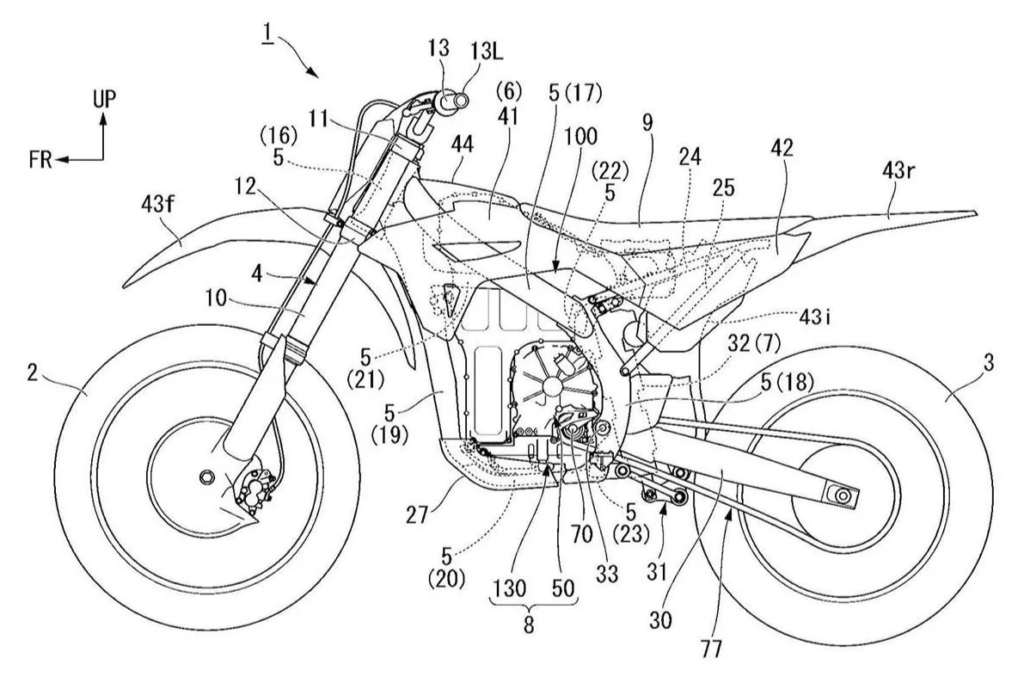
Times are weird, and I guess weird times call for weird measures. At least, as per Honda, which thinks it’s about time electric motorcycles replicated the old-school feel of gas bikes. The Japanese giant has apparently filed a patent for a motorcycle system that uses a fake clutch, a fake flywheel, and a set of vibration motors. And it’s not just another random patent. Honda’s CR Electric Proto motocross bike, which is the same electric dirt bike design the company has been covertly developing for competitive use, serves as the lab rat for the patent. The system uses electronics to change the motor’s response based on the position of the clutch lever as opposed to a conventional mechanical clutch. Image from the patent filed by HondaHonda The electronic clutch would proportionately lower motor output when the clutch is pulled halfway in. And when it would be completely pulled, the system would cut the power completely regardless of the throttle position. Sounds gimmicky, doesn’t it? But in reality, Honda’s already seeing how to put this tech to use. As per the patent, the rider will be able to preload the throttle while gripping the clutch lever, thereby quickly releasing it to produce a torque burst, effectively replicating the hard launch that motocross riders rely on. Honda thinks that would be helpful in competitive riding scenarios where accurate power modulation is important, particularly when starting aggressively or over uneven terrain. But that’s just the simulated electronic clutch system. 13d, 13b, and 13f are all vibration motorsHonda What about the apparent vibrator motors? The patent suggests there’s more than one of these motors installed in the handlebars close to the clutch lever. It would help offer the same haptic input of engine vibration and, more importantly, the “bite point” sensation of engaging a mechanical clutch. But why? Why all this? Especially when one of the biggest selling points of electric motos is their quietness and the simplicity of operation. Well, one obvious reason is racing. There’s no denying that using an electronically controlled clutch would make sense in motocross races, for instance, like taking off. Then, there’s the less obvious reason: to familiarize beginner riders transitioning from ICE motorcycles to electric bikes, to make the shift smoother. Honda’s CR Electric Proto motocross bike serves as the lab rat for the patentHonda As AMCN, which was the first to break this story, also notes, Honda is hardly the first to file a patent to change the way e-motos feel. Previously, the likes of Zero and Kymco have filed patents for faux clutches and even simulated multi-speed transmissions. So it’s not like brands aren’t noticing that buyers are asking for more feel and feedback from electric motorcycles. Understandably, too. Motorcycling has never been purely logical. We like vibration. We like noise. We like the little imperfections that make a machine feel alive, even when those same things objectively make it slower, dirtier, and less efficient. Honda clearly isn’t trying to solve a problem here – it’s trying to preserve a feeling. And that’s the funniest thing about all this. We spent years engineering motorcycles to become smoother, faster, and easier to ride, only to arrive at electrification and immediately start recreating all the quirks we spent decades trying to eliminate. Somewhere out there, an engineer is probably programming a vibration motor to simulate clutch chatter while another engineer nearby is trying to eliminate actual vibration from a combustion bike. The circle is complete. Via: AMCN source

Honda's thinking of adding a fake clutch and vibration motors to its e-motos Read More »

Colgate wants to know: What’s the story behind your smile?

Colgate-Palmolive is leaning heavily into emotional storytelling across Asia Pacific, launching a new campaign built around family memory, care and the small everyday rituals passed between generations. Titled “Every smile has a story”, the campaign spans Australia, New Zealand, the Philippines, India and Malaysia, using deeply personal family narratives to position Colgate less as an oral care product and more as a trusted part of life’s defining moments. Rather than focusing on product claims or clinical messaging, the campaign centres on themes of distance, childhood, parenting and intergenerational connection. Don’t miss: Colgate taps K-pop icon IU for star power and sparkle In the Philippines, the campaign follows a grandmother working overseas who sends Balikbayan boxes home to her family, with Colgate becoming a quiet symbol of love, care and protection despite the physical distance between generations. The Australian chapter features AFL star Patty Cripps, who grew up in a remote community hundreds of kilometres from a dentist. The campaign focuses on how habits passed down from his mother are now being carried forward to his own child. In New Zealand, the campaign highlights Colgate’s long-running “Bright Smiles, Bright Futures” programme through the story of a kindergarten teacher helping children build confidence through oral health education. Meanwhile in India, Colgate spotlights a multi-generational sweet shop family whose legacy is built not only on confectionery, but also on its continued trust in Colgate to help keep the family’s smiles cavity-free. Another India story features Prateik Smita Patil, son of the late Indian actress Smita Patil, focusing on how he carries forward one of his mother’s most cherished gifts, her smile. Through the campaign, Colgate-Palmolive is positioning oral care as more than a daily routine, linking it instead to family traditions, intergenerational trust and emotional connections across the region. Samir Singh, EVP marketing at Colgate-Palmolive Asia Pacific, said the campaign is rooted in a universal desire to protect one’s family and support their health and well-being through every stage of life. “These are stories about growing up, about being away from home and coming back, about joy, disappointments, celebrations, ups and downs, about life, and most of all, about love,” he said. “Colgate’s role in these stories is small but intimate, and completely authentic. We hope this will become a new way of communicating to people who are tired of hyperbole and exaggerated claims. Of telling human stories, simply and honestly.”  The campaign also builds on Colgate-Palmolive’s wider “Make more smiles” positioning, which was introduced last year alongside a refreshed corporate identity and brand film. The film opened with the line, “What’s in a smile? To us, everything that matters in this world,” framing the company’s new tagline as a call to action for its employees to advance its purpose of reimagining a healthier future for people, pets and the planet. As part of the refresh, Colgate-Palmolive updated its logo in a more vibrant shade of blue, with a curved white space between the “c” and “p” designed to resemble a smile. The rebrand also included a modernised colour palette, standardised graphic elements and an updated approach to photography, iconography and digital use Related articles:  Colgate-Palmolive promotes Krisha Dy to global director of equity content and experience    Garlic, durian and sotong? Darlie gives bad breath a surreal twist   Unilever’s Pepsodent launches ‘dentfluencer’ academy to reshape oral care narratives   source

Colgate wants to know: What’s the story behind your smile? Read More »

New “superfuel” promises 32% boost in aircraft and rocket range

CycloKinetics, a US propellant company, has unveiled a new family of superfuels for aircraft, missiles, and rockets that increase fuel performance by 32%. Aimed at the defense market, the fuels could allow vehicles to fly farther while carrying heavier payloads. If you’re an aficionado of old matinee serials or pulp thrillers, scientists were forever inventing secret rocket fuels before being kidnapped by dastardly villains in improbable costumes for their troubles. It was all very exciting until you learned a bit about basic rocketry and discovered that secret super rocket fuels were pretty much a non-starter from the get-go. Well, not quite. True, the gold standard in terms of energy density for practical fuels will always be hydrogen, with methane a distant second. But leaving out the cryogenic class and concentrating on more day-to-day rocket, missile, and aviation fuels, there’s still a lot of room for improvement. CycloKinetics’ approach is to create “plug-in” fuels that can replace conventional fuels in various vehicles without requiring modifications to the craft or its engines. There’s nothing particularly wild or exotic about this, and no unobtanium-type elements are involved. It’s more a matter of changing the geometry of the hydrocarbon molecules that make up the fuel itself. Conventional aviation fuels consist of linear and branched hydrocarbon molecules, which limits how much energy can be packed into a given volume. CycloKinetics instead engineers cycloparaffinic hydrocarbons – that is, ring-shaped molecular structures that pack more carbon and hydrogen atoms into the same space as would be occupied by conventional fuels. CylcoKinetics The upshot is 32% more energy in the same volume as standard Jet A fuel. That means, for example, an aircraft capable of flying 1,500 nautical miles (1,726 miles, 2,778 km) on standard fuel could potentially exceed 1,950 nautical miles (2,244 miles, 3,611 km) using the new superfuel, while reconnaissance aircraft could remain on station up to 30% longer. According to a white paper from the company, the new fuels eliminate the need for aromatics or sulfur, and they don’t “coke” or break down like conventional fuels, which can leave behind abrasive carbon deposits when used as engine coolants. This soot reduction could also make engines stealthier by reducing their infrared signature. The superfuels also boast much greater thermal stability, meaning they can absorb more heat without degrading and tolerate very low temperatures without becoming viscous. That makes them particularly well suited for high-altitude flight. CycloKinetics is currently producing three fuel types. These include CycloJP, a replacement for Jet A, JP-5, JP-8, and JPTS used in turbine-powered aircraft and unmanned aircraft systems (UAS); CycloRP, a rocket propellant intended to replace RP-1 and RP-2 refined kerosene used in liquid rocket engines; and CK-10, which replaces JP-10 fuel used in cruise missiles and standoff munitions. The company’s current production capacity reportedly stands at 60,000 gallons (227,125 L) per year as of 2025, with further scaling planned by 2027. Because the fuels are created using a proprietary fermentation and catalytic process, the product is likely more expensive than conventional fuels. That combination of limited capacity and higher cost probably explains why the primary customer base currently lies in the defense sector, where the demand for increasingly long-range missions can outweigh fuel price concerns. “Building superior fuels has been our business for 15 years, and that work has earned us the trust of leading airlines and every branch of the U.S. military,” said Mukund Karanjikar, CEO and founder of CycloKinetics. “Creating CycloKinetics as a dedicated defense entity is the logical outcome of that history; we now have the scale and operational depth to warrant the same structure. Across defense and space, propulsion is no longer a background variable but a primary driver of mission capability. From high-altitude ISR and long-range strike systems to next-generation propulsion and space launch, performance increasingly comes down to the energy powering the platform. As operational demands evolve, advanced propellants have become a critical lever for extending range, increasing endurance, and enabling entirely new mission profiles that were previously out of reach.” Source: CycloKinetics source

New “superfuel” promises 32% boost in aircraft and rocket range Read More »

Dow Jones Futures Fall, Oil Jumps; America Denies Iran Report That U.S. Navy Ship Struck

Dow Jones futures fell slightly early Monday, along with S&P 500 futures while Nasdaq futures turned higher. Crude oil prices rose. The U.S. military denied an Iranian claim that it struck a U.S. Navy ship with missiles. On Sunday, President Donald Trump said the U.S. Navy would “guide” ships through the Strait of Hormuz, but reportedly won’t include actual escorts.… Copyright ©2026 Investor’s Business Daily, LLC. All rights reserved. 87990cbe856818d5eddac44c7b1cdeb8 source

Dow Jones Futures Fall, Oil Jumps; America Denies Iran Report That U.S. Navy Ship Struck Read More »