Industry Groups Want FCC Enforcement Rework

By Christopher Cole ( May 1, 2025, 7:32 PM EDT) — Five telecom industry groups asked the Federal Communications Commission on Thursday to revamp its enforcement policies after a recent Fifth Circuit decision wiped out a $57 million consumer data privacy fine against AT&T…. Law360 is on it, so you are, too. A Law360 subscription puts you at the center of fast-moving legal issues, trends and developments so you can act with speed and confidence. Over 200 articles are published daily across more than 60 topics, industries, practice areas and jurisdictions. A Law360 subscription includes features such as Daily newsletters Expert analysis Mobile app Advanced search Judge information Real-time alerts 450K+ searchable archived articles And more! Experience Law360 today with a free 7-day trial. source

Industry Groups Want FCC Enforcement Rework Read More »

Judge Told Data Would Let Rivals Mimic Google Search

By Matthew Perlman ( May 1, 2025, 9:13 PM EDT) — An academic testifying for Google on Thursday told a D.C. federal court that the data sharing provisions being proposed as a fix in the search monopolization case would allow rivals to reverse engineer Google search and if not match the results, at least mimic them…. Law360 is on it, so you are, too. A Law360 subscription puts you at the center of fast-moving legal issues, trends and developments so you can act with speed and confidence. Over 200 articles are published daily across more than 60 topics, industries, practice areas and jurisdictions. A Law360 subscription includes features such as Daily newsletters Expert analysis Mobile app Advanced search Judge information Real-time alerts 450K+ searchable archived articles And more! Experience Law360 today with a free 7-day trial. source

Judge Told Data Would Let Rivals Mimic Google Search Read More »

What makes a true AI agent? CIOs struggle with the definition as hype blurs lines

In most cases, vendors aren’t yet offering truly agentic AI with real autonomy, some critics say, but are instead pitching simpler AI chatbots, assistants, or add-ons to large language models (LLMs) as agentic AI. Many so-called agents are just LLM wrappers or “glorified LLM workflows,” says Zach Bartholomew, VP of product at Perigon, provider of an AI-powered and context-based search tool. The agent bandwagon There’s a lot of “agent-washing” in the IT industry right now, says Chris Shayan, head of AI at Backbase, a banking software vendor. “I’ve sat through dozens of vendor pitches where basic automation was rebranded as autonomous agents,” he says. “Many solutions being marketed as agents are actually just traditional algorithms with better interfaces, and there’s a world of difference that CIOs and CTOs are struggling to navigate.” source

What makes a true AI agent? CIOs struggle with the definition as hype blurs lines Read More »

US GDP Forecast by Components 2025

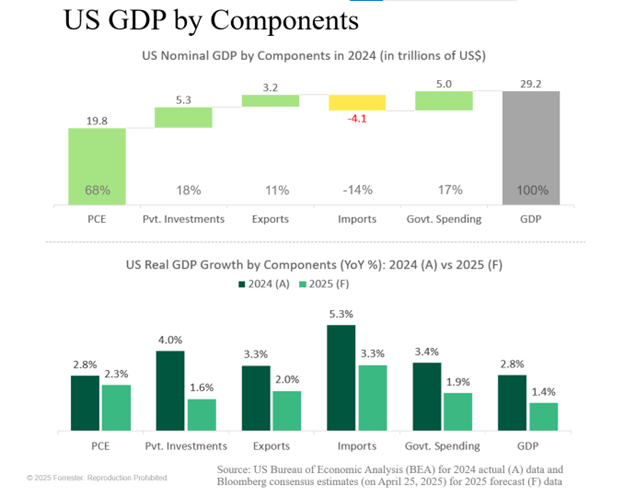
Tariff impacts, trade wars, market volatility, business uncertainty, recession risk, and rebounding inflation — these developments have dominated recent US business and economy news headlines. Economists have been revising their US GDP growth forecasts downward and raising the probability of a recession. They expect inflation to rise again as the cost of imported goods increases and retailers pass these costs on to consumers. We expect both businesses and consumers to slow spending until the cloud of uncertainty around trade policy clears. How We See GDP Components Evolving To monitor economic activity, we continue to examine GDP growth through its major components, along with a few key economic indicators. Our analysis considers both historical trends and forward-looking projections for the coming quarters and years. Following is a summary of GDP and its component trends: Nominal GDP: US nominal GDP reached $29.2 trillion in 2024. US consumer spending, also known as personal consumption expenditures (PCE), is the largest component of GDP, totaling $19.8 trillion and accounting for 68% of GDP in 2024. US business spending, also referred to as fixed investments in nonresidential and residential assets, totaled $5.3 trillion. In 2024, US exports of goods and services reached $3.2 trillion while imports totaled $4.1 trillion. Government consumption expenditures and gross investments reached $5.0 trillion (see figure below). Real GDP growth: Real GDP, which strips out the effects of inflation, is the key metric that economists use to assess true economic growth. Real GDP in the US grew by 2.8% in 2024. Current consensus forecasts project real GDP growth of 1.4% in 2025. Consumer spending growth: US PCE grew by 2.8% in 2024, and the consensus forecast for 2025 is 2.3%. The growth in real consumer spending on services has outpaced growth in spending on goods for the past three years, and this trend will likely continue in 2025. Business spending growth: Business investments in assets to support future production is another critical driver of GDP. Real business spending grew by 4.0% in 2024. Economists currently forecast 1.6% growth in 2025 as businesses delay investment decisions due to trade policy uncertainties. Exports and imports growth: Net exports (exports minus imports) are a key part of GDP calculation. When exports exceed imports, the result is a positive contribution to GDP. Consensus expectations for 2025 point to 2.0% growth in real exports (down from 3.3% in 2024) and 3.3% growth in real imports (down from 5.3% last year). Government spending growth: Real government spending grew by 3.4% in 2024, and current projections suggest 1.9% growth in 2025.   Forrester clients: To help you navigate this uncertain environment, we will continue to publish quarterly insights on the US economy, what it means for your business, and how best to prepare. Please see our recently published report, US Economic Trends And Outlook, Q2 2025, and reach out with any questions or schedule a guidance session. Please also check out this page to explore our research on how to lead through volatility. source

US GDP Forecast by Components 2025 Read More »

Majorities of Americans Support Several – But Not All – Types of Foreign Aid

A worker loads boxes of fortified cereal for USAID famine relief at the Transylvania Vocational Services production facility in Brevard, North Carolina, in 2019. (Charles Mostoller/The Washington Post via Getty Images) How we did this Pew Research Center conducted this study to measure Americans’ opinions on how the U.S. should engage with and provide aid to other countries. The report also examines how Americans see the United States’ global standing and how they view other countries. This analysis builds on the Center’s previous study of Americans’ opinions on the most pressing foreign policy issues of the day, including major world conflicts and trade and tariffs. For this analysis, we surveyed 3,605 U.S. adults from March 24 to 30, 2025. Everyone who took part in this survey is a member of the Center’s American Trends Panel (ATP), a group of people recruited through national, random sampling of residential addresses who have agreed to take surveys regularly. This kind of recruitment gives nearly all U.S. adults a chance of selection. Surveys were conducted either online or by telephone with a live interviewer. The survey is weighted to be representative of the U.S. adult population by gender, race, ethnicity, partisan affiliation, education and other categories. Read more about the ATP’s methodology. Here are the questions used for this analysis, along with responses, and its methodology. A new Pew Research Center survey finds substantial public support for several forms of U.S. foreign aid. Around eight-in-ten Americans say the United States should provide medicine and medical supplies, as well as food and clothing, to people in developing countries. Roughly six-in-ten believe the U.S. should give aid that supports economic development and helps strengthen democracy in other nations. There is less support, however, for providing military aid or funding art and cultural activities. Democrats and Democratic-leaning independents are consistently more supportive of foreign aid than Republicans and Republican leaners. Still, majorities of Republicans say the U.S. should give developing nations medicine and medical supplies, along with food and clothing. And more than four-in-ten Republicans support aid meant to boost economic development and strengthen democracy. The survey was conducted after President Donald Trump and his administration ended most activities of the U.S. Agency for International Development (USAID). In general, 45% of U.S. adults disapprove of ending most USAID programs, while 35% approve. (For more, read “Americans Give Early Trump Foreign Policy Actions Mixed or Negative Reviews.”) The new survey also finds that Democrats and Republicans hold different views about the value of international engagement and cooperation. For instance, when asked which comes closer to their opinion – “It’s best for the future of our country to be active in world affairs” or “We should pay less attention to problems overseas and concentrate on problems here at home” – 62% of Democrats choose the former. In contrast, 67% of Republicans favor a domestic focus. A majority of Americans (64%) say the U.S. should take into account the interests of other countries when dealing with major international issues, even if it means making compromises. This compares with 34% who say the U.S. should follow its own interests, even when other countries strongly disagree. Around eight-in-ten Democrats (83%) think the U.S. should take into account the interests of other countries. Republicans are divided: 47% say the U.S. should consider other countries, while 52% say it should follow its own interests. Which nation poses the greatest threat to the U.S.? When asked to name the country they believe poses the greatest threat to the U.S. in an open-ended question, 42% of Americans say China, while 25% say Russia. No other country is named by more than 5% of adults, and roughly a quarter say either that they are not sure or that no country poses the greatest threat. Responses to this question have shifted somewhat since we last asked it two years ago. In 2023, both Republicans and Democrats named China as the top threat to the U.S. That’s still the case among Republicans (a 58% majority name China), but Democrats now say Russia is the greatest threat (39% vs. 28% who name China). Do Americans have positive or negative views of major countries? We also asked respondents whether they have a favorable or unfavorable opinion of several countries and international organizations, including the European Union. The countries receiving the highest ratings are the six that, along with the U.S., compose the G7: Japan, Canada, Italy, the United Kingdom, Germany and France. Over six-in-ten rate each of these countries favorably, including roughly half or more among both Democrats and Republicans. Americans also give the EU generally positive ratings. In contrast, few see China (21%), Russia (13%) or Iran (10%) positively. Democrats are more likely than Republicans to rate most countries we asked about favorably. Republicans, however, are more than twice as likely as Democrats to give Israel a positive rating (62% vs. 29%). The only other country that Republicans rate more highly than Democrats is Russia (16% vs. 9%). Which countries are gaining or losing influence? We also asked respondents whether they believe the influence of certain countries has been getting stronger, getting weaker or staying about the same in recent years. Americans are more likely to say their own country is losing influence than they are to say this about any other nation. Roughly half of Americans (52%) say the influence of the U.S. has been getting weaker in recent years, including 67% of Democrats and 37% of Republicans. Partisan views are essentially reversed from last year: In 2024, 67% of Republicans said the United States’ influence has been declining, compared with 44% of Democrats. Far fewer Americans overall say U.S. influence is getter stronger, though the share who feel this way has grown since last year (22% vs. 14% in 2024). In their assessments of other countries, Americans are particularly likely to believe China is gaining influence in world affairs (73%). Nearly half say Russia’s influence is getting stronger, while roughly four-in-ten say this about Israel. Perceptions of


Majorities of Americans Support Several – But Not All – Types of Foreign Aid Read More »

Agentic AI Strengthens Digital Adoption Platform Offerings

Digital adoption platform (DAP) providers have been at the forefront of integrating automation into workflows to streamline user effort and enhance software experiences. Today, many DAPs come equipped with native robotic process automation capabilities and are continuously developing more sophisticated automation use cases. Additionally, these providers are enthusiastic about incorporating AI into DAPs, offering copilots, builder assistants, and bots to drive personalization and contextualization. With the emergence of agentic AI, vendors are now exploring new use cases to further boost the performance of DAPs. The Case For Agentic AI In DAPs But what role do AI agents play within the context of DAPs? DAPs’ core use case is to improve the usage and adoption of software applications with personalized nudges and interactive support across journeys configured within the supported application. There, AI agents can automate processes or workflows that are designed to empower users — giving them more control, personalization, and “automated ease” — in how they interact with the supported applications and digital tools to perform their tasks. Agentic workflows, though still in their early stages, hold promise for enhancing platform capabilities by introducing both incremental and significant improvements to software experiences. Individualized Learning Experiences DAPs serve as guided learning and knowledge delivery tools that provide in-the-moment guidance, support, and engagement across systems such as customer relationship management, human capital management, and enterprise resource planning. These journeys and walkthroughs are typically configured for a user cohort that has similar adoption challenges. With AI agents, DAPs can now, with relative ease, configure and deliver: Tailored learning paths. Tailoring the learning experience at a user level based on their role, experience, and past interactions with the application ensures that users are not overwhelmed with irrelevant information, making the learning process more efficient. Adaptive support. This entails dynamically adjusting the support level provided based on the user’s proficiency and behavior patterns. This could mean offering more detailed guidance to a novice or streamlining prompts for an experienced user. Agentic workflows can also be programmed to integrate security best-practices training tailored to the user’s interactions with the platform. Automated And Efficient Support DAPs help deploy automation to improve user experience with reduced clicks for tasks, automated form fills, and automated service ticket management. Agentic frameworks give DAPs increased agility in discovering opportunities for automation and creating autonomous workflows for: Task automation. This involves identifying repetitive tasks within workflows that can be fully or partially automated, thereby saving time for the user and allowing them to focus on more value-added activities. Automated content management. Advanced DAPs have started to leverage generative AI to enable automated content creation by learning from user journeys and clicks. With agentic workflows, DAPs can configure AI assistants to generate, validate, and organize content for specific roles or modules within a content workflow, significantly reducing manual content management efforts. Integration Management The true power in DAPs is building journeys and walkthroughs that span different applications that are part of a workflow to enable continuous guidance and support for users navigating their systems of work. But most enterprises struggle to identify and build these connected journeys and lose momentum after the initial deployments. With AI agents, enterprises can vastly optimize the manual effort in solving the complexities of cross-application adoption management with: Cross-platform support. AI agents can be leveraged to identify connected journeys and workflows during initial implementation to help build a roadmap for cross-application use cases and seamlessly scale from single-application use cases for digital adoption. Integration and interoperability management. In environments where multiple digital tools need to work together seamlessly, AI agents can be leveraged to identify and resolve dependencies, as well as build specialized training sessions focused on the integration points and interoperability between different systems. Security And Privacy Enforcement Experimenting with AI requires enterprises to continuously build awareness of sound and ethical use of AI among user groups, particularly with bring-your-own-AI (BYOAI) frameworks. DAPs have begun helping enterprises do more with AI by improving user adoption of AI tools through contextual learning and guidance. With AI agents, they can also help establish robust governance policies to drive responsible usage of AI through: User consent and shadow AI. Deploying AI agents that provide users with clear options regarding data collection, usage, and personalization improves enterprise trust in working with AI. DAP vendors have started to build agents to specifically identify and report on shadow AI usage and can now deploy agents to apply better controls and guardrails for BYOAI frameworks. Bias mitigation. AI agents can help enterprises actively identify and reduce biases in AI algorithms and data sets to ensure fairness and inclusiveness in automated recommendations and decisions. Deploying AI agents within DAPs represents a forward-thinking approach to enhancing digital adoption, user engagement, and overall productivity within organizations. With AI agents, DAPs can help organizations solve usage, adoption, and experience challenges with highly optimized human oversight. If you’re a Forrester client, you can access The Forrester Wave™: Digital Adoption Platforms, Q4 2024. Visit my Forrester bio page and click “Follow” to receive notifications. You can also follow me on LinkedIn here. Forrester clients can also schedule an inquiry or guidance session with me to delve deeper into this topic. source

Agentic AI Strengthens Digital Adoption Platform Offerings Read More »

Liquid AI is revolutionizing LLMs to work on edge devices like smartphones with new ‘Hyena Edge’ model

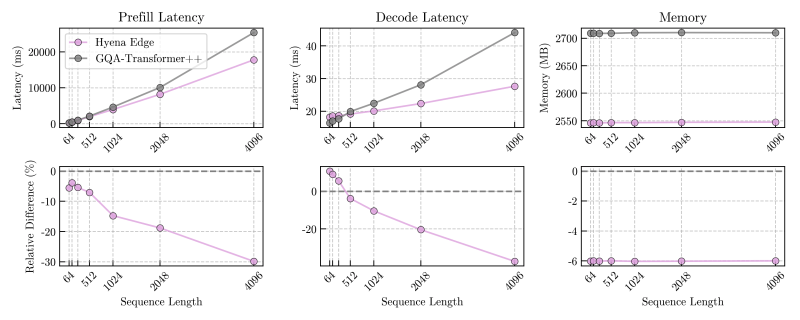
Join our daily and weekly newsletters for the latest updates and exclusive content on industry-leading AI coverage. Learn More Liquid AI, the Boston-based foundation model startup spun out of the Massachusetts Institute of Technology (MIT), is seeking to move the tech industry beyond its reliance on the Transformer architecture underpinning most popular large language models (LLMs) such as OpenAI’s GPT series and Google’s Gemini family. Yesterday, the company announced “Hyena Edge,” a new convolution-based, multi-hybrid model designed for smartphones and other edge devices in advance of the International Conference on Learning Representations (ICLR) 2025. The conference, one of the premier events for machine learning research, is taking place this year in Singapore. New convolution-based model promises faster, more memory-efficient AI at the edge Hyena Edge is engineered to outperform strong Transformer baselines on both computational efficiency and language model quality. In real-world tests on a Samsung Galaxy S24 Ultra smartphone, the model delivered lower latency, smaller memory footprint, and better benchmark results compared to a parameter-matched Transformer++ model. A new architecture for a new era of edge AI Unlike most small models designed for mobile deployment — including SmolLM2, the Phi models, and Llama 3.2 1B — Hyena Edge steps away from traditional attention-heavy designs. Instead, it strategically replaces two-thirds of grouped-query attention (GQA) operators with gated convolutions from the Hyena-Y family. The new architecture is the result of Liquid AI’s Synthesis of Tailored Architectures (STAR) framework, which uses evolutionary algorithms to automatically design model backbones and was announced back in December 2024. STAR explores a wide range of operator compositions, rooted in the mathematical theory of linear input-varying systems, to optimize for multiple hardware-specific objectives like latency, memory usage, and quality. Benchmarked directly on consumer hardware To validate Hyena Edge’s real-world readiness, Liquid AI ran tests directly on the Samsung Galaxy S24 Ultra smartphone. Results show that Hyena Edge achieved up to 30% faster prefill and decode latencies compared to its Transformer++ counterpart, with speed advantages increasing at longer sequence lengths. Prefill latencies at short sequence lengths also outpaced the Transformer baseline — a critical performance metric for responsive on-device applications. In terms of memory, Hyena Edge consistently used less RAM during inference across all tested sequence lengths, positioning it as a strong candidate for environments with tight resource constraints. Outperforming Transformers on language benchmarks Hyena Edge was trained on 100 billion tokens and evaluated across standard benchmarks for small language models, including Wikitext, Lambada, PiQA, HellaSwag, Winogrande, ARC-easy, and ARC-challenge. On every benchmark, Hyena Edge either matched or exceeded the performance of the GQA-Transformer++ model, with noticeable improvements in perplexity scores on Wikitext and Lambada, and higher accuracy rates on PiQA, HellaSwag, and Winogrande. These results suggest that the model’s efficiency gains do not come at the cost of predictive quality — a common tradeoff for many edge-optimized architectures. Hyena Edge Evolution: A look at performance and operator trends For those seeking a deeper dive into Hyena Edge’s development process, a recent video walkthrough provides a compelling visual summary of the model’s evolution. The video highlights how key performance metrics — including prefill latency, decode latency, and memory consumption — improved over successive generations of architecture refinement. It also offers a rare behind-the-scenes look at how the internal composition of Hyena Edge shifted during development. Viewers can see dynamic changes in the distribution of operator types, such as Self-Attention (SA) mechanisms, various Hyena variants, and SwiGLU layers. These shifts offer insight into the architectural design principles that helped the model reach its current level of efficiency and accuracy. By visualizing the trade-offs and operator dynamics over time, the video provides valuable context for understanding the architectural breakthroughs underlying Hyena Edge’s performance. Open-source plans and a broader vision Liquid AI said it plans to open-source a series of Liquid foundation models, including Hyena Edge, over the coming months. The company’s goal is to build capable and efficient general-purpose AI systems that can scale from cloud datacenters down to personal edge devices. The debut of Hyena Edge also highlights the growing potential for alternative architectures to challenge Transformers in practical settings. With mobile devices increasingly expected to run sophisticated AI workloads natively, models like Hyena Edge could set a new baseline for what edge-optimized AI can achieve. Hyena Edge’s success — both in raw performance metrics and in showcasing automated architecture design — positions Liquid AI as one of the emerging players to watch in the evolving AI model landscape. source

Liquid AI is revolutionizing LLMs to work on edge devices like smartphones with new ‘Hyena Edge’ model Read More »

UiPath’s new orchestrator guides AI agents to follow your enterprise’s rules

Join our daily and weekly newsletters for the latest updates and exclusive content on industry-leading AI coverage. Learn More By now, many enterprises have begun exploring AI agents and determining whether deploying them is a viable option for their business. But many still equate agents with something most companies have had for years: automation.  Automation pioneer UiPath sees agents and orchestrating the entire ecosystem — a little differently.  The company announced its new UiPath Platform for Agentic Automation. However, it made clear that agents are not a new version of robotic process automation (RPA); rather, they are another tool that enterprises can integrate with RPA to complete workflows.  Daniel Dines, UiPath founder and CEO, told VentureBeat in an interview that agents cannot be fully automated as they are built today. “The big problem with LLMs today is that they are nondeterministic, so you cannot run them directly in an autonomous fashion,” Dines said. “If you look at most implementations of agents, these are actually chatbots. So we’re moving from chat in, chat out to an agent that is data in, action out, where we orchestrate between agents, humans and robots.”  Key to UiPath’s offering is its AI orchestration layer, Maestro. It oversees the flow of information from agents to the human employee to the automation layer. UiPath described Maestro as a centralized supervisor who “automates, models and optimizes complex business processes” and monitors performance.  Breaking down agents and automation Maestro takes user prompts and breaks down the process into manageable steps to complete it. Instead of allowing agents to access information indiscriminately, Dines said Maestro has three steps. First, the agent takes the prompt, analyzes it, and recommends how to complete the query. Next, a human user approves of the recommendation. Then, an RPA tool will execute on that recommendation, completing the request.  Dines said Maestro makes the workflow more transparent and accountable because a human remains in the loop and a rules-based RPA finishes the task. For UiPath, separating agents that take in data to make a recommendation from the automation that acts upon that recommendation ensures enterprises don’t let agents have unfettered access to their entire system.  “I think it’s a very powerful way for enterprises to adopt agents. And look, in many discussions with clients, I think they resonate very well because they are really concerned about the unlimited agency of agents,” Dines said. UiPath also integrates with the orchestration framework provider LangChain to offer open, multi-agent frameworks. The Platform for Agentic Automation also works with Anthropic and Microsoft frameworks, with UiPath being part of Google’s Agent-to-Agent protocol.  Not every agent is automation Dines insists that thinking about agents as a complete stack solution, where the agents read the data and then take action,  “Agents being nondeterministic in nature are transactional; they create effects on the underlying systems. No client I know will take risks on this,” Dines said. “Transactions should be 100% reliable, and only automations can offer this type of reliability. So our solution is the best of those worlds.” He added that “maybe in some future” agentic AI “will become more reliable, and some actions you can you can delegate to agents, but it should be a progression.” Others in the industry believe that agents are the next evolution of automation. In fact, the entire premise of agentic AI is to have a system that does things on the user’s behalf. A secondary goal for many is to have “ambient” agents, where AI agents run in the background, proactively act for the user and alert people to any changes that need their attention.  UiPath, however, still needs to make a case that its approach to agents is more effective than all-in-one agent offerings and cuts through the hype surrounding agents that do everything for users.  Companies like ServiceNow, Salesforce, Writer and Microsoft have all released agentic platforms aimed at enterprise users. Writer’s new platform relies on self-evolving models for autonomous agents.  Enterprises also showed excitement around the idea that AI agents could streamline much of their work and automate many manual tasks in companies.  source

UiPath’s new orchestrator guides AI agents to follow your enterprise’s rules Read More »

Bank of America’s big bet on AI started small

Gopalkrishnan, who is the CIO of six of the bank’s eight lines of business, says Bank of America operates a hybrid “hosting strategy” based on a virtual private cloud the bank has operated for years and public clouds as needed. BofA has relationships with Microsoft, AWS, Google, and other clouds, but like many bank CIOs, Gopalkrishnan prefers to keep workloads close for cost and security reasons. “We have been very effective at scaling it, which lets us get to a point where we’re not paying for bursty volumes,” Gopalkrishnan says, adding it has been “interesting” to see repatriation efforts of some organizations away from cloud computing. “We’ve always said we’re not going to over-index and over-swing the pendulum,” the CIO says. “Our view is we essentially have a hosting strategy. We’ve got multiple availability zones in our virtual private cloud. We extensively use our virtual private cloud, and as need be, we can burst into public clouds based on the use cases, either for other software providers or for ourselves.” source

Bank of America’s big bet on AI started small Read More »

Crypto Influencer Launches SPAC As 2 Acquirers Tap Market

By Aislinn Keely ( May 1, 2025, 6:35 PM EDT) — A special purpose acquisition company led by crypto influencer Anthony Pompliano and advised by Reed Smith LLP has filed for an initial public offering to raise $200 million, while two other blank-check companies eyeing the fintech and tech sectors have raised more than $400 million combined…. Law360 is on it, so you are, too. A Law360 subscription puts you at the center of fast-moving legal issues, trends and developments so you can act with speed and confidence. Over 200 articles are published daily across more than 60 topics, industries, practice areas and jurisdictions. A Law360 subscription includes features such as Daily newsletters Expert analysis Mobile app Advanced search Judge information Real-time alerts 450K+ searchable archived articles And more! Experience Law360 today with a free 7-day trial. source

Crypto Influencer Launches SPAC As 2 Acquirers Tap Market Read More »