IFA Berlin 2021: World's leading consumer electronics trade show canceled

When I first heard that major, real-world tech trade shows were coming starting as early as Mobile World Congress (MWC) in Barcelona in late June. I didn’t see how they could do it. In the United States, thanks to widespread Covid-19 vaccinations, life may return to something like normal, but it’s a different story in much of Europe. So, it came as no surprise when IFA Berlin, the world’s largest consumer and home electronics trade show, decided not to open its doors.  An email from Messe Berlin and gfu Consumer & Home Electronics, IFA’s sponsoring organizations, announced that “IFA 2021 will not take place in September.” Why? The reasons were simple enough. “Ultimately, several key global health metrics did not move as fast in the right direction as had been hoped for – from the rapid emergence of new COVID-19 variants, for example in South Asia, to continued uncertainties about the speed of the rollout of vaccination programs around the world.” Another factor was that the Messe Berlin exhibition halls were continuing to be used “to support the fight against COVID-19 by converting parts of its area into a vaccination center and an emergency hospital facility.”  While coronavirus infections continue to decline in Europe, Germany alone had 9,796 new cases in the most recent daily count.  Martin Ecknig, Messe Berlin’s CEO explained:  “We did not take this decision lightly. IFA Berlin is arguably the most important event of the year for brands and retailers alike. IFA Berlin connects our industry with trade visitors, media, and real consumers like no other event. However, the health and safety of everybody have to be absolutely paramount. The efforts to contain this pandemic – from the roll-out of vaccination programs to the resumption of international travel – did not happen at the pace we had hoped for. Given these developments, this difficult and disappointing decision was inevitable.” That may have been the case with IFA, but another major global technology show set in Europe, MWC, still plans to go on. Even though major telecom companies such as Qualcomm. Ericsson, Google, IBM, Lenovo, Nokia, Oracle, Samsung, and Sony have all backed out of the in-person conference, MWC’s sponsor GSMA insists the show will go on.  In part, this may be because the Spanish government desperately wants tourists to return to the country.  The Spanish minister for industry, commerce, and tourism, Reyes Maroto, said “Spain expects to welcome around 45 million foreign tourists in 2021, just over half the number who came in 2019 before the pandemic struck. Spain and GSMA set up a special, permissive travel authorization for  MWC registrants.  In any case, the European Union (EU) is expected to allow quarantine-free travel for vaccinated visitors to enter the EU. Approved vaccinations include all those from the US trio of vaccine makers: Pfizer, Moderna, and Johnson & Johnson.  Me? I love Barcelona and Berlin, but even though I am vaccinated I wouldn’t have gone. We’re still not out of the woods yet. Talk to me later about trade shows towards the end of the year. Related Stories: source

IFA Berlin 2021: World's leading consumer electronics trade show canceled Read More »

Kirkland, Latham Lead Chinese Online Insurer's $30M US IPO

By Tom Zanki ( April 30, 2025, 4:52 PM EDT) — Shares of Chinese online insurance distributor Yuanbao Inc. rallied in debut trading Wednesday after it priced a $30 million initial public offering at the top of its range, represented by Kirkland & Ellis LLP and underwriters’ counsel Latham & Watkins LLP, as more companies test a shaky U.S. IPO market…. Law360 is on it, so you are, too. A Law360 subscription puts you at the center of fast-moving legal issues, trends and developments so you can act with speed and confidence. Over 200 articles are published daily across more than 60 topics, industries, practice areas and jurisdictions. A Law360 subscription includes features such as Daily newsletters Expert analysis Mobile app Advanced search Judge information Real-time alerts 450K+ searchable archived articles And more! Experience Law360 today with a free 7-day trial. source

Kirkland, Latham Lead Chinese Online Insurer's $30M US IPO Read More »

Meta unleashes Llama API running 18x faster than OpenAI: Cerebras partnership delivers 2,600 tokens per second

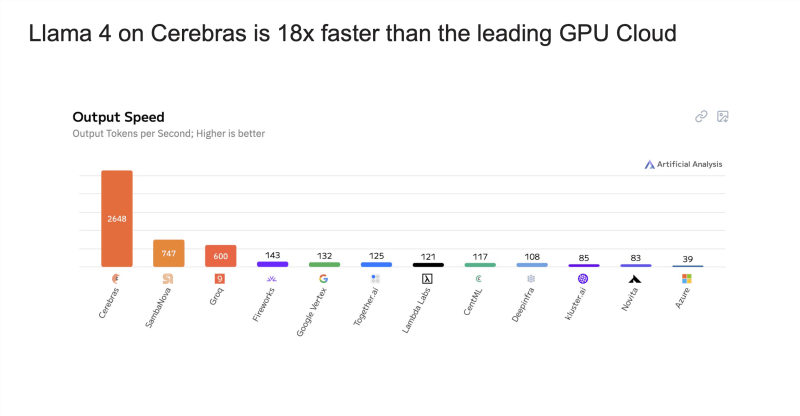
Join our daily and weekly newsletters for the latest updates and exclusive content on industry-leading AI coverage. Learn More Meta announced today a partnership with Cerebras Systems to power its new Llama API, offering developers access to inference speeds up to 18 times faster than traditional GPU-based solutions. The announcement, made at Meta’s inaugural LlamaCon developer conference in Menlo Park, positions the company to compete directly with OpenAI, Anthropic, and Google in the rapidly growing AI inference service market, where developers purchase tokens by the billions to power their applications. “Meta has selected Cerebras to collaborate to deliver the ultra-fast inference that they need to serve developers through their new Llama API,” said Julie Shin Choi, chief marketing officer at Cerebras, during a press briefing. “We at Cerebras are really, really excited to announce our first CSP hyperscaler partnership to deliver ultra-fast inference to all developers.” The partnership marks Meta’s formal entry into the business of selling AI computation, transforming its popular open-source Llama models into a commercial service. While Meta’s Llama models have accumulated over one billion downloads, until now the company had not offered a first-party cloud infrastructure for developers to build applications with them. “This is very exciting, even without talking about Cerebras specifically,” said James Wang, a senior executive at Cerebras. “OpenAI, Anthropic, Google — they’ve built an entire new AI business from scratch, which is the AI inference business. Developers who are building AI apps will buy tokens by the millions, by the billions sometimes. And these are just like the new compute instructions that people need to build AI applications.” A benchmark chart shows Cerebras processing Llama 4 at 2,648 tokens per second, dramatically outpacing competitors SambaNova (747), Groq (600) and GPU-based services from Google and others — explaining Meta’s hardware choice for its new API. (Credit: Cerebras) Breaking the speed barrier: How Cerebras supercharges Llama models What sets Meta’s offering apart is the dramatic speed increase provided by Cerebras’ specialized AI chips. The Cerebras system delivers over 2,600 tokens per second for Llama 4 Scout, compared to approximately 130 tokens per second for ChatGPT and around 25 tokens per second for DeepSeek, according to benchmarks from Artificial Analysis. “If you just compare on API-to-API basis, Gemini and GPT, they’re all great models, but they all run at GPU speeds, which is roughly about 100 tokens per second,” Wang explained. “And 100 tokens per second is okay for chat, but it’s very slow for reasoning. It’s very slow for agents. And people are struggling with that today.” This speed advantage enables entirely new categories of applications that were previously impractical, including real-time agents, conversational low-latency voice systems, interactive code generation, and instant multi-step reasoning — all of which require chaining multiple large language model calls that can now be completed in seconds rather than minutes. The Llama API represents a significant shift in Meta’s AI strategy, transitioning from primarily being a model provider to becoming a full-service AI infrastructure company. By offering an API service, Meta is creating a revenue stream from its AI investments while maintaining its commitment to open models. “Meta is now in the business of selling tokens, and it’s great for the American kind of AI ecosystem,” Wang noted during the press conference. “They bring a lot to the table.” The API will offer tools for fine-tuning and evaluation, starting with Llama 3.3 8B model, allowing developers to generate data, train on it, and test the quality of their custom models. Meta emphasizes that it won’t use customer data to train its own models, and models built using the Llama API can be transferred to other hosts—a clear differentiation from some competitors’ more closed approaches. Cerebras will power Meta’s new service through its network of data centers located throughout North America, including facilities in Dallas, Oklahoma, Minnesota, Montreal, and California. “All of our data centers that serve inference are in North America at this time,” Choi explained. “We will be serving Meta with the full capacity of Cerebras. The workload will be balanced across all of these different data centers.” The business arrangement follows what Choi described as “the classic compute provider to a hyperscaler” model, similar to how Nvidia provides hardware to major cloud providers. “They are reserving blocks of our compute that they can serve their developer population,” she said. Beyond Cerebras, Meta has also announced a partnership with Groq to provide fast inference options, giving developers multiple high-performance alternatives beyond traditional GPU-based inference. Meta’s entry into the inference API market with superior performance metrics could potentially disrupt the established order dominated by OpenAI, Google, and Anthropic. By combining the popularity of its open-source models with dramatically faster inference capabilities, Meta is positioning itself as a formidable competitor in the commercial AI space. “Meta is in a unique position with 3 billion users, hyper-scale datacenters, and a huge developer ecosystem,” according to Cerebras’ presentation materials. The integration of Cerebras technology “helps Meta leapfrog OpenAI and Google in performance by approximately 20x.” For Cerebras, this partnership represents a major milestone and validation of its specialized AI hardware approach. “We have been building this wafer-scale engine for years, and we always knew that the technology’s first rate, but ultimately it has to end up as part of someone else’s hyperscale cloud. That was the final target from a commercial strategy perspective, and we have finally reached that milestone,” Wang said. The Llama API is currently available as a limited preview, with Meta planning a broader rollout in the coming weeks and months. Developers interested in accessing the ultra-fast Llama 4 inference can request early access by selecting Cerebras from the model options within the Llama API. “If you imagine a developer who doesn’t know anything about Cerebras because we’re a relatively small company, they can just click two buttons on Meta’s standard software SDK, generate an API key, select the Cerebras flag, and then all of a sudden, their tokens are being processed on a giant wafer-scale engine,” Wang

Meta unleashes Llama API running 18x faster than OpenAI: Cerebras partnership delivers 2,600 tokens per second Read More »

How Postman powers the future of agentic AI with new API collaboration tools

Keith Shaw: Taken off, right? Taylor Pechacek: They have, yeah—definitely. Keith Shaw: Today, you’re going to show us some agentic AI capabilities. Taylor Pechacek: Yes, very excited about this. We’re constantly improving the product, and today we have a major release around how to build agents on the Postman platform. Keith Shaw: That’s a huge topic. So who is this really designed for? I’m guessing software developers, but are there others within a company who could benefit from this? Taylor Pechacek: Great question. It’s really aimed at our core market—developers. But there are many types: backend, frontend, QA, platform engineering, DevOps. And since we’re a collaboration platform, APIs are central to modern software development, which also includes product managers, designers, solution engineers, and sales teams. Agents will also help non-developers start building by making it more accessible. It expands beyond our developer core to help a broader audience improve their workflows. source

How Postman powers the future of agentic AI with new API collaboration tools Read More »

Afterpay CEO believes Australia has an opportunity to be a tech talent exporter

Anthony Eisen, co-founder and CEO of Australia’s buy now, pay later platform Afterpay, has told the audience of Macquarie Technology Summit that Australia has an opportunity to be an exporter of top tech talent. “Australia is an incredibly attractive place where you can base global talent that doesn’t have limitations anymore in terms of being able to do business globally, particularly if it’s tech-based,” he said on Thursday. “I think there’s a real opportunity to make this more of an export-style industry for our country. I think the government recognises that, and they’re doing more and more to facilitate it.” He described Australia’s tech talent pool as being “very strong” and something Afterpay has reaped the benefit of first-hand. “We’ve seen Australian talent, when they have the opportunity to build globally scalable platforms, just shine very strongly, particularly as Australians in our company have moved internationally with our business,” he said. Recent statistics by Hays, however, indicate that Australia and New Zealand’s tech sector has continued to suffer from a severe skills shortage, particularly as international borders remain shut. For Eisen though, he believes distance should no longer be an excuse for why talent cannot be easily sourced. “The tyranny of distance is lost with technology-based businesses. The most fabulous thing about the opportunity to build a platform that’s scalable is that it does transcend borders, especially when you look at what we’ve been through with COVID,” he said.   He pointed out how Afterpay has continued to run its head office out of Australia, despite operating in countries including the United States, United Kingdom, and Asia. “We haven’t regionalised our business, we’ve globalised our business, and while we have global functions now, it’s not about concentration in a geography … and that’s why I also say Australia can be a global head office in a lot of ways,” he said.  “The global leadership team is spread out … [and] is split between Sydney, Melbourne, San Francisco, London, and we have a core group in Asia as well, so just approaching it that way I think is quite important and something we’re trying to get better at as we grow.”  Besides exporting tech talent, being able to attract talent to Australia and see them establish companies locally is equally important, Eisen said.  “I think as Australia gets more and more on the map, being able just to attract that experience onto our shores is really important to mix with the talent that we have here,” he said. “Australia has now produced a whole lot of pretty fantastic global startups that have become scale-ups, terrific companies … but the more and more companies from Australia that can grow in that fashion, I think it’s really leading the light.” During his virtual Q&A, Eisen also took the opportunity to highlight that Afterpay would soon be launching Money By Afterpay, which Eisen described as where “customers will actually be able to deposit money and they’ll have savings goals, and budgeting goals, and different services that go around our platform.” In March, Afterpay, together with Zip Co, agreed to a buy now, pay later code of practice that was developed by the Australian Finance Industry Association as a vow to be transparent and focus on the needs of the customer. RELATED COVERAGE source

Afterpay CEO believes Australia has an opportunity to be a tech talent exporter Read More »

FCC Aims To Fight Robocall Scams With Caller ID Reg

By Christopher Cole ( April 28, 2025, 6:36 PM EDT) — The Federal Communications Commission on Monday proposed new rules to make sure phone networks that haven’t adopted internet technology are still authenticating caller ID…. Law360 is on it, so you are, too. A Law360 subscription puts you at the center of fast-moving legal issues, trends and developments so you can act with speed and confidence. Over 200 articles are published daily across more than 60 topics, industries, practice areas and jurisdictions. A Law360 subscription includes features such as Daily newsletters Expert analysis Mobile app Advanced search Judge information Real-time alerts 450K+ searchable archived articles And more! Experience Law360 today with a free 7-day trial. source

FCC Aims To Fight Robocall Scams With Caller ID Reg Read More »

Salesforce takes aim at ‘jagged intelligence’ in push for more reliable AI

Join our daily and weekly newsletters for the latest updates and exclusive content on industry-leading AI coverage. Learn More Salesforce is tackling one of artificial intelligence’s most persistent challenges for business applications: the gap between an AI system’s raw intelligence and its ability to consistently perform in unpredictable enterprise environments — what the company calls “jagged intelligence.” In a comprehensive research announcement today, Salesforce AI Research revealed several new benchmarks, models, and frameworks designed to make future AI agents more intelligent, trusted, and versatile for enterprise use. The innovations aim to improve both the capabilities and consistency of AI systems, particularly when deployed as autonomous agents in complex business settings. “While LLMs may excel at standardized tests, plan intricate trips, and generate sophisticated poetry, their brilliance often stumbles when faced with the need for reliable and consistent task execution in dynamic, unpredictable enterprise environments,” said Silvio Savarese, Salesforce’s Chief Scientist and Head of AI Research, during a press conference preceding the announcement. The initiative represents Salesforce’s push toward what Savarese calls “Enterprise General Intelligence” (EGI) — AI designed specifically for business complexity rather than the more theoretical pursuit of Artificial General Intelligence (AGI). “We define EGI as purpose-built AI agents for business optimized not just for capability, but for consistency, too,” Savarese explained. “While AGI may conjure images of superintelligent machines surpassing human intelligence, businesses aren’t waiting for that distant, illusory future. They’re applying these foundational concepts now to solve real-world challenges at scale.” How Salesforce is measuring and fixing AI’s inconsistency problem in enterprise settings A central focus of the research is quantifying and addressing AI’s inconsistency in performance. Salesforce introduced the SIMPLE dataset, a public benchmark featuring 225 straightforward reasoning questions designed to measure how jagged an AI system’s capabilities really are. “Today’s AI is jagged, so we need to work on that. But how can we work on something without measuring it first? That’s exactly what this SIMPLE benchmark is,” explained Shelby Heinecke, Senior Manager of Research at Salesforce, during the press conference. For enterprise applications, this inconsistency isn’t merely an academic concern. A single misstep from an AI agent could disrupt operations, erode customer trust, or inflict substantial financial damage. “For businesses, AI isn’t a casual pastime; it’s a mission-critical tool that requires unwavering predictability,” Savarese noted in his commentary. Inside CRMArena: Salesforce’s virtual testing ground for enterprise AI agents Perhaps the most significant innovation is CRMArena, a novel benchmarking framework designed to simulate realistic customer relationship management scenarios. It enables comprehensive testing of AI agents in professional contexts, addressing the gap between academic benchmarks and real-world business requirements. “Recognizing that current AI models often fall short in reflecting the intricate demands of enterprise environments, we’ve introduced CRMArena: a novel benchmarking framework meticulously designed to simulate realistic, professionally grounded CRM scenarios,” Savarese said. The framework evaluates agent performance across three key personas: service agents, analysts, and managers. Early testing revealed that even with guided prompting, leading agents succeed less than 65% of the time at function-calling for these personas’ use cases. “The CRM arena essentially is a tool that’s been introduced internally for improving agents,” Savarese explained. “It allows us to stress test these agents, understand when they’re failing, and then use these lessons we learn from those failure cases to improve our agents.” New embedding models that understand enterprise context better than ever before Among the technical innovations announced, Salesforce highlighted SFR-Embedding, a new model for deeper contextual understanding that leads the Massive Text Embedding Benchmark (MTEB) across 56 datasets. “SFR embedding is not just research. It’s coming to Data Cloud very, very soon,” Heinecke noted. A specialized version, SFR-Embedding-Code, was also introduced for developers, enabling high-quality code search and streamlining development. According to Salesforce, the 7B parameter version leads the Code Information Retrieval (CoIR) benchmark, while smaller models (400M, 2B) offer efficient, cost-effective alternatives. Why smaller, action-focused AI models may outperform larger language models for business tasks Salesforce also announced xLAM V2 (Large Action Model), a family of models specifically designed to predict actions rather than just generate text. These models start at just 1 billion parameters—a fraction of the size of many leading language models. “What’s special about our xLAM models is that if you look at our model sizes, we’ve got a 1B model, we all the way up to a 70B model. That 1B model, for example, is a fraction of the size of many of today’s large language models,” Heinecke explained. “This small model packs just so much power in taking the ability to take the next action.” Unlike standard language models, these action models are specifically trained to predict and execute the next steps in a task sequence, making them particularly valuable for autonomous agents that need to interact with enterprise systems. “Large action models are LLMs under the hood, and the way we build them is we take an LLM and we fine-tune it on what we call action trajectories,” Heinecke added. Enterprise AI safety: How Salesforce’s trust layer establishes guardrails for business use To address enterprise concerns about AI safety and reliability, Salesforce introduced SFR-Guard, a family of models trained on both publicly available data and CRM-specialized internal data. These models strengthen the company’s Trust Layer, which provides guardrails for AI agent behavior. “Agentforce’s guardrails establish clear boundaries for agent behavior based on business needs, policies, and standards, ensuring agents act within predefined limits,” the company stated in its announcement. The company also launched ContextualJudgeBench, a novel benchmark for evaluating LLM-based judge models in context—testing over 2,000 challenging response pairs for accuracy, conciseness, faithfulness, and appropriate refusal to answer. Looking beyond text, Salesforce unveiled TACO, a multimodal action model family designed to tackle complex, multi-step problems through chains of thought-and-action (CoTA). This approach enables AI to interpret and respond to intricate queries involving multiple media types, with Salesforce claiming up to 20% improvement on the challenging MMVet benchmark. Co-innovation in action: How customer feedback shapes Salesforce’s enterprise AI roadmap Itai Asseo, Senior Director of Incubation and

Salesforce takes aim at ‘jagged intelligence’ in push for more reliable AI Read More »

Franciscan Health’s Pursuit of Observability and Automation

The layers of tech and data used by an institution such as Franciscan Health, a 12-hospital system in Indiana that also has a presence in suburban Chicago, can need a bit of decluttering for sake of efficiency. The path to sort out data and other aspects of observability led the health system to observability platform Pantomath. Sarang Deshpande, vice president of data and analytics for Franciscan Health, says when he joined three years ago, he saw that — much like other healthcare providers — they operated with a combination of tools and technologies stacked together. That approach may have served in the moment, choosing the best tools available at the time, he says. It also piled up a bit of confusion. Diagnosing the Problem As with other types of long-running institutions, hospitals might not move swiftly when it comes to technology adoption. “The maturity typically you’ll see on the provider side around technology … digital adoption is lower than you would find in manufacturing or even on the healthcare side if you think of pharmaceuticals or medical devices,” Deshpande says. On the nonprofit side, he says, the main focus is patient care with most capital investments going into buildings, hospitals, and clinics rather than new tech. At least that may have been the case until the pandemic put the world on different footing. “Technology tends to lag a little bit, but after COVID that has changed quite a bit,” Deshpande says. Related:Confidential Computing: CIOs Move to Secure Data in Use Prior to COVID, Franciscan Health tended to purchase technology tools based on what was needed at the time, he says, and largely on-premises. Compounding the complexity, Deshpande says there is a plethora of ways data is collected and ingested in the hospital system. “Our electronic medical record system is the biggest of all where most of our patient data comes from,” he says. On top of that, he says there are also billing and ERP systems, ITSM ticketing systems, and time-keeping systems to account for. Further, there are regulatory requirements around the hospital system’s reporting, he says. Assessing the Tech Ailment Information that Franciscan’s system ingests, Deshpande says, includes flat file datasets, as well as data from a CMS, third-party payers, or ancillary third parties. With so many formats and inputs, he says there was not a very clear-cut way to access data. Franciscan Health must also be accountable for sending information out, Deshpande says. The varied tech tools Franciscan Health collected over the years meant there was no standardized data pipeline. “That problem was very obvious to me from the get-go,” Deshpande says. “We have tried to solve it through people and process to a large extent, but there’s only so much you can do when there are siloed teams that are accountable for one piece of the data flow.” Related:Preparing Your Tech Business for a Possible Recession With so many pieces and layers in play, tech challenges were inevitable. “Whenever there was a failure or a data quality issue or a job didn’t run on time or got delayed, the downstream impact of that was very localized,” Deshpande says. Being accountable for accuracy, timeliness of the data, he says the issues became apparent to him. “That’s where we realized we had a big problem where the non-standardized set of tools, processes, and people in their jobs were making it very difficult for us to have any level of accuracy that our leadership demands of us,” he says. In the digital transformation era, with migrations to the cloud and more automation, Deshpande says post-COVID resources were extremely limited and most every health system seeks to do more with less. “Labor costs are off the charts,” he says. “I think that’s where most people are realizing that we need to leverage not just technology at the frontlines for our patients, but also for optimal work internally.” Related:Principal Financial Group CIO on Being a Technologist and Business Leader Prescribing a Strategy That’s where the observability platform Pantomath came into play to help transform Franciscan Health’s data operations. Deshpande says use of the platform introduced automation with the intent to reduce human error and dependency in the equation. “We will always need eyeballs on things to validate, verify, and to fix,” he says, “but basic monitoring, observation, alerting and things of that nature should be very easy to automate. Things are never as easy it seems.” Use of the platform let Franciscan Health repurpose their labor force to work smarter through AI and LLMs, Deshpande says. “We wanted a more consistent way of monitoring and solving the problem of data accuracy, data currency, and data validation.” Franciscan Health’s system comprises five different regions, he says, that historically were separate entities that came together through mergers and acquisitions. They still operate relatively independently from a daily workflow perspective, says Deshpande. That includes management of staff and patient population. Deshpande says one measurement for success of the observability effort is whether his team can conduct business, grow, and transform at the same time without additional labor — and still deliver. He says the work continues, with at least two years out in terms of migrating all on-prem infrastructure while also building new use cases on the data platform. “The next couple of years will be all about migration, consolidation, and how can we get to a point where this modern data platform in the cloud will be up and running and we can reduce our footprint in the data center and the cost that comes with it,” Deshpande says. source

Franciscan Health’s Pursuit of Observability and Automation Read More »

Writer releases Palmyra X5, delivers near GPT-4.1 performance at 75% lower cost

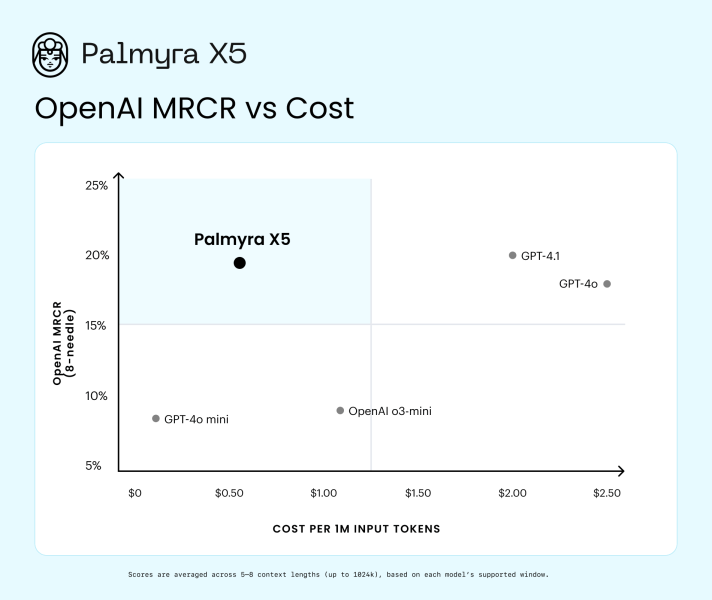
Join our daily and weekly newsletters for the latest updates and exclusive content on industry-leading AI coverage. Learn More Writer, the enterprise generative AI company valued at $1.9 billion, today released Palmyra X5, a new large language model (LLM) featuring an expansive 1-million-token context window that promises to accelerate the adoption of autonomous AI agents in corporate environments. The San Francisco-based company, which counts Accenture, Marriott, Uber, and Vanguard among its hundreds of enterprise customers, has positioned the model as a cost-efficient alternative to offerings from industry giants like OpenAI and Anthropic, with pricing set at $0.60 per million input tokens and $6 per million output tokens. “This model really unlocks the agentic world,” said Matan-Paul Shetrit, Director of Product at Writer, in an interview with VentureBeat. “It’s faster and cheaper than equivalent large context window models out there like GPT-4.1, and when you combine it with the large context window and the model’s ability to do tool or function calling, it allows you to start really doing things like multi-step agentic flows.” A comparison of AI model efficiency showing Writer’s Palmyra X5 achieving nearly 20% accuracy on OpenAI’s MRCR benchmark at approximately $0.60 per million tokens, positioning it favorably against more expensive models like GPT-4.1 and GPT-4o (right) that cost over $2.00 per million tokens. (Credit: Writer) AI economics breakthrough: How Writer trained a powerhouse model for just $1 million Unlike many competitors, Writer trained Palmyra X5 with synthetic data for approximately $1 million in GPU costs — a fraction of what other leading models require. This cost efficiency represents a significant departure from the prevailing industry approach of spending tens or hundreds of millions on model development. “Our belief is that tokens in general are becoming cheaper and cheaper, and the compute is becoming cheaper and cheaper,” Shetrit explained. “We’re here to solve real problems, rather than nickel and diming our customers on the pricing.” The company’s cost advantage stems from proprietary techniques developed over several years. In 2023, Writer published research on “becoming self-instruct,” which introduced early stopping criteria for minimal instruct tuning. According to Shetrit, this allows Writer to “cut costs significantly” during the training process. “Unlike other foundational shops, our view is that we need to be effective. We need to be efficient here,” Shetrit said. “We need to provide the fastest, cheapest models to our customers, because ROI really matters in these cases.” Million-token marvel: The technical architecture powering Palmyra X5’s speed and accuracy Palmyra X5 can process a full million-token prompt in approximately 22 seconds and execute multi-turn function calls in around 300 milliseconds — performance metrics that Writer claims enable “agent behaviors that were previously cost- or time-prohibitive.” The model’s architecture incorporates two key technical innovations: a hybrid attention mechanism and a mixture of experts approach. “The hybrid attention mechanism…introduces attention mechanism that inside the model allows it to focus on the relevant parts of the inputs when generating each output,” Shetrit said. This approach accelerates response generation while maintaining accuracy across the extensive context window. Palmyra X5’s hybrid attention architecture processes massive inputs through specialized decoder blocks, enabling efficient handling of million-token contexts. (Credit: Writer) On benchmark tests, Palmyra X5 achieved notable results relative to its cost. On OpenAI’s MRCR 8-needle test — which challenges models to find eight identical requests hidden in a massive conversation — Palmyra X5 scored 19.1%, compared to 20.25% for GPT-4.1 and 17.63% for GPT-4o. It also places eighth in coding on the BigCodeBench benchmark with a score of 48.7. These benchmarks demonstrate that while Palmyra X5 may not lead every performance category, it delivers near-flagship capabilities at significantly lower costs — a trade-off that Writer believes will resonate with enterprise customers focused on ROI. From chatbots to business automation: How AI agents are transforming enterprise workflows The release of Palmyra X5 comes shortly after Writer unveiled AI HQ earlier this month — a centralized platform for enterprises to build, deploy, and supervise AI agents. This dual product strategy positions Writer to capitalize on growing enterprise demand for AI that can execute complex business processes autonomously. “In the age of agents, models offering less than 1 million tokens of context will quickly become irrelevant for business-critical use cases,” said Writer CTO and co-founder Waseem AlShikh in a statement. Shetrit elaborated on this point: “For a long time, there’s been a large gap between the promise of AI agents and what they could actually deliver. But at Writer, we’re now seeing real-world agent implementations with major enterprise customers. And when I say real customers, it’s not like a travel agent use case. I’m talking about Global 2000 companies, solving the gnarliest problems in their business.” Early adopters are deploying Palmyra X5 for various enterprise workflows, including financial reporting, RFP responses, support documentation, and customer feedback analysis. One particularly compelling use case involves multi-step agentic workflows, where an AI agent can flag outdated content, generate suggested revisions, share them for human approval, and automatically push approved updates to a content management system. This shift from simple text generation to process automation represents a fundamental evolution in how enterprises deploy AI — moving from augmenting human work to automating entire business functions. Writer’s Palmyra X5 offers an 8x increase in context window size over its predecessor, allowing it to process the equivalent of 1,500 pages at once. (Credit: Writer) Cloud expansion strategy: AWS partnership brings Writer’s AI to millions of enterprise developers Alongside the model release, Writer announced that both Palmyra X5 and its predecessor, Palmyra X4, are now available in Amazon Bedrock, Amazon Web Services’ fully managed service for accessing foundation models. AWS becomes the first cloud provider to deliver fully managed models from Writer, significantly expanding the company’s potential reach. “Seamless access to Writer’s Palmyra X5 will enable developers and enterprises to build and scale AI agents and transform how they reason over vast amounts of enterprise data—leveraging the security, scalability, and performance of AWS,” said Atul Deo, Director of Amazon Bedrock at AWS, in the

Writer releases Palmyra X5, delivers near GPT-4.1 performance at 75% lower cost Read More »

3. Americans’ views of allies and threats

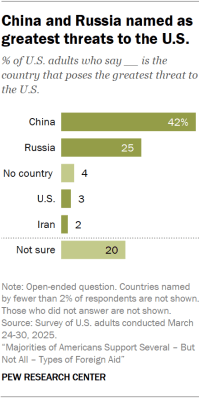
When asked which country poses the greatest threat to the U.S., China remains at the top of Americans’ list. Since we last asked this question in 2023, however, the share who name China as the biggest threat has declined, while the share who name Russia has grown. Roughly four-in-ten Americans (37%) say they are unsure which country is the United States’ greatest ally. As in the past, the United Kingdom is mentioned more than any other nation. But the shares who call Canada or Israel the top ally have increased since 2023. Which country poses the greatest threat to the U.S.? Roughly four-in-ten Americans (42%) say China poses the greatest threat to the U.S. when asked in an open-ended question. Russia is named by the next-largest share (25%). Smaller shares say no country (4%), the U.S. itself (3%) or Iran (2%) is the greatest threat. One-in-five say they are not sure. The share who name China as the greatest threat has declined from 50% in 2023. Conversely, the share who see Russia as the United States’ greatest threat has grown from 17%. Views by party Whether China or Russia is viewed as the top threat to the U.S. varies by party affiliation. Republicans and Republican-leaning independents are most likely to say that China is the United States’ greatest threat (58% vs. 12% who name Russia). Conversely, Democrats and Democratic leaners are most likely to call Russia the top threat (39% vs. 28% who name China). In 2023, China was the top choice among both Republicans and Democrats. Conservative Republicans are especially likely to see China as a threat (68%) compared with their moderate or liberal peers (45%). Among Democrats, liberals are more likely to name Russia (46%) than those who are moderate or conservative (34%).  Do China and Russia present economic or security threats?  After respondents named the country they see as the greatest threat to the U.S., we asked them to rate how much of a threat that country poses to the U.S. economy and to U.S. national security. Among those who name China as the country’s greatest threat, overwhelming majorities say it threatens the U.S. economy (97%) and U.S. security (94%) at least a fair amount. Indeed, most think China poses a great deal of threat to each. Among those who name Russia, more see it as a security threat (98%) than an economic threat (71%). Who is the United States’ most important ally? We also asked Americans which country they think is the United States’ most important ally. Roughly four-in-ten (37%) say they are unsure. Among those who do give an answer, the United Kingdom is mentioned most often (by 18% of adults), followed by Canada (12%) and Israel (9%). The share naming Canada as the top U.S. ally has doubled from 6% since we last asked this question in 2023. In that time, the share naming Israel has also roughly doubled – from 4% in 2023. These shifts over time in large part reflect changes in partisan attitudes. Republicans have become more likely to say Israel is the United States’ top ally (17% vs. 8% in 2023), while views among Democrats have not changed. At the same time, Democrats have become more likely to say that Canada is the most important ally (19% vs. 9% in 2023), while Republicans’ views have not shifted. Today, opinions also vary somewhat by age and religion: Age: Americans ages 50 and older most frequently point to the UK as the top U.S. ally (24%). In contrast, the UK is named by half as many adults under 50 (12%), and a similar share also name Canada (11%). Younger adults are much more likely than older adults to say they are not sure who the country’s most important ally is (44% vs. 29%). Religion: Around a quarter each among White evangelical Protestants (25%) and Jews (26%) say Israel is the country’s most important ally. Americans’ ratings of other countries Majorities of Americans give positive ratings to fellow G7 member countries Canada, France, Germany, Italy, Japan and the UK. Democrats are more likely than Republicans to see these allies in a favorable light, though. Between 75% and 87% of Democrats rate these countries positively, compared with 51% to 76% of Republicans. Japan is the only country in this group that gets similar – and overwhelmingly positive – ratings from both parties. Americans also give the EU a favorable rating (60%). Once again, Democrats rate the EU more positively than Republicans (78% vs. 44%). Half of Americans have positive views of Mexico, up from 37% last year. Favorable ratings of the United States’ southern neighbor have increased among both Democrats and Republicans, though a large gap remains: Democrats are more than twice as likely as Republicans to have a positive view of Mexico (67% vs. 32%). Adults under 50 also tend to have more positive views of Mexico when compared with those ages 50 and older (55% vs. 44%). Roughly half of Americans have a positive opinion of India (49%), a slight increase from 43% in 2024. Israel stands out among the countries included in our survey: Though 9% of Americans say it is the United States’ most important ally – making it the third-most commonly named – fewer than half have a favorable view of the country (45%). This is down from 55% since we last asked in 2022. Israel is also one of the only countries asked about that Republicans are more likely to rate positively than Democrats. In fact, Republicans are about twice as likely as Democrats to say they have a positive opinion of Israel (62% vs. 29%). And adults ages 50 and older are more likely to say this than younger adults (54% vs. 37%). Related: How Americans view Israel and the Israel-Hamas war at the start of Trump’s second term Few Americans hold positive views of China, Russia and Iran. Around one-in-five rate China positively, and roughly one-in-ten have a favorable opinion of Russia or Iran. Along

3. Americans’ views of allies and threats Read More »