Three former Netflix employees charged for profiting $3 million from insider trading

Image: Getty Images Three former Netflix employees along with two others have been charged for allegedly performing insider trading of Netflix. The charges, pressed by the US Securities and Exchange Commission (SEC), accuse the five individuals of generating over $3 million in total profits by trading on confidential information about Netflix’s subscriber growth. According to the SEC’s complaint, Sung Mo Jun, who is a former Netflix software engineer, headed a long-running scheme to illegally trade on non-public information concerning the growth of Netflix’s subscriber base, a key metric Netflix reports for its quarterly earnings announcements. The complaint alleges that Sung Mo Jun, while employed at Netflix in 2016 and 2017, repeatedly tipped subscriber growth information to his brother, Joon Mo Jun, and his close friend, Junwoo Chon, who both used it to trade in advance of multiple Netflix earnings announcements. The SEC’s complaint further alleges that after Sung Mo Jun left Netflix in 2017, he obtained confidential Netflix subscriber growth information from two other individuals, Ayden Lee and Jae Hyeon Bae, who still worked at Netflix at the time. The Jun brothers and Chon allegedly tried to evade detection by using encrypted messaging applications and paying cash kickbacks. The SEC’s complaint was filed in a Seattle federal court, with the two Juns, Chon, Lee, and Bae each receiving a charge for violating the Securities Exchange Act’s antifraud provisions. The US Attorney’s Office for the Western District of Washington has also raised a parallel action for the same charges. In the most recent quarter, Netflix reported it gained an additional 1.54 million paying subscribers while unveiling plans to add video games to its service in a bid to expand its revenue streams. At the start of this year, Netflix said it was spending $500 million for original content from South Korea this year alone. Related Coverage source

Three former Netflix employees charged for profiting $3 million from insider trading Read More »

Sony Eyes $49B Semiconductor Unit Sale, Plus More Rumors

By Tom Zanki ( May 1, 2025, 3:51 PM BST) — Sony could sell its semiconductor unit for $49 billion, while proxy advisory firm Glass Lewis is considering ending its practice of advising shareholder votes on politically charged topics, and AI startup Nscale plans to raise $2.7 billion in private capital to support the construction of data centers around the world…. Law360 is on it, so you are, too. A Law360 subscription puts you at the center of fast-moving legal issues, trends and developments so you can act with speed and confidence. Over 200 articles are published daily across more than 60 topics, industries, practice areas and jurisdictions. A Law360 subscription includes features such as Daily newsletters Expert analysis Mobile app Advanced search Judge information Real-time alerts 450K+ searchable archived articles And more! Experience Law360 today with a free 7-day trial. source

Sony Eyes $49B Semiconductor Unit Sale, Plus More Rumors Read More »

FTX Ch. 11 Trust Asks To Keep Customer Info Confidential

By Jeff Montgomery ( April 29, 2025, 9:41 PM EDT) — In a just-under-the-wire move, the FTX bankruptcy recovery trust has sought a seventh extension for a mid-2023 ruling by the U.S. Bankruptcy Court for the District of Delaware allowing confidential treatment of its 9 million customers’ information, citing the data’s continued value to the estate…. Law360 is on it, so you are, too. A Law360 subscription puts you at the center of fast-moving legal issues, trends and developments so you can act with speed and confidence. Over 200 articles are published daily across more than 60 topics, industries, practice areas and jurisdictions. A Law360 subscription includes features such as Daily newsletters Expert analysis Mobile app Advanced search Judge information Real-time alerts 450K+ searchable archived articles And more! Experience Law360 today with a free 7-day trial. source

FTX Ch. 11 Trust Asks To Keep Customer Info Confidential Read More »

Firing All Cylinders: Turning product launches from a whimper to a BANG

At Forrester, we frequently hear from clients struggling with product launches. Common issues include an overwhelming volume of minor launches that fail to make an impact, marketing teams receiving last-minute notifications about launches, or a lack of innovation — often relying on recycled spreadsheets from previous launches. Recognizing that only a quarter of firms employ a launch process even vaguely approaching best-in-class, we set out to address these challenges through a certification workshop at our recent B2B Summit. We began by introducing attendees to our proprietary Product Marketing And Management (PMM) Model (client login required). The PMM Model outlines key responsibilities for marketing, product, sales, and customer success teams at every stage of bringing an offering to market. While we typically conduct very comprehensive maturity assessments with clients, the Summit’s packed agenda led us to adopt a lighter approach. Participants used sticky notes to identify areas where they excelled and those needing improvement. One delegate shared, “It was so useful to think about marketing’s role in the product development lifecycle and where we could add value throughout. Usually, we’re an afterthought.” With marketers making up most of the audience, they identified key areas for improvement, including business opportunity proposals, market requirements, and launch dashboards. Alarmingly, more attendees lacked a clear target audience for their launches than those who did. Sales teams also faced critique for weak target-setting, while product teams were urged to focus more on competitive differentiation to ensure that new offerings stand out.   Next, we tackled the launch process itself, offering guidance on launch tiering and its implications for resource allocation. Participants quickly realized that not all launches warrant equal attention — a bug fix or technical debt resolution doesn’t always justify a tier-one launch. One delegate noted, “I loved the launch tiering. It was so simple yet actionable.” The workshop concluded with an exercise for attendees to complete the Forrester Launch-Plan-On-A-Page Template. This outlined launch goals, target audiences, metrics, timelines, buyer needs, competitive differentiation, and overall strategy. As one participant remarked, “I love that we left with a template we can take back to the office and use repeatedly.” In just over an hour, attendees walked away with actionable ideas and the reassurance that they weren’t alone in facing launch challenges. If you’re a Forrester client looking to refine your launch processes, contact your account team to schedule a guidance session. source

Firing All Cylinders: Turning product launches from a whimper to a BANG Read More »

Confidential Computing: CIOs Move to Secure Data in Use

As cyber threats grow more sophisticated and data privacy regulations grow sharper teeth, chief CIOs are under increasing pressure to secure enterprise data at every stage — at rest, in motion, and now, increasingly, in use.  Confidential computing, a technology that protects data while it is being processed, is becoming an essential component of enterprise security strategies. While the promise is clear, the path to implementation is complex and demands strategic coordination across business, IT, and compliance teams.  Itai Schwartz, co-founder and CTO at Mind, explains confidential computing enables secure data processing even in decentralized environments, which is particularly important for AI workloads and collaborative applications.  “Remote attestation capabilities further support a zero-trust approach by allowing systems to verify the integrity of workloads before granting access,” he says via email.    CIOs Turning to Confidential Computing  At its core, confidential computing uses trusted execution environments (TEEs) to isolate sensitive workloads from the broader computing environment. This ensures that sensitive data remains encrypted even while in use — something traditional security methods cannot fully achieve.  “CIOs should treat confidential computing as an augmentation of their existing security stack, not a replacement,” says Heath Renfrow, CISO and co-founder at Fenix24.  Related:Franciscan Health’s Pursuit of Observability and Automation He says a balanced approach enables CIOs to enhance security posture while meeting regulatory requirements, without sacrificing business continuity.  The technology is especially valuable in sectors like finance, healthcare, and the public sector, where regulatory compliance and secure multi-party data collaboration are top priorities.   Confidential computing is particularly valuable in industries handling highly sensitive data, explains Anant Adya, executive vice president and head of Americas at Infosys. “It enables secure collaboration without exposing raw data, helping banks detect fraud across institutions while preserving privacy,” he explains via email.    Implementation Without Disruption  Despite its potential, implementing confidential computing can be disruptive if not handled carefully. This means CIOs must start with a phased and layered strategy.  “Begin by identifying the most sensitive workloads, such as those involving regulated data or cross-border collaboration, and isolate them within TEEs,” Renfrow says. “Then integrate confidential computing with existing IAM, DLP, and encryption frameworks to reduce operational friction.”  Related:Preparing Your Tech Business for a Possible Recession Adya echoes that sentiment, noting organizations can integrate confidential computing by adopting a phased approach that aligns with their existing security architecture. He recommends starting with high-risk workloads like financial transactions or health data before expanding deployment.  Schwartz emphasizes the importance of setting long-term expectations for deployment.   “Introducing confidential computing is a big change for organizations,” he says. “A common approach is to define a policy where every new data-sensitive component will be created using confidential computing, and existing components will be migrated over time.”  Jason Soroko, senior fellow at Sectigo, stresses the importance of integrating confidential computing into the broader enterprise architecture. “CIOs should consider the value of separating ‘user space’ from a ‘secure space,’” he says.   Enclaves are ideal for storing secrets like PKI key pairs and digital certificates, allowing sensitive workloads to be isolated from their authentication functions.  Addressing Performance and Scalability  One of the main challenges CIOs face when deploying confidential computing is performance overhead. TEEs can introduce latency and may not scale easily without optimization.  Related:Principal Financial Group CIO on Being a Technologist and Business Leader “To address performance and scalability while maintaining business value, CIOs can prioritize high-impact workloads,” Renfrow says. “Focus TEEs on workloads with the highest confidentiality requirements, like financial modeling or AI/ML pipelines that rely on sensitive data.”  Adya suggests keeping fewer sensitive computations outside TEEs to reduce the load. “Offload only the most sensitive computations, and leverage hardware acceleration and cloud-managed confidential computing services to improve efficiency,” he recommends.  Soroko adds that hardware selection is critical, suggesting CIOs should be choosing TEE hardware that has an appropriate level of acceleration. “Combine TEEs with hybrid cryptographic techniques like homomorphic encryption to reduce overhead while maintaining data security,” he says.   For scalability, Renfrow recommends infrastructure automation, for example adopting infrastructure-as-code and DevSecOps pipelines to dynamically provision TEE resources as needed. “This improves scalability while maintaining security controls,” he says.   Aligning with Zero Trust and Compliance  Confidential computing also supports zero-trust architecture by enforcing the principle of “never trust, always verify.”  TEEs and remote attestation create a secure foundation for workload verification, especially in decentralized or cloud-native environments.  “Confidential computing extends zero-trust into the data application layer,” Schwartz says. “This is a powerful way to ensure that sensitive operations are only performed under verified conditions.”  Compliance is another major driver for adoption, with regulations such as GDPR, HIPAA, and CPRA increasingly demand data protection throughout the entire lifecycle — including while data is in use.  The growing list of regulations and compliance issues will require CIOs to demonstrate stronger safeguards during audits.  “Map confidential computing capabilities directly to emerging data privacy regulations,” Renfrow says. “This approach can reduce audit complexity and strengthen the enterprise’s overall compliance posture.”  Adya stresses the value of collaboration across internal teams, pointing out successful deployment requires coordination between IT security, cloud architects, data governance leaders, and compliance officers.   As confidential computing matures, CIOs will play a pivotal role in shaping how enterprises adopt and scale the technology.  For organizations handling large volumes of sensitive data or operating under stringent regulatory environments, confidential computing is no longer a fringe solution — it’s becoming foundational.  Success will depend on CIOs guiding adoption through a focus on integration, continuous collaboration across their enterprise, and by aligning security strategies with business objectives.  “By aligning confidential computing with measurable outcomes — like reduced risk exposure, faster partner onboarding, or simplified audit readiness — CIOs can clearly demonstrate its business value,” Renfrow says.  source

Confidential Computing: CIOs Move to Secure Data in Use Read More »

Has Oracle knocked SAP off the ERP throne?

However, neither provider explicitly discloses its results in the ERP sector. Instead, Apps Run The World made estimates based on public records, cloud and non-cloud business models in its supplier database, and the results of annual surveys including supplier feedback. Oracle customers are being milked harder According to the analysts, the reason for the change in leadership is simple math. Oracle, for example, has more than 100,000 customers in the entire ERP segment (which includes both financial management and industry-specific back-office solutions), each of which contributed an average of $87,700 last year. In contrast, SAP only generated an average of $61,429 with each of its 141,399 ERP customers, or around 30% less per customer. Apps Run The World puts the average turnover of a customer with Oracle Fusion Cloud ERP at $257,286 and one with SAP S/4 HANA at $253,100. At the same time, the analysts point out that Oracle grew by 17.7% in 2024, while SAP only grew by 13.7%. source

Has Oracle knocked SAP off the ERP throne? Read More »

US announces suspended tariffs on countries charging Digital Services Taxes

The United States Trade Representative (USTR) has wrapped up a year-long investigation into DSTs (Digital Services Taxes) that affect US tech firms. It will impose tariffs on six countries, but will hold off implementing them for 180 days to allow negotiations to continue. Among the countries within the USTR investigation, and now subject to the suspended tariffs, are Austria, India, Italy, Spain, Turkey, and the UK.  G20 nations floated the idea of a digital services tax in 2019 under a plan to levy more taxes from tech giants, most of which are headquartered in the US.  SEE: Guide to Becoming a Digital Transformation Champion (TechRepublic Premium) On April 1 2020, the UK introduced a 2% tax on the revenues of search engines, social media services and online marketplaces if they make money from UK users.   France also implemented the tax and was threatened with retribution from former US president Donald Trump, but was not named in the USTR’s latest announcement regarding suspended US trade tariffs. France was also under investigation over its digital services tax. The 180-day suspension will allow the US to complete multilateral negotiations on international taxation at the OECD and in the G20 process, the USTR said.   The US launched its investigation into the DST schemes on June 2, 2020 in Austria, Brazil, the Czech Republic, the European Union, India, Indonesia, Italy, Spain, Turkey, and the UK.   “The United States is focused on finding a multilateral solution to a range of key issues related to international taxation, including our concerns with digital services taxes,” said USTR ambassador Katherine Tai.  “The United States remains committed to reaching a consensus on international tax issues through the OECD and G20 processes. Today’s actions provide time for those negotiations to continue to make progress while maintaining the option of imposing tariffs under Section 301 if warranted in the future.” SEE: GDPR: Fines increased by 40% last year, and they’re about to get a lot bigger In January, the USTR announced that it had determined the UK’s DST “is unreasonable or discriminatory and burdens or restricts U.S. commerce and thus is actionable under Section 301.” The UK’s digital services tax applies to companies with digital services revenues exceeding £500 million and UK digital services revenues exceeding £25 million. source

US announces suspended tariffs on countries charging Digital Services Taxes Read More »

How music shapes Dan Massey’s approach to IT leadership

I find these same concepts relate directly to the strategy, design, and execution of technology projects. There is a tremendous amount of creativity on how business strategy, process engineering, data and analytics, software, and hardware all come together to solve business problems and meet customer needs. Once designed, these solutions have to be secure, scalable, and highly available. As a result, precise execution is critical. Being on beat and hitting the right notes is the product of many takes in the recording studio, just as writing and testing code is critical to ensuring the final product is the highest possible quality. At the same time, playing music in a band and leading a technology organization both require continual attention and adaptability. In music, that might come in the form of improvising and responding to the dynamics of your bandmates during a live performance. You have to be nimble in those situations, and it takes a lot of practice and experience to build your chops and be able to listen and adjust in the moment. This is something we’re all too familiar with as technology leaders. Especially with the speed of change and innovation, you have to make smart calls under pressure and be able to navigate quickly evolving business priorities, unexpected challenges, and new opportunities. Does playing music help you process complex problems and see patterns differently? If so, how? source

How music shapes Dan Massey’s approach to IT leadership Read More »

More accurate coding: Researchers adapt Sequential Monte Carlo for AI-generated code

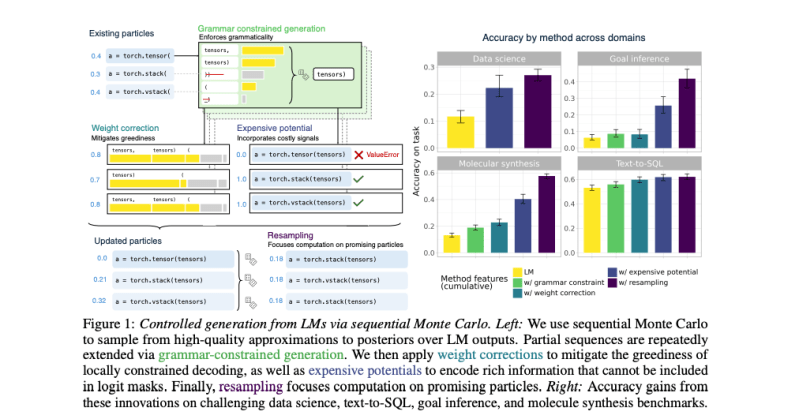
Join our daily and weekly newsletters for the latest updates and exclusive content on industry-leading AI coverage. Learn More Coding with the help of AI models continues to gain popularity, but many have highlighted issues that arise when developers rely on coding assistants.  However, researchers from MIT, McGill University, ETH Zurich, Johns Hopkins University, Yale and the Mila-Quebec Artificial Intelligence Institute have developed a new method for ensuring that AI-generated codes are more accurate and useful. This method spans various programming languages and instructs the large language model (LLM) to adhere to the rules of each language. The group found that by adapting new sampling methods, AI models can be guided to follow programming language rules and even enhance the performance of small language models (SLMs), which are typically used for code generation, surpassing that of large language models. In the paper, the researchers used Sequential Monte Carlo (SMC) to “tackle a number of challenging semantic parsing problems, guiding generation with incremental static and dynamic analysis.” Sequential Monte Carlo refers to a family of algorithms that help figure out solutions to filtering problems.  João Loula, co-lead writer of the paper, said in an interview with MIT’s campus paper that the method “could improve programming assistants, AI-powered data analysis and scientific discovery tools.” It can also cut compute costs and be more efficient than reranking methods.  The researchers noted that AI-generated code can be powerful, but it can also often lead to code that disregards the semantic rules of programming languages. Other methods to prevent this can distort models or are too time-consuming.  Their method makes the LLM adhere to programming language rules by discarding code outputs that may not work early in the process and “allocate efforts towards outputs that more most likely to be valid and accurate.” Adapting SMC to code generation The researchers developed an architecture that brings SMC to code generation “under diverse syntactic and semantic constraints.”  “Unlike many previous frameworks for constrained decoding, our algorithm can integrate constraints that cannot be incrementally evaluated over the entire token vocabulary, as well as constraints that can only be evaluated at irregular intervals during generation,” the researchers said in the paper.  Key features of adapting SMC sampling to model generation include proposal distribution where the token-by-token sampling is guided by cheap constraints, important weights that correct for biases and resampling which reallocates compute effort towards partial generations. The researchers noted that while SMC can guide models towards more correct and useful code, they acknowledged that the method may have some problems. “While importance sampling addresses several shortcomings of local decoding, it too suffers from a major weakness: weight corrections and expensive potentials are not integrated until after a complete sequence has been generated from the proposal. This is even though critical information about whether a sequence can satisfy a constraint is often available much earlier and can be used to avoid large amounts of unnecessary computation,” they said.  Model testing To prove their theory, Loula and his team ran experiments to see if using SMC to engineer more accurate code works.  These experiments were:  Python Code Generation on Data Science tasks, which used Llama 3 70B to code line-by-line and test early versions  Text-to-SQL Generation with Llama 3 8B- Instruct Goal Inference in Planning Tasks to predict an agent’s goal condition, and also used Llama 3 8B Molecular Synthesis for drug discovery They found that using SMC improved small language models, improved accuracy and robustness, and outperformed larger models.  Why is it important AI models have made engineers and other coders work faster and more efficiently. It’s also given rise to a whole new kind of software engineer: the vibe coder. But there have been concerns over code quality, lack of support for more complex coding and compute costs for simple code generation. New methods, such as adapting SMC, may make AI-powered coding more useful and enable engineers to trust the code generated by models more.  Other companies have explored ways to improve AI-generated code. Together AI and Agentica released DeepCoder-14B, which harnesses fewer parameters. Google also improved its Code Assist feature to help enhance code quality.  source

More accurate coding: Researchers adapt Sequential Monte Carlo for AI-generated code Read More »

Judge Weighs Impact Of Top Court Ruling On DOE Grant Cap

By Brian Dowling ( April 28, 2025, 6:38 PM EDT) — A federal judge hearing a challenge to a Department of Energy grant cap on Monday expressed concerns about the case’s potential overlap with a U.S. Supreme Court ruling that cast doubt on a bid to revive federal teacher training grants…. Law360 is on it, so you are, too. A Law360 subscription puts you at the center of fast-moving legal issues, trends and developments so you can act with speed and confidence. Over 200 articles are published daily across more than 60 topics, industries, practice areas and jurisdictions. A Law360 subscription includes features such as Daily newsletters Expert analysis Mobile app Advanced search Judge information Real-time alerts 450K+ searchable archived articles And more! Experience Law360 today with a free 7-day trial. source

Judge Weighs Impact Of Top Court Ruling On DOE Grant Cap Read More »