OpenAI Requires Identity Verification For Access To Its Latest Models

OpenAI announced that it will require organizations to complete an identity verification (IDV) process to verify their organization’s identity before being allowed to access the latest OpenAI models. Identity verification will likely require developers to digitally verify themselves using government-issued photo ID from permitted countries and prove their affiliation with their organization. Forrester expects that the reasons for OpenAI’s decision include: The ability to block malicious or rogue country-based developers from APIs to models. Tying developers to only one client organization, ensuring that one developer accesses OpenAI models only on behalf of one organization (this helps with vetting organizations). Better enforcement of rate limitations to models. Protecting OpenAI models from IP theft. A need to correlate true identities to prompts and model responses that slip through genAI guardrails (e.g., asking for instructions on how to commit acts of terrorism). This is especially important as large language models (LLMs) expand from text-focused input-output to new modalities (audio, image, video). OpenAI’s decision parallels a larger market trend about linking online, digital identities to real-world ones. Included in this trend are age verification (gaming, gambling, adult content websites) requirements, regulatory compliance with know-your-customer/anti-money-laundering regulations, and nonrepudiation of user transactions. Firms using OpenAI should define an internal governance (onboarding and offboarding) process for permissioning access to genAI/LLM models, including OpenAI. Shadow genAI access puts the firm’s and its customers’ intellectual property at risk of disclosure via these models. Further, Forrester recommends that end user organizations leverage multichannel-capable (web, mobile app, contact center, in-person), low-user-friction but powerful identity verification solutions. source

OpenAI Requires Identity Verification For Access To Its Latest Models Read More »

Key Questions Dominating The Innovation Agenda

While we receive many client inquiries on best practices for innovation management, there have been four recurring categories of inquiries lately that dominate our client conversations. Do we still need an innovation team? Clients want to validate their organizational innovation setups against best practices. While most of our clients are operating centralized innovation teams, their mandates vary from technology foresight and experimentation to innovation facilitation and delivery. The best setup for you depends on your organization’s innovation maturity and therefore must adapt as your innovation practice evolves, from centralized do-it-all teams to vanishing formal structures as innovation is embedded in everybody’s job and mind. Read more about innovation setups here. Should we build innovations or empower innovators? The answer aligns with your innovation team’s ambition or strategy. Temporarily, it can make sense to start with an innovation team that not only ideates but also delivers proofs of concept, pilots, and products based on these ideas. But in the long run, innovation teams should instead facilitate the process, empower other ideators and innovators, and help nourish the right attitude and mindset across staff to enable others to innovate. Here are more tips around innovation ambitions and mandates. What are specific tips and tricks for setting up an innovation lab? Many of our clients are either in the process of setting up a physical (rarely a digital) innovation lab or they’re considering shifting the focus of an existing innovation lab for better performance. Questions related to this include whether to position the lab more so as a safe zone for experimentation or a technology showroom, how to staff it, how to make and keep it attractive, and who the target audiences should be. If you want to learn more about innovation labs, here is our best practice report. How are others leveraging genAI to become more innovative? The misconception still exists that emerging technology adoption equals innovation, which is not true. While it is essential to continuously research and experiment with emerging technologies such as generative AI to understand potential benefits, costs, risks, and prerequisites for your organization, technology experimentation is not innovative, per se. Turning learnings from technology experiments into solutions to existing problems or elevating products and services through new technologies, however, is truly innovative. Therefore, we recommend generative AI experimentation to learn how the technology can help your organization. At the same time, you must identify improvement areas or challenges that could benefit from generative AI. If there isn’t a match, don’t apply the technology. As matches vary by industry, process, culture, and/or organizational readiness, it doesn’t help to just copy what others are doing. Read this report to understand how to assign innovation contribution areas for generative AI. If you want to discuss these or any other questions about innovation management best practices, book an inquiry or guidance session with me or one of my colleagues. source

Key Questions Dominating The Innovation Agenda Read More »

NZ’s digital leaders seek government partnerships as cyber security rated top priority

“Several digital leaders struggled to pinpoint specific government initiatives in the digital technology space this year,” the report said. “Some leaders say they ‘haven’t really heard much about what they’re doing at all’, while others ‘struggle to see what they’ve done.’” A common view was that government restructuring and shifting priorities had sidelined digital technology and this was seen by many as a missed opportunity. “There is a strong perception that the government lacks a coordinated and strategic approach to digital transformation, with some leaders stating, ‘we don’t have a digital ambition’,” the report said. “While there may have been enthusiasm and rhetoric, many feel it has yet to translate into meaningful action.” source

NZ’s digital leaders seek government partnerships as cyber security rated top priority Read More »

FTC Defends John Deere Right-To-Repair Suit

By Nadia Dreid ( April 29, 2025, 10:26 PM EDT) — Farm machinery-maker Deere & Co. is trying to get out of an FTC enforcement action using the same arguments that didn’t help it escape multidistrict litigation accusing the company of breaking antitrust laws by restricting access to repair services, the government says…. Law360 is on it, so you are, too. A Law360 subscription puts you at the center of fast-moving legal issues, trends and developments so you can act with speed and confidence. Over 200 articles are published daily across more than 60 topics, industries, practice areas and jurisdictions. A Law360 subscription includes features such as Daily newsletters Expert analysis Mobile app Advanced search Judge information Real-time alerts 450K+ searchable archived articles And more! Experience Law360 today with a free 7-day trial. source

FTC Defends John Deere Right-To-Repair Suit Read More »

3. How people rate press, speech and internet freedoms in their country

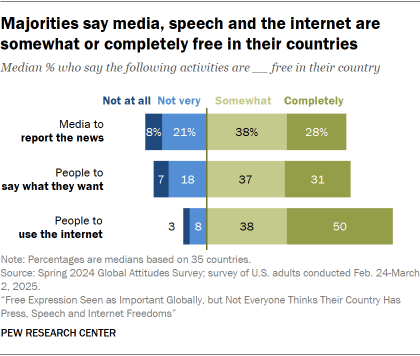
In 35 countries, we asked respondents how free the media are to report the news in their country, how free people are to say what they want, and how free people are to use the internet. Majorities in many of the countries surveyed say media, speech and the internet are at least somewhat free of state or government censorship. A 50% median globally say people in their country are completely free to use the internet. Substantially fewer say people in their country are completely free to say what they want (31% median) and that the media are completely free to report the news (28% median). Compared with people in other countries, Latin Americans are less likely to say they have these freedoms. People’s perceptions of these freedoms are strongly linked with views of how democracy is working in their country. In most countries, those who characterize their press, speech and internet use as free are more likely to say they are satisfied with the functioning of their democracy. In many countries, supporters of the political party in power are more likely to say that media, speech and the internet are completely free in their country. It’s important to note that many political changes have occurred since we fielded the global survey in spring 2024, so attitudes may have shifted since then. Freedom of the press A median of 28% across 35 countries say the media are completely free to report the news in their country. Another 38% think the media are somewhat free. In the U.S. and Canada, large majorities believe the media are at least somewhat free, although only about one-third of adults in each country say the media are completely free. Majorities in most of the European countries surveyed see the media as free. Greece is a stark exception: A majority of people there say Greek media are not free to report the news, including 35% who say the media are not at all free. On the other end of the spectrum, nearly nine-in-ten Swedes say their media are at least somewhat free, including 46% who characterize the Swedish press as completely free. In the Asia-Pacific region, the perception of free media is most common in Australia and the Philippines. But in Singapore and South Korea, opinions are more split: About half or more in each country say their media are completely or somewhat free to report the news, while 46% in South Korea and 45% in Singapore say the media are not very or not at all free. In all four sub-Saharan African countries polled, majorities rate their media as free, including 59% in Ghana who say their media are completely free. Opinions are more divided in Nigeria than elsewhere in the region. Negative perceptions of press freedom are common in most of the Latin American countries surveyed, especially Chile. Roughly seven-in-ten Chileans (69%) say the media are not very or not at all free to report the news. And opinions are divided in Argentina, Colombia, Mexico and Peru. Views by support for governing parties At the time the survey was fielded in spring 2024, people who supported the active governing party were often more likely than nonsupporters to characterize their country’s media as completely free. This was the case in 27 countries. In Turkey, four-in-ten adults who support the government of President Recep Tayyip Erdoğan say the Turkish media are completely free to report the news. This compares with only 7% of those who do not support Erdoğan’s government – a difference of 33 points. Similar divides on this question are found between supporters and nonsupporters of the governing parties in Hungary, India and Israel (24, 22 and 22 points, respectively). Views of democracy by perceptions of press freedom In 27 countries, people who say the media are completely free to report the news in their country are more likely to say they are very or somewhat satisfied with the way their democracy is working, compared with those who characterize the media as less free. In Turkey, those who say media reporting is completely free are more 54 points more likely than those who say it is not completely free to be satisfied with their democracy (77% vs. 23%). Similar differences are found in Hungary, Germany and Canada (37, 34 and 30 points, respectively). Freedom of speech A median of 31% across 35 countries say people in their country are completely free to say what they want, with 37% saying people are somewhat free to do this. Among Americans and Canadians, eight-in-ten or more believe people in their country are at least somewhat free to say what they want. And about a third of adults in each say speech is completely free. In Europe, 92% of Swedes say that people are free to say what they want, including 47% who say they are completely free. By comparison, a much smaller majority of adults in France (61%) say people are free to say what they want. Majorities in every Asia-Pacific country surveyed say people are at least somewhat free to express themselves, although the sentiment that speech is completely free is most widespread in India (50%) and the Philippines (45%). Singapore again stands out, with only 11% saying speech is completely free and 42% saying it is not at all or not very free. In the Middle East-North Africa region, around eight-in-ten adults in Israel (78%) say people are at least somewhat free to say what they want in their country. Views are more pessimistic in Turkey, where nearly half (47%) say speech is either not very or not at all free. And in the sub-Saharan African countries surveyed, majorities characterize speech as free  – especially in Ghana, where 58% say speech is completely free.  In Latin America, views of free speech are more divided. Majorities of Argentines, Brazilians and Mexicans say people are at least somewhat free to say what they want in their country. But opinions are split in Chile and Peru, where around


3. How people rate press, speech and internet freedoms in their country Read More »

ITC Affirms Optimum's Network Patent Case Is Over

By Andrew Karpan ( April 28, 2025, 10:28 PM EDT) — The U.S. International Trade Commission has decided not to breathe any new life into Optimum Communications Services Inc.’s patent infringement case against several Chinese tech companies over network switching and routing patents, but it also cut part of an agency judge’s findings on ownership of the patents…. Law360 is on it, so you are, too. A Law360 subscription puts you at the center of fast-moving legal issues, trends and developments so you can act with speed and confidence. Over 200 articles are published daily across more than 60 topics, industries, practice areas and jurisdictions. A Law360 subscription includes features such as Daily newsletters Expert analysis Mobile app Advanced search Judge information Real-time alerts 450K+ searchable archived articles And more! Experience Law360 today with a free 7-day trial. source

ITC Affirms Optimum's Network Patent Case Is Over Read More »

Teens, Social Media and Mental Health

(Thomas Barwick/Getty Images) How we did this Pew Research Center conducted this study to understand teens’ experiences and attitudes around teen mental health and social media. Part of this study also examines parents’ perspectives. The Center conducted an online survey of 1,391 U.S. teens and parents from Sept. 18 to Oct. 10, 2024, through Ipsos. Ipsos recruited the teens via their parents, who were part of its KnowledgePanel. The KnowledgePanel is a probability-based web panel recruited primarily through national, random sampling of residential addresses. Parents were asked to think about one teen in their household (if there were multiple teens ages 13 to 17 in the household, one was randomly chosen). At the conclusion of the parent’s section, the parent was asked to have this chosen teen come to the computer and complete the survey in private. The survey is weighted to be representative of two different populations: 1) parents with teens ages 13 to 17 and 2) teens ages 13 to 17 who live with parents. For each of these populations, the survey is weighted to be representative by age, gender, race and ethnicity, household income and other categories. Here are the questions among teens and among parents used for this report, along with responses, and the survey methodology­­­. This research was reviewed and approved by an external institutional review board (IRB), Advarra, an independent committee of experts specializing in helping to protect the rights of research participants. Rising rates of poor mental health among youth have been called a national crisis. While this is often linked to factors like the COVID-19 pandemic or poverty, some officials, like former Surgeon General Vivek Murthy, name social media as a major threat to teenagers. Our latest survey of U.S. teens ages 13 to 17 and their parents finds that parents are generally more worried than their children about the mental health of teenagers today. And while both groups call out social media’s impact on young people’s well-being, parents are more likely to make this connection. Still, teens are growing more wary of social media for their peers. Roughly half of teens (48%) say these sites have a mostly negative effect on people their age, up from 32% in 2022. But fewer (14%) think they negatively affect them personally. Other key findings from the survey: More teens report spending too much time on social media: 45% of teens say they spend too much time on social media in our current survey, up from 36% in 2022. Girls’ experiences on social media skew more negative, at times: Teen girls are more likely than boys to say social media hurt their mental health (25% vs. 14%), confidence (20% vs. 10%) or sleep (50% vs. 40%). A majority of teens see social media as a positive space for friendships and creativity: 74% of teens say these platforms make them feel more connected to their friends, and 63% say they give them a place to show off their creative side. Teens and parents have different comfort levels talking about teen mental health: 80% of parents say they’re extremely or very comfortable talking to their teen about their teen’s mental health. Smaller shares of teens (52%) feel the same way. Social media as a mental health resource: 34% of teens say they at least sometimes get information about mental health on social media. Jump to read about views among parents and teens on: Mental health concerns | Openness to talking about mental health with others Jump to read about views among teens on: Social media as a mental health resource | Social media’s effect on teens | Feelings about social media in their own lives | Screen time Parents’ and teens’ concerns about mental health To better understand how families are grappling with issues related to youth mental health, we asked teens and parents to share their level of concern, thoughts on underlying causes, and openness to discussing mental health. Parents are more likely than teens to be concerned about teen mental health today. Overall, 55% of parents report being extremely or very concerned about the mental health of teens today. Fewer teens (35%) say the same, according to our survey of 1,391 parents and their teens conducted Sept. 18-Oct. 10, 2024. On the other hand, a larger share of teens than parents say they’re not too or not at all worried about the state of teen mental health (23% vs. 11%). About this report There are growing debates about social media’s impact on youth mental health. This survey seeks to surface teens’ and their parents’ perspectives on this topic, not to supply evidence or establish causality. We used the overarching term “mental health” throughout our survey questions to ask teens and parents about their broad experiences. Teens’ and parents’ views, by gender Teens’ concerns about mental health differ by gender. Girls more often than boys say that they are highly concerned about teen mental health (42% vs. 28%). We also see differences among parents – both based on their gender and the gender of their child. Mothers are more likely than fathers to say they are extremely or very concerned about the mental state of teens today (61% vs. 47%). Additionally, parents of a teen girl are more likely than those with a teen boy to express high levels of concern (61% vs. 49%). Related: The Gender Gap in Teen Experiences Teens’ and parents’ views, by race and ethnicity There are also notable differences by race and ethnicity. Seven-in-ten Black parents say they are extremely or very worried about teen mental health. This is higher than the shares seen among White (55%) and Hispanic (52%) parents. Black teens also stand out in their concern about teen mental health. Half of Black teens report being highly concerned, compared with 39% of Hispanic teens and an even smaller share of White teens (31%). What contributes the most to teens’ mental health? Parents and teens who say they are at least somewhat concerned about teen mental health today were then asked

Teens, Social Media and Mental Health Read More »

FCC Tells Courts 5th Circ. Wrong To Kill $57M AT&T Fine

By Ali Sullivan ( April 28, 2025, 10:04 PM EDT) — The Federal Communications Commission defended multimillion-dollar fines against T-Mobile and Verizon in letters to the D.C. Circuit and Second Circuit, urging the appeals courts not to heed the Fifth Circuit’s toss of a related $57 million privacy fine against AT&T…. Law360 is on it, so you are, too. A Law360 subscription puts you at the center of fast-moving legal issues, trends and developments so you can act with speed and confidence. Over 200 articles are published daily across more than 60 topics, industries, practice areas and jurisdictions. A Law360 subscription includes features such as Daily newsletters Expert analysis Mobile app Advanced search Judge information Real-time alerts 450K+ searchable archived articles And more! Experience Law360 today with a free 7-day trial. source

FCC Tells Courts 5th Circ. Wrong To Kill $57M AT&T Fine Read More »

USPTO Discovery In VLSI Row Unlawul, PQA Tells Fed. Circ.

By Theresa Schliep ( April 28, 2025, 10:49 PM EDT) — A company that was sanctioned for flouting discovery while challenging the validity of a VLSI Technology LLC patent underpinning a since-vacated $1.5 billion infringement verdict told the Federal Circuit on Friday that the U.S. Patent and Trademark Office director lacked the authority to order that discovery…. Law360 is on it, so you are, too. A Law360 subscription puts you at the center of fast-moving legal issues, trends and developments so you can act with speed and confidence. Over 200 articles are published daily across more than 60 topics, industries, practice areas and jurisdictions. A Law360 subscription includes features such as Daily newsletters Expert analysis Mobile app Advanced search Judge information Real-time alerts 450K+ searchable archived articles And more! Experience Law360 today with a free 7-day trial. source

USPTO Discovery In VLSI Row Unlawul, PQA Tells Fed. Circ. Read More »