Microsoft sees AI agents shaking up org charts, eliminating traditional functions

Employees at frontier companies are particularly positive on AI’s potential to grow their companies rapidly. “Frontier company employees expect to be able to work more efficiently with AI in the future, which can be interpreted as meaning that they are looking forward to the future positively,” Oh Seong-mi explained. MS predicted that most organizations will shift toward becoming frontier companies in the next two to five years, redefining employee roles. Major examples include Bayer, Dow Chemical, and Wells Fargo. Bayer is currently introducing AI agents into product development, saving 6 hours per week, and Dow Chemical is introducing AI to delivery operations, with an expected cost savings of millions of dollars. Wells Fargo has used AI agents for customer service at more than 4,000 branches, reducing information search time from 10 minutes to 30 seconds. According to the report, companies are also significantly increasing their use of AI agents. 46% of leaders say their companies are fully automating work processes using agents, and they expected rapid expansion in customer service, marketing, and product development in the next 12 to 18 months. source

Microsoft sees AI agents shaking up org charts, eliminating traditional functions Read More »

Thomson Reuters Tells 3rd Circ. AI Fair Use Appeal Is Too Early

By Lauren Berg ( April 25, 2025, 10:59 PM EDT) — Thomson Reuters on Thursday urged the Third Circuit to reject tech startup Ross Intelligence’s bid for a quick appeal focusing on two key questions from a trial court decision concluding it infringed the Westlaw platform to create an artificial intelligence-backed competing legal research tool…. Law360 is on it, so you are, too. A Law360 subscription puts you at the center of fast-moving legal issues, trends and developments so you can act with speed and confidence. Over 200 articles are published daily across more than 60 topics, industries, practice areas and jurisdictions. A Law360 subscription includes features such as Daily newsletters Expert analysis Mobile app Advanced search Judge information Real-time alerts 450K+ searchable archived articles And more! Experience Law360 today with a free 7-day trial. source

Thomson Reuters Tells 3rd Circ. AI Fair Use Appeal Is Too Early Read More »

IBM claims $3.5 billion productivity boost through AI agent use

According to Lee Ji-eun, IBM is utilizing AI-based digital agents in areas such as human resources, finance, sales, and IT. In IBM’s human resources function, its AskHR agent has been used to automate 94% of simple tasks such as vacation requests and pay statements. In IT, AskIT has reduced the number of calls and chats for the IT support team by 70%, she said. Furthermore, IBM has integrated AI agents in each area into a single platform. Defining an ecosystem that links AI agents, assistants, and business applications in each area into a single integrated environment as “agentic AI,” CTO Lee Ji-eun explained that AI agents that perform tasks autonomously can focus on their own areas of expertise while being organically connected to each other like a network to efficiently execute complex work processes. This integrated approach enables IBM to manage work across various departments and functions from a single interface. Kim Ji-kwan, executive director of client engineering, who took part in the demo, introduced Watsonx Orchestrate as a core platform for agentic AI development. According to Executive Director Kim Ji-kwan, Watsonx Orchestrate integrates multiple business applications and AI agents into a single interface to intelligently analyze user requests and connect them to the appropriate path. source

IBM claims $3.5 billion productivity boost through AI agent use Read More »

Ex-Google Engineer Claims Coercion In AI Trade Secrets Case

By Ivan Moreno ( April 25, 2025, 7:01 PM EDT) — A former Google software engineer accused of stealing artificial intelligence trade secrets for Chinese startups has asked a California federal court to suppress statements he made to government investigators, alleging they used forceful tactics during an interrogation and did not read him his Miranda rights…. Law360 is on it, so you are, too. A Law360 subscription puts you at the center of fast-moving legal issues, trends and developments so you can act with speed and confidence. Over 200 articles are published daily across more than 60 topics, industries, practice areas and jurisdictions. A Law360 subscription includes features such as Daily newsletters Expert analysis Mobile app Advanced search Judge information Real-time alerts 450K+ searchable archived articles And more! Experience Law360 today with a free 7-day trial. source

Ex-Google Engineer Claims Coercion In AI Trade Secrets Case Read More »

Beyond The Architecture Cage Match: The Microservices Vs. Monoliths Battle Is Hurting Your Business

In the red corner, weighing in with independent scalability and distributed complexity: microservices! In the blue corner, the reigning legacy champion, with its infamous deployment challenges: the monolith! For years, architects and technology executives have watched this architectural cage match with bated breath. Technology forums buzzed with trash talk from both sides. Conference speakers built careers championing one approach while demonizing the other. Vendors sold middleware solutions promising to crown you champion — if only you’d pick their preferred fighter. But what if we told you that this entire spectacle was all just a waste of time? The truth? Your organization shouldn’t pick a single winner in this so-called battle. You need different solutions tailored to specific contexts. Reality Check: The Tale Of The Tape The industry landscape is littered with both cautionary tales and success stories that illustrate architectural tension. Consider how Segment, the customer data platform, famously documented its journey from monolith to microservices and then partially back again. The engineering team initially split Segment’s platform into over 100 microservices in pursuit of scalability, only to face what they called “death by a thousand microservices.” The team eventually consolidated back to a more balanced approach after experiencing mounting operational complexity and debugging challenges that outweighed the benefits. On the flip side, many established enterprises cling to aging monoliths long past their expiration dates. When retail giant Target began its digital transformation, it realized that its monolithic architecture couldn’t deliver the agility needed to compete with Amazon. Its pragmatic phased approach to modernization — selectively decomposing components while maintaining core systems — helped Target achieve an impressive digital turnaround without falling into either extreme of the architectural spectrum. The lesson from both scenarios? Architectural decisions driven by trends rather than business context frequently lead organizations astray. Architecture is about weighing trade-offs, not adhering to dogma. Dropping The Gloves: Three Principles For Practical Architecture Decisions Respect context over dogma. The most successful organizations that we advise approach architecture as a spectrum of options, not a binary choice. They understand that different components of their system have different needs. Features that change frequently might benefit from isolation and independent deployment, while stable functions might remain tightly integrated. Evolve incrementally, not revolutionarily. Revolutionary architectural changes make for exciting conference talks but disastrous implementation stories. Progressive, measurable evolution toward targeted outcomes consistently outperforms “big bang” transformations. The best architectures grow organically to address specific pain points, not theoretical ideals. Measure what matters to the business. The ultimate victor in any architectural decision should be determined by measurable business outcomes, not technical elegance. Does the change increase deployment frequency? Reduce time-to-market? Improve reliability? Lower operational costs? Architecture should serve the business, not the other way around. The Real Champion: Architectural Pragmatism As we enter a new era of digital acceleration, the organizations pulling ahead aren’t arguing about monoliths versus microservices. They’re pragmatically applying architectural patterns where they make sense, modernizing incrementally where they see concrete benefits, and staying focused on delivering business value. So go beyond the battle royale, put down the architectural dogma, and start asking better questions about what your specific context, organization, and business needs demand. The true champion of modern software architecture isn’t a particular pattern — it’s the pragmatic, business-focused approach that delivers real results in your unique context. Because in the real world, the only architectural approach fighter that truly wins is the one that helps your business succeed. For more insight into how to handle the cage match, read our full report here. source

Beyond The Architecture Cage Match: The Microservices Vs. Monoliths Battle Is Hurting Your Business Read More »

Babak Hodjat Talks Groundbreaking Work on Natural Language Tech

A desire for consistency in how AI performs, and with the results it delivers, is shared among many companies and their customers, says Babak Hodjat, CTO of AI for Cognizant. Delivering such consistency may require internal and external effort to mature the technology. Hodjat’s experience with AI runs from the early days of his career, through the development of natural language technology found in Apple’s Siri digital assistant, to his current role at Cognizant. In addition to discussing some of his pioneering work, he shared his perspective on the need CTOs have to research innovations in development outside of their organizations, ways CTOs can set the future they want to see in motion, and how a book of all things can be his go-to “device” that offers him inspiration in his role. source

Babak Hodjat Talks Groundbreaking Work on Natural Language Tech Read More »

9 IT skills where expertise pays the most

Tech companies still hold a competitive edge when it comes to salaries, despite mass layoffs across the industry in recent years. Despite reductions in staff, there are tech skills that continue to demand a premium salary, driving industry competition to hire talent with the right skills. The average annual salary for tech professionals inside the tech industry is $114,861, while those outside it earn about $108,674, according to the Dice 2025 Tech Salary Report. For salaries within the tech industry, that’s a 2.2% growth year over year, while tech salaries in outside industries have seen a slight decline of .5% year over year. However, expertise in these particular nine skills is likely to earn you a pay bump across any industry, as technology has become vital for typical business operations. Dice compared salary data from those who identified as experts in these skillsets to those who reported using the skills regularly, uncovering a premium for expert-level tech professionals with these skillsets. Read on to find out how such expertise can make you stand out in any industry. source

9 IT skills where expertise pays the most Read More »

Houston Texans Accused Of Infringing Ticketing Patent

By Catherine Marfin ( April 25, 2025, 3:23 PM EDT) — The Houston Texans are accused of infringing patented technology for a ticketing service that allows users to buy tickets for sporting events based on individual players’ probability of appearing in a match…. Law360 is on it, so you are, too. A Law360 subscription puts you at the center of fast-moving legal issues, trends and developments so you can act with speed and confidence. Over 200 articles are published daily across more than 60 topics, industries, practice areas and jurisdictions. A Law360 subscription includes features such as Daily newsletters Expert analysis Mobile app Advanced search Judge information Real-time alerts 450K+ searchable archived articles And more! Experience Law360 today with a free 7-day trial. source

Houston Texans Accused Of Infringing Ticketing Patent Read More »

ARX Robotics rides defence tech wave with €31M for battlefield robots

German defence tech startup ARX Robotics has secured €31mn to ramp up production of its autonomous battlefield robots, which look like mini tanks — minus the guns.  ARX — backed by NATO’s Innovation Fund — will also use the fresh capital to advance its operating system, Mithras OS. The software is designed to modernise existing military vehicles through AI, sensor systems, and autonomous driving capabilities. The company estimates it can retrofit 50,000 NATO vehicles with the tech. The co-founder and CEO of ARX, Marc Wietfeld — who will speak at TNW Conference and the Assembly in June — wants his company to become the European leader in the segment. “The demand for modular, software-driven defence systems is growing rapidly — and we’re building the company that will define this category in Europe”, said Wietfeld. The 💜 of EU tech The latest rumblings from the EU tech scene, a story from our wise ol’ founder Boris, and some questionable AI art. It’s free, every week, in your inbox. Sign up now! Earlier this month, ARX announced plans to invest £45mn into a new UK facility, where it will build its autonomous ground vehicles. The company expects the plant to produce 1,800 war robots each year once up and running. ARX’s machines drive around on treads and can be fitted with equipment such as radar, mine-sweeping devices, or medical stretchers. The largest carries military payloads weighing up to 500kg — including injured soldiers — across the battlefield.  The robots are modular, built using off-the-shelf components made in Europe. They’re designed so soldiers can fix them on the battlefield within minutes, without tools. The vehicles move around autonomously, but military personnel can also control them remotely from a tablet. Rise of defence tech The armed forces of Germany, Austria, Switzerland, Hungary, and the UK have already conducted field tests of ARX’s technology. In February, the company delivered 30 of its war bots to Ukrainian Armed Forces units engaged in active combat. The European Defence Agency (EDA) also recently contracted ARX to participate in the first EU-wide defence innovation initiative. “ARX Robotics has fielded the largest Western UGV fleet to Ukraine and we look forward to continuing to support the company as it expands its reach across NATO nations,” said Chris O’Connor, partner at NATO Innovation Fund. HV Capital was the leading investor in the company’s new Series A funding round. Omnes Capital and existing investors NATO Innovation Fund and Project A also chipped in. ARX’s raise comes amid substantial increases in European defence spending in recent months.  In March 2025, EU leaders endorsed the “ReArm Europe” plan, aiming to mobilise up to £683bn (€800bn) over the next four years to enhance military capabilities. The UK government, meanwhile, has committed to raising defence spending to 2.5% of GDP and wants to spend at least 10% of its defence budget on “innovative technologies.” If you want to watch Marc Wietfeld’s talk or anything else on the packed agenda for TNW Conference, we have a special offer for you. Use the code TNWXMEDIA2025 at the checkout to get 30% off your ticket. source


ARX Robotics rides defence tech wave with €31M for battlefield robots Read More »

1. Widespread global public concern about made-up news

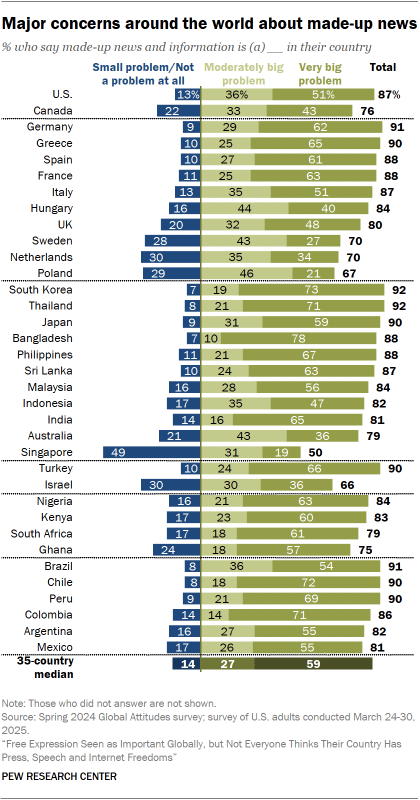
Many people around the world have major concerns about made-up news and information. A median of more than eight-in-ten adults across 35 countries surveyed say it is a big problem in their country, including 59% who see it as a very big problem. Concern about fabricated news is uniformly high across the sub-Saharan African and Latin American countries surveyed. Half or more of the public in each of these countries believes false news is a very big problem there. In North America, 43% of Canadians and about half of Americans (51%) say made-up news is a very big problem in their country. For a closer look at Americans’ views on made-up news and information, read our October report: “Americans’ Views of 2024 Election News.” Similarly, roughly half of adults or more in France, Germany, Greece, Italy, Spain and the UK consider false news a very big problem. However, in the Netherlands, Poland and Sweden, only about a third or fewer agree. Large shares in much of the Asia-Pacific region say manipulated news is a very big problem in their country, including majorities of at least seven-in-ten in Bangladesh, South Korea and Thailand. In Singapore, only 19% say made-up news and information is a very big problem – the smallest share of all the countries surveyed. Nearly half of adults there (49%) say fabricated news is a small problem or not a problem at all. Since 2019, a “fake news” law has enabled the government of Singapore to act against what it considers to be false information online. Singaporean opposition leaders, tech companies and rights groups alike have criticized the law, saying it gives the government too much power and significantly limits freedom of speech in the country. About a third of Australians (36%) also say made-up news and information is a very big problem in their country. In late 2024, the Australian government considered passing a law like the one in Singapore but scrapped the plan after they were met with significant opposition. Views by demographic group, attitudes toward free expression Concern about false news is widespread: In most of the countries surveyed, similar shares of younger and older adults, men and women, and people of different educational backgrounds and political ideologies say made-up news and information is a very big problem. At the same time, there are differences in most countries based on people’s attitudes toward freedom of the press, free speech and freedom on the internet. Those who say these freedoms are very important are often more likely to consider made-up news and information a very big problem in their country, compared with those who say these freedoms are somewhat, not too or not at all important. Views of democracy by concern about made-up news and information Satisfaction with democracy is also tied to levels of concern about fabricated news. In 22 of 35 surveyed countries, people who see made-up news and information as a very big problem are less likely to say they are very or somewhat satisfied with the way their democracy is working. Some of the biggest differences are in Europe: About a third of Hungarians who think made-up news and information is a very big problem in their country express satisfaction with the state of Hungarian democracy (34%). In contrast, 60% of Hungarians who say this is a moderately big problem, small problem or not a problem at all are satisfied with their democracy. Similarly, just 15% of Greeks who are very concerned about made-up news are satisfied with the way democracy is working in their country. More than twice as many of those who are less concerned (36%) say they’re satisfied with their democracy’s functioning. But these differences are not limited to Europe. Other countries – particularly high-income nations – also show strong links between concern about made-up news and satisfaction with democracy. For instance, in both Canada and Israel, people who think made-up news is a very big problem are at least 20 percentage points more likely than those who think it’s less of a problem to be satisfied with their country’s democracy. source

1. Widespread global public concern about made-up news Read More »