The Kraft Group CIO Talks Updating Gillette Stadium and More

The gridiron action of the New England Patriots naturally takes center stage in the public eye, but when the team’s owner, holding company The Kraft Group, wanted to update certain tech resources, the plan encompassed its extensive operations. Michael Israel, CIO for The Kraft Group, discussed with InformationWeek the plan for networking upgrades — facilitated through NWN — at Gillette Stadium, home field for the Patriots, as well as the holding company’s other business lines, which include paper and packaging, real estate development, and the New England Revolution Major League Soccer club. Talk us through not only the update effort for the stadium, but what were the initial thoughts, initial plans, and pain points that got the process started for the company. The roots of the business are in the paper manufacturing side. We have a paper, cardboard recycling mill in Montville, Conn. I have 10 cardboard box manufacturing plants from Red Lion, Pa. up through Dover, N.H., in the northeast. International Forest Products, which is a large commodities business which moves paper-based products all over the world. When we talk about our network, we have a standardized platform across all of our enterprise businesses and my team is responsible for maintaining and securing all of the businesses. Related:Surgical Center CIO Builds an IT Department We have a life cycle attached to everything that we buy and when we look at what the next five years brings to us, we were looking and saying we have the host of networking projects coming up. It will be the largest networking set of upgrades that we do from a strategic point over that period. So, the first of which NWN is currently working on is a migration to a new voice over IP platform. Our existing platform was end-of-life, moving to a new cloud-based platform, new Cisco platform. They are managing that transition for us and that again covers our entire enterprise. [We’re] building a new facility for the New England Patriots, their practice facility, which will be ready next April. Behind that we have FIFA World Cup coming in next June-July [in 2026] and we have essentially seven matches here. It’s the equivalent of seven Super Bowls over a six-week period. Behind that comes a refresh of our Wi-Fi environment, refresh of our overall core networking environment. Then it’s time for a refresh of our firewalls. I have over 80 firewalls in my environment, whether virtual or physical. And to add insult to injury, on top of all of that, we may have a new stadium that we’re building up in Everett for our soccer team, which is potentially scheduled to open in 2029 or 2030. Related:Knowledge Gaps Influence CEO IT Decisions So as we were looking at all of this, the goal here is to create one strategic focus for all of these projects and not think about them individually. Sat down with NWN saying, “Hey, typically I will be managing two to three years in advance. We need to take a look at what we’re going to do over the next five years to make sure that we’re planning for growth. We’re planning to manage all of this from standards and from a central location.” Putting together what that strategic plan looks like over that period of time and building a relationship with NWN to be able to support it, augment the staff that I have. I don’t have enough resources internal to handle all of this myself. And that’s a large endeavor, so that’s where this partnership started to form. Can you describe the scale of your operations further? You mentioned hosting the equivalent of several Super Bowls in terms of operations at the stadium. If you take the stadium as a whole and we focus there for a second, for Taylor Swift concert or a FIFA event coming in — for Taylor Swift, we had 62,000 unique visitors on our Wi-Fi network at one time. There’s 1,800 WAPs (wireless access points) supporting the stadium and our campus here now. Related:CIO Angelic Gibson: Quell AI Fears by Making Learning Fun I got a note on my radio during one of the evenings saying there’s 62,000 people. I said, “How can that be? There’s only 52,000 guests.” Well, it turns out there was a TikTok challenge in one of our parking lots and there were 10,000 teenagers on the network doing TikTok. These are the things that we don’t plan for, and FIFA is going to be a similar situation where typically we’re planning for how many people are physically sitting in the stadium for a FIFA event. Our parking lots are becoming activation zones, so we’re going to have to plan to support not just who’s physically entering and scanning tickets and sitting in the bowl, but who’s on the grounds as a whole. And that’s something that we haven’t had to do in the past. It’s something that some of the warmer stadiums down in the South or in the in the West Coast who host Super Bowls, they’re used to that type of scenario, but there are 16 venues throughout North America that are supporting FIFA and many of them, like us, we’re not used to having that large-size crowd and your planning to support that is critical for us as we start to do this. We are now 15 months away, 14 months away. We’re in high gear right now. What led the push to make changes? The interests are of the guests to the stadium? The team’s needs? Or was it to meet the latest standards and expectations in technology and networking? If you think about the networks, and it’s kind of irrelevant whether it’s here at the stadium or in our manufacturing plants, the networks have physically been — if it’s plugged in, if it’s a Wi-Fi attachment, etcetera, you can track what is going on and what your average bandwidth utilization is. What we were seeing over the last year with

The Kraft Group CIO Talks Updating Gillette Stadium and More Read More »

AI Use Of Hollywood Works: The Case For Statutory Licensing

Amid entertainment industry concerns about how generative artificial intelligence uses its copyrighted content, a statutory licensing framework may offer a more viable path than litigation and petitions — one that aligns legal doctrine, economic incentives and technological progress, says Rob Rosenberg at Telluride Legal. source

AI Use Of Hollywood Works: The Case For Statutory Licensing Read More »

Google adds more AI tools to its Workspace productivity apps

Join our daily and weekly newsletters for the latest updates and exclusive content on industry-leading AI coverage. Learn More Google continues to bring its flagship AI models to its productivity apps, expanding its Gemini features.  The company today announced several updates to its Workspace products, including the addition of Audio Overviews and new streamlined methods for tracking meetings.  Audio Overviews, which was first introduced in Google’s popular NotebookLM, allows people to create podcasts on their chosen research topic.  Now, through Gemini, users can create audio files based on uploaded documents and slides. They can also generate audio overviews within deep research reports. These podcast-style audio files are downloadable. Audio Overview generates voices and grounds its discussions solely on the provided documents.  Google previously told VentureBeat that its tests showed some people prefer learning through listening, where information is presented in a conversational format.  The company also launched a new feature called Canvas in Gemini, which lets people create drafts and refine text or code using the Gemini model. Google said Canvas helps “generate, optimize and preview code.” Canvas documents can be shared with Google Docs.  Updated calendars Google also streamlined how users can add events and meetings to their calendars. Gemini will detect if an email contains details of events and can prompt people to add it to their calendar. The model will surface emails with potential appointments if the user misses them.  Some plug-ins for Google, such as Boomerang, offer similar features that display appointments above the subject line. The Gemini-powered calendar feature will open a Gemini chat window alerting the user of the event.  Pointing AI models to surface data or events from emails has become a cornerstone of enterprise AI assistants and agents. Microsoft’s new agents parse through emails for input. Startup Martin AI has an AI assistant that manages calendars, emails and to-do lists.   Melding generative AI with productivity Google added Gemini chat to Workspace last year to integrate the standalone chat platform with Gmail, Google Docs and Calendars. This brought Google closer to Microsoft’s Copilot, which added AI models to its productivity platforms, including Outlook.   Enterprises continue to add AI features to the workplace, and it’s possible that if their employees regularly access things like Gemini on their Gmails and use AI models for research, AI adoption rates may be even higher.  source

Google adds more AI tools to its Workspace productivity apps Read More »

Seven Insights From Our Postsale Strategy Workshop At B2B Summit

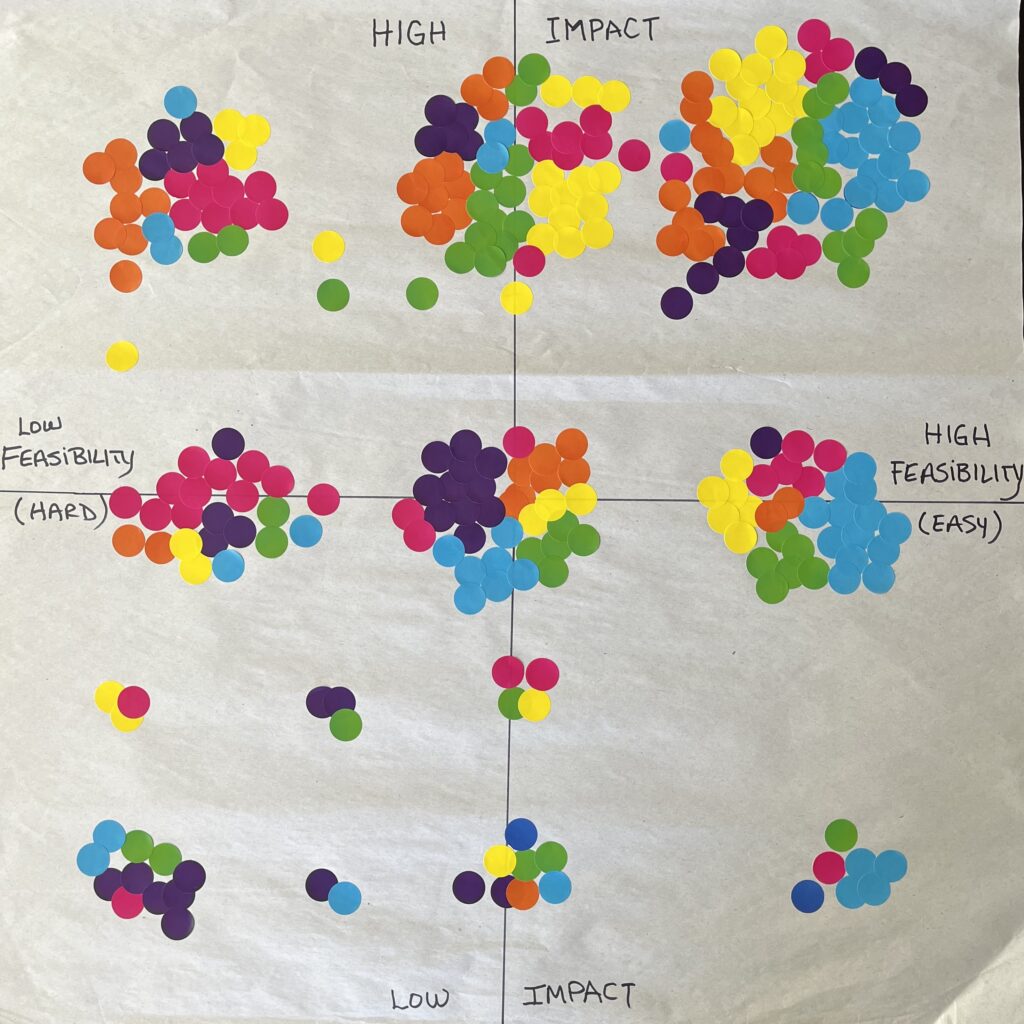
“Does your postsale strategy set up customers for success?” was the question we asked the 47 people who attended our workshop during Forrester’s B2B Summit earlier this month. After completing a survey to score their organizations on 16 questions about postsale strategy, we asked everyone to share how raising scores in any of the six categories might impact their business. Working in teams of six to eight, workshop participants placed Post-It notes for each category on flip charts to rate the expected business and customer impact against how feasible it would be to raise a score. Ranking impact vs. feasibility The photograph here summarizes the “impact” versus “feasibility” ratings across all the teams that completed this exercise. The colored stickers correspond to the following six categories from our assessment tool: Team purpose/charter = Blue Strategic alignment to business goals and other teams = Yellow Performance metrics = Green Technology and data readiness = Hot pink Customer lifecycle management = Orange Budget/funding model and capacity planning = Purple While not analytically rigorous (e.g., many of the stickers should appear directly on top of each other if reflecting the exact ratings from the Post-It notes exercise), the patterns reveal several interesting findings: A solid postsale strategy can have a meaningful impact. Attendees represented a wide range of roles and many did not hold direct postsale responsibilities, but the number of stickers placed between the middle and the top of the chart led many to observe that postsale programs can have a positive impact on customers and business outcomes alike. Defining your charter or purpose is relatively easy — so get it done. Many blue stickers along the right edge show that this is so. Top charters seek to help customers achieve their goals through proactive and empathetic experiences with postsale teams focused on driving and protecting retention, growth, and advocacy. Ditto for performance metrics that demonstrate outcomes and value. Quite a few green stickers show up in the upper-right quadrant, showing that attendees feel it is important — and relatively easy — to assess the impact of postsale programs on business success and customer outcomes. (Doing it consistently, however, is a different matter!) Aligning strategically and managing lifecycles rigorously can have a big impact on both customers and the business. Many orange (lifecycle) and yellow (alignment) stickers populate the high-impact/high-feasibility area. Interestingly, quite a few attendees could have scored higher on these two assessment categories. While impactful and feasible, these two practices don’t get nearly enough attention today. While impactful, investing in technology and managing data is hard. At the end of the exercises, we asked attendees to reflect on what they learned. Almost unanimously, participants commented on the challenges they face with technology implementation, data access, and data management, yet they see these areas as foundational to creating and supporting postsale programs that deliver value. Making the business case to fund postsale activity is less of a challenge. A pocket of purple stickers in the middle tells us that while having the right funding model and business case is important, participants feel that other areas, such as alignment and lifecycle management, potentially have more impact. Some are cynical about whether what you say you will do (charters) and how you fund it (business justification) have enough impact. A smattering of blue (purpose) and purple (budget) stickers across the bottom puzzled us a bit. Post-exercise discussion revealed a somewhat pessimistic view that current market and business conditions make it difficult to adjust resources, decreasing feasibility. And without change here, the resulting impact will remain low. Keep in mind that individual company scores are not reflected on this chart. It is possible, for example, to rate a category as high on impact and feasibility but to achieve a low score for it. Good news: This situation represents an ideal opportunity for improvement with relatively less effort! If you’d like to explore your postsale strategy further, please feel free to take our online assessment (no company or personally identifiable information will be shared, although we collect some to understand the demo- and firmographics of respondents). Upon completion, everyone will see how their scores compare to the average of scores collected to date. Forrester clients are welcome to schedule a discussion with Shari Srebnick or myself to discuss how to improve your results in any category. source

Seven Insights From Our Postsale Strategy Workshop At B2B Summit Read More »

1. Evaluations of Trump: Job approval and confidence on issues

Roughly 100 days into his second term in the White House, Trump’s job approval rating has declined across a range of demographic and partisan groups. Trump does not currently draw confidence from a majority of Americans for his handling of any major issue, while his rating on the economy is at its lowest point in surveys dating back to 2019. More Americans say that, compared with the Biden administration, the Trump administration’s policies have made the U.S. economy weaker (49%) rather than stronger (37%). Another 13% say there is not much difference. More also say Trump’s policies put the U.S. in a weaker position internationally (49%) rather than a stronger position (39%). Trump’s job approval Trump’s approval rating has fallen 7 percentage points since February. Today, 40% of Americans approve, compared with 47% two months ago. The president’s rating has declined among most subgroups, but the drop is slightly more pronounced among his less enthusiastic supporters in last fall’s election – as well as among 2024 nonvoters. Trump’s 2024 voters In February, 94% of those who reported voting for Trump in 2024 approved of the way he was handling his job. This has declined to 88% today. Among those who said they supported him strongly in the 2024 election, 96% approve of the job he is doing as president – similar to views two months ago (99%). The decline is sharper among Trump voters who said they supported him less strongly in 2024, or leaned toward supporting him before eventually doing so (88% in February vs. 75% today). Harris’ 2024 voters Trump’s job rating remains very low among those who said they voted for Kamala Harris last fall. Just 2% of these voters approve of his job performance. 2024 nonvoters Views of Trump’s job performance also dropped among those who did not vote in 2024. In February, 44% of nonvoters approved. Today, 31% of nonvoters approve – a 13-point decline. Trump’s job approval among demographic groups Today, 40% of U.S. adults approve of the way Trump is handling his job as president, including 31% who strongly approve. Nearly six-in-ten disapprove, including 48% who do so strongly. Trump’s rating has dropped 7 points among adults overall, and most subgroups have seen a similarly sized decline. Ratings among Asian Americans have fallen more sharply than those of most other groups: While nearly half of Asian adults approved of Trump in February (47%), that share has dropped to 29% today. (Estimates for Asian adults are representative of English speakers only.) Views of Trump’s ability to handle key issues Today, fewer than half of Americans express confidence in Trump to handle most issues – ranging from trade to foreign policy to abortion. Across all 10 issues asked about on the survey, adults are more likely to say they have little or no confidence in Trump than to say they are very or somewhat confident in him. The public is slightly more confident in his ability to make good decisions about immigration (48% are very or somewhat confident) than they are on his handling of trade (45%), a potential public health emergency (45%) and a variety of other issues. As was the case in previous surveys, adults are far less confident in Trump’s ability to unify the nation. Two-thirds of adults are not confident he can bring the country closer together. Wide partisan gaps in confidence There continue to be wide partisan gaps in confidence in Trump’s ability to handle a variety of issues. Among Republicans Sizable majorities of Republicans are at least somewhat confident Trump can handle each of the issues in the survey, including immigration, trade, economic policy and foreign policy. They are particularly confident he can make good decisions about immigration (84%). They are significantly less confident he can bring the country closer together (58%). Among Democrats Democrats broadly lack confidence in Trump. About one-in-ten express confidence in him on each issue asked about. Confidence in Trump to handle issues over time Across several key issues, confidence in Trump has declined since November – just after his 2024 election victory. Confidence in Trump’s handling of immigration continues to be higher than in his first term, while his foreign policy ratings are on par with his first term. But when it comes to the economy, Trump draws less confidence today than he did either in his first term or during the 2024 campaign. Confidence in Trump on the economy The economy has long been an area of relative strength for Trump. During his 2020 and 2024 presidential campaigns, Americans expressed more confidence in Trump’s ability to handle the economy than they did in either Biden or Harris. Last summer, 54% of adults said they were very or somewhat confident in Trump to make good economic decisions. That number rose to 59% in Pew Research Center’s postelection survey in November. Today, 45% are confident in his ability to handle the economy – down 14 points from a few months ago and lower than throughout 2019 and 2020, during his first term. Confidence among partisans Among Republicans, the share expressing confidence in Trump’s handling of the economy is down 12 points since November. Among Democrats, there has been a 16- point drop in that time. How does Trump compare with Biden on economic confidence? The share expressing confidence in Trump on the economy is still higher than the share who expressed confidence in Biden for much of his term. Confidence was highest for Biden shortly after he took office in 2021. In March of that year, 56% of Americans said they were at least somewhat confident Biden could make good decisions about the economy. These ratings declined steadily throughout his term – particularly in 2022 – before reaching a low of 36% in December 2023. How Trump’s administration stacks up against Biden’s on economic, international policy Economic policy Today, 49% of Americans say that, compared with the Biden administration, the policies of the Trump administration are making the country’s economy weaker. A smaller share

1. Evaluations of Trump: Job approval and confidence on issues Read More »

3 ways SJ is able to fuel its digital journey

“The goal is to have a best of breed to be able to quickly handle and adapt to changes,” he says. “It also enables other types of efficiency improvements, such as building good conditions for a data platform, which is a prerequisite for using new technology like AI.” Some might say that making a cloud journey now is quite late, and there might be something to that, admits Caddeo, but positioning is good and he’s encouraged by what’s being done. “We’re doing what we can, and we have good momentum, good speed, and a good team,” he says. “The cloud gives us greater flexibility and dynamism, so it’s part of the optimization of the platform we’re working with.” source

3 ways SJ is able to fuel its digital journey Read More »

Lawtech startup upgrades 'sovereign legal AI' amid 'volatile' geopolitics

Berlin-based startup Xayn has rebranded itself after its flagship product, “Noxtua” — a “sovereign European legal AI” aimed at law professionals.  Alongside its new name, Noxtua has secured €80.7mn in funding to refine its AI models and expand to new markets.  The lead investor in the round was C.H.Beck, one of Germany’s oldest publishing houses. Noxtua will use the firm’s database of over 55 million law-related documents to train a new AI model called Beck-Noxtua.  Beck-Noxtua will join Noxtua’s suite of AI models, which work a bit like ChatGPT. However, unlike more general-purpose chatbots, all of the company’s models are trained on “exclusive high-quality legal data sets selected and meticulously labelled by legal experts,” its CEO and co-founder, Dr. Leif-Nissen Lundbæk, told TNW.   The 💜 of EU tech The latest rumblings from the EU tech scene, a story from our wise ol’ founder Boris, and some questionable AI art. It’s free, every week, in your inbox. Sign up now! “Noxtua has a deep understanding of the nuanced differences between various legal definitions,” Lundbæk said. Law professionals use the tool to conduct legal research as well as analyse, review, summarise, translate, and draft legal documents. It’s available in several languages, but focuses on German and English.  Noxtua is a AI copilot for lawyers. Credit: Noxtua European ‘sovereign AI’ Noxtua — then Xayn — first launched in 2017. Lundbæk and fellow co-founder Professor Michael Huth spun out the company from research on privacy-first AI solutions at Oxford University and Imperial College London.  Noxtua’s first product was a data privacy-focused mobile search engine. But it later pivoted to fully focus on legal AI, following the launch of its first model last year in collaboration with CMS, Germany’s largest business law firm. Noxtua bills itself as “Europe’s secure and sovereign legal AI.”  The startup said it hosts its models at data centres in Europe, owned by European cloud providers. It fully encrypts all user data and designs its AI models to be “fully compliant” with European data protection standards like GDPR from the outset. Europe’s reliance on American AI and cloud infrastructure has come under increasing scrutiny in recent months, fuelled by increasing transatlantic tensions under President Trump. The volatility is driving consumers to look for more secure alternatives.  “The geopolitical situation has become highly volatile, with historical certainties being questioned,” said Lundbæk. “During these times, independence, sovereignty, and autonomy become ever more important.” Europe’s digital sovereignty will be a hot topic at TNW Conference, which takes place on June 19-20 in Amsterdam. Tickets for the event are now on sale — use the code TNWXMEDIA2025 at the check-out to get 30% off. source

Lawtech startup upgrades 'sovereign legal AI' amid 'volatile' geopolitics Read More »

Reduce, Reuse, Recycle! The US Government Applies The Concept To Software Coding

The US government’s SHARE IT Act became law in December 2024, requiring that all custom-developed software be accessed, shared, used, and modified governmentwide. By allowing any federal agency to access and use the code, the SHARE IT Act ensures that the investments in custom-developed software ($12 billion spent annually) are maximized, reducing the need for each agency to develop or contract for similar software independently. Agencies are not only mandated to share their custom-developed software with one another but are also empowered to modify the code to better meet their specific needs. This capability to tailor and enhance software without starting from scratch is a boon for rapid, cost-effective technological advancement within the government. The SHARE IT Act Puts Pressure On Quality Coding Practices According to the SHARE IT Act, agencies have 210 days from enactment of the law to ensure that all custom-developed code and corresponding documentation, data models, schemas, metadata, architecture designs, configuration scripts, and artifacts required to develop, build, test, and deploy the code are: 1) stored at not less than one public repository or private repository; 2) accessible to federal employees; and 3) owned by the agency. This means that US government agency software developers and leaders must follow best practices for shared code and: Double down on security and governance. Double-check that static application security testing and dependency updates run regularly on the project and mandate. Monitor the software bill of materials using software composition analysis solutions to detect newly disclosed vulnerabilities for any open-source code that the software relies on. When making an agency source code public, consider using the OpenSSF GitHub action to ensure that your project meets baseline security standards. Government agencies have found success in establishing an open-source governance program office such as the one established by the Centers for Medicare and Medicaid Services. Influence project direction. Government program offices likely won’t have significant influence over the direction of large custom-development projects, making alignment with specific needs challenging if you are expecting a full solution out of the box. That said, it is important that your developers understand and contribute to the custom-development projects you rely on. Make it a goal to fix security issues and quality defects. In the event that a critical vulnerability is discovered, the developers in the community will be the first to know and your team can help with remediation efforts. Take into account interoperability and integration risks. When evaluating project reuse, be sure that your developers are able to understand, extend, and maintain the code to meet your agency’s needs. Reach out to the repository owners and maintainers to let them know that you will be utilizing their project. They can be an invaluable resource should you run into challenges integrating the code with other systems. Interoperability with legacy architectures can lead to costly integration challenges. Implementing a platform such as Dapr (distributed application runtime) within your technology stack will change the optimal methods for developing applications. The SHARE IT Act paves the way for a more interconnected, efficient, and innovative federal government by leveraging the full potential of custom-developed software if implemented properly. To dive deeper into how to build a foundation for using shared custom-developed code, read the full reports on assessing open-source viability in government projects and The Forrester Wave™: Software Composition Analysis Software, Q4 2024. Set up a guidance session with Janet Worthington and Devin Dickerson to discuss in detail. source

Reduce, Reuse, Recycle! The US Government Applies The Concept To Software Coding Read More »

Broadcom wins Google Cloud Partner of the Year award for fifth year

Broadcom has once again been recognized with a prestigious 2025 Google Cloud Infrastructure Modernization Partner of the Year for virtualization. This marks our fifth consecutive time being recognized with the honor, a testament to our unwavering commitment to collaborating with Google Cloud to deliver exceptional hybrid cloud solutions. Together, we’ve built our partnership with customer choice as a top priority, offering flexibility in deployment and unique license portability between on-prem and Google Cloud environments. With VMware Cloud Foundation license portability and Google Cloud VMware Engine, customers can tailor their hybrid cloud experience to perfectly match their specific needs. The cornerstone of our success lies in the powerful synergy between Broadcom and Google Cloud. Our collaboration fuels innovation and flexibility, allowing organizations such as HD Supply to complete their cloud migration in 50% of the projected time, and ADT to scale their virtual desktop environments to support 20,000 employees in just 10 days. Our mutual customers have increased efficiency and performance, reduced operational expenses, and gained the ability to scale rapidly to meet their evolving business needs – all key elements of their digital transformations. “Google Cloud’s Partner Awards recognize partners who have created outsized value for customers through the delivery of innovative solutions and a high level of expertise,” said Kevin Ichhpurani, President, Global Partner Ecosystem, Google Cloud. “We’re proud to announce Broadcom as a 2025 Google Cloud Partner Award winner and celebrate their impact enabling customer success over the past year.” At the core of our partnership lies Google Cloud VMware Engine (GCVE), a solution that combines the power of VMware Cloud Foundation (VCF) with unique Google Cloud capabilities, setting a new standard for the hybrid cloud experience. GCVE delivers: An impressive four 9’s of uptime SLA within a single zone Flexible node families with 8 node shapes for optimized capacity management Up to 200 Gbps of east-west networking Native VPC integration and much more. One of the most significant achievements of this collaboration is GCVE’s full support for VCF. This powerful combination empowers enterprises to seamlessly extend their on-prem environments to the cloud. VCF provides a modern software-defined infrastructure, built-in cyber resilience and threat prevention, as well as industry-leading compute, storage, networking, automation, and management capabilities. This robust platform enables organizations to effectively virtualize their entire infrastructure on Google Cloud. A key milestone in this partnership was Google Cloud becoming ready to offer VCF license portability, since last year. This capability allows customers to extend their entitlements from on-prem to GCVE, leveraging a consistent operational experience across environments. Together we are bringing customers enhanced choice, flexibility, reduced operational complexity and costs, and guaranteed investment protection. Complementing VCF license portability, customers continue to have the option to purchase a VCF-licensed GCVE environment, inclusive of VCF software, directly from Google Cloud. This flexible approach provides organizations with a range of deployment options tailored to their specific needs. We are incredibly proud to have earned this 2025 Google Cloud Partner of the Year award, a testament to the remarkable impact of our collaboration with Google Cloud. We’re excited to continue building on this shared success, driving innovation and delivering exceptional value to our customers. Together, we are shaping the future of hybrid cloud, empowering businesses to achieve their full potential. To learn more, read the IDC Business Value of Google Cloud VMware Engine paper. source

Broadcom wins Google Cloud Partner of the Year award for fifth year Read More »

Ethically trained AI startup Pleias releases new small reasoning models optimized for RAG with built-in citations

Join our daily and weekly newsletters for the latest updates and exclusive content on industry-leading AI coverage. Learn More French AI startup Pleias made waves late last year with the launch of its ethically trained Pleias 1.0 family of small language models — among the first and only to date to be built entirely on scraping “open” data, that is, data explicitly labeled as public domain, open source, or unlicensed and not copyrighted. Now the company has announced the release of two open source small-scale reasoning models designed specifically for retrieval-augmented generation (RAG), citation synthesis, and structured multilingual output. The launch includes two core models — Pleias-RAG-350M and Pleias-RAG-1B — each also available in CPU-optimized GGUF format, making a total of four deployment-ready variants. They are all based on Pleias 1.0, and can be used independently or in conjunction with other LLMs that the organization may already or plan to deploy. All appear to be available under a permissive Apache 2.0 open source license, meaning they are eligible for organizations to take, modify and deploy for commercial use cases. RAG, as you’ll recall, is the widely-used technique that enterprises and organizations can deploy to hook an AI large language model (LLM) such as OpenAI’s GPT-4o, Google’s Gemini 2.5 Flash, Anthropic’s Claude Sonnet 3.7 or Cohere’s Command-A, or open source alternatives like Llama 4 and DeepSeek V3 to external knowledge bases, such as enterprise documents and cloud storages. This is often necessary for enterprises that want to build chatbots and other AI applications that reference their internal policies or product catalogs (an alternative, prompting a long context LLM with all the information necessary, may not be suitable for enterprise use cases where security and per-token transmission costs are concerns). The Pleias-RAG model family is the latest effort to bridge the gap between accuracy and efficiency in small language models. These models are aimed at enterprises, developers, and researchers looking for cost-effective alternatives to large-scale language models without compromising traceability, multilingual capabilities, or structured reasoning workflows. The target userbase is actually Pleias’s home continent of Europe, as co-founder Alexander Doria told VentureBeat via direct message on the social network X: “A primary motivation has been the difficulty of scaling RAG applications in Europe. Most private organization have little GPUs (it may have changed but not long ago less than 2% of all [Nvidia] H100 [GPUs] were in Europe). And yet simultaneously there are strong incentive to self-host for regulated reasons, including GDPR. “SLMs have progressed significantly over the past year, yet they are too often conceived as ‘mini-chatbots’ and we have observed a significant drop of performance in non-English languages, both in terms of source understanding and quality of text generation. So we have been satisfied to hit most of our objectives: An actual alternative to 7-8b models for RAG even on CPU and other constrained infras. Fully verifiable models coming with citation support. Preservation of European language performance.” However, of course the models being open source under the Apache 2.0 license means anyone could take and use them freely anywhere in the world. Focused on grounding, citations, and facts A key feature of the new Pleias-RAG models is their native support for source citation with literal quotes, fully integrated into the model’s inference process. Unlike post-hoc citation methods or external chunking pipelines, the Pleias-RAG models generate citations directly, using a syntax inspired by Wikipedia’s reference format. This approach allows for shorter, more readable citation snippets while maintaining verifiability. Citation grounding plays a functional role in regulated settings. For sectors like healthcare, legal, and finance — where decision-making must be documented and traceable — these built-in references offer a direct path to auditability. Pleias positions this design choice as an ethical imperative, aligning with increasing regulatory demands for explainable AI. Proto agentic? Pleias-RAG models are described as “proto-agentic” — they can autonomously assess whether a query is understandable, determine if it is trivial or complex, and decide whether to answer, reformulate, or refuse based on source adequacy. Their structured output includes language detection, query and source analysis reports, and a reasoned answer. Despite their relatively small size (Pleias-RAG-350M has just 350 million parameters) the models exhibit behavior traditionally associated with larger, agentic systems. According to Pleias, these capabilities stem from a specialized mid-training pipeline that blends synthetic data generation with iterative reasoning prompts. Pleias-RAG-350M is explicitly designed for constrained environments. It performs well on standard CPUs, including mobile-class infrastructure. According to internal benchmarks, the unquantized GGUF version produces complete reasoning outputs in roughly 20 seconds on 8GB RAM setups. Its small footprint places it in a niche with very few competitors, such as Qwen-0.5 and SmolLM, but with a much stronger emphasis on structured source synthesis. Competitive performance across tasks and languages In benchmark evaluations, Pleias-RAG-350M and Pleias-RAG-1B outperform most open-weight models under 4 billion parameters, including Llama-3.1-8B and Qwen-2.5-7B, on tasks such as HotPotQA, 2WikiMultiHopQA, and MuSiQue. These multi-hop RAG benchmarks test the model’s ability to reason across multiple documents and identify distractors — common requirements in enterprise-grade knowledge systems. The models’ strength extends to multilingual scenarios. On translated benchmark sets across French, German, Spanish, and Italian, the Pleias models show negligible degradation in performance. This sets them apart from other SLMs, which typically experience a 10–35% performance loss when handling non-English queries. The multilingual support stems from careful tokenizer design and synthetic adversarial training that includes language-switching exercises. The models not only detect the language of a user query but aim to respond in the same language—an important feature for global deployments. In addition, Doria highlighted how the models could be used to augment the performance of other existing models an enterprise may already be using: “We envision the models to be used in orchestration setting, especially since their compute cost is low. A very interesting results on the evaluation side: even the 350m model turned out to be good on entirely different answers than the answers [Meta] Llama and [Alibaba] Qwen were performing at. So there’s a real

Ethically trained AI startup Pleias releases new small reasoning models optimized for RAG with built-in citations Read More »