Forrester’s Top Threats For 2025

2025 started with a bang! Technology and geopolitics are changing so fast that many can’t keep track of the latest trends, with an announcement of new, benchmark-shattering genAI-related tech seemingly every week. Meanwhile, planned job cuts across US employers are at their highest levels since 2020, we are on the brink of a global trade war, and geopolitical tensions are high. On the plus side, there was a reported 35% year-over-year decrease in ransomware payments from 2024, but we’re not even one-third of the way through 2025 and things are already hectic. To help security leaders better prepare for the chaos that is and will be this year, Forrester has released our yearly report on the top threats that we expect organizations to face in 2025. Read the full report here: The Top Cybersecurity Threats In 2025. This report is based on data and trends from the changing dynamics in the threat landscape. We expect that organizations will face the following in 2025: Global regulatory disruptions. Some regulations are being established in force this year, others are cropping up net new, and still others are being revoked. With so much regulatory change, organizations must focus on compliance change management and prioritize requirements that are being enforced now. High-quality deepfakes. Convincing deepfakes are becoming easier to create thanks to the proliferation of open-source algorithms, purpose-built websites, cheap GPU power, and the wide availability of voice and audio profiles. Mitigating deepfakes requires an investment in end-user education and the implementation of strong authentication methods. Tech exuberance over generative AI. The anthropomorphizing of genAI means that people trust it even when they shouldn’t, which puts your organization at risk. It’s critical to invest in ML and AI security tools and create processes focused on discovery, policy enforcement, and detection and response. Job loss radicalization. A new economic reality has emerged in 2025, with a flurry of activity that saw job cuts to 4% of the US federal government workforce, massive tech layoffs, and job cuts in Europe. Managing potential insider threats with an insider risk management program is paramount this year. Generative AI-driven extortion. Ransomware became less lucrative in 2024, and attackers are likely to mix things up because of it. Before genAI, stealing data was only so useful — reviewing millions of emails takes far too much time. Now, with GenAI, attackers can perform a quick sentiment analysis on troves of stolen data for extortion schemes. Prepare now for infostealers, which lead to extortion and will become a bigger threat than ransomware. For more on what to know about these threats and what to do about them, read the full report. If you have more questions about the threat landscape, book an inquiry or guidance session with me or one of my colleagues. source

Forrester’s Top Threats For 2025 Read More »

Tribal 'Window' For New Spectrum Licenses Defended At FCC

By Christopher Cole ( April 18, 2025, 7:29 PM EDT) — A pair of public interest groups asked Democrats on the Federal Communications Commission to support a tribal “window” allowing Native American bidders a chance to reserve licenses in a commercial spectrum band that’s poised for FCC auction…. Law360 is on it, so you are, too. A Law360 subscription puts you at the center of fast-moving legal issues, trends and developments so you can act with speed and confidence. Over 200 articles are published daily across more than 60 topics, industries, practice areas and jurisdictions. A Law360 subscription includes features such as Daily newsletters Expert analysis Mobile app Advanced search Judge information Real-time alerts 450K+ searchable archived articles And more! Experience Law360 today with a free 7-day trial. source

Tribal 'Window' For New Spectrum Licenses Defended At FCC Read More »

Google’s Gemini 2.5 Flash introduces ‘thinking budgets’ that cut AI costs by 600% when turned down

Join our daily and weekly newsletters for the latest updates and exclusive content on industry-leading AI coverage. Learn More Google has launched Gemini 2.5 Flash, a major upgrade to its AI lineup that gives businesses and developers unprecedented control over how much “thinking” their AI performs. The new model, released today in preview through Google AI Studio and Vertex AI, represents a strategic effort to deliver improved reasoning capabilities while maintaining competitive pricing in the increasingly crowded AI market. The model introduces what Google calls a “thinking budget” — a mechanism that allows developers to specify how much computational power should be allocated to reasoning through complex problems before generating a response. This approach aims to address a fundamental tension in today’s AI marketplace: more sophisticated reasoning typically comes at the cost of higher latency and pricing. “We know cost and latency matter for a number of developer use cases, and so we want to offer developers the flexibility to adapt the amount of the thinking the model does, depending on their needs,” said Tulsee Doshi, Product Director for Gemini Models at Google DeepMind, in an exclusive interview with VentureBeat. This flexibility reveals Google’s pragmatic approach to AI deployment as the technology increasingly becomes embedded in business applications where cost predictability is essential. By allowing the thinking capability to be turned on or off, Google has created what it calls its “first fully hybrid reasoning model.” Pay only for the brainpower you need: Inside Google’s new AI pricing model The new pricing structure highlights the cost of reasoning in today’s AI systems. When using Gemini 2.5 Flash, developers pay $0.15 per million tokens for input. Output costs vary dramatically based on reasoning settings: $0.60 per million tokens with thinking turned off, jumping to $3.50 per million tokens with reasoning enabled. This nearly sixfold price difference for reasoned outputs reflects the computational intensity of the “thinking” process, where the model evaluates multiple potential paths and considerations before generating a response. “Customers pay for any thinking and output tokens the model generates,” Doshi told VentureBeat. “In the AI Studio UX, you can see these thoughts before a response. In the API, we currently don’t provide access to the thoughts, but a developer can see how many tokens were generated.” The thinking budget can be adjusted from 0 to 24,576 tokens, operating as a maximum limit rather than a fixed allocation. According to Google, the model intelligently determines how much of this budget to use based on the complexity of the task, preserving resources when elaborate reasoning isn’t necessary. How Gemini 2.5 Flash stacks up: Benchmark results against leading AI models Google claims Gemini 2.5 Flash demonstrates competitive performance across key benchmarks while maintaining a smaller model size than alternatives. On Humanity’s Last Exam, a rigorous test designed to evaluate reasoning and knowledge, 2.5 Flash scored 12.1%, outperforming Anthropic’s Claude 3.7 Sonnet (8.9%) and DeepSeek R1 (8.6%), though falling short of OpenAI’s recently launched o4-mini (14.3%). The model also posted strong results on technical benchmarks like GPQA diamond (78.3%) and AIME mathematics exams (78.0% on 2025 tests and 88.0% on 2024 tests). “Companies should choose 2.5 Flash because it provides the best value for its cost and speed,” Doshi said. “It’s particularly strong relative to competitors on math, multimodal reasoning, long context, and several other key metrics.” Industry analysts note that these benchmarks indicate Google is narrowing the performance gap with competitors while maintaining a pricing advantage — a strategy that may resonate with enterprise customers watching their AI budgets. Smart vs. speedy: When does your AI need to think deeply? The introduction of adjustable reasoning represents a significant evolution in how businesses can deploy AI. With traditional models, users have little visibility into or control over the model’s internal reasoning process. Google’s approach allows developers to optimize for different scenarios. For simple queries like language translation or basic information retrieval, thinking can be disabled for maximum cost efficiency. For complex tasks requiring multi-step reasoning, such as mathematical problem-solving or nuanced analysis, the thinking function can be enabled and fine-tuned. A key innovation is the model’s ability to determine how much reasoning is appropriate based on the query. Google illustrates this with examples: a simple question like “How many provinces does Canada have?” requires minimal reasoning, while a complex engineering question about beam stress calculations would automatically engage deeper thinking processes. “Integrating thinking capabilities into our mainline Gemini models, combined with improvements across the board, has led to higher quality answers,” Doshi said. “These improvements are true across academic benchmarks – including SimpleQA, which measures factuality.” Google’s AI week: Free student access and video generation join the 2.5 Flash launch The release of Gemini 2.5 Flash comes during a week of aggressive moves by Google in the AI space. On Monday, the company rolled out Veo 2 video generation capabilities to Gemini Advanced subscribers, allowing users to create eight-second video clips from text prompts. Today, alongside the 2.5 Flash announcement, Google revealed that all U.S. college students will receive free access to Gemini Advanced until spring 2026 — a move interpreted by analysts as an effort to build loyalty among future knowledge workers. These announcements reflect Google’s multi-pronged strategy to compete in a market dominated by OpenAI’s ChatGPT, which reportedly sees over 800 million weekly users compared to Gemini’s estimated 250-275 million monthly users, according to third-party analyses. The 2.5 Flash model, with its explicit focus on cost efficiency and performance customization, appears designed to appeal particularly to enterprise customers who need to carefully manage AI deployment costs while still accessing advanced capabilities. “We’re super excited to start getting feedback from developers about what they’re building with Gemini Flash 2.5 and how they’re using thinking budgets,” Doshi said. Beyond the preview: What businesses can expect as Gemini 2.5 Flash matures While this release is in preview, the model is already available for developers to start building with, though Google has not specified a timeline for general availability. The company indicates it will

Google’s Gemini 2.5 Flash introduces ‘thinking budgets’ that cut AI costs by 600% when turned down Read More »

LinkedIn: Top 10 Large Companies for Career Growth in US

Sundar Pichai at the Google I/O 2017 Keynote. Image: Steven Zimmerman/Creative Commons Alphabet, Google’s parent company, has claimed the top spot on LinkedIn’s 2025 list of the 50 best large US employers for career growth. The rankings, which relied entirely on LinkedIn data, evaluated companies on key indicators of career progression, such as employee promotions, skill development, and internal mobility. LinkedIn noted that “Google goes the extra mile to retain and grow its talent pipeline.” The search engine giant also “invests heavily in leadership and development … and coaching for managers across all levels,” as well as offering education reimbursement so employees can continue their degrees without a financial burden. Top 10 large companies for career growth in the US Rounding out the top 10 companies on LinkedIn’s list are: Amazon: Its AWS Grow Our Own Talent program helps employees with nontraditional work experience land in-demand data center roles. The program is part of the company’s $1.2 billion investment to upskill its workforce in emerging technical areas. Wells Fargo: The financial services firm’s Career Development Program provides professional training and development courses for employees in roles requiring less than five years of experience. Northrop Grumman: The defense and space manufacturer helps employees advance their technical skills while on the job. Its initiatives include a program that exposes early-career employees to foundational technical competencies across the company. PwC: The professional services firm has invested $1 billion in AI upskilling, resulting in over 75% of employees using GenAI tools daily. Capital One: The financial services firm offers four employee-led internal colleges where employees can deepen their skills in areas such as design thinking and leadership. AT&T: The telecommunications giant has implemented several tools and programs to help employees work more efficiently, including its AI productivity assistant, Ask AT&T. JPMorganChase: The financial services firm has pivoted toward skills-based employment and expanded its talent pool. Around 70% of roles for experienced hires or candidates with experience do not require a college degree. EY: The professional services firm offers job candidates “Space for the Curious” experiences that guide them through the application process. This includes features such as an AI-enabled interview coach that helps them practice interviewing and VR headsets with digital twins of EY offices that illustrate what it’s like to work there. Walmart: The retail giant’s Live Better U program creates promotion pathways for associates to advance to higher-level jobs through opportunities to learn key skills and earn degrees at no cost. Feedback about LinkedIn’s rankings Reaction to LinkedIn’s list was mixed. In the comments section of the LinkedIn post about this research, one HR leader called it “Informative,” noting that “many of these companies have been part of large layoffs. So while there’s growth at a big company, I think [it’s] important to look to other mid-sized companies not on this list.” A talent acquisition leader commented that “Alphabet has been laying off. Amazon did [return to office] RTO and it’s gone horribly and most employees are unhappy. JPMorganChase? With a CEO screaming at employees? EY just laid off their entire U.S. recruiting workforce. Walmart requires relocation to Tornado Alley.” Eight free LinkedIn Learning courses LinkedIn is offering these learning courses free for all members until May 7. The courses include career topics such as leveraging your transferable skills and creating your own internal mobility plan. source

LinkedIn: Top 10 Large Companies for Career Growth in US Read More »

Health Insurers Must Forge A New Frontier In 2025

Health insurers (HIs) face a tough road ahead to improve customer experience. As health insurance leaders balance cutting costs with the pressure for innovation in a rapidly evolving ecosystem, they must revisit their priorities to cocreate value and strengthen trust with members. To help guide health insurance leaders, our new report, The Seven Trends That Matter For US Health Insurers In 2025, explores the top seven trends for HIs in 2025, including: Redefining the end-to-end member experience. The relationship with your customers starts before they buy, and each touchpoint is an opportunity to ensure salience, fit, and trust. To earn trust, HIs must still tackle the basics, proving their competence, dependability, and accountability. Experimenting with benefits to address the affordability crisis. Affordability remains a top concern for key stakeholders including members, employers, and insurers. In response, employers are experimenting with new insurance and benefit models like Individual Coverage Health Reimbursement Arrangements (ICHRAs), Exclusive Provider Organizations (EPOs), and other plan arrangements that favor quality and cost savings. As plan options diversify, HIs must invest in more robust tools to help consumers navigate to the best plan fit. Reinventing pharmacy benefit managers (PBMs). PBMs find themselves under the microscope as HIs and regulators alike seek to improve transparency and reduce medication costs for consumers. Optum Rx’s recent move to eliminate 10% of prior authorizations signals a shift toward a simpler medication approval process, improving efficiency and patient access. HIs must prioritize affordability, revamp new pharmacy service models, and cut the red tape to drive improved outcomes. Ready to chart your course? Schedule a guidance session now to discuss how your organization can seize these opportunities. Forrester clients can also read the companion report on The Seven Trends That Matter For US Healthcare Providers In 2025 and watch our recent on-demand webinar that covers both perspectives. Not a client? Learn more about how you can have Forrester on your side and by your side. source

Health Insurers Must Forge A New Frontier In 2025 Read More »

Loft Labs’ vCluster cuts Kubernetes costs and speeds up development

Today, I’ll walk through vCluster and the vCluster Platform. We’ll start with a common use case: giving every GitHub pull request a dedicated Kubernetes cluster. I’ve built a workflow using Argo CD, Crossplane, and vCluster. When a developer creates a pull request, they just add a label—say, “create PR vCluster”—and that kicks off a workflow that deploys the application into a vCluster. Thanks to sleep mode and auto-delete, that vCluster doesn’t run continuously. If no one interacts with it, it goes to sleep, spinning down all cost-incurring resources. When needed, a developer clicks a link, interacts with the API server, and the vCluster spins back up—fast, like a container. source

Loft Labs’ vCluster cuts Kubernetes costs and speeds up development Read More »

FTC To Narrow Data Privacy Scope As Uncertainties Loom

By Allison Grande ( April 17, 2025, 11:06 PM EDT) — The Republican-led Federal Trade Commission is poised to pursue a data privacy agenda focused on established harms and statutory authorities rather than ambitious rulemaking, although the recent firing of two commissioners casts doubt on the long-term viability of these actions and the future of a crucial transatlantic data transfer pact…. Law360 is on it, so you are, too. A Law360 subscription puts you at the center of fast-moving legal issues, trends and developments so you can act with speed and confidence. Over 200 articles are published daily across more than 60 topics, industries, practice areas and jurisdictions. A Law360 subscription includes features such as Daily newsletters Expert analysis Mobile app Advanced search Judge information Real-time alerts 450K+ searchable archived articles And more! Experience Law360 today with a free 7-day trial. source

FTC To Narrow Data Privacy Scope As Uncertainties Loom Read More »

Digesting A 2nd Circ. Ruling On Food Delivery App Arbitration

By Brant Kuehn and Tapan Oza ( April 15, 2025, 5:04 PM EDT) — In a ruling that’s giving food delivery apps some heartburn, the U.S. Court of Appeals for the Second Circuit recently addressed the use of arbitration provisions for in-app terms of service click-throughs…. Law360 is on it, so you are, too. A Law360 subscription puts you at the center of fast-moving legal issues, trends and developments so you can act with speed and confidence. Over 200 articles are published daily across more than 60 topics, industries, practice areas and jurisdictions. A Law360 subscription includes features such as Daily newsletters Expert analysis Mobile app Advanced search Judge information Real-time alerts 450K+ searchable archived articles And more! Experience Law360 today with a free 7-day trial. source

Digesting A 2nd Circ. Ruling On Food Delivery App Arbitration Read More »

No Redo In Ex-CEO's $6M Stock Case Against Co., Law Firm

By Aaron Keller ( April 17, 2025, 4:00 PM EDT) — The former CEO of WorldQuant Predictive Technologies LLC cannot reargue failed $6 million stock loss claims against the company from which he was ousted or its law firm Pullman & Comley LLC, a Connecticut trial judge has ruled…. Law360 is on it, so you are, too. A Law360 subscription puts you at the center of fast-moving legal issues, trends and developments so you can act with speed and confidence. Over 200 articles are published daily across more than 60 topics, industries, practice areas and jurisdictions. A Law360 subscription includes features such as Daily newsletters Expert analysis Mobile app Advanced search Judge information Real-time alerts 450K+ searchable archived articles And more! Experience Law360 today with a free 7-day trial. source

No Redo In Ex-CEO's $6M Stock Case Against Co., Law Firm Read More »

2. Views of China’s role in the world

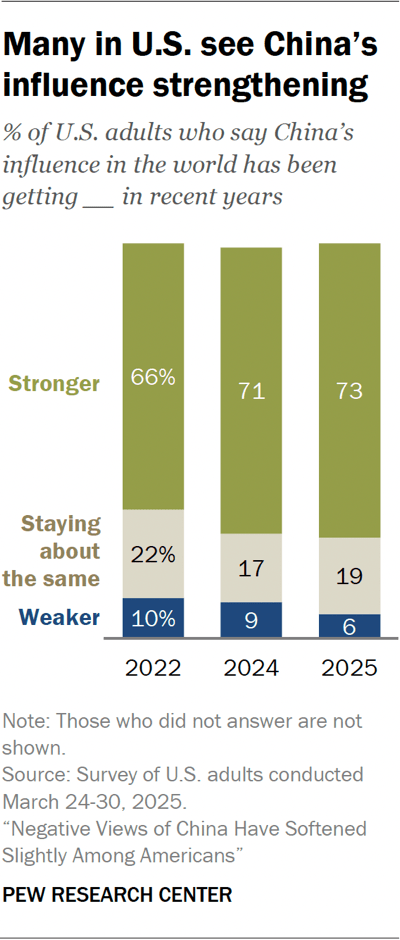
Most Americans say China’s international influence has been growing stronger in recent years. Still, Americans tend to say the U.S. – not China – is the world’s top economic and military power. Americans see China’s global influence getting stronger A 73% majority of Americans say China’s influence in the world has been getting stronger in recent years. A similar share (71%) held this view in 2024. About two-in-ten (19%) say China’s influence has stayed about the same, while 6% say it’s getting weaker. Views by party Unlike many other opinions related to China, there are no significant differences between Republicans and Democrats on this question. About equal shares in both parties say that China is growing stronger (71% vs. 75%). Views by age Americans ages 50 and older are slightly more likely than adults under 50 to say China’s global influence is getting stronger (76% vs. 70%). Which country is the leading economic power? About half of Americans (48%) think the U.S. is the world’s leading economic power. Another 38% say it’s China, and smaller shares name Japan (7%) or the EU (6%). These views are largely unchanged since we last asked this question in 2023, though the share naming the U.S. as the world’s top economic power has been as high as 54% in 2020. Views by party The stability of these views overall hides major partisan shifts that have occurred over the past two years. In 2023, Republicans were about equally likely to describe the U.S. (46%) and China (45%) as the world’s leading economy. Among Republicans, the share naming the U.S. as the top economy has gone up 12 points, while the share naming China has fallen by about the same amount. Today, a clear majority of Republicans (58%) name the U.S. as the world’s top economic power, compared with 32% who name China. Democrats are now about equally likely to name China (43%) and the U.S. (40%) as the world’s leading economic power. By comparison, 52% of Democrats said the U.S. was the top economy in 2023, and 33% said China. Views by age Older Americans are less likely than younger people to say China is the world’s leading economic power. Among those ages 65 and older, 27% name China as the top economy – a much larger share (60%) name the U.S. In comparison, adults under 30 are about equally likely to see China and the U.S. as the world’s top economic power. Which country is the leading military power? Most Americans (76%) say the U.S. is the world’s leading military power. Fewer say the top military power is China (14%) or Russia (8%). Compared with 2022, Americans are more likely to see the U.S. as the world’s leading military power (+6 points), but they are still less likely than they were in 2020 to hold this view. Views by party Republicans are more likely than Democrats to see the U.S. as the world’s leading military power, though majorities of both parties hold this view (80% and 73%). This is a reversal from 2022, when Democrats were more likely than Republicans to see the U.S. as the leading military power (75% vs. 67%) and less likely than Republicans to name China (16% vs. 22%). source

2. Views of China’s role in the world Read More »