Dealing with prima donna IT superstars

Most CIOs will tell you there are three or four people in their organizations who deliver enormous value to IT and are worth every dollar they get. They’re the superstars of databases, data management, security, applications, infrastructure, and systems. They can troubleshoot and resolve any issue, come up with any new module you might need for integrating software, organize and manage data, and perform delicate background systems functions and tunings that produce enormous impact for IT projects. But there is often a flip side to managing these elite IT pros. These individuals know their value and take pride in their expertise, which can result in king-size egos. It’s little wonder then that some CIOs refer to these tech giants both as “gems” and “prima donnas” — sometimes in the same sentence. In IT, prima donnas — an Italian term for those who find it difficult to work under direction or as part of a team — can often be those very same tech gurus CIOs need most to do the heavy tech lifting for major projects. Other staff members are also attuned to the guru–prima donna syndrome, and they look to their CIOs and project managers to solve the personal issues that can arise when a personality of this type is part of the team. But this isn’t always easy. source

Dealing with prima donna IT superstars Read More »

Musk Blames Twitter Investors For 'Languish' In Case

By Sarah Jarvis ( April 17, 2025, 10:22 PM EDT) — Elon Musk on Thursday pushed back against a trial schedule proposed by a class of former Twitter investors in litigation accusing the right-wing billionaire of intentionally tanking the social media platform’s stock price, saying the investors have caused the case to “languish.”… Law360 is on it, so you are, too. A Law360 subscription puts you at the center of fast-moving legal issues, trends and developments so you can act with speed and confidence. Over 200 articles are published daily across more than 60 topics, industries, practice areas and jurisdictions. A Law360 subscription includes features such as Daily newsletters Expert analysis Mobile app Advanced search Judge information Real-time alerts 450K+ searchable archived articles And more! Experience Law360 today with a free 7-day trial. source

Musk Blames Twitter Investors For 'Languish' In Case Read More »

Trends in Neuromorphic Computing CIOs Should Know

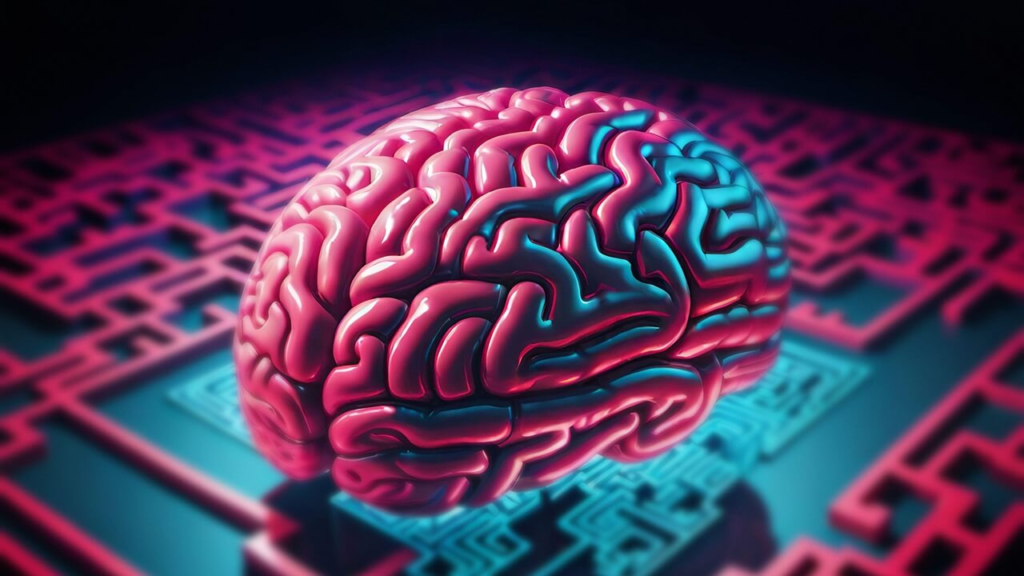
Neuromorphic computing is the term applied to computer elements that emulate the way the human brain and nervous system function. Proponents believe that the approach will take artificial intelligence to new heights while reducing computing platform energy requirements.  “Unlike traditional computing, which incorporates separate memory and processors, neuromorphic systems rely on parallel networks of artificial neurons and synapses, similar to biological neural networks,” observes Nigel Gibbons, director and senior advisor at consulting firm NCC Group in an online interview.  Potential Applications  The current neuromorphic computing application landscape is largely research-based, says Doug Saylors, a partner and cybersecurity co-lead with technology research and advisory firm ISG. “It’s being used in multiple areas for pattern and anomaly detection, including cybersecurity, healthcare, edge AI, and defense applications,” he explains via email.  Potential applications will generally fall into the same areas as artificial intelligence or robotics, says Derek Gobin, a researcher in the AI division of Carnegie Mellon University’s Software Engineering Institute. “The ideal is you could apply neuromorphic intelligence systems anywhere you would need or want a human brain,” he notes in an online interview.  Related:Breaking Down the Walls Between IT and OT “Most current research is focused on edge-computing applications in places where traditional AI systems would be difficult to deploy, Gobin observes. Many neuromorphic techniques also intrinsically incorporate temporal aspects, similar to how the human brain operates in continuous time, as opposed to the discrete input-output cycles that artificial neural networks utilize.” He believes that this attribute could eventually lead to the development of time-series-focused applications, such as audio processing and computer vision-based control systems.  Current Development  As with quantum computing research, there are multiple approaches to both neuromorphic hardware and algorithm development, Saylors says. The best-known platforms, he states, are BrainScaleS and SpiNNaker. Other players include GrAI Matter labs and BrainChip.  Neuromorphic strategies are a very active area of research, Gobin says. “There are a lot of exciting findings happening every day, and you can see them starting to take shape in various public and commercial projects.” He reports that both Intel and IBM are developing neuromorphic hardware for deploying neural models with extreme efficiency. “There are also quite a few startups and government proposals looking at bringing neuromorphic capabilities to the forefront, particularly for extreme environments, such as space, and places where current machine learning techniques have fallen short of expectations, such as autonomous driving.”  Related:How to Tell When You’re Working Your IT Team Too Hard Next Steps  Over the short term, neuromorphic computing will likely be focused on adding AI capabilities to specialty edge devices in healthcare and defense applications, Saylors says. “AI-enabled chips for sensory use cases are a leading research area for brain/spinal trauma, remote sensors, and AI enabled platforms in aerospace and defense,” he notes.  An important next step for neuromorphic computing will be maturing a technology that has already proven successful in academic settings, particularly when it comes to scaling, Gobin says. “As we’re beginning to see a plateau in performance from GPUs, there’s interest in neuromorphic hardware that can better run artificial intelligence models — some companies have already begun developing and prototyping chips for this purpose.”  Another promising use case is event-based camera technology, which shows promise as a practical and effective medium for satellite and other computer vision applications, Gobin says. “However, we have yet to see any of these technologies get wide-scale deployment,” he observes. “While research is still very active with exciting developments, the next step for the neuromorphic community is really proving that this tech can live up to the hype and be a real competitor to the traditional hardware and generative AI models that are currently dominating the market.”  Related:3 Ways to Build a Culture of Experimentation to Fuel Innovation Looking Ahead  Given the technology’s cost and complexity, coupled with the lack of skilled resources, it’s likely to take another seven to 10 years before widespread usage of complex neuromorphic computing occurs, Saylors says. “However, recent research in combining neuromorphic computing with GenAI and emerging quantum computing capabilities could accelerate this by a year or two in biomedical and defense applications.”  Mainstream adoption hinges on hardware maturity, cost reduction, and robust software, Gibbons says. “We may see initial regular usage within the next five to 10 years in specialized low-power applications,” he predicts. “Some of this will be dictated by the maturation of quantum computing.” Gibbons believes that neuromorphic computing’s next phase will focus on scaling integrated chips, refining and spiking neural network algorithms, and commercializing low-power systems for applications in robotics, edge AI, and real-time decision-making.  Gibbons notes that neuromorphic computing may soon play an important role in advancing cybersecurity. The technology promises to offer improved anomaly detection and secure authentication, thanks to event-driven intelligence, he explains. Yet novel hardware vulnerabilities, unknown exploit vectors, and data confidentiality remain critical concerns that may hamper widespread adoption.  source

Trends in Neuromorphic Computing CIOs Should Know Read More »

3. Views of trade between China and the U.S.

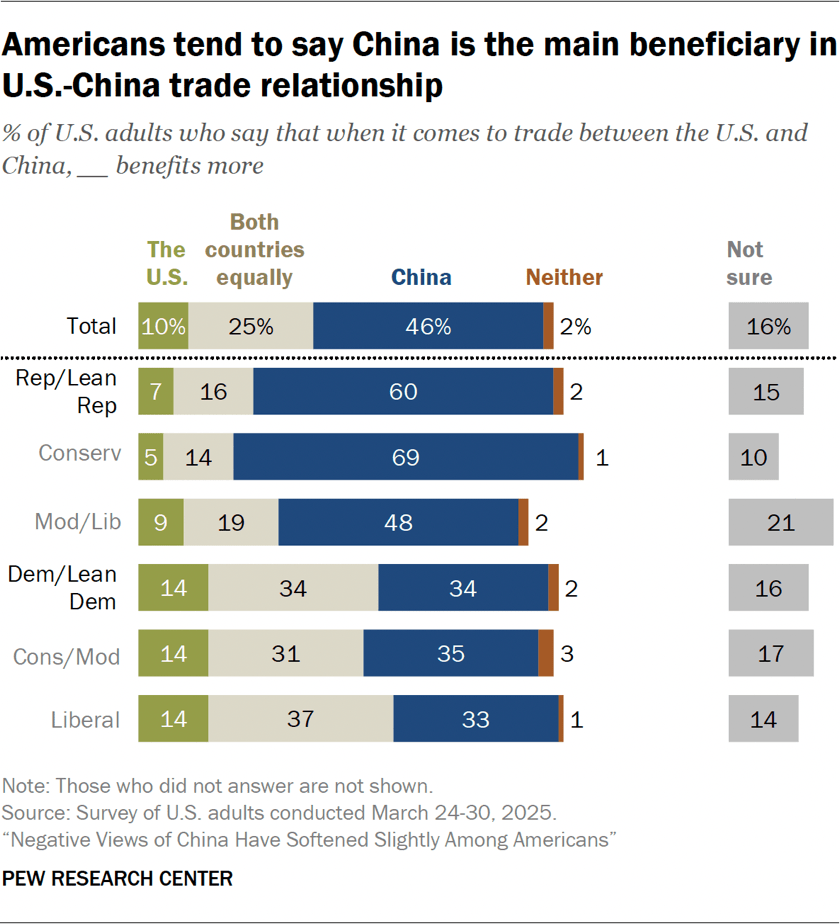
Americans tend to believe the U.S.-China trade relationship benefits China more than the U.S.: 46% hold this view, while a quarter say both countries benefit equally and 10% say the U.S. benefits more. Nonetheless, Americans are skeptical that increased tariffs on Chinese imports will have a positive effect on the country or on their own lives.  (The survey was conducted March 24-30, 2025, after President Donald Trump implemented tariffs on China in February and again in early March, but before further tariffs were imposed in April. China responded with tariffs on the U.S. both before and after the survey was fielded.) Who benefits most from the U.S.-China trade relationship? When asked whether one country benefits more from U.S.-China trade, the largest share of Americans (46%) say China does, largely unchanged since we last asked the question in 2023. The U.S.-China trade relationship is seen as more unbalanced than the U.S.-Canada or U.S.-Mexico trade relationships. For more on U.S. assessments of trade with the country’s top trade partners, read “How Americans view trade between the U.S. and China, Canada and Mexico.” Views by party Republicans and Democrats see different winners in the U.S.-China trade relationship. Among Republicans and Republican-leaning independents, a 60% majority say China benefits more from U.S.-China trade. Conservative Republicans are especially likely to hold this view (69%). In comparison, Democrats and Democratic leaners are equally divided between saying China benefits more and saying the two countries benefit equally (34% take each stance). Views by age Older Americans are more likely than younger adults to see China as the main beneficiary of trade between the U.S. and China. A majority of those ages 65 and older (56%) say China benefits more than the U.S., compared with 27% of those ages 18 to 29. How do Americans feel about increased tariffs on China? As of mid-April, Trump has implemented increasingly high tariffs on imports from China – adding to the tariffs put in place during his first administration. Many more Americans think increased tariffs on China will be bad for the U.S. – and for them personally – than say these tariffs will be good. Around a quarter say either that increased tariffs will have no effect on the U.S. or that they are unsure about tariffs’ national effects. Over a third say the same about how tariffs will affect them personally. When we asked similar questions in 2021, people were more likely to say tariffs would have a negative impact on the country than on themselves personally. Now, relatively equal shares anticipate a negative impact on both. Americans who think the U.S. benefits more than China does from U.S.-China trade are far more likely to see the tariffs as bad than good for the country (68% vs. 18%). The same is true for those who think both countries benefit equally from U.S.-China trade – they tend to say tariffs will affect the U.S. negatively (71%) rather than positively (11%). Those who say China benefits more from U.S.-China trade are about equally likely to say tariffs on China will be bad for the U.S. as to say they will be good (41% vs. 37%). For more views of increasing tariffs on China, read “Americans Give Early Trump Foreign Policy Actions Mixed or Negative Reviews.” source

3. Views of trade between China and the U.S. Read More »

“Still Federating After All These Years”: The Realities Of EA Maturation

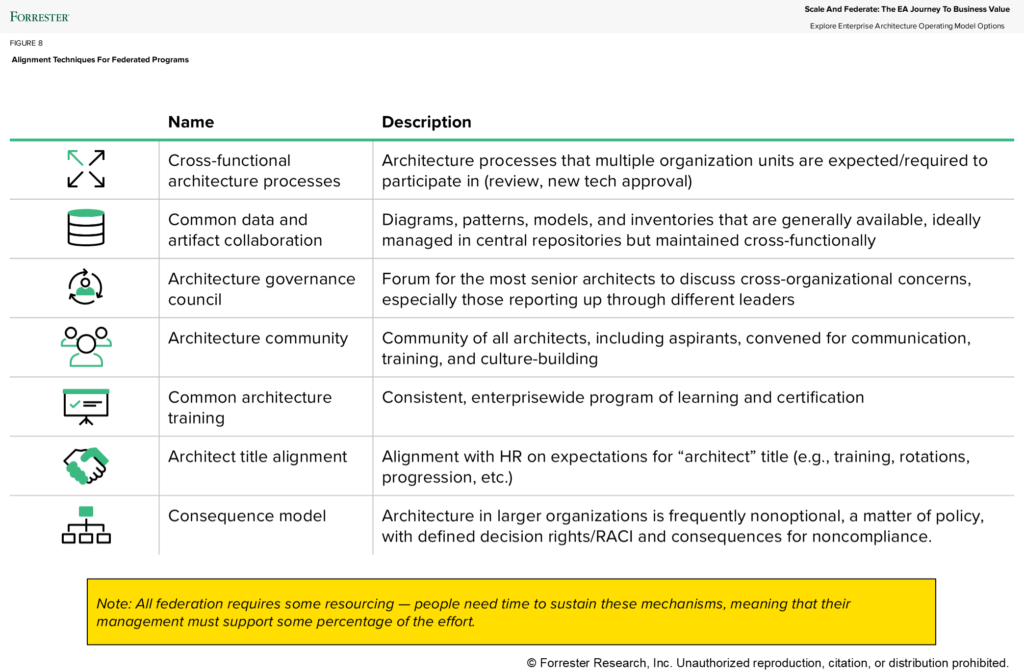
Another day, another LinkedIn hot take on enterprise architecture. They fall into various camps: those confusing EA with a Marvel villain, others who think that the 10-year-old religious war between “business” and “enterprise” architects has any actual meaning (pro tip: it’s about as relevant as whether Han shot first), or folks who think that EA […] source

“Still Federating After All These Years”: The Realities Of EA Maturation Read More »

How Courts Weigh Section 1782 Discovery For UPC Cases

By Erik Puknys and Michelle Rice ( April 17, 2025, 5:23 PM EDT) — Since the Unified Patent Court began operations in June 2023, it has become a major patent litigation forum. Generally, the scope and available tools of discovery in European jurisdictions, and now at the UPC, are relatively limited compared to that in the U.S. To support their cases before the UPC, parties have employed Title 28 of the U.S. Code, Section 1782, to seek discovery from affiliated U.S. entities…. Law360 is on it, so you are, too. A Law360 subscription puts you at the center of fast-moving legal issues, trends and developments so you can act with speed and confidence. Over 200 articles are published daily across more than 60 topics, industries, practice areas and jurisdictions. A Law360 subscription includes features such as Daily newsletters Expert analysis Mobile app Advanced search Judge information Real-time alerts 450K+ searchable archived articles And more! Experience Law360 today with a free 7-day trial. source

How Courts Weigh Section 1782 Discovery For UPC Cases Read More »

Does Your Digital Strategy Fit On A Single Page? It Should.

Effective digital leaders treat strategy as both a verb and a noun: a cycle of work and outputs that sets an organization’s direction and continuously explores new ideas. A strategy on a page is an output that lays out the essential components of your digital strategy on a single page. To help digital business and strategy teams condense their strategy into an easily digestible document, we built The Forrester Digital-Strategy-On-A-Page Template that focuses on the following six components of strategy: Purpose: A concise statement that describes the objective of the digital business. The purpose could be an underlying challenge your team hopes to address, the role your brand or product/service will play in people’s lives, or a digital-specific articulation of a firm’s overarching corporate strategy. Vision: A clear direction for growth, outlining where the digital business plans to be in the future. Hypotheses: A hypothesis is the bedrock of an effective strategy. It uses limited evidence and definable unknowns to predict a desirable outcome. Our template calls for multiple hypotheses: specific, falsifiable statements that challenge current thinking or assumptions about the market. Guiding principles: Three or four principles that will guide how your organization will identify opportunities, create new ideas, determine needed resources, and prioritize initiatives. Success metrics: Three to five KPIs or other metrics that will indicate the effectiveness of your firm’s digital initiatives and their efficiency. Stakeholders: The key people, personas, and roles that will lead, influence, collaborate on, and be significantly affected by your digital strategy. This can include customers, internal stakeholders, external partners, and third-party developers. Outlining your strategy through this template can help team members and collaborators think clearly about how their day-to-day actions align with the strategy. The template helps guide ongoing discussions and future strategic exercises within your team and among other teams. Clients we invite you to try the Digital-Strategy-On-A-Page Template yourself! You can also set up a guidance session to discuss how you can build your own strategy on a page. If you’re not a client, reach out to us! (This blog post was coauthored by Ashley Villarreal.) source

Does Your Digital Strategy Fit On A Single Page? It Should. Read More »

Cybersecurity Ruling Misconstrues Law, FCC Told

By Jared Foretek ( April 18, 2025, 8:56 PM EDT) — Rural broadband companies are voicing opposition to a recent Federal Communications Commission decision requiring them to combat cybersecurity threats, saying the commission failed to consider the regulatory burden the new rules would impose on carriers…. Law360 is on it, so you are, too. A Law360 subscription puts you at the center of fast-moving legal issues, trends and developments so you can act with speed and confidence. Over 200 articles are published daily across more than 60 topics, industries, practice areas and jurisdictions. A Law360 subscription includes features such as Daily newsletters Expert analysis Mobile app Advanced search Judge information Real-time alerts 450K+ searchable archived articles And more! Experience Law360 today with a free 7-day trial. source

Cybersecurity Ruling Misconstrues Law, FCC Told Read More »

JPMorgan, BofA Face GOP Pressure Over Chinese Co.'s IPO

By Sarah Jarvis ( April 18, 2025, 9:46 PM EDT) — The chair of a China-focused U.S. House committee has urged Bank of America and JPMorgan Chase & Co. not to underwrite a Hong Kong initial public offering of Contemporary Amperex Technology Co. Ltd. over concerns the Chinese electric car battery maker is affiliated with the Chinese military…. Law360 is on it, so you are, too. A Law360 subscription puts you at the center of fast-moving legal issues, trends and developments so you can act with speed and confidence. Over 200 articles are published daily across more than 60 topics, industries, practice areas and jurisdictions. A Law360 subscription includes features such as Daily newsletters Expert analysis Mobile app Advanced search Judge information Real-time alerts 450K+ searchable archived articles And more! Experience Law360 today with a free 7-day trial. source

JPMorgan, BofA Face GOP Pressure Over Chinese Co.'s IPO Read More »