
From virtualization to cloud: Achieving hybrid cloud success

There are many benefits of running workloads in the cloud, including greater efficiency, stronger performance, the ability to scale, and ubiquitous access to applications, data, and cloud-native services. That said, there are also advantages to a hybrid approach, where applications live both on-premises and in the cloud. A collaboration between Google Cloud and Broadcom enables organizations to take full advantage of this strategy. As a result, enterprises can gain business benefits, including the ability to: Maximize and protect their existing VMware investments Easily connect workloads running in different environments Place workloads where they want, when they want Gain access to all the benefits of the public cloud. A nondisruptive migration The most compelling benefits for IT leaders are the ease of migration and the consistency of the software platform and functionality between on-premises and cloud environments. Customers can stand up a dedicated cloud in under an hour and seamlessly extend or move virtual workloads to Google Cloud VMware Engine without any disruption or refactoring. The solution combines the power of VMware Cloud Foundation (VCF) with unique Google Cloud capabilities, delivering a consistent operational experience from on-prem to the cloud without the need for retraining. In addition, with VCF license portability, customers can extend their entitlements from on-prem to Google Cloud VMware Engine, gaining choice and flexibility for where they place their workloads. Additionally, VMware NSX empowers IT teams to extend their layer 2 and 3 environments and associated design rules into Google Cloud. This means they can maintain identical policies across environments, which dramatically simplifies administration and security governance in hybrid cloud deployments. Benefits of running virtualized workloads in Google Cloud A significant advantage to housing workloads in the cloud: scalability on demand. In times of peak use — such as end-of-year processes or heavy e-commerce traffic around holidays — IT can size for average use and burst as needed. That’s a more efficient and less costly model than having to provision for peak use year-round with an on-premises environment. Also, moving workloads to the cloud reduces the need to purchase, deploy, and maintain on-premises equipment. IT can also connect cloud-based VMware workloads to powerful artificial intelligence (AI), analytics, and other cloud services. In addition, IT can expect to gain high availability and resilience; Google Cloud leverages the same global backbone that runs YouTube, Gmail, Google Photos, and many other services used daily around the world. Finally, IT can realize considerable savings by leveraging its existing VMware skill sets and gain additional value by connecting other cloud services to enterprise applications. Costs are predictable and transparent, enabling organizations to determine their overall workload requirements and then migrate between on-premises locations and the cloud as appropriate. “Hybrid cloud doesn’t have to be complex,” says Mike Fink, global technical sales director for Google Cloud VMware Engine at Broadcom. “Thanks to this partnership, IT can move virtualized workloads and licenses into the cloud, protect their investment in VMware technology, and leverage Google automation to reduce overall cost while supercharging applications with cloud services, elasticity, and high availability.” Find out how easy it is to extend from on-prem to the cloud and migrate your workloads to Google Cloud VMware Engine. Find more information by clicking here. source

From virtualization to cloud: Achieving hybrid cloud success Read More »
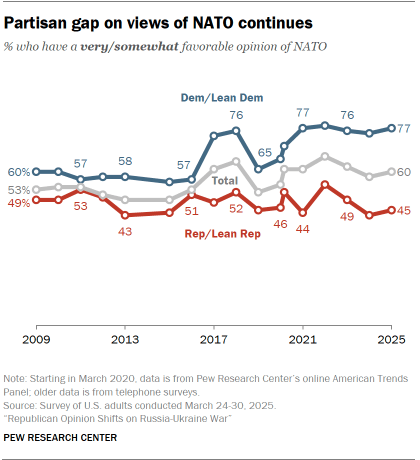
3. How Americans view NATO and U.S. NATO membership

Here are several key takeaways about Americans’ assessments of NATO: While a majority of Americans (60%) express a positive view of NATO, there continue to be partisan differences: 77% of Democrats have a favorable view of the international alliance, compared with 45% of Republicans. These views have not moved significantly over the past year. More Americans say the U.S. benefits from membership in NATO (66%) than say it does not (32%). Democrats are much more likely than Republicans to say the U.S. benefits from NATO membership. NATO favorability Six-in-ten U.S. adults have a favorable view of NATO, similar to the share who said this in 2024. Another 37% have an unfavorable view of the alliance. Partisanship For several years, there has been a wide partisan gap in U.S. opinions of NATO. About three-quarters of Democrats and Democratic-leaning independents (77%) express a positive view of the organization, while 45% of Republicans and Republican leaners feel this way. Neither partisan group has shifted significantly in their views over the past year. There are ideological differences in these views within both partisan coalitions: Moderate or liberal Republicans (51%) are more likely than conservative Republicans (41%) to express a positive view of NATO. Liberal Democrats are more likely than conservative or moderate Democrats to have a favorable opinion of the alliance (85% vs. 72%). Does the U.S. benefit from NATO membership? About two-thirds of Americans (66%) say the U.S. benefits a great deal or a fair amount from being a member of NATO, while 32% say it does not benefit much or at all. The share who say the U.S. benefits from NATO membership has increased modestly from 63% in February 2025, and is the same share who viewed membership favorably in spring 2024. Partisanship and change over time About eight-in-ten Democrats (83%) believe the U.S. benefits from being a member of NATO, compared with about half of Republicans (49%). Liberal Democrats are particularly likely to say the U.S. benefits from membership in the alliance (90%), while a 57% majority of conservative Republicans say the U.S. does not benefit much or at all. The share of Republicans who said the U.S. benefits from being part of NATO has dropped since we first asked this question in spring 2021; at that time, 55% saw at least a fair amount of benefit to NATO membership. Democrats’ views have not changed much since then. Views of international engagement and Russia U.S. adults who say the country should be active in world affairs (81%) are more likely to think the U.S. benefits from being a member of the alliance than those who prefer the country pay less attention to problems overseas and instead focus on domestic issues (52%). And those who say Russia is an enemy of the U.S. (72%) are more likely than those who see Russia as a competitor (49%) or partner (44%) to have a favorable view of NATO. source

3. How Americans view NATO and U.S. NATO membership Read More »

Network Security at the Edge for AI-ready Enterprise

Modern enterprises are adopting AI applications, particularly generative AI (GenAI), at a rapid rate. This adds new network security challenges to already complex enterprise workloads spanning data centers, campuses, cloud, branches, and remote user locations. Network data is being reshaped by the rapid adoption of AI products. By 2026, it is estimated that over 80% of businesses are likely to have adopted generative AI APIs or apps, yet a recent McKinsey study suggests that less than 50% are ready to manage the associated cybersecurity risks. Shadow AI usage among employees is also on the rise — with no oversight from IT — further exposing organizations to cyber attacks. AI model and application developers are building inherent security mechanisms within these applications. IT teams are also tightening their security posture within the data center. But threat actors scan for vulnerabilities in common entry points that include users, devices, and applications at the edge or in the cloud. VeloCloud, a division of Broadcom, has developed AI-based architecture to address the needs of an AI-ready enterprise. Why Modern Network Architecture Demands AI Security Solutions With about 47% of organizations citing adversarial capabilities enabled by generative AI (GenAI) as their top cybersecurity concern, risks of data loss and compliance violations are rising in multi-cloud and edge environments. It doesn’t stop there. Security teams are also inundated with an overwhelming array of security alerts, inconsistent controls, fragmented governance, and visibility gaps as organizations expand their technological footprint across diverse platforms — creating blind spots that sophisticated attackers readily exploit. A 2025 Tenable Cloud AI Risk Report reveals that 70% of cloud AI workloads in cloud environments have unremediated vulnerabilities that leave data exposed. Unfortunately, many organizations still rely on conventional security solutions to address these risks. Traditional approaches to addressing security risks with AI applications may not be adequate. Traffic generated from AI applications tends to be distributed and latency-sensitive, so deploying all security tools at the data center may deliver a secure but sub-optimal experience. It is imperative to enforce security on the optimal path between users and the application, or between model consumers and the models. How VeloCloud Solutions Improve Security for AI-Ready Enterprise Enterprises adopting AI-driven applications require networks that can dynamically adapt to evolving workloads while providing security enforcement on an optimal path outside the data center. VeloCloud addresses these challenges with VeloRAIN, an AI-powered networking architecture designed to enhance security, performance, and scalability for distributed AI workloads. VeloCloud SASE is built using the VeloRAIN architecture offering modular components that include VeloCloud SD-WAN for secure campus and branch connectivity, VeloCloud SD-Access for ZTNA-based remote user access, and Symantec SSE for VeloCloud for security enforcement in the cloud. VeloCloud Dynamic Multipath Optimization™ (DMPO) technology is being enhanced with AI to analyze network conditions in real time and select the best paths for traffic in a way that ensures reliability across multiple networks. Complementing this is Dynamic Application-Based Slicing (DABS), designed to enhance performance by prioritizing critical applications and allocating bandwidth accordingly. Together, these technologies maintain optimal Quality of Experience (QoE) by adapting to network fluctuations and application demands, even in complex, multi-cloud environments. Its AI-driven approach enables real-time application identification and policy enforcement, ensuring that AI workloads receive the necessary prioritization and protection. Features that Set VeloRAIN Apart Unlike traditional SD-WAN solutions that rely on static policies, VeloRAIN dynamically adjusts network resources based on AI-driven traffic patterns to mitigate performance bottlenecks and reduce attack surfaces. Below are four key ways VeloRAIN can benefit your organization: AI-Driven Threat Protection VeloCloud SASE uses AI to gather, analyze, detect, and act on evolving threats. By processing billions of threat signals from various sources, including endpoints, emails, and internet traffic, it enables proactive defense against zero-day attacks and evolving cyber threats. Powered by Symantec Global Threat Intelligence Network the solution enables enterprises to address their security and compliance needs with the changing nature of threat landscapes. Path Optimized Security VeloCloud SASE offers customers the flexibility to configure security policies centrally and enforce these policies at the branch or in the cloud. Branch enforcement is made possible by the native integration of enhanced firewall services on the VeloCloud SD-WAN appliance. Cloud enforcement takes advantage of VeloCloud’s global network of SASE points of presence optimally located closer to public cloud and SaaS application vendors. Securing Data in Motion When users access applications, data is transferred between branch, campus, remote locations, cloud, and the data center. This data has to be protected and any chance of data loss to threat actors has to be prevented. VeloCloud SASE allows only authorized users to access AI applications and in doing so it encrypts any data that is exchanged. Any attempts to exfiltrate that data are monitored and blocked. Optimized Performance for AI Applications AI workloads demand high bandwidth and low-latency connectivity. VeloRAIN-based solutions continuously analyze network conditions and adapt application traffic in real time to maintain optimal performance. This ensures that AI models, including interconnected AI agents, receive consistent network quality without disruption. The platform also integrates AI-driven telemetry to predict and allocate bandwidth efficiently, as well as prevent congestion and ensure seamless application performance. Conclusion As enterprises embrace AI-driven applications across distributed environments, robust network security becomes paramount. VeloCloud, a Broadcom division, harnesses the power of VeloRAIN, its AI-enhanced architecture to deliver cutting-edge security, seamless performance, and scalability that outpace conventional solutions. Tailored to protect data and AI models at the edge and in the cloud, VeloCloud empowers organizations to mitigate risks while ensuring an exceptional user experience. Visit VeloCloud today to learn how the solution can enhance your enterprise’s security and resilience. source

Network Security at the Edge for AI-ready Enterprise Read More »

How to Handle a Runaway IT Development Team

IT development teams are known for their iconoclasts, free spirits, and non-conformists. It’s embedded in their DNA. That’s what makes developers so good at their jobs. Yet when a team suddenly deviates wildly from its assigned mission, it’s time to intervene and issue a course-correction that will get them back on track without bruising egos or killing morale.  There’s rarely a single goal for any IT development team, says Liz James, managing security consultant at cybersecurity firm NCC Group. “Where there are a few goals, there’s a tendency for them to become overly broad and not effectively measurable,” she explains in an online interview.  Warning Signs  When a team starts solving problems nobody asked them to solve, you’ve got an issue, observes Peter Murphy Lewis, founder of Strategic Pete, a marketing advisory company. “Maybe they’re over-engineering, chasing the ‘perfect’ solution, or adding features no one needs,” he says via email.  The first sign that an IT team is drifting is when task progress appears strained, says Alex Osmichenko, CEO of website development firm IT Monks. The team is working hard, implementing various changes with good intentions, but these small victories don’t add up to the big picture, he notes in an online interview. “It feels like your people are moving, but your company isn’t,” Osmichenko explains. “If you find yourself going off-topic in meetings and spending most of your time discussing features that weren’t originally defined, your team may be struggling to understand what the goal is and how to get there.”  Related:Breaking Down the Walls Between IT and OT When an IT team veers off course, the damage isn’t just confined to a delayed timeline or blown budget — there’s also a ripple effect, Lewis says. “Stakeholders lose confidence, your users get a half-baked product, and the team itself starts feeling like they’re running on a hamster wheel.” Worse yet, if the IT leader lets this behavior slide, it can become accepted culture. “Teams start to believe that wandering is acceptable — and that’s a disaster waiting to happen.”  If team drift isn’t caught early, deadlines might be missed and products left unfinished. “It can also affect team morale, as people see that their hard work isn’t reflected in the big changes,” Osmichenko says. “This can lead to burnout and decreased efficiency.”  Preventative Steps  IT teams are often under pressure to innovate and move fast, and that can lead to scope creep or distractions, Lewis says. “Studies show that over half of IT projects fail to meet their objectives, and this is one of the reasons why.”   Related:How to Tell When You’re Working Your IT Team Too Hard “Divergence from goals and objectives will happen just by meeting with real world constraints and challenges,” James adds.  The first step toward corralling a runaway team is establishing an open dialog. “As a leader, you should show the team that you’re not blaming them for anything — you’re encouraging cooperation, not punishment,” Osmichenko says. Give everyone a chance to contribute, and don’t reject new ideas that may not be immediately pressing. “Encouraging the team to adjust course together keeps morale high and makes them feel like a part of the solution.”  “Plan your project clearly,” Osmichenko advises. “Break it down into smaller checkpoints so that deviations from the goal are easier to spot,” he says. Hold regular meetings for coordination, not just in critical situations. “Your team must understand the importance of feedback and be honest when discussing new challenges.”  Balance is important, especially in IT where it’s very easy to burn out and get lost in an avalanche of large and small tasks. “This doesn’t mean that challenges are insurmountable,” Osmichenko notes. “In fact, they can make your team stronger.”  Getting Back on Track  Goal diversions happen for a reason, James says. “The first step is understanding what that reason is and being able to understand if it was a missed requirement or goal from the outset, or if it truly is a diversion that doesn’t contribute to the final objective.”  Related:3 Ways to Build a Culture of Experimentation to Fuel Innovation Keep it real and don’t place blame. “Most teams want to succeed — they just need to be pointed in the right direction,” Lewis says. “Make sure to note the good things they’ve accomplished, even if it’s off course.”  It’s important to set clear goals and guardrails from day one, Lewis advises. “Make sure everyone knows what success looks like and why it matters.” He recommends establishing regular check-ins to catch team drift early. “Create space where the team feels safe to speak up if they see misalignment,” Lewis suggests. “A little course correction early beats a full-on rescue mission later.”  A Final Thought  On the bright side, a runaway team is usually a passionate team, Lewis says. “Channel that energy,” he advises. “If they’re bursting with ideas, carve out some time for structured innovation where they can explore without derailing the main project.” source

How to Handle a Runaway IT Development Team Read More »

FCC Boots 7 From E-Rate Program After Fraud Convictions

By Nadia Dreid ( April 16, 2025, 7:47 PM EDT) — Seven people who were convicted of defrauding the Federal Communications Commission’s E-Rate program have been suspended from the subsidy program that helps offset the cost of internet service for schools and libraries, the agency has revealed…. Law360 is on it, so you are, too. A Law360 subscription puts you at the center of fast-moving legal issues, trends and developments so you can act with speed and confidence. Over 200 articles are published daily across more than 60 topics, industries, practice areas and jurisdictions. A Law360 subscription includes features such as Daily newsletters Expert analysis Mobile app Advanced search Judge information Real-time alerts 450K+ searchable archived articles And more! Experience Law360 today with a free 7-day trial. source

FCC Boots 7 From E-Rate Program After Fraud Convictions Read More »

Four Signs That Portfolio Marketers Are Evading Messaging Responsibilities

  What in the world is going on with messaging? Over the past few months, I have had numerous conversations where it seems that the responsibility for creating messaging has been upended. Messaging development has sprawled across too many areas within B2B teams, which has led to multiple, disparate — or even competing — versions of messages that get communicated to buyers and customers. Confusion is almost guaranteed, leading to frustration for both the provider and their buyers and customers. Product and portfolio marketing should own buyer-focused messaging. It has always been a core responsibility, as high-performing product and portfolio marketers are experts on understanding markets and buyers. They are uniquely qualified to develop effective messaging that resonates with buyers, helping buyers connect their needs to product offerings throughout the entire decision-making process. But results from Forrester’s Portfolio Marketing Survey, 2024, indicate that portfolio marketers are neglecting this crucial messaging responsibility. The survey gathered insights from product and portfolio marketing decision-makers based on their responses to questions about core responsibilities and key activities. Our research uncovered these alarming data points: Message creation ranked lowest as an important skill. Portfolio marketers have a broad remit, so it’s no surprise that they work on a variety of things and require a vast skill set. But when the survey asked respondents what skills are most important for being successful in their role, they ranked message creation dead last across all options, with only 11% selecting it as an important skill. More than 25% of portfolio marketers outsource messaging development. There’s nothing more important than understanding buyers and developing value propositions and messaging that connect a buyer’s needs to the capabilities of an offering. Yet one out of every four respondents indicated that they outsourced the development of messaging and value proposition to third parties. There are many things that are smart to outsource — messaging is not one of them! Messaging is not deemed as important in helping achieve business goals. Among eight key activity areas ranging from identifying new market opportunities to orchestrating product launches, messaging was at the very bottom of the list. Only 5% of respondents said that crafting messaging for buyers or offerings is the most important activity in helping the organization achieve its business goals. Portfolio marketers are spending time on non-core activities. It can be difficult to prioritize what to work on for a function that shoulders such a variety of responsibilities, but the survey results showed that portfolio marketers are spending just as much time on non-core activities, such as brand awareness and demand generation, as on messaging. Thirty-six percent of respondents indicated that they own or lead demand generation and 36% own or lead brand awareness efforts; this is compared to just 34% owning or leading messaging development. Portfolio marketing leaders need to take notice and respond quickly — make sure that your teams invest time for messaging development. Forrester clients can leverage The Messaging Nautilus®: Buyer’s Journey, a model made of four steps that helps portfolio marketers build concise, specific, and relevant messaging that motivates buyers throughout the purchase process. And if you would like to have a more detailed conversation with me, you can request a guidance session or inquiry — let’s chat! source

Four Signs That Portfolio Marketers Are Evading Messaging Responsibilities Read More »

Meta’s US Antitrust Trial: What You’ve Missed So Far

Meta’s Mark Zuckerberg. Image: Meta Meta was summoned to Washington to defend its acquisitions of Instagram and WhatsApp in a trial brought by the US Federal Trade Commission, which alleges the deals were part of a monopolistic strategy. The FTC wants Meta to divest these platforms to create a more level playing field in the social app market. Meta, which went only by Facebook then, bought photo-sharing app Instagram in 2012 and messaging platform WhatsApp in 2014. It argues that the acquisitions fueled the apps’ growth and that there’s little evidence they would have evolved into viable competitors on their own. On Wednesday, Meta CEO Mark Zuckerberg maintained that he never intended to stifle competition through acquisition, according to live reporting from The Verge. “Was the intent to stop offering or stop making Instagram good? Absolutely not,” he said. His hope was just to scale the app’s user base tenfold, but he had done so hundredfold by 2018. Zuckerberg and the Meta team emphasised that the company has always faced — and continues to face — rivals while building Facebook, Instagram, and WhatsApp, including platforms like TikTok and Google Plus. Day 1: Monday, April 14 The most significant points discussed on the first day centred around TikTok. While the FTC wants to prove that Meta has monopolised the market of social apps that “connect friends and family,” it does not include TikTok in that market. Meta argues that the Chinese video-sharing app should be seen as a viable competitor that holds comparable market value, according to The Verge. For instance, when TikTok was banned in the US for one day in January 2025, Facebook and Instagram usage spiked by 20% and 17%, respectively. If Zuckerberg can prove that the FTC’s market definition is too narrow, Meta could win the case. The courts also heard that, in February 2012, Zuckerberg considered acquiring Instagram but did not make any significant changes to avoid creating “a hole in the market for someone else to fill.” Nevertheless, per The Verge, the CEO said he never took this route. What’s hot at TechRepublic Day 2: Tuesday, April 15 Zuckerberg was asked to explain why, in a February 2012 exchange, he agreed with CFO David Ebersman’s suggestion that acquiring Instagram could help “neutralize a potential competitor,” according to The Verge. On the stand, he said that buying a company will inherently result in a competitor being taken off the market. He also admitted that he could have built a new app to compete with Instagram, but “whether it would have succeeded or not … is a matter of speculation,” according to the BBC. In an email sent before Instagram’s acquisition, Zuckerberg said that Meta was “so far behind” in the photo-sharing space and that the prospect of falling behind was “really scary,” per Mashable. Nevertheless, his company did start building the competing product Facebook Camera, after, in 2011, he was more focused on Instagram’s camera technology than its social potential. Zuckerberg then realised that his app would not catch up with Instagram, so he scrapped it and pursued acquisition. In court, the CEO admitted he was “worried” about other messaging apps like WeChat from “broadly competing with (Meta)” before it acquired WhatsApp. The statement was in response to messages from January 2013, in which Zuckerberg suggested “block(ing) WeChat, Kakao and Line ads” as they “are trying to build social networks and replace us,” per The Verge. The second day of the trial illuminated several of Zuckerberg’s ideas to expand his company, which never came to fruition. One was buying Snapchat, now Snap, for a proposed $6 billion. The Facebook founder was particularly concerned when Snapchat released Stories, saying in internal messages from 2014 that it was “now more of a competitor for Instagram and News Feed than it ever was for messaging.” He also considered creating a Facebook feed that shows only ads, deleting all users’ Facebook Friends to regain its “cultural relevance,” and spinning out Instagram into its own company. The latter was pre-empting the regulatory scrutiny his company is currently under, as in a 2018 email, he admitted that “most companies actually perform better after they’ve been split up.” Day 3: Wednesday, April 16 Zuckerberg said that Facebook’s “growth slowed down dramatically” when TikTok became popular, reiterating how the social media platform is not the only dominant player in the market, according to The Verge. He also didn’t consider acquiring TikTok’s precursor, Musical.ly, as he didn’t want to deal with “any connection that they had to China.” ByteDance subsequently acquired it and became a major competitor, the CEO said. Zuckerberg acknowledged that competition is now coming from YouTube, too, as “richer forms of media” like video have become more attractive to digital creators, per CNN. However, the platform is not considered a competitor in the market that the FTC has defined. The FTC argued that Facebook gained disproportionate influence from “network effects,” as its large, sustained user base encourages new users to join and existing users to stay, since much of their social circle is already on the platform. However, Zuckerberg argued that network effects aren’t solely beneficial. He explained that users may eventually see their feeds dominated by content from people they no longer care about, making the platform obsolete. This is why he considered resetting everyone’s Friends lists. Regarding WhatsApp, Zuckerberg said that the motivation behind its acquisition was never to hinder its growth and prevent it from challenging Meta’s dominance, because he knew that the founders had no plans to do so. After getting to know them, he found they “looked down” on adding features that could make the app more competitive and eventually had to persuade them to implement those changes. Ex-Meta COO Sheryl Sandberg came to the stand near the end of the session and said she was shaken when Google Plus was launched in 2011, noting how it was “almost an exact replica” of Facebook. source

Meta’s US Antitrust Trial: What You’ve Missed So Far Read More »

SAP customers on Business Suite: New strategy, same old concerns

“To achieve this, SAP must continuously harmonize its product landscape and consistently implement uniform standards, for example, in data models and identity and security services,” said DSAG CTO Sebastian Westphal. “Because, by definition, a suite requires the seamless integration of the SAP solutions it contains, uniform operating models, and clear migration and implementation strategies along the way.”  What’s wanted in Business Suite: Flexible integration In addition, DSAG members expect a modular suite that can be flexibly adapted to corporate requirements and integrated into corporate architectures without undue effort and expense. Moreover, several points of SAP’s strategy still need to be clarified. According to Westphal, transparent cost structures and contract models, as well as long-term support for partner solutions, are key concerns. “There’s still a lot to do to create a fully integrated business suite,” Westphal said.   RISE Migration expected to be extended Regarding migration, DSAG customer companies welcome SAP’s continuation of its RISE Migration and Modernization program, originally announced at the beginning of 2024 — and originally scheduled to expire at the end of last year. This program is expected to significantly reduce the costs and time required for migrating to the new SAP world, for example, by offsetting previous investments in SAP products. According to the DSAG, SAP will continue the program in 2025 under a different name. A corresponding announcement is expected in the coming weeks.  source

SAP customers on Business Suite: New strategy, same old concerns Read More »

OpenAI launches o3 and o4-mini, AI models that ‘think with images’ and use tools autonomously

Join our daily and weekly newsletters for the latest updates and exclusive content on industry-leading AI coverage. Learn More OpenAI launched two groundbreaking AI models today that can reason with images and use tools independently, representing what experts call a step change in artificial intelligence capabilities. The San Francisco-based company introduced o3 and o4-mini, the latest in its “o-series” of reasoning models, which it claims are its most intelligent and capable models to date. These systems can integrate images directly into their reasoning process, search the web, run code, analyze files, and even generate images within a single task flow. “There are some models that feel like a qualitative step into the future. GPT-4 was one of those. Today is also going to be one of those days,” said Greg Brockman, OpenAI’s president, during a press conference announcing the release. “These are the first models where top scientists tell us they produce legitimately good and useful novel ideas.” How OpenAI’s new models ‘think with images’ to transform visual problem-solving The most striking feature of these new models is their ability to “think with images” — not just see them, but manipulate and reason about them as part of their problem-solving process. “They don’t just see an image — they think with it,” OpenAI said in a statement sent to VentureBeat. “This unlocks a new class of problem-solving that blends visual and textual reasoning.” During a demonstration at the press conference, a researcher showed how o3 could analyze a physics poster from a decade-old internship, navigate its complex diagrams independently, and even identify that the final result wasn’t present in the poster itself. “It must have just read, you know, at least like 10 different papers in a few seconds for me,” Brandon McKenzie, a researcher at OpenAI working on multimodal reasoning, said during the demo. He estimated the task would have taken him “many days just for me to even like, onboard myself, back to my project, and then a few days more probably, to actually search through the literature.” The ability for AI to manipulate images in its reasoning process — zooming in on details, rotating diagrams, or cropping unnecessary elements — represents a novel approach that industry analysts say could revolutionize fields from scientific research to education. I had early access, o3 is an impressive model, seems very capable. Some fun examples:1) Cracked a business case I use in my class2) Creating some SVGs (images created by code alone)3) Writing a constrained story of two interlocking gyres4) Hard science fiction space battle. pic.twitter.com/TK4PKvKNoT — Ethan Mollick (@emollick) April 16, 2025 OpenAI executives emphasized that these releases represent more than just improved models — they’re complete AI systems that can independently use and chain together multiple tools when solving problems. “We’ve trained them to use tools through reinforcement learning—teaching them not just how to use tools, but to reason about when to use them,” the company explained in its release. Greg Brockman highlighted the models’ extensive tool use capabilities: “They actually use these tools in their chain of thought as they’re trying to solve a hard problem. For example, we’ve seen o3 use like 600 tool calls in a row trying to solve a really hard task.” This capability allows the models to perform complex, multi-step workflows without constant human direction. For instance, if asked about future energy usage patterns in California, the AI can search the web for utility data, write Python code to analyze it, generate visualizations, and produce a comprehensive report — all as a single fluid process. OpenAI surges ahead of competitors with record-breaking performance on key AI benchmarks OpenAI claims o3 sets new state-of-the-art benchmarks across key measures of AI capability, including Codeforces, SWE-bench, and MMMU. In evaluations by external experts, o3 reportedly makes 20 percent fewer major errors than its predecessor on difficult, real-world tasks. The smaller o4-mini model is optimized for speed and cost efficiency while maintaining strong reasoning capabilities. On the AIME 2025 mathematics competition, o4-mini scored 99.5 percent when given access to a Python interpreter. “I really do believe that with this suite of models, o3 and o4-mini, we’re going to see more advances,” Mark Chen, OpenAI’s head of research, said during the press conference. The timing of this release is significant, coming just two days after OpenAI unveiled its GPT-4.1 model, which excels at coding tasks. The rapid succession of announcements signals an acceleration in the competitive AI landscape, where OpenAI faces increasing pressure from Google’s Gemini models, Anthropic’s Claude, and Elon Musk’s xAI. Last month, OpenAI closed what amounts to the largest private tech funding round in history, raising $40 billion at a $300 billion valuation. The company is also reportedly considering building its own social network, potentially to compete with Elon Musk’s X platform and to secure a proprietary source of training data. o3 and o4-mini are super good at coding, so we are releasing a new product, Codex CLI, to make them easier to use. this is a coding agent that runs on your computer. it is fully open source and available today; we expect it to rapidly improve. — Sam Altman (@sama) April 16, 2025 How OpenAI’s new models transform software engineering with unprecedented code navigation abilities One area where the new models particularly excel is software engineering. Brockman noted during the press conference that o3 is “actually better than I am at navigating through our OpenAI code base, which is really useful.” As part of the announcement, OpenAI also introduced Codex CLI, a lightweight coding agent that runs directly in a user’s terminal. The open-source tool allows developers to leverage the models’ reasoning capabilities for coding tasks, with support for screenshots and sketches. “We’re also sharing a new experiment: Codex CLI, a lightweight coding agent you can run from your terminal,” the company announced. “You can get the benefits of multimodal reasoning from the command line by passing screenshots or low fidelity sketches to the model, combined with access to your code locally.”

OpenAI launches o3 and o4-mini, AI models that ‘think with images’ and use tools autonomously Read More »

Paebbl opens ‘world’s first’ demo plant that turns CO2 into dust

Paebbl has opened its first demo plant in Rotterdam as it looks to ramp up its carbon capture technology.   When we visited Paebbl’s sprawling facility in June last year, it was a mishmash of prototype machines, batch samples, machinery, and equipment — some of it still in its packaging. Now, the site is purportedly the world’s biggest plant capable of continuously mineralising CO2. Paebbl said the plant was completed in “record time” with the help of Dutch engineering companies Spie and Vicoma. The project also received an undisclosed financial investment from the Netherlands Enterprise Agency (RVO).   Andreas Saari, co-CEO and co-founder of Paebbl, said the milestone brings the Dutch-Nordic startup “one step closer” to bringing high-performance materials and climate impact together “on a scale that really matters.”  Saari, the former CEO of Slush, co-founded Paebbl in 2021 alongside his former Northzone partner Marta Sjögren, early Klarna investor Jane Walerud, and Dutch scientist Pol Knops.       From Shark Tank to Tinder Swindler TNW Conference 2025 combines the latest breakthroughs in tech, the startup ecosystem & enterprise innovation How does Paebbl’s technology mineralise CO2? Paebbl’s technology artificially accelerates the slow, natural process of carbon mineralisation.   Paebbl feeds crushed olivine rock and CO2 captured from heavy industry into its machine, where it undergoes enhanced mineralisation. The CO2 turns into CO3 (carbon trioxide) and binds to the olivine.  For every ton of CO2 captured, it produces about three tons of powder, the scientific name for which is “silicon-rich” magnesium carbonate.  This powder feels like a soft, fine dust and is grey with a tinge of green from the olivine it’s made from. Around half of the emissions from cement are produced when limestone is heated to produce lime. Paebbl’s powder can replace lime and other additives in substances like wall filler, turning buildings into carbon sinks.  Paebbl is one of an emerging cohort of carbon removal startups looking to capture CO2 and use it as a resource to make new, cleaner products.  Known as carbon capture, utilisation, and storage (CCUS), this approach differs from the more established carbon capture and storage (CCS) championed by the oil and gas industry, where carbon is captured at source and buried underground.  In October, Paebbl secured $25mn from the likes of Amazon and German cement industry giants Holcim and Goldbeck, bringing its total raised to $38mn, according to Dealroom data. Paebbl aims to build a commercial-scale plant in 2027. While the company hasn’t yet disclosed the location of this facility, Marta previously told TNW that they will focus on setting up factories in areas with “high demand for end products (building material), nearby feedstock supply (CO2 and olivine rock)”, and access to renewable energy. In Europe, the Nordics, Spain, and Portugal stand out in this respect.   Paebbl aims to bring 1 million tons of its product to the market by 2030. The startup plans to make money by selling the rock powder itself and through providing carbon removal credits to companies looking to offset their emissions. Sustainability will be a hot topic at TNW Conference, which takes place on June 19-20 in Amsterdam. Tickets for the event are now on sale. Use the code TNWXMEDIA2025 at the check-out to get 30% off the price tag. source

Paebbl opens ‘world’s first’ demo plant that turns CO2 into dust Read More »