1. U.S. views of China and Xi

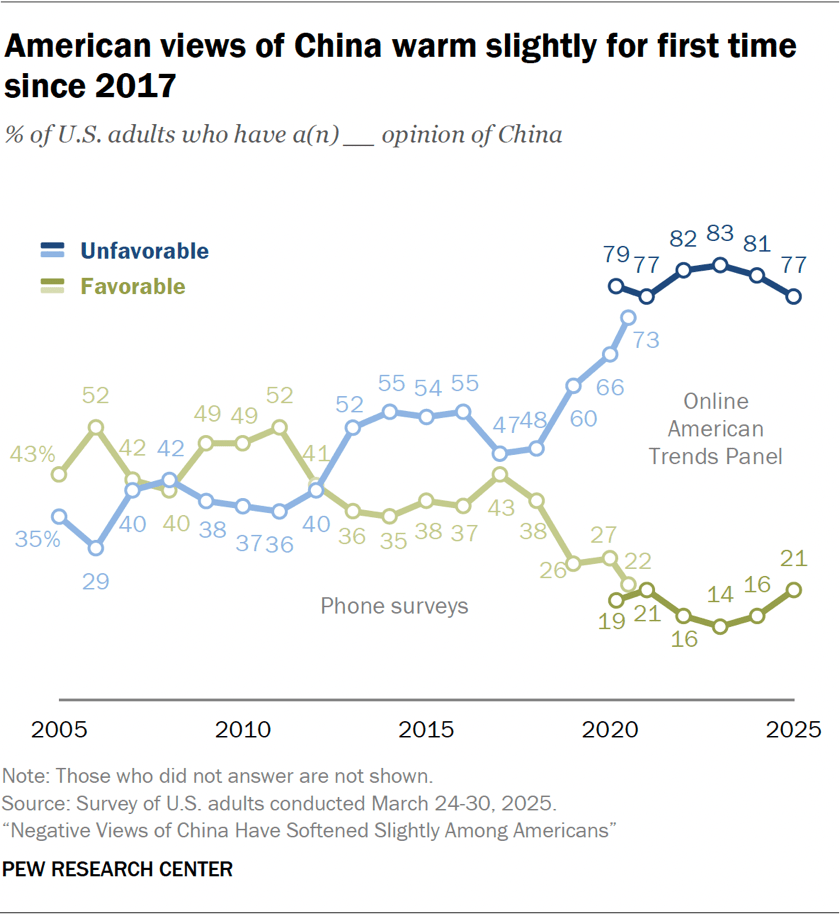
Americans hold largely unfavorable opinions of China and Chinese President Xi Jinping, but ratings of both have improved slightly since 2024. Views of China are mostly negative More than three-quarters of Americans (77%) have an unfavorable opinion of China. Though a sizable majority, this reflects a decrease from 81% in 2024. It also marks the first time in five years we’ve measured a significant year-over-year decline in the share of Americans with an unfavorable view of China. The change is even greater when it comes to the share of those with a very unfavorable view of China: Today, 33% of U.S. adults have a very unfavorable view, down from 43% last year. Views by party Views of China tend to vary by party. While majorities of adults in both parties have an unfavorable opinion of China, Republicans and Republican-leaning independents are significantly more likely than Democrats and Democratic leaners to hold this view (82% vs. 72%). Still, views of China are warming across the board. The share of Republicans with a very unfavorable opinion of China has dropped 16 points since 2024, while the share among Democrats has dropped 6 points.  Conservative Republicans stand out among ideological groups, with about half (51%) saying they have a very unfavorable view of China. That is 20 points more than the share of moderate and liberal Republicans (31%) and roughly double the shares of conservative and moderate Democrats (24%) and liberal Democrats (24%) who say the same. Views by age Older Americans are most critical of China. About half of those ages 65 and older have a very unfavorable opinion of China. This share drops to 37% among those ages 50 to 64, 27% among those ages 30 to 49, and 21% among adults under 30. Americans largely lack confidence in Xi Three-quarters of U.S. adults have little or no confidence in Chinese President Xi Jinping to do the right thing regarding world affairs. This includes 39% who have no confidence at all in him. Only about one-in-ten Americans (11%) say they have some confidence in Xi, and just 1% have a lot of confidence in him. Another 12% say they have never heard of the Chinese president. Similar to Americans’ overall views of China, the share of those with confidence in Xi has risen slightly since 2024 (+4 points). Views by party Opinions of Xi also vary by party. While sizable majorities of both Republicans and Democrats have little or no confidence in Xi’s leadership on the world stage, Republicans are especially likely to lack confidence. Conservative Republicans are the most critical: 86% are not confident in Xi, including 54% who have no confidence at all. Views by age Confidence in Xi is lowest among older Americans. Adults ages 65 and older are 21 points more likely than those ages 18 to 29 to have little or no confidence in the Chinese president (85% vs. 64%). Older adults are also more likely to know who Xi is. When asked, just 5% of those ages 65 and older say they have never heard of him. That share rises to 20% among adults ages 18 to 29. source

1. U.S. views of China and Xi Read More »

Stuck Stage-Zero Opportunities Expose Critical Gaps In Sales Processes

One of the most common issues we see from companies that have adopted the B2B Revenue Waterfall as part of a revenue process transformation (RPT) is sales failing to pick up and progress stage-zero (qualified) opportunities. Even the most well-intentioned and thorough RPT teams can’t force sales to address the valuable signal- and buying-group-based opportunities passed to them. Marketing may get frustrated and question the effectiveness of the transformation effort because they aren’t seeing positive results from their work. Big changes like an RPT require patience, determination, and a commitment to the long game — in this case, revenue growth. To address this challenge, marketing leaders must ensure that team members stay the course by developing incremental metrics that tie to things under their control so that they understand the endgame. But marketing will also need to work with sales leadership to get them to understand the value of the stage-zero opportunity and how to leverage it to drive positive revenue impact. This means sales leaders must get involved and adhere to a level of governance over these early-stage opportunities where it is likely that very little or even no governance existed before. Stage-zero opportunities are critical because they represent momentum in the B2B Revenue Waterfall. It is the activation of the handoff from marketing to sales. Marketing will identify opportunities with signals, enrich the account data, and add buying group members to the account and opportunity, then a revenue development representative will book a meeting for the next sales expert in the process. Sales receives these meetings-booked opportunities and further develops the opportunity to determine its viability before ultimately closing the deal. Sales knows its role in the traditional sales process, but its role in a transformed revenue process may be murkier. If your organization has stuck stage-zero opportunities, one or more of these is the likely breakpoint: Agreement. In a revenue process transformation, marketing and sales agreement is more critical than the alignment that marketing and sales typically attempt at the campaign or program level. RPT requires marketing and sales leadership to agree that there is a need to transform and agree on the implementation strategy and on definitions at each step in the process. Leaders need to roll this down to their direct reports and hold their teams accountable. Looking at situations where the sales team may be falling back to their old ways and not leveraging the power of the transformation is a key focal point. Revenue process transformation is implemented in a bottom-up manner but will never be successful if there is not a top-down agreement on how the transformation will drive revenue growth. Understanding. Every team member involved in the transformation must understand why it is pivotal to the future of the business. They must understand what is forcing change, the business approach to addressing it, and their role in it. Even when team members know what is expected of them, they may work in parallel with or even outside the new framework without understanding the negative downstream impact. This type of behavior is a sign that more enablement is needed. These employees need to understand both the positive and negative impacts of not actively engaging in the transformation. Enablement. Governance via the use of strong sales-level agreements, opportunity stage management, sales process, and measurement using the B2B Revenue Waterfall will be very important in this transformation. Enablement is the tool to reduce friction in the governance process. A formal onboarding program is required as a part of transformation planning. If taught in piecemeal fashion, team members will quickly suffer from change fatigue and bad behaviors will develop because each piecemeal change can result in workarounds that are difficult to break once created. The enablement plan must include an overview of the entire workflow process, an understanding of why it’s important to the business, lessons on each individual step they will be responsible for, details on how they will be measured, and an opportunity for regular interactions with their leaders to ensure that they are successful. The sales team’s acceptance of, and willingness to address, the new buying-group-centric stage-zero opportunities passed to them from marketing will ultimately define the success of a revenue process transformation. No function wants to be the team that limits growth. source

Stuck Stage-Zero Opportunities Expose Critical Gaps In Sales Processes Read More »

Windsurf: OpenAI’s potential $3B bet to drive the ‘vibe coding’ movement

Join our daily and weekly newsletters for the latest updates and exclusive content on industry-leading AI coverage. Learn More ‘Vibe coding’ is a term of the moment, as it refers to a more accepted use of AI and natural language prompts for basic code completion.  OpenAI is reportedly looking to get in on the movement — and own more of the full-stack coding experience — as it eyes a $3 billion acquisition of Windsurf (formerly Codeium). If the deal materializes, it would be OpenAI’s most expensive acquisition to date.  The news comes on the heels of the company’s release of o3 and o4-mini, which are capable of “thinking with images,” or more intuitively understanding low-quality sketches and diagrams. This development follows the launch of the GPT-4.1 model family. The AI company nobody can stop talking about also recently raised a $40 billion funding round.  Industry watchers and insiders have been abuzz about the potential deal, as it could not only make OpenAI an even bigger industry player than it already is, but also further accelerate the cultural adoption of vibe coding.  “Windsurf could be game-changing for OpenAI because it is one of the tools that developers are racing to,” Lisa Martin, research director at The Futurum Group, told VentureBeat. “This deal could solidify OpenAI as a developer’s best friend.” A bet on vibe coding? AI-assisted coding isn’t a new concept by a long shot, but “vibe coding” — a term coined by OpenAI cofounder Andrej Karpathy — is a relatively new approach, as it leverages generative AI and natural language prompts to automate coding tasks.  This is compared to other AI coding assistants and no-code and low-code tools that use visual drag-and-drop elements. Vibe coding is all about incorporating AI into end-to-end development workflows, with the focus being intent rather than manual coding minutiae.  Windsurf is among the top tools in the space, along with Cursor, Replit, Lovable, Bolt, Devin and Aider. The company released Wave 6 earlier this month, which aims to address common workflow bottlenecks.  “Windsurf has been leading the charge in building truly AI-native development tools, helping developers accelerate delivery without compromising on experience,” said Mitchell Johnson, chief product development officer at software security firm Sonatype. “Like early open source, this started as ‘outlaw tech’ — but it’s quickly becoming foundational.”  Andrew Hill, CEO and co-founder of crowdsource AI agent platform Recall, said the potential acquisition is “a bet on vibe coding as the future of software development.” Windsurf has fast feedback loops, good defaults, and “just the right toggles” for people with the right intuition to guide AI to solve their problems. It is also an environment designed for co-creation.  “Let the coding leapfrogging commence from Replit, Claude, Cursor, Windsurf — what’s next?,” said Hill, calling vibe coding a “productivity unlock.” “The best agents will be built by humans who can vibe through a hundred ideas in a weekend.”  OpenAI owning more of the stack Others note that if OpenAI does acquire Windsurf, it signals a clear move to own more of the full-stack coding experience rather than just supplying the underlying models.  “Windsurf has focused on developer-centric workflows, not just raw code generation, which aligns with the growing need for contextual and collaborative coding tools,” said Kaveh Vahdat, AI industry watcher and founder of RiseAngle and RiseOpp.  Arvind Rongala, CEO of corporate training services company Edstellar, called it more of a power move than a software grab. With vibe coding, developers want environments that are “expressive, intuitive and nearly collaborative, rather than merely text editors.”  With Windsurf, OpenAI would have direct access to the next generation of code creation and sharing, he noted, with the plan being vertical integration. “The intelligence layer already belongs to OpenAI. It wants the canvas now.”  OpenAI has enormous power over not just what is developed, but how it is built, said Rongala, since it owns the creative tools that developers use for hours every day. “This isn’t about taking market share away from Replit or GitHub,” he said. “Making such platforms seem antiquated is the goal.” A strategy move or a scramble? Vahdat pointed out that a Windsurf acquisition would put OpenAI in more direct competition with GitHub Copilot and Amazon CodeWhisperer, both of which are backed by platform giants.  “The real value here is not just in the tool itself but in the distribution and user behavior data that comes with it,” he said. “That kind of insight is strategically important for improving AI coding systems at scale.”  The move is especially interesting because it could position OpenAI more directly against Microsoft, even though the two are closely partnered through tools like GitHub Copilot, noted Brian Jackson, principal research director at Info-Tech Research Group.  A deal would support OpenAI’s “larger strategy of moving beyond simple chat interactions and becoming a tool that helps users take real action and automate everyday workflows,” he said.  Still, Sonatype’s Johnson noted, what if Windsurf becomes tightly coupled with OpenAI’s ecosystem? Developers benefit most when tools can integrate freely with the AI models that suit their needs — whether that’s GPT, Claude or open-source.  “If ownership limits that flexibility, it could introduce a form of vendor lock-in that slows the very momentum Windsurf helped create,” he said.  Some OpenAI critics, meanwhile, see it as a desperate move. Matt Murphy, partner with Menlo Ventures, called Anthropic superior at coding, and the company has the best models and strongest partnerships.  “OpenAI’s move here feels like a scramble to close the gap — but it risks alienating key allies and still doesn’t address the core issue: Claude is the better model,” he posited.  source

Windsurf: OpenAI’s potential $3B bet to drive the ‘vibe coding’ movement Read More »

CISA’s Reversal Extends Support for CVE Database, Averting Possible National Security Problem

Image: CROCOTHERY/Adobe Stock The nonprofit organization MITRE, which maintains the Common Vulnerabilities and Exposures (CVE) database, said on April 15 that the US government funding for its operations will expire without renewal; however, in a last-minute reversal announced the morning of April 16, CISA said it has extended support for the database. At the same time, CVE Board members have founded the CVE Foundation, a nonprofit not affiliated with the US federal government, to maintain the CVE program. The CVE program, which has been in place since 1999, is an essential way to report and track vulnerabilities. Many other cybersecurity resources, such as Microsoft’s Patch Tuesday update and report, refer to CVE numbers to identify flaws and fixes. Organizations called CVE Numbering Authorities are associated with MITRE and authorized to assign CVE numbers. “CVE underpins a huge chunk of vulnerability management, incident response, and critical infrastructure protection efforts,” wrote Casey Ellis, founder of crowdsourced cybersecurity hub Bugcrowd, in an email to TechRepublic. “A sudden interruption in services has the very real potential to bubble up into a national security problem in short order.” Funds were expected to run out on MITRE without renewal A letter sent to CVE board members began circulating on social media on Tuesday. “Current contracting pathway for MITRE to develop, operate, and modernize CVE and several other related programs, such as CWE, will expire,” said the letter from Yosry Barsoum, vice president and director of the Center for Securing the Homeland, a division of MITRE. CWE is Common Weakness Enumeration, the list of hardware and software weaknesses. “The government continues to make considerable efforts to continue MITRE’s role in support of the program,” Barsoum wrote. MITRE is traditionally funded by the Department of Homeland Security. DOWNLOAD: Protect your company with our premade and customizable network security policy.  MITRE did not respond to TechRepublic’s questions about the cause of the expiration or what cybersecurity professionals can expect next. The foundation has not specified whether the cut in funding is related to the widespread cull by the Department of Government Efficiency (DOGE). CVE Foundation has been laying the groundwork for a new system for the past year Prior to CISA’s announcement, an independent foundation said they were prepared to step in to continue the CVE program. The CVE Foundation is a nonprofit dedicated to maintaining the CVE submission program and database. Must-read security coverage “While we had hoped this day would not come, we have been preparing for this possibility.” wrote an anonymous CVE Foundation representative in a press release on Wednesday. “In response, a coalition of longtime, active CVE Board members have spent the past year developing a strategy to transition CVE to a dedicated, non-profit foundation.” The CVE Foundation plans to detail its structure, timeline, and opportunities for involvement in the future. With CISA extending funding, the foundation may not be needed yet – although it may be reassuring to know its services and backups are available. source

CISA’s Reversal Extends Support for CVE Database, Averting Possible National Security Problem Read More »

Law School's Missed Lessons: Preparing For Corporate Work

Law school often doesn’t cover the business strategy, financial fluency and negotiation skills needed for a successful corporate or transactional law practice, but there are practical ways to gain relevant experience and achieve the mindset shifts critical to a thriving career in this space, says Dakota Forsyth at Olshan Frome. source

Law School's Missed Lessons: Preparing For Corporate Work Read More »

Apple Gets Tariff Relief

After the stock market and hopes of consumer electronics companies such as Apple were buoyed by news of a tariff reprieve on consumer electronics on Friday, they were rapidly dashed by reports that no such exception was in the offing. Instead, these categories were moved to a different “bucket.” Businesses thrive on stability because they plan around rules of engagement — plans that entail commitments of significant time, resources, and capital expenditure. Ergo, markets perform better when businesses are confident that the rules are really the rules. When Friday’s policies are thrown out with Sunday’s brunch leftovers, companies will resort to one primary strategy: Do as little as possible and thereby do no harm. This is exactly what we recommend in our report, Consumer Marketing, CX, And Digital Leaders: How To Thrive Through Volatility (US): Times of extreme volatility often spawn organizationwide crises of “Everything must change, all at once” — a narrative that is both false and dangerous. Instead, keep a cool head, resist knee-jerk reactions, and fine-tune strategies precisely and creatively to adapt to only the meaningful and substantial changes in the market and business environment. What does Apple do on Monday now that Friday’s rules don’t apply? Here’s what I predict: Lobby the US administration hard and keep hopes alive for an exemption, for itself or the category. It’s been a successful route in the past and is really the best option in this tariff regime. Stay put and reduce risk, avoiding significant changes and accumulating inventory, as the company has been doing, to serve as an insurance policy (and if Apple doesn’t need to use it, that’s even better). Continue business-as-usual supply chain diversification, mostly independent of the current tariff volatility. The company has been moving production to countries such as India and Vietnam well before this administration; it can incorporate options to expedite this if the tariffs remain. Have Plan B pricing that looks at different price elasticities by product line. Come up with the right price points and offers (such as trade-in) that do not jeopardize upgrade cycles into more expensive phones and the adoption of the lucrative Apple ecosystem. Manage the China relationship, because the country matters not just as a supply source but as a market that is already under threat and can be a source of significant revenue pain. The trade war has added strain to the relationship, but Apple has to work hard to avoid blowback. To better manage your brand and business through this period of uncertainty and shifting consumer behaviors, please read our report, Consumer Marketing, CX, And Digital Leaders: How To Thrive Through Volatility (US). If you are a Forrester client, stay tuned for additional research on how CMOs can better manage uncertainty and volatility. Go to my Forrester bio and click “Follow” to be notified. Also, as a client, you can schedule time with me for an inquiry or guidance session or talk to your account team about workshops and strategy days on planning through uncertainty. source

Apple Gets Tariff Relief Read More »

NVIDIA announcements, news and more, from GTC 2025

Presented by NVIDIA The AI revolution is accelerating driven by billion-parameter reasoning models needed to develop agentic and physical AI. As NVIDIA founder and CEO Jensen Huang shared in his GTC keynote, the move from training to full-production inference is causing AI compute demand to skyrocket as data centers worldwide transform into AI factories designed to churn out millions of user queries efficiently and effectively. To meet this $1 trillion opportunity, NVIDIA at GTC unveiled major advancements – from the Blackwell Ultra AI platform and an operating system for AI factories to advancements in networking, robotics and accelerated computing. Blackwell is already in full production — delivering an astonishing 40x performance boost over Hopper. This architecture is redefining AI model training and inference, making AI applications more efficient and more scalable. And coming second-half 2025 is the next evolution of the Blackwell AI factory platform: Blackwell Ultra — a powerhouse GPU with expanded memory to support the next generation of AI models. NVIDIA continues to move fast, committed to an annual AI architecture refresh. NVIDIA Vera Rubin is designed to supercharge AI data center performance and efficiency. Beyond GPUs, AI infrastructure is undergoing a seismic shift with innovations in photonics, AI-optimized storage and advanced networking. These breakthroughs will dramatically enhance scalability, efficiency and energy consumption across massive AI data centers. Meanwhile, physical AI for robotics and industry is a colossal $50 trillion opportunity, according to Huang. From manufacturing and logistics to healthcare and beyond, AI-powered automation is poised to reshape entire industries. NVIDIA Isaac and Cosmos platforms are at the forefront, driving the next era of AI-driven robotics. Some of the NVIDIA announcements at GTC NVIDIA Roadmap: The NVIDIA roadmap includes Vera Rubin, tobe released in the second half of 2026, followed by the launch of Vera Rubin Ultra in 2027. The Rubin chips and servers boast improved speeds, especially in data transfers between chips, which is a critical feature for large AI systems with many chips. And scheduled for 2028 is Feynman, the next architecture to be released, making use of next-gen HBM memory. DGX Personal AI computers: Powered by the NVIDIA Grace Blackwell platform, DGX Spark and DGX Station are designed to develop, fine-tune and inference large models on desktops. They’ll be manufactured by a number of companies, including ASUS, Dell and HP. Spectrum-X AND Quantum-X networking platforms: These silicon photonics networking switches help AI factories connect millions of GPUs across sites, and reduce energy consumption dramatically. The Quantum-X Photonics InfiniBand switches will be available later this year, and Spectrum-X Photonics Ethernet switches will arrive in 2026. Dynamo Software: Released for free, open-source Dynamo software helps speed the process of multi-step reasoning, improving efficiency and reducing time to innovation in AI factories. NVIDIA Accelerated Quantum Research Center: A Boston-based research center will provide cutting-edge technologies to advance quantum computing in collaboration with leading hardware and software makers. NVIDIA ISAAC GR00T N1: A foundational model for humanoid robots, GR00T N1 is the world’s first open, fully customizable foundation model for generalized humanoid reasoning and skills. It has a dual system similar to reasoning models, for both fast and slow thinking.   Newton Physics Engine: NVIDIA also announced a collaboration with Google DeepMind and Disney Research to develop Newton, an open-source physics engine that lets robots learn how to handle complex tasks with greater precision. These are just the highlights — don’t miss the full GTC recap, live on NVIDIA’s blog. Sponsored articles are content produced by a company that is either paying for the post or has a business relationship with VentureBeat, and they’re always clearly marked. For more information, contact [email protected]. source

NVIDIA announcements, news and more, from GTC 2025 Read More »

QXO Prices $500M Offering Connected To $11B Beacon Buy

By Jade Martinez-Pogue ( April 17, 2025, 6:21 PM EDT) — Building products distribution company QXO Inc. announced the pricing of a stock offering, with plans to raise $500 million, which will be used to finance a portion of its pending $11 billion acquisition of Beacon Roofing Supply Inc…. Law360 is on it, so you are, too. A Law360 subscription puts you at the center of fast-moving legal issues, trends and developments so you can act with speed and confidence. Over 200 articles are published daily across more than 60 topics, industries, practice areas and jurisdictions. A Law360 subscription includes features such as Daily newsletters Expert analysis Mobile app Advanced search Judge information Real-time alerts 450K+ searchable archived articles And more! Experience Law360 today with a free 7-day trial. source

QXO Prices $500M Offering Connected To $11B Beacon Buy Read More »

Beyond ARC-AGI: GAIA and the search for a real intelligence benchmark

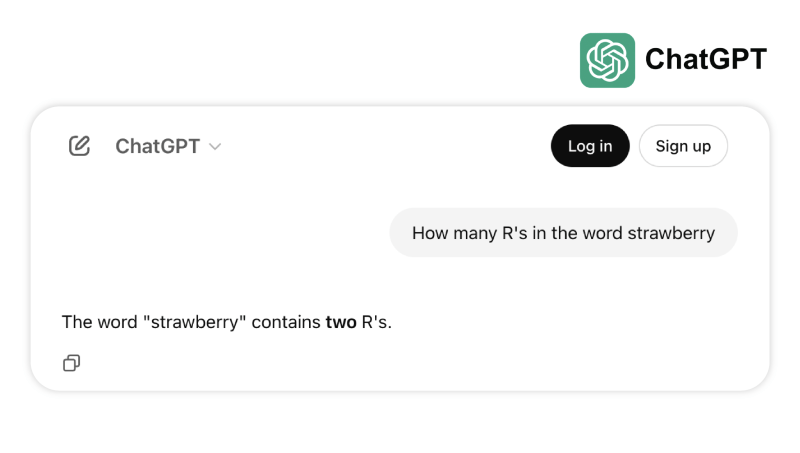
Join our daily and weekly newsletters for the latest updates and exclusive content on industry-leading AI coverage. Learn More Intelligence is pervasive, yet its measurement seems subjective. At best, we approximate its measure through tests and benchmarks. Think of college entrance exams: Every year, countless students sign up, memorize test-prep tricks and sometimes walk away with perfect scores. Does a single number, say a 100%, mean those who got it share the same intelligence — or that they’ve somehow maxed out their intelligence? Of course not. Benchmarks are approximations, not exact measurements of someone’s — or something’s — true capabilities. The generative AI community has long relied on benchmarks like MMLU (Massive Multitask Language Understanding) to evaluate model capabilities through multiple-choice questions across academic disciplines. This format enables straightforward comparisons, but fails to truly capture intelligent capabilities. Both Claude 3.5 Sonnet and GPT-4.5, for instance, achieve similar scores on this benchmark. On paper, this suggests equivalent capabilities. Yet people who work with these models know that there are substantial differences in their real-world performance. What does it mean to measure ‘intelligence’ in AI? On the heels of the new ARC-AGI benchmark release — a test designed to push models toward general reasoning and creative problem-solving — there’s renewed debate around what it means to measure “intelligence” in AI. While not everyone has tested the ARC-AGI benchmark yet, the industry welcomes this and other efforts to evolve testing frameworks. Every benchmark has its merit, and ARC-AGI is a promising step in that broader conversation.  Another notable recent development in AI evaluation is ‘Humanity’s Last Exam,’ a comprehensive benchmark containing 3,000 peer-reviewed, multi-step questions across various disciplines. While this test represents an ambitious attempt to challenge AI systems at expert-level reasoning, early results show rapid progress — with OpenAI reportedly achieving a 26.6% score within a month of its release. However, like other traditional benchmarks, it primarily evaluates knowledge and reasoning in isolation, without testing the practical, tool-using capabilities that are increasingly crucial for real-world AI applications. In one example, multiple state-of-the-art models fail to correctly count the number of “r”s in the word strawberry. In another, they incorrectly identify 3.8 as being smaller than 3.1111. These kinds of failures — on tasks that even a young child or basic calculator could solve — expose a mismatch between benchmark-driven progress and real-world robustness, reminding us that intelligence is not just about passing exams, but about reliably navigating everyday logic. The new standard for measuring AI capability As models have advanced, these traditional benchmarks have shown their limitations — GPT-4 with tools achieves only about 15% on more complex, real-world tasks in the GAIA benchmark, despite impressive scores on multiple-choice tests. This disconnect between benchmark performance and practical capability has become increasingly problematic as AI systems move from research environments into business applications. Traditional benchmarks test knowledge recall but miss crucial aspects of intelligence: The ability to gather information, execute code, analyze data and synthesize solutions across multiple domains. GAIA is the needed shift in AI evaluation methodology. Created through collaboration between Meta-FAIR, Meta-GenAI, HuggingFace and AutoGPT teams, the benchmark includes 466 carefully crafted questions across three difficulty levels. These questions test web browsing, multi-modal understanding, code execution, file handling and complex reasoning — capabilities essential for real-world AI applications. Level 1 questions require approximately 5 steps and one tool for humans to solve. Level 2 questions demand 5 to 10 steps and multiple tools, while Level 3 questions can require up to 50 discrete steps and any number of tools. This structure mirrors the actual complexity of business problems, where solutions rarely come from a single action or tool. By prioritizing flexibility over complexity, an AI model reached 75% accuracy on GAIA — outperforming industry giants Microsoft’s Magnetic-1 (38%) and Google’s Langfun Agent (49%). Their success stems from using a combination of specialized models for audio-visual understanding and reasoning, with Anthropic’s Sonnet 3.5 as the primary model. This evolution in AI evaluation reflects a broader shift in the industry: We’re moving from standalone SaaS applications to AI agents that can orchestrate multiple tools and workflows. As businesses increasingly rely on AI systems to handle complex, multi-step tasks, benchmarks like GAIA provide a more meaningful measure of capability than traditional multiple-choice tests. The future of AI evaluation lies not in isolated knowledge tests but in comprehensive assessments of problem-solving ability. GAIA sets a new standard for measuring AI capability — one that better reflects the challenges and opportunities of real-world AI deployment. Sri Ambati is the founder and CEO of H2O.ai. source

Beyond ARC-AGI: GAIA and the search for a real intelligence benchmark Read More »

Negative Views of China Have Softened Slightly Among Americans

Fewer now consider China an enemy or say it’s the country posing the greatest threat to the U.S. A shipping crate from China awaits inspection by U.S. Customs and Border Protection at a Los Angeles freight facility in 2022. (Patrick T. Fallon/AFP via Getty Images) How we did this Pew Research Center conducted this study to understand how Americans see China and its relationship with the U.S. The report gauges American views of China in terms of both economics and national security. This analysis builds on previous Center research on Americans’ opinions of China and on the most pressing foreign policy issues of the day going back decades, such as major world conflicts, trade and tariffs, U.S. military decisions and other related developments of the times. For this analysis, we surveyed 3,605 U.S. adults from March 24 to March 30, 2025. Everyone who took part in this survey is a member of the Center’s American Trends Panel (ATP), a group of people recruited through national, random sampling of residential addresses who have agreed to take surveys regularly. This kind of recruitment gives nearly all U.S. adults a chance of selection. Surveys were conducted either online or by telephone with a live interviewer. The survey is weighted to be representative of the U.S. adult population by gender, race, ethnicity, partisan affiliation, education and other categories. Read more about the ATP’s methodology. Here are the questions used for this analysis, along with responses, and its methodology. Americans hold largely negative views of China: Most have a very or somewhat unfavorable view of the country, and they tend to name China as the nation that poses the greatest threat to the United States. Still, attitudes toward China have warmed somewhat. For the first time in five years, the share of Americans with an unfavorable opinion of China has fallen from the year before – albeit slightly, from 81% in 2024 to 77% in 2025. And the share who have a very unfavorable opinion of China has dropped 10 percentage points since last year. The share of Americans who call China an enemy of the U.S., rather than a partner or a competitor, has also fallen. One-third now hold this view, down from 42% last year. Still, when asked which country poses the greatest threat to the U.S., Americans mention China more often than any other nation (42%). But the share who name China has fallen 8 points since 2023, when we last asked this question. These are among the findings of a Pew Research Center survey conducted March 24-30, 2025, among 3,605 U.S. adults. The survey took place amid escalating economic tensions between the U.S. and China, caused in part by rapidly shifting tariff policies: Views by party Negative attitudes toward China have softened among Republicans and Republican-leaning independents, though they continue to be more critical of the country than Democrats and Democratic leaners. The share of Republicans with an unfavorable view of China is down 8 points since 2024, including a 16-point drop in the share with a very unfavorable view. In comparison, unfavorable views among Democrats saw a 5-point decline. Republicans are 14 points less likely than they were in 2024 to label China an enemy of the U.S. Since we first began asking this question in 2021, Republicans have generally been more likely to call China an enemy than a competitor, but they are now equally likely to use each label. Among Democrats, the share who consider China an enemy has fallen 6 points since last year. For their part, Democrats have become less likely to name China as the country posing the greatest threat to the U.S. – 28% say this is the case, down from 40% in 2023. Republicans saw a more muted change in that time (-5 points). For Democrats, much of this change relates to an increasing share naming Russia as the top threat to the U.S. For more on U.S. views of Russia, read “Republican Opinion Shifts on Russia-Ukraine War.” There have also been pronounced changes from previous years in partisan assessments of China’s international influence: In 2024, Republicans were 10 points more likely than Democrats to say China’s global influence was growing. Now, adults in both parties are equally likely to hold this view. While Republicans used to be more inclined than Democrats to label China the world’s top economic and military power, Democrats are now more likely to hold these views. Views on trade and tariffs Americans do not think the trade relationship between the U.S. and China is balanced. Nearly half (46%) say China benefits more from U.S.-China trade, though a quarter say both countries benefit equally; 10% think the U.S. benefits more. A majority of Republicans say China benefits more from the U.S.-China trade relationship. Democrats are divided between the view that both countries benefit equally and the view that China benefits more. We asked the same questions about U.S. trade with Canada and Mexico. Americans consider the U.S.-China trade relationship more unbalanced than the others: 26% of Americans say Canada benefits more than the U.S. from their trade relationship, and 29% say this in Mexico’s case. Americans are largely skeptical about the effects of increased tariffs on China. About half say these tariffs will be bad for the U.S., and a similar share say the tariffs will be bad for them personally. Among Democrats, 80% think the tariffs will harm the country, and 75% believe these measures will harm them personally. Republicans are more optimistic. While only 17% say increased tariffs on China will be good for them personally, they are more inclined to say the tariffs will be good than bad for the country (44% vs. 24%). Related: Americans Give Early Trump Foreign Policy Actions Mixed or Negative Reviews source

Negative Views of China Have Softened Slightly Among Americans Read More »