European tech warns Trump tariffs will hit both hardware and software

Europe’s tech industry is bracing for impact after the Trump administration announced sweeping tariffs yesterday. The US slapped a 20% tariff on imports from the EU — twice the rate for the UK. Switzerland fared even worse, receiving a hefty 32% levy.  Several European tech firms, investors, and analysts told TNW that the measures could disrupt supply chains, force pricing adjustments, and stem the flow of transatlantic VC capital — plunging European tech companies big and small into uncertainty. “Trump’s trade tariffs will have a huge impact on the global tech landscape, forcing startups to reconsider their headquarters and assess alternative markets,” said Louis Fearn, principal and sustainability lead at InMotion Ventures, the investment arm of Jaguar Land Rover.   Hugging Face, ASML, OpenAI, Monzo & Datasnipper Check out the NEW speakers for TNW Conference 2025 on June 19 & 20. For companies with hardware-dependent models, the tariffs represent a major cost challenge. Miika Mäkitalo, CEO of Finnish firm HappyOrNot, which makes customer feedback terminals, noted that nearly half of the company’s business is across the pond. He said the tariffs might force the firm to consider “initiating assembly and production in the United States.” Although the tariffs only apply to physical goods, service-based startups will also feel the impact.  Benjamin Avraham, founder and CEO of Swiss fintech Okoora, said there are many “secondary effects” that will harm the “smaller startup community” indirectly. These include changes in supply chains, barriers to VC investments, and increased volatility in exchange rates.   Software could also suffer from additional constraints. Amanda Brock, CEO at open-source lobby group OpenUK, said that while software has long been characterised as an intangible service, it “may be subject to other trade restrictions.”  The fallout has already begun. Trump’s tariffs have sent markets into disarray and risk compounding existing tensions in global trade. Stocks have plunged around the world and countries have promised retaliatory measures. “The newly announced blanket tariffs by President Trump create more uncertainty in the global tech industry,” said Martin Hartley, Group CCO of international tech consultancy Emagine. “These measures could make businesses in the EU avoid the US altogether to sidestep additional costs.” For European startups, the tariffs may force a stark strategic choice. “Trump is playing with fire,” warned Matt Penneycard, partner at UK-based Ada Ventures. “Startups selling to US customers now face two options: anchor in Europe and embrace its stability, or find ways to maintain access to the States by setting up operations there.”  He added that this moment could be an opportunity for Europe. “As the US becomes a tougher place to operate, top talent may follow stability — this is Europe’s moment to build a new Silicon Valley.” European startups are the heartbeat of TNW Conference, which takes place on June 19-20 in Amsterdam. Tickets for the event are now on sale. Use the code TNWXMEDIA2025 at the check-out to get 30% off the price tag. source

European tech warns Trump tariffs will hit both hardware and software Read More »

Top 15 Microsoft Azure certifications to expedite your IT career

Azure Network Engineer Associate This certification validates your prowess to deploy networking solutions by using the Azure portal and other methods such as PowerShell, Azure Command-Line Interface, and Azure Resources Manager templates. It also demonstrates your aptitude to work with solution architects, security engineers, cloud administrators, and DevOps engineers to deliver Azure solutions. The exam measures thorough expertise in planning, implementing, and maintaining Azure networking solutions comprising connectivity, routing, hybrid networking, security, and private access to Azure services. Job role: Network engineer Required exam: Designing and Implementing Microsoft Azure Networking Solutions Azure Security Engineer Associate This certification focuses on your expertise in implementing Azure Security Controls that secure identity, access, data, applications, and networks in cloud and hybrid environments. It proves your ability to execute responsibilities such as managing the security posture of the organization, responding to security incident escalation, conducting threat modeling, identifying and neutralizing detected flaws, and implementing threat protection. To earn this certification, you need moderate to robust knowledge of most Azure offerings and an understanding of basic IT security principals. This exam tests your knowledge in four different subject areas: managing identity and access; implementing platform protection; managing security operations; and securing data and application. Job role: Security engineer Required exam: Microsoft Azure Security Technologies Azure Solutions Architect Expert The certification validates your subject matter expertise in designing cloud and hybrid solutions on Azure, including network, compute, monitoring, storage, and security. It requires advanced experience and deep knowledge of IT operations comprising networking, governance, disaster recovery, data platforms, virtualization, business continuity, identity, and security. To earn it, you must have Azure Administrator Associate certification (see above), which tests your skills to implement, monitor, and manage an organization’s Microsoft Azure environment. Job role: Solution architect Required exam: Designing Microsoft Azure Infrastructure Solutions source

Top 15 Microsoft Azure certifications to expedite your IT career Read More »

North Korean Hackers Disguised as IT Workers Targeting UK, European Companies

Image: DC_Studio/Envato North Korean hackers who disguise themselves as IT workers are applying for work in the U.K., according to Google Threat Intelligence Group. Success in the U.S. is declining due to rising awareness of their tactics, indictments, and right-to-work verification challenges, prompting them to turn elsewhere. The attackers pose as legitimate remote workers, looking to generate revenue, access sensitive company data, or perform espionage operations through employment. Researchers observed them seeking out login credentials for job sites and human capital management platforms. “Europe needs to wake up fast,” Jamie Collier, Lead Threat Intelligence Advisor, Europe, Google Threat Intelligence Group, told TechRepublic in an email. “Despite being in the crosshairs of IT worker operations, too many perceive this as a U.S. problem. North Korea’s recent shifts likely stem from U.S. operational hurdles, showing IT workers’ agility and ability to adapt to changing circumstances.” SEE: UK Cyber Risks Are ‘Widely Underestimated,’ Warns Country’s Security Chief Hackers are targeting larger organisations and new territories Activity has increased since late October, according to Google, with attackers from the Democratic People’s Republic of Korea targeting larger organisations and new territories. It’s not just the U.K., either, as researchers have discovered evidence of a rise in activity in Germany, Portugal, Serbia, and elsewhere in Europe. Google’s researchers uncovered a fake CV listing degrees from Belgrade University in Serbia and fabricated residential addresses in Slovakia. Additionally, they found detailed instructions on how to navigate European job sites and secure employment in Serbia, including using the Serbian time zone for communication, as well as a broker facilitating the creation of fake passports. More aggressive tactics stem from desperation The North Korean IT workers are also using more aggressive tactics, such as moving operations within corporate virtualised infrastructure and threatening to release proprietary corporate data after being fired unless a ransom is paid. The researchers link this to desperation to maintain their revenue stream while law enforcement cracks down on their operations in the US. While workers once avoided burning bridges with employers after termination in the hope of being rehired, they now likely believe their dismissal stems from being caught, prompting them to threaten employers instead. “A decade of diverse cyberattacks precedes North Korea’s latest surge — from SWIFT targeting and ransomware, to cryptocurrency theft and supply chain compromise,” Collier told TechRepublic. “This relentless innovation demonstrates a longstanding commitment to fund the regime through cyber operations.” How the North Korean IT worker operations work Targeted industries include defence and government sectors, with the fake workers “providing fabricated references, building a rapport with job recruiters, and using additional personas they controlled to vouch for their credibility.” They are recruited through online platforms including Upwork, Telegram, and Freelancer. North Korean workers pretend to be from a diverse set of countries, including Italy, Japan, Malaysia, Singapore, Ukraine, the U.S., and Vietnam, using a combination of stolen personal details from real individuals and fabricated information. They have even been known to use AI to generate profile photos, create deepfakes for video interviews, and translate communications into target languages using AI writing tools. In exchange for employment, the North Korean infiltrators offer services in the development of web solutions, such as job marketplaces, bots, content management systems, blockchain, and AI apps, indicating a broad range of expertise. Payment is made in cryptocurrency and through cross-border transfer platforms like Payoneer and TransferWise, helping to obscure its origin and destination. The IT workers use certain “facilitators” to aid them in their pursuits. These are individuals or entities based in the target territories that help them find jobs, bypass verification checks, and receive funds fraudulently. The Google team has found evidence of facilitators in both the U.S. and U.K., locating a corporate laptop from New York that was operational in London. Must-read security coverage Bring Your Own Device environments are making life easier for the workers Many businesses with distributed workforces implement Bring Your Own Device policies, where employees can use their personal devices for work. The Google team believes that, since January, the North Korean IT workers have been identifying these companies as prime targets to gain employment. SEE: BYOD and Personal Apps: A Recipe for Data Breaches A company-owned device will likely be rife with security features, such as activity monitoring, and can be traced back to its user by the address the company shipped it to and its endpoint software inventories. Therefore, the attacker will be more likely to evade detection by using their own laptop to access internal systems through their employer’s virtual machines. source

North Korean Hackers Disguised as IT Workers Targeting UK, European Companies Read More »

What does an AI consultant actually do?

Since AI technologies are developing rapidly, continuous training is important. Online courses, boot camps and certificates (such as AWS Machine Learning Specialty or Microsoft Certified: Azure AI Engineer Associate) as well as workshops and conferences. However, the most important thing for gaining experience is to work on AI projects in a real-world setting. Above all, a good AI consultant is willing to learn. Technologies, frameworks and standards change quickly – if you want to be in the game for the long haul, you have to stay on top of things. An AI consultant’s most important skills The most important skills of AI consultants are, accordingly, programming, data analysis and mathematics/statistics. Mastering programming languages such as Python is a great advantage, as is a sound knowledge of data (databases) and general software development. Above all, however, it is important to understand how to handle data and algorithms. Equally important as the “hard skills,” however, are the “soft skills.” These include: source

What does an AI consultant actually do? Read More »

5. Religious switching into and out of Hinduism

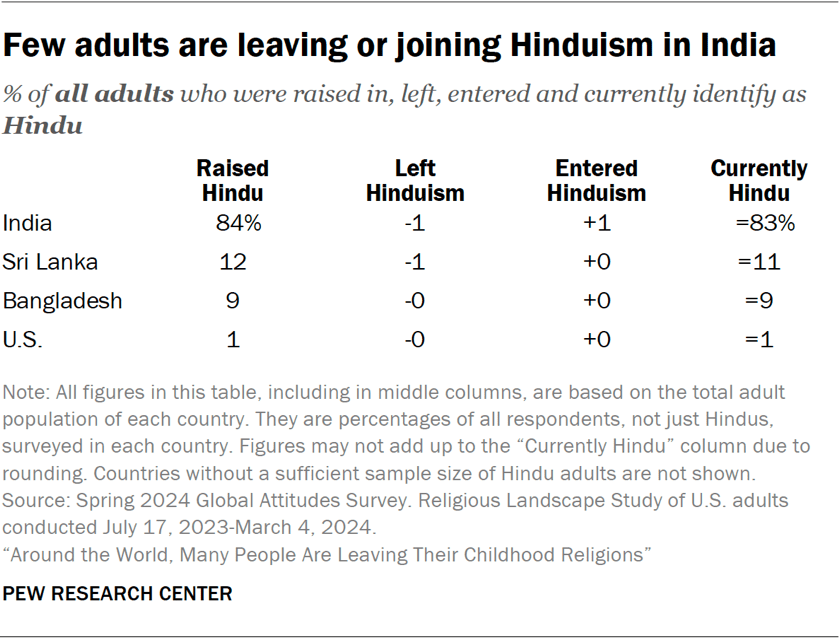
Terminology Throughout this report, religious switching refers to a change between the religious group in which a person says they were raised (during their childhood) and their religious identity now (in adulthood). The rates of religious switching are based on responses to two survey questions we asked of adults ages 18 and older: “What is your current religion, if any?” “Thinking about when you were a child, in what religion were you raised, if any?” The responses to these two questions allow us to calculate what percentage of the public has left a religious group (or “switched out”) and what percentage has entered (or “switched in”). This kind of switching can take place without any formal rite or ceremony. We have analyzed switching into and out of five widely recognized, worldwide religions to allow for consistent comparisons around the globe. Specifically, this report analyzes change between the following groups: Christianity, Islam, Judaism, Buddhism, Hinduism, other religions, religiously unaffiliated adults, and those who did not answer the question. For example, someone who was raised Buddhist but now identifies as Christian would be considered as having switched religions – as would someone who was raised Christian but is now unaffiliated. However, switching within a religious tradition, such as between Catholicism and Protestantism, is not captured in this report. (Refer to Pew Research Center’s 2023-24 Religious Landscape Study for an analysis of switching in the United States that does count some switching within Christianity. Read “4 facts about religious switching within Judaism in Israel” for an analysis of switching within Judaism.) Religiously unaffiliated refers to people who answer a question about their current religion (or their upbringing) by saying they are (or were raised as) atheist, agnostic or “nothing in particular.” This category is sometimes called “no religion” or “nones.” Other religions is an umbrella category. It contains a wide variety of religions that are not in the other categories and that have survey sample sizes too small to analyze separately in most countries. This includes Sikhism, Jainism, the Baha’i faith, African traditional religions, Native American religious traditions, and others. Disaffiliation rates refer to the percentage of adults who say they were raised in a religion but are now religiously unaffiliated (or have no religion). Net gains/losses are the differences between the percentage of survey respondents who say they were raised in a particular religious category (as children) and the percentage who identify with that same category at the time of the survey (as adults). The “net” gain or loss takes into account both sides of the equation – those who have left and those who have entered the group. Retention rates show, among all the people who say they were raised in a particular religious group, the percentage who still describe themselves as belonging to that group today. Accession rates (also called entrance rates) show, among all the people who describe themselves as belonging to a particular religious group today, the percentage who were raised in some other group. This section explores religious switching into and out of Hinduism, reviewing where Hinduism has had the largest net gains and losses, what percentage of adults who were raised Hindu are still Hindu (i.e., retention rates), which religious groups those who have left Hinduism have switched into, and where Hinduism has the largest shares of new entrants (i.e., the highest accession rates). Of the 36 countries surveyed, just four have sufficient sample sizes to allow analysis of religious switching into and out of Hinduism: Bangladesh, India, Sri Lanka and the United States. Net gains and losses for Hinduism Very small shares of the overall population in any of the countries analyzed have left or joined Hinduism. In the U.S., Hindus are a small share of the population to begin with (1%). Remaining Hindu The Hindu retention rate is high in all the places analyzed, but there is some variation. Nearly all people who were raised Hindu in India and Bangladesh still identify as Hindu today. In Sri Lanka, roughly nine-in-ten people who were brought up as Hindus have retained that identity, as have about eight-in-ten in the U.S. Leaving Hinduism Of the countries surveyed, the highest shares of people raised Hindu who no longer identify as Hindu are in the U.S. (18%) and Sri Lanka (11%). In Sri Lanka, most who have left Hinduism now identify as Christians. In the U.S., 11% of people who were raised Hindu are now religiously unaffiliated (i.e., they identify religiously as atheist, agnostic or “nothing in particular”) and 6% are Christians. Entering Hinduism Most people who currently identify as Hindu say they were raised as Hindus, resulting in low “accession” (or entrance) rates into Hinduism across the four countries analyzed. The U.S. has the highest accession rate, with 8% of Hindu American adults saying they were raised outside of Hinduism. Where has Hinduism experienced the largest net gains or losses from religious switching? Across the four countries analyzed, relatively few people (at least, as a percentage of the overall public in each country) have either left or entered Hinduism. For instance, in India, the country with the world’s largest Hindu population, roughly equal shares of Indians say they were raised Hindu (84%) and currently identify as Hindu (83%). Only 1% of all Indian adults have left Hinduism, and a similarly small share have become Hindus after having been raised in another religion or with no affiliation. In the U.S., just 1% of adults were raised Hindu, and the percentage of all U.S. adults who have left Hinduism rounds to zero – as does the percentage who have switched into Hinduism. What percentage of people raised Hindu are still Hindu? The Hindu retention rate is high in all the countries where it can be measured. For example, in Bangladesh and India, nearly all adults who were raised Hindu still identify as Hindu today (99% each). Which religious groups have former Hindus switched to? Analyzing retention rates also reveals the religious groups that former Hindus have joined. In the

5. Religious switching into and out of Hinduism Read More »

Looking for New Career Opportunities? Study for the PMP® Certification with This Preparation Pack

TL;DR: For $19.99, you can get this lifetime resource to study up on project management tactics and prepare for the Project Management Professional (PMP®) certification. Are you looking for a more challenging or lucrative career opportunity? Whether you feel stagnant at your current job or are aspiring to work as a project manager, your credibility and job potential could benefit from earning the proper certifications. For anyone whose next goal is to land a position as a project manager, you’ll definitely need experience. If you don’t necessarily have enough, consider studying for the Project Management Professional (PMP®) certification. You could find resources online (which cost an arm and a leg), or you could prepare and stay up-to-date on project management tactics by training with this $19.99 (reg. $408) course pack. The PMBOK® 7 framework was recently released, meaning now may be your best opportunity to impress hiring managers with your certification and skills. In this bundle, you’ll gain access to over 20 hours of training across 52 lectures. This bundle’s courses are divided into five parts designed to maximize your learning experience and build upon each section. All courses are taught in a video format for more flexible and interactive learning, and since this bundle is yours for life, you can learn at your own pace. Check out some of the project management strategies you’ll dive into: Learn what the PMP® certification and PMBOK® 7 framework is all about to start your journey. You’ll get the latest insights to keep up with industry standards. Practical knowledge: You’ll study project performance domains, models, methods, and artifacts, all of which can be applied to real-world scenarios. You’ll also gain expertise in necessary project management skills. Effective exam strategies: These can help you gain familiarity ahead of the exam, and having these proven techniques at hand could help you pass the PMP® certification exam. Gain the necessary skills to take and pass the PMP® certification exam with this project management training bundle, now just $19.99. StackSocial prices subject to change. source

Looking for New Career Opportunities? Study for the PMP® Certification with This Preparation Pack Read More »

Tracking Changes To AI Evidence Under Federal Rules

By Avi Gesser, Jim Pastore and Matt Kelly ( April 1, 2025, 5:51 PM EDT) — As the first quarter of 2025 draws to a close, and we look ahead to the spring, important changes to the Federal Rules of Evidence regarding the use of artificial intelligence in the courtroom are on the horizon…. Law360 is on it, so you are, too. A Law360 subscription puts you at the center of fast-moving legal issues, trends and developments so you can act with speed and confidence. Over 200 articles are published daily across more than 60 topics, industries, practice areas and jurisdictions. A Law360 subscription includes features such as Daily newsletters Expert analysis Mobile app Advanced search Judge information Real-time alerts 450K+ searchable archived articles And more! Experience Law360 today with a free 7-day trial. source

Tracking Changes To AI Evidence Under Federal Rules Read More »

3. Public and expert predictions for AI’s next 20 years

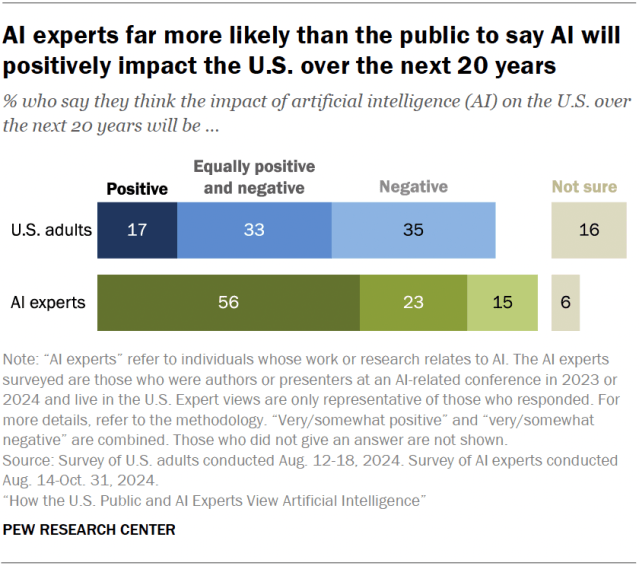
The rapid rise of artificial intelligence promises to transform many aspects of life, from education and work to personal connections. Over the next 20 years, AI advancements will continue. But whether this leads to excitement or concern or brings more benefits than harm is highly debated. This chapter examines how the American public and experts anticipate AI’s impact across key areas in the coming decades. How will AI impact the U.S. over the next 20 years? There are many predictions for what AI may bring. However, the public and experts don’t see eye to eye on the type of impact AI will have on the country. Fully 56% of AI experts surveyed say AI will have a very or somewhat positive impact on the United States over the next 20 years. This compares with 17% among the general public. Conversely, 35% of U.S. adults believe AI will negatively affect the country over the next two decades, compared with 15% of experts. The public is also more likely than experts to say that AI’s impact on the U.S. will be equally positive and negative (33% vs. 23%) or that they’re unsure (16% vs. 6%). By gender, among AI experts surveyed and U.S. adults There are substantial gender differences among experts on AI’s potential impact on the country. Among AI experts surveyed, men are far more likely than women to say AI’s impact would be positive (63% vs. 36%). Female experts are more likely than their male counterparts to predict negative outcomes (23% vs. 12%) or to foresee an equal mix of both (36% vs. 19%). Gender gaps are also present among U.S. adults, but they are far more modest than the differences seen among experts.  Among all adults, 22% of men say AI will have a positive impact on the U.S., compared with 12% of women. (Refer to Appendix B for more details on how views vary by demographic groups.) By job sector, among AI experts surveyed We also explored experts’ views by job sector. About six-in-ten experts surveyed who work for a private company or business (63%) believe AI’s impact on the U.S. will be positive. Among those who work at a college or university, that share is 55%. AI’s impact on elections, education, jobs and health care Our survey examined public and expert opinions on AI’s impact across 10 specific sectors, revealing areas of disagreement and alignment. The starkest differences between experts and the public are about AI’s influence on work and the economy. AI experts surveyed are far more likely than the general public to believe that over the next 20 years, AI will have a very or somewhat positive impact on how people do their jobs (73% vs. 23%) or the economy (69% vs. 21%). Views also vary widely on AI’s impact on health care, education and the arts. Even as medical care is the one area in which the public is most optimistic about AI’s impact, experts are 40 percentage points more likely than the general population to believe it will positively affect medical care (84% vs. 44%). AI experts are also more likely than the public to think this technology will benefit K-12 education (61% vs. 24%) or arts and entertainment (48% vs. 20%). Still, some areas show more common ground, notably elections and news. AI experts and the public are both wary of AI’s role in politics and journalism. Just 11% of experts surveyed and 9% of the public believe AI will positively impact elections in the U.S. over the next 20 years. In fact, 61% of these experts believe AI will harm elections in the future, with 50% of the public saying the same. News is also an area where small shares of experts (18%) and the public (10%) believe it will be a good thing for the country. About half or more of experts (56%) and the public (51%) predict it will negatively affect the news people get. It’s also worth noting that the general public is generally more unsure of their predictions. For example, about a quarter of U.S. adults say they are not sure of the type of impact AI will have on the criminal justice system (28%), personal relationships (24%) or elections (23%). By gender, among AI experts surveyed There are sizable gender differences among experts in their views about AI’s impact on certain aspects of society. For example, 68% of male experts surveyed say AI’s impact on K-12 education over the next 20 years will be very or somewhat positive, compared with 42% of female experts. Among AI experts, men are also more likely than women to say AI will lead to positive outcomes for the environment (43% vs. 18%), medical care (89% vs. 72%) and the economy (74% vs. 57%), for example. By gender, among U.S. adults While the public is less confident than experts about AI’s potential positive impact on the country, there are also gender differences among U.S. adults overall. Men are consistently more optimistic than women regarding AI’s potential over the next two decades, particularly in medical care (54% vs. 34%). Larger shares of men than women say AI will benefit other areas, like how people do their jobs and the environment. There is agreement on AI’s impact on elections, with only about one-in-ten men and women saying it will have a positive effect. Will AI lead to fewer jobs? We’ve seen anxiety in our prior work around AI and jobs both among the public and workers. Our current survey finds this sentiment is more widely held among the general public than among AI experts. Overall, 64% of U.S. adults say that over the next 20 years, AI will lead to fewer jobs in the U.S., while just 5% think it will lead to more jobs. And more than one-in-ten say it either won’t make a difference (14%) or that they’re unsure (16%).  AI experts’ opinions are more mixed. Roughly four-in-ten (39%) foresee fewer jobs due to AI over the next two decades.

3. Public and expert predictions for AI’s next 20 years Read More »

Were the White House’s Tariffs Calculations Done By AI?

Image: kckate16/Envato Elements Questions have swirled as to whether the U.S. government relied on generative AI to establish the tariffs that are expected to take effect April 5. When asked to calculate global tariffs, AI models including OpenAI’s ChatGPT, Google’s Gemini, xAI’s Grok, and Anthropic’s Claude all produced the same formula reportedly used by President Donald Trump in his newly unveiled trade reforms. Critics argue that tasking a generative AI with formulating a policy decision of global significance sets an alarming precedent — one that underscores both the superficiality of its calculations and the magnitude of its consequences. Increased U.S. tariffs could significantly raise the cost of consumer and business electronics. AI returns similar output to the Office of the U.S. Trade Representative’s calculations Early on April 3, economist James Surowiecki posted his investigation into the tariffs. The White House set out to impose “reciprocal tariffs.” However, Surowiecki noted, the document from the Office of the United States Trade Representative showing the equation used to determine those tariffs divides the U.S. trade deficit by each country’s exports to the U.S. This, Suroweicki said, is not reciprocal. Economist Wojtek Kopczuk asked ChatGPT to calculate tariffs to balance out the U.S. trade deficit. He received a similar answer to the White House’s documentation, showing the AI used “a basic approach” that divided the trade deficit by the total trade. Entrepreneur Amy Hoy ran a similar experiment, yielding identical results from AI models. The White House has not made a statement regarding potential AI use in the creation of the equation used to calculate the tariffs. So, we don’t know whether the equation was generated by AI or what prompt may have been used to create it; however, the uniform and straightforward response to a complex economic issue does bear the hallmarks of generative AI. Elon Musk, CEO of Grok maker xAI, is currently serving as a special government employee to the Trump administration. More must-read AI coverage Trump team suggests tariffs will encourage U.S. business The Trump administration has stated high tariffs could encourage U.S. manufacturing and create revenue for the government. The goal of the reciprocal tariffs is to “to ensure fair trade, protect American workers, and reduce the trade deficit,” according to the White House statement. Trump and his team, meanwhile, may see the high tariff percentages as a negotiating tactic, as Donald Trump’s son Eric Trump wrote on X on April 3. “The first to negotiate will win — the last will absolutely lose. I have seen this movie my entire life…,” Eric Trump wrote. Some countries are exempt from tariff adjustment Countries with steep Trump-era taxes on goods coming into the U.S. — notably Canada and Mexico — are exempt from the new wave of tariffs. Russia remains exempt due to existing sanctions, as do countries like North Korea and Cuba. source

Were the White House’s Tariffs Calculations Done By AI? Read More »

AI PCs: A paradigm shift in the modern workplace

The modern workplace is undergoing the most transformative era since the dawn of the internet, with AI PCs emerging as a driving force in redefining productivity, security, and enterprise IT management. Unlike previous hardware refresh cycles, AI PCs represent a foundational shift in how businesses operate—leveraging AI to create smarter, more efficient, and agile organization. According to a recent IDC survey, AI PC adoption is surging, with 82% of ITDMs surveyed expected to acquire AI PCs before the end of 2025. This rapid adoption underscores a growing recognition: AI PCs are not just an upgrade—they are a necessity for businesses looking to stay competitive in an AI-driven world. Today, ITDMs have an enormous opportunity in front of them. As they evaluate their strategic roadmaps, ITDMs must consider how AI PCs fit into their strategies to ensure their organizations are prepared for the next wave of workplace evolution. A balancing act: Cloud and local AI adoption AI PCs are reshaping how businesses approach AI workloads, offering a compelling alternative to cloud-based computing. The cloud remains the go-to for many AI applications due to its unmatched scale and processing power. However, with dedicated NPUs and high-performance CPUs and GPUs, AI PCs are proving to be a competitive force in enterprise computing, delivering strong AI performance for business tasks while maintaining energy efficiency. By executing AI workloads locally, AI PCs help organizations reduce latency, optimize performance, and enhance privacy, making them a viable complement—or even an alternative—to cloud-based applications. This shift enables businesses to empower employees with real-time AI-driven assistance, including automated content generation, advanced data analysis, and workflow optimization, without relying solely on cloud computing. By striking a balance between cloud and local AI, businesses can ensure optimal performance while maintaining control over sensitive data, fostering a more secure, efficient, and productive work environment. source

AI PCs: A paradigm shift in the modern workplace Read More »