Anthropomorphizing AI: Dire consequences of mistaking human-like for human have already emerged

Join our daily and weekly newsletters for the latest updates and exclusive content on industry-leading AI coverage. Learn More In our rush to understand and relate to AI, we have fallen into a seductive trap: Attributing human characteristics to these robust but fundamentally non-human systems. This anthropomorphizing of AI is not just a harmless quirk of human nature — it is becoming an increasingly dangerous tendency that might cloud our judgment in critical ways. Business leaders are comparing AI learning to human education to justify training practices to lawmakers crafting policies based on flawed human-AI analogies. This tendency to humanize AI might inappropriately shape crucial decisions across industries and regulatory frameworks. Viewing AI through a human lens in business has led companies to overestimate AI capabilities or underestimate the need for human oversight, sometimes with costly consequences. The stakes are particularly high in copyright law, where anthropomorphic thinking has led to problematic comparisons between human learning and AI training. The language trap Listen to how we talk about AI: We say it “learns,” “thinks,” “understands” and even “creates.” These human terms feel natural, but they are misleading. When we say an AI model “learns,” it is not gaining understanding like a human student. Instead, it performs complex statistical analyses on vast amounts of data, adjusting weights and parameters in its neural networks based on mathematical principles. There is no comprehension, eureka moment, spark of creativity or actual understanding — just increasingly sophisticated pattern matching. This linguistic sleight of hand is more than merely semantic. As noted in the paper, Generative AI’s Illusory Case for Fair Use: “The use of anthropomorphic language to describe the development and functioning of AI models is distorting because it suggests that once trained, the model operates independently of the content of the works on which it has trained.” This confusion has real consequences, mainly when it influences legal and policy decisions. The cognitive disconnect Perhaps the most dangerous aspect of anthropomorphizing AI is how it masks the fundamental differences between human and machine intelligence. While some AI systems excel at specific types of reasoning and analytical tasks, the large language models (LLMs) that dominate today’s AI discourse — and that we focus on here — operate through sophisticated pattern recognition. These systems process vast amounts of data, identifying and learning statistical relationships between words, phrases, images and other inputs to predict what should come next in a sequence. When we say they “learn,” we’re describing a process of mathematical optimization that helps them make increasingly accurate predictions based on their training data. Consider this striking example from research by Berglund and his colleagues: A model trained on materials stating “A is equal to B” often cannot reason, as a human would, to conclude that “B is equal to A.” If an AI learns that Valentina Tereshkova was the first woman in space, it might correctly answer “Who was Valentina Tereshkova?” but struggle with “Who was the first woman in space?” This limitation reveals the fundamental difference between pattern recognition and true reasoning — between predicting likely sequences of words and understanding their meaning. The copyright conundrum This anthropomorphic bias has particularly troubling implications in the ongoing debate about AI and copyright. Microsoft CEO Satya Nadella recently compared AI training to human learning, suggesting that AI should be able to do the same if humans can learn from books without copyright implications. This comparison perfectly illustrates the danger of anthropomorphic thinking in discussions about ethical and responsible AI. Some argue that this analogy needs to be revised to understand human learning and AI training. When humans read books, we do not make copies of them — we understand and internalize concepts. AI systems, on the other hand, must make actual copies of works — often obtained without permission or payment — encode them into their architecture and maintain these encoded versions to function. The works don’t disappear after “learning,” as AI companies often claim; they remain embedded in the system’s neural networks. The business blind spot Anthropomorphizing AI creates dangerous blind spots in business decision-making beyond simple operational inefficiencies. When executives and decision-makers think of AI as “creative” or “intelligent” in human terms, it can lead to a cascade of risky assumptions and potential legal liabilities. Overestimating AI capabilities One critical area where anthropomorphizing creates risk is content generation and copyright compliance. When businesses view AI as capable of “learning” like humans, they might incorrectly assume that AI-generated content is automatically free from copyright concerns. This misunderstanding can lead companies to: Deploy AI systems that inadvertently reproduce copyrighted material, exposing the business to infringement claims Fail to implement proper content filtering and oversight mechanisms Assume incorrectly that AI can reliably distinguish between public domain and copyrighted material Underestimate the need for human review in content generation processes The cross-border compliance blind spot The anthropomorphic bias in AI creates dangers when we consider cross-border compliance. As explained by Daniel Gervais, Haralambos Marmanis, Noam Shemtov, and Catherine Zaller Rowland in “The Heart of the Matter: Copyright, AI Training, and LLMs,” copyright law operates on strict territorial principles, with each jurisdiction maintaining its own rules about what constitutes infringement and what exceptions apply. This territorial nature of copyright law creates a complex web of potential liability. Companies might mistakenly assume their AI systems can freely “learn” from copyrighted materials across jurisdictions, failing to recognize that training activities that are legal in one country may constitute infringement in another. The EU has recognized this risk in its AI Act, particularly through Recital 106, which requires any general-purpose AI model offered in the EU to comply with EU copyright law regarding training data, regardless of where that training occurred. This matters because anthropomorphizing AI’s capabilities can lead companies to underestimate or misunderstand their legal obligations across borders. The comfortable fiction of AI “learning” like humans obscures the reality that AI training involves complex copying and storage operations that trigger different legal obligations in other jurisdictions. This fundamental misunderstanding of AI’s

Anthropomorphizing AI: Dire consequences of mistaking human-like for human have already emerged Read More »

Google’s Gemini AI just shattered the rules of visual processing — here’s what that means for you

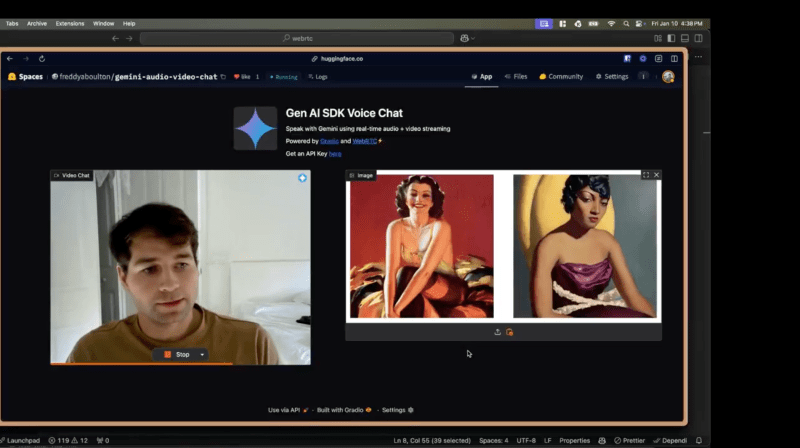
Join our daily and weekly newsletters for the latest updates and exclusive content on industry-leading AI coverage. Learn More Google’s Gemini AI has quietly upended the AI landscape, achieving a milestone few thought possible: The simultaneous processing of multiple visual streams in real time. This breakthrough — which allows Gemini to not only watch live video feeds but also to analyze static images simultaneously — wasn’t unveiled through Google’s flagship platforms. Instead, it emerged from an experimental application called “AnyChat.” This unanticipated leap underscores the untapped potential of Gemini’s architecture, pushing the boundaries of AI’s ability to handle complex, multi-modal interactions. For years, AI platforms have been restricted to managing either live video streams or static photos, but never both at once. With AnyChat, that barrier has been decisively broken. “Even Gemini’s paid service can’t do this yet,” Ahsen Khaliq, machine learning (ML) lead at Gradio and the creator of AnyChat, said in an exclusive interview with VentureBeat. “You can now have a real conversation with AI while it processes both your live video feed and any images you want to share.” A Gradio team member demonstrates Gemini AI’s new capability to process real-time video alongside static images during a voice chat session, showcasing the potential for multi-stream visual processing in artificial intelligence. (credit: x.com / @freddy_alfonso_) How Google’s Gemini is quietly redefining AI vision The technical achievement behind Gemini’s multi-stream capability lies in its advanced neural architecture — an infrastructure that AnyChat skillfully exploits to process multiple visual inputs without sacrificing performance. This capability already exists in Gemini’s API, but it has not been made available in Google’s official applications for end users. In contrast, the computational demands of many AI platforms, including ChatGPT, limit them to single-stream processing. For example, ChatGPT currently disables live video streaming when an image is uploaded. Even handling one video feed can strain resources, let alone when combining it with static image analysis. The potential applications of this breakthrough are as transformative as they are immediate. Students can now point their camera at a calculus problem while showing Gemini a textbook for step-by-step guidance. Artists can share works-in-progress alongside reference images, receiving nuanced, real-time feedback on composition and technique. The interface of Gemini Chat, an experimental platform leveraging Google’s Gemini AI for real-time audio, video streaming and simultaneous image processing, showcasing its potential for advanced AI applications. (Credit: Hugging Face / Gradio) The technology behind Gemini’s multi-stream AI breakthrough What makes AnyChat’s achievement remarkable is not just the technology itself but the way it circumvents the limitations of Gemini’s official deployment. This breakthrough was made possible through specialized allowances from Google’s Gemini API, enabling AnyChat to access functionality that remains absent in Google’s own platforms. Using these expanded permissions, AnyChat optimizes Gemini’s attention mechanisms to track and analyze multiple visual inputs simultaneously — all while maintaining conversational coherence. Developers can easily replicate this capability using a few lines of code, as demonstrated by AnyChat’s use of Gradio, an open-source platform for building ML interfaces. For example, developers can launch their own Gemini-powered video chat platform with image upload support using the following code snippet: A simple Gradio code snippet allows developers to create a Gemini-powered interface that supports simultaneous video streaming and image uploads, showcasing the accessibility of advanced AI tools.(Credit: Hugging Face / Gradio) This simplicity highlights how AnyChat isn’t just a demonstration of Gemini’s potential, but a toolkit for developers looking to build custom vision-enabled AI applications. “The real-time video feature in Google AI Studio can’t handle uploaded images during streaming,” Khaliq told VentureBeat. “No other platform has implemented this kind of simultaneous processing right now.” The experimental app that unlocked Gemini’s hidden capabilities AnyChat’s success wasn’t a simple accident. The platform’s developers worked closely with Gemini’s technical architecture to expand its limits. By doing so, they revealed a side of Gemini that even Google’s official tools haven’t yet explored. This experimental approach allowed AnyChat to handle simultaneous streams of live video and static images, essentially breaking the “single-stream barrier.” The result is a platform that feels more dynamic, intuitive and capable of handling real-world use cases much more effectively than its competitors. Why simultaneous visual processing is a game-changer The implications of Gemini’s new capabilities stretch far beyond creative tools and casual AI interactions. Imagine a medical professional showing an AI both live patient symptoms and historical diagnostic scans at the same time. Engineers could compare real-time equipment performance against technical schematics, receiving instant feedback. Quality control teams could match production line output against reference standards with unprecedented accuracy and efficiency. In education, the potential is transformative. Students can use Gemini in real-time to analyze textbooks while working on practice problems, receiving context-aware support that bridges the gap between static and dynamic learning environments. For artists and designers, the ability to showcase multiple visual inputs simultaneously opens up new avenues for creative collaboration and feedback. What AnyChat’s success means for the future of AI innovation For now, AnyChat remains an experimental developer platform, operating with expanded rate limits granted by Gemini’s developers. Yet, its success proves that simultaneous, multi-stream AI vision is no longer a distant aspiration — it’s a present reality, ready for large-scale adoption. AnyChat’s emergence raises provocative questions. Why hasn’t Gemini’s official rollout included this capability? Is it an oversight, a deliberate choice in resource allocation, or an indication that smaller, more agile developers are driving the next wave of innovation? As the AI race accelerates, the lesson of AnyChat is clear: The most significant advances may not always come from the sprawling research labs of tech giants. Instead, they may originate from independent developers who see potential in existing technologies — and dare to push them further. With Gemini’s groundbreaking architecture now proven capable of multi-stream processing, the stage is set for a new era of AI applications. Whether Google will fold this capability into its official platforms remains uncertain. One thing is clear, however: The gap between what AI can do and what it

Google’s Gemini AI just shattered the rules of visual processing — here’s what that means for you Read More »

How CISOs Can Build a Disaster Recovery Skillset

You hear this mantra in cybersecurity over and over again: It’s not if, it’s when. Data breaches, ransomware attacks, and all manner of incidents abound, it seems like disaster lurks around every corner. The prevalence of these incidents has shifted the CISO’s emphasis from prevention to resilience. Yes, even the most prepared enterprises can still get hit. What matters is how they bounce back.   Today’s CISO role has disaster recovery baked into the job description. How can they cultivate that skillset and use it to guide their organizations through the fallout of a major cybersecurity incident?   Defining Critical Disaster Recovery Skills  Disaster recovery has become an essential part of the CISO role. “In cybersecurity, we live in the world of incidents, whether it’s someone clicking on a phish or someone plugging in a USB drive, or someone who’s conducted fraud against your company,” Ross Young, CISO in residence at venture capital fund Team8, tells InformationWeek.   Incident response and disaster recovery go hand in hand. “Some of the best CISOs are some of the best understanders of disaster recovery efforts and apply those in their own security response plans,” says Matt Hillary, CISO at compliance automation platform Drata.   Effective disaster recovery requires both technical skills and human skills.   Related:What Does Biden’s New Executive Order Mean for Cybersecurity? On the technical side, CISOs must understand how each part of the technology stack is used in their organizations and how that technology impacts the CIA triad: confidentiality, integrity, and availability.   “A lot of that technical work is going to be driven down to the engineering level. Ideally, the CISO will have done the right work to bring in the right talent and drive the technical remediation,” says Marshall Erwin, CISO at Fastly, a cloud computing services company.   CISOs also need to be able to put themselves in the mindset of attackers to understand their goals and what they could be doing once inside the network. “You can say, ‘Team, here’s where we need to be looking, here’s where we need to point our lens and our forensic skills to identify what an attacker did to be able to make sure that we kicked them out and have cleaned up our internal network,’” says Erwin.   But human skills are equally important. CISOs need to be able to communicate effectively across multiple teams and with C-suite peers to lead an effective response.   “What you feel you need to do from a security investigative perspective might be the opposite from [what] business resilience … folks want to take,” says Mandy Andress, CISO at Elastic, an AI search company. “How do you navigate, communicate, and find the … compromises.”   Related:3 Strategies For a Seamless EU NIS2 Implementation A lot of that work is best done in advance of an actual incident. CISOs can add their voice to disaster recovery plans to ensure the security perspective is in place before an attacker gets inside.   In the heat of a cybersecurity disaster, CISOs also have a responsibility to their team. They need skills to get them through the incident response process.   “It seems like every incident I’ve ever seen, it always happens on a Saturday when everybody’s at their kid’s baseball game or something else. It’s the most inconvenient time possible. How do you keep the positive moral?” says Young.   Remaining calm and decisive in the midst of a stressful situation that can last days, weeks, or even months is necessary and not without its challenges. “I think there is a lot of bravado sometimes in … the security community,” says Hillary. “I don’t know if it’s a mask or if it’s something else that leads us to not being as human as we need to be. And so just to continue to be humble, teachable, and learn throughout that incident.”  Cultivating Disaster Recovery Skills   While people may have different career paths that lead them to the CISO role, they’ve most likely worked through cybersecurity incidents along the way.   Related:Microsoft Rings in 2025 With Record Security Update “Incidents are frequent enough that you’re going to have that experience at some point in your career and develop that expertise organically,” says Erwin.   While trial by fire is an excellent teacher, there are other ways that CISOs can shore up their disaster response and recovery toolboxes. Industry conferences, for example, can offer valuable training.   “When I was the CISO of Caterpillar Financial, I went to FS-ISAC [Financial Services-Information Sharing and Analysis Center], and they had a CISO conference where they did tabletop exercises simulating an insider threat,” Young shares.   CISOs can lead their own tabletop exercises at their enterprises to better understand the holes in their incident response plans and areas where they need to strengthen their own skills.   Other leaders within an organization can be valuable resources for CISOs looking to cultivate these skills. “One of my closest peers that I usually … go to is someone who’s over on the infrastructure team,” says Hillary. “Any kind of disaster impact or availability incident that they experience on their end, they have a plan for, they have a really good, well-exercised muscle within the organization to recover.”  CISOs can also look outside of their organizations for ways to sharpen their skills. Hillary shares that he always looks at other breaches and outages. “I usually ask myself two questions. How do I know that this same vector isn’t being used against my company right now? How do I know this same incident that this other company is experiencing can’t happen to us?” he says. “So, it helps drive a lot of preventative measures.”  Navigating Disaster  In a world of third-party risk, human error, and motivated threat actors, even the best prepared CISOs cannot always shield their enterprises from all cybersecurity incidents. When disaster strikes, how can they put their skills to work?    “It is an opportunity for the CISO to step in and lead,” says Erwin. “That’s the most critical thing a CISO is going to do in those incidents, and if

How CISOs Can Build a Disaster Recovery Skillset Read More »

Devin 1.2: Updated AI engineer enhances coding with smarter in-context reasoning, voice integration

Join our daily and weekly newsletters for the latest updates and exclusive content on industry-leading AI coverage. Learn More Last year, Cognition started the AI agent wave with a product called Devin — the world’s first AI engineer. The offering was under wraps for several months, but now it’s generally available and learning new chops very quickly. Case in point: the Scott Wu-led startup has just released Devin 1.2, which brings a bunch of new capabilities to take the AI engineer’s ability to handle entire development projects to a whole new level. The biggest highlight of Devin 1.2 is its improved in-context reasoning, which makes the agent better at handling and reusing code. It also includes the ability to take voice messages via Slack, which gives users a more seamless way to tell Devin what it has to do. The development comes at a time when AI-powered agents are being touted as the future of modern work. Experts believe that there will soon be a time when humans and agents will be working together, with the former seamlessly handling repetitive tasks (which is already beginning to happen). Recently, at CES, Nvidia boss Jensen Huang said that in the future, enterprise IT departments would evolve into “HR departments” for AI, responsible for commissioning and maintaining agents working across different functions within the company. What does Devin 1.2 bring to the table? While not a major upgrade, Devin 1.2 introduces some interesting capabilities to make the agent better at its job. The number one feature here is the improved ability to reason in context in a code repository. This essentially means Devin can now better understand the structure and content of a repository. With this understanding, the agent can identify which file is relevant to a particular task, recognize and re-use existing code and patterns, and be more accurate in suggesting edits or creating pull requests (PRs), reducing errors and manual adjustments. For developers, this capability would mean accelerated workflows and reduced cognitive load from searching for files, understanding codebases or fixing inconsistent code.  The other notable update with Devin 1.2 is the introduction of voice messages. Devin can also take voice commands from users, via Slack.  Voice messages for Devin via Slack All one has to do is tag Devin in a Slack chat, hit the “Record audio clip” button and describe the task or feedback the AI engineer should execute. Devin will prepare a step-by-step action and begin to execute the command using its developer tools — its own shell, code editor and browser. The move simplifies how one interacts with the agent, saving the hassle of typing natural-language prompts into Devin’s chatbot-style interface. Improved login process, new enterprise controls Cognition has also made some usability improvements in Devin. For instance, in the new release the company is introducing machine snapshots to simplify the login process for Devin’s workspace. “If you log in for Devin during onboarding with Devin’s browser, we’ll save the cookie for future sessions (if the cookie expires, you’ll need to provide credentials for Devin in Secrets as well). This also unblocks authentication processes that require visiting a URL on Devin’s machine,” the company wrote in a blog post. Cognition is also introducing enterprise accounts, where organization admins will get a centralized console to manage multiple Devin workspaces, including members and their access controls, as well as billing for them.  Finally, the company is adding a usage-based billing model, allowing users to pay for additional capacity beyond their subscription limits. This way, once the users have exhausted their monthly allocation of ACUs, they can continue building beyond that limit by paying for extra usage.  The model has been active since January 9, with users able to set their additional usage budgets according to their needs. This allows users to maintain control over spending while ensuring uninterrupted service when they need additional capacity. Currently, Devin is generally available for engineering assistance at a starting price of $500 a month — with no seat limits. Multiple enterprises are already incorporating it into their workflows, including Lumos, OpenSea, Curai Health, Nu Bank and Ramp. Devin’s new capabilities come as competition in the AI engineering space is heating up. From GitHub Copilot’s widespread adoption to Magic and Poolside AI raising substantial funding to develop cutting-edge capabilities, the race to create the ultimate AI coding assistant is intensifying. Each player is striving to redefine software development, promising faster workflows, reduced cognitive load, and seamless collaboration between human and AI. As these AI-powered agents continue to evolve, they’re not only transforming how developers work but shaping the future of modern work itself, where efficiency and innovation are driven by a partnership between humans and machines. By 2028, Gartner estimates, 33% of enterprise software applications will include agentic AI, enabling autonomous decision-making in 15% of day-to-day work. source

Devin 1.2: Updated AI engineer enhances coding with smarter in-context reasoning, voice integration Read More »

Redefining enterprise transformation in the age of intelligent ecosystems

As IT professionals and business decision-makers, we’ve routinely used the term “digital transformation” for well over a decade now to describe a portfolio of enterprise initiatives that somehow magically enable strategic business capabilities. Ultimately, the intent, however, is generally at odds with measurably useful outcomes. Transformation initiatives usually defy gravity in terms of what is practical and realistic for modern enterprises with legacy applications and infrastructure, yet we persist in funding them on a large scale and positioning them as value and outcome-driven   When we consider the implications of fixed infrastructure costs and capex investments, efforts like cloud migration, enterprise data platforms, robotic process automation (RPA), and API-first initiatives presented an almost irresistible opportunity to enable and unlock business capabilities and value. What we consistently overlooked were the direct and indirect consequences of disruption to business continuity, the challenges of acquisitions and divestitures, the demands of integration and interoperability for large enterprises and, most of all, the unimpressive track record for most enterprise transformation efforts. The scorecard speaks for itself. A study by McKinsey found that less than 30% of digital transformation initiatives are successful in achieving their objectives. For large enterprises, the success rate is even lower, with estimates hovering around 16-20% due to the scale and complexity of the initiatives.  The API-first era  In 2012, as a software architect in a global sportswear and apparel enterprise, it became clear to me during the API-first era that transformation was no longer a matter of lofty ambitions that included monolithic service bus implementations, refactoring, reverse engineering or re-engineering in-house applications along with infrastructure modernization. Later, as an enterprise architect in consumer-packaged goods, I could no longer realistically contemplate a world where IT could execute mass application portfolio migrations from data centers to cloud and SaaS-based applications and survive the cost, risk and time-to-market implications. Our commitments to the businesses we supported as architects were perpetually at odds with reality. A tectonic shift was moving us all from monolithic architectures to self-service models and an existential crisis for architecture and IT was upon us.    source

Redefining enterprise transformation in the age of intelligent ecosystems Read More »

Patch Tuesday: Microsoft’s January 2025 Security Update Patches Exploited Elevation of Privilege Attacks

Microsoft’s latest batch of security patches includes an expanded blacklist for certain Windows Kernel Vulnerable Drivers and fixes for several elevations of privilege vulnerabilities. The January 2025 Security Update addressed 159 vulnerabilities. Security patches should be applied to keep software up-to-date. However, early versions of patches may be unreliable and should be cautiously approached and deployed in test environments first. 1 Pipedrive CRM Employees per Company Size Micro (0-49), Small (50-249), Medium (250-999), Large (1,000-4,999), Enterprise (5,000+) Any Company Size Any Company Size Features 24/7 Customer Support, Analytics / Reports, API, and more 2 CrankWheel Employees per Company Size Micro (0-49), Small (50-249), Medium (250-999), Large (1,000-4,999), Enterprise (5,000+) Any Company Size Any Company Size Features Analytics / Reports, API, Dashboard, and more Microsoft updates the Vulnerable Driver Blacklist The January 2025 security update for Windows 11, version 24H2 expands the list of vulnerable drivers that could be used in Bring Your Own Vulnerable Driver attacks. BYOVD Vulnerabilities in kernel drivers could allow threat actors to sneak malware into the kernel. “The vulnerable driver blocklist is designed to help harden systems against non-Microsoft-developed drivers across the Windows ecosystem,” according to Microsoft’s recommended driver block rules. Vulnerability in Windows Hyper-V NT Kernel Integration VSP issue patched Microsoft released patches for three Windows Hyper-V NT Kernel Integration VSP Elevation of Privilege Vulnerabilities that have already been exploited: CVE-2025-21333, CVE-2025-21334, and CVE-2025-21335. Successfully exploiting any of them could have granted an attacker SYSTEM privileges. SEE: Employees bypassing security suggestions remains a major concern for businesses. Must-read security coverage A few vulnerabilities score high on the CVSS severity score Other significant CVEs in this update include a remote code execution vulnerability in Object Linking and Embedding, a technology that enables linking in Microsoft Outlook. This vulnerability has a severity rating of 9.8 but has not been exploited in the wild. Similarly, an elevation of privilege vulnerability in the NTLMv1 protocol has a rating of 9.8 but has not been publicly exploited. The third risk, with a score of 9.8, patched in January, is a remote code execution vulnerability in the Windows Reliable Multicast Transport Driver. Citrix components may interfere with installing the January security update Users with Citrix components in their computers might not be able to install the January 2025 Windows security update, Microsoft pointed out. Microsoft and Citrix are working on a fix, and Citrix has provided a workaround. Downloads or automatic patches available for other vulnerabilities Microsoft is aware of a few other issues with the latest Windows 11 build. The OpenSSH (Open Secure Shell) may not open for users who have installed the October 2024 security update. Microsoft has released a fix. Meanwhile, Arm users can only access the video game Roblox directly — as opposed to through the Microsoft Store on Windows — for now. On Jan. 7, Microsoft released an update to PowerPoint 2016. The organization has fixed a problem in which OLE could automatically load and instantiate in PowerPoint. Users with Microsoft Update will receive the patch automatically, or it can be downloaded manually. Microsoft highlighted one patch from outside its ecosystem in January: CVE-2024-50338, an information disclosure vulnerability in Git for Microsoft Visual Studio, has been patched. The vulnerability can expose secrets or privileged information belonging to Visual Studio users. source

Patch Tuesday: Microsoft’s January 2025 Security Update Patches Exploited Elevation of Privilege Attacks Read More »

Microsoft’s AutoGen update boosts AI agents with cross-language interoperability and observability

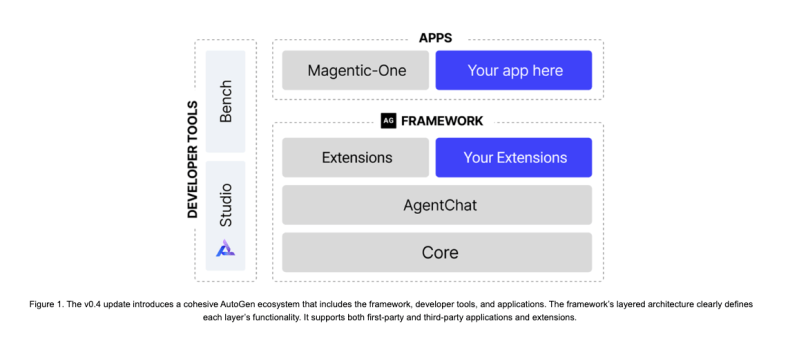
Join our daily and weekly newsletters for the latest updates and exclusive content on industry-leading AI coverage. Learn More Microsoft has updated its AutoGen orchestration framework so the agents it helps build can become more flexible and give organizations more control.  AutoGen v0.4 brings robustness to AI agents and solves issues customers identified around architectural constraints.  “The initial release of AutoGen generated widespread interest in agentic technologies,” Microsoft researchers said in a blog post. “At the same time, users struggled with architectural constraints, an inefficient API compounded by rapid growth and limited debugging and intervention functionality.” The researchers added that customers are asking for stronger observability and control, flexibility around multi-agent collaboration and reusable components.  AutoGen v0.4 is more modular and extensible, with scalability and distributed agent networks. It adds asynchronous messaging; cross-language support, observability and debugging; and built-in and community extensions.  Asynchronous messaging means agents built with AutoGen v0.4 support event-driven and request-interaction patterns. The framework is more modular, so developers can add plug-in components and build long-running agents. It also enables users to design more complex and distributed agent networks.  AutoGen’s extension module simplifies the process of working with multi-agent teams and advanced model clients. It also allows open-source developers to manage their extensions.  To address the issue of observability, AutoGen v0.4 has built-in metric tracking, messaging tracing and debugging tools so users can monitor agent interactions. The updates enable interoperability between agents speaking different coding languages; for now, AutoGen v0.4 supports Python and .NET, but support for additional languages is in the works.  New framework Microsoft updated AutoGen’s framework to better define responsibilities across the framework, tools and application.  It has three layers: core, which consists of the foundational building blocks for an event-driven system; AgentChat, a “task-driven, high-level API built on the core layer” that features group chat, code execution and pre-built agents and is most similar to AutoGen v0.2; and first-party extensions, which interface with integrations like the Azure code executor and OpenAI’s model client.   Along with updating its framework, some tools Microsoft built around AutoGen also got an upgrade.  AutoGen Studio, a low-code interface for rapidly prototyping agents, was rebuilt on the AutoGen v4.0 AgentChat API. Users can get real-time agent updates, pause conversations or redirect agents with mid-execution control, design agent teams with a drag-and-drop interface, import custom agents and get interactive feedback.  Microsoft and agents Microsoft released AutoGen in October 2023 with the hope of simplifying how agents communicate with each other. Along with LangChain and LlamaIndex, AutoGen was one of the first AI agent orchestration frameworks released before agents became the buzzword they are today.  Since then, Microsoft released other agentic systems including Magentic-One, a generalist agentic system that can power multiple agents to complete tasks.  The company has embraced AI agents, deploying perhaps the largest AI agent ecosystems through its Copilot Studio platform.  But other companies are hot on its heels. Salesforce launched AgentForce, and more recently its updated AgentForce 2.0, while ServiceNow released a library of customizable agents. AWS has also added more support for creating multi-agent systems to its Bedrock platform.  source

Microsoft’s AutoGen update boosts AI agents with cross-language interoperability and observability Read More »

9th Circ. Revisits Board Members' Blocks On Social Media

By Craig Clough ( January 17, 2025, 10:18 PM EST) — An attorney for two California school board members on Friday urged the Ninth Circuit to reverse a lower court’s ruling that his clients violated the First Amendment by blocking two constituents from their Facebook page, saying that new rules outlined by the U.S. Supreme Court when it remanded the case call for it…. Law360 is on it, so you are, too. A Law360 subscription puts you at the center of fast-moving legal issues, trends and developments so you can act with speed and confidence. Over 200 articles are published daily across more than 60 topics, industries, practice areas and jurisdictions. A Law360 subscription includes features such as Daily newsletters Expert analysis Mobile app Advanced search Judge information Real-time alerts 450K+ searchable archived articles And more! Experience Law360 today with a free 7-day trial. source

9th Circ. Revisits Board Members' Blocks On Social Media Read More »

Beyond RAG: How cache-augmented generation reduces latency, complexity for smaller workloads

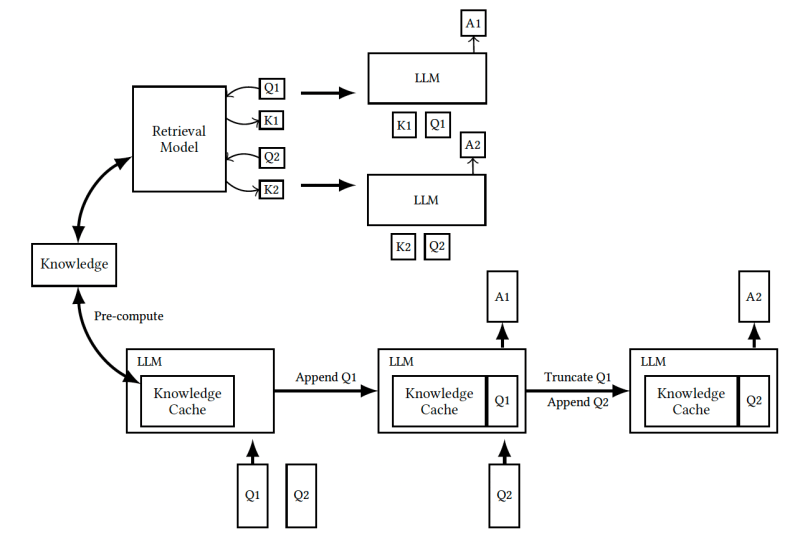
Join our daily and weekly newsletters for the latest updates and exclusive content on industry-leading AI coverage. Learn More Retrieval-augmented generation (RAG) has become the de-facto way of customizing large language models (LLMs) for bespoke information. However, RAG comes with upfront technical costs and can be slow. Now, thanks to advances in long-context LLMs, enterprises can bypass RAG by inserting all the proprietary information in the prompt. A new study by the National Chengchi University in Taiwan shows that by using long-context LLMs and caching techniques, you can create customized applications that outperform RAG pipelines. Called cache-augmented generation (CAG), this approach can be a simple and efficient replacement for RAG in enterprise settings where the knowledge corpus can fit in the model’s context window. Limitations of RAG RAG is an effective method for handling open-domain questions and specialized tasks. It uses retrieval algorithms to gather documents that are relevant to the request and adds context to enable the LLM to craft more accurate responses. However, RAG introduces several limitations to LLM applications. The added retrieval step introduces latency that can degrade the user experience. The result also depends on the quality of the document selection and ranking step. In many cases, the limitations of the models used for retrieval require documents to be broken down into smaller chunks, which can harm the retrieval process.  And in general, RAG adds complexity to the LLM application, requiring the development, integration and maintenance of additional components. The added overhead slows the development process. Cache-augmented retrieval RAG (top) vs CAG (bottom) (source: arXiv) The alternative to developing a RAG pipeline is to insert the entire document corpus into the prompt and have the model choose which bits are relevant to the request. This approach removes the complexity of the RAG pipeline and the problems caused by retrieval errors. However, there are three key challenges with front-loading all documents into the prompt. First, long prompts will slow down the model and increase the costs of inference. Second, the length of the LLM’s context window sets limits to the number of documents that fit in the prompt. And finally, adding irrelevant information to the prompt can confuse the model and reduce the quality of its answers. So, just stuffing all your documents into the prompt instead of choosing the most relevant ones can end up hurting the model’s performance. The CAG approach proposed leverages three key trends to overcome these challenges. First, advanced caching techniques are making it faster and cheaper to process prompt templates. The premise of CAG is that the knowledge documents will be included in every prompt sent to the model. Therefore, you can compute the attention values of their tokens in advance instead of doing so when receiving requests. This upfront computation reduces the time it takes to process user requests. Leading LLM providers such as OpenAI, Anthropic and Google provide prompt caching features for the repetitive parts of your prompt, which can include the knowledge documents and instructions that you insert at the beginning of your prompt. With Anthropic, you can reduce costs by up to 90% and latency by 85% on the cached parts of your prompt. Equivalent caching features have been developed for open-source LLM-hosting platforms. Second, long-context LLMs are making it easier to fit more documents and knowledge into prompts. Claude 3.5 Sonnet supports up to 200,000 tokens, while GPT-4o supports 128,000 tokens and Gemini up to 2 million tokens. This makes it possible to include multiple documents or entire books in the prompt. And finally, advanced training methods are enabling models to do better retrieval, reasoning and question-answering on very long sequences. In the past year, researchers have developed several LLM benchmarks for long-sequence tasks, including BABILong, LongICLBench, and RULER. These benchmarks test LLMs on hard problems such as multiple retrieval and multi-hop question-answering. There is still room for improvement in this area, but AI labs continue to make progress. As newer generations of models continue to expand their context windows, they will be able to process larger knowledge collections. Moreover, we can expect models to continue improving in their abilities to extract and use relevant information from long contexts. “These two trends will significantly extend the usability of our approach, enabling it to handle more complex and diverse applications,” the researchers write. “Consequently, our methodology is well-positioned to become a robust and versatile solution for knowledge-intensive tasks, leveraging the growing capabilities of next-generation LLMs.” RAG vs CAG To compare RAG and CAG, the researchers ran experiments on two widely recognized question-answering benchmarks: SQuAD, which focuses on context-aware Q&A from single documents, and HotPotQA, which requires multi-hop reasoning across multiple documents. They used a Llama-3.1-8B model with a 128,000-token context window. For RAG, they combined the LLM with two retrieval systems to obtain passages relevant to the question: the basic BM25 algorithm and OpenAI embeddings. For CAG, they inserted multiple documents from the benchmark into the prompt and let the model itself determine which passages to use to answer the question. Their experiments show that CAG outperformed both RAG systems in most situations.  CAG outperforms both sparse RAG (BM25 retrieval) and dense RAG (OpenAI embeddings) (source: arXiv) “By preloading the entire context from the test set, our system eliminates retrieval errors and ensures holistic reasoning over all relevant information,” the researchers write. “This advantage is particularly evident in scenarios where RAG systems might retrieve incomplete or irrelevant passages, leading to suboptimal answer generation.” CAG also significantly reduces the time to generate the answer, particularly as the reference text length increases.  Generation time for CAG is much smaller than RAG (source: arXiv) That said, CAG is not a silver bullet and should be used with caution. It is well suited for settings where the knowledge base does not change often and is small enough to fit within the context window of the model. Enterprises should also be careful of cases where their documents contain conflicting facts based on the context of the documents, which might confound the

Beyond RAG: How cache-augmented generation reduces latency, complexity for smaller workloads Read More »

Space-based wildlife tracker relaunches after split with Russia

In 2018, after decades of research and tens of millions in funding, Russian astronauts attached a wildlife-tracking receiver to the exterior of the International Space Station (ISS). The device received data from tagged animals across the planet and beamed it to a ground station in Moscow. From there, it went to an open-source database called Movebank.  The space tracker was the final piece of the puzzle for the ICARUS project, an international effort led by German biologist Martin Wikelski to track the migratory patterns of wildlife from space. It was a game-changer for conservationists, who could monitor the journeys of tiny birds, bats, cats and other animals on a global scale for the first time. The data could even warn us of volcanic eruptions or protect us from diseases.  That was until Russia invaded Ukraine in March 2022. After that, the West severed most of its bilateral research with Moscow. ICARUS was shot from the sky. But now, Wikelski — the director of the Max Planck Institute of Animal Behavior — looks to give the project new wings.  Russian astronauts Sergei Prokopyev and Oleg Artemyev install the ICARUS antenna assembly on the Zvezda module of the ISS. Credit: Roscosmos, DLR Today, the Max Planck Society announced that it has teamed up with German spacetech startup Talos to launch ICARUS 2.0. Founded in 2022, Talos builds tiny solar-powered IoT tags that attach to the fur or feathers of wildlife. The five-gram devices gather location data, alongside measurements of the surrounding temperature, humidity, pressure, and acceleration. The tags then beam this information to a receiver aboard an orbiting CubeSat, which then relays it to researchers back on Earth. The next big thing? It might be you… TNW Conference is here to support startups & scaleups to become the next big thing. Be part of the journey. Price increase on Friday. “ICARUS 2.0 represents a complete technological overhaul,” Gregor Langer, Talos’ CEO,  told TNW. “We’re replacing the Russian ISS-based technologies while also significantly improving the update frequency and accuracy of the animal-tracking data.”  For Wikelski and scientists across the globe, it’s the perfect solution. The system enables high-precision tracking of animals. It’s relatively inexpensive to deploy and operate. And perhaps most importantly, it means that ICARUS is finally freed from the clutches of geopolitics, putting scientists back in control.  “The shutting down of ICARUS illustrated the potential vulnerability of international research projects to geopolitical changes and, thus, the importance of sovereign infrastructures,” said Langer. “However, this relaunch also demonstrates the huge potential of ‘NewSpace’ technologies and companies that can provide services for which governmental institutions were still needed just a few years ago.”  Once up and running again, ICARUS will allow scientists to observe animal movements in near totality for the first time and help create what Wikelski calls the “internet of animals.”  A blackbird fitted with a GPS transmitter. Credit: Talos While ICARUS 2.0 will use 5-gram GPS tags for now, the project plans to deploy devices weighing less than 1 gram in the future. Meanwhile, other scientists in Germany are even working on miniature trackers for bees.   “ICARUS 2.0 will be a critical tool for addressing environmental challenges, including climate change, conservation, and zoonotic disease tracking such as SARS, bird flu, and the West Nile virus,” said Wikelski. The ICARUS 2.0 mission aims to launch the CubeSat constellation in phases. The first satellite is set to launch aboard a SpaceX Falcon 9 rocket this autumn, with all five CubeSats expected to be operational by the end of 2026. Funded by the Max Planck Society, the system will cost roughly $1.57mn to launch and have annual operating expenses of around $160,000.  “By leveraging space technologies and collaborating with innovative space startups, the ICARUS initiative benefits from faster development cycles and enhanced capabilities, further expanding its reach and impact in global scientific research and conservation efforts,” Wikelski concluded.   source

Space-based wildlife tracker relaunches after split with Russia Read More »