Nvidia tackles agentic AI safety and security with new NeMo Guardrails NIMs

Join our daily and weekly newsletters for the latest updates and exclusive content on industry-leading AI coverage. Learn More As the use of agentic AI continues to grow, so too does the need for safety and security. Today, Nvidia announced a series of updates to its NeMo Guardrails technology designed specifically to address the needs of agentic AI. The basic idea behind guardrails is to provide some form of policy and control for large language models (LLMs) to help prevent unauthorized and unintended outputs. The guardrails concept has been broadly embraced in recent years by multiple vendors, including AWS. The new NeMo Guardrails updates from Nvidia are designed to make it easier for organizations to deploy and provide more granular types of controls. NeMo Guardrails are now available as a NIM (Nvidia Inference Microservices), which are optimized for Nvidia’s GPUs. Additionally, there are three new specific NIM services that enterprises can deploy for content safety, topic control and jailbreak detection. The guardrails have been optimized for agentic AI deployments, rather than just singular LLMs. “It’s not just about guard-railing a model anymore,” Kari Briski, VP for enterprise AI models, software and services at Nvidia, said in a press briefing. “It’s about guard railing and a total system.” What the new NeMo Guardrails bring to enterprise Agentic AI Agentic AI use is expected to be a dominant trend in 2025.  While agentic AI has plenty of benefits, it also brings new challenges, particularly around security, data privacy and governance requirements, which can create significant barriers to deployment. The three new NeMo Guardrails NIMs are intended to help solve some of those challenges. They include: Content Safety NIM: Trained on Nvidia’s Aegis content safety dataset with 35,000 human-annotated samples, this service blocks harmful, toxic and unethical content. Topic Control NIM: Helps ensure that AI interactions remain within predefined topical boundaries, preventing conversation drift and unauthorized information disclosure. Jailbreak Detection NIM: Helps prevent security bypasses through clever hacks, leveraging training data from 17,000 known successful jailbreaks. Complexity of safeguarding agentic AI systems The complexity of safeguarding agentic AI systems is significant, as they can involve multiple interconnected agents and models.  Briski provided an example of a retail customer service agent scenario. Consider a person interacting with at least three agents, a reasoning LLM, a retrieval-augmented generation (RAG) agent and a customer service assistant agent. All are required to enable the live agent.  “Depending on the user interaction, many different LLMs or interactions can be made, and you have to guardrail each one of them,” said Briski. While there is complexity, she noted that a key goal with NeMo Guardrails NIMs is to make it easier for enterprises. As part of today’s rollout, Nvidia is also providing blueprints to demonstrate how the different guardrail NIMs can be deployed for varying scenarios, including customer service and retail. How Nvidia guardrails impact agentic AI performance Another primary concern for enterprises deploying agentic AI is performance.  Briski said that as enterprises deploy agentic AI, there can be concern about introducing latency by adding guardrails.  “I think as people were initially trying to add guardrails in the past, they were applying larger LLMs to try and guardrail,” she explained.  The latest NeMo Guardrail NIMs have been fine-tuned and optimized to address latency concerns. Nvidia’s early testing shows that organizations can get 50% better protection with guardrails, which only add approximately a half second of latency. “This is really important when deploying agents, because as we know, it’s not just one agent, there are multiple agents that could be within an agentic system,” said Briski. Nvidia NeMo Guardrails NIMs for agentic AI are available under the Nvidia AI enterprise license, which currently costs $4,500 per GPU per year. Developers can try them out for free under an open source license, as well as on build.nvidia.com. source

Nvidia tackles agentic AI safety and security with new NeMo Guardrails NIMs Read More »

Here’s what AI-powered startups need to succeed in 2025

Presented by Twilio In 2024, thousands of startups emerged built on the powerful capabilities of cutting-edge large language models (LLMs). Statistically speaking, only one-fifth will survive to the end of 2025. To make it beyond this year, these companies will need an edge. That said, I’ve never been more excited about the potential of a new tech sector. AI-powered startups will remake our world in ways we can’t imagine yet — if they have the ingredients to succeed. Serving as a judge for Twilio’s Startup Searchlight 2.0 competition, which celebrates the builders creating the future of communications and customer engagement, drove this point home for me. We selected 12 honorees from among the more than 500 companies that applied. All of the winners embody a few basic principles that startups need to remember when building AI-powered solutions. Keep these in mind, and you will have a good start on building an AI business that will last. 1. Focus on business basics You can’t count on AI alone to give you a competitive advantage — it’s too ubiquitous. The challenges of starting and running a startup remain much as they were before LLMs came along. You need to attract, convert and retain customers. You need to keep costs under control: While AI is getting cheaper all the time, it is still possible to run up the tab if you create complicated workflows (and take note that 72% of IT and financial leaders say AI costs are becoming “unmanageable”). Of course, you also need to establish and defend a sustainable competitive advantage. AI’s power can be your advantage too, if you can take something that is currently complicated to do and encapsulate it in an easy-to-use API framework. That’s what Twilio did for telephony a decade ago, and it’s what the big AI models are doing today. If you want to build a sustainable tech business today, think about how you can deliver it via an API. 2. Build more than a wrapper If you’re just creating a “wrapper” for existing LLMs, you won’t be able to maintain differentiation over the long haul.  For example, if you’re trying to create a tool to help create code, do speech transcription or scan PDFs and extract information, it doesn’t matter how nice your interface is — the major LLMs are already excellent at these tasks. Focus on an area where you can provide a differentiated service that gives you a compounding advantage through a data flywheel or network effects. For example, one of the AI Startup Searchlight honorees, Goodcall, automates voice calls for businesses. It has been amassing anonymized data from over 4 million customer calls to build a more robust database and improved analytics. Another area startups could focus on is pulling data out of unstructured customer conversations. One Searchlight honoree, Spoke AI, does this by pulling data from customers’ voice calls so that business users can see who is calling them, what they might want, how they are feeling and what they talked about previously with colleagues. 3. Understand the growth trajectory of AI  AI is changing incredibly fast. The number of AI patents per year has increased 31x since 2010, with over 62,000 granted in 2022.  When deciding where to focus your efforts, first learn about the arc of LLM development and where it’s likely to go in the next 12 months. If you don’t, your solution may be obsolete before you can get it to market. For example, the big AI labs are currently working to enhance the reasoning capabilities of these models, improving their capabilities in various complex domains. Don’t focus on advanced reasoning unless you have billions in funding! By contrast, one of the Searchlight honorees, CuraJOY, is a grassroots tech nonprofit that uses AI and entertainment to improve the accessibility, effectiveness and equity of social and mental health support. That’s definitely not an area of focus for the big AI models — but it’s meeting a major societal need. 4. Capture the excitement New AI solutions attract a lot of interest, but the excitement is fleeting. If you don’t have a plan to capture those tire-kickers and turn them into long-term customers, your business will fade quickly along with the hype. You need to maintain a high interest level. One way to do that is to keep improving your product based on customers’ input. For example, you might use AI to capture and sort customer feedback and route the highest-value feature requests directly to your product team. That will keep customers coming back and fuel sustainable growth. Another way is to keep raising the bar with new capabilities, certifications and customer-friendly offers. Here’s an illustration from a Searchlight honoree: Alpharun is an AI-powered phone interview platform; it was part of the OpenAI accelerator this year and won the audience award at the 2024 Staffing Industry Analysts conference. The company wasn’t content to rest on its laurels: It’s already securing key technology certifications and offering its customers uptime guarantees, international support and top-notch reliability — essential offerings for the enterprise customers it’s targeting. Looking forward to an AI-powered economy While 2024 marked the year of AI experimentation, 2025 will be defined by AI-powered startups delivering measurable business impact. Through my work at Lightspeed and experience judging Twilio’s Searchlight competition, one thing is clear: The most promising companies aren’t just creating clever AI implementations — they’re building robust businesses that can weather the inevitable changes in technology.  The AI Searchlight honorees exemplify this approach, building true competitive moats with compounding advantages. These companies show us that lasting success comes from combining AI capabilities with deep domain expertise and strong business fundamentals.  We’re at the dawn of a new tech boom, and I have no doubt that some of today’s builders will emerge as tomorrow’s tech giants.  Learn more about the Twilio AI Startup Searchlight and the honorees here. Nnamdi Iregbulem is an investment partner at Lightspeed Venture Partners. Sponsored articles are content produced by a company that is

Here’s what AI-powered startups need to succeed in 2025 Read More »

Is A $7 Million Super Bowl Ad Worth It? Probably Not.

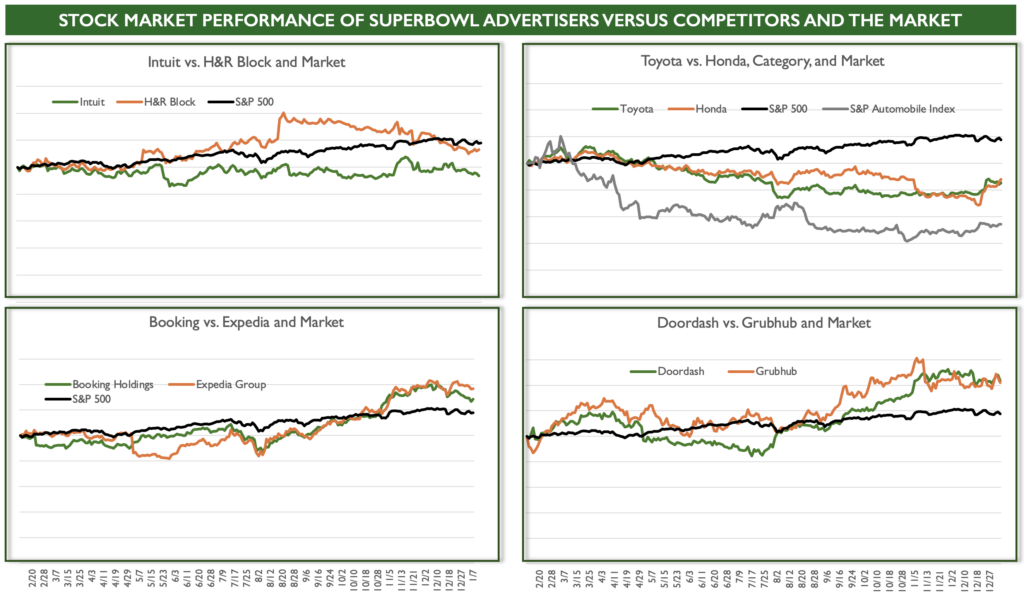
Is a Super Bowl ad worth it? A 30-second spot at this year’s Super Bowl will set you back a cool 7 million bucks. And even if you wanted one of those spots, you can’t have it — they’ve been gone for a while. That must mean these ads are like the proverbial goose laying golden eggs, right? Wrong! Can a Super Bowl ad spot be a sensible investment? Perhaps in some cases, like for a low-awareness brand that needs a jolt of awareness or for a brand making a pivot that it needs a lot of people to know about. But has it worked out for all the blue-chip brands that gobble up the ad space as soon as it hits the market? We decided to check out a few brands that advertised in 2024 (most of which plan to advertise again in 2025) and see how they fared after their Super Bowl campaign. Do Super Bowl campaigns create shareholder value? Attribution analysis of advertising spend can be extremely complex and messy, and that’s not what we are doing here. Instead, we want to see if the brands that advertised did well for their shareholders in the months following the Super Bowl. We compare the stock price of the advertised brand with that of a close peer, and then we throw in the S&P 500 (to measure against overall market movement) and, if available, an industry index (to compare against the category). Here’s how to easily read the charts below: The advertised brand is in green, the competitive brand is in orange, and the market or category indices are in black and gray. We’ve indexed the prices back to the day of Super Bowl 2024 so you can easily compare the advertised brand’s market performance versus that of the others. Seven million dollars later … Here are the findings for the four brands we analyzed:   Intuit has advertised its free online and premium paid tax software (Turbo Tax) in every Super Bowl since 2014 and plans to do so again in 2025. Since its 2024 Super Bowl ad, the company has consistently lagged the S&P 500 and, worse yet, significantly fallen short of its competitor, H&R Block, which has outperformed the market for most of the year. In 2024, Toyota featured the Tacoma in its Super Bowl ad. The year has not been kind to the automobile industry, whose category stock performance has fallen well below the S&P. Toyota did stay ahead of the industry but, for the most part, trailed Honda’s performance. Doordash has been advertising its delivery platform since 2022 and plans to do so again in Super Bowl 2025. After its 2024 campaign, which included a sweepstakes, Doordash pushed ahead of the S&P for a bit but since has had mixed results in beating the market, and unfortunately, it has trailed Grubhub by significant margins for the best part of the year following the Super Bowl. Booking Holdings, like Doordash, has been advertising at the Super Bowl since 2022 and will be back in 2025. Immediately following the Super Bowl, its stock trailed the market and Expedia for a couple of months, made up some ground through the summer months, and since then has closely tracked Expedia. There is little in Booking Holdings’ stock performance to indicate a lift from the Super Bowl. Ouch! What’s a marketer to do? Granted that more analysis needs to be done to truly determine the ROI of a Super Bowl ad (or, for that matter, any ad), but when you sink that much money into an ad campaign and your stock has nothing to show for it, it raises red flags. There are two stark lessons here for any marketer planning a campaign of any size or significance: You are ultimately answerable to the shareholder (or equivalent stakeholders in private companies) for whom you create value, so you must orient your metric around demonstrating outcomes for the enterprise. That’s how you demonstrate your utility to the business. You better be buttoned up on the numbers if you’re pitching marketing campaigns in an environment where your company performance clearly trails your peers. Can you prove that this is the best use of money compared to everything else the company could do with those funds? If I were the CMO at any of these companies that are limping along despite massive ad spend, I’d be telling my CEO that we would be far worse off if we did not make that marketing investment. But, and this is a big but, I’d have to have the numbers to back it up. Better yet, I’d make sure those numbers came with my CFO’s stamp of approval. (Tyler Castro contributed to the analyses and research for this post.) Learn more: Read my research on how brands grow. Follow my work: Go to my Forrester bio and click “Follow.” Chat with me: If you are a Forrester client interested in discussing these topics, please schedule time with me for an inquiry or a guidance session. Plan a session: If you are a Forrester client looking to host a strategy session on a related topic (for example, “the future of digital consumer experience related to AI”), please contact your account team or email me at [email protected]. source

Is A $7 Million Super Bowl Ad Worth It? Probably Not. Read More »

TNW Conference 2025 is reborn — with a new startup mission

TNW Conference will be born again this summer. Over 18 years of unforgettable events, countless future tech stars have used our stage as a springboard to success. We’ve driven vast investments, showcased endless innovations, and made friends along the way. We’ve also learnt from our mistakes. But don’t worry, fellow kids — we’re not getting old yet. We’re still mixing serious business with festival vibes. We are, however, shaking the party up a bit. To celebrate our coming of age, we’re going back to our roots. Today, we’re relaunching TNW Conference with a renewed focus on our founding mission: elevating the startups and scaleups shaping our future. Since 2006, TNW Conference has earned a reputation as a launchpad for world-changing ideas. We make it our thing to introduce startups and scaleups to the right crowd, so big ideas can grow into big things and shake up the world. The likes of Slack, Trello, Bolt, and Vinted have graced our stages en route to becoming world leaders. They’ve been joined by a star-studded selection of speakers, from web inventor Sir Tim-Berners Lee and Reddit CEO Steven Huffman to Hollywood star Zoe Saldana and NSA whistleblower Edward Snowden.  Showcase your startup at TNW Conference Get noticed. Build brand awareness. Connect with the industry players who can help turn your big idea into the next big thing. We’ve also supported 13 of the 15 Dutch unicorns in the early stages of their growth journeys. This year, we want to foster a new generation of tech titans.  “At TNW, we’ve always had a knack for spotting the extraordinary before it becomes the norm,” said Boris Veldhuijzen van Zanten, the founder of TNW. “From fledgling startups to transformative technologies, we thrive on helping innovators take their first big leap.” Well, that all sounds lovely, I hear you say, but is there any substance behind your grandiose ambitions? Thanks for asking—and mind your manners. Of course there’s substance. Here’s a taste of what’s in store. What’s new for TNW Conference 2025? For our return to the iconic NDSM venue in Amsterdam on June 19-20, TNW Conference is being transformed into an exclusive, curated, and higher-quality platform. We’re doubling down on the attendee experience — and the element of surprise that’s a become a trademark of the event. Every change intends to maximise our impact. Let’s dig into a few details: Tickets will be restricted to just 4,500 guests. By restricting our numbers, we can create an intimate, tailored experience. The audience has been curated. Over 2,000 startups and scaleups, 675+ investors, 900+ policymakers, and 900+ corporate innovators will be in attendance. We’ve focused our agenda around three key themes: Growth & Venture, Next in Tech, and Enterprise Innovation. Streamlining the program allows us to provide more relevant content. It also enhances collaboration and actionable insights.  Tech5 returns. The network of top European founders has helped over 585 companies including Wise, Too Good To Go, Picnic, and Revolut. At TNW Conference, the program will feature a competition for the best growth-stage startups. We have a new edition of The Assembly — an invite-only gathering of policymakers and business leaders. Themes for this year’s edition include defence tech — a timely pick with the NATO Summit arriving in Amsterdam one week later. Deep tech, AI, climate tech, and other verticals are also on the agenda. The Corporate Innovator ticket launches. Our new pass will connect corporate leaders with tech pioneers in an exclusive Corporate Lounge. Our vision has been endorsed by our gorgeous home city. This year’s TNW Conference has been chosen as a flagship event of Amsterdam750 — a celebration of the Dutch capital’s 750th birthday. A hand-picked crew of tech leaders has also supported the refreshed plans. Among them is Victoria Slivkoff, the Head of Ecosystem at VC fund Walden Catalyst Venture and Executive Managing Director of the Extreme Tech Challenge. “TNW’s renewed focus on empowering startups driving global impact underscores the transformative power of scalable innovation to create a better world,” she said. “By fostering collaboration, providing unparalleled resources and visibility, TNW is creating a launchpad for visionary entrepreneurs tackling the world’s most pressing challenges.” Why attend TNW Conference 2025? We’ve redesigned TNW Conference for one reason: to better serve European startups, scaleups, and the surrounding ecosystem. Here’s what’s on offer for our community: For Startups & Scaleups: Showcase your startup on the same platform where today’s tech giant once stood. Gain exposure, connect with industry players, meet investors, and find new clients. For Investors: Unearth tech’s hottest companies. Expand your deal pipeline, connect with high-growth entrepreneurs, and network with fellow investors. For Corporate Innovators: Inject some startup thinking into your enterprise to stay ahead of the curve and learn how to innovate at scale — fast. For Ecosystem Builders: Helping national startups grow into global businesses. Connect key players, foster partnerships, and unearth pioneering innovations. Join us to discover the next big thing — before it’s a thing. The next steps We’ll soon share extra details on the agenda — including our thrilling first batch of speakers and an eye-catching array of partners. In the meantime, Andy Lürling, a founding partner at VC firm Lumo Labs and a TNW Advisory Board member, has a few tips for the event. “The better you prepare for your visit to the conference — by exploring the TNW platform to identify who will be attending, who is relevant for you to meet, and which sessions are most valuable for you — the higher the quality of your experience will be,” he said. “Don’t hesitate to approach people, start conversations spontaneously, ask questions, and share your own experiences, knowledge, and network.” You can join Andy and us at TNW Conference in June. Just don’t call it a comeback — but you can call it a rebirth. Tickets for TNW Conference are now on sale. We’re going to sell-out — so don’t delay in ordering your pass. Use the code TNWXMEDIA2025 at the check-out to get 30% off the

TNW Conference 2025 is reborn — with a new startup mission Read More »

The era of custom chips

Presented by Marvell This article is part of VentureBeat’s special issue, “AI at Scale: From Vision to Viability.” Read more from the issue here. AI is about to face some serious growing pains. Demand for AI services is exploding globally. Unfortunately, so is the challenge of delivering those services in an economical and sustainable manner. AI power demand is forecasted to grow by 44.7% annually, a surge that will double data center power consumption to 857 terawatt hours in 2028: As a nation today, that would make data centers the sixth largest consumer of electricity, right behind Japan. It’s an imbalance that threatens the “smaller, cheaper, faster” mantra that has driven every major trend in technology for the last 50 years. It also doesn’t have to happen. Custom silicon — unique silicon optimized for specific use cases — is already demonstrating how we can continue to increase performance while cutting power even as Moore’s Law fades into history. Custom may account for 25% of AI accelerators (XPUs) by 2028 (Marvell estimate), and that’s just one category of chips going custom. The data center as a factory Jensen Huang’s vision for AI factories is apt. These coming AI data centers will churn at an unrelenting pace, 24/7. And, like manufacturing facilities, their ultimate success or failure for service providers will be determined by operational excellence, the two-word phrase that rules manufacturing. Are we consuming more, or less, energy per token than our competitor? Why is mean time to failure rising? What’s the current operational equipment effectiveness (OEE)? In oil and chemicals, the end products sold to customers are indistinguishable commodities. Where they differ is in process design, as they leverage distinct combinations of technologies to squeeze out marginal gains. The same will occur in AI. Going forward, diversity will rule, and the operators with the lowest cost, least downtime and ability to roll out new differentiating services and applications will become the favorite of businesses and consumers. In short, the best infrastructure will win. The custom chip concept One of the chief ways to differentiate will be through custom silicon that is enabled by custom semiconductors — that is, chips containing unique IP or features that achieve leapfrog performance for an application. It’s a spectrum ranging from AI accelerators built around distinct, singular design to a merchant chip containing additional custom IP, cores and firmware to optimize it for a particular software environment. While the focus is now primarily on higher-value chips such as AI accelerators, every chip will get customized: Meta, for example, recently unveiled a custom network interface controller (NIC), a relatively unsung chip that connects servers to networks, to reduce the impact of downtime. A single stack of high bandwidth memory (HBM) can require an interface with 2,048 pins to transfer data, or more than 8,000 per XPU. Customizing can dramatically reduce power, pin count and increase memory capacity. XPUs with custom HBM are expected in one to two years. Customization will involve rethinking every aspect of semiconductor design. Some, for example, are looking at ways to optimize the base chip and interfaces for managing the gigabytes of high bandwidth memory (HBM) used as a cache in high-end AI accelerators. Optimization can potentially increase memory inside the chip package by up to 33%, reduce interface power by 70% and increase the available silicon real estate for logic functions by close to 25% (Marvell estimate).   The custom category also includes new, emerging classes of interconnect chips aimed at scaling up the size and capabilities of computing systems. Today, servers typically contain eight or fewer XPUs and/or CPUs and all of the components are housed in an aluminum box that slides into a rack. In the future, AI systems will contain hundreds of accelerators along with storage and memory spread over several racks connected with a portfolio of optical engines tailored to the specifications of XPUs, CXL controllers, PCIe retimers, transmit-receive optical digital signal processors (DSPs) and other devices. Many of these devices didn’t even exist a few years ago, but are expected to grow rapidly: 75% of AI and cloud servers may contain PCIe retimers within two years, according to The 650 Group. While these devices and servers will be grounded in technology standards, architectures and designs will vary widely from cloud to cloud. A periodic table for semis But how does one make custom semiconductors — where designing a platform for producing 3nm or 2nm chips can cost over $500 million? In a market where large language models (LLMs) change every few months? And how will these technologies work with emerging ideas like cold plate or immersive cooling? As basic as it sounds, it starts with the elemental ingredients. Serializer-deserializer (SerDes) circuits are the textbook “most important technology in the world” you’ve never heard about. These components control the flow of data between chips and infrastructure devices such as switches and servers. An 800G optical module, for example, is built with eight 100G SerDes. A single data center rack will contain tens of thousands of SerDes. You can think of them as the molecules of networking: Fundamental building blocks that have an outsized influence on the health of the system as a whole. Slightly reducing the picojoules consumed in transmitting bits across a SerDes can translate into substantial energy saving across a global infrastructure. Similarly, chip packaging now plays an outsized role in chip design because it provides a mechanism for streamlining power delivery and data paths while continuing to boost computing performance. More than 50% of power in a chip can get consumed by moving data from between different subsystems inside the chip itself. Chip industry 2.0? As custom becomes the norm, we will also face a new dilemma: How does a company deliver custom products and still leverage the benefits of mass manufacturing? To date, semiconductor makers have succeeded by making very large numbers of a small handful of devices. ”Custom” used to mean taking fairly simple actions like tweaking speed or cache size, similar

The era of custom chips Read More »

Announcing The Modern Application Development Services Wave, Q1 2025

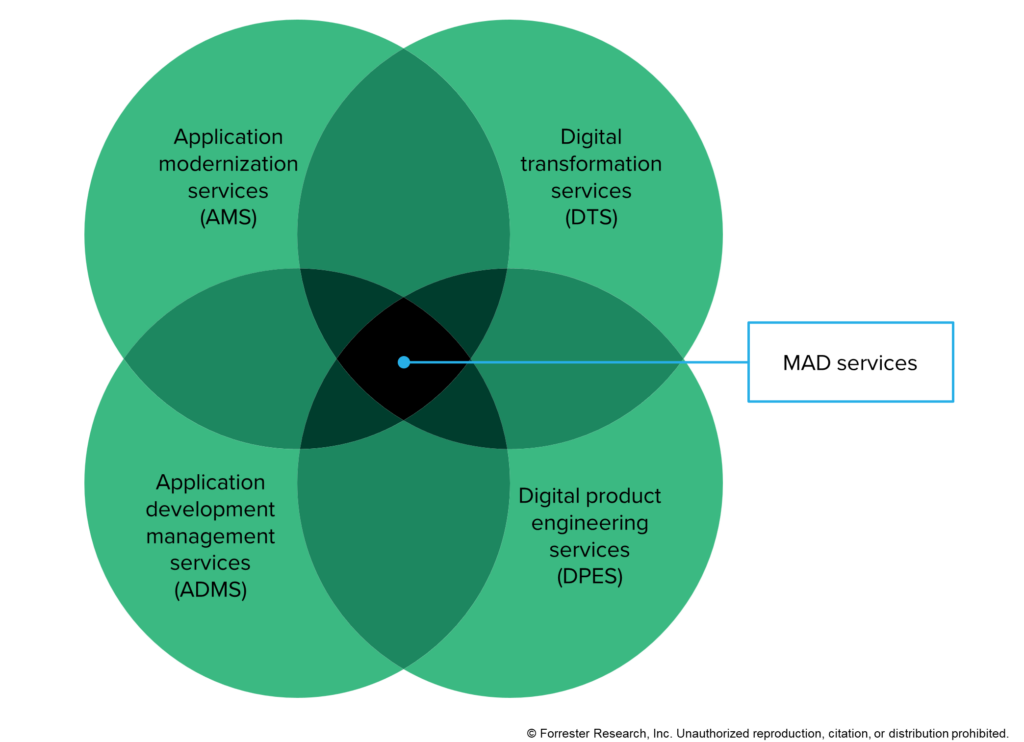
MAD Services Deliver Cool New Products While Transforming Your Development Capabilities Modern application development (MAD) services represent the next wave in custom application development services. Emerging from the convergence of current and past services such as application development management services (ADMS), digital transformation services (DTS), digital product engineering services (DPES), and broader application modernization services (AMS), MAD services are now utilized by leading organizations, with an increasing number of CIOs showing strong interest in these offerings (see figure below).   What sets MAD services apart? It’s their unique ability to not only support clients in delivering modern apps using the latest technologies and development practices but also their role in transforming and modernizing their custom development capabilities. The Venn diagram illustrates the context for MAD services and their foundational services, though it doesn’t capture the market’s multibillion-dollar scale, which is expected to grow. We just published The Forrester Wave™: Modern Application Development Services, Q1 2025, which analyzes and compares 13 medium and large market players out of more than 50 providers that offer MAD services: Accenture, Capgemini, CI&T, Cognizant, EPAM, Globant, HCLTech, Infosys, LTIMindtree, NTT DATA, Softtek, Tata Consultancy Services, and Thoughtworks. Why These Players And Not Others? The MAD services market is highly competitive, and Forrester clients can learn more about the broader landscape and discover a wider group of vendors in The Modern Application Development Services Landscape, Q3 2024. This most recent MAD services Wave’s analysis focuses on medium and large vendors compared to our previous Wave evaluation on the same market, in which the emphasis was on smaller ones. But not every company from the landscape report met the stringent criteria for inclusion in the Wave, which were: Significant peer recognition. These were providers most frequently cited in client bids. Forrester mindshare. This entails the service providers that were referenced more during briefings, inquiries, or research projects over the last year. MAD capabilities. The Wave’s vendors offer comprehensive and differentiating sets of MAD capabilities or, in Forrester’s view, unique capabilities that warrant inclusion. Global MAD services revenue of at least US$450 million. The included vendors have global MAD services revenue of US$450 million in at least two of the North America, LATAM, EMEA, or APAC regions combined. What Distinguishes The Leaders, Strong Performers, And Contenders? Our Wave methodology categorizes vendors into three groups, Leaders, Strong Performers, and Contenders, based on a range of services that we evaluated: agile, DevOps, microservices architecture, cloud services, and more advanced services such as site reliability engineering, project-to-product capabilities, AI and generative AI architecture services, and the testing and development of AI-infused applications. Showing differentiation in all these services was key to our evaluation. Reference clients, case studies, and other evidence also played a critical role in our analysis. After all, it’s the provider’s ability to enhance your team’s skills in new technologies and practices that truly differentiates MAD services from traditional ADMS or AMS services. We encourage readers not to dismiss any provider without first examining the detailed descriptions of strategy, capabilities, and client feedback in our Wave report. Download the accompanying Excel file for a breakdown of the questions, scoring, and criteria grading. For more information, feedback, or questions, email me at [email protected], or if you’re a Forrester client, schedule a guidance session or inquiry. I’m here to assist! source

Announcing The Modern Application Development Services Wave, Q1 2025 Read More »

Quantum Brilliance secures $20M for portable diamond-based accelerators

Australian-German startup Quantum Brilliance has raised $20mn in Series A funding as it looks to deploy small, portable quantum accelerators that promise to supercharge the computational power of everything from data centres and robots to satellites. A quantum accelerator is a specialised hardware unit that speeds up specific quantum algorithms, or tasks. They act as co-processors to classical computers, such as CPUs or GPUs, taking on specific quantum calculations.   Austrian deep tech fund Main Sequence, In-Q-Tel (IQT) in the US, and Japan’s Intervalley Ventures led the funding round. “It represents a significant step forward as we advance the design, performance, and manufacturability of diamond quantum devices,” said Quantum Brilliance CEO Mark Luo.    Founded in 2019, Quantum Brilliance uses diamonds in its accelerators, allowing them to operate at room temperature, unlike most quantum systems that need super-cooling.  The result is quantum devices that are portable and energy-efficient, making them particularly useful for large-scale deployment in edge devices. “Diamond quantum technology holds immense promise for developing compact and ruggedised quantum sensors and accelerators,” said Nat Puffer, managing director at IQT. “We believe this technology will play a pivotal role in addressing strategic challenges across industries and critical national priorities.”  The 💜 of EU tech The latest rumblings from the EU tech scene, a story from our wise ol’ founder Boris, and some questionable AI art. It’s free, every week, in your inbox. Sign up now! Last year, Quantum Brilliance announced a strategic partnership with Oak Ridge National Laboratory in the United States, home to Frontier, the world’s first exascale supercomputer. The startup will install its diamond accelerators alongside the laboratory’s high-performance computing (HPC) systems to explore the potential of combining quantum computing with classical computing.  In addition, Germany’s cybersecurity agency awarded Quantum Brilliance a $15mn contract in September to deliver the world’s first mobile quantum computer by 2027. A mobile quantum computer could perform complex calculations on-site instead of relying on data centres or cloud access. Quantum computers are rewriting the rules of computing, tapping into the mind-boggling magic of quantum physics to tackle problems regular machines can’t touch. Powered by qubits that can juggle multiple states at once, they’re built to crack optimisation puzzles, simulate complex systems, and revolutionise encryption — at blistering speeds. Interest in quantum computing has been abuzz since Google unveiled an experimental machine that was able to solve a mathematical equation in five minutes that a traditional supercomputer could not master in 10 septillion years. The breakthrough brought the dream of quantum computing a step closer to reality. Nevertheless, Nvidia’s CEO Jensen Huang was quick to pour cold water on the hype, cautioning at CES 2025 that practical quantum applications are still 15-30 years away. source

Quantum Brilliance secures $20M for portable diamond-based accelerators Read More »

Reimagine application modernisation with the power of generative AI

In a global economy where innovators increasingly win big, too many enterprises are stymied by legacy application systems. As a consequence, these businesses experience increased operational costs and find it difficult to scale or integrate modern technologies. According to research from NTT DATA, 90% of organisations acknowledge that outdated infrastructure severely curtails their capacity to integrate cutting-edge technologies, including GenAI, negatively impacts their business agility, and limits their ability to innovate.[1] Retaining outdated technology may seem like a cautious approach but there are mounting inherent dangers. Maintaining, updating, and patching old systems is a complex challenge that increases the risk of operational downtime and security lapse. Modernising with GenAI Modernising the application stack is therefore critical and, increasingly, businesses see GenAI as the key to success. The solution—GenAI—is also the beneficiary. Indeed, more than 80% of organisations agree that scaling GenAI solutions for business growth is a crucial consideration in modernisation strategies.[2] The myriad potential of GenAI enables enterprises to simplify coding and facilitate more intelligent and automated system operations. By leveraging large language models and platforms like Azure Open AI, for example, organisations can transform outdated code into modern, customised frameworks that support advanced features. GenAI can also harness vast datasets, insights, and documentation to provide guidance during the migration process. This allows for a more informed and precise approach to application development, ensuring that modernised applications are robust and aligned with business needs. The business benefits of GenAI-driven modernisation The benefits of powering application modernisation with GenAI are clear. According to Forrester, for example, the approach accelerates and simplifies onboarding for new learners and developers, powers more effective digital governance, and improves the user experience.[3] Looking ahead, GenAI promises a quantum leap in how we develop software, democratising development and bridging the skill gaps that hold back growth. The Software Development Life Cycle (SDLC) will be redefined and various job roles will merge into a unified, frictionless workbench of expert creation. The norm will shift towards real-time, concurrent, and collaborative development fast-tracking innovation and increasing operational agility. Considerations for success As enterprises look to integrate GenAI solutions into their application modernisation programmes, making the right technological choices is key. Some solution considerations include: Productivity: Does the solution deliver the level of productivity required for largescale code migrations? Speed: Does it deliver rapid, secure, pre-built tools and resources so developers can focus on quality outcomes for the business rather than risk and integration? Alignment: Is the solution customisable for -specific architectures, and therefore able to unlock additional, unique efficiency, accuracy, and scalability improvements? Scalability: Does it allow for enterprise-grade DevOps integration, scaling to cover the entire modernisation process,  for efficiency, differentiation, and maximised business value? The foundation of the solution is also important. Look for a platform that is based on a strong technology partnership, with proven expertise. NTT DATA’s Coding with Azure OpenAI is a prime example of just such a solution. The platform can automate up to 80% of code generation and transformation,  as well as helping reduce time-to-market by 50%.[4] GenAI-based modernisation and coding platforms will prove fundamental to business success in the years ahead. Through these solutions, enterprises will be able to accelerate application modernisation and development, saving time and money while catalysing innovation. For a deeper understanding of these insights and to learn more about -how your organisation can effectively implement GenAI strategies, we invite you to explore the full report. [1] NTT DATA, Global GenAI Report, 2024 https://services.global.ntt/en-us/campaigns/global-genai-report [2] Ibid [3] Forrester, The Rise of Application Generation Platforms, May 2024 https://www.forrester.com/blogs/the-rise-of-application-generation-platforms/ [4] NTT DATA, Accelerating Legacy Application Modernization with NTT DATA Coding and Azure OpenAI, 2024 source

Reimagine application modernisation with the power of generative AI Read More »

S&C-Led Symbotic Buys Walmart's AI-Based Robotics Biz

By Jade Martinez-Pogue ( January 16, 2025, 4:45 PM EST) — Artificial intelligence-enabled robotics technology company Symbotic Inc., advised by Sullivan & Cromwell LLP, on Thursday announced plans to acquire Walmart’s Advanced Systems and Robotics, and the two will enter into a multiyear partnership under which Walmart will buy and deploy robotic systems to be used for 400 pickup and deliver centers at Walmart locations…. Law360 is on it, so you are, too. A Law360 subscription puts you at the center of fast-moving legal issues, trends and developments so you can act with speed and confidence. Over 200 articles are published daily across more than 60 topics, industries, practice areas and jurisdictions. A Law360 subscription includes features such as Daily newsletters Expert analysis Mobile app Advanced search Judge information Real-time alerts 450K+ searchable archived articles And more! Experience Law360 today with a free 7-day trial. source

S&C-Led Symbotic Buys Walmart's AI-Based Robotics Biz Read More »

Dry January Is Really A Lesson In Self-Optimization

The US Surgeon General’s recent warning on alcohol consumption and cancer risk comes at a time when many consumers are participating in dry January, with new terms such as sober-curious being used and demand for “sober bars.” But rather than getting caught up in the pessimistic future of alcoholic beverage companies or the food and beverage industries, the consumer implication here is really about an obsession with self-optimization. Forty-four percent of US consumers and 45% of UK consumers self-reported their plans to make New Year’s resolutions in 2025, according to Forrester’s December 2024 Consumer Pulse Survey, and much of their intentions haven’t changed over previous years: exercising better habits with their health, finances, and connections with friends and family. Consumers Now Live In The Age Of Self-Growth The global medical spa market — with services in beauty treatments such as injectables and weight loss enhancements — is projected to surpass $59.4 billion by 2033; emerging startups around longevity and biohacking are fueling headlines and investments by billionaires, with a focus on research and development around anti-aging therapies; and the percentage of US adults who received any mental health treatment in the past year increased 4% between 2019 and 2023. The emphasis on self-optimization and personal growth trends is fueled and amplified by a couple of cultural factors: Algorithms that influence content consumption. Consumer preferences are now driven by recommendation engines and social media algorithms, spotlighting the “illusory truth effect,” through which humans are more likely to believe that something is true simply because it is repeated often. Hacks, products, and advice on being a better version of yourself will continue to reign over the types of content that the individual consumer consumes and engages with. Increased access but decreased control. The feeling of being overwhelmed by too many choices has steadily grown 3% between 2021 and 2024 in the US, according to Forrester’s Consumer Benchmark Survey, 2024. In reaction to handing over agency to technology, consumers will seek ways to increase control over their life. With better metrics, technologies, and therapies — from daily usage of smartphones to expensive biotherapies — these tools optimize a person’s physical and mental health, steadily ushering consumers toward increased experimentation over self-optimization. Consumer trends typically indicate a turning point to something bigger. Identifying the trend will give you awareness, but to act on it, marketers must look at the bigger picture. Why are consumers behaving this way? Where are they turning to? Why is this trend happening at this moment? To help you better understand consumer trends in 2025 and beyond, schedule a guidance session with me. source

Dry January Is Really A Lesson In Self-Optimization Read More »