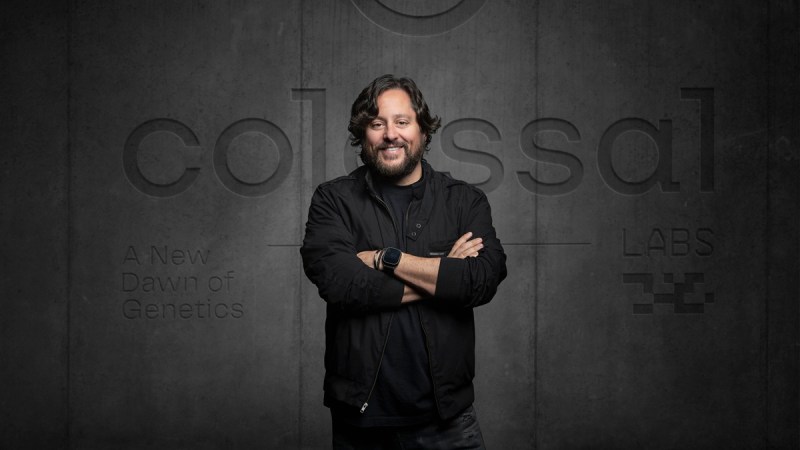
Join our daily and weekly newsletters for the latest updates and exclusive content on industry-leading AI coverage. Learn More Colossal BioSciences has raised $200 million in a new round of funding to bring back extinct species like the woolly mammoth. Dallas- and Boston-based Colossal is making strides in the scientific breakthroughs toward “de-extinction,” or bringing back extinct species like the woolly mammoth, thylacine and the dodo. I would be remiss if I did not mention this is the plot of Michael Crichton’s novel Jurassic Park, where scientists used the DNA found in mosquitoes preserved in amber to bring back the Tyrannosaurus Rex and other dinosaurs. I mean, what could go wrong when science fiction becomes reality? Kidding aside, this is pretty amazing work and I’m not surprised to see game dev Richard Garriott among the investors. The big investor this time was TWG Global, a diversified holding company with operating businesses and investments in technology/AI, financial services, private lending and sports and media. The investor is jointly led by Mark Walter and Thomas Tull. Since launching in September 2021, Colossal has raised $435 million in total funding. This latest round of capital places the company at a $10.2 billion valuation. Colossal will leverage this latest infusion of capital to continue to advance its genetic engineering technologies while pioneering new revolutionary software, wetware and hardware solutions, which have applications beyond de-extinction including species preservation and human healthcare. “Our recent successes in creating the technologies necessary for our end-to-end de-extinction toolkit have been met with enthusiasm by the investor community. TWG Global and our other partners have been bullish in their desire to help us scale as quickly and efficiently as possible,” said CEO Colossal Ben Lamm, in a statement. “This funding will grow our team, support new technology development, expand our de-extinction species list, while continuing to allow us to carry forth our mission to make extinction a thing of the past.” Colossal employs over 170 scientists and partners with labs in Boston, Dallas, and Melbourne, Australia. In addition, Colossal sponsors over 40 full time postdoctoral scholars and research programs in 16 partner labs at some of the most prestigious universities around the globe. Colossal’s scientific advisory board has grown to include over 95 of the top scientists working in genomics, ancient DNA, ecology, conservation, developmental biology, and paleontology. Together, these teams are tackling some of the hardest problems in biology, including mapping genotypes to traits and behaviors, understanding developmental pathways to phenotypes like craniofacial shape, tusk formation, and coat color patterning, and developing new tools for multiplex and large-insert genome engineering. “Colossal is the leading company working at the intersection of AI, computational biology and genetic engineering for both de-extinction and species preservation,” said Mark Walter, CEO of TWG Global, in a statement. “Colossal has assembled a world-class team that has already driven, in a short period of time, significant technology innovations and impact in advancing conservation, which is a core value of TWG Global. We are thrilled to support Colossal as it accelerates and scales its mission to combat the animal extinction crisis.” “Colossal is a revolutionary genetics company making science fiction into science fact. We are creating the technology to build de-extinction science and scale conservation biology particularly for endangered and at-risk species. I could not be more appreciative of the investor support for this important mission,” said George Church, Colossal cofounder and a professor of genetics at Harvard Medical School and professor of Health Sciences and Technology at Harvard and the Massachusetts Institute of Technology (MIT). In October 2024, the Colossal Foundation was launched, a sister 501(c)(3) focused on overseeing the deployment and application of Colossal-developed science and technology innovations. The organization currently supports 48 conservation partners and their global initiatives around the world. This includes partners like Re:wild, Save The Elephants, Biorescue, Birdlife International, Conservation Nation, Sezarc, Mauritian Wildlife Foundation, Aussie Ark, International Elephant Foundation, Saving Animals From Extinction. Currently the Colossal Foundation is focused on supporting conservation partners who are working on new innovative technologies that can be applied to conservation and those who benefit from the development and deployment of new genetic rescue and de-extinction technologies to help combat the biodiversity extinction crisis. Tracking Progress on Colossal’s De-Extinction Projects Ben Lamm is CEO of Colossal Biosciences The first step in every de-extinction project is to recover and analyze preserved genetic material and use that data to identify each species’ core genomic components. In addition to recruiting Beth Shapiro, a global leader in ancient DNA research, as Colossal’s chief science officer, Colossal has built a team of Ph.D experts in ancient DNA among its scientific advisors, including Love Dalen, Andrew Pask, Tom Gilbert, Michael Hofreiter, Hendrik Poinar, Erez Lieberman Aiden, and Matthew Wooler. With this team, Colossal continues to push advances in ancient DNA through support to academic labs and internal scientific research. All three core species – mammoth, thylacine, and dodo – have already benefited from this coalescence of expertise. As an example, Colossal now has the most contiguous and complete ancient genomes to date for each of these three species; these genomes are the blueprints from which these species’ core traits will be engineered. The path from ancient genome to living species requires a systems model approach to innovation across computational biology, cellular engineering, genetic engineering, embryology, and animal husbandry, with refinement and tuning in each step along the de-extinction pipeline occurring simultaneously. To date, Colossal’s scientists have achieved monumental breakthroughs at each step for each of the three flagship species. In the last three years, Colossal’s first major project to be announced, the woolly mammoth project, generated new genomic resources, made breakthroughs in cell biology and genome engineering, and explored the ecological impact of de-extinction, with implications for mammoths, elephants, and species across the vertebrate tree of life. Woolly Mammoth De-extinction Project Progress The mammoth team has generated chromosome-scale reference genomes for the African elephant, Asian elephant, and rock hyrax, all of which have been released on the National Center for