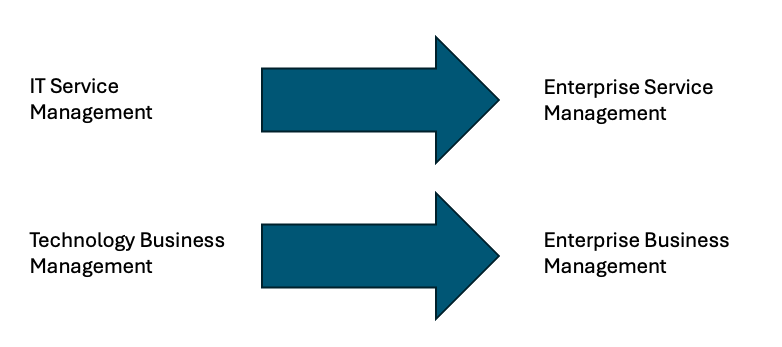
Product Model And Enterprise Business Management Lead The Conversation with Tracy Woo This year, I had the pleasure of attending three standout conferences: first, Atlassian’s Team ’24 and ServiceNow’s Knowledge ’24, and last week, the TBM Conference in San Diego (with a co-branded CloudyCon for FinOps). Each had its highlights, but the TBM Council Conference really brought together product centricity and transparency in the modern IT operating model. The discussions were rich with insights, and the networking opportunities were invaluable. The Shift To Product Centricity Product centricity is no longer a buzzword — it’s here to stay. Keynotes from Mastercard and BNY Mellon underscored this shift. Both organizations are fully embracing product-centric approaches, moving away from the traditional waterfall investment styles to more steady-state, value stream-based funding. This move isn’t just a leading-edge trend; in many large orgs, it’s a done deal. They’ve already gone through their first iteration of product-centric transformation and are now fine-tuning their approaches. This shift is not just about changing funding models but also about fundamentally rethinking how IT delivers value to the business. Mastercard, for example, has made significant strides in showing the total cost of ownership by product. It compared its product-centric transformation to an “HGTV renovation” — tearing out the old operating model down to the studs and completely rebuilding. The idea is to give products more autonomy, treating them as businesses within the business (this phrase was uttered several times at various sessions). This shift requires capabilities for chargeback or at least showback, holding teams accountable for their financial performance and creating a culture where IT products are managed with the same rigor and accountability as any other business unit. Service costing and pricing by product are becoming increasingly important. Organizations need to manage capacity and utilization effectively, and this requires a clear understanding of service costs. I was in one breakfast discussion that drilled into the problem of unused capacity and how to charge for it; it’s a perennial problem in IT finance and has similarities to the notorious “death spiral” problem in public utilities. The move to product centricity also brings a new level of accountability. Agile teams may be awarded the autonomy they crave, but be careful what you wish for. In Spider-Man’s words, “With great power comes great responsibility.”* Product teams must make their numbers and justify their costs, and large orgs are turning to TBM implementations to realize this. Enterprise Business Management A new (to me, anyways) acronym was making the rounds at the conference: enterprise business management, or EBM. For those of you who have followed Forrester’s research on enterprise service management (ESM) and how it emerged from IT service management, this is exactly analogous. When the initial IT help desks with their service catalogs were established, other business units would use them and say “Cool! Why not my area?” So facilities, HR, marketing, legal, and many other areas started leveraging what had initially been IT-centric workflows. (This is a major reason for ServiceNow’s success and continued expansion into non-IT domains, which many still find puzzling.) Now we see a similar dynamic with IT finance, and just like with ESM, facilities in many cases is the next one to the party. If history repeats, we’ll also see HR, legal, corporate communications, and others developing cost models for their services — in other words, the increasing application of tools and techniques first developed for IT financial management (ITFM) to non-IT accounting and finance problems. Why would an organization do this, you ask? Because so-called “technology business management” and the related practices of IT finance are not — repeat, not — tightly coupled to technology itself. What? An IT finance tool represents a general capability to create better business-aligned visibility across the low-level facts of the general ledger. Actual costs such as people, software, hardware, and services are rolled up into higher-order cost pools, which can then be defined as services with cost drivers (e.g., headcount) and then consumed by business units in pursuit of their outcomes. Did I say much about technology there? Hardware and software are just a couple of expense categories. Who cares if they are “technical”? Other business operations might desire to do much the same thing with their base costs. TBM thought leaders tell me that when TBM is implemented and the CFO grasps the implications, they start to think about other applications of the same techniques to other operational units, especially cost centers. They are also useful in environments sensitive to overhead and allocated costs (e.g., grant-funded). My prediction: The enterprise service management vendors will increasingly grasp the opportunity here and either develop their own approaches or partner more strongly with established TBM/ITFM vendors. Architecting And Governing IT Management Data State Farm’s breakout session covered its project-to-product work, as well; I was also glad when they drilled into the importance of IT management data hygiene. Maintaining accurate data is crucial, whether for operational purposes or transparency in IT costs. This session highlighted the challenges of maintaining clean data and the importance of getting buy-in from all stakeholders, even when the data isn’t perfect. Enterprise architecture received multiple callouts across sessions as a key capability assisting in reducing sprawl and providing key insights into large IT portfolios. There were many mentions that the configuration management database (CMDB) is essential for IT finance, despite ongoing industry skepticism and struggles. CMDBs continue to fail when they are implemented by engineers or IT service management practitioners without data chops. It’s not just about ITIL or turning up an auto-discovery feed to “11,” a la “Spinal Tap”; data architecture and governance are crucial. Success comes when you realize that you are faced with a large-scale, complex database that needs to be managed by data professionals using well-understood principles like data quality management. FinOps The relationship between FinOps and IT financial management was a hot topic at the TBM Council Conference. FinOps, which focuses on managing cloud costs and ensuring that cloud spending aligns with business value, is currently more