Forrester

Siemens Continues The Shift From Grease To Code With Acquisition Of Altair Engineering

German industrial conglomerate Siemens continued its evolution from hardware maker to technology provider this week, announcing the company’s intention to acquire Altair Engineering for around US$10 billion. Industrial giants such as Siemens rose to dominance by making high-quality physical objects. Lower-cost competition and increasingly complex multistakeholder ecosystems mean this old route to success is no longer sufficient. To survive, industrial firms must move faster, deliver new value to new stakeholders, and respond to the shifting expectations of both their customers and their customers’ customers. We call this digital transformation of traditional manufacturing firms the shift from grease to code, and it can’t simply be about making existing industrial processes more efficient. The acquisition of software firms such as Altair is part of this. The challenge, as always, is to integrate these smart buys into the acquiring firm without giving it indigestion and without spooking — or disappointing — customers. Altair’s Offerings Complement Siemens’ Industrial Software Portfolio Altair’s still best known in the industrial space for its simulation, modeling, and high-performance computing (HPC) capabilities, which complement Siemens’ mechanical and electronic design portfolio. Altair’s data analytics and AI platform, RapidMiner, was acquired back in 2022 and was evaluated in The Forrester Wave™: AI/ML Platforms, Q3 2024. Report authors Mike Gualtieri and Rowan Curran celebrated RapidMiner’s “exceptional” user experience but also noted that “Altair needs to boost its roadmap to keep pace with the platform capabilities being added by other vendors.” Siemens’ deep pockets will come in handy if it feels that RapidMiner’s shortcomings should be addressed to deliver maximum value as part of the Siemens portfolio. Another recent Altair acquisition, Cambridge Semantics, was apparently being integrated into RapidMiner, but Cambridge Semantics’ Anzo graph database might also be of interest to Siemens in its own right, as it could help Siemens’ knowledge graph ambitions. A customer quoted in The Forrester Wave™: Enterprise Data Fabric, Q2 2022 commented that “Anzo is a foundational piece that allows us to integrate and harmonize structured and unstructured data together,” a use case to which Siemens’ industrial customers can certainly relate. Altair’s text mining could offer Teamcenter X a means to parse voice-of-the-customer insights and regulatory compliance text into product lifecycle management requirements. For clients using complementary products from Siemens and Altair, this acquisition is likely to be good news. Those with use cases served by products from both vendors will have questions to ask, reassuring themselves that any pruning of overlapping product lines works to their benefit. Siemens customers who currently trust an Altair competitor for their simulation, modeling, or HPC needs should be reassured by Siemens’ current enthusiasm for promoting openness and interoperability but may wish to take a fresh look at the Altair portfolio when it’s time to renew contracts. Altair doesn’t only serve the manufacturing sector. Customers in industries such as financial services will need to be reassured that their interests — and the product roadmap on which they depend — will still be served. There’s no need to panic, but it wouldn’t be a bad idea to keep an eye on some of the alternative vendors in The AI/ML Platforms Landscape, Q1 2024, just in case. As always, if you have your own perspectives to share, please schedule a briefing and tell us all about them. If you’re a Forrester client and want to discuss (or challenge) our thinking on this topic, please schedule an inquiry. source

Siemens Continues The Shift From Grease To Code With Acquisition Of Altair Engineering Read More »


What The US Election Results Mean For Consumer Spending

With a new administration set to take office in 2025, a different set of economic policies will come into play, shaping consumer sentiment and driving spending behavior. We aren’t sure quite yet exactly what these policies will be — just as for brands, campaign promises often diverge significantly from the delivered experience. But from what we can discern both from policy chatter and preliminary market movements, we can draw some early insights: The election result, for those who like it, will not materially affect consumer spending. The stock market is on a tear, likely buoyed by the promise of a favorable tax climate, especially for corporate taxes, under the new administration. But the promise of corporate tax breaks has quite some distance to travel before they trickle down, if at all, to the average person’s kitchen table. Our analysis has shown that many of the economic benefits of recent years have not been distributed evenly across income groups, introducing a wedge between economic strength and consumer sentiment. The present economic climate remains unchanged, and so will election-fueled consumer spending. The election results, for those who do not like it, will also not materially affect consumer spending. While conventional wisdom may suggest that those dissatisfied with the outcomes of an election may withhold spending, the data does not support that claim. Researchers at Princeton and Chicago Booth analyzed four presidential elections from 2000 to 2012 and found that ideological opposition to an election outcome did not drive consumer behavior and spending. While some parts of the population may not be in the best of spirits, their spending will not suffer (often, such consumers self-report that they will spend less, but the behavioral data does not support their claim). New economic policies raise the specter of higher prices, which may spook consumers. The new administration’s trade and immigration policies may adversely affect prices. These inflationary tendencies will stress inflation rates that have only recently settled into a more palatable range between 2–3%. If consumers were to see higher prices in 2025 as a result of tariffs or labor shortages, the weary consumer may pull back on spending, but given how much of a sore point inflation was in this election cycle, we would expect the new administration to be especially sensitive to any inflationary policy. Any reversal of rate cuts will dampen spending. After a long spell of rate increases to cool down the economy, the Fed has moved to cut rates twice since September. If the economic policies described above put upward pressure on prices, the Fed, which makes decisions independent of the president, may increase rates to cool inflation. Any such increase will dampen market sectors such as automotive, consumer durables, and especially housing, which will have a multiplicative effect on various other goods and services. Interest rate movements will likely remain a bone of contention between the Fed and the next administration for the next four years. We are just days into a new mandate, and much will shake out in the next few months as the new administration prepares to take office. We’ll track the news to understand how it may affect consumers and brands — expect an update in January as we set the stage for consumer spending and behavior in 2025. To stay connected to brand, marketing, and growth strategy topics, go to my Forrester bio and choose “Follow.” If you are a Forrester client interested in discussing these topics, please schedule time with me. source

What The US Election Results Mean For Consumer Spending Read More »

“AI Responsibly” With GenAI In Martech

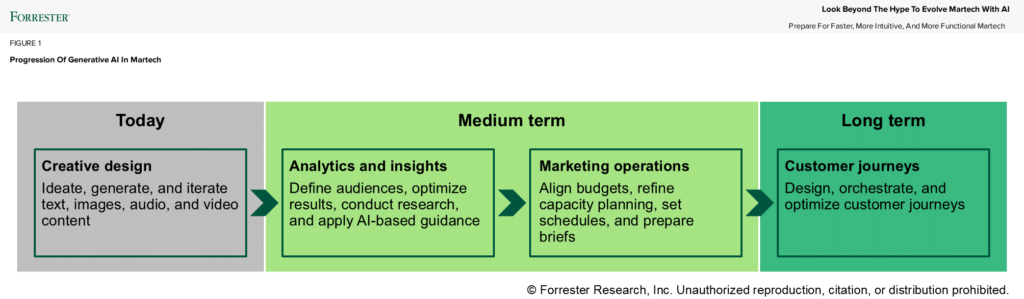
Decades ago, the alcohol industry launched its ubiquitous “Drink responsibly” marketing campaign. In 2024, it’s time to “AI responsibly” in marketing technology (martech). There are parallels between drinking and using generative AI (genAI): People often start because others are trying it; it might make things look more appealing; and you could embarrass yourself if you’ve had too much. Now is the perfect time to be methodical with genAI. Despite the hype, genAI in martech is still in its relative early stages. Last year, we envisioned the evolution of genAI use cases in martech playing out in multiple stages over time:   This is still an accurate picture of where we are today. Marketers are still dabbling in creative design, with only limited adoption for the analytics, insights, and operational assistants identified in the midterm. So this month, we published two research pieces to help marketers “AI responsibly” when planning for and incorporating new genAI capabilities into their martech ecosystems. Incorporating these learnings and resources should help marketers move past early-stage adoption stagnation. 1. Prioritizing GenAI Use Cases In Martech The B2C Martech AI Use Cases Planning Tool provides definitions for 26 martech use cases and helps marketers define the scope of their genAI adoption. The interactive tool allows marketers to select which use cases are in current use vs. prioritizing which go on the martech roadmap. The most common use cases today are content generation as well as natural language interfaces and application assistants within tools. Forrester also offers a B2B Revenue Technology Use Case Template, which can be used as a guide for creating outcome-focused use cases to gain buy-in for AI and other technology requests. 2. Operationalizing GenAI In Martech Shift Generative AI In Martech From Theory To Reality guides B2C and B2B marketers on genAI activation across four critical aspects: People. GenAI adoption is a group project across key stakeholders. Identify your core personas, which typically will span the marketer, IT, data scientist, and steward personas. Process. You’ll need an iterative approach to incorporating genAI. Follow five steps: ideate, forecast, prototype, prioritize, and activate. Implementation. There are multiple ways to access genAI for the many martech use cases. Consider genAI tools embedded in third-party technology, open or closed public large language models (LLMs), or building your own LLM. Measurement. Make a plan now for how you’ll measure genAI’s impact. Too many marketers lack defined metrics. They should measure both efficiency and effectiveness goals. There’s a lot to consider with genAI and martech, so let’s continue the conversation. Schedule a guidance session or inquiry with Katie Linford, Joe Stanhope, Rusty Warner, or Jessica Liu. source

“AI Responsibly” With GenAI In Martech Read More »

New Research: Content Management Systems Trends & Landscape

According to Forrester’s Marketing Survey, 2024, 69% of global B2C decision-makers increased their investment in content management technology, up from 59% who did so in 2023. Web content management software growth now outpaces the growth of the broader software market and is poised to reach $15.3 billion (total addressable market) by 2028. Business investment and growth in this content management system (CMS) market are primarily driven by: The proliferation of content-driven digital experiences across a growing number of digital touchpoints, which requires robust management capabilities. An increase in consumer demand for speed in their digital experiences, which requires outstanding experience delivery. Increasing investment in digital transformations generating new use cases, which requires new content-led digital experiences. New CMS Research Focuses On Business Impacts Of Emerging Features, Not Chasing Shiny Objects Through six months of research across the CMS vendor community, our October 2024 report, Strategic Technology Selection Guide For Content Management Systems, gives leaders a deeper understanding of the emerging trends in content management tech, from visual builders to content studios. Approaching the CMS landscape through the strategic lenses of business revenue and cost drivers helps leaders correctly prioritize emerging features for impact to business outcomes. Further, these two new reports help leaders develop targeted vendor shortlists amid the following challenges and trends: Communicating generative AI’s value to executives and boards. Generative AI capabilities in CMSes are impacting content operations, team efficiencies, and cost drivers across enterprises, but clearly communicating the current and future investment of CMSes enabled with enhanced genAI features remains a challenge. Selecting the right architecture and solution. Confusing messaging and varied capabilities of CMSes have made the decision between platforms vs. composability and “pure headless” vs. “hybrid” solutions more challenging than ever. Capitalizing on technology investments. The future of content management and consumption is changing rapidly. Evaluating CMS trends helps leaders balance results today while helping them evaluate emerging features that they can capitalize on as consumers and technology change. Let’s Connect As you work through your CMS strategy and selection, schedule a guidance session with me to correctly navigate the challenges and trends listed above. source

New Research: Content Management Systems Trends & Landscape Read More »

Retailers: Boost User Confidence This Holiday Season

Are your customers abandoning their shopping carts or not returning after their first purchase? Is your call center receiving repeated inquiries about information already available on your website? Is it taking too long for customers to check out? This may indicate that your customers lack the information and reassurance they need, and therefore don’t feel confident to move forward.  The UX field has long emphasized ease and effectiveness, but good UX is also shaped by whether customers feel valued, understood, and confident. User confidence is a user’s belief that a product, service, or system works as expected and is dependable.  According to the US and Canada CX Index Rankings, confidence is the top positive emotion that impacts customer loyalty. Yet we often observe that brands fail to inspire confidence in digital experiences and reassure customers that they’ve taken the rights steps or gotten to the right place.   Design For Confidence To Build Trust  Think about a customer looking for a product that they need you to deliver in two days – but they don’t know which products qualify for this option. Compare that experience to a customer who can filter products by delivery times upfront. Ultimately, both customers likely find what they need, but the second has a more positive emotional experience. When the design builds confidence, users not only complete tasks successfully but also have emotionally positive experiences that drive loyalty and build trust.  How To Increase Your Customers’ Confidence  This holiday season, take action to increase your customers’ confidence in your digital experiences. High customer engagement during the holidays is an opportunity to determine where your customers need confidence most in their journeys.   Here are four best practices you can start with:  Inform users on their progress and the result of their actions. Users hesitate to proceed on apps or websites without clear information on what happens next and they may need extra reassurance for certain tasks, such as orders and returns. What’s going to happen after clicking “continue” in the checkout flow? What’s the next step after they initiate a return? Will the user be notified about the status of their return or will they have to contact customer service for updates? Provide descriptive button language to clarify the next steps and proactively update them on their progress. Avoid coercive and deceptive design patterns. Coercive and deceptive design patterns, commonly known as “dark patterns,” manipulate customers into acting against their own interest and hurt customer trust in the long term. Fake countdown timers that create a false sense of urgency, forcing users to add an item to cart to reveal the price, and difficult cancellations are just a few examples of manipulative design patterns. Growing awareness of these practices is leading to calls for stricter regulatory guidelines and enforcement to protect customers. In July 2023, the FTC filed a complaint against Amazon for using coercive and deceptive design that trapped consumers into signing up for Prime and made it difficult to cancel the subscription. Most recently, the agency announced a final “click-to-cancel” rule that requires sellers to make the cancellation process for subscriptions and memberships easy for customers. These manipulative design patterns frustrate customers and damage loyalty — and put companies at risk of legal fines and reputation damage. Even if you’re not intentionally using these design patterns, your digital experiences may still come across as manipulative. To avoid this, evaluate your experiences by asking whether you are genuinely aiding customers in making informed decisions without obscuring or misrepresenting content.  Reduce bad friction in the UX. Friction does not always mean poor usability. In fact, designing the appropriate level of friction into customer journeys earns customer trust. For example, excessive friction – such as intrusive pop-ups, lengthy forms, or convoluted return policies – confuses users and leads to frustration and abandonment. By contrast, good friction – like requiring multiple steps in a payment process to ensure careful review – builds confidence.   Review your user flows to eliminate bad friction and increase good friction. The US government is taking action on this issue as well: The White House launched its “Time Is Money” initiative to combat corporate practices that make consumer interactions unnecessarily burdensome. That includes excessive paperwork, subscriptions that are difficult to cancel, and use of dysfunctional chatbots that provide incorrect information and make it difficult to get help from a human agent.   Provide clear guidance in forms and error messages. Clear input guidelines and error messages are essential to help users understand what information is required and why. This enhances confidence, but brands often miss it. I shared the story of how vague guidelines and error messaging impacted my choice of insurance provider in a previous blog post. Recently, while shopping with a new retailer, I was frustrated to be asked to create an account — especially since I couldn’t check out as a guest. Additionally, when prompted for my birthday without any explanation, I was left wondering if it was a legal requirement, for marketing purposes, or something else entirely.  Are you clearly communicating what information you need and why in forms? Do error messages clearly explain what’s missing and how to fix the issue? Review your digital experience with these questions in mind and make sure that usability flaws like unclear information don’t negatively impact your customers’ experience.   Let’s connect  The holiday season is a time for new beginnings — so start by enhancing user confidence in your digital experiences. If you’re a Forrester client and would like to discuss this topic further, set up a conversation with me here. You can also follow or connect with me on LinkedIn.  source

Retailers: Boost User Confidence This Holiday Season Read More »

What To Expect On Singles Day 2024: Intensified Competition, Price Wars, And GenAI

Despite slowing economic growth, Singles Day 2024 is shaping up to be one of the most competitive and innovative shopping events yet. Here are the key trends to watch: Promotions are getting bigger and starting earlier. Promotions started earlier this year, with Alibaba, JD.com, and Pinduoduo launching on October 14, 2024, a week earlier than usual. Alibaba kicked off with a 1-billion-yuan ($142 million) promotion, waiving delivery fees for Taobao orders of over 99 yuan in Hong Kong, enhancing its 88VIP membership program with benefits worth RMB 20 billion, and distributing RMB 2 billion in red packets via Taobao Live. JD.com is hosting Super Days with flash sales, free delivery on orders of over RMB 9.9, and exclusive discounts for JD PLUS members. Pinduoduo is offering dynamic pricing and personalized discounts, extending offers to international customers through its cross-border Global Sales service. Premium global brands engage in price wars. This year sees new and unusual entrants making their mark on Singles Day. To compete with Huawei and Xiaomi, Apple is offering significant discounts on its products. Discounts include a 500-yuan ($70) voucher for all iPhone 16 models and an extra trade-in subsidy of up to 1,100 yuan ($154), bringing total savings of up to 1,600 yuan ($225). The action paid off, with Apple products generating RMB 1 billion ($712 million) in orders within the first 5 minutes. Even luxury beauty brands like Estée Lauder, La Mer, and SK-II are offering deep discounts and extravagant gifts to stay competitive. E-commerce platforms leverage generative AI to improve performance. Alibaba’s AI-driven tool, Quanzhantui, supports over 250,000 merchants and 1.3 million products, optimizing sales strategies and leading to a 66% increase in GMV on the first day. JD.com enhances customer service with AI-powered chatbots providing real-time assistance and personalized recommendations. Pinduoduo uses AI to analyze market trends and consumer preferences, offering dynamic pricing and personalized discounts. Recommendations For Brands And Marketers To navigate the competitive landscape of Singles Day 2024, brands and marketers should consider the following strategies: Start early and leverage membership programs. Launch promotions early and utilize membership programs to offer exclusive benefits. This can help build anticipation and loyalty among your most dedicated customers. Innovate with limited editions and collaborations. Introduce limited-edition products and collaborate with influencers or celebrities to create buzz. This can drive sales without eroding brand value. Utilize generative AI for personalization and efficiency. Implement AI tools to analyze consumer behavior and preferences, enhance customer service, and improve personalized marketing efficiency. source

What To Expect On Singles Day 2024: Intensified Competition, Price Wars, And GenAI Read More »

US And Canadian 2024 Net Promoter Score℠ Results: Another Year Of Decline

Forrester recently published Net Promoter Score℠ (NPS) rankings for brands in the United States and Canada. As part of our annual Customer Experience Benchmark Survey, we surveyed 98,363 consumers in the United States and 43,324 Canadian consumers, asking about their likelihood to recommend brands they interacted with in the past 12 months as a measure of customer loyalty. Our analysis revealed: Overall scores suffered deep decline. NPS fell significantly for the majority of industries for both countries. NPS improved for only one industry in each country: airlines in the US and auto/home insurers in Canada. Interestingly, the investment industry is the only industry in both countries that maintained level NPS performance. Scores declined across the board. A higher percentage of brands (36% in each country) had significant decreases compared to drops in 2023. For the majority of brands, NPS remained stable and a small proportion of brands (6% in the US and 4% in Canada) improved. Many previous industry leaders prevailed. Despite drops in NPS, many industry leaders retained their top spots by continuing to outperform competitors. Top-ranked brands in 11 of 13 US industries remained on top, as did leaders in three of nine Canadian industries in the study. What to do next: Don’t compare these scores to the ones you measured internally. Even if you measure NPS internally, we don’t recommend comparing your scores directly to ours (or other third-party national benchmarks). It is not an apples-to-apples comparison, since survey methodologies and sampling differ. In most cases, the NPS you measured will probably be higher than an NPS derived by a third party such as Forrester, partly because people tend to be more candid when responding to blinded third-party surveys. Instead, focus on trended information. Ask yourself if your company’s scores are moving in the same direction as your industry or key competitors. Are your scores improving at a faster rate? These answers will be more useful than simply looking at absolute scores. Keep in mind that NPS measures loyalty, not CX quality. If your company uses NPS to gauge the success of the customer experience (CX) program, bear in mind that NPS is a loyalty metric, not a direct measure of CX quality. It is only effective at improving CX when it’s part of a CX measurement and improvement system that measures the performance of your customers’ journeys. The Net Promoter Scores in this report are more like relationship Net Promoter Scores than transactional Net Promoter Scores. As such, they tell only one part of your customers’ stories. Dig more deeply to understand drivers of customer intent. Understand key drivers of NPS and performance on specific journey-level moments of truth to more directly help you identify opportunities to improve your CX. Link information from more targeted studies, seek unsolicited and unstructured sources of customer feedback, and link to internal operational data. All of these provide additional perspectives to what happened as your customers engaged with your brand. Don’t neglect broader factors that impact customer perceptions and what they value, including your organization’s culture, employee experience, and marketplace conditions. The impact of these factors are explored in this recent Forrester report. Let’s Talk Forrester clients can schedule a guidance session with me to discuss how to interpret these scores and next steps for improving CX quality. source

US And Canadian 2024 Net Promoter Score℠ Results: Another Year Of Decline Read More »

Fujitsu’s CX Transformation: A Blueprint For B2B Success

As a global B2B technology and services company, Fujitsu has long recognized the importance of customer experience (CX) in driving business success. But a few years ago, the company’s European division decided it was time to double down on CX as a strategic imperative because it saw an opportunity to differentiate with CX, especially in B2B, and aspired to become a long-term, trusted digital transformation partner to its customers. The results have been impressive. Fujitsu Needed A Tailored Approach To Scaling CX The need for this tailored approach was because of Fujitsu’s culture, ways of working, and customer relationships. To find out more about the team’s approach, we spent time with some of Fujitsu Europe’s CX team members. A big thank you to Ben Phillips for generously giving his time, together with Avril Durnan, Mercedes Cáceres Garmendia, Katie Stabler, Leila Clare, Roel van der Heiden, and François Caffi. We published the insights in the report, Case Study: How Fujitsu Europe Scaled Its CX Transformation. Find a summary of key points below — more details are in the report. Fujitsu Europe’s CX Transformation Was Built On Four Key Pillars Ensuring CX expertise, business alignment, and accountability. Fujitsu brought in seasoned CX professionals to lead the charge, forming a customer experience performance center. It created a dedicated “CX community” that worked closely with business experts to ensure that the CX approach was practical and effective. The CX team also established clear CX accountability across the organization. Making CX “real” for leaders and account teams. Fujitsu knew that “change happens where top-down and bottom-up meet,” so it focused on showing leaders and account teams how CX could make them more successful. The team created success stories, developed frameworks to communicate the “why and how” of CX, and worked to deeply understand the challenges faced by account teams. A crucial framework was a CX maturity staircase that showed leaders and all employees where Fujitsu was and where it wanted to go (see below). Using a standardized but customizable approach to scale CX. Fujitsu knew a “one size fits all” approach wouldn’t work, so it developed a common process, tools, and templates that could be tailored to the needs of specific account teams and customers. This allowed it to scale CX transformation across the region. Focusing on value by cocreating improvements with customers. Fujitsu moved beyond just conducting annual Net Promoter Score℠ (NPS) surveys, instead working closely with customers to understand their evolving needs and cocreate solutions. This helped it uncover actionable insights and build stronger, more valuable relationships.   The Results Speak For Themselves Fujitsu’s CX transformation shows that B2B companies can drive significant business impact by elevating the customer experience. From 2020 to 2024, Fujitsu Europe saw a nearly 30-point increase in NPS for its core ICT business, as well as a 42-point increase in NPS for its digital transformation services. It also experienced strong account performance, with contract renewals, extensions, and growth. Takeaways For Other B2B Organizations Fujitsu’s approach provides critical learnings for other B2B organizations: Invest in CX expertise and make it a cross-functional effort. Bringing in seasoned CX professionals and embedding them across the organization is crucial for driving real change. Engage leaders and frontline teams alike. CX transformation requires buy-in and ownership at all levels, from the C-suite to the account managers. Balance standardization and customization. Develop a common CX framework, but empower teams to tailor it to their specific customer needs. Put the customer at the center. Go beyond just collecting feedback to truly understanding customer needs and cocreating solutions. Watch out for more content — we will publish a CX Cast recording with Ben Phillips soon. source

Fujitsu’s CX Transformation: A Blueprint For B2B Success Read More »

Double-Clicking Into The Compensation Capabilities Of Sales Performance Management

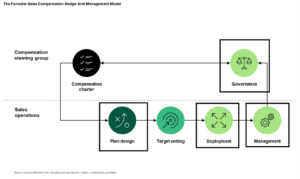
Sales compensation is one of the largest line items on most companies’ P&Ls and is a critical investment in achieving revenue goals. Optimizing this investment increases in complexity as companies grow and expand their products and sales structure, making it difficult to administer seller plans without the use of a sales performance management/incentive compensation management (SPM/ICM) solution. While sales performance management (SPM) platforms represent a broader set of capabilities such as planning, territory design, and quota management, most clients engaging with Forrester to evaluate SPM platforms focus on compensation optimization and administration, which includes plan design, deployment, management, and governance (see figure). The Forrester Sales Compensation Design And Management Model   Client requests for a better understanding of these capabilities led us to do a deeper evaluation of the incentive compensation elements of SPM platforms, which are focused on delivering: Decreased compensation administration costs by reducing manual work. The core reasons why companies buy SPM/ICM solutions are to prevent hiring additional resources or to implement technology to reduce the resources required to administer current compensation programs. These solutions allow companies to redeploy those resources to higher-priority initiatives. Reduced time to payment by better connecting performance to rewards. The combined challenge of complex compensation measures and the manual effort required to accurately pay sellers often creates lead times for payouts that result in a performance being rewarded months or quarters after they achieved their objectives. Companies want to close this gap and reward sellers at the point of success. This better connects payouts to results and keeps sellers focused on achieving current objectives. Increased motivation by enabling custom plans for complex organizations. While most organizations want simplification of their compensation plans, they also want to maximize motivation for each sales role. An SPM/ICM solution can enable organizations to maintain efficiency while also efficiently deploying compensation plans that are aligned to a wide variety of different roles in an organization. While the broader capabilities of SPM platforms are valuable, the primary goal of most clients evaluating this technology is to improve the efficiency and effectiveness of their compensation programs. Forrester’s SPM/ICM landscape and forthcoming Forrester Wave™ evaluation will focus on identifying the capabilities that are most critical and the companies that do this best. The planning elements of SPM platforms merit their own evaluation, which will follow the evaluation of this SPM/ICM market. Forrester clients can click here to read our landscape on this market. Connect with me on LinkedIn to talk more about this category and how it can improve the effectiveness of your compensation program. source

Double-Clicking Into The Compensation Capabilities Of Sales Performance Management Read More »