marketing interactive

What CMOs need to know about the APAC B2B buyer journey in 2025

The B2B buying cycle has a start and an end, but the path between the two is rarely straight. New research across 632 APAC B2B organisations by Green Hat Marketing shows that buyers are rewriting the rules of engagement, driven by AI, economic pressures, and a younger, digital-native cohort that is reshaping long-standing norms. For nearly two decades, APAC buyers have been delaying engagement with sellers until later in the journey. This was largely because accessible content made buyers self-sufficient, while Millennials and Gen Zs were only beginning to enter buying teams. Today, that rhythm has changed. Buyers are reaching out almost 12 weeks earlier than last year, contacting vendors when they are only 60% of the way through the journey. Despite evaluating slightly more vendors—an average of 5.5 per deal—the buying teams are smaller, the cycles faster, and the point of first contact has shifted dramatically. Don’t miss: Report: Over 40% of B2B deals stall due to hidden buyers  Winning the shortlist in a digital-native era Even with these changes, some truths remain. Buying parties still follow a two-phase journey: the ‘Selection Phase’, where they research, shortlist, and rank vendors, and the ‘Validation Phase’, where they confirm selections, negotiate, and contract. What has changed is the pace. The average APAC buying journey now lasts 11 months, down from 13, and the average team consists of 11 members. Yet the vendor topping the shortlist at the end of the ‘Selection Phase’ still wins 76% of the time. In fact, 95% of ultimate winners are on the shortlist from the very start, and 72% of vendors on that shortlist are established on day one. Buyers report prior experience with 73% of day-one vendors, and 80% personally know someone at the vendor organisation. Clearly, the most successful vendors enter the process with a head start. The younger generation is asserting itself too. APAC buying teams now average between 38 and 44 years old, with Millennials and Gen Zs making up 72% of members. These buyers demand transparency, frictionless information, and fewer interactions with sellers. They have run eight to nine purchase journeys on average within the same category and enter each new evaluation with a clear idea of which vendors to consider. Interestingly, while digital natives drive much of the push for self-directed research, older buyers have embraced AI tools at similar rates, meaning adoption spans all age groups. AI’s impact on the B2B buying journey AI is accelerating engagement, not just enabling it. Almost all APAC buyers report using AI to support their process, with most applications concentrated in the early and middle stages. While buyers have long been confident evaluating vendors independently, AI has highlighted critical knowledge gaps, particularly around the capabilities, costs, implementation, and security of AI-infused solutions. In fact, nearly half of buyers cite economic uncertainty as a reason to engage vendors sooner, compressing cycles further. Combined, AI and macroeconomic pressures are reversing a two-decade trend of delayed seller contact. In addition, buyers are particularly focused on understanding how AI is integrated into B2B solutions. They want clarity on functionality, pricing, model training, data storage, and security. With vendor websites often falling short on these topics, direct engagement becomes the only reliable path to insight. This has prompted a noticeable drop in the use of external consultants and analysts, falling from 77% to 56%, and fewer interactions per vendor per person—from 20 to 16. Nearly 58% of buyers report engaging with vendor representatives earlier than they otherwise would to address these AI questions. APAC in context While these trends are regional, there are notable sub-regional differences. Singapore buyers place 80% of their shortlist on day one and have prior experience with 91% of vendors, slightly higher than Australasia, Hong Kong, and Southeast Asia. Across APAC, the composition of buying teams remains consistent: requirements are mostly set before vendor contact, and prior experience continues to heavily influence final decisions. Region % of shortlist placed from day one Winner on day one shortlist Winner with prior vendor experience Avg. number of journeys in category Australia / New Zealand 72% 94% 86% 8.5 Hong Kong 70% 92% 87% 8.2 Singapore 80% 96% 91% 9.0 Southeast Asia 69% 92% 88% 8.3 Marketing’s new battlefield The implications for CMOs are profound. Traditional demand-generation strategies, MQL-focused metrics, and individual-buyer engagement models no longer suffice in this new era dominated by digital-native teams. Winning the ‘Selection Phase’ has become critical; 76% of the time, the preferred vendor at this stage becomes the ultimate winner. Brands must invest in discoverability across search and AI tools, build content that strengthens preference at point-of-first-contact, and rebalance budgets toward brand-building rather than demand-generation. Account-based marketing is no longer optional. Engaging the entire buying party with persona-based content is crucial, whether for reputational or solution-focused buyers. Thought leadership must be tailored for industries and personas, while sellers need ready-to-go materials to answer questions on AI capabilities, data privacy, security, pricing, and training. Measurement models must evolve, shifting from clicks and MQLs to holistic engagement metrics across the journey, including share of search, buying-party engagement, Marketing Qualified Accounts, and pipeline uplift. Ultimately, CMOs must ensure that the C-suite understands the new reality: decisions are increasingly made before sales ever enters the picture. Marketing must take the lead in winning the shortlist battleground, guiding the buying party, and opening the gates for Sales to convert. In this fast-moving landscape, adapting to the digital-native, AI-empowered, and economically cautious buyer is no longer a competitive advantage—it’s table stakes. Related articles:   Study: 94% of B2B marketers in SG struggle to capture audience attention  Report: B2B marketers still struggle to reach the right audiences, but AI may help Why proving ROI is the new battleground for B2B marketers  source

What CMOs need to know about the APAC B2B buyer journey in 2025 Read More »

Weber Shandwick strengthens leadership in China and across APAC

Weber Shandwick has announced a series of leadership and structural updates aimed at strengthening its business in China and across Asia Pacific, reflecting the agency’s continued investment in growth sectors and client priorities. Corbin Hsieh has been appointed head of Weber Create and consumer practice for APAC, where he will lead the agency’s earned-first creative and integrated media offering. Based in Shanghai, Hsieh will work closely with market leaders across the region to expand creative capabilities and drive new opportunities for clients. Hsieh previously served as managing director for China, navigating a challenging market while elevating the firm’s people and client work. “My passion lies in the consumer side of business, where creativity and cultural understanding drive impactful work,” he said. “Our goal is to connect culture, influence, and creativity to help brands succeed in a fast-changing world.” Don’t miss: Weber Shandwick promotes Arif Rajab to general manager of SG To ensure smooth leadership transition, Robert Magyar has been named acting managing director for China, while continuing in his role as executive vice president and head of healthcare for APAC. Based in Beijing, Magyar brings more than two decades of business leadership experience spanning China, Indonesia, Japan, Switzerland, and the U.S. Since rejoining Weber Shandwick last year, he has helped grow the healthcare practice into one of the firm’s strongest pillars. In his expanded role, Magyar will focus on driving client growth and maintaining momentum in China. “China is one of the most dynamic markets in the world, where reputation and stakeholder engagement are more important than ever,” he said. Weber Shandwick has also strengthened its public policy and advisory offering with the integration of Bridge Beijing, a strategic communications agency known for helping international organisations engage with China. Founded in 2016, Bridge Beijing has advised leading global health organisations, philanthropic foundations, and NGOs, including a longstanding partnership with the Gates Foundation. The integration brings additional sector expertise and local insight to Weber Shandwick’s global network, enhancing its ability to deliver impactful, locally informed strategies. Tyler Kim, CEO, Weber Shandwick APAC, said the moves represent “a significant milestone in advancing our capabilities and deepening our commitment in China.” He added, “By combining proven local expertise with the strength of our global creative network, we’re uniquely positioned to deliver innovative, high-impact solutions for clients navigating an increasingly dynamic market landscape.” Related articles:Weber Shandwick strengthens APAC client experience with new VPWeber Shandwick strengthens APAC sustainability team with new VPWeber Shandwick strengthens ops in HK, China and SG source

Weber Shandwick strengthens leadership in China and across APAC Read More »

In conversation: Reinventing influence in the age of content

In the latest episode of MARKETING-INTERACTIVE’s Marketing Connected podcast series, “In Conversation,” Tjin Lee, the head of Southeast Asia for Gusto Collective, shares about how social media has always been more than a marketing platform, and how it’s been a mirror of her own evolution. From her early days posting pictures of her baby to her current voice on women’s empowerment, entrepreneurship, and aging, Lee’s digital journey reflects both personal growth and professional insight. Don’t miss: In conversation: What’s next for MARKETING-INTERACTIVE Australia Her foray into social media began as a simple experiment. “I started an account to explore what was then, a new platform,” she recalled. “It was personal, just me posting pictures of my chubby baby dressed up in funny costumes.” What began as a mom account soon transformed as Lee’s career and interests evolved. “As the children got older, I didn’t want them in front of the camera. So my content shifted to things I cared about, such as entrepreneurship, women’s empowerment, and how we age with confidence.” Lee is quick to distinguish between being an influencer, and being influential. For her, creating content is an extension of her work as an agency lead. “If you don’t get in there and play with social media yourself, how can you advise clients?” she said. It’s like trying to sell a car when you don’t know how to drive. That hands-on approach has shaped how she leads her team and guides luxury clients navigating a fast-changing digital landscape. She treats social media like a living laboratory, where she constantly experiments with formats, timing, and tone. “It’s captivating,” she said. “You post stories after a reel, and your views spike by 20%. You learn that you only have 0.8 seconds to capture attention before someone scrolls past. If your first frame is a product shot, you’ve already lost them.” Her fascination with digital behaviour ties neatly into Gusto Collective’s mission of blending creativity with technology. As a veteran of the fashion and luxury marketing world, Lee sees social media not as a threat to high-end storytelling but as a new kind of stage, one where authenticity and engagement are the true currencies of influence. Social media is no longer about posting pictures of your latte anymore, or about an aesthetic feed. “I use it as an extension of my voice, where I can share about entrepreneurship, women empowerment, and empowered aging. I feel like the world could do with more role models in these pillars,” Lee shared.  And while she continues to evolve her voice online, Lee remains clear-eyed about her purpose. “For me, it’s about connecting meaningfully—with women, with entrepreneurs, with anyone navigating change. The older I get, the more powerful I feel.” Catch the full conversation here in this video: Tune into the rest of this conversation on your favourite podcast platforms, by searching up Marketing Connected. For all the visual people out there, we’ve got your back as well, with our vodcasts on YouTube. Accelerate your brand’s growth with AI-first strategies, emerging tech and data-driven experiences. Join the industry’s leading marketers at Digital Marketing Asia 2025 Malaysia on 30 October to uncover transformative trends, real-world wins and powerful ideas for 2025 and beyond. Related articles: In conversation: How tech is powering a global tea brand Gusto Collective expands into SEA with acquisition of Mercury Integrated Gusto Collective expands across SG and MY with new business wins source

In conversation: Reinventing influence in the age of content Read More »

Circles.Life parent sues M1 over breach of mobile network deal

Circles.Life parent company Liberty Wireless has filed a lawsuit against M1 over alleged refusal to negotiate amendments to a 2019 mobile virtual network contract in line with Singapore’s wholesale framework for mobile services. In a filing on the Singapore Exchange on 13 October seen by MARKETING-INTERACTIVE, Keppel, which owns M1, said Liberty Wireless had commenced a High Court action against M1 over its contract dated 22 May 2019. Liberty Wireless claims M1 has wrongfully refused to enter good faith negotiations to amend or vary the 2019 contract to address implications of the Infocomm Media Development Authority’s wholesale framework issued in January 2020. The company is seeking a court declaration obliging M1 to negotiate within 14 days and may also pursue rectification of the contract if errors or mistakes are found. Don’t miss: Keppel to divest M1’s telco business to Simba in SG$1.43b deal M1 has engaged legal counsel and said it does not consider the allegations meritorious, intending to vigorously defend its position.  Keppel said it does not expect the legal proceedings to affect or delay completion of the proposed transaction. The company said it will update the market on any material developments and advised shareholders to exercise caution when dealing in its securities. “The Company will make appropriate announcements in the event of any material developments. Shareholders are advised to exercise caution when dealing with the shares or other securities of the Company. Shareholders should consult their stockbrokers, bank managers, solicitors or other professional advisors if they have any doubt about the actions they should take,” said Keppel in the filing.  The dispute comes amid Keppel’s ongoing sale of M1. In August 2025, Keppel’s wholly owned subsidiary Keppel Konnect, together with Konnectivity, entered a sale and purchase agreement with Simba Telecom for the sale of M1. The transaction will see Keppel receive close to SG$1 billion in cash proceeds for its 83.9% effective stake, subject to post-completion adjustments. Keppel will retain M1’s fast-growing ICT business, which complements its integrated connectivity portfolio including data centres and subsea cables. The deal values M1 at 7.3 times EV/EBITDA, which Keppel described as an “attractive” valuation. The proposed transaction is expected to reshape Singapore’s telecommunications sector by consolidating two agile, digitally-driven players with track records in innovation. Combining M1’s cloud-native network and hyper-personalised service capabilities with Simba’s digital consumer model could unlock synergies in network and infrastructure, creating what Keppel calls a “nimble and competitive digital-first telco” to support Singapore’s digital economy. Related articles:  Business Insider sues Google over alleged monopolisation of digital ad market Warner Bros. sues Midjourney over AI use of Superman, Batman and other iconic characters  Grab SG abandons acquisition of Trans-cab  source

Circles.Life parent sues M1 over breach of mobile network deal Read More »

Salesforce deepens ties with OpenAI to bring enterprise data into ChatGPT

Salesforce and OpenAI have announced a wide-ranging partnership that will bring Salesforce’s Agentforce 360 platform directly into ChatGPT, allowing businesses to access CRM data, customer conversations and Tableau visualisations inside the conversational interface for the first time. Unveiled during the opening session of Dreamforce 2025 in San Francisco, the integration marks a major convergence between enterprise systems and generative AI. It also gives OpenAI’s frontier models, including GPT-5, a deeper foothold in business workflows by embedding them within Salesforce’s customer and commerce applications. SEE MORE: Salesforce opens the age of ‘Agentic Enterprise’ The partnership lets companies query sales records, analyse customer sentiment and generate data-driven insights simply by typing into ChatGPT. Salesforce’s enterprise logic and governance layer remains intact, with all activity governed through its Atlas Reasoning Engine. Businesses can also use OpenAI models inside Salesforce to build intelligent agents and prompts within the Agentforce 360 Platform. Marc Benioff, chair and CEO of Salesforce, described the move as a “natural step” in the company’s push toward what he calls the “age of the Agentic Enterprise.” “As consumers, we already get instant recommendations or insights from ChatGPT,” Benioff said. “Now enterprises can deliver that same intelligence and immediacy. By uniting the world’s leading frontier AI with the world’s #1 AI CRM, we’re creating the trusted foundation for companies to become Agentic Enterprises.” For employees, the partnership means Salesforce tools will soon surface in ChatGPT’s app ecosystem, giving authorised users access to customer data and Tableau dashboards within a secure conversational environment. ChatGPT’s capabilities are being woven into Salesforce-owned Slack, allowing teams to summarise conversations, generate content and surface insights in the flow of work. Developers will also be able to tag OpenAI’s Codex agent inside Slack channels to write or edit code based on natural-language instructions. “We believe that AI systems are going to unlock potential for humanity levels that we today can’t even comprehend,” Brad Lightcap COO OpenAI, told delegates during on the opening day of Dreamforce.  OpenAI CEO Sam Altman said the goal was to make AI feel more embedded in everyday workflows. “Our partnership with Salesforce is about making the tools people use every day work better together, so work feels more natural and connected,” he said. “It’s an important step in how AI can improve daily workflows under our efforts together.” The collaboration also extends into commerce. A new experience will allow merchants using Agentforce Commerce to surface product listings directly inside ChatGPT, with purchases handled through Instant Checkout. The system uses Salesforce’s Agentic Commerce Protocol and Stripe infrastructure to enable privacy-compliant, tokenised transactions without losing control of customer data. Benioff positioned the integration as the next phase of enterprise AI – one that moves beyond siloed apps toward multi-surface, conversational experiences. “The tools we use to work and shop are blending,” he said. “AI isn’t just in the background anymore – it’s the interface.” source

Salesforce deepens ties with OpenAI to bring enterprise data into ChatGPT Read More »

Asahi Super Dry launches first global brand platform ‘Seek What Is Unique’

Asahi Super Dry has unveiled its first global brand platform, Seek What Is Unique, created by Havas London in collaboration with Havas Creative Network agencies across Australia, Asia and North America. The campaign marks Havas’ first work for the brand since being appointed global creative agency outside Japan in December 2024. It introduces a unified creative and design platform celebrating Asahi’s distinctive brewing process and its signature Karakuchi taste – the beer’s crisp, dry flavour profile that has helped make it a global icon. The campaign launches in Australia with a cinematic 30-second film shot in the heart of Tokyo by award-winning directing duo Alaska, through production company Iconoclast. The story follows two friends on a night-time adventure through neon-lit streets and hidden alleys before discovering a modern bar featuring a singing puffer fish – a symbol of Japan’s blend of tradition and modernity. Outdoor activations will bring the new brand world into Australian cityscapes, including 3D-enabled billboards and a 360 immersive cube in Sydney’s World Square. Influencer collaborations will spotlight Melbourne’s fashion culture and Sydney’s food and arts scene, encouraging consumers to seek out unique experiences. In January 2026, Asahi Super Dry will extend the platform through its Australian Open partnership, where it will host a Seek What Is Unique bar experience on the Grand Slam Oval and a full trade precinct takeover. “Seek What Is Unique is a celebration of what makes Asahi Super Dry a standout in Australia,” Ben Eyles, head of beer at Asahi Beverages, said. “We’ve seen phenomenal growth locally, with Aussies embracing the crisp taste and modern Japanese edge that sets it apart. This new platform brings that uniqueness to life in bold, immersive ways – from 3D billboards and influencer-led storytelling to a major presence at the Australian Open.” Globally, the campaign is supported by a new design system that unites Asahi Super Dry’s visual identity across markets. Drawing on contrasts between precision and boldness, it introduces a refreshed colour palette, graphic language, tone of voice, and product photography – reflecting what the brand describes as “modern Japanese style.” Małgorzata Lubelska, global and category brand director at Asahi Europe and International, said the new platform “marks a confident and bold step forward in our global brand journey to drive growth. We are celebrating the unique taste of the No.1 Japanese beer as well as the unique culture of modern Japan, tapping into relevant consumer trends, through originality, modernity, and the spirit of discovery.” Mark Whelan, chairman and UK group chief creative officer at Havas UK, added: “Asahi Super Dry is a genuinely unique beer, in the way it is made and its taste experience. We are honouring that with a cinematic adventure set in the unique and iconic city of Tokyo – blending modern aesthetic with traditional roots – just like the brand itself.” The Seek What Is Unique platform rolls out globally across TV, digital, OOH, and experiential from this month, with Australia serving as one of the first launch markets. source

Asahi Super Dry launches first global brand platform ‘Seek What Is Unique’ Read More »

PepsiCo says it will be ‘agentic AI-first’ by 2026; Dell and Accenture say reinvent or be replaced

PepsiCo has declared itself on track to become the first global brand to operate as an “agentic AI-first” enterprise by 2026, as some of the world’s biggest corporate leaders outlined how artificial intelligence is reshaping the fundamentals of business at every level.  Speaking at during the opening keynote of Salesforce’s Dreamforce 2025 conference in San Francisco, executive vice president and chief strategy and transformation officer Athina Kanioura told the audience that PepsiCo’s agentic AI transformation will touch every part of the company, connecting strategy, innovation and operations through Salesforce’s Agentforce 360 platform. “We will be agentic in every part of the business by the end of 2026,” Kanioura said.  “We will be the first company to be agentic AI-first by the end of 2026 in every part of the business, connecting all operations, connecting all our processes, the way we think of the business and strategise the business, the way we do innovation, commercialisation, execution and making sure that every employee in the company has a sales and growth mindset. We are all about profitable growth.” SEE MORE: Salesforce opens the age of ‘Agentic Enterprise’ Kanioura credited Salesforce as a key partner helping embed AI across the organisation, from marketing and sales to customer service and supply chain.  “We want every employee to do what is possible and reach their full potential,” Kanioura (pictured below) said. “That’s why we have been working with across the whole gamma and spectrum of marketing, sales, service and field, through Slack and even supply chain.” While PepsiCo is setting the benchmark for full-scale adoption, Dell Technologies chair and CEO Michael Dell used the same stage to issue a stark warning about complacency. “I think we all woke up around November of 2022 and saw these incredible models, and it really created an opportunity to unlock the power of all the dark data that exists in the world,” Dell said. “If we don’t really get on this, a new company is going to come along and it’s going to put us out of business.” Dell told his team that the only way to stay ahead of disruption was to become the company that could potentially displace them.  “We’ve totally reset the business, reimagined the business and I think all companies will have to do that from a competitive standpoint,” he said. Adding another layer to the discussion, Julie Sweet, chair and CEO of Accenture, described AI transformation as a leadership test as much as a technological one. “We call it reinvention. The first thing you have to do is to say, ‘I’ve got to reinvent everything,’” Sweet said. “Every day I look at how we’re operating as a company, and if I don’t see myself saying, ‘Here’s how we used to do it, and here’s how we’re going to do it,’ and there isn’t a big delta, a big difference, then I know I’m not serving my clients and my employees enough. It’s not just a small thing – it’s about reinventing.” Together, the three leaders underscored how the agentic era is reshaping business strategy across industries – not just in technology but in consumer goods, infrastructure and professional services.  From PepsiCo’s operational overhaul to Dell’s reinvention drive and Accenture’s cultural reset, the message from Dreamforce 2025 was clear: in the next wave of AI transformation, every company will have to become the disruptor before it gets disrupted. source

PepsiCo says it will be ‘agentic AI-first’ by 2026; Dell and Accenture say reinvent or be replaced Read More »

NTUC LearningHub energises lifelong learning with fresh campaign and tagline

NTUC LearningHub (NTUC LHUB) has unveiled its latest brand campaign for 2025/2026, featuring a new tagline, a brand film, and a comprehensive media strategy.  The campaign aims to strengthen NTUC LHUB’s position as Singapore’s leading provider of Continuing Education and Training in an increasingly competitive adult learning landscape. At the heart of the campaign is a brand film conceptualised and produced by Lioncat Films, which highlights NTUC LHUB’s mission to empower individuals and organisations through lifelong learning. The film conveys the message that upskilling and reskilling are not just career necessities but can also lead to personal growth and transformation. Don’t miss: FairPrice adds heart to the hustle of daily errands  Complementing the film is the refreshed tagline, “Learn your life around”, which underscores the brand’s commitment to making learning practical, accessible, and transformative for all workers—from executives and professionals to youth and rank-and-file employees across industries. The new line reinforces NTUC LHUB’s positioning as ‘Your trusted partner in lifelong learning’. To amplify the campaign’s reach, Lioncat Films also spearheaded the media buy across digital and outdoor platforms, ensuring the message connects with a broad audience in Singapore. “We wanted to create a campaign that feels forward-looking, progressive, and full of energy, while keeping the focus on what matters most—empowering our learners,” said Soh Hooi Peng, chief strategy officer, NTUC LearningHub. “The message that you can ‘Learn Your Life Around’ encapsulates the transformative power of lifelong learning in a fresh, clever, and memorable way. We’re delighted with how the agency brought this to life through creative and impactful storytelling,” added Soh.  Leo Poloniecki, creative director at Lioncat Films, added, “NTUC LearningHub had an appetite for fresh thinking and dynamic storytelling—so this brief represented an opportunity for us creatively. With the new film, tagline, posters, and a thoughtful media rollout, we’re proud to have helped the brand reach out to the nation in a way that’s relevant to today’s fast-changing employment landscape.” The campaign is now rolling out across major digital channels, out-of-home media, and video platforms, marking the latest chapter in NTUC LearningHub’s ongoing efforts to champion lifelong learning in Singapore. As part of the broader NTUC ecosystem, NTUC LearningHub’s campaign complements initiatives from FairPrice Group, which is highlighting everyday innovations that make life “a little better” for young Singaporean families in its own campaign, “Every day, made a little better”. While NTUC LearningHub focuses on personal growth and career transformation through lifelong learning, FairPrice Group emphasises practical support and meaningful daily experiences for households. Together, the campaigns showcase NTUC’s dual commitment to empowering individuals professionally and improving everyday life across the nation. Related articles:  NTUC, SISEU to support We. Communications workers hit by layoffs  NTUC concludes creative pitch  NTUC Enterprise and Income Insurance rebuts former CEO’s open letter  source

NTUC LearningHub energises lifelong learning with fresh campaign and tagline Read More »

Salesforce opens the age of ‘Agentic Enterprise’ amid fastest innovation cycle in its history

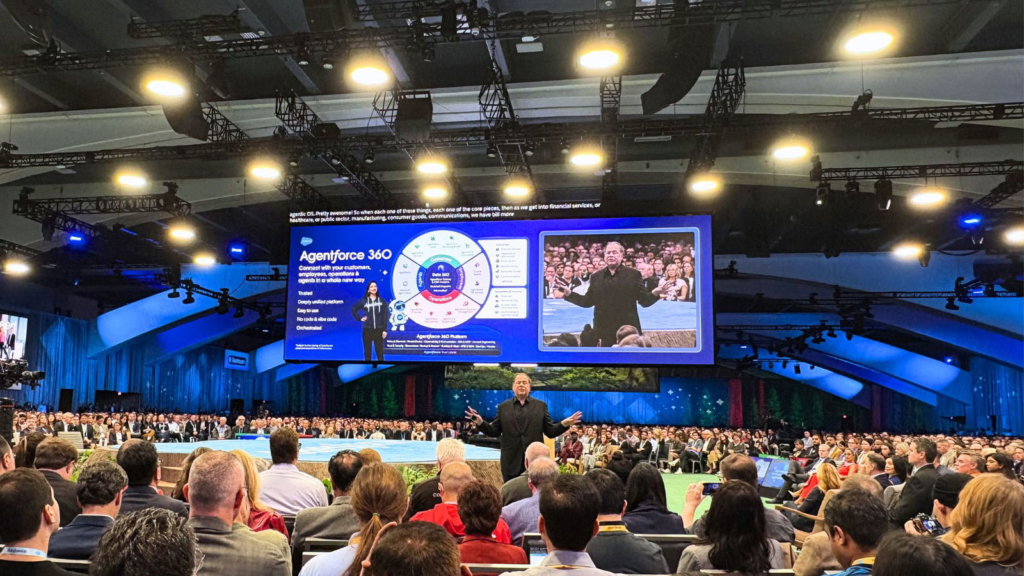
It’s been almost one year since Salesforce introduced its Agentforce technology to the world, but in that short time the company says it has already begun to reshape how the future workforce, marketing, customer journeys and CX will operate at scale. The company’s latest release, Agentforce 360, aims to bridge what Salesforce chair and CEO Marc Benioff calls the “agentic divide” – connecting human employees with AI agents to supercharge business systems at every stage. Speaking during the opening keynote of Dreamforce 2025 in San Francisco, Benioff said Agentforce 360 would unleash a new model of productivity – one grounded in data, governance and measurable impact – and push innovation faster than any technology in the company’s history. “We didn’t really have the ability to envision how much progress we would make a year ago, but it’s gone so fast,” Benioff said. “A year ago, Agentforce was a product. Now it’s a platform. It’s what everything Salesforce has to offer. I think the demonstrations are incredibly compelling.” Benioff said Salesforce has entered a phase where the pace of innovation has surpassed even customer adoption. “This is the moment where this technology innovation is outstripping customer adoption. Our job is to get those customers into adoption mode,” he said. One of those customers is global snacks giant PepsiCo, which has embraced agentic AI at scale and plans to be “agentic AI-first” by the end of 2026. Athina Kanioura, PepsiCo’s executive vice president and chief strategy and transformation officer, told attendees that PepsiCo’s transformation will touch every part of the company – connecting strategy, innovation and operations through Salesforce’s Agentforce 360 platform. “We will be agentic in every part of the business by the end of 2026,” Kanioura said. “We are the first company which will be agentic AI-first by the end of 2026 in every part of the business – connecting all operations, connecting all our processes, the way we think of the business and strategise the business, the way we do innovation, commercialisation, execution, and making sure that every employee in the company has a sales and growth mindset. We are all about profitable growth.” Innovation from the top Across the opening day of Dreamforce 2025, some of the world’s biggest brands said this was not a time to be complacent – and that innovation must start from the top. David Walmsley, chief digital and technology officer at Pandora, described this new customer environment as a make or break moment “It’s a massive strategic play for us. It’s not a new project or a new initiative – it is the future. This is where our business is heading. “The CEO needs to lead the AI revolution inside an organisation. Absolutely, it starts at the top, because it has to change every part of the organisation. For us, that starts with the brand. It starts with the customer and customer engagement. That’s why we’re so excited about this journey.”  Walmsley said around 24% of Pandora’s business was online, but that 98% of our customer relationships start in the digital space. He described the company’s push towards agentic AI as beginning on a new era.  “This is the internet again, this is electricity. It’s that important to us. But change has to start at the top.” Dell Technologies chair and CEO Michael Dell went further, saying that brands that fail to act now do so at their own peril. “If we don’t really get on this, a new company is going to come along and it’s going to put us out of business,” Dell said. “I think we all woke up around November of 2022 and saw these incredible models, and it really created an opportunity to unlock the power of all the dark data that exists in the world.” Benioff echoed that sentiment, noting that the pace of innovation has reached a level few could have predicted – and that innovation itself has become the new competitive pressure. “We’re in a moment in AI where we can’t believe the rate of change and innovation. I’m sure everybody wakes up and goes, wow, that’s amazing. This is unbelievable. Nvidia sold who to what and who gave what to whom. It’s beyond our expectation.” He added that even amid rapid change, Salesforce remains focused on listening closely to customers. “We are all just listening to the customer more deeply, because the answers remain with the customers – and that’s who’s guiding us.” Benioff said the company is investing heavily in its Agentforce platform and moving faster than it ever has before. “We’re investing huge amounts in Agentforce, huge amounts. But listen to this – we have gone faster with Agentforce than we have with any other technology we’ve created,” he said. “Now you’re going to see a new Agentforce – one built on every app we make. One with voice, one that is predictable and accurate, one that is intelligent and with context.” And context, he said, is everything. “If you don’t have your data, you don’t have your context. You need that deep data integration, and that is something we have learned.” Benioff said the vision behind Agentforce 360, unveiled during the keynote, is to connect humans, agents and data on one trusted platform. “Agentforce 360 connects humans, agents and data on one trusted platform, helping every employee and every company achieve more than they ever thought possible,” he said. The week-long conference, drawing around 50,000 people, sets the stage for the next chapter of enterprise AI. Salesforce’s message is simple but ambitious: AI won’t replace people – it will work alongside them. And the company is staking its reputation, and billions of dollars, on making that happen. A structural shift Co-founder Parker Harris called it “the biggest transition in technology” of his career, predicting that by 2029, 40% of the work in the Fortune 1000 will be done by AI. It’s a headline figure, but also a signal that Salesforce sees AI not as a background tool, but as a structural shift

Salesforce opens the age of ‘Agentic Enterprise’ amid fastest innovation cycle in its history Read More »

Trip.com and Live Nation Asia elevate concert travel experience

Travel platform Trip.com Group has forged a multi-year strategic partnership with Live Nation Asia, global live entertainment company, to integrate travel and live music experiences across key Asian markets. Launching across Hong Kong, Macau, Singapore, Thailand, South Korea and Mainland China, the collaboration will allow fans to plan concert-focused trips — combining exclusive presale access to shows with flights, hotels, and curated local experiences through Trip.com’s platform. This partnership marks Trip.com Group’s first step into the live entertainment travel space, reinforcing its commitment to meeting evolving traveller demands and reflecting how tourism, hospitality, and live entertainment are coming together in new ways. The partnership creates room for collaboration with local hotels, attractions, and tourism stakeholders in these markets, building concert-driven products and experiences that encourage more bookings, longer stays, and greater destination appeal in Asia. The inaugural launch of this partnership introduced exclusive bundled experiences for the K-pop group TWICE’s Hong Kong tour. As the official travel partner for the TWICE world tour in Hong Kong, Trip.com offered fans early presale access, curated hotel packages, and convenient transport options. Expanding beyond Hong Kong, similar travel bundles and early access opportunities will be available in five other Asian markets, giving fans a chance to see both global and regional superstars. These packages may combine concert tickets with popular attractions such as Hong Kong Disneyland, Rainforest Wild ASIA, sightseeing bus tours, and hotel stays—creating a comprehensive and elevated travel experience. Following its role as BLACKPINK’s official sponsor in Bangkok and Hong Kong, Trip.com is also providing presale access for the upcoming BLACKPINK world tour stops in Singapore and Hong Kong. The move comes as Trip.com recognises that live music becomes a growing driver of travel, and the partnership is designed to empower fans to follow the artists they love while supporting regional tourism and elevating destination appeal in Asia.According to Trip.com’s Momentum consumer survey, which highlights the next big trends in travel, nearly 66% of Asia Pacific travellers are willing to travel internationally for concerts, with Gen Z and Millennials leading the trend. In Singapore, hotel bookings tripled during Lady Gaga’s Asia-exclusive show, while in Hong Kong, over half of concertgoers extended their stay for leisure, driving revenue across tourism sectors. Artists are also adding shows in cities such as Singapore, Bangkok, and Seoul, establishing these cities as must-visit music hubs. “Today’s music lovers are embracing immersive experiences that extend far beyond the concert itself,” said Bo Sun, chief marketing officer, Trip.com Group. “Through partnerships like this, we are enhancing the travel journey, adding value for fans and unlocking new cultural and economic value for destinations and the wider industry in Asia. Together, we’re proud to pioneer the future of tourism through entertainment.” “Concert travel is redefining tourism across Asia,” said James Dick, EVP of partnerships and media, Live Nation Asia. “Together with Trip.com, we’re helping fans turn concerts into unforgettable trips that shape the culture of entire cities.” MARKETING-INTERACTIVE has reached out to Trip.com for more information.  Take your brand to new heights with cutting-edge AI strategies, innovative technology, and data-powered experiences. Don’t miss Digital Marketing Asia 2025 in Hong Kong on 20-21 October, where 200+ marketing leaders will explore game-changing trends, proven successes, and bold ideas shaping the future. Related articles: Trip.com Group empowers travellers with new suite of AI capabilitiesTrip.com checks out with Asia PR Werkz for regional duties source

Trip.com and Live Nation Asia elevate concert travel experience Read More »