ABrandADay’s AI-led work with Senoko Energy earns double silver at MARKies 2026

This post is sponsored by ABrandADay. Artificial intelligence took centre stage for ABrandADay at the MARKies Awards Singapore 2026, where the branding consultancy picked up two silver trophies for its work with AiChat for Senoko Energy. The agency was recognised for “Most Effective Use – Artificial Intelligence” and “Most Effective Use – Marketing Automation”, spotlighting a body of work that went beyond a single campaign, and instead, reflected a broader and evolving approach to how AI can be embedded into marketing communications. Rather than treating AI as a one-off activation, the collaboration between ABrandADay, AiChat, and Senoko Energy was built as an ongoing capability. From tactical executions to more thematic brand campaigns, AI was applied as a layer across the marketing ecosystem to improve how the brand communicates, responds, and converts. At the core of this was a closer working model. ABrandADay operated as part of Senoko Energy’s fractional marketing team, allowing both sides to test, adopt, and respond to emerging technologies in real time. This proximity enabled faster iteration cycles, tighter feedback loops, and a clearer line of sight between experimentation and business outcomes. According to the teams, this approach was especially critical given the initiative marked one of Senoko Energy’s first meaningful steps into AI within its commercial function. Without a fixed road map, the work required constant calibration – balancing ambition with a practical application. The result was a system that was less about isolated innovation and more about sustained integration. AI was not treated as a headline feature, but as an integrated tool that enhanced everyday decision-making across the campaigns. From experimentation to embedded capability The MARKies recognition suggested this approach was beginning to resonate. In a landscape where AI is often positioned as a buzzword, the work demonstrated a more grounded application. Automation and intelligence were used to streamline processes, personalise engagement, and optimise performance, rather than simply add novelty. This reflects ABrandADay’s broader philosophy. The agency has increasingly focused on building capabilities within client organisations, rather than delivering standalone outputs. The role of the fractional model This shift is closely tied to its move towards a fractional CMO and CBO model. By embedding senior marketing leadership within the client teams, ABrandADay is able to work alongside internal stakeholders on a continuous basis. This creates the conditions needed for AI adoption to take root, as strategy, execution, and optimisation are handled within a single loop. The fractional model also allows for a more responsive approach to change. As new tools and technologies emerge, teams can assess and implement them without the delays that often come with more traditional agency structures. “Today, organisations want more than a set of recommendations. They want someone who can roll up their sleeves, take ownership, and build something that lasts. That is how we partner clients such as Senoko Energy, the Institute of Singapore Chartered Accountants, and TheSeafoodCompany,” said ABrandADay’s chief creative officer, Nafe Tong. Two patterns converging The wins at MARKies 2026 highlighted the convergence of two key developments shaping the marketing landscape. The first is the growing role of AI in driving marketing effectiveness. As tools become more accessible and sophisticated, the focus is shifting from experimentation to application. Brands are under increasing pressure to demonstrate how AI can deliver measurable impact, whether through improved targeting, efficiency or the customer experience. The second is the rise of fractional leadership models. As organisations look for more flexible and accountable ways to access senior expertise, the traditional agency-client dynamic is evolving. Fractional arrangements offer a middle ground, combining a strategic oversight with a hands-on execution. “Our work with Senoko Energy sat at the intersection of these shifts. By embedding ourselves within the client team while leveraging AI across the marketing funnel, we positioned ourselves as both a strategic partner and an operational driver,” said ABrandADay’s chief executive officer, Jas Seow. Beyond the awards While the double silver victories marked a significant milestone, it also pointed to a broader direction of AI. AI is no longer a future-facing concept. It is becoming a core part of how marketing functions operate day to day. At the same time, the structures through which marketing is delivered are changing, with more fluid, integrated models gaining traction. If anything, the MARKies recognition signals the industry is beginning to reward not just bold ideas, but the systems and ways of working that allow those ideas to scale. And increasingly, that may depend on how well brands can combine the right tools with the right structures to make them work. source

ABrandADay’s AI-led work with Senoko Energy earns double silver at MARKies 2026 Read More »

Homo erectus may have passed a genetic legacy down to modern humans after all

Sally Christine Reynolds, Bournemouth University/ The Conversation For most of the 20th century, the model of human origins was a tree: with the trunk dividing into branches, and then twigs. Each species of human relative (hominin) was a neat, single branch. As an undergraduate, I was taught that Homo sapiens was one of these branches that emerged in Africa, spread across the world, and displaced every archaic human it encountered. Neanderthals, Homo erectus, and other ancient relatives were evolutionary dead ends – unfortunate cousins who left no descendants. In the 30 years since I left university, those early lessons are now radically revised. That neat replacement story is now comprehensively wrong, largely thanks to studies like the one published in Nature this week by Qiaomei Fu from the Chinese Academy of Sciences and colleagues. The paper achieves something that would have seemed impossible a decade ago: it recovers meaningful biological information from H. erectus fossils far too old for DNA. Instead of genetic sequences, the team extracted ancient proteins from the enamel of six teeth from three Chinese sites – Zhoukoudian (which, in the early 20th century, produced fossil remains known as “Peking Man”), Hexian and Sunjiadong – all dating to around 400,000 years ago. Homo erectus is widely regarded as the first hominin to leave Africa; the evidence suggests this species had moved into Eurasia nearly two million years ago. It remains the most geographically widespread human ancestor that ever lived. The new study indicates that Homo erectus exchanged genes (probably through interbreeding) with Denisovans in East Asia roughly 400,000 years ago. The study suggests that some of that genetic legacy, it now appears, was passed on to living people in the Philippines, Papua New Guinea, and across south-east Asia. Tooth enamel is the hardest tissue in the body, and its proteins survive long after DNA has degraded beyond recovery. What the team found in those proteins is striking. All six specimens share a previously unknown amino acid variant – a tiny molecular signature, a single letter changed in the protein sequence, never seen in any other hominin alive or dead. This variant clusters these East Asian H. erectus into a distinct group, confirming their identity and settling a long-running debate about whether the unusual Hexian fossils were H. erectus at all. A second variant they share, however, is not unique to H. erectus. It also appears in Denisovans – a mysterious archaic (non-Homo sapiens) human group known mainly from a cave in Siberia. The corresponding genetic variant turns up in living people at frequencies of 21% in the Philippines and about 1% in India, distributed in a pattern that matches what we’d expect if it entered modern humans via Denisovan ancestry. The most reasonable interpretation is that H. erectus populations in East Asia passed this variant to Denisovans through interbreeding, and Denisovans later passed it on to the ancestors of modern Southeast Asians and Oceanians. This transfer of genetic material from one species to another is known as introgression. The lineage we once thought was a dead end has, it turns out, left a small but detectable trace in living human genomes – a molecular thread connecting a Peking Man tooth to living people in Asia. A pattern repeated But the significance of today’s paper extends well beyond the specific variant or the specific populations involved. What it really shows is that interbreeding between archaic human lineages was not exceptional. It was routine. Every major hominin lineage we have been able to examine genomically shows admixture. Modern humans outside Africa carry roughly 2% Neanderthal DNA. Papuans and Aboriginal Australians carry an additional 2–5% Denisovan ancestry. West African populations carry genetic signatures from an unidentified archaic lineage. Even Denisovans themselves, as today’s study adds further weight to, received gene flow from something older and more diverged — likely H. erectus. A 2019 review in the American Journal of Physical Anthropology documents at least three distinct introgression events from Denisovan-like populations into Southeast Asian and Oceanic ancestors alone, some occurring as recently as 20,000 years ago. The picture is not one of clean lineages but of a tangled web of contact and exchange extending across millions of years. The implications are far-reaching. Our genomes are not the product of a single unbroken lineage emerging from Africa. They are mosaics, assembled from contributions by multiple archaic groups, each adapted to its own regional environment. Some of the Denisovan-derived variants in Papuan genomes, for instance, appear to influence immune function. The H. erectus-derived variant identified today has unknown functional consequences – that remains an open question – but the precedent from other gene variants that have introgressed (genes that have passed from one species into another) suggests that adaptation to new environments may have been part of the story. Ghost populations Perhaps most intriguing is what the new paper implies about all the populations we cannot yet study. H. erectus survived in Indonesia until perhaps 100,000 years ago. Homo floresiensis, the diminutive “hobbit” species, was present on Flores when modern humans arrived. Another human lineage, Homo luzonensis, occupied the Philippines. None of these populations have yielded DNA, and until today, none had yielded any molecular data at all. Were they also absorbed, at least partially, into the human populations that replaced them? The genomic evidence from living people has not, so far, detected their signal clearly – but the tools available until recently were blunt instruments. The proteomic approach demonstrated in today’s paper offers a way forward. If proteins can be recovered from H. erectus enamel at 400,000 years, the same approach applied to floresiensis or luzonensis material might finally reveal whether those lineages, too, contributed something to the humans who came after them. The old metaphor of a tree – a single trunk branching into distinct species – has been quietly replaced in the scientific literature. It might be better to consider the process as a braided river, with many channels running partly together and partly apart, exchanging water continuously.

Homo erectus may have passed a genetic legacy down to modern humans after all Read More »

US Army eyes major leap in battlefield night vision technology

The US Army has selected three vendors to boost the service’s night vision system into the 21st century by replacing the legacy system from over 20 years ago with the next-generation Binocular Night Observation Device (BiNOD). Since entering service in 2000, the US military and NATO allies have relied heavily on the AN/PVS-14 monocular system as their primary night vision device, and its significance can’t be overstated. It wasn’t that long ago that war effectively ended at sundown. The loss of light meant retreating to safe positions until daybreak. Night operations depended on a full moon, artillery illumination, a lot of shouting, or sending out small squads and scouts to inflict whatever damage they could – if they were lucky. After the Second World War, night vision systems that amplified ambient light or operated in the infrared spectrum began to change things. Early systems, however, were expensive, heavy, temperamental, and suited mainly to reconnaissance or sniper roles. By the 1990s, night vision technology had become more practical, but high costs and complexity largely restricted their use to vehicle crews and specialized reconnaissance units. The BiNOD system reflects over 30 years of developmentElbit America Then in 2000 came the AN/PVS-14, which fundamentally shifted the paradigm. Compact and lightweight, the units were cheap enough (by military standards, at least) to be mass-produced and issued to ordinary soldiers as standard field equipment. Mounted on rifles or infantry helmets, they radically changed military strategy and tactics by effectively turning night into day and making combat a round-the-clock affair. However, the system had its shortcomings. Though the AN/PVS-14 was so advanced at the time that its export or civilian sale was heavily restricted for security reasons, it was far from perfect. For one thing, the AN/PVS-14 was a monocular system using a single image tube. That meant users saw a flat, two-dimensional image with no real depth perception – a bit like looking through a toilet paper roll due to the limited field of view. In addition, the Generation 3 system relied on light intensification and used a green phosphor display that offered relatively poor contrast. Worse, it could be visually confusing because the human eye interprets low-light conditions primarily through brightness differences rather than color. The green tint forced the brain to process color variations where it really wanted contrast information instead, leading to increased eye strain and fatigue. The NOVA night vision systemL3Harris Now, the US Army wants a major upgrade to its night vision capabilities. To achieve this, it has awarded contracts to three companies in line with government policy encouraging competition among defense contractors while also ensuring redundancy and sufficient production capacity to meet future needs. All three are firm-fixed-price contracts for the companies to develop, produce and test their respective Binocular Night Observation Devices. The systems submitted by Elbit America, L3Harris, and Photonis all reflect a transition from monocular to binocular systems, providing a wider field of view, improved situational awareness, and proper depth perception – so less tripping over air pockets in the dark. They also share a move away from green phosphor displays in favor of white phosphor technology, producing black-and-white imagery that is less confusing to the eye, making the brain happy and resulting in less eye fatigue. In addition, all three systems are designed so the eye tubes can rotate independently, allowing the wearer to flip one out of the way to preserve natural night vision in one eye while using intensified vision in the other. When not in use, both tubes can be folded back against the helmet, lowering the center of gravity for greater comfort and reducing the risk of the device banging into door frames or vehicle hatches, which tends to make squad leaders rather cross. When a tube is flipped up on any of the systems, it automatically switches off to conserve power and avoid projecting a telltale glow. When the entire unit is flipped up, it powers down completely. The Vyper Pro night vision systemPhotonis Defense All of the BiNOD systems are water-resistant to depths of 66 ft (20 m) for at least two hours and can operate in temperatures ranging from -40 °C (-40 °F) to 49 °C (120 °F). They also use the same dovetail shoe, making them compatible with standard helmet mounts. In addition, the goggles can be adjusted to fit the operator’s interpupillary distance, while the diopters can be tuned for users requiring prescription lenses. Elbit America’s BiNOD candidate features upgraded optics that provide sharper edge-to-edge clarity compared to the aging lens designs of the legacy fleet. Its light-amplification system has also been expanded to include optional thermal imaging and optical overlays. The architecture is modular, simplifying future upgrades. Ergonomics have also been improved, with the unit’s center of gravity better balanced to reduce eye and neck strain for infantry personnel who may need to wear the device for up to 10 hours a night. The L3Harris NOVA system is also modular for easier upgrades and field repairs. Each eye tube can be removed using only four screws, greatly reducing downtime and minimizing the need for specialized tools. Inside the NOVA goggles is L3Harris’s proprietary unfilmed Gen 3 image intensifier technology. By removing the ion barrier film found in standard Gen 3 tubes, NOVA is claimed to achieve higher clarity and greater light sensitivity, particularly in near-total darkness. The design also incorporates an integrated IR illuminator for close-range tasks. Meanwhile, the Photonis Defense Vyper Pro focuses on ultralight construction, replacing magnesium or aluminum alloy with a high-strength carbon-fiber-reinforced polymer housing for reduced weight and improved impact resistance. Unlike standard Gen 3 systems, the Vyper Pro features “out-of-band” capabilities, allowing operators to see a broader spectrum of light, including high-frequency infrared lasers and ultraviolet markers invisible to comparable systems. In addition, the Vyper includes an ultra-fast autogating power supply specifically designed for urban operations, where sudden flashes from muzzle blasts, explosions, or streetlights can cause traditional night vision devices to “bloom” or wash out. With such a

US Army eyes major leap in battlefield night vision technology Read More »

中銀人壽推客戶尊享「安心灣區·享老頤居」體驗計劃

為積極響應國家養老金融政策及粵港澳大灣區融合發展,引領「北上養老」新趨勢及 助力港人探索大灣區優質的康養生活,中銀集團人壽保險有限公司(「中銀人壽」)夥 拍 深 圳 市 幸 福 健 康 產 業 ( 集 團 ) 有 限 公 司 (「 深 圳 幸 福 健 康 集 團 」) 旗 下 的 「 深 業 頤 居 坪山康養中心」(「康養中心」),推出「安心灣區·享老頤居」深度康養體驗計劃,讓中 銀人壽現有客戶及其照顧者有機會一同親身體驗灣區跨境養老生活,攜手策劃無憂享 老的新篇章。 由即日起至2026年6月11日,中銀人壽現有客戶致電中銀人壽客戶服務熱線 (852) 2862 9851登記參加「安心灣區·享老頤居」深度康養體驗計劃,即有機會獲享1次免 費4人2日1夜深度康養體驗,名額有限,先到先得,額滿即止。 專屬康養中心管家一站式深度康養體驗 深度康養體驗計劃包含4人入住1晚深業頤居坪山康養中心山景雙人房(共2間)、入 住期間之早、午、晚3餐、來回香港至康養中心點對點專車接送及入住期間享用指定康 養體驗。專屬康養中心管家將按客戶及其照顧者的需求彈性編排體驗行程及各類康養 體驗,包括私人康養導賞團、註冊中醫問診、指定中醫康復療程、學院式康養活動及 附近生態文化景點旅遊免費諮詢服務等。詳情請參閱「安心灣區·享老頤居」深度康養體驗計劃宣傳單張: https://www.boclife.com.hk/f/upload/2603/ShumYipImmersi veExperience_Flyer_TC.pdf LinkedIn Email Facebook Twitter WhatsApp The post 中銀人壽推客戶尊享「安心灣區·享老頤居」體驗計劃 appeared first on VeriMedia. source

中銀人壽推客戶尊享「安心灣區·享老頤居」體驗計劃 Read More »

Suntory concludes media pitch for Asia

Suntory Beverage & Food Asia has appointed Publicis Media to oversee integrated strategic media buying and planning duties for its regional subsidiary brands in Asia, as confirmed to MARKETING-INTERACTIVE. The appointment follows a competitive pitch process, concluded recently, facilitated by global consultancy Ebiquity, according to a Suntory Beverage & Food Asia spokesperson. Publicis was selected for their proven track record in delivering strategic value, integrated ways of working, strong regional and local reporting capabilities. Under the terms of a new multi-year agreement, Publicis Media will assume responsibility for media operations across Thailand, Taiwan, Hong Kong, Malaysia and Singapore. The move comes during a period of significant financial momentum for the company, as regional revenue rose 11.2% to JPY 406.867 billion, up from JPY 365.782 billion the previous year. While proactive marketing investments helped sales volumes exceed expectations, the brand has navigated a nuanced economic environment. Overall segment profit surpassed internal forecasts despite a decline in the health supplement business and the financial impact of Thailand’s April 2025 sugar tax increase. This growth reflects a resilient performance even as market conditions remain challenging in regions such as Vietnam and Thailand. On the consumer side, Suntory is capitalising on high-impact brand experiences by expanding its popular branding crossover with Pokémon. This latest iteration features a sophisticated rollout of 18 unique bottle designs across its portfolio, including Pepsi. The creative concept focuses on the evolutionary nature of the franchise, with artwork depicting Pokémon progressing from their initial forms to their fully-evolved states. Mark your calendars for 24 June! #Content360 Hong Kong returns with a dynamic, one-day event dedicated to pivotal trends—from the silver economies to breakthrough IP collaborations, sports, and beyond. Let’s dive into the art of curating content with creativity, critical thinking and confidence! Related articles: Suntory picks Dentsu for creative duties across 3 APAC marketsSuntory’s lemon mascot is back for summer drinks marketing push source

Suntory concludes media pitch for Asia Read More »

Why Honda reporting its first annual loss in 70 years is a big deal

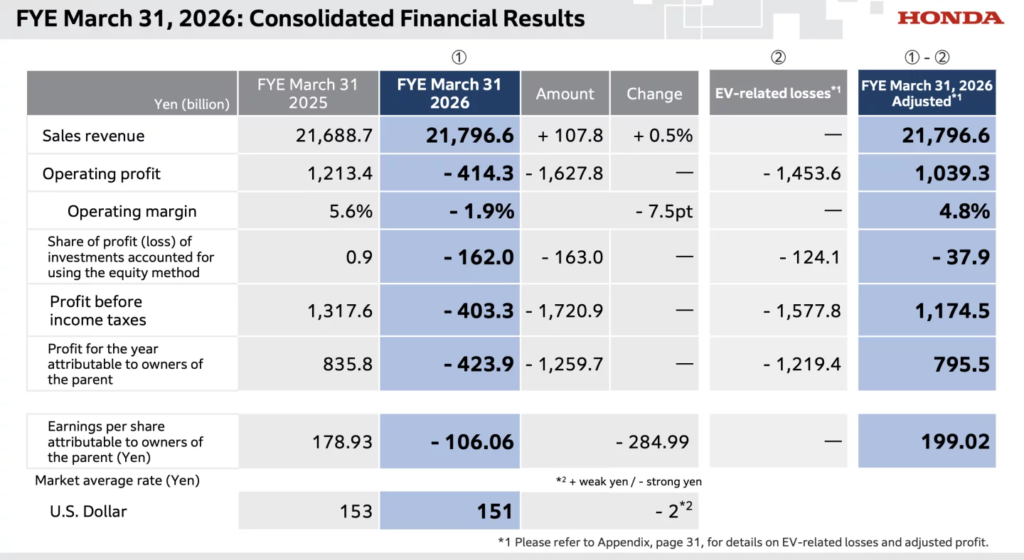
This one’s a biggie. Honda has just posted its first annual loss since becoming a publicly traded company back in 1957. And it’s not a small number either – Honda reported a staggering net loss of US$2.7 billion for the fiscal year ending March 31. That’s a dramatic reversal when compared to the company’s profit of more than $7.5 billion the previous fiscal year. So what went wrong? A major bet on electrification simply didn’t pay off the way the Japanese giant had hoped. Speaking at a press conference on May 14, Honda CEO Toshihiro Mibe discussed how dramatically the EV market has changed for both consumers and businesses. He acknowledged that although Honda attempted to respond, it failed to do so quickly enough. According to Mibe, the company is now abandoning both its goal of fully transitioning to electric and fuel-cell vehicle sales by 2040 and its target of EVs accounting for one-fifth of all new-car sales by 2030. Not only that, Honda’s $10.4-billion investment plan to manufacture EVs and batteries in Canada has now been put on hold indefinitely. The numbers, taken directly from Honda’s Financial Results PresentationHonda Honda also admitted that changes in US policy, including the removal of tax incentives for EV buyers and the introduction of tariffs, were major contributing factors behind the losses. That led to a sharp decline in Honda’s EV sales. In the final quarter of 2025, the company sold only around 15,000 EVs globally. In the United States alone, sales of the Honda Prologue reportedly fell by as much as 86%. Then again, Honda is hardly alone in this struggle. Automakers across the board are dealing with sluggish EV sales despite rising gasoline prices in 2026. But credit where it’s due: Honda has been quick to act by pivoting harder toward hybrid technology, with ambitious plans to launch 15 new hybrid models by 2030. And despite the sea of red ink, Honda’s stock has actually risen substantially over the past few days. Shares climbed 7% on May 15 alone. Why? There are several reasons. Honda’s unit sales across sectorsHonda For one, investors were buying into the next 12 months rather than reacting purely to the past year’s results. Secondly, the market appears far more interested in Honda’s projected operating profit of $3.14 billion for the coming year than Bloomberg’s consensus estimate of $1.3 billion. And perhaps most importantly, Honda had already warned investors back in March that it expected to incur up to $15.7 billion in EV-related expenses. In that sense, the market reaction wasn’t quite as paradoxical as it first appeared. Much of the shock had already been priced in when the earlier warning was issued. This latest report simply confirmed the scale of the write-down and demonstrated that the damage was concentrated around one major strategic gamble. What makes Honda’s first annual loss in nearly 70 years so significant isn’t just the number itself – it’s what Honda has historically represented within the automotive world. This is a company that built its reputation on engineering discipline, financial caution, and an almost irritating level of consistency. Honda changes its stance on electrificationHonda Honda wasn’t supposed to be the company making panic pivots or swallowing multi-billion-dollar write-downs while chasing the EV transition. And yet here we are: one of the industry’s most methodical manufacturers suddenly looking just as vulnerable and uncertain as everyone else. Still, it’s not all doom and gloom. Honda expects to return to profitability this year, banking on cost-cutting measures and the continued strength of its motorcycle business to help stabilize the company. “The motorcycle business will expand production capacity in India … and aim for record-high sales of 22.8 million units,” Honda said in its earnings statement. But this story is bigger than Honda alone. For years, the global automotive industry treated electrification as an inevitable straight road into the future. Massive EV investments, factory expansions, and aggressive deadlines were all built around the assumption that consumer demand would rise in lockstep with corporate ambition. Honda’s loss is a reminder that the transition is turning out to be far messier than the PowerPoint presentations promised. Legacy automakers now find themselves trapped in perhaps the worst possible middle ground: too deep into EV spending to retreat cleanly, yet not far enough ahead to dominate the market the way Tesla or China’s BYD already do. Despite the loss last fiscal year, Honda still anticipates returning to profitability this yearHonda But if you ask me, there’s something symbolic about Honda being the company to blink first. Because if even Honda – with its global scale, motorcycle profits, and famously conservative management – can stumble this hard, it sends a deeply uncomfortable message about the state of the industry overall. Honda’s loss isn’t just a bad financial year. It feels like the first real crack in the illusion that the industry had this transition fully figured out. Source: Honda source

Why Honda reporting its first annual loss in 70 years is a big deal Read More »

RIMOWA's new campaign traces legacy through a single case

Premium luggage brand RIMOWA has launched “For a lifetime of lives”, a campaign exploring the bond between movement, craft, and the trusted objects that stay with people through time. Conceived as a cinematic story unfolding across generations, the campaign follows a single RIMOWA case as it moves through life’s different chapters. This extends RIMOWA’s long-standing creative commitment, as seen in its craftsmanship and engineering. The campaign reflects a philosophy integral to RIMOWA and embedded in its lifetime commitment to all suitcases: that the most meaningful journeys unfold over time, driven by curiosity and the instinct to keep moving forward. Directed by Argentinian filmmaking trio Pantera, with a score by American trumpeter Theo Croker, the campaign unfolds through films centred on a trumpet and the RIMOWA aluminium case that protects it. The narrative follows the instrument and its case as they pass from father to son, tracing time and legacy. Through shifting moments, spaces, and sounds, the case remains a quiet companion across lives shaped by music, creativity, and change. The first episode, “Window seat”, begins with a quiet gesture of legacy: a trumpeter father hands his cased instrument to his son as he prepares to leave home. The film interweaves fragments of the father’s past with the son’s first steps forward. In the second episode “Run it back”, the son is now a musician. His life unfolds between rehearsal rooms and the road as he works to find his voice. Moving between discipline and freedom, the episode captures the formative years of an artist’s journey, with the RIMOWA case gathering the dents and marks that come with each stage of life. The final episode, “Another take”, follows a day leading to a performance. It captures the quiet hours before stepping on stage, the fragments of music that shape a life devoted to sound, and the moments after the performance ends. Together, the films explore two narratives inside every RIMOWA case: engineering and durability, alongside the emotional journey across a lifetime. Dents, stickers, and travel marks become part of its character. The campaign also includes still imagery, photographed by artist Tyler Mitchell. Through scenes of travelling, the images introduce a wider cast of characters, each moment reflecting the quiet bond between a person and the trusted objects that accompany them. At the centre of the campaign is the RIMOWA classic cabin silver. MARKETING-INTERACTIVE has reached out to RIMOWA for more information.  Don’t miss: Jay Chou next to discover London with Rimowa Part of the LVMH Group, RIMOWA is a German luxury luggage brand founded in Cologne in 1898. Its global ambassadors come from sports, music, and pop culture. These include Rosé from BLACKPINK and Formula One driver Lewis Hamilton, who recently appeared at the opening of RIMOWA’s new flagship store in Cologne. Mark your calendars for 24 June! #Content360 Hong Kong returns with a dynamic, one-day event dedicated to pivotal trends—from the silver economies to breakthrough IP collaborations, sports, and beyond. Let’s dive into the art of curating content with creativity, critical thinking and confidence! Related articles: Jay Chou next to discover London with RimowaTokopedia’s suitcase messages turn Jakarta airport into a marketing playgroundThis pet fish just hitched a ride on a Samsonite suitcase for a campaign source

RIMOWA's new campaign traces legacy through a single case Read More »

Stock Market Today: S&P 500, Nasdaq Score Record Highs On War Ceasefire; Tesla Shares Jump (Live Coverage)

The Dow Jones Industrial Average advanced while the S&P 500 and the Nasdaq scored record-high closes Wednesday after President Donald Trump extended the U.S.-Iran ceasefire indefinitely. Meanwhile, shares of Tesla (TSLA) headed higher in late trade after the electric-car giant reported earnings. On Wednesday, the Dow industrials rose 0.7% and the S&P 500 picked up 1.1%, breaking into new highs… Copyright ©2026 Investor’s Business Daily, LLC. All rights reserved. 87990cbe856818d5eddac44c7b1cdeb8 source

Stock Market Today: S&P 500, Nasdaq Score Record Highs On War Ceasefire; Tesla Shares Jump (Live Coverage) Read More »

Bing reaches one billion users – signalling a new phase for search and decision-making

Bing has crossed one billion monthly active users, a milestone that underscores its growing role in how people navigate the web today. But what makes this moment significant isn’t the scale alone – it’s what that growth tells us about how search is evolving in an AI-driven world. AI is fundamentally reshaping how people discover, evaluate, and decide. More of the early journey – filtering options, comparing products, narrowing choices – is now happening before a user ever types a query. As a result, the intent that reaches search is more defined from the outset – sharper, more contextual, and closer to action. For advertisers, that shift has real implications. Microsoft Advertising data shows that three and four-word queries leading to clicks on AI-generated answers have grown significantly year over year (Source: Microsoft Internal Data. Global Search Network Only O&O. Q4 2024 – Q4 2025), while single-word queries have declined by 6% (Source: Microsoft Internal Data. Global Search Network Only O&O. Jan 2025 – Jan 2026). That pattern reflects a consumer who has already done some of the thinking and is now arriving in search ready to narrow down, compare, and decide. This is supported by broader research. An IAB and Talk Shoppe study found that 80% of shoppers are now using AI to research and compare products, with usage highest in the early and middle stages of the shopping journey. As AI absorbs more of the early discovery process, search is becoming the place where decisions happen. To support this shift, Microsoft Advertising is introducing AI Max, now in open pilot. AI Max uses AI to expand query matching, personalise creative, and optimise landing experiences – helping brands show up more effectively as consumer intent becomes more nuanced across surfaces such as Bing and Copilot. Importantly, advertisers remain in control – opting into AI Max and setting guardrails such as brand parameters, exclusions, and messaging constraints, with full transparency into how queries and assets are performing. At the same time, new formats such as Offer Highlights bring relevance directly into the AI-powered experience. These formats surface key product differentiators such as free shipping or in-store pick-up, within the context of a Copilot conversation, aligning brand messaging with what matters most in the moment. This approach connects relevance with immediacy, helping brands show up with clarity and impact when users are ready to act. Search anchors high-intent behaviour As the journey evolves, search continues to concentrate on high-value intent. ComScore data shows that search usage continues to grow globally, with total minutes spent far exceeding time on generative AI platforms alone. For marketers, this reframes the role of search as a central layer in both research and decision-making. GWI data cited by Microsoft Advertising shows that search engines reach 13% more users than social networks and 116% more than video platforms for product research globally. In Southeast Asia, the dynamic between search and social is more nuanced. In Singapore, Malaysia, and Thailand, search reaches 2.4% to 18% more users than social networks for online product research and ranks as the second most-used channel in Indonesia, the Philippines, and Vietnam. It also outperforms video platforms across all markets, reinforcing its role in high-intent validation. (Source: GWI, Q2 2024 – Q1 2025, Southeast Asia). This illustrates that search is not solely one touchpoint among many, but a persistent decision infrastructure, a place where people validate what they’ve encountered elsewhere and determine what to do next. From ranking to influence: How AI is changing visibility To truly understand this shift, marketers need to look under the hood of how search itself now works. Behind every AI-generated answer is a layer Microsoft refers to as grounding – the mechanism that connects AI to real-time, authoritative web content, ensuring responses are based on current and verifiable sources rather than model memory alone. As AI increasingly mediates how consumers interact with information, grounding determines which content is retrieved, which sources are prioritised, and, ultimately, what shapes the answer a user sees. In an AI-first environment, visibility is no longer defined only by rankings or clicks, but by how content contributes to answers, citations, and outcomes. The AI visibility evolution is now becoming measurable. Earlier this year, Microsoft introduced AI Performance in Bing Webmaster Tools, a view into how content appears across AI-generated experiences, including Copilot and AI summaries in Bing. It shows how often content is cited, which pages are referenced, and the “grounding queries” that triggered those citations, the internal phrases AI systems use to match user intent to content. For advertisers, this opens a new lens on performance: not just whether users clicked, but whether your content was selected, trusted, and used to shape the response. This is a meaningful shift: from being found to being trusted. As AI continues to reshape the path to purchase, search is playing an expanding role in how decisions are made. AI shapes how intent is formed. Search captures that intent and converts it into action. For marketers, this creates an opportunity to engage across two critical dimensions: optimising for human decision-making and the AI systems that increasingly guide it. To learn more about the evolution of search in advertising, and what it requires from marketers, download Microsoft Advertising’s practical guide to navigating the AI search landscape. Five things you didn’t know about Bing 1. It has just joined the billion club: Bing has crossed one billion monthly active users and has grown more in the past five years than the previous 10 combined. 2. It’s woven into everyday workflows: Through Windows, Edge, and Copilot, Bing surfaces across task-driven moments throughout the day often in contexts where intent is immediate and action-oriented. 3. Microsoft Rewards drives repeat search behaviour: Users earn points for searching, completing quizzes, and engaging across

Bing reaches one billion users – signalling a new phase for search and decision-making Read More »

World’s first native color LiDAR gives machines human-like vision

For years, machines have navigated the world color-blind. LiDAR sensors – the laser-based eyes of self-driving cars, industrial robots, and inspection drones – build precise 3D maps of their surroundings, but everything is built of monochrome geometric shapes. Ouster’s new Rev8 sensor family aims to change that, not by bolting a camera onto a LiDAR unit, but by fusing color directly into every point of data the sensor captures. Autonomous perception systems generally fall into two camps: camera-only arrays – like the vision system Tesla uses for its underwhelming Full Self Driving tech – or a two-step sensor fusion approach with LiDAR for precise geometry, a camera for color, and a software algorithm to combine them. That stitching process introduces calibration errors, latency, and spatial mismatches – a problem that becomes critical when a robot or vehicle is moving fast through a crowded street. The new LiDAR can make robots see the world like humansOuster Rev8 eliminates that architecture entirely. Each point in the 3D map the sensor generates already carries color information at the moment of capture, with no additional software processing required. This, Ouster says, makes it the first LiDAR with native color – though it isn’t competing alone for long. Just a few weeks ago, the Hesai Group, the global leader in LIDAR technology, presented a full-color platform called 6D ETX. The Chinese sensor takes a different approach: rather than simply adding color to the point cloud, it captures six full dimensions of data – X, Y, and Z coordinates alongside reflectivity, velocity, and color – making it less a color LIDAR and more a multi-dimensional perception engine. Ouster’s technology is built around its new L4 chip, which embeds Fujifilm‘s color science – the same expertise behind the company’s imaging technology – to deliver hardware-level color processing. It integrates 42.9 GMACs of processing capacity, detects up to 20 trillion photons per second, and operates at 40 kHz with picosecond-level precision. Those numbers are dense, but they mean a single sensor can now read a traffic sign, detect whether the car ahead is braking by the color of its brake lights or produce topographic maps with real-world color data – all without additional hardware or calibration. The OS1 Max has a 500 m (1,640 ft) range, and color baked into every data pointOuster The flagship model of the Rev8 family is the OS1 Max, a 256-channel sensor with a detection range of up to 200 m (656 ft) at 10% reflectivity – meaning it can spot surfaces that absorb most of the light hitting them – and up to 500 m (1,640 ft) under optimal conditions. Its field of view spans 45 degrees vertically and 360 degrees horizontally, and Ouster claims it doubles both the range and resolution of its previous generation, the Rev7. The sensor handles an impressive spread of lighting conditions, from near-total darkness at 1 lux up to 2,000,000 lux, roughly equivalent to intense direct sunlight. Color depth reaches 48 bits with 116 dB of dynamic range – technical shorthand for the sensor’s ability to capture fine detail across extremely bright and extremely dark areas simultaneously. “Rev8 is the most advanced family of LiDAR sensors ever released and sets a new standard in sensing,” said Ouster CEO Angus Pacala. “With the L4 Ouster Silicon, we are delivering on the promise of our digital architecture to deliver exponential improvements in performance, doubling our core specs and simultaneously introducing the world’s first native color LiDAR to give machines 3D human-like sight for the next era of Physical AI.” From near-darkness to direct sunlight, Rev8 captures color and geometry in a single passOuster Early adopters include Google, Volvo Autonomous Solutions, Skydio, PlusAI, and Seegrid, among roughly two dozen companies across robotics, automotive, and smart infrastructure. The launch also reflects a broader strategic shift. In February 2026, Ouster acquired StereoLabs – a computer vision specialist – for US$38 million in cash plus 1.8 million shares, signaling a move away from selling standalone sensors toward offering a full perception platform. When color and geometry are fused at the source, training AI models becomes significantly easier. “Rev8 is the foundational technology that will allow customers to move from prototype to commercial production at scale, providing the reliability and affordability required to enable real-world autonomy across industries,” added Pacala. Rev8 sensors are available to order (though we’ve no word on pricing for business customers), with shipments expected to begin this quarter. REV8 OS1 MAX with Native Color in Chinatown SF Source: Ouster source

World’s first native color LiDAR gives machines human-like vision Read More »