From banquet to bistro: How the product model is transforming the business of technology

Instead of organizing by skillset—developers here, testers there—product teams are cross-functional by design. They bring together the full lifecycle of expertise required to support a capability like configure-price-quote (CPQ), digital commerce, or fulfillment. They don’t just build software; they own strategy, delivery, iteration, and ultimately, outcomes. And that last word is key: outcomes. In a project model, teams are measured by what they deliver—how many story points they burn down, how fast they release features. In a product model, the question is different: Did we move the needle on a meaningful business metric? For a commerce team, that might mean increasing pipeline velocity or boosting conversion rates. For an internal team, success might be defined by time savings, productivity improvements, or reductions in operational risk. Regardless of the domain, the emphasis is the same: value over volume. source

From banquet to bistro: How the product model is transforming the business of technology Read More »

馬來西亞商貿講座探索港人到當地開設辦事處和投資新機遇

(相)馬來西亞投資發展局(MIDA)香港區負責人賽夫萬代領事(Safwan)。 由亞瑪尼集團(Armani Group)主辦的「馬來西亞商貿投資機遇講座」圓滿舉行,活動深入剖析馬來西亞市場環境、投資政策、品牌推廣策略及房地產項目介紹,為港商開拓東南亞市場提供實質指引。 馬來西亞投資發展局(MIDA)香港區負責人賽夫萬代領事(Safwan)強調,作為馬來西亞官方投資促進機構,MIDA提供全方位支援服務包括: – 專案評估與審批 – 營業許可證申請 – 稅務優惠諮詢 – 外派人員職位批准 賽夫萬特別指出,2024年香港為馬來西亞第五大外資來源地,投資總額達26億美元。馬來西亞憑藉語言相通(22%華人人口)、營商環境與香港相似等優勢,成為港商進軍擁有6億人口的東盟市場之理想跳板。 亞瑪尼集團提供優質地產項目 亞瑪尼集團的營銷總監嚴鍈健(Jonathan)則介紹集團主要業務包括:房地產開發、建築工程、傢俱貿易和製造,並擁有兩間馬來西亞上市公司。今次重點推介兩大發展項目: 1. Armani Hallson(阿瑪尼·浩鑫) – 吉隆坡黃金地段永久產權項目 – 直通雙子塔及輕鐵站的300米覆蓋天橋 – 預計回報率達8% – 配備專業酒店管理團隊 2. Lofthill Residence(御豪苑) – 酒店式服務公寓 – 距地鐵站僅60公尺 – 永久業權,入門門檻低 – 投資自住兩相宜 TVBI:助企業拓展海外華人市場 同場,電視廣播旗下TVBI總經理陳樹鴻(Desmond)分享媒體行銷策略: – 透過TVB馬來西亞頻道及社交平台,精準接觸當地華人社群; – 結合粵語內容與本土化行銷,有效降低文化隔閡; – 提供藝人協作、品牌授權等多元合作模式,顯著提升品牌知名度。 講座最後由已經到馬來西亞開設公司的本港企業嘉賓分享在馬來西亞設立公司及開拓業務的經驗。而與會者對馬來西亞投資環境展現高度興趣,表達想進行實地考察的意願。主辦方將籌組商務考察團,協助港商深入瞭解馬來西亞市場機會。 據悉,本次講座成功搭建馬、港商貿交流平台,為企業拓展東南亞市場打下基礎。 (相)亞瑪尼集團的營銷總監嚴鍈健(Jonathan)。 LinkedIn Email Facebook Twitter WhatsApp source

馬來西亞商貿講座探索港人到當地開設辦事處和投資新機遇 Read More »

With B2B Sales Disruption On The Doorstep, What’s Next?

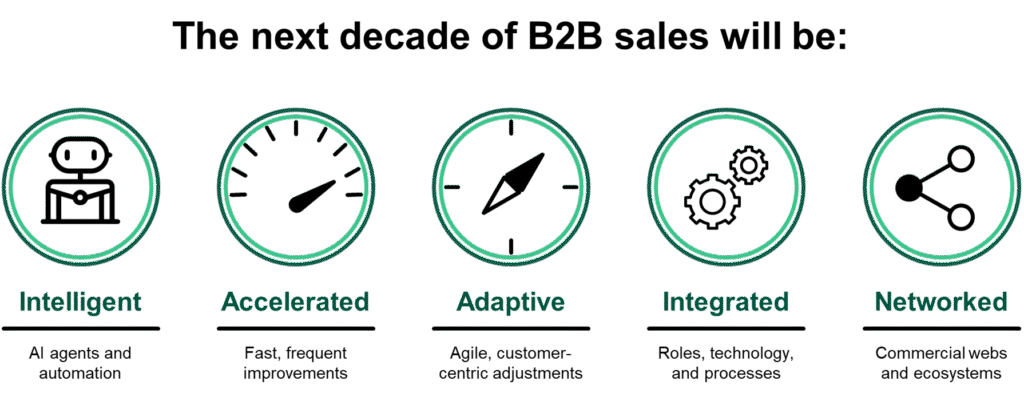
Buying and selling continue to change, and everybody wants to know how AI affects B2B sales. Here’s the situation: Sales teams have long struggled to adapt their tools and techniques to today’s purchasing dynamic. Now, new forces stress sales organizations in unprecedented ways. Paradoxically, these same forces fuel an emerging B2B sales supercycle — an extended period of growth and transformation. Our latest report, The Dawn Of A New B2B Sales Supercycle, looks at the future of sales. The disruptive decade ahead has characteristics never seen before, which significantly affect all revenue and go-to-market teams. Simultaneously, the future will be both chaotic and exciting. To succeed in this new reality, selling teams must unlearn much of what has made them successful in the past. The Enduring Forces Shaping B2B Sales Previously, the internet, cloud, and digitization have driven long cycles of growth and change. Similarly, the next supercycle is forming. This extended period of B2B sales will be more intelligent, accelerated, adaptive, integrated, and networked (see figure below). Furthermore, it will change nearly every aspect of sales: strategy, budgets, coverage, training, quotas, compensation, execution, and more. Shaping this future is a handful of forces: Artificial intelligence. AI bots will automate routine sales tasks, and AI agents will perform higher-order selling actions. With AI, sales process and tech will become essential. Self-service. Buyers continue to complete more purchasing tasks on their own. Consequently, buying motions disrupt selling motions, and sellers must prioritize buyer enablement. Buying complexity. Customers have more choices, tools, and stakeholders in their buying network, but this purchase complexity creates longer sales cycles and seller confusion. Ecosystems. Partner ecosystems are digitizing and growing, thrusting the route-to-market topic to the forefront of sales strategy. Critically, routes to market are routes to revenue. PE and VC composition. A greater number of opportunistic, tech-savvy private equity and venture capital portfolio companies increases competition for larger incumbents.   The Implications For Sales And Revenue Leaders Most B2B sales organizations have an unsustainably large amount of transformation debt, a backlog of improvements that should have been made long ago but weren’t. These improvements are often shelved in favor of short-term sales goals. Unfortunately, this puts sales teams further back on the change curve. Moreover, sales leaders face shocking new realities in the next decade: Employment and income insecurity will rise among sales professionals. In Forrester’s Future Of Work Survey, 2024, 60% of B2B employees say they fear losing their job due to automation within the next 10 years. For B2B sellers working to hit quota, this adds to already high stress and turnover rates. Sales leaders, take note: There is an emerging wellness crisis among sellers. AI sales agents will be onboarded and trained to co-sell. With AI and automation driving this supercycle, 75% of B2B automation decision-makers in Forrester’s Automation Survey, 2024, indicated that they expect their organization to invest in sales automation in the next 18 months. Indeed, AI will automate selling tasks and customer touchpoints; it will also co-sell with account executives. Sales budgets that are heavy on headcount will be light on results. Important sales tech investments come with an expectation of cost reduction and productivity elsewhere. This creates tough trade-offs. Sales leaders must optimize budgets across a changing mix of headcount, technology, and workflow. As tech improves, headcount decisions will become agonizingly difficult for sales leaders. Go-to-market roles, processes, and technologies will continue to merge. Expect convergence both within sales and across sales, marketing, product, and customer success. Convergence touches everything — process, tech, roles, working groups, and more. As an example, development rep roles will likely be partially automated and combined with other go-to-market roles. Sales Practices Must Match Sales Realities The best sellers adapt their tools and techniques for the moment. Fortunately, that hasn’t changed much. Nonetheless, it’s difficult for long-time sales leaders to reimagine their own function — and to then get the organizational support to transform it. Yet this is exactly what sales and revenue leaders must do. To understand how AI affects B2B sales, explore more insights in the new report, The Dawn Of A New B2B Sales Supercycle (client access required). You’ll also learn about several other trends and their implications for sales teams. Many B2B sales and revenue leaders are already adjusting to this new future. As a next step, schedule a guidance session to determine where best to start. source

With B2B Sales Disruption On The Doorstep, What’s Next? Read More »

From legacy to lakehouse: Centralizing insurance data with Delta Lake

This unification of data engineering, data science and business intelligence workflows contrasts sharply with traditional approaches that required cumbersome data movement between disparate systems (e.g., data lake for exploration, data warehouse for BI, separate ML platforms). Lakehouse creates a synergistic ecosystem, dramatically accelerating the path from raw data collection to deployed AI models generating tangible business value, such as reduced fraud losses, faster claims settlements, more accurate pricing and enhanced customer relationships.  Legacy out, Delta in To sum up, an important strategic change for insurance businesses striving for long-term growth and operational excellence is transitioning from outdated, rigid legacy systems to contemporary, resilient lakehouse architecture supported by Delta Lake. This shift involves more than just implementing modern technology; it involves radically re-architecting the data foundation to realize its full potential. Effectively utilizing artificial intelligence’s revolutionary power requires centralizing data, guaranteeing its dependability with features like ACID transactions and schema enforcement, and enabling unified processing of all data types. Successfully establishing this approach will put insurers in a strong position to innovate more quickly, run more smoothly, control risk more skillfully, and provide better customer service.  source

From legacy to lakehouse: Centralizing insurance data with Delta Lake Read More »

FCC Clears Remaining Roadblocks For Smart Car Tech

By Christopher Cole ( April 22, 2025, 5:38 PM EDT) — There won’t be any more need for waivers of technical rules to kickstart smart car technology in the 5.9 gigahertz spectrum band now that recent regulations have paved the way for the advancement, the Federal Communications Commission said…. Law360 is on it, so you are, too. A Law360 subscription puts you at the center of fast-moving legal issues, trends and developments so you can act with speed and confidence. Over 200 articles are published daily across more than 60 topics, industries, practice areas and jurisdictions. A Law360 subscription includes features such as Daily newsletters Expert analysis Mobile app Advanced search Judge information Real-time alerts 450K+ searchable archived articles And more! Experience Law360 today with a free 7-day trial. source

FCC Clears Remaining Roadblocks For Smart Car Tech Read More »

TIAA’s CIO Sastry Durvasula on merging the CIO and COO roles

Maryfran Johnson Hi. Good afternoon, and welcome to CIOLeadership Live. I’m your host, Maryfran Johnson, CEO of Maryfran Johnson Media and the former editor in chief of CIO magazine and events. Since November of 2017 this video and audio podcast has been produced by the editors of cio.com and the digital media division of foundry, which is an IDG company, our growing online library of past interviews all still openly available on both CIO.com and our YouTube channel includes more than 150 chief information technology and digital officers from mid sized to large companies across every industry, joining our esteemed lineup of CIOs, actually, for the second time in our show history, is Sastry Durvasula, who is the Chief Operating information and Digital Officer at TIAA. This is the Fortune 100 financial services firm that started out more than a century ago as the Teachers Insurance and Annuity Association of America. It was founded by Andrew Carnegie to build a sustainable Retirement System for teachers today. TIA is a $40 billion nonprofit organization with 16,000 employees globally providing retirement and investment products and financial advice, mostly to people working in the academic, research, medical, nonprofit and government sectors. Sastry joined the organization in February of 2022 in what was then an unusually broad CIO plus role where he combined technology leadership with client services across a company that is managing $1.4 trillion in assets. And six months ago, in November of 24 he was promoted into yet another unique role, overseeing the four connected pillars of the company globally, that is technology, digital and client services, operations and shared services. Before he joined TIAA, he was the global chief technology and digital officer and a partner at McKinsey and Company. And before that, served in various digital data and Chief Information Officer roles at insurance broker Marsh McLennan and also at American Express. Then just last month, when the latest honorees to be inducted into the CIO Hall of Fame were announced. Sastry’s name was, not so surprisingly, on that list of seven outstanding business technology leaders who are making a real difference in the world of it. Leadership. Sastry, welcome and congratulations on your latest honor. Thank you. Thank you so much, Maryfran, It’s always pleasure to be on your show and appreciate your very kind introduction. Thank you. Well, you’re absolutely welcome, and there’s not that many CIOs that have made two appearances on the show over these years. So it’s great to have you back. Let’s talk about let’s start out talking about what has changed for you in this unusual compounded role of CEO, COO and CIO and digital chief. Talk about how the role came to be and what your marching orders were from your CEO. Sastry Durvasula Yeah, you know, as you said, I joined in 2022 in fact, on Valentine’s Day of 2022romantic, yes, with lots of love for TIAA. And you know, this is, you know, as I discussed in our last episode, you know, I’ve only worked for 100 year old companies most of my career. So, yeah, so I just, I love the culture aspects. I love the power of technology, you know, transforming and reimagining businesses. So that was the reason why, you know, I was gravitated to TIAA, and obviously working with a very progressive CEO like Shawna Brown Duckett was a big plus for me when I, when I made the decision to join TIAA since, you know, obviously, it’s been now three plus years, and the world has changed quite a bit. Financial services industry changed a lot. Technology changed a lot with the advent of same year, actually the year I joined in 2022 in A4 ChatGPT was born, and the world changed since then. So tech changed a lot. You know, the way we serve our clients changed a lot. And hence my role change. So, you know, it’s a very, I would say, progressive set of opportunities that I took onbeyond technology and client services. You know, we’re putting our technology, especially AI, you know, in delighting our clients through, you know, digital and client experience. Of next generation, you know, driving a level of operational efficiencies, elevating our shared services. So basically, my remit now has what was originally my role, which is technology and client services. But as you said, we’ve added the digital and client experience with Jessica Austin Barker, who’s our Chief Digital and client experience officer who’s on my leadership team now, as well as a lot more focus on, you know, operational excellence and elevating our shared services. Because fundamentally, I believe that, you know, digital transformation, or AI power transformation, or technology transformation, ultimately, is here to serve the business. And these four connected pillars, you know, are the pillars that the businesses of TIAA, all three businesses, you know, stand on, whether it’s retirement that we started with our wealth management, where we serve, you know, our participants, and then you know, asset management, where we manage, as you said, you know, manage $1.4 trillion of assets out across the globe. So I think it’s a great set of pillars to be responsible for. You know, it’s over with over half of the organization from a colleague standpoint. So it’s, that’s the other thing that changed from a people, you know, leadership, responsibility and and driving, really, this ai, ai powered world that we are all fast walking into and driving up reskilling and upskilling, I think that’s what really changed. I’m I’m super excited, you know, with the set of responsibilities and the leadership team that we’ve assembled and the opportunities that we have in front of us, well, I’ve started when in a lot of my recent recordings with CIOs, I’ve started kind of watching the clock to see whether it’s the first five minutes or the first 10 minutes when we start talking about AI, and we’re mostly at the five


TIAA’s CIO Sastry Durvasula on merging the CIO and COO roles Read More »

What's Next For Lab Test Regulation Without FDA Authority

A recent Texas federal court decision vacating the U.S. Food and Drug Administration’s final rule that would apply FDA regulations to laboratory-developed tests signals potential positive impacts in the diagnostic space, and could inspire more healthcare entities to litigate against the government, say attorneys at Hooper Lundy. source

What's Next For Lab Test Regulation Without FDA Authority Read More »

中國電力旗下新源智儲躋身全球儲能系統出貨量第五位

隨著全球積極發展可再生能源,儲能技術越顯重要。香港亦積極推動智慧城市發展及能源轉型,儲能系統在穩定電網、提升能源效率方面扮演關鍵角色。在這個背景下,中國電力(02380.HK)旗下新源智儲在2024年儲能行業權威榜單中表現亮眼,榮登國內及全球儲能系統出貨量Top 5,同時躋身國內並網裝機規模Top 10,為香港能源發展帶來啟示。 新源智儲出貨量躋身全球TOP 5 技術實力獲肯定 根據中關村儲能產業技術聯盟(CNESA)於第十三屆儲能國際峰會暨展覽會(ESIE 2025)上發佈的2024年度中國儲能企業系列榜單,新源智儲不僅躋身中國市場儲能系統出貨量Top 5,更在全球市場取得相同佳績,同時打入國內市場並網裝機規模Top 10,彰顯其強勁的發展勢頭和領先的技術實力。 全方位解決方案 助推全球儲能發展 新源智儲的成功,歸功於其技術先發優勢和全場景解決方案能力。針對工商業、獨立共享儲能電站、新能源配儲等全球多元化需求,新源智儲推出超過20種定制化解決方案,覆蓋多種應用場景。在中國市場,新源智儲以高質量交付和系統穩定性,助力全國24個省份實現電網升級;在海外市場,其亞太市場佔有率亦持續提升,品牌影響力日益擴大。 科研實力獲認可 奠定行業領先地位 過去一年,新源智儲在科研領域亦取得重大突破,牽頭承建國家應急管理部「電化學能源消防安全聯合創新重點實驗室」,並獲評國資委「科改企業優秀單位」,以及獲批「獨角獸企業」、「北京市企業技術中心」、「北京市就業創業工作先進集體」等多項榮譽,核心競爭力顯著提升。 香港借鏡成功經驗 推動能源轉型 香港政府近年積極推動能源轉型,例如在《香港氣候行動藍圖2050》中,提出發展可再生能源及提升能源效益的目標。新源智儲在儲能領域的成功經驗,值得香港借鏡,尤其在技術研發、應用場景拓展以及政策支持方面,可為香港發展儲能技術提供寶貴的參考。中國電力作為在香港上市的公司,其業務發展亦有助提升香港股市的整體實力,並吸引更多國際投資者關注香港市場,提升香港能源股的動力。 LinkedIn Email Facebook Twitter WhatsApp The post 中國電力旗下新源智儲躋身全球儲能系統出貨量第五位 appeared first on VeriMedia. source

中國電力旗下新源智儲躋身全球儲能系統出貨量第五位 Read More »

Tracking The Evolution In Litigation Finance

By Robert Wilkins ( April 17, 2025, 6:59 PM EDT) — In the U.S., litigation finance is still a young business. Even so, it has evolved substantially since its inception, with important lessons for the plaintiffs bar, the defense bar and for the financiers that continue to change their underwriting methods, analytical models and financial offerings…. Law360 is on it, so you are, too. A Law360 subscription puts you at the center of fast-moving legal issues, trends and developments so you can act with speed and confidence. Over 200 articles are published daily across more than 60 topics, industries, practice areas and jurisdictions. A Law360 subscription includes features such as Daily newsletters Expert analysis Mobile app Advanced search Judge information Real-time alerts 450K+ searchable archived articles And more! Experience Law360 today with a free 7-day trial. source

Tracking The Evolution In Litigation Finance Read More »

3. Tariffs, DEI and cuts to government: Views of Trump's key actions

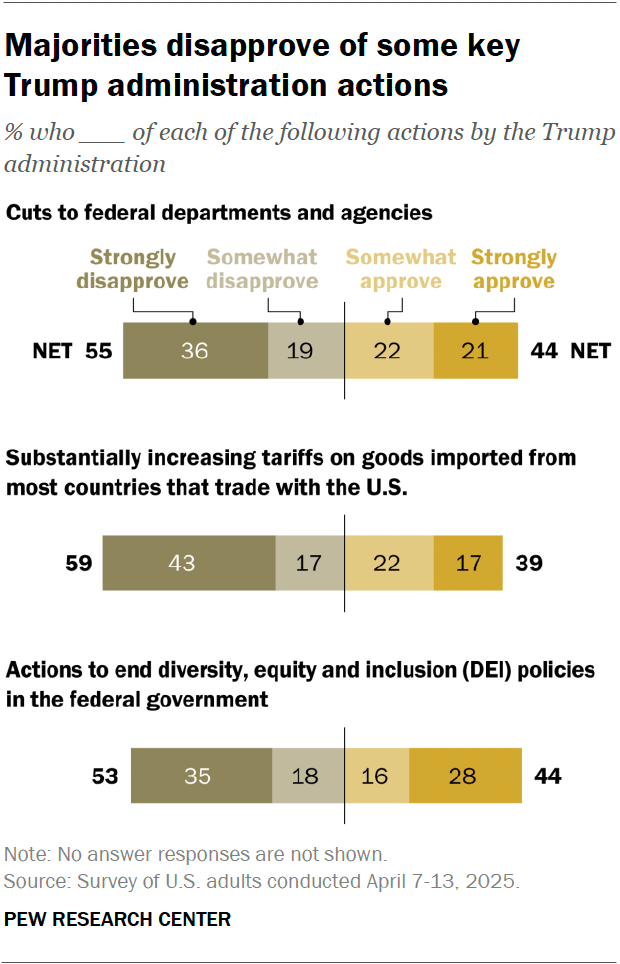
Over the last few months, the Trump administration has moved to reduce the size of the federal government, substantially increase tariffs on imported goods from most countries, and end diversity, equity and inclusion (DEI) policies in the federal government. The public views all three of these actions more negatively than positively. Still, large majorities of Republicans say they approve of each. Americans name a wide variety of actions when asked to describe what they like most and least about Trump’s second administration so far. Immigration actions come up most frequently as the thing respondents like most about the administration (20% mention this), though 11% mention immigration actions as what they least like. Another 30% volunteer “nothing” when asked what they like most. And while Americans most often cite the way the administration is governing as what they like least (22%), tariffs (15%) and government cuts (11%) are also mentioned frequently. Jump to Americans’ responses to our open-ended questions. Cuts to federal departments and agencies A 55% majority of Americans disapprove of the cuts that the Trump administration is making to federal departments and agencies, while 44% approve. By a wide margin, Republicans approve of the administration’s cuts. By an even wider margin, Democrats disapprove: 78% of Republicans and Republican-leaning independents approve of these cuts. 89% of Democrats and Democratic leaners disapprove. While views are largely split along partisan lines, 22% of Republicans disapprove of the administration’s government cuts – twice the share of Democrats who approve (11%). Ideology Conservative Republicans are particularly likely to approve of the administration’s cuts to government (87%). This includes 57% who strongly approve. Moderate and liberal Republicans approve of the cuts by a narrower – though still nearly two-to-one – margin (64% approve, 35% disapprove). Nearly all liberal Democrats (96%) and a large majority of conservative and moderate Democrats (83%) disapprove of the administration’s cuts. But liberal Democrats are more likely to say they strongly disapprove (81% vs. 54%). Effects of the federal government cuts Have cuts to government been careless or careful? Views of the way the Trump administration has been making cuts to federal departments and agencies are more negative than positive: About six-in-ten (59%) say the administration has been “too careless” in making cuts. Fewer say its approach has been about right (34%) or “too careful” (5%). Will cuts make government better or worse at meeting Americans’ needs? About half (51%) say the cuts will make government worse at meeting Americans’ needs. Roughly a third (34%) say they will make government better at this. Will cuts make government run better or worse? Similarly, 51% say the cuts will make government run worse, while 36% say they will make it run better. Will cuts save money or cost money? And about half (48%) say the cuts will cost Americans money in the long run. About four-in-ten (41%) say they will save Americans money in the long run. Partisans have different expectations about the impact of federal government cuts Among Democrats About nine-in-ten Democrats (89%) say the administration’s approach to cutting federal government has been too careless. Eight-in-ten Democrats or more say the Trump administration’s approach will make government worse at meeting people’s needs (83%), make government run worse (84%), and cost Americans money in the long run (80%). No more than one-in-ten say these cuts will improve how the federal government functions or save Americans money. Among Republicans Most Republicans are optimistic about the impact of the cuts. Six-in-ten or more say they will make the federal government better at meeting people’s needs (63%), make government run better (67%), and save Americans money in the long run (75%). Two-in-ten Republicans or fewer say the cuts will have negative effects in these areas. About six-in-ten Republicans (62%) say the cuts have been handled about right, while 7% say the administration has been too careful. Roughly three-in-ten (29%) say the administration’s approach to cuts has been too careless. Tariff increases Nearly six-in-ten Americans (59%) disapprove of the Trump administration’s tariff increases on goods imported from most countries that trade with the U.S., including 43% who strongly disapprove. About four-in-ten (39%) approve of these increases, including 17% who strongly approve. (The survey was in the field on April 9, when the administration announced a 90-day pause on some tariffs. There were no significant differences in views of the administration’s tariff actions when comparing interviews completed before and after the announcement.) Political party Democrats overwhelmingly disapprove of the tariff increases: 90% disapprove, including 74% who strongly disapprove. 70% of Republicans approve, including 34% who strongly approve. Race and ethnicity White adults are closely divided on the administration’s tariff actions, with 53% disapproving and 46% approving. By contrast, 79% of Black adults disapprove of the tariff increases, as do 70% of Asian adults and 66% of Hispanic adults. Age Younger adults are less likely than older adults to approve of the administration’s tariff policy: 45% of those ages 50 and older approve, compared with 34% of adults under 50. This pattern holds among Republicans: 80% of Republicans ages 50 and older approve of the tariff increases, compared with 60% of Republicans ages 18 to 49. There are no age differences among Democrats. Household income There are only modest differences in these views by income, with middle-income Americans (41%) slightly more likely to approve of the tariff increases than those living in lower-income (37%) or upper-income (36%) households. Self-reported 2024 vote Trump’s 2024 voters largely approve of the tariffs (81%), while those who voted for Democratic candidate Kamala Harris in 2024 overwhelmingly disapprove (93%). Voters who strongly supported Trump in the 2024 election express more support – and much more intense support – for the administration’s tariff policy than those who supported him less strongly: 88% of his strong supporters approve of the tariffs, including 56% who strongly approve. Among Trump’s less enthusiastic supporters in 2024, 68% support the tariffs, and 20% do so strongly; 30% disapprove of the administration’s tariff increases. Ending DEI policies in the federal

3. Tariffs, DEI and cuts to government: Views of Trump's key actions Read More »