Tracking The Evolution In Litigation Finance

By Robert Wilkins ( April 17, 2025, 6:59 PM EDT) — In the U.S., litigation finance is still a young business. Even so, it has evolved substantially since its inception, with important lessons for the plaintiffs bar, the defense bar and for the financiers that continue to change their underwriting methods, analytical models and financial offerings…. Law360 is on it, so you are, too. A Law360 subscription puts you at the center of fast-moving legal issues, trends and developments so you can act with speed and confidence. Over 200 articles are published daily across more than 60 topics, industries, practice areas and jurisdictions. A Law360 subscription includes features such as Daily newsletters Expert analysis Mobile app Advanced search Judge information Real-time alerts 450K+ searchable archived articles And more! Experience Law360 today with a free 7-day trial. source

Tracking The Evolution In Litigation Finance Read More »

3. Tariffs, DEI and cuts to government: Views of Trump's key actions

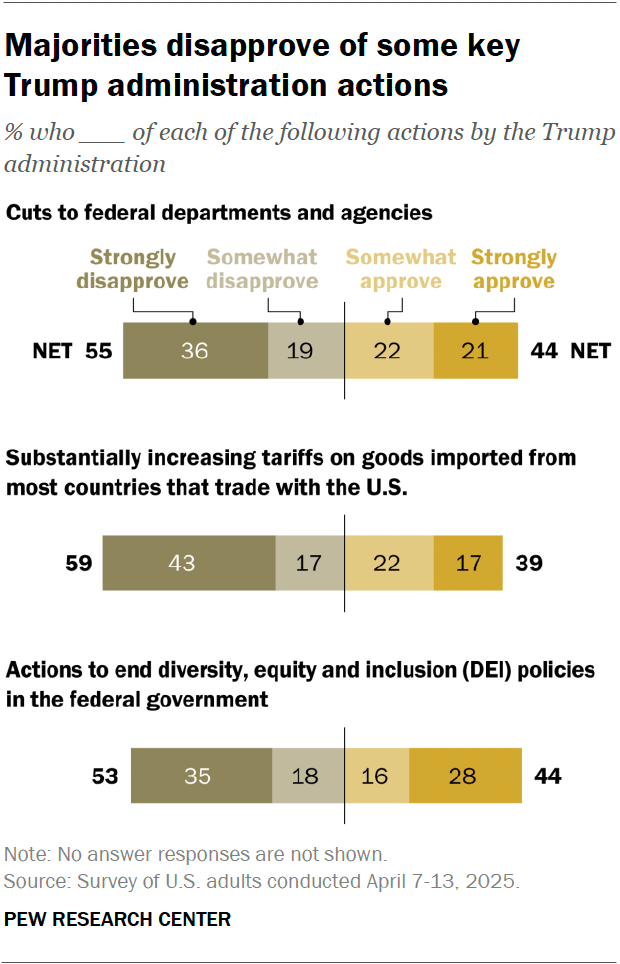
Over the last few months, the Trump administration has moved to reduce the size of the federal government, substantially increase tariffs on imported goods from most countries, and end diversity, equity and inclusion (DEI) policies in the federal government. The public views all three of these actions more negatively than positively. Still, large majorities of Republicans say they approve of each. Americans name a wide variety of actions when asked to describe what they like most and least about Trump’s second administration so far. Immigration actions come up most frequently as the thing respondents like most about the administration (20% mention this), though 11% mention immigration actions as what they least like. Another 30% volunteer “nothing” when asked what they like most. And while Americans most often cite the way the administration is governing as what they like least (22%), tariffs (15%) and government cuts (11%) are also mentioned frequently. Jump to Americans’ responses to our open-ended questions. Cuts to federal departments and agencies A 55% majority of Americans disapprove of the cuts that the Trump administration is making to federal departments and agencies, while 44% approve. By a wide margin, Republicans approve of the administration’s cuts. By an even wider margin, Democrats disapprove: 78% of Republicans and Republican-leaning independents approve of these cuts. 89% of Democrats and Democratic leaners disapprove. While views are largely split along partisan lines, 22% of Republicans disapprove of the administration’s government cuts – twice the share of Democrats who approve (11%). Ideology Conservative Republicans are particularly likely to approve of the administration’s cuts to government (87%). This includes 57% who strongly approve. Moderate and liberal Republicans approve of the cuts by a narrower – though still nearly two-to-one – margin (64% approve, 35% disapprove). Nearly all liberal Democrats (96%) and a large majority of conservative and moderate Democrats (83%) disapprove of the administration’s cuts. But liberal Democrats are more likely to say they strongly disapprove (81% vs. 54%). Effects of the federal government cuts Have cuts to government been careless or careful? Views of the way the Trump administration has been making cuts to federal departments and agencies are more negative than positive: About six-in-ten (59%) say the administration has been “too careless” in making cuts. Fewer say its approach has been about right (34%) or “too careful” (5%). Will cuts make government better or worse at meeting Americans’ needs? About half (51%) say the cuts will make government worse at meeting Americans’ needs. Roughly a third (34%) say they will make government better at this. Will cuts make government run better or worse? Similarly, 51% say the cuts will make government run worse, while 36% say they will make it run better. Will cuts save money or cost money? And about half (48%) say the cuts will cost Americans money in the long run. About four-in-ten (41%) say they will save Americans money in the long run. Partisans have different expectations about the impact of federal government cuts Among Democrats About nine-in-ten Democrats (89%) say the administration’s approach to cutting federal government has been too careless. Eight-in-ten Democrats or more say the Trump administration’s approach will make government worse at meeting people’s needs (83%), make government run worse (84%), and cost Americans money in the long run (80%). No more than one-in-ten say these cuts will improve how the federal government functions or save Americans money. Among Republicans Most Republicans are optimistic about the impact of the cuts. Six-in-ten or more say they will make the federal government better at meeting people’s needs (63%), make government run better (67%), and save Americans money in the long run (75%). Two-in-ten Republicans or fewer say the cuts will have negative effects in these areas. About six-in-ten Republicans (62%) say the cuts have been handled about right, while 7% say the administration has been too careful. Roughly three-in-ten (29%) say the administration’s approach to cuts has been too careless. Tariff increases Nearly six-in-ten Americans (59%) disapprove of the Trump administration’s tariff increases on goods imported from most countries that trade with the U.S., including 43% who strongly disapprove. About four-in-ten (39%) approve of these increases, including 17% who strongly approve. (The survey was in the field on April 9, when the administration announced a 90-day pause on some tariffs. There were no significant differences in views of the administration’s tariff actions when comparing interviews completed before and after the announcement.) Political party Democrats overwhelmingly disapprove of the tariff increases: 90% disapprove, including 74% who strongly disapprove. 70% of Republicans approve, including 34% who strongly approve. Race and ethnicity White adults are closely divided on the administration’s tariff actions, with 53% disapproving and 46% approving. By contrast, 79% of Black adults disapprove of the tariff increases, as do 70% of Asian adults and 66% of Hispanic adults. Age Younger adults are less likely than older adults to approve of the administration’s tariff policy: 45% of those ages 50 and older approve, compared with 34% of adults under 50. This pattern holds among Republicans: 80% of Republicans ages 50 and older approve of the tariff increases, compared with 60% of Republicans ages 18 to 49. There are no age differences among Democrats. Household income There are only modest differences in these views by income, with middle-income Americans (41%) slightly more likely to approve of the tariff increases than those living in lower-income (37%) or upper-income (36%) households. Self-reported 2024 vote Trump’s 2024 voters largely approve of the tariffs (81%), while those who voted for Democratic candidate Kamala Harris in 2024 overwhelmingly disapprove (93%). Voters who strongly supported Trump in the 2024 election express more support – and much more intense support – for the administration’s tariff policy than those who supported him less strongly: 88% of his strong supporters approve of the tariffs, including 56% who strongly approve. Among Trump’s less enthusiastic supporters in 2024, 68% support the tariffs, and 20% do so strongly; 30% disapprove of the administration’s tariff increases. Ending DEI policies in the federal

3. Tariffs, DEI and cuts to government: Views of Trump's key actions Read More »

Boaty McBoatface submarine takes NATO-backed quantum tech underwater

UK startup Aquark Technologies has used Boaty McBoatface — the internet’s best-loved submarine — to test its quantum sensing technology underwater for the first time. The NATO-backed company put its so-called “cold atom” system inside the autonomous submarine. Boaty McBoatface then descended to the bottom of a giant indoor tank at the National Oceanography Centre (NOC) in Southampton. The idea was to test how Aquark’s quantum tech — which must be completely isolated from external disturbances to function — would fare in the temperatures and pressures of an underwater environment.  Boaty Mcboatface with its quantum payload being lowered into the test tank. Credit Aquark/NOC Andrei Dragomir, the startup’s co-founder and CEO, called the trial a “resounding success” as the device performed just as it would on dry land. Dragomir said he expects practical applications of the technology to follow shortly. Aquark’s patented cold atom technology can be used as an alternative position, navigation, and timing (PNT) device, independent from satellites and thus immune to external tampering such as GPS interference.  The 💜 of EU tech The latest rumblings from the EU tech scene, a story from our wise ol’ founder Boris, and some questionable AI art. It’s free, every week, in your inbox. Sign up now! That’s especially useful for vehicles like planes, drones, and submarines — hence NATO’s interest. The tech can also be used to measure minute variations in gravity caused by different densities in the seabed.  Dr Alex Phillips, head of marine autonomous and robotics systems at NOC, believes the technology has the potential to make a “substantial contribution to underwater navigation and seabed imaging.”    How does Aquark’s “cold atom” quantum sensing work? Aquark cools atoms — typically from rubidium, a soft, silvery-white metal — to near absolute zero using lasers to create what’s known as a cold atom “trap”. At these ultra-low temperatures, the atoms slow down and take on quantum properties.  These quantum atoms are extremely sensitive to external forces such as gravity, acceleration, or rotation. By analysing those forces, scientists can measure acceleration, magnetic fields, rotation, gravity, and time with far greater precision than classical devices such as accelerometers, atomic clocks, or gravimeters. Cold atom traps form the foundation of quantum sensors — a bit like how a chip forms the basis of a quantum computer. These sensors could transform everything from air traffic control to underground exploration.  Scientists have been trapping atoms for decades, using magnetic fields. But during his PhD, Dragomir found a way to trap atoms without magnetic fields at all.   This translates to systems that are smaller, lighter, cheaper, and more energy-efficient than existing ones, the company previously told TNW. They are also more robust and can be used in difficult terrain. Aquark has developed a cold atom trap that can operate virtually anywhere — including underwater. Credit: Aquark/NOC Aquark has previously tested its tech onboard a Royal Navy vessel and inside a small drone. It’s now been further validated on the NOC’s Autosub Long Range, affectionately known as Boaty McBoatface after the moniker won a public poll to name the vessel.  Dragomir has high hopes for Aquark’s next adventures. “In the future, we may be able to measure the density of minerals under the sea floor using gravity measurements or perform high-sensitivity magnetic field measurements, giving scientists new ways of seeing things that were previously hidden,” he said. “We may even uncover some hidden treasures!” source

Boaty McBoatface submarine takes NATO-backed quantum tech underwater Read More »

1. How Americans view Russia and Putin

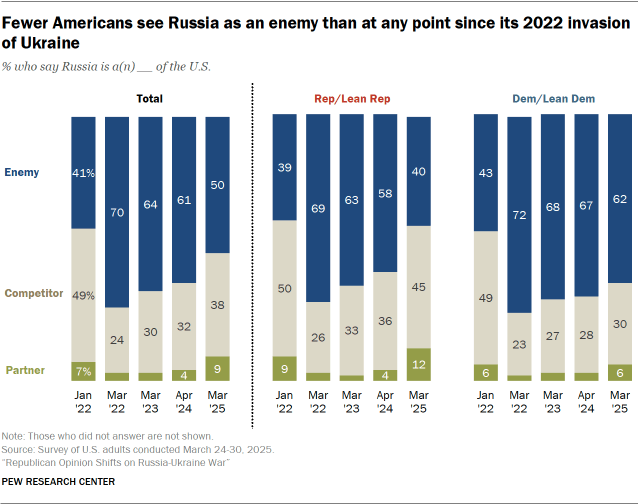
Here are several key takeaways about Americans’ views of Russia: Half of U.S. adults see Russia as an enemy of the U.S., down from 61% in 2024. More Republicans see Russia as a competitor than as an enemy for the first time since before the Russia-Ukraine war started. While most Americans – including majorities of Democrats and Republicans – continue to express negative views of Russia and Putin, smaller shares of Republicans express very unfavorable opinions of Russia and no confidence at all in Putin than in 2024. Opinions among Democrats have not changed much. Is Russia a competitor, partner or enemy of the U.S? Half of Americans today label Russia as an enemy of the U.S., while 38% see Russia as a competitor and 9% see it as a partner. This represents an 11-point drop in views of Russia as an enemy since last year and a 20-point drop since March 2022, just weeks after the Russian invasion of Ukraine. Still, more Americans see Russia as an enemy now than they did before the invasion (50% vs. 41% in January 2022). Partisanship Democrats and Democratic-leaning independents are more likely than Republicans and Republican leaners to see Russia as an enemy of the U.S. (62% vs. 40%). Republicans are about as likely to see Russia as an enemy now as they were before the current conflict in Ukraine began. In January 2022, just before Russia invaded Ukraine, 39% of Republicans saw Russia as an enemy. This share increased to 69% in the early months of the war and has fallen fairly steadily since. Republicans are also twice as likely as Democrats to see Russia as a partner of the U.S. (12% vs. 6%). Favorability of Russia Americans continue to have negative views of Russia. In the current survey, 13% see Russia very or somewhat favorably, while 85% see it very or somewhat unfavorably. These are generally similar to ratings in 2024. Strongly negative views of Russia have been declining in recent years. Currently, 51% of Americans have a very unfavorable opinion of the country. As recently as March 2022, 69% had a very unfavorable view of Russia. Partisanship There are some differences in views of Russia by party. About four-in-ten Republicans (41%) hold a very unfavorable view of Russia, compared with 62% of Democrats. Inversely, Republicans are more likely than Democrats to have a favorable view of Russia (16% vs. 9%). Confidence in Putin Americans’ confidence in the Russian president remains low as well. About one-in-ten (12%) have at least some confidence in Putin to do the right thing regarding world affairs, compared with 84% who have little or no confidence in his leadership. In fact, a 57% majority of Americans have no confidence at all in Putin. Partisanship and views over time As with views of Russia, attitudes toward Putin have shifted slightly in recent years. In 2024, 67% of Americans had no confidence at all in Putin, including 75% of Democrats and 61% of Republicans. But in the current survey, 43% of Republicans have no confidence at all in Putin, an 18-point decline. Around seven-in-ten Democrats (72%) have no confidence at all in Putin, little changed from last year. source

1. How Americans view Russia and Putin Read More »

The Tech Exec’s Guide To Decoding Cybersecurity Vendor Performance

Forrester analyzed the earnings calls of the 10 largest cybersecurity vendors by market cap and identified key trends for technology executives (Forrester clients can read the report here). Earnings calls provide valuable insight into your vendors’ strategic performance — you need strong partners that are not only financially resilient but have a clear strategy for how their portfolio will deal with upcoming tech, economic, and threat challenges. The trends revealed on these calls show some of your vendors’ sales tactics and negotiation strategies, which you can then use to your advantage in the procurement process. Forrester identified the following key trends in the latest round of earnings calls: Managed services gain momentum for vendors, but benefits are dubious. Vendors are increasingly leaning on managed services to boost revenue, positioning them as a way for you to save time and reduce resource strain. For example, CrowdStrike, Trend Micro and Rapid7’s managed service businesses all experienced double-digit growth. At first glance, adopting managed security services can streamline your security operations, but this is not a guarantee. Ensure that you define your desired outcomes before signing up to these seemingly attractive deals, and ask vendors to clarify the measurable benefits — such as faster incident response or more accurate threat detection — to see if these services will integrate with your existing systems and teams. Market volatility could mean better negotiating power for tech execs. Even when vendors posted strong recent earnings, stock prices often dipped due to uncertainty in their future outlook or due to weaker guidance than analysts anticipated. Additionally, headcounts dropped in 2024 only for companies to reverse back to attracting talent again in 2025. In their quest for growth in these volatile conditions, vendors are offering more aggressive pricing or bundle deals to secure your commitment. Press vendors on real ROI, rather than being tantalized by attractive discounts in contract proposals or renewals, and emphasize mutual flexibility and partnership through contract clauses. If the future is truly uncertain, you’ll want the option to pivot if budgets, technologies, or threats change more quickly than expected with your cyber partners. Platform and AI hype demand closer scrutiny. Every vendor has now built or acquired an integrated platform and invested in an AI-driven strategy. The record acquisition from Google taking over Wiz, for example, showcases Google’s strategy to buy and integrate rather than build. These dynamics provide competitive pressure on vendors, and for you, they make it harder to determine hype from reality. This not only leads to a full platform play being a key consideration for buyers but also puts pressure on competitors such as Fortinet, Palo Alto Networks, and others. Because every vendor claims an integrated platform and AI-driven strategy, it’s getting harder and harder to determine which emperors actually have no clothes. For vendors promising end-to-end coverage via a single platform, verify how seamlessly these tools truly integrate or whether AI is genuinely improving capabilities by requesting evidence of success from your peers in environments similar to yours. You want to avoid accidentally becoming the marquee client. Additionally, assess your concentration risk of working with one vendor and diversify if you need to do so. Forrester technology executive or security and risk clients who have questions about these earnings calls can reach out to to me via inquiry or guidance session. source

The Tech Exec’s Guide To Decoding Cybersecurity Vendor Performance Read More »

Bernstein Litowitz Looks To Hire SEC's Ex-Top Crypto Cop

By Jessica Corso ( April 23, 2025, 12:55 PM EDT) — Investor-side firm Bernstein Litowitz Berger & Grossmann LLP has disclosed in a court filing that it is seeking to hire Jorge Tenreiro, the former head of the U.S. Securities and Exchange Commission’s crypto enforcement unit as well as the onetime chief of the agency’s entire litigation team…. Law360 is on it, so you are, too. A Law360 subscription puts you at the center of fast-moving legal issues, trends and developments so you can act with speed and confidence. Over 200 articles are published daily across more than 60 topics, industries, practice areas and jurisdictions. A Law360 subscription includes features such as Daily newsletters Expert analysis Mobile app Advanced search Judge information Real-time alerts 450K+ searchable archived articles And more! Experience Law360 today with a free 7-day trial. source

Bernstein Litowitz Looks To Hire SEC's Ex-Top Crypto Cop Read More »

OpenAI makes ChatGPT’s image generation available as API

Join our daily and weekly newsletters for the latest updates and exclusive content on industry-leading AI coverage. Learn More People can now natively incorporate Studio Ghibli-inspired pictures generated by ChatGPT into their businesses. OpenAI has added the model behind its wildly popular image generation tool, used in ChatGPT, to its API.  The gpt-image-1 model will allow developers and enterprises to “integrate high-quality, professional-grade image generation directly into their own tools and platforms.”  “The model’s versatility allows it to create images across diverse styles, faithfully follow custom guidelines, leverage world knowledge, and accurately render text — unlocking countless practical applications across multiple domains,” OpenAI said in a blog post.  Pricing for the API separates tokens for text and images. Text input tokens, or the prompt text, will cost $5 per 1 million tokens. Image input tokens will be $10 per million tokens, while image output tokens, or the generated image, will be a whopping $40 per million tokens.  Competitors like Stability AI offer a credit-based system for its API where one credit is equal to $0.01. Using its flagship Stable Image Ultra costs eight credits per generation. Google’s image generation model, Imagen, charges paying users $0.03 per image generated using the Gemini API. Image generation in one place OpenAI allowed ChatGPT users to generate and edit images directly on the chat interface in April, a few months after adding image generation into ChatGPT through the GPT-4o model.  The company said image generation in the chat platform “quickly became one of our most popular features.” OpenAI said over 130 million users have accessed the feature and created 700 million photos in the first week alone.  However, this popularity also presented OpenAI with some challenges. Social media users quickly discovered that they could prompt ChatGPT to generate images inspired by the Japanese animation juggernaut Studio Ghibli, and as a result, my social media feeds were filled with the same photos for the entire weekend. The trend prompted OpenAI CEO Sam Altman to claim the company’s GPUs “are melting.”  OpenAI previously added its image model DALL-E 3 on ChatGPT. That model was a diffusion transformer model rather than the native multimodal understanding that GPT-4o has.  Enterprise use cases  Enterprises want the ability to generate images for their projects, and many don’t want to open a separate application to do so. By adding the image model to its API, OpenAI allows enterprises to connect gpt-image-1 to their own ecosystems.  OpenAI said it’s already seen several enterprises and startups use the model for creative projects, products and experiences, naming several well-known brands in its blog post.  Canva is reportedly exploring ways to integrate gpt-image-1 for its Canva AI and Magic Studio Tools. GoDaddy has already begun experimenting with image generation for customers to create their logos, and Airtable now enables enterprise marketing and creative teams to easily manage asset workflows at scale. OpenAI said gpt-image-1 will get the same safety guardrails on the API as in ChatGPT. The company said images generated with the model natively include metadata from the Coalition for Content Provenance and Authenticity (C2PA) that labels content as AI-generated and tracks ownership. OpenAI is part of C2PA’s steering committee.  Users can also control content moderation to generate images that best align with their brand.  OpenAI promised that it will not use customer API data, including any images uploaded or generated by gpt-image-1 to train its models.  source

OpenAI makes ChatGPT’s image generation available as API Read More »

Google Cloud Next 2025: Agentic AI Stack, Multimodality, And Sovereignty

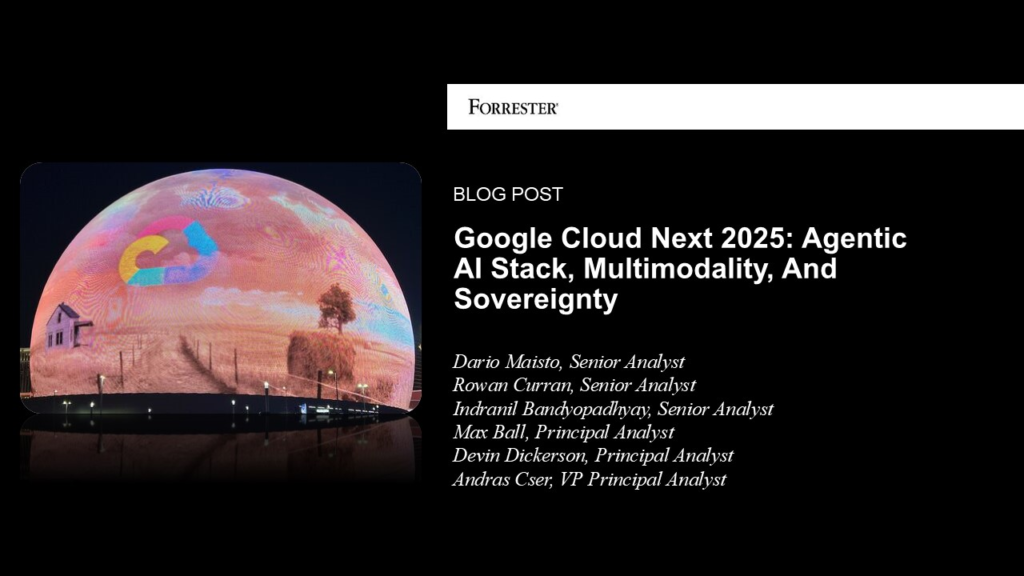
Loads of news came out of a hot Google Cloud Next 2025 in Las Vegas. The most notable announcements? Sovereign AI solutions on-prem, developer innovations that meet timely needs, very applicable multimodality for content and CX, and new elements for building the enterprise agentic AI stack. What was lacking? In the security domain, AI agents notably still find limited use in the security command center and SecOps. Discover what happened at Google Cloud Next 2025 and what to do about it. Top Developments At Google Cloud Next 2025 AI sovereignty: AI plays a significant part in meeting digital sovereignty requirements. Gemini can now run in Google Distributed Cloud (GDC) locally and in air-gapped environments, making AI accessible for regulated organizations. Vertex AI offers access to proprietary, third-party, and open-source models, reducing dependency on non-sovereign tools and providing flexibility. Additionally, Google announced Agentspace, which provides granular IT controls, including role-based access control (RBAC), VPC Service Controls, and IAM integration. Developer innovations: Google unveiled a comprehensive vision for AI-enhanced software development, pushing the boundaries of current paradigms centered on chat interfaces. Agent technology, described as specialized AI services that can collaborate on complex, goal-oriented tasks, is encapsulated within streamlined services like the Agent Development Kit (ADK). The Kanban-style assistant interface breaks new ground in AI coding assistance, aligning well with agile development practices and signaling an evolution in enterprise AI tools beyond chatbots. Multimodal content creation: Multimodal Vertex AI now unifies advanced generative models — Lyria (music), Veo 2 (video), Chirp 3 (speech), and Imagen 3 (images) — into a single platform. This integration enables the creation of fully orchestrated production assets, such as promotional campaigns that include photos, custom soundtracks, and voiceovers from simple text prompts. By consolidating these models with enterprise-grade safety measures, Google streamlines content creation workflows, reduces time to market, and ensures compliance, positioning multimodal Vertex AI as a transformative solution for businesses. AI-centric customer experience: In a demonstration, Google showcased how a bot could assist in finding the right fertilizer for petunias, highlighting the high-quality, human-sounding voice and the integration of video and other channels for complex interactions. The bot’s ability to consult with an agent in the background for more challenging queries demonstrated the potential for AI to enhance customer service experiences significantly. Enterprise agentic AI: Google introduced several elements to build and orchestrate enterprise agentic AI systems. The agent SDK provides a toolkit for constructing agentic architectures, linking reasoners, memory, and necessary tools and data. Interoperability between agents is a market challenge, but Google’s agent SDK supports MCP, a popular agent framework. The Agent2Agent protocol facilitates interagent and interecosystem communication for complex workflows, though it is not a security or governance framework. Security enhancements: Google unified its security portfolio under Google Unified Security (GUS), encompassing SecOps, the security control center (SCC), and Chrome Enterprise Premium, and plans to use agentic AI for security incident and malware analysis, with SCC enhancements such as agentless malware scanning, regulatory compliance management, and attack path simulation. Additionally, Google introduced Model Armor for AI protection and discussed integrating Wiz intellectual property into SCC and GCP cloud security post-acquisition. What Should You Do Next? Given the new capabilities in AI sovereignty, agentic AI, and multimodality, here’s what tech and CX leaders can plan to do next: Consider whether these new options address your digital sovereignty needs. Digital sovereignty requirements are growing and becoming more specific in nature. While full sovereignty is challenging, dedicated solutions can address specific needs. Google Distributed Cloud helps regulated sectors leverage Google Cloud functionalities on-prem. S3NS, a Google and Thales company, addresses sovereignty requirements in France under SecNum regulation, with similar constructs in development for Germany. Organizations can achieve digital sovereignty targets using foreign cloud vendors alongside native options. Public-sector organizations and orgs in regulated industries can leverage these options for their sovereign cloud deployments. Multimodal is here, so redefine your content strategy. Google Next made it clear that enterprises are leveraging multimodal platforms like Vertex AI, and so should you. But how do you get started? Identify your core objectives — marketing videos, branded imagery, or full-scale campaigns — and map them to your platform’s functionalities. Collaborate with technical teams to establish thorough safety protocols and ensure regulatory compliance at every stage. Iteratively refine your prompts and outputs to shape engaging multimedia experiences that resonate with your audience. By harnessing generative AI across multiple formats, you can streamline production, adapt swiftly to market demands, and maintain a decisive edge in an evolving creative landscape. Test out a unified agentic AI interface with context. If you leverage Google’s productivity suite, you may be able to unify agents with a single adaptive interface by connecting Agentspace to popular apps like Confluence, Google Drive, Jira, Microsoft SharePoint, ServiceNow, and more — all from within Agentspace. Diagnose changes to user interactions with applications. Enterprise application interfaces with forms, buttons, and workflows are evolving as AI evolves. Google’s agentic approach signals a major shift in user engagement, with software starting with narrow functions (i.e., a customer interacting with an agent and a human supervisor, as demoed at Next). Similar transformations will occur in marketing, employee experience, and other functions. This is a wake-up call for enterprise application and experience leaders. Enterprises must define, standardize, design, and govern how users interact with these new applications. Approach multicloud security success with skepticism. AI agents for Level 1 semiautomatic incident response and malware analysis are promising use cases (i.e., capturing evidence during detection, investigation, and response workflows), but automatic AI-driven cloud configuration security and drift remediation remain too risky. Using SCC for multicloud (AWS and Azure) is feasible but underutilized by Google Cloud Platform customers. Security professionals using GCP should monitor how Wiz IP transforms Google cloud security and whether Google can maintain Wiz as a cloud-agnostic CNAPP and cloud detection and response tool. Reach out to Forrester to schedule an inquiry to help guide your AI, cloud, and security initiatives or to dig into these announcements. source


Google Cloud Next 2025: Agentic AI Stack, Multimodality, And Sovereignty Read More »

FICO Chief Analytics Officer Scott Zoldi has spent the last 25 years at HNC and FICO (which merged) leading analytics and AI at HNC FICO is well known in the consumer sector for credit scoring, while the FICO Platform helps businesses understand their customers better so they can provide hyper-personalized customer experiences. “From a FICO perspective, it’s making sure that we continue to develop AI in a responsible way,” says Zoldi. “There’s a lot of [hype] about generative AI now and our focus has been around operationalizing it effectively so we can realize this concept of ‘the golden age of AI’ in terms of deploying technologies that actually work and solve business problems.” W

FICO Chief Analytics Officer Scott Zoldi has spent the last 25 years at HNC Software and FICO (which merged) leading analytics and AI at FICO is well known in the consumer sector for credit scoring, while the FICO Platform helps businesses understand their customers better so they can provide hyper-personalized customer experiences.   “From a FICO perspective, it’s making sure that we continue to develop AI in a responsible way,” says Zoldi. “There’s a lot of [hype] about generative AI now and our focus has been around operationalizing it effectively so we can realize this concept of ‘the golden age of AI’ in terms of deploying technologies that actually work and solve business problems.”  While today’s AI platforms make model governance and efficient deployment easier, and provide greater model development control, organizations still need to select an AI technique that best fits the use case.  A lot of the model hallucinations and unethical behavior are based on the data on which the models are built, Zoldi says. “I see companies, including FICO, building their own data sets for specific domain problems that we want to address with generative AI. We’re also building our own foundational models, which is fully within the grasp of almost all organizations now,” he says.   Related:Surgical Center CIO Builds an IT Department He says their biggest challenge is that you can never totally get rid of hallucinations. “What we need to do is basically have a risk-based approach for who’s allowed to use the outputs, when they’re allowed to use the outputs, and then maybe a secondary score, such as a AI risk score or AI trust score, that basically says this answer is consistent with the data on which it was built and the AI is likely not hallucinating.”  Some reasons for building one’s own models include full control of how the model is built, and reducing the probability of bias and hallucinations based on the data quality.    “If you build a model and it produces an output, it could be hallucination or not. You won’t know unless you know the answer, and that’s really the problem. We produce AI trust scores at the same time as we produce the language models because they’re built on the same data,” says Zoldi. “[The trust score algorithms] understand what the large language models are supposed to do. They understand the knowledge anchors — the knowledge base that the model has been trained on — so when a user asks a question, it will look at the prompts, what the response was, and provide a trust score that indicates how well aligned the model’s response is aligned with the knowledge anchors on which the model was built. It’s basically a risk-based approach.”  Related:Knowledge Gaps Influence CEO IT Decisions FICO has spent considerable time focused on how to best incorporate small or focused language models as opposed to simply connecting to a generic GenAI model via an API. These “smaller” models may have eight to 10 billion parameters versus 20 billion or more than 100 billion, for example.  He adds that you can take a small language model and achieve the same performance of a much larger model, because you can allow that small language model to spend more time reasoning out an answer. “And it’s powerful because it means that organizations that can only afford a smaller set of hardware can build a smaller model and deploy it in such a way that it’s less costly to use and just as performant as a large language model for a lot less cost, both in model development and in the inference costs of actually using it in a production sense.”  Scott Zoldi The company has also been using agentic AI.  “Agentic AI is not new, but we now have frameworks that assign decision authority to independent AI operators. I’m okay with agentic AI, because you decompose problems into much simpler problems, and those simpler problems [require] much simpler models,” says Zoldi. “The next area is a combination of agentic AI and large language models, though building small language models and solving problems in a safe way is probably top of mind for most of our customers.”  Related:The Kraft Group CIO Talks Gillette Stadium Updates and FIFA World Cup Prep For now, FICO’s primary use case for agentic AI is generating synthetic data to help counter and stay ahead of threat actors’ evolving methods. Meanwhile, FICO has been building focused language models that address financial fraud and scams, credit risks, originations, collections, behavior scoring and how to enable customer journeys. In fact, Zoldi recently created a focused model in only 31 days using a very small GPU.  “I think we’ve all seen the headlines about how these humongous models with billions of parameters and thousands of GPUs, but you can go pretty far with a single GPU,” says Zoldi.   Challenges Zoldi Sees in 2025  One of the biggest challenges CIOs faces is anticipating the shifting nature of the US regulatory environment. However, Zoldi believes regulation and innovation go hand in hand.  “I firmly believe that regulation and innovation inspire each other, but others are wondering how to develop their AI applications appropriately when [they’re not prescriptive],” says Zoldi. “If they don’t tell you how to meet the regulation, then you’re guessing how the regulations might change and how to meet them.”   Many organizations consider regulation a barrier to innovation rather than an inspiration for it.   “The innovation is basically a challenge statement like, ‘What does that innovation need to look like?’ so that I can meet my business objective, get a prediction, and have an interpretable model while also having ethical AI. That means better models,” says Zoldi. “Some people believe there shouldn’t be any constraints, but if you don’t have them, people will continue to ask for more data and ignore copyrights. You can also go down a deep learning path where models are uninterpretable, unexplainable, and often unethical.”  What Innovation at FICO Looks Like  At FICO, innovation and

FICO Chief Analytics Officer Scott Zoldi has spent the last 25 years at HNC and FICO (which merged) leading analytics and AI at HNC FICO is well known in the consumer sector for credit scoring, while the FICO Platform helps businesses understand their customers better so they can provide hyper-personalized customer experiences. “From a FICO perspective, it’s making sure that we continue to develop AI in a responsible way,” says Zoldi. “There’s a lot of [hype] about generative AI now and our focus has been around operationalizing it effectively so we can realize this concept of ‘the golden age of AI’ in terms of deploying technologies that actually work and solve business problems.” W Read More »

CIOs increasingly dump in-house POCs for commercial AI

“We’re used to CIOs going out and buying software, and this year, they’re going to be sold [AI] software,” he says. “In the past, they had an idea in mind, a problem to solve, and it is directional, intentional. They are in control.” In some cases, the CIOs won’t have a choice about whether to purchase the add-on AI, Lovelock says. “This year, virtually every software company, for virtually every product, will have a gen AI feature this year, if they don’t already,” he says. “The salespeople are going to be calling their customers and saying, ‘We have gen AI,’ and in some cases, you come in one morning, and you have a slightly higher bill and a new button.” source

CIOs increasingly dump in-house POCs for commercial AI Read More »