In Light Of New Tariffs, Focus On Digitizing And Diversifying Your Supply Chain

In the ever-evolving landscape of global trade, the recent imposition of new tariffs and sanctions is leaving many business leaders concerned about the future of their supply chain strategies. Navigating through the complexities of today’s global trade environment presents a multifaceted challenge for businesses. While, in the short term, consumers will bear the brunt as importers include tariffs in their prices, this moment also presents an opportunity for supply chain leaders to diversify and digitize their supply chains for greater resilience. In earlier research, we outlined three steps that business leaders should take to digitally transform their supply chains. Tariffs are just one element shaping global trade flows, especially in a world of increasing regulation and compliance mediated by shared data about materials, methods, and treatment of labor. Meanwhile, the COVID-19 pandemic and the ongoing war in Ukraine demonstrate that the location of manufacturing still matters and that companies need to diversify their supply chains to maintain an optimal balance between cost and flexibility. In another recent blog, we already discussed how prospective tariffs might impact supply chain processes and supporting applications. Industries That Are Being Challenged To Scale Up Domestic Production Face The Greatest Risk Manufacturing: Manufacturers in automotive, pharmaceutical, and consumer electronics are most heavily impacted by tariffs. COVID-19 demonstrated the risks of exclusive reliance on global supply chains, susceptible equally to disruption from war, pestilence, or tariffs. Manufacturers like Ford and General Motors consider all risks including exposure to tariffs in their sourcing strategies and use local suppliers to mitigate risk. Other manufacturers such as HP build optionality into their supply chain strategies. This buys options on production capacity in case a particular product offering takes off, but it also avoids outright commitment to subcontractor capacity in case of weaker demand. You can actually measure the business value of your supply chain optionality using Forrester’s Total Economic Impact™ (TEI) methodology. Agriculture: The agricultural sector suffered from tariffs imposed on US exports such as soybeans, dairy, and pork. China, one of the largest markets for US agricultural products, retaliated against earlier US tariffs by imposing its own duties on these goods, significantly reducing demand. Some farmers sought new markets, while others cut production or shifted to alternative crops. The ripple effect of tariffs on agriculture extends beyond farmers, affecting global supply chains and consumer prices. The situation is exacerbated by the current export challenges faced by Ukraine, historically known as the breadbasket of the world. Semiconductor-dependent industries: The US’s efforts to curb China’s strength in embedded electronic components, together with the EU’s sovereign cloud initiatives, force global manufacturers to manage a technology stack for each imperial block. Manufacturers must carefully choose their markets of operation. For example, the Dutch tool maker ASML obtained exemption from US sanctions only after negotiations between their governments. Meanwhile, Chinese firms placed $16 billion orders with NVIDIA ahead of tighter export regulations. Life sciences: The pharmaceutical and life sciences sector faces its own set of challenges with the US pushing toward domestic production of critical drug ingredients. The adoption of advanced supply chain tools, such as TraceLink, reflects the industry’s move toward greater transparency and resilience. The Role Of Logistics And Freight Suppliers Will Further Increase In a climate fraught with trade uncertainties and slowdowns, logistics and freight suppliers emerge as crucial navigators. Their expertise in customs clearance and compliance becomes invaluable, guiding businesses through challenging terrain. Continual maintenance of enterprise master data (for example, ship-to and ship-from addresses) helps master attributes such as sustainability or country of origin. The adoption of global trade management solutions like those provided by SAP and Oracle exemplifies the strategic measures that companies can take to ensure smooth operations amid the complexities of global trade. I look forward to hearing your viewpoint on how to best deal with current uncertainty and flourish in the next four years. In the meantime, please book a guidance session to discuss how you can leverage our research and tools to create better supply chain resilience. I also want to thank Forrester Research Associate Lorenzo Annicchiarico, who contributed to this blog. source

In Light Of New Tariffs, Focus On Digitizing And Diversifying Your Supply Chain Read More »

$115 million just poured into this startup that makes engineering 1,000x faster — and Bezos, Altman, and Nvidia are all betting on its success

Join our daily and weekly newsletters for the latest updates and exclusive content on industry-leading AI coverage. Learn More Rescale, a digital engineering platform that helps companies run complex simulations and calculations in the cloud, announced today that it has raised $115 million in Series D funding to accelerate the development of AI-powered engineering tools that can dramatically speed up product design and testing. The funding round, which brings Rescale’s total capital raised to more than $260 million, included investments from Applied Ventures, Atika Capital, Foxconn, Hanwha Asset Management Deeptech Venture Fund, Hitachi Ventures, NEC Orchestrating Future Fund, Nvidia, Prosperity7, SineWave Ventures, TransLink Capital, the University of Michigan, and Y Combinator. The San Francisco-based company has drawn support from an impressive roster of early backers including Sam Altman, Jeff Bezos, Paul Graham, and Peter Thiel. This latest round aims to propel Rescale’s vision of transforming how products are designed across industries by combining high-performance computing, intelligent data management, and a new field the company calls “AI physics.” “Rescale was founded with the mission to empower engineers and scientists to accelerate innovation by running computations and simulations more efficiently,” Joris Poort, Rescale’s founder and CEO, said in an interview with VentureBeat. “That’s exactly what we’re focused on today.” From Boeing’s carbon fiber challenge to a $260 million startup The company’s origins trace back to Poort’s experience working on the Boeing 787 Dreamliner more than 20 years ago. He and his co-founder Adam McKenzie were tasked with designing the aircraft’s wing using complex physics-based simulations. “My co-founder, Adam, and I were working at Boeing, running large-scale physics simulations for the 787 Dreamliner,” Poort told VentureBeat. “It was the first fully carbon fiber commercial airplane, which posed significant engineering challenges. Most airplanes before had always been built out of aluminum, but carbon fiber has many different layers and variables that needed to be optimized.” The challenge they faced was a lack of sufficient computing resources to run the millions of calculations needed to optimize the innovative carbon fiber design. “We couldn’t get enough compute resources. This was 20 years ago, before cloud computing existed,” he recalled. “We had to bootstrap together and cobble together resources from different organizations just to run these large-scale simulations over the weekend.” This experience led directly to Rescale’s founding mission: build the platform they wished they had during those Boeing years. “Rescale was founded to build the platform we wish we had, because it took us many years to develop all these capabilities,” Poort explained. “We were really just engineers trying to design the best possible plane, but we had to become applied mathematicians and computer scientists, doing all this infrastructure work just to solve engineering problems.” How AI models are turning days of calculations into seconds Central to Rescale’s ambitions is the concept of “AI physics” — using artificial intelligence models trained on simulation data to dramatically accelerate computational engineering. While traditional physics simulations might take days to complete, AI models trained on those simulations can deliver approximate results in seconds. “With AI physics, you train AI models on simulation data sets, allowing you to run these simulations over 1,000 times faster,” Poort said. “The AI model provides probabilistic answers—essentially estimates—whereas traditional physics calculations are deterministic, giving you exact results.” He offered a concrete example from one of Rescale’s customers: “General Motors motorsports, they’re designing the external aerodynamics of a Formula One vehicle. They may run thousands of these sort of fluid dynamics, aerodynamic calculations. Normally, these may take, like, about three days on, say, 1000 compute cores. Now, with an AI model, they’re able to do this in like less than a second.” This thousand-fold acceleration allows engineers to explore design spaces much more rapidly, testing many more iterations and possibilities than previously feasible. “The really unique advantage of AI physics is that you can verify the answers. It’s just math,” Poort emphasized. “This is different from LLMs, where you might encounter hallucinations that are difficult to validate. Many questions don’t have definitive answers, but in physics, you have concrete, verifiable solutions.” The funding comes amid increasing enterprise investments in technologies that speed up product development. The high-performance computing market has grown to approximately $50 billion, with simulation software reaching $20 billion and product lifecycle data management about $30 billion, according to figures shared by Rescale. What differentiates Rescale is its “compute recommendation engine,” which optimizes workloads across different cloud architectures in real-time. “Our unique differentiation is our technology called the compute recommendation engine. This allows us to optimize workloads in real time across different architectures available across all public clouds,” Poort said. “We support 1,150 different applications with many versions, operating systems, and hardware architectures. When combined together, this creates more than 50 million different possible configurations.” The company’s enterprise customers, which include Arm, General Motors, Samsung, SLB (formerly Schlumberger), and the U.S. Department of Defense, collectively spend over $1 billion annually to power their virtual product development and scientific discovery environments. Beyond simulation: Data management and AI integration for modern engineering Rescale is accelerating its roadmap in three key areas. First, expanding its library of over 1,250 applications and network of more than 500 cloud datacenters. Second, establishing unified data management and digital thread capabilities for all computing workflows. Third, enabling faster engineering through AI. “We also have a product called Rescale Data, which focuses on creating an intelligent data layer,” Poort explained. “This is sometimes called the digital thread. Throughout the product lifecycle—whether you’re developing an aircraft, a car, or in life sciences, a medical device or drug—you need to track all that data. If an issue arises, you can look back to see when that data was created, what the input files were, and related information.” Applied Materials, one of the investors in this round, has been working with Rescale to enhance its simulation capabilities. Rather than simply accelerating existing processes, the partnership suggests a more profound shift in how engineering knowledge is captured and applied. The most intriguing aspect of

$115 million just poured into this startup that makes engineering 1,000x faster — and Bezos, Altman, and Nvidia are all betting on its success Read More »

New open source AI company Deep Cogito releases first models and they’re already topping the charts

Join our daily and weekly newsletters for the latest updates and exclusive content on industry-leading AI coverage. Learn More Deep Cogito, a new AI research startup based in San Francisco, officially emerged from stealth today with Cogito v1, a new line of open source large language models (LLMs) fine-tuned from Meta’s Llama 3.2 and equipped with hybrid reasoning capabilities — the ability to answer quickly and immediately, or “self-reflect” like OpenAI’s “o” series and DeepSeek R1. The company aims to push the boundaries of AI beyond current human-overseer limitations by enabling models to iteratively refine and internalize their own improved reasoning strategies. It’s ultimately on a quest toward developing superintelligence — AI smarter than all humans in all domains — yet the company says that “All models we create will be open sourced.” Deep Cogito’s CEO and co-founder Drishan Arora — a former Senior Software Engineer at Google who says he led the large language model (LLM) modeling for Google’s generative search product —also said in a post on X they are “the strongest open models at their scale – including those from LLaMA, DeepSeek, and Qwen.” The initial model lineup includes five base sizes: 3 billion, 8 billion, 14 billion, 32 billion, and 70 billion parameters, available now on AI code sharing community Hugging Face, Ollama and through application programming interfaces (API) on Fireworks and Together AI. They’re available under the Llama licensing terms which allows for commercial usage — so third-party enterprises could put them to work in paid products — up to 700 million monthly users, at which point they need to obtain a paid license from Meta. The company plans to release even larger models — up to 671 billion parameters — in the coming months. Arora describes the company’s training approach, iterated distillation and amplification (IDA), as a novel alternative to traditional reinforcement learning from human feedback (RLHF) or teacher-model distillation. The core idea behind IDA is to allocate more compute for a model to generate improved solutions, then distill the improved reasoning process into the model’s own parameters — effectively creating a feedback loop for capability growth. Arora likens this approach to Google AlphaGo’s self-play strategy, applied to natural language. Benchmarks and evaluations The company shared a broad set of evaluation results comparing Cogito models to open-source peers across general knowledge, mathematical reasoning, and multilingual tasks. Highlights include: Cogito 3B (Standard) outperforms LLaMA 3.2 3B on MMLU by 6.7 percentage points (65.4% vs. 58.7%), and on Hellaswag by 18.8 points (81.1% vs. 62.3%). In reasoning mode, Cogito 3B scores 72.6% on MMLU and 84.2% on ARC, exceeding its own standard-mode performance and showing the effect of IDA-based self-reflection. Cogito 8B (Standard) scores 80.5% on MMLU, outperforming LLaMA 3.1 8B by 12.8 points. It also leads by over 11 points on MMLU-Pro and achieves 88.7% on ARC. In reasoning mode, Cogito 8B achieves 83.1% on MMLU and 92.0% on ARC. It surpasses DeepSeek R1 Distill 8B in nearly every category except the MATH benchmark, where Cogito scores significantly lower (60.2% vs. 80.6%). Cogito 14B and 32B models outperform Qwen2.5 counterparts by around 2–3 percentage points on aggregate benchmarks, with Cogito 32B (Reasoning) reaching 90.2% on MMLU and 91.8% on the MATH benchmark. Cogito 70B (Standard) outperforms LLaMA 3.3 70B on MMLU by 6.4 points (91.7% vs. 85.3%) and exceeds LLaMA 4 Scout 109B on aggregate benchmark scores (54.5% vs. 53.3%). Against DeepSeek R1 Distill 70B, Cogito 70B (Reasoning) posts stronger results in general and multilingual benchmarks, with a notable 91.0% on MMLU and 92.7% on MGSM. Cogito models generally show their highest performance in reasoning mode, though some trade-offs emerge — particularly in mathematics. For instance, while Cogito 70B (Standard) matches or slightly exceeds peers in MATH and GSM8K, Cogito 70B (Reasoning) trails DeepSeek R1 in MATH by over five percentage points (83.3% vs. 89.0%). In addition to general benchmarks, Deep Cogito evaluated its models on native tool-calling performance — a growing priority for agents and API-integrated systems. Cogito 3B supports four tool-calling tasks natively (simple, parallel, multiple, and parallel-multiple), whereas LLaMA 3.2 3B does not support tool calling. Cogito 3B scores 92.8% on simple tool calls and over 91% on multiple tool calls. Cogito 8B scores over 89% across all tool call types, significantly outperforming LLaMA 3.1 8B, which ranges between 35% and 54%. These improvements are attributed not only to model architecture and training data, but also to task-specific post-training, which many baseline models currently lack. Looking ahead Deep Cogito plans to release larger-scale models in upcoming months, including mixture-of-expert variants at 109B, 400B, and 671B parameter scales. The company will also continue updating its current model checkpoints with extended training. The company positions its IDA methodology as a long-term path toward scalable self-improvement, removing dependence on human or static teacher models. Arora emphasizes that while performance benchmarks are important, real-world utility and adaptability are the true tests for these models — and that the company is just at the beginning of what it believes is a steep scaling curve. Deep Cogito’s research and infrastructure partnerships include teams from Hugging Face, RunPod, Fireworks AI, Together AI, and Ollama. All released models are open source and available now. source

New open source AI company Deep Cogito releases first models and they’re already topping the charts Read More »

Apple vs. Starlink: The Tech Feud That Could Shape the Next Frontier of Mobile Service

Image: John Gress Media Inc, Shutterstock / John Gress Media Inc Apple is seeking to eliminate cell phone dead spots though expanded satellites, but Elon Musk’s Starlink won’t let that happen without a fight, according to an exclusive report from The Wall Street Journal. Sources who spoke to WSJ say SpaceX is now putting pressure on U.S. federal regulators to stall Apple’s expansion of its Globalstar satellite service, which directly competes with SpaceX’s Starlink network. Reportedly, the pressure intensified after discussions between the two companies broke down. Originally, they were attempting to strike a deal to directly connect iPhones to Starlink satellites, but talks ended without a direct agreement. Instead, SpaceX and T-Mobile will be able to offer their alternative satellite services on Apple devices, a departure from Apple’s famously closed ecosystem. Why satellite availability is limited All satellites use radio frequencies to send signals to Earth. If too many satellites try to use the same frequency, the signals become muddled, degrading communication and slowing down data speeds. To prevent this from happening, most geographic regions license specific radio frequencies to certain satellite providers. The more radio frequencies that a single company controls, the more data it can send and the faster its communication will be. However, if one company monopolizes too many radio frequencies in one region, it forces other satellite providers out. Other providers must offer limited services on a smaller bandwidth, or they opt out altogether, leading to dead zones with no service at all. Having a monopoly or a majority hold on satellite signals also allows the majority provider to drive up costs. This results in price gouging consumers who rely on the provider for cell phone service. Mobility must-reads Apple and SpaceX compete for satellite dominance So far, SpaceX has launched over 550 satellites, far more than Apple, which allows Starlink to dominate the satellite connectivity market. SpaceX launched its first Starlink satellite in 2018, and began offering limited access to its beta internet service in 2020. Apple didn’t start offering the service until two years later, when it struck a deal with Globalstar in 2022. Globalstar actually hired SpaceX to launch Apple’s satellites, further complicating the ties between the companies. Currently, Apple devices use this satellite service to send texts and make SOS calls when no other cell service is available. With this expansion of its Globalstar partnership, Apple is seeking to offer more connectivity in more remote areas outside of emergency scenarios — which will directly compete with Starlink. This satellite space race marks the latest in a series of clashes between Apple and Elon Musk. Apple and Tesla have previously clashed over the distribution of X on Apple devices as well as the development of self-driving cars using AI models. source

Apple vs. Starlink: The Tech Feud That Could Shape the Next Frontier of Mobile Service Read More »

DeepSeek-GRM: Introducing an Enhanced AI Reasoning Technique

Image: Envato/DC_Studio Researchers from AI company DeepSeek and Tsinghua University have introduced a new technique to enhance “reasoning” in large language models (LLMs). Reasoning capabilities have emerged as a critical benchmark in the race to build top-performing generative AI systems. China and the U.S. are actively competing to develop the most powerful and practical models. According to a Stanford University report in April, China’s LLMs are rapidly closing the gap with their U.S. counterparts. In 2024, China produced 15 notable AI models compared to 40 in the U.S., but it leads in patents and academic publications. What is DeepSeek’s new technique? DeepSeek researchers published a paper, titled “Inference-Time Scaling for Generalist Reward Modeling,” on Cornell University’s arXiv, the archive of scientific papers. Note that papers published on arXiv are not necessarily peer-reviewed. In the paper, the researchers detailed a combination of two AI training methods: generative reward modeling and self-principled critique tuning. “In this work, we investigate how to improve reward modeling (RM) with more inference compute for general queries, i.e. the inference-time scalability of generalist RM, and further, how to improve the effectiveness of performance-compute scaling with proper learning methods,” the researchers wrote. More must-read AI coverage SEE: DDoS Attacks Now Key Weapons in Geopolitical Conflicts, NETSCOUT Warns Reward modeling is the process of training AI to align more closely with user preferences. With Self-Principled Critique Tuning, the model generates its own critiques or ‘principles’ during inference to fine-tune its answers. The combined approach continues the effort to let LLMs deliver more relevant answers faster. “Empirically, we show that SPCT significantly improves the quality and scalability of GRMs, outperforming existing methods and models in various RM benchmarks without severe biases, and could achieve better performance compared to training-time scaling,” the researchers wrote. They called the models trained with this method DeepSeek-GRM. “DeepSeek-GRM still meets challenges in some tasks, which we believe can be addressed by future efforts in generalist reward systems,” the researchers wrote. What’s next for DeepSeek? DeepSeek has generated significant buzz around the R1 model, which rivals leading reasoning-focused models like OpenAI o1. A second model, DeepSeek-R2, is rumored for release in May. The company also launched DeepSeek-V3-0324, an updated reasoning model released in late March. According to the paper, models built with the new GRM-SPCT method will be open-searched, though no release date has been specified. source

DeepSeek-GRM: Introducing an Enhanced AI Reasoning Technique Read More »

6 Best Same-Day Business Loans for 2025

For businesses needing quick access to working capital, a same-day business loan may fit the bill. It can provide you with a simple application process, usually with minimal documentation required. The best options will offer flexible qualifications, various loan types, and favorable rates and terms. I’ve reviewed the best same-day business funding options across various lenders, with my top picks detailed below. Best overall for flexible qualification requirements: Lendio Best for a variety of flexible loan options: Credibly Best for businesses seeking short-term financing: Bluevine Best for tailored financing solutions: National Funding Best for minimal documentation requirements: QuickBridge Best for large funding needs: Fora Financial Best same-day business loans at a glance Max. loan amount Repayment term Est. starting rate Funding speed Lendio $10 million Varies per loan type Varies per loan type As fast as same-day Credibly $10 million 24 months 1.11x factor rate As fast as same-day Bluevine $250,000 Up to 12 months 7.8% As fast as same-day National Funding $500,000 Varies 1.11x factor rate As fast as same-day QuickBridge $500,000 18 months 1.11x factor rate Within 24 hours Fora Financial $1.5 million Varies 1.1x factor rate As fast as same-day Lendio: Best overall for flexible qualification requirements Image: Lendio Lendio is a standout choice if you’re looking to explore various loan options. With a network of over 75 partnering lenders, it has multiple loan options you can apply for with a single application, saving you time and money. Whether you’re seeking a line of credit, working capital, or equipment financing, Lendio’s broker services can connect you with lenders offering products tailored to your business needs. I recommend Lendio for its flexible qualifications, regardless of whether you’re a startup, a borrower with less-than-ideal credit, or a company looking for a large loan amount. Depending on the loan type you choose, you can receive both approval and funding as fast as same-day. After filling out a short online application, you’ll be paired with a funding specialist who will guide you through your potential options and ensure you’re matched with the best financing option for your business. They’ll review your application, answer any questions, and ensure you’re matched with the best lender that understands your financing needs. How to qualify Credit score: Varies by loan product Time in business: Varies by loan product Annual revenue: Varies by loan product Loan types & details Loan amount Interest rate Repayment terms A/R financing Up to $10 million 3% and up Up to 1 year Short-term loan $10,000 to $5 million 8% and up 6 months to 7 years Equipment financing $5,000 to $5 million 7.5% and up 1 to 10 years Cash advance $5,000 to $1 million 18% and up 3 to 36 months Line of credit Up to $250,000 8% to 60% 6 to 24 months Features Access to over 75 lenders with a single application Quick application process (10-15 minutes) Fast approval and funding (as fast as same-day) Dedicated funding specialists to help you Various financing options Pros and cons Pros Cons Variety of loan options across multiple lenders Quick approval and funding timeline Dedicated funding specialists offered Flexible qualifications Interest rates can vary widely depending on the lender and loan type Additional fees may apply based on the lender Lendio is not a direct lender, but rather a broker Credibly: Best for a variety of flexible loan options Image: Credibly I chose Credibly for its variety of loans, which have quick funding speeds and overall flexibility. It offers a wide variety of business loans, including working capital loans, merchant cash advances, business lines of credit, and equipment financing. Each offers quick access to financing and is designed to meet the unique needs of various business industries. You can receive approval within as little as four hours by completing a simple and efficient online application. Depending on the loan type, funding can be available as quickly as the same day, helping you gain access to capital if your business has time-sensitive financing needs. How to qualify Credit score: Minimum of 500 (can vary per loan type) Time in business: At least 6 months Monthly revenue: Minimum of $15,000 Loan types & details Loan amount Interest rate Repayment terms Equipment financing $10,000 to $10 million​ Varies Varies Working capital loans $25,000 to $600,000 Factor rates starting at 1.11​x 6 to 24 months Business lines of credit Up to $600,000 Factor rates starting at 1.11​x 3 to 24 months Merchant cash advances Up to $600,000 Factor rates starting at 1.11​x 3 to 24 months Features Same-day funding for most loan types (as quick as four hours) Multiple loan options for a wide variety of business needs Flexible qualifications, even for businesses with low credit scores Pros and cons Pros Cons Quick approval and funding timeline Various loan types available for different types of business needs Flexible qualification requirements Simple application process Loan terms, interest rates, and fees can vary widely depending on the loan type and qualifications Funding may not be guaranteed Bluevine: Best for businesses seeking short-term financing Image: Bluevine Bluevine stands out to me because of its combination of competitive rates, quick approval and funding speeds, and flexible repayment options. Its line of credit is a solid option if you seek fast access to capital with favorable rates and terms. It’s also ideal if you need to make quick decisions and move fast without the stress of high fees or long wait times, which is why I chose it as the best pick for short-term financing needs. Notably, it’s also in our roundup of the best business lines of credit. The application process is quick and easy to fill out. You can apply online in as little as five minutes, and if approved, you can access funds as fast as the same day. With low starting rates and flexible repayment terms, Bluevine’s offerings are designed to help businesses manage their finances efficiently without any complicated processes. How to qualify Credit score: 625 or higher Time in business: At least

6 Best Same-Day Business Loans for 2025 Read More »

BREAKING: 2nd Circ. Revives IBM Retirees' Mortality Data Fight

By Patrick Hoff ( April 3, 2025, 10:54 AM EDT) — The Second Circuit on Thursday reopened a proposed class action accusing IBM of shorting retirees on pension payments by using outdated mortality data, saying the trial court should’ve sought clarity about certain documents before tossing the case…. Law360 is on it, so you are, too. A Law360 subscription puts you at the center of fast-moving legal issues, trends and developments so you can act with speed and confidence. Over 200 articles are published daily across more than 60 topics, industries, practice areas and jurisdictions. A Law360 subscription includes features such as Daily newsletters Expert analysis Mobile app Advanced search Judge information Real-time alerts 450K+ searchable archived articles And more! Experience Law360 today with a free 7-day trial. source

BREAKING: 2nd Circ. Revives IBM Retirees' Mortality Data Fight Read More »

Stanford’s AI Index: 5 critical insights reshaping enterprise tech strategy

Join our daily and weekly newsletters for the latest updates and exclusive content on industry-leading AI coverage. Learn More The Stanford Institute for Human-Centered Artificial Intelligence (HAI) has released its 2025 AI Index Report, providing a data-driven analysis of AI’s global development. HAI has been developing a report on AI over the last several years, with its first benchmark coming in 2022. Needless to say, a lot has changed. The 2025 report is loaded with statistics. Among some of the top findings: The U.S. produced 40 notable AI models in 2024, significantly ahead of China (15) and Europe (3). Training compute for AI models doubles approximately every five months, and dataset sizes every eight months. AI model inference costs have fallen dramatically – a 280-fold reduction from 2022 to 2024. Global private AI investment reached $252.3 billion in 2024, a 26% increase. 78% of organizations report using AI (up from 55% in 2023). For enterprise IT leaders charting their AI strategy, the report offers critical insights into model performance, investment trends, implementation challenges and competitive dynamics reshaping the technology landscape. Here are five key takeaways for enterprise IT leaders from the AI Index. 1. The democratization of AI power is accelerating Perhaps the most striking finding is how rapidly high-quality AI has become more affordable and accessible. The cost barrier that once restricted advanced AI to tech giants is crumbling. The finding is in stark contrast to what the 2024 Stanford report found. “I was struck by how much AI models have become cheaper, more open, and accessible over the past year,” Nestor Maslej, research manager for the AI Index at HAI told VentureBeat. “While training costs remain high, we’re now seeing a world where the cost of developing high-quality—though not frontier—models is plummeting.” The report quantifies this shift dramatically: the inference cost for an AI model performing at GPT-3.5 levels dropped from $20.00 per million tokens in November 2022 to just $0.07 per million tokens by October 2024—a 280-fold reduction in 18 months. Equally significant is the performance convergence between closed and open-weight models. The gap between top closed models (like GPT-4) and leading open models (like Llama) narrowed from 8.0% in Jan. 2024 to just 1.7% by Feb. 2025. IT leader action item: Reassess your AI procurement strategy. Organizations previously priced out of cutting-edge AI capabilities now have viable options through open-weight models or significantly cheaper commercial APIs. 2. The gap between AI adoption and value realization remains substantial While the report shows 78% of organizations now use AI in at least one business function (up from 55% in 2023), real business impact lags behind adoption. When asked about meaningful ROI at scale, Maslej acknowledged: “We have limited data on what separates organizations that achieve massive returns to scale with AI from those that do not. This is a critical area of analysis we intend to explore further.” The report indicates that most organizations using generative AI report modest financial improvements. For example, 47% of businesses using generative AI in strategy and corporate finance report revenue increases, but typically at levels below 5%. IT leader action item: Focus on measurable use cases with clear ROI potential rather than broad implementation. Consider developing stronger AI governance and measurement frameworks to track value creation better. 3. Specific business functions show stronger financial returns from AI The report provides granular insights into which business functions are seeing the most significant financial impact from AI implementation. “On the cost side, AI appears to benefit supply chain and service operations functions the most,” Maslej noted. “On the revenue side, strategy, corporate finance, and supply chain functions see the greatest gains.” Specifically, 61% of organizations using generative AI in supply chain and inventory management report cost savings, while 70% using it in strategy and corporate finance report revenue increases. Service operations and marketing/sales also show strong potential for value creation. IT leader action item: Prioritize AI investments in functions showing the most substantial financial returns in the report. Supply chain optimization, service operations and strategic planning emerge as high-potential areas for initial or expanded AI deployment. 4. AI shows strong potential to equalize workforce performance One of the most interesting findings concerns AI’s impact on workforce productivity across skill levels. Multiple studies cited in the report show AI tools disproportionately benefit lower-skilled workers. In customer support contexts, low-skill workers experienced 34% productivity gains with AI assistance, while high-skill workers saw minimal improvement. Similar patterns appeared in consulting (43% vs. 16.5% gains) and software engineering (21-40% vs. 7-16% gains). “Generally, these studies indicate that AI has strong positive impacts on productivity and tends to benefit lower-skilled workers more than higher-skilled ones, though not always,” Maslej explained. IT leader action item: Consider AI deployment as a workforce development strategy. AI assistants can help level the playing field between junior and senior staff, potentially addressing skill gaps while improving overall team performance. 5. Responsible AI implementation remains an aspiration, not a reality Despite growing awareness of AI risks, the report reveals a significant gap between risk recognition and mitigation. While 66% of organizations consider cybersecurity an AI-related risk, only 55% actively mitigate it. Similar gaps exist for regulatory compliance (63% vs. 38%) and intellectual property infringement (57% vs. 38%). These findings come against a backdrop of increasing AI incidents, which rose 56.4% to a record 233 reported cases in 2024. Organizations face real consequences for failing to implement responsible AI practices. IT leader action item: Don’t delay implementing robust responsible AI governance. While technical capabilities advance rapidly, the report suggests most organizations still lack effective risk mitigation strategies. Developing these frameworks now could be a competitive advantage rather than a compliance burden. Looking ahead The Stanford AI Index Report presents a picture of rapidly maturing AI technology becoming more accessible and capable, while organizations still struggle to capitalize on its potential fully.  For IT leaders, the strategic imperative is clear: focus on targeted implementations with measurable ROI, emphasize responsible governance and leverage AI to enhance workforce

Stanford’s AI Index: 5 critical insights reshaping enterprise tech strategy Read More »

New Year New Us: Introducing Forrester’s International Security & Risk Team Research

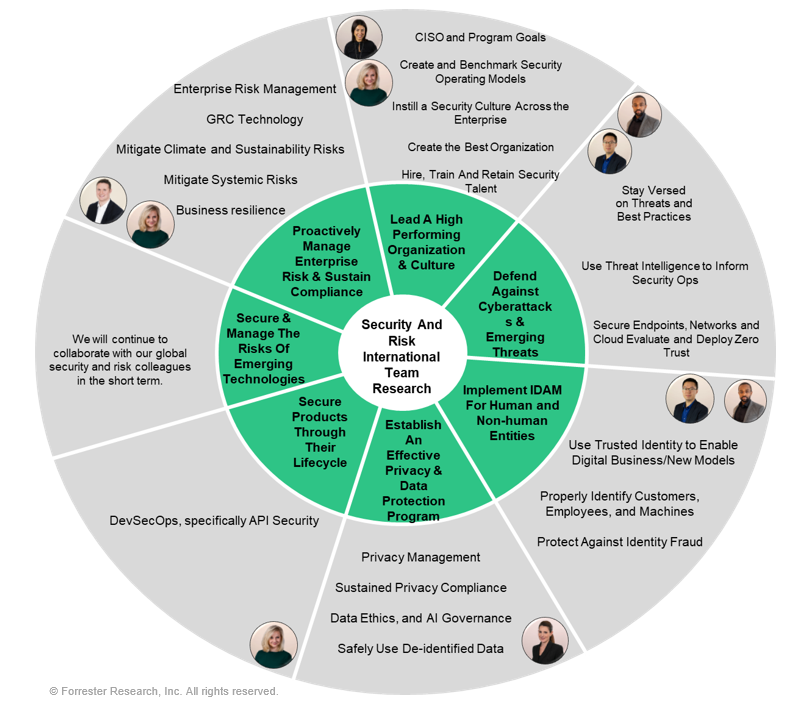
In February 2025, I transitioned to the role of vice president and research director for international security and risk. With the change, I’m extending my remit from successfully leading our APAC Security & Risk Forrester Decisions business to our well-established EMEA function. I also move from an individual contributor role to one where I’m leading a team of extraordinary people, and I’m now responsible for our collective research agenda across EMEA and APAC. As I deep-dive into our backgrounds, existing research, and capabilities, I feel a sense of pride, hope, and joy at the opportunity ahead. As a team, we cover a multitude of security and risk priorities (see figure below). We’re also geographically distributed across six countries in EMEA and APAC — no one else is as uniquely positioned to add this level of global perspective to our research and our clients. In my excitement and anticipation, I’d like to introduce you to our newly formed team and our 2025 priorities: Paul returns to the analyst chair, supporting Forrester’s global enterprise and cyber risk management and maturity assessment. Luckily for us, Paul McKay made the decision to get back in the analyst chair as VP and principal analyst, working with Alla Valente and Cody Scott to globally support cyber risk management research. Paul has already delivered some hard–hitting research and blogs that have the potential to move our clients to do important things. This includes refreshing Forrester’s Information Security Maturity Model (FISMM) and an informative blog outlining the key risks in the 2025 WEF Global Risks Report. Paul will also be working on key technology and service markets, including governance, risk and compliance (GRC) platforms. He’ll also reclaim his prior cyber risk ratings coverage, leading a Forrester Wave™ evaluation in 2026, and he’ll evaluate risk consulting services. Tope leans into his background to deliver pragmatic Zero Trust, managed detection and response, and digital identity research. With an international background in security architecture, penetration testing, and advisory, Tope Olufon’s research reflects this background, leading Forrester’s efforts in the managed detection and response (MDR) space in Europe and soon to publish a new landscape and Wave evaluation in 2025. He works with our Zero Trust (ZT) colleagues with a focus on making ZT pragmatic, delivering our research on How To Build A Zero Trust Roadmap. Tope is currently writing research on how to think like an attacker in order to use offensive security techniques to uplift ZT capabilities. Leaping off his research on Europe’s fragmented, but hopeful, digital identity landscape, Tope will continue to drive our research on digital identity market trends and their practical applications in the workplace. Madelein sets herself a broad and ambitious agenda, covering security org structure, consulting services, resilience regs, and API security. Madelein van der Hout has an ambitious agenda for 2025. She is ramping up to lead Forrester’s research on security organizational structure and operating models, a highly requested topic by our clients. (Heads up: We’ll be calling out for research interviews shortly.) She continues to lead Wave evaluation efforts on cybersecurity consulting in Europe, with a new Wave report to be published this year. Madelein will support Amy DeMartine’s research on operational resilience in 2024, focusing on regulations and mandates, especially DORA — a hot topic for our clients. She also has plans to double-click into her 2024 API security coverage with Sandy Carielli, giving our clients a well–needed API security roadmap. Enza and Meng enrich our international research, leading on privacy, trust, AI regs, identity and access management, and threat intel. Enza Iannopollo joined Forrester around the same time as I did, and it’s been an honor following her career path in becoming one of the world’s most sought–after experts on privacy and trust ethics — one of the rare people who earns standing ovations at privacy keynotes. She has led significant research on the EU AI Act, how sellers can trust the use of generative AI, and synthetic data. Meng Liu heralds from a payments background, expanding his coverage in recent years to adjacent areas in fraud management, anti-money laundering, and identity verification in collaboration with Andras Cser. Meng saw his research as a natural transition to security and risk and will collaborate with Jitin Shabadu to expand his coverage in APAC to threat intelligence, especially given its adjacency to fraud-related issues such as impersonation and deepfake detections. Meng will also collaborate with Geoff Cairns to expand our most requested topics in APAC: identity and access management (IAM). My career purpose of human-centered security, security culture, and security leadership will continue. I will still contribute to research that aligns to my purpose, which is making security human-centered, as well as focusing on the security and risk priority to lead a high-performing security organization and culture. In this capacity, I will lead markets and research on topics such as human risk management and security culture, as well as some select security and CISO leadership and career path research. Inevitably, I will have to relinquish some deeply loved parts of my agenda, which are critical to our clients, to very capable hands. Madelein will update our research on security champions networks, the CISO’s guide to successfully leading change, and human risk management metrics. Jess Burn will take over my plans for research on leadership and human skills in security to complement her existing cybersecurity skills body of work. As a team, we continue to be relentlessly committed to our clients, our research, and each other. With our global security and risk colleagues, we look forward to serving you in the above capacities. Forrester security and risk clients who have questions about the following risk, security, or privacy-related topics can connect via inquiry or guidance session to our experts: Human-centered security, security culture, security leadership, or human risk management: Jinan Budge GRC, cyber risk ratings, risk services, or enterprise and cyber risk management: Paul McKay Building ZT roadmaps, MDR, or digital identity: Tope Olufon Security org structures, consulting services in Europe, resilience regulations, or API security: Madelein van der Hout Privacy, trust, AI regs and ethics, or

New Year New Us: Introducing Forrester’s International Security & Risk Team Research Read More »