From project to product: Architecting the future of enterprise technology

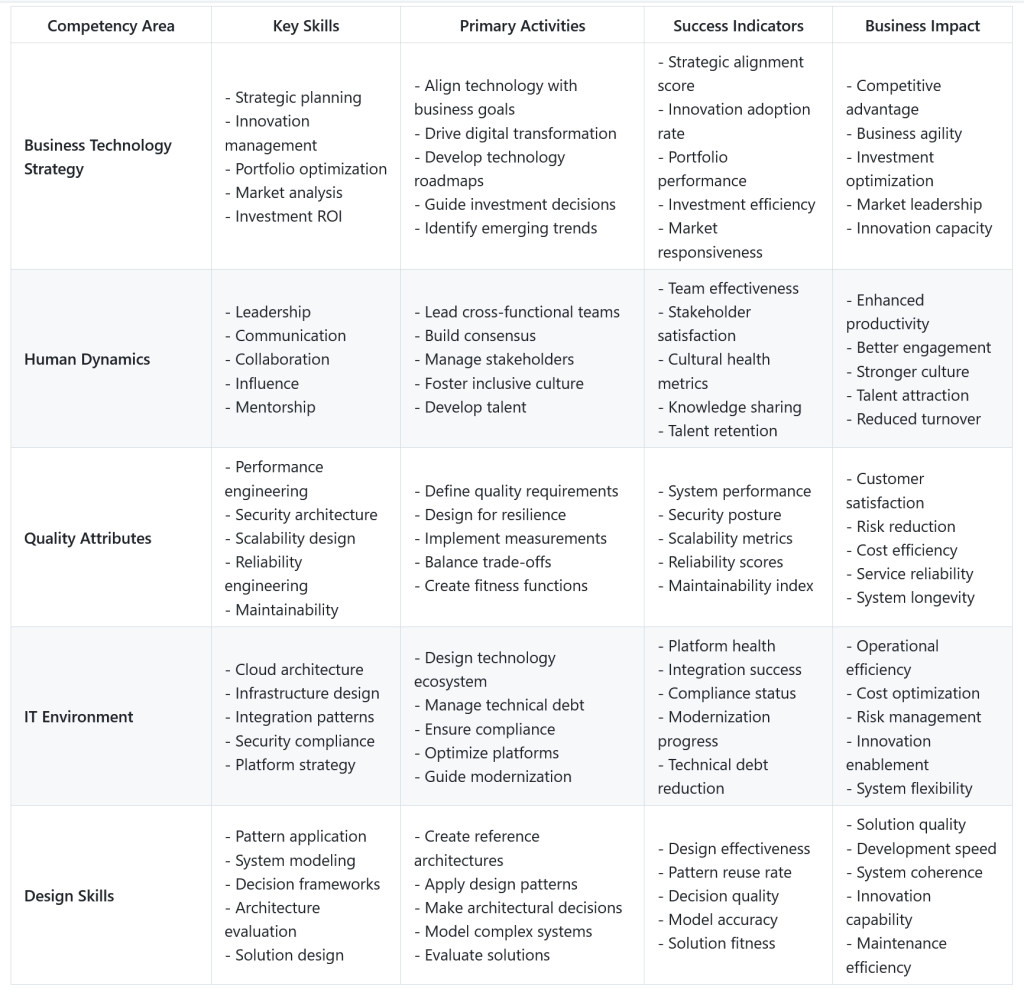
Shawn McCarthy Each competency area requires both depth and breadth, developing what IASA calls “T-shaped” skills — deep expertise in some areas combined with broad knowledge across many domains. This comprehensive model helps architects become true enablers of organizational success.  Rethinking architecture as an ecosystem  Instead of static blueprints that dictate every detail, modern architects steward an evolving ecosystem — one where teams can continuously refine services, products, and platforms. This approach enables:  Faster time-to-value: Shortened cycles between idea and production  De-risked change: Architecture decisions and technology stacks that can shift without major upheavals  Empowered teams: Autonomy in design choices, backed by shared tools, data and standards that facilitate alignment  Continuous evolution: Architecture that adapts to changing business needs and technological opportunities  Key focus areas for modern architects  Vision and strategy Develop and communicate clear architectural vision Align technical strategy with business objectives Create roadmaps for evolutionary change Balance innovation with stability  Platform thinking Build reusable capabilities and services Create self-service platforms that enable team autonomy Establish clear platform governance models Monitor and optimize platform adoption  Community building Foster a culture of knowledge sharing Build communities of practice Enable cross-team collaboration Promote architectural thinking at all levels  Measurement and improvement Define clear success metrics Implement feedback loops Track architectural health indicators Drive continuous improvement  Putting it all together  In this urban planner model, the architect’s job is to:  Envision a cohesive future state aligned to business outcomes  Enable teams with platforms and best-practice patterns  Inspire innovation by reducing friction and celebrating collaboration  Hold the organization accountable for ensuring architectural decisions lead to real, measurable value  The modern architect must balance multiple perspectives and priorities:  Technical excellence vs. business pragmatism  Innovation vs. stability  Standardization vs. flexibility  Global optimization vs. local autonomy  By moving beyond rigid blueprints and embracing an urban planner ethos, the modern architect helps the enterprise navigate complexity, seize opportunities and build a thriving technology ecosystem — one that combines agility, innovation and clear alignment with strategic goals.  VII. Practical implementation guide  Start by establishing some guiding principles as a reference point but also helping teams through their transformation. Teams should know good enough is acceptable and continuous improvement is encouraged. Make the best recommendations/decisions based on the information at hand.  Phase 1: Foundation building  Just as cities begin with basic infrastructure, we start with:  Architecture maturity assessment  Just enough current state knowledge  Business capability mapping  Quick win identification  Baseline metrics establishment  Initial product domain definition  Phase 2: Transformation launch  Like developing new city districts, we focus on:  Cross-functional team building  Measurement framework implementation  Cultural transformation initiation  Pilot program launches  Feedback mechanism establishment  Phase 3: Scale and optimize  Similar to expanding successful urban development patterns:  Pattern replication  Framework refinement  Automation enhancement  Business integration deepening  Governance evolution  Redefining product domains as you learn/mature  VIII. Conclusion: Building tomorrow’s enterprise  The transformation from project-centric to product-oriented architecture represents more than a change in delivery methodology — it’s a fundamental shift in how we create and sustain business value through technology. Just as thriving cities evolve from collections of buildings into vibrant, interconnected communities, our technology landscapes must transform from isolated projects into dynamic product platforms that enable continuous innovation.  Vision of the transformed enterprise  Platforms that accelerate rather than constrain innovation  Self-service capabilities that democratize development  Automated guardrails ensuring continuous alignment with quality attributes  Transparent portfolio health metrics guiding decisions  Engaged teams thriving in a culture of continuous learning  Architecture designed for evolution, not perfection  Strong technical foundations that enable rapid innovation  In the process, architects step out from behind the mysterious curtain — like Oz — and into a role more akin to the curious and imaginative Alice. By fostering collaboration, curiosity and continuous improvement, you’ll build not just technology solutions, but a resilient digital ecosystem that can adapt to tomorrow’s challenges.  Key takeaways for technology leaders  Start with business outcomes, not just technical standards Align DORA metrics and ISO 25010 quality attributes for holistic insight Provide platforms and guardrails that make doing the right thing easy Measure what matters — tie metrics to strategic objectives Invest in talent and culture: a thriving city needs skilled, motivated citizens Design for evolution: domain-driven design and modularity enable faster adaptation Continuously share insights and scale successful patterns Remember, just as great cities aren’t built in a day, this transformation is a journey rather than a destination. The key is to start now, move purposefully, and keep the focus on enabling business outcomes rather than enforcing technical standards. In doing so, you’ll build not just a technology landscape, but a thriving ecosystem that powers your organization’s future success.  Call to action: Starting your transformation  Assess your current state against the framework provided  Identify your most pressing improvement opportunities  Build a coalition of business and technology leaders  Choose a high-impact pilot area for initial focus  Establish clear metrics for measuring progress  Share successes and learnings broadly  Scale proven patterns across the organization  Maintain focus on continuous improvement  Organizations that successfully navigate this transformation will build competitive advantages through faster response to market opportunities, more efficient use of technology investments, improved ability to attract and retain talent, enhanced capacity for innovation, and greater business-technology alignment.  The time to start is now. Your technology ecosystem’s future success depends on the foundations you build today.  Shawn McCarthy is vice president and chief architect, Global Architecture, Risk & Governance, at Manulife. Len van Greuning is chief information officer, Manulife Investment Management. This article was made possible by our partnership with the IASA Chief Architect Forum. The CAF’s purpose is to test, challenge and support the art and science of Business Technology Architecture and its evolution over time as well as grow the influence and leadership of chief architects both inside and outside the profession. The CAF is a leadership community of the IASA, the leading non-profit professional association for business technology architects. source

From project to product: Architecting the future of enterprise technology Read More »

Albright Clears Cisco At Close Of $121M Network Patent Trial

By Ryan Davis ( January 17, 2025, 9:38 PM EST) — Cisco prevailed Thursday in a trial alleging that it owed $121 million for infringing a Corrigent Corp. communications network patent, when Western District of Texas Judge Alan Albright granted Cisco’s motion arguing that Corrigent failed to prove its case…. Law360 is on it, so you are, too. A Law360 subscription puts you at the center of fast-moving legal issues, trends and developments so you can act with speed and confidence. Over 200 articles are published daily across more than 60 topics, industries, practice areas and jurisdictions. A Law360 subscription includes features such as Daily newsletters Expert analysis Mobile app Advanced search Judge information Real-time alerts 450K+ searchable archived articles And more! Experience Law360 today with a free 7-day trial. source

Albright Clears Cisco At Close Of $121M Network Patent Trial Read More »

3. The impact of all-male and all-female social groups

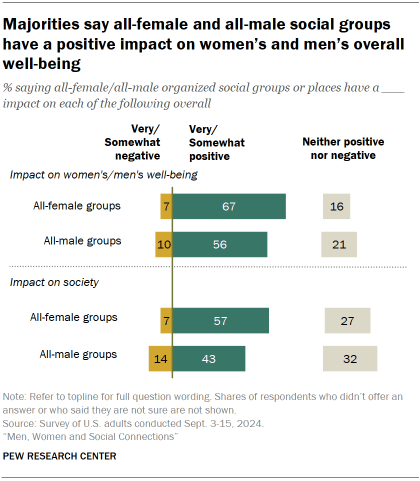
We were also interested in learning how the public feels about same-gender organized social groups or places where men can gather with other men and women with other women. Majorities of U.S. adults say these groups have a positive impact on the well-being of men and women, respectively. Still, more say all-female groups have a positive impact on women’s well-being (67%) than say the same about the impact of male-only groups on men (56%). In thinking about the impact these types of groups have on society, a majority of Americans (57%) say that all-female social groups have a very or somewhat positive effect; a smaller share (43%) say the same about all-male groups. Differences by gender Men and women both see more benefits in all-female groups than in all-male groups. Among men 63% of men say all-female groups have a positive impact on women’s well-being; 57% say all-male groups have a positive impact on men’s well-being. 55% say all-female groups have a positive impact on society overall; 47% say the same about all-male groups. Among women 71% of women say all-female groups have a positive impact on women’s well-being; 56% say all-male groups have positive impact on men’s well-being. 59% say all-female groups have a positive impact on society overall; 39% say the same about all-male groups. Differences by party Republicans and Democrats have different views on the impact of same-gender social groups. By double-digit margins, larger shares of Republicans and Republican-leaning independents than Democrats and Democratic leaners say that all-male social groups have a positive impact on men’s overall well-being (63% vs. 50%) and on society (50% vs. 37%). In turn, more Democrats than Republicans say that all-female social groups benefit both women’s overall well-being (72% vs. 65%) and society (64% vs. 53%). There are some notable differences by gender within each party. Democratic women are the most likely to say that all-female groups are beneficial for women and society. For example, 76% of Democratic women say all-female groups have a positive impact on women’s overall well-being. This compares with 70% of Republican women, 67% of Democratic men and 60% of Republican men. In turn, Republican men are the most likely to say all-male groups have a positive impact on society – 54% say this, compared with 45% of Republican women, 40% of Democratic men and only 34% of Democratic women. source

3. The impact of all-male and all-female social groups Read More »

Google’s new neural-net LLM architecture separates memory components to control exploding costs of capacity and compute

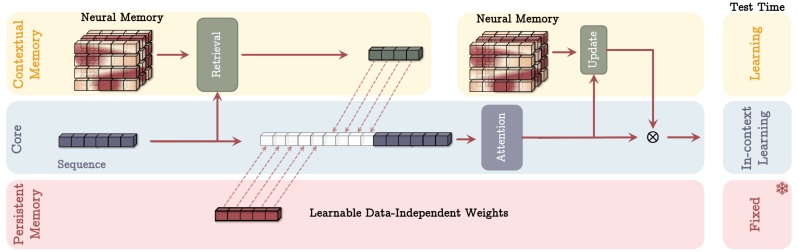
Join our daily and weekly newsletters for the latest updates and exclusive content on industry-leading AI coverage. Learn More A new neural-network architecture developed by researchers at Google might solve one of the great challenges for large language models (LLMs): extending their memory at inference time without exploding the costs of memory and compute. Called Titans, the architecture enables models to find and store during inference small bits of information that are important in long sequences.  Titans combines traditional LLM attention blocks with “neural memory” layers that enable models to handle both short- and long-term memory tasks efficiently. According to the researchers, LLMs that use neural long-term memory can scale to millions of tokens and outperform both classic LLMs and alternatives such as Mamba while having many fewer parameters.  Attention layers and linear models The classic transformer architecture used in LLMs employs the self-attention mechanism to compute the relations between tokens. This is an effective technique that can learn complex and granular patterns in token sequences. However, as the sequence length grows, the computing and memory costs of calculating and storing attention increase quadratically. More recent proposals involve alternative architectures that have linear complexity and can scale without exploding memory and computation costs. However, the Google researchers argue that linear models do not show competitive performance compared to classic transformers, as they compress their contextual data and tend to miss important details. The ideal architecture, they suggest, should have different memory components that can be coordinated to use existing knowledge, memorize new facts, and learn abstractions from their context.  “We argue that in an effective learning paradigm, similar to [the] human brain, there are distinct yet interconnected modules, each of which is responsible for a component crucial to the learning process,” the researchers write. Neural long-term memory “Memory is a confederation of systems — e.g., short-term, working, and long-term memory — each serving a different function with different neural structures, and each capable of operating independently,” the researchers write. To fill the gap in current language models, the researchers propose a “neural long-term memory” module that can learn new information at inference time without the inefficiencies of the full attention mechanism. Instead of storing information during training, the neural memory module learns a function that can memorize new facts during inference and dynamically adapt the memorization process based on the data it encounters. This solves the generalization problem that other neural network architectures suffer from. To decide which bits of information are worth storing, the neural memory module uses the concept of “surprise.” The more a sequence of tokens differs from the kind of information stored in the model’s weights and existing memory, the more surprising it is and thus worth memorizing. This enables the module to make efficient use of its limited memory and only store pieces of data that add useful information to what the model already knows. To handle very long sequences of data, the neural memory module has an adaptive forgetting mechanism that allows it to remove information that is no longer needed, which helps manage the memory’s limited capacity. The memory module can be complementary to the attention mechanism of current transformer models, which the researchers describe as “short-term memory modules, attending to the current context window size. On the other hand, our neural memory with the ability to continuously learn from data and store it in its weights can play the role of a long-term memory.” Titan architecture Example of Titan architecture (source: arXiv) The researchers describe Titans as a family of models that incorporate existing transformer blocks with neural memory modules. The model has three key components: the “core” module, which acts as the short-term memory and uses the classic attention mechanism to attend to the current segment of the input tokens that the model is processing; a “long-term memory” module, which uses the neural memory architecture to store information beyond the current context; and a “persistent memory” module, the learnable parameters that remain fixed after training and store time-independent knowledge. The researchers propose different ways to connect the three components. But in general, the main advantage of this architecture is enabling the attention and memory modules to complement each other. For example, the attention layers can use the historical and current context to determine which parts of the current context window should be stored in the long-term memory. Meanwhile, long-term memory provides historical knowledge that is not present in the current attention context. The researchers ran small-scale tests on Titan models, ranging from 170 million to 760 million parameters, on a diverse range of tasks, including language modeling and long-sequence language tasks. They compared the performance of Titans against various transformer-based models, linear models such as Mamba and hybrid models such as Samba.  Titans (red line) outperforms other models, including GPT-4, on long-sequence tasks in both few-shot and fine-tuned settings (source: arXiv) Titans demonstrated a strong performance in language modeling compared to other models and outperformed both transformers and linear models with similar sizes. The performance difference is especially pronounced in tasks on long sequences, such as “needle in a haystack,” where the model must retrieve bits of information from a very long sequence, and BABILong, where the model must reason across facts distributed in very long documents. In fact, in these tasks, Titan outperformed models with orders of magnitude more parameters, including GPT-4 and GPT-4o-mini, and a Llama-3 model enhanced with retrieval-augmented generation (RAG). Moreover, the researchers were able to extend the context window of Titans up to 2 million tokens while maintaining the memory costs at a modest level. The models still need to be tested at larger sizes, but the results from the paper show that the researchers have still not hit the ceiling of Titans’ potential. What does it mean for enterprise applications? With Google being at the forefront of long-context models, we can expect this technique to find its way into private and open models such as Gemini and Gemma. With LLMs supporting longer context windows,

Google’s new neural-net LLM architecture separates memory components to control exploding costs of capacity and compute Read More »

Bridging continents: The role of connectivity in Africa’s digital transformation

Africa’s IT landscape is experiencing accelerated digital transformation due to a young, tech-savvy population, a boost in the gross domestic product (GDP), and an increase in demand for low-latency connectivity. While expanded internet access drives digital growth and opens opportunities for the adoption of more digital solutions, challenges remain in meeting the continent’s connectivity needs. Simply put, there is a direct link between economic progress and IT infrastructure, with robust trade dependent on a strong digital foundation. The state of connectivity in Africa The African Union’s cross-border trade ambitions hinge on a connected Africa with ready access to the internet’s core data routes (called the “backbone of the internet”), neutrality, and cross-governmental cooperation. The first challenge Africa must tackle is increasing interconnection throughout the continent. Interconnection opens access to foreign markets, but it also encourages cross-continental trade. But for the continent to expand to international markets, it needs strong and dependable access to interconnection hubs. And for Africa to become a global powerhouse in the digital economy, leaders on the continent must prioritize: More subsea cable connections to enhance reliability in the event of a cut in other cables Terrestrial cable networks to rural areas with minimal transportation infrastructure Increased investment in digital transformation infrastructure The role of subsea cables in Africa’s digital economy Undersea cables serve as a critical part of Africa’s connectivity journey. Take the regional economic community of 16 countries known as the Southern African Development Community (SADC), for example. It launched a Regional Information Infrastructure Project, enabling access to the international internet backbone through undersea cables. Member states made the first steps to cross-border trade by establishing cross-border transmission links. These transmission links enable the buying and selling of energy between them and the leaders of the South African Power Pool. This has fast-tracked infrastructure projects to upgrade or create energy systems in less developed countries in the SADC trade bloc.1 Overview of major subsea cable projects in Africa With economic progress, Africa needs comprehensive connectivity to fulfil its potential, though the continent has seen an exponential increase in capacity and network infrastructure from its shores compared to those of Europe and the Middle East. For example, 2Africa connects 33 countries (16 of which are in Africa) and delivers internet access to 3 billion people (30% of the world’s population). Other major connectivity projects of note include: The Africa-1 subsea cable system: A 20,000 km submarine cable system linking Europe, the Middle East, and South Africa. The PEACE (Pakistan and East Africa Connecting Europe) cable: A 15,000 km cable spanning from France to Singapore with landing stations in North Africa, East Africa, and the Middle East. The Equiano subsea cable system: A 12,000 km Google-owned system from Portugal to South Africa with several branches either planned or in operation along the west coast of Africa. Its first landing is in Lagos, Nigeria, with planned branches in Togo and Namibia. Note: Submarine Telecoms Forum lists Equiano’s biggest benefit as redundancy to serve as a backstop against outages that slow or put a stop to trade and other communications. Amidst this progress, however, the lack of data center access raises a big challenge to Africa’s connectivity, as most countries in Africa have a national data center.2 In fact, nearly 300 million Africans live more than 50 km from a fiber or cable broadband connection.3 With Africa poised for expansive economic growth stemming from its burgeoning digital transformation, a lack of connectivity threatens the bright future the global community sees for the continent. The importance of terrestrial cable networks Without the resilience of international connections within Africa to global digital infrastructure through subsea cables, analysis of the number of data centers on the continent becomes futile. That is why major service providers have invested in terrestrial connections that link African nations and subsea connections linking the African continent to the rest of the world. One recent example from the cloud computing space is Google’s announcement of the Umoja fiber optic cable route, which connects two of the continent’s strongest economies, Kenya and South Africa. Other examples are the efforts of Orange to link markets in West Africa or cross-border fiber routes by Yafibr. Also, the investments from satellite companies in Africa will bring internet access to the masses. Either by providing backhaul links for 4G/5G base stations by Avanti or SES or direct internet access, such as SpaceX’s Starlink or Amazon’s Project Kuiper. Increased digital infrastructure investment unlocks Africa’s economic potential Other drivers of digital infrastructure include latency and data sovereignty. From South Africa to Kenya and the other 52 African nations, each will want to retain data within their countries to protect state secrets, the privacy of citizens, and intellectual property rights. But to build this data residency, increased data center and digital infrastructure investment is needed. Let’s examine recent trends in digital infrastructure investment. For instance: The African data center market has a 12.34% compound annual growth rate, outpacing North America’s data center market growth projections by 1.34% between 2024 and 2029.4,5 The African continent has made much needed progress in terrestrial network infrastructure and boasts 1.2 million km of terrestrial fiber networks as of 2022. That’s up from 820,000 km in 2017. Yet, it’s clear the continent will benefit from more progress in this area.6 The African Union’s strategy for digital transformation in Africa lists expanded data center infrastructure and cross-border connectivity as a main priority for the continent’s growth plan.7 Increased investments in data center development unlocks the emerging potential of Africa’s economy. Partnering with a provider like us with an expansive network of data centers on the African continent speeds strategic development for enterprises looking to tap into the burgeoning economy. The impact of improved connectivity in Africa Intra-African trade stands at 16% of global exports today. In comparison, in Europe and Asia, that percentage is 69% and 59%.8 To increase trade between nations, the African Continental Free Trade Area (AfCFTA) proposes an incremental reduction of tariffs, which is estimated to boost trade to 52%.9 With the internet economy of Africa poised to make up 5.2% of the continent’s GDP or $180

Bridging continents: The role of connectivity in Africa’s digital transformation Read More »

What Does Biden's New Executive Order Mean for Cybersecurity?

On. Jan. 16, just days before leaving office, President Biden issued an executive order on improving the nation’s cybersecurity. The extensive order comes on the heels of the breaches of US Treasury and US telecommunications providers perpetrated by China state-sponsored threat actors.  “Adversarial countries and criminals continue to conduct cyber campaigns targeting the United States and Americans, with the People’s Republic of China presenting the most active and persistent cyber threat to United States Government, private sector, and critical infrastructure networks,” the order states.   This new executive order, building on the one Biden issued in 2021, is extensive. It addresses issues ranging from third-party supply chain risks and AI to cybersecurity in space and the risks of quantum computers.   Could this executive order shape the federal government’s approach to cybersecurity? And how uncertain is its impact under the incoming Trump administration?   The Executive Order  The executive order outlines a broad set of initiatives to address nation state threats, improve defense of the nation’s digital infrastructure, drive accountability for software and cloud providers, and promote innovation in cybersecurity.  Like the 2021 executive order, the newly released order emphasizes the importance of collaboration with the private sector.   Related:3 Strategies For a Seamless EU NIS2 Implementation “Since it’s an executive order, it’s mainly aimed at the federal government. It doesn’t directly regulate the private sector,” Jim Dempsey, managing director of the Cybersecurity Law Center at nonprofit International Association of Privacy Professionals (IAPP), tells InformationWeek. “It indirectly aims to impact private sector cybersecurity by using the government’s procurement power.”  For example, the order directs software vendors working with the federal government to submit machine-readable secure software development attestations through the Cybersecurity and Infrastructure Security Agency (CISA) Repository for Software Attestation and Artifacts (RSAA).   “If CISA finds that attestations are incomplete or artifacts are insufficient for validating the attestations, the Director of CISA shall notify the software provider and the contracting agency,” according to the order.   The order also calls for the development of guidelines relating to the secure management of cloud service providers’ access tokens and cryptographic keys. In 2023, China-backed threat actor stole a cryptographic key, which led to the breach of several government agency Outlook email systems, Wired reports. A stolen key was behind the compromise of BeyondTrust that led to the recent US Treasury breach.   Related:Microsoft Rings in 2025 With Record Security Update AI, unsurprisingly, doesn’t go untouched by the order. It delves into establishing a program for leveraging AI models for cyber defense.    The Biden administration also uses the executive order to call attention to cybersecurity threats that may loom larger in the future. The order points to the risks posed by quantum computers and space system cybersecurity concerns.   Biden’s Cyber Legacy  The Biden Administration made cybersecurity a priority. In addition to the 2021 executive order on cybersecurity, the administration released a National Cybersecurity Strategy and an implementation plan in 2023.     The current administration also took sector-specific actions to bolster cybersecurity. For example, Biden issued an executive order focused on maritime cybersecurity.   Kevin Orr, president of RSA Federal at RSA Security, a network security company, saw a positive response to the Biden Administration’s efforts to improve cybersecurity within the government.   “I was surprised at how many agencies … have leaned in the last 18 months, especially within the intelligence community, have really adopted basic identity proofing, coming forward with multifactor authentication, and really strengthening their defenses,” Orr shares.   Related:How CISOs Can Build a Disaster Recovery Skillset While the Biden Administration has worked to further cybersecurity, there are questions about adoption of new policies and best practices. Some stakeholders call for more regulatory enforcement.    “Much like any regulation, people are only going to follow it if there’s some type of regulatory teeth to it,” Joe Nicastro, field CTO at software security firm Legit Security, argues.   Others argue for incentives are more likely to drive adoption of cybersecurity measures.   Cybersecurity is an ongoing national security concern, and the Biden administration is soon passing the torch.   “I think this administration can leave extremely, extremely proud,” says Dempsey. “Certainly, they are handing over the nation’s cybersecurity to the incoming Trump administration in far better shape than it was four years ago.”  A New Administration   While the order could mean big changes in the federal government’s approach to cybersecurity, the timing makes its ultimate impact uncertain. Many of its directives for federal agencies have a long runway, months or years, for compliance. Will the Trump administration enforce the executive order?  Cybersecurity has largely been painted as a bipartisan issue. And there has been some continuity between the first Trump Administration and the Biden Administration when it comes to cyber policies.   For example, the Justice Department recently issued a final rule on Biden’s Executive Order 14117 “Preventing Access to Americans’ Bulk Sensitive Personal Data and United States Government-Related Data by Countries of Concern.” That order charges the Justice Department with establishing a regulatory program to prevent the sale of Americans’ sensitive data to China, Russia, Iran, and other foreign adversaries. That order and subsequent ruling stem from an executive order signed by Trump in 2019.   Biden’s 2025 cybersecurity executive order puts a spotlight on cyber threats from China, and President-Elect Trump has been vocal about his intention to crack down on those threats. But that does not preclude changes to or dismissal of provisions in Biden’s final cybersecurity executive order.   “There may be some things that the incoming administration will ignore or deprioritize. I’d be a little surprised if they repealed the order,” says Dempsey.   CISA was a major player in the Biden administration’s approach to cybersecurity, and it will continue to play a big role if this new executive order rolls out as outlined. But the federal agency has been criticized by several Republican lawmakers. Some have called to limit its power or even shut it down, AP News reports.   The incoming Trump administration is also expected to take a more hands-off approach to regulation in many areas. Critical infrastructure is consistently at the

What Does Biden's New Executive Order Mean for Cybersecurity? Read More »

FCC Mandates More Efforts To Combat Telecom Cyber Threats

By Christopher Cole ( January 17, 2025, 5:25 PM EST) — The Federal Communications Commission has provided details of new requirements on telecom providers to counter cybersecurity threats, a late-hour move criticized several days ago by the agency’s incoming Republican leadership before the new rules were formally released…. Law360 is on it, so you are, too. A Law360 subscription puts you at the center of fast-moving legal issues, trends and developments so you can act with speed and confidence. Over 200 articles are published daily across more than 60 topics, industries, practice areas and jurisdictions. A Law360 subscription includes features such as Daily newsletters Expert analysis Mobile app Advanced search Judge information Real-time alerts 450K+ searchable archived articles And more! Experience Law360 today with a free 7-day trial. source

FCC Mandates More Efforts To Combat Telecom Cyber Threats Read More »

Runway’s new AI image generator Frames is here, and it looks fittingly cinematic

Join our daily and weekly newsletters for the latest updates and exclusive content on industry-leading AI coverage. Learn More The AI media tech provider Runway has announced the release of Frames, its newest text-to-image generation model, and it’s winning early praise from users for producing highly cinematic visuals — a fitting compliment given Runway is known primarily as an AI video model provider. Could Frames dethrone Midjourney as the go-to choice for AI filmmakers and artists? Announced back in November 2024, Frames was initially made available to selected Runway Creators Program ambassadors and power users over the last few weeks. As of today, it’s available to all through Runway’s Unlimited and Enterprise subscription plans, which cost $95 per month/$912 when paid annually or, in the case of the Enterprise plan, $1,500 annually. The company has also posted a showcase of new images generated by users of Frames on its website here, under the name “Worlds of Frames.” Users can generate still images with it on Runway’s website at app.runwayml.com — if they have subscribed to the appropriate plan — and then with one click, use the images as the basis for movies made with Runway’s image-to-video models such as Gen-3 Alpha Turbo. According to Runway, Frames provides an advanced level of stylistic control and visual fidelity, making it a versatile tool for industries like editorial, art direction, pre-visualization, brand development, and production. As Cristóbal Valenzuela, Runway’s cofounder and CEO, wrote on a post on the social network X: “Frames has been engineered from the ground up for professional creative work. If you’re in editorial, art direction, pre-vis, brand development, production, etc., this model is for you.” Valenzuela further noted that the model’s prompting system allows for precision and depth, enabling users to achieve nuanced, naturalistic and cinematically composed results. Users seem to agree, with @GenMagic writing on X: “Very high quality, lots of control with style, and you can animate your images right in runway super quick. I felt like seeing some 90s aesthetic mall nostalgia, and Frames did not disappoint.” Or as user @AIandDesign put it: “Damn @runwayml Frames is completely insane. I can’t stop.” Creativity meets consistency Frames allows users to design worlds with specific points of view and aesthetic characteristics. Its ability to maintain stylistic consistency while offering broad creative exploration sets it apart from previous models, which are often more random and “roll the dice” in terms of user experience. With Frames, users can establish a distinct visual identity for their projects and reliably generate variations that remain true to that specific style. In addition to enabling custom stylistic designs, Frames at launch comes with a library of 19 preset visual styles that users are able to select and further customize: 1. Vivid 2. Vivid Warm 3. Vivid Cool 4. High Contrast 5. High Contrast Warm 6. High Contrast Cool 7. B&W 8. B&W Contrast 9. Muted Pastel 10. Dreamscape 11. Nordic Minimal 12. Light Anime 13. Dark Anime 14. Painted Anime 15. 3D Cartoon 16. Sketch 17. Low Angle 18. In Motion 19. Terracotta These worlds demonstrate the wide range of creative possibilities offered by Frames, making it an ideal tool for artists, designers and filmmakers seeking stylistic precision. Designed for creative pros Frames offers several enhancements tailored for professional users. The model excels in rendering advanced textures, natural lighting and complex compositions, providing more flexibility and a departure from the rigid outputs of earlier image generation models. This release marks the first version of Frames, and Runway has outlined a clear roadmap for future updates, including more style tools and controls. Safety and ethical considerations Runway continues to prioritize safety and ethical responsibility in its generative AI tools. As part of the company’s Foundations for Safe Generative Media initiative, Frames includes robust content moderation features to prevent misuse. The company’s in-house visual moderation system detects and blocks harmful or inappropriate content, balancing creative freedom with safety. To address concerns about misinformation and misuse, Frames embeds invisible watermarks in all AI-generated content. These watermarks comply with provenance standards set by the Coalition for Content Provenance and Authenticity (C2PA), allowing users to trace whether a media item is AI-generated. Additionally, Runway is committed to improving fairness and representation in its generative models. Efforts have been made to reduce bias in visual outputs and to support diverse demographics and languages. Nonetheless, Runway remains party to a lawsuit from human artists who accuse the company and others such as Stability AI and Midjourney of training on their artwork without permission, in violation of copyright. The case, Andersen v. Stability AI Ltd. (3:23-cv-00201), remains unresolved for now, but is working its way through the courts. source

Runway’s new AI image generator Frames is here, and it looks fittingly cinematic Read More »

ChatGPT Can Now Schedule Tasks in Advance

Starting Jan. 14, some ChatGPT subscribers can use the generative AI to set reminders or add to their routines. For example, OpenAI said, ChatGPT can provide weekly news briefings or a daily weather report. The content will be delivered as notifications on desktop (macOS), browser, and mobile. What does the tasks feature in ChatGPT do? The tasks feature instructs ChatGPT to create content at a certain date and time. This content may be preset reminders — such as “Department meeting” — or newly generated text like affirmations or summaries of the news. ChatGPT can suggest tasks based on conversations. Users may set up to 10 tasks while the feature is in beta. More must-read AI coverage How to set up a task or reminder in ChatGPT Tasks is available to Plus, Team, or Pro-level subscribers. To access it, select “4o with scheduled tasks” in the model picker. Users at these tiers can create tasks through ChatGPT on the web, on the desktop application, or in the mobile app. However, the tasks manager pane is only available through ChatGPT on a web browser. In the tasks management pane, users can specify specific dates for when the tasks feature should send them reminders. Settings for recurring reminders are also found in the tasks management pane. While the instructions for the task are given in the form of a natural language prompt, the date selection in the tasks manager dashboard appears to be a conventional drop-down menu. OpenAI plans to eventually release the tasks feature to all tiers, including for free, the company said on X on Jan. 14. A task can be set as part of an ongoing conversation with ChatGPT, such as this prompt about a fitness plan. Image: OpenAI OpenAI’s move toward agentic AI Tasks in ChatGPT continue the trend in generative AI of “agentic” tools, which chain together multiple prompts autonomously to perform relatively complex actions. Tasks’ ability to remind users of upcoming meetings could compete with Google Calendar, Apple’s Siri or mobile calendar, or Amazon Alexa. The difference between the tasks feature and a conventional calendar or to-do list may be seen most clearly in generative AI’s more creative-sounding abilities. For example, one of OpenAI’s prompts is “Start my day with daily affirmations at 7 am.” This is agentic in that it combines multiple prompts: sending a reminder at 7 AM every day and generating an affirmation. SEE: Our ChatGPT cheat sheet rounds up the generative AI’s new features. Still, ChatGPT with tasks replicates much of what existing technology can do, with the added challenge of the generative aspect potentially introducing inaccuracies and misunderstandings. Older applications can send reminders without using as much energy and resources. Meanwhile, both Google and Microsoft announced changes to how they package generative AI on Jan. 15. Microsoft added agents — based on OpenAI’s GPT-4o — to the commercial tier of Microsoft 365. Google added Gemini Advanced and Notebook LM Plus to Google Workspace Business and will add it to Enterprise tiers in late January. TechRepublic has reached out to OpenAI for more information. source

ChatGPT Can Now Schedule Tasks in Advance Read More »

5 takeaways for CIOs from the Thinkers360 AI Trust Index

As agentic AI starts to permeate into core processes and enterprise workflows such as software programming, cybersecurity, ERP, CRM, BI, supply chain, retail, and other areas, the trust equation will shift from informational trust issues to transactional trust issues. The latter include ensuring appropriate levels of human oversight, accountability, transparency in decision-making, exception handling, and so on. While the no-code/low-code nature of agentic AI will streamline BP redesign efforts, it’ll be critical to spend a suitable amount of these time savings on thorough testing across all workflows and scenarios. Even though your AI is now smart enough to handle exceptions, it’ll be important to carefully test these situations as well.     Decide on AI policies… …to align with and clearly communicate to end users, and proactively impact trust levels in your implementations. Aligning with various national and international pacts and other forms of standards, policies, and agreements is a great way to demonstrate commitment to AI ethics to end users. For example, the EU AI Pact supports “voluntary commitments from the industry to adopt the principles of the EU AI Act before its official implementation.” Your AI governance practices can be a key differentiator, so it’s important to communicate internally as well as with customers and partners.   source

5 takeaways for CIOs from the Thinkers360 AI Trust Index Read More »